Organisational Behaviour Report: Leadership & Motivation at Apple
VerifiedAdded on 2023/01/18
|13
|3620
|69
Report
AI Summary
This report provides an in-depth analysis of organisational behaviour, using Apple Inc. as a case study. It explores the influence of culture, politics, and power on individual and team performance, referencing Handy's model of organisational culture and various power dynamics. The report also delves into motivation in an organisational context, discussing content and process theories such as Maslow's hierarchy, ERG theory, and Vroom's expectancy theory, along with practical techniques for employee motivation. Furthermore, the report differentiates between effective and ineffective teams by examining factors like shared objectives, open discussion, trust, leadership, and commitment. It highlights key characteristics that contribute to team success and offers insights into the complexities of organisational behaviour within a leading technology company.
Organisational Behaviour

Paraphrase This Document
Need a fresh take? Get an instant paraphrase of this document with our AI Paraphraser
Table of Contents
INTRODUCTION...........................................................................................................................3
LO1..................................................................................................................................................3
P1 Influence of culture, politics and power on individual and team behaviour and performance
......................................................................................................................................................3
LO2 .................................................................................................................................................5
P2 Motivation in organisation al context.....................................................................................5
LO3..................................................................................................................................................7
P3 Characteristics of effective teams...........................................................................................7
LO4 ................................................................................................................................................8
P4 Concept and philosophies of organisational behaviour-.........................................................8
CONCLUSION................................................................................................................................9
REFERENCES..............................................................................................................................11
INTRODUCTION...........................................................................................................................3
LO1..................................................................................................................................................3
P1 Influence of culture, politics and power on individual and team behaviour and performance
......................................................................................................................................................3
LO2 .................................................................................................................................................5
P2 Motivation in organisation al context.....................................................................................5
LO3..................................................................................................................................................7
P3 Characteristics of effective teams...........................................................................................7
LO4 ................................................................................................................................................8
P4 Concept and philosophies of organisational behaviour-.........................................................8
CONCLUSION................................................................................................................................9
REFERENCES..............................................................................................................................11
INTRODUCTION
Behaviour of individuals and groups working in an organisation is collectively known as
organisational behaviour. There are various factors that influence this behaviour and this
behaviour also affects many other factors. Study of this behaviour help in improving
performance of individuals and teams through changing their behaviour. This report includes
study of Apple Inc.'s, (a American technology company which develops and deals in consumer
electronics) organisational behaviour. Influence of Apple Inc.'s culture, politics and power on
performance of its employees have also been discussed in this report. This report further
discusses some of theories of motivation and their effect in organisation and by what factors an
effective team can be differentiated from ineffective team.
LO 1
P1 Influence of culture, politics and power on individual and team behaviour and performance
According to Shein, (1985) the culture of an organisation represents the beliefs, values and
assumptions that create an unique environment of organisation and differentiates one
organisation from another. Culture plays an vital role for performance and attitude of individuals
in organisational context. Apple Inc.'s corporate culture (organisational culture) which is a key
factor that contributes to success of organisation. Culture mainly focuses on innovative thinking
and people working in Apple Inc. are motivated and encouraged to think and work innovatively.
To understand organisational culture better there is a model 'Handy's model of organisational
culture' which divide culture into four classes which are-
Power culture
Role culture
Task culture
Person culture
A person culture is defined as culture where power remains in the hands of top authorities and
they take all the major decisions and individuals are judged on the basis of what they have
achieved. Concentration of power is main feature of this culture.
A role culture is a culture based on roles of individual in organisation, this culture is highly
controlled where everyone works according to their role and responsibilities. Power in this
culture is based on the role of individual in the organisational hierarchy.
Behaviour of individuals and groups working in an organisation is collectively known as
organisational behaviour. There are various factors that influence this behaviour and this
behaviour also affects many other factors. Study of this behaviour help in improving
performance of individuals and teams through changing their behaviour. This report includes
study of Apple Inc.'s, (a American technology company which develops and deals in consumer
electronics) organisational behaviour. Influence of Apple Inc.'s culture, politics and power on
performance of its employees have also been discussed in this report. This report further
discusses some of theories of motivation and their effect in organisation and by what factors an
effective team can be differentiated from ineffective team.
LO 1
P1 Influence of culture, politics and power on individual and team behaviour and performance
According to Shein, (1985) the culture of an organisation represents the beliefs, values and
assumptions that create an unique environment of organisation and differentiates one
organisation from another. Culture plays an vital role for performance and attitude of individuals
in organisational context. Apple Inc.'s corporate culture (organisational culture) which is a key
factor that contributes to success of organisation. Culture mainly focuses on innovative thinking
and people working in Apple Inc. are motivated and encouraged to think and work innovatively.
To understand organisational culture better there is a model 'Handy's model of organisational
culture' which divide culture into four classes which are-
Power culture
Role culture
Task culture
Person culture
A person culture is defined as culture where power remains in the hands of top authorities and
they take all the major decisions and individuals are judged on the basis of what they have
achieved. Concentration of power is main feature of this culture.
A role culture is a culture based on roles of individual in organisation, this culture is highly
controlled where everyone works according to their role and responsibilities. Power in this
culture is based on the role of individual in the organisational hierarchy.
⊘ This is a preview!⊘
Do you want full access?
Subscribe today to unlock all pages.

Trusted by 1+ million students worldwide
Task culture in organisation is when formation of teams to address specific problem or complete
project (Scott, 2018). Power in this culture depends on the basis of team members and status of
project and problem. Team dynamic are major factors to affect the culture.
People culture is simply made up of belief of individuals working in the organisation that they
are superior in organisation. Power in this lies in group of individuals.
As Apple Inc.'s culture is being discussed the organisation has a task culture as said by its
founders Apple Inc. works in teams these are given objective and mission then how to complete
that is decided by teams and top management also works in teams.
Power simply refers to authority given to or taken by individual or group to make
decision for self and for others who comes in the control through authority. Every individual in
organisation exercise more or less power in organisation. These power can be derived from these
sources, which are
Legitimate Power, which comes to a person from their position in the organisational structure.
Like power of senior over junior.
Expert power, power which comes to a individual because of knowledge possessed by them in
specific area of expertise. Like in a legal situation power of a lawyer remain high as others will
do whatever they suggest.
Referent power, comes from ability of individual to influence others and from personal relations
where an individual is respected ny others and that is why can take decision regarding them.
Coercive power, when a person influence others by means of punishments and threats and take
decision on behalf of others or for others to follow their decision out of fear.
Reward power, when a person can influence allocation of reward and incentives in organisation
Use of power to make informal, unofficial efforts to influence others decision, increase
power and achieve objectives comes under concept of organisational politics (Phillips, and
Phillips, 2016). This is used in various types by information controlling, making impressions,
attacking and blaming etc.
These factors culture, power and politics impact behaviour of team and individual in
various manners. Where culture of power exist in organisation it will hinder creativity of
individual and team and chances of politics are higher which may affect interest of individuals
negatively and limits performance of people in organisation to merely following orders . Where
role culture exist informal relations of individual get affected and this impact their behaviour and
project (Scott, 2018). Power in this culture depends on the basis of team members and status of
project and problem. Team dynamic are major factors to affect the culture.
People culture is simply made up of belief of individuals working in the organisation that they
are superior in organisation. Power in this lies in group of individuals.
As Apple Inc.'s culture is being discussed the organisation has a task culture as said by its
founders Apple Inc. works in teams these are given objective and mission then how to complete
that is decided by teams and top management also works in teams.
Power simply refers to authority given to or taken by individual or group to make
decision for self and for others who comes in the control through authority. Every individual in
organisation exercise more or less power in organisation. These power can be derived from these
sources, which are
Legitimate Power, which comes to a person from their position in the organisational structure.
Like power of senior over junior.
Expert power, power which comes to a individual because of knowledge possessed by them in
specific area of expertise. Like in a legal situation power of a lawyer remain high as others will
do whatever they suggest.
Referent power, comes from ability of individual to influence others and from personal relations
where an individual is respected ny others and that is why can take decision regarding them.
Coercive power, when a person influence others by means of punishments and threats and take
decision on behalf of others or for others to follow their decision out of fear.
Reward power, when a person can influence allocation of reward and incentives in organisation
Use of power to make informal, unofficial efforts to influence others decision, increase
power and achieve objectives comes under concept of organisational politics (Phillips, and
Phillips, 2016). This is used in various types by information controlling, making impressions,
attacking and blaming etc.
These factors culture, power and politics impact behaviour of team and individual in
various manners. Where culture of power exist in organisation it will hinder creativity of
individual and team and chances of politics are higher which may affect interest of individuals
negatively and limits performance of people in organisation to merely following orders . Where
role culture exist informal relations of individual get affected and this impact their behaviour and
Paraphrase This Document
Need a fresh take? Get an instant paraphrase of this document with our AI Paraphraser
job satisfaction and but chances of creativity are higher in this type of organisation and use of
legitimate power will limit taking undue advantage. Task culture is one of the best culture to be
adopted by organisation and main factor behind success of Apple Inc. this limits politics and
encourage expert and referent power and performance of individual in team gets better and
behaviour of people focuses on achieving team goals but chances of individual performance
getting impacted negatively are higher I this organisational culture.
Organisational politics-
This refers to behaviour and process of interactions in an organisation. This also include
use of power to make effective decisions in the organisation (Cacciattolo, 2015). This behaviour
includes activities of humans' in organisation that are not required on the for their formal role in
the organisation. Organisational politics can also be regarded as someone taking undue
advantage of their power in organisation for personal gain and selfish motives.
LO 2
P2 Motivation in organisational context
An invisible factor that drives individual and group to achieve something is motivation,
when in organisation this drives people to achieve goals of the organisation in which they are
working. There are various theories that explains how motivation work and can be used in
organisation to make people work for achievement of organisational goals. These theories are
divided in 2 types-
Content Theories and process theories.
Content Theories which includes, Maslow's need hierarchy theory, Alderfer's ERG theory,
McClelland's theory of needs and Herzberg's two factor theory. These content theories focus on
WHAT factors which are converted in needs motivate individuals to work and achieve
organisational goals.
Whereas Process Theories which includes, Skinners reinforce theory, Vroom's expectancy
theory, Adam's Equity theory and Locke's Goal setting theory (Burnes, Hughes and By 2018).
These theories focus on HOW individual can be motivated.
Content theories suggest that individual in organisation have different set of needs and different
researchers have divided them into categories and consider that needs of all individual lies in this
category. When these needs remain unfulfilled this triggers negative behaviour and when these
needs are fulfilled they keep individuals motivated. According to these theories managers and
legitimate power will limit taking undue advantage. Task culture is one of the best culture to be
adopted by organisation and main factor behind success of Apple Inc. this limits politics and
encourage expert and referent power and performance of individual in team gets better and
behaviour of people focuses on achieving team goals but chances of individual performance
getting impacted negatively are higher I this organisational culture.
Organisational politics-
This refers to behaviour and process of interactions in an organisation. This also include
use of power to make effective decisions in the organisation (Cacciattolo, 2015). This behaviour
includes activities of humans' in organisation that are not required on the for their formal role in
the organisation. Organisational politics can also be regarded as someone taking undue
advantage of their power in organisation for personal gain and selfish motives.
LO 2
P2 Motivation in organisational context
An invisible factor that drives individual and group to achieve something is motivation,
when in organisation this drives people to achieve goals of the organisation in which they are
working. There are various theories that explains how motivation work and can be used in
organisation to make people work for achievement of organisational goals. These theories are
divided in 2 types-
Content Theories and process theories.
Content Theories which includes, Maslow's need hierarchy theory, Alderfer's ERG theory,
McClelland's theory of needs and Herzberg's two factor theory. These content theories focus on
WHAT factors which are converted in needs motivate individuals to work and achieve
organisational goals.
Whereas Process Theories which includes, Skinners reinforce theory, Vroom's expectancy
theory, Adam's Equity theory and Locke's Goal setting theory (Burnes, Hughes and By 2018).
These theories focus on HOW individual can be motivated.
Content theories suggest that individual in organisation have different set of needs and different
researchers have divided them into categories and consider that needs of all individual lies in this
category. When these needs remain unfulfilled this triggers negative behaviour and when these
needs are fulfilled they keep individuals motivated. According to these theories managers and
organisation can motivate individuals through identifying their needs and factors that motivates
them so that they can fulfil these needs to motivate individuals in the organisation.
On the other hand, process needs how desired behaviour in individuals can be caused and
sustained and undesired behaviour stopped. These theories consider that process of individual
motivation is based on sense of accomplishment, preferences and reward factors. All these
theories have a particular process to motivate individual in organisation. Skinners theory
considers that individuals can be motivated through positive and negative reinforcement, it
focuses on behavioural changes to influence their actions. Vroom's expectancy theory considers
that a process where individual evaluate his efforts and its outcome which if equitable or more
then it motivates an individual. Equity theory also seeks to measure input and output of
individual with other (referent) and goal setting theory considers that goals with certain
characteristics drive individuals to achieve them (Hankonen, 2018). All these theories can be
used in high performing organisation at top level because most of these theories focus on
motivating through realising self esteem of individuals and also attempt to change behaviour
which is required more at top level. But in content theories fulfilling needs is motivational factor.
In content theories Maslow's hierarchy of needs seeks to have needs of self esteem and these
theories attempt to fulfil that. Where these theories fulfil self esteem content theories can be used
at low and middle level to motivate individuals and they will improve their performance.
There are various techniques through which employees can be motivated. Some of them
are-
Positive work Environment, this include supportive superiors and co-workers, availability of all
the tools and knowledge required for performing. These things will keep people with a positive
mindset and they will remain motivated.
Reasonable and achievable Goals, when employees feel that goals they are required to achieve
are achievable and reasonable as per their capabilities.
Recognise achievement and accomplishments, one employee achieved something organisation
should recognise this and give adequate reward for that it will not only motivate the employee
having it but will also motivate others to get that recognition and reward (Coccia, 2015).
Be Transparent, sharing things with employees make them feel what result their efforts have
brought to organisation and they feel included in top management. This will instigate them to
improve their performance.
them so that they can fulfil these needs to motivate individuals in the organisation.
On the other hand, process needs how desired behaviour in individuals can be caused and
sustained and undesired behaviour stopped. These theories consider that process of individual
motivation is based on sense of accomplishment, preferences and reward factors. All these
theories have a particular process to motivate individual in organisation. Skinners theory
considers that individuals can be motivated through positive and negative reinforcement, it
focuses on behavioural changes to influence their actions. Vroom's expectancy theory considers
that a process where individual evaluate his efforts and its outcome which if equitable or more
then it motivates an individual. Equity theory also seeks to measure input and output of
individual with other (referent) and goal setting theory considers that goals with certain
characteristics drive individuals to achieve them (Hankonen, 2018). All these theories can be
used in high performing organisation at top level because most of these theories focus on
motivating through realising self esteem of individuals and also attempt to change behaviour
which is required more at top level. But in content theories fulfilling needs is motivational factor.
In content theories Maslow's hierarchy of needs seeks to have needs of self esteem and these
theories attempt to fulfil that. Where these theories fulfil self esteem content theories can be used
at low and middle level to motivate individuals and they will improve their performance.
There are various techniques through which employees can be motivated. Some of them
are-
Positive work Environment, this include supportive superiors and co-workers, availability of all
the tools and knowledge required for performing. These things will keep people with a positive
mindset and they will remain motivated.
Reasonable and achievable Goals, when employees feel that goals they are required to achieve
are achievable and reasonable as per their capabilities.
Recognise achievement and accomplishments, one employee achieved something organisation
should recognise this and give adequate reward for that it will not only motivate the employee
having it but will also motivate others to get that recognition and reward (Coccia, 2015).
Be Transparent, sharing things with employees make them feel what result their efforts have
brought to organisation and they feel included in top management. This will instigate them to
improve their performance.
⊘ This is a preview!⊘
Do you want full access?
Subscribe today to unlock all pages.
Trusted by 1+ million students worldwide
In Apple Inc. they use intrinsic and extrinsic motivators. For intrinsic reward they give people
work which is challenging and which people like doing, Apple Inc. allow its employees to try
and fail and then learn from that failure. For extrinsic reward they give various monetary reward
and recognition and gifts.
LO 3
P3 Difference in Effective and Ineffective team-
Two or more than two individuals working together to achieve common goal is known as
team. Teams are effective when they are able to achieve its goal on time and effectively. As
opposed to ineffective team which can not achieve its goals on time. There are some qualities in
effective team that differentiate it from ineffective team (Hankonen, 2018). These qualities are-
Shared objective- Effective teams have shared objective. All the members of the team
are working to achieve common objective of the team and they keep team objectives before
individual objectives. This qualities is not there in ineffective team members in ineffective team
often do not agree on common objective.
Open Discussion- Members in effective team often involve themselves into open
discussion to find solution of the problem and agree on a single solution after discussion and then
work on it. Whereas members of ineffective teams often do what they find right according to
them, which does not allow for coordination and goals remain unachieved.
Trust among team members- Biggest strength of effective team is trust among team
members, they all trust each other and respect each others value and opinion. Which does not
exist in ineffective team and contribute to its ineffectiveness.
Logical Arguments- Arguments in effective team are based on logics and rational
thoughts members are concerned with doing what is right and what if good for achieving goals of
the team (Nicolson, 2015). In ineffective team members are concerned with doing what they
think is right and arguments are based on ego rather than rational.
Leadership- Effective teams have situational leadership whereas ineffective teams have
leadership either decided by top authorities or there is no leadership as every member consider
themselves as leader.
Clarity of Goals- Members of effective teams often have clear idea of the goals they are
working to achieve this quality lack in ineffective teams, members remain in ambiguity about
goals they working to achieve.
work which is challenging and which people like doing, Apple Inc. allow its employees to try
and fail and then learn from that failure. For extrinsic reward they give various monetary reward
and recognition and gifts.
LO 3
P3 Difference in Effective and Ineffective team-
Two or more than two individuals working together to achieve common goal is known as
team. Teams are effective when they are able to achieve its goal on time and effectively. As
opposed to ineffective team which can not achieve its goals on time. There are some qualities in
effective team that differentiate it from ineffective team (Hankonen, 2018). These qualities are-
Shared objective- Effective teams have shared objective. All the members of the team
are working to achieve common objective of the team and they keep team objectives before
individual objectives. This qualities is not there in ineffective team members in ineffective team
often do not agree on common objective.
Open Discussion- Members in effective team often involve themselves into open
discussion to find solution of the problem and agree on a single solution after discussion and then
work on it. Whereas members of ineffective teams often do what they find right according to
them, which does not allow for coordination and goals remain unachieved.
Trust among team members- Biggest strength of effective team is trust among team
members, they all trust each other and respect each others value and opinion. Which does not
exist in ineffective team and contribute to its ineffectiveness.
Logical Arguments- Arguments in effective team are based on logics and rational
thoughts members are concerned with doing what is right and what if good for achieving goals of
the team (Nicolson, 2015). In ineffective team members are concerned with doing what they
think is right and arguments are based on ego rather than rational.
Leadership- Effective teams have situational leadership whereas ineffective teams have
leadership either decided by top authorities or there is no leadership as every member consider
themselves as leader.
Clarity of Goals- Members of effective teams often have clear idea of the goals they are
working to achieve this quality lack in ineffective teams, members remain in ambiguity about
goals they working to achieve.
Paraphrase This Document
Need a fresh take? Get an instant paraphrase of this document with our AI Paraphraser
Membership- Members in effective teams often have similar job status. Ineffective
teams have members from various job status, this makes difficult to coordinate with each other,
members who have high status in organisation try to suppress those have comparatively low
status.
Lookout for Mistakes- In effective teams members do not blame each other for mistakes
they tend to find solution to correct the mistakes. But ineffective team members often focus on
who committed mistakes. Effective team members always focus on solution whereas ineffective
team members focus on problem.
Commitment- Commitment of members of effective teams are comparatively higher and
put their best efforts to achieve these goals on the other hand this commitment lack in the
members of ineffective teams.
Management Support- though this is a reciprocal factor that management support
effective team because effective teams are high performing and at the same time support from
management also help them to perform better (Coccia, M., 2015). Which is not same with
ineffective teams.
All these qualities that exist in effective teams differentiate it from ineffective teams. Effective
tends are tend to achieve goals on time and are more successful in performance and productivity.
If seen this way teams in Apple Inc. are efficient because of having all these qualities
because Apple Inc.'s structure is team oriented and all the task there are completed in teams and
success of Apple Inc. clearly show and justify effectiveness of its teams.
LO 4
P4 Concept and philosophies of organisational behaviour-
Organisational behaviour is behaviour of individuals and group in organisational context,
their behaviour towards organisation and other individuals of organisation. A study about
interface between organisation and human behaviour is known organisational behaviour. Main
objective of this study is to give a better conceptualization of organisational life. OB has been
described in various ways, some of them are-
Individual Difference- Each individual is different from each other and OB also consider this
difference while studying and using its concepts.
Motivated Behaviour- individuals have different needs that motivate them. All individuals can
not be motivated through one motivational technique.
teams have members from various job status, this makes difficult to coordinate with each other,
members who have high status in organisation try to suppress those have comparatively low
status.
Lookout for Mistakes- In effective teams members do not blame each other for mistakes
they tend to find solution to correct the mistakes. But ineffective team members often focus on
who committed mistakes. Effective team members always focus on solution whereas ineffective
team members focus on problem.
Commitment- Commitment of members of effective teams are comparatively higher and
put their best efforts to achieve these goals on the other hand this commitment lack in the
members of ineffective teams.
Management Support- though this is a reciprocal factor that management support
effective team because effective teams are high performing and at the same time support from
management also help them to perform better (Coccia, M., 2015). Which is not same with
ineffective teams.
All these qualities that exist in effective teams differentiate it from ineffective teams. Effective
tends are tend to achieve goals on time and are more successful in performance and productivity.
If seen this way teams in Apple Inc. are efficient because of having all these qualities
because Apple Inc.'s structure is team oriented and all the task there are completed in teams and
success of Apple Inc. clearly show and justify effectiveness of its teams.
LO 4
P4 Concept and philosophies of organisational behaviour-
Organisational behaviour is behaviour of individuals and group in organisational context,
their behaviour towards organisation and other individuals of organisation. A study about
interface between organisation and human behaviour is known organisational behaviour. Main
objective of this study is to give a better conceptualization of organisational life. OB has been
described in various ways, some of them are-
Individual Difference- Each individual is different from each other and OB also consider this
difference while studying and using its concepts.
Motivated Behaviour- individuals have different needs that motivate them. All individuals can
not be motivated through one motivational technique.
Value of human being- individuals want to be treated differently from other resources of
production. Now the old idea of treating humans like resource are refused by people.
Mutuality of Interest- Organisational goals and individual goals are getting mutual. Individuals
are encouraged to align their goals with organisational goals so both of their goals can be
achieved without extra efforts.
Philosophies of Organisational Behaviour-
Autocratic Model- This philosophy of organisational behaviour is based on power
dynamics in organisation. In this managers are authorised to give orders and employees are
supposed to follow these orders (Scott, 2018). Employees are completely dependent on boss and
only substantial needs of employees are met and performance level of employees remain same.
Custodial Model- in this main source of motivation of employees is considered as
money. Boss give monetary incentives to motivate employees and employees also want security
and safety. Employee in this model is dependent on organisation and security needs of
employees are met. Employees cooperation in this model is passive.
Supportive Model- This model of OB is based on leadership in the organisation.
Managers support their employees and employees also perform well and happily. Employees
participate in organisational activities and are not dependent on anyone. This model seeks to
satisfy employees need for recognition and status in the organisation. Employees' performance in
this model is active cooperation.
Collegial Model- This model is based on partnership and employees perform in team.
Employees are not dependent on anyone and have a responsive behaviour in the organisation and
remain in self-discipline (Allen, Porter and Angle, 2016). Employees needs of self-actualization
gets fulfilled in this model. They work enthusiastically.
The last Collegial Model is applied in Apple Inc., though structure of organisation is traditional
hierarchical, there all employees work according to their interest and actively participate in
organisational goal achievement activities and for that they contribute through achieving their
team goals and in Apple Inc. employees are allowed to learn by mistakes and guidance is given
to the employees whenever required and asked by the employees. This have contributed to the
success of organisation and have managed to become innovative in its field of consumer
electronics.
production. Now the old idea of treating humans like resource are refused by people.
Mutuality of Interest- Organisational goals and individual goals are getting mutual. Individuals
are encouraged to align their goals with organisational goals so both of their goals can be
achieved without extra efforts.
Philosophies of Organisational Behaviour-
Autocratic Model- This philosophy of organisational behaviour is based on power
dynamics in organisation. In this managers are authorised to give orders and employees are
supposed to follow these orders (Scott, 2018). Employees are completely dependent on boss and
only substantial needs of employees are met and performance level of employees remain same.
Custodial Model- in this main source of motivation of employees is considered as
money. Boss give monetary incentives to motivate employees and employees also want security
and safety. Employee in this model is dependent on organisation and security needs of
employees are met. Employees cooperation in this model is passive.
Supportive Model- This model of OB is based on leadership in the organisation.
Managers support their employees and employees also perform well and happily. Employees
participate in organisational activities and are not dependent on anyone. This model seeks to
satisfy employees need for recognition and status in the organisation. Employees' performance in
this model is active cooperation.
Collegial Model- This model is based on partnership and employees perform in team.
Employees are not dependent on anyone and have a responsive behaviour in the organisation and
remain in self-discipline (Allen, Porter and Angle, 2016). Employees needs of self-actualization
gets fulfilled in this model. They work enthusiastically.
The last Collegial Model is applied in Apple Inc., though structure of organisation is traditional
hierarchical, there all employees work according to their interest and actively participate in
organisational goal achievement activities and for that they contribute through achieving their
team goals and in Apple Inc. employees are allowed to learn by mistakes and guidance is given
to the employees whenever required and asked by the employees. This have contributed to the
success of organisation and have managed to become innovative in its field of consumer
electronics.
⊘ This is a preview!⊘
Do you want full access?
Subscribe today to unlock all pages.
Trusted by 1+ million students worldwide
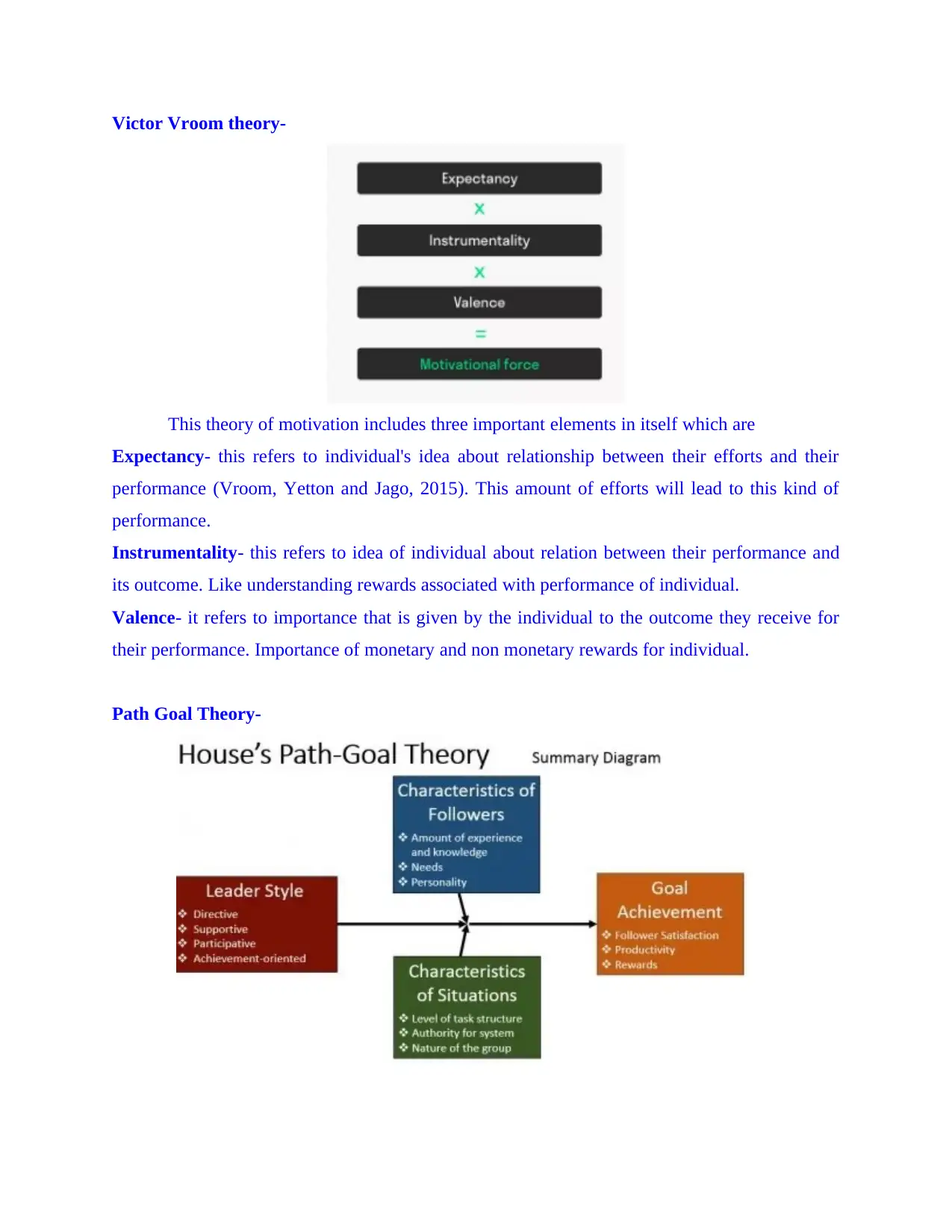
Victor Vroom theory-
This theory of motivation includes three important elements in itself which are
Expectancy- this refers to individual's idea about relationship between their efforts and their
performance (Vroom, Yetton and Jago, 2015). This amount of efforts will lead to this kind of
performance.
Instrumentality- this refers to idea of individual about relation between their performance and
its outcome. Like understanding rewards associated with performance of individual.
Valence- it refers to importance that is given by the individual to the outcome they receive for
their performance. Importance of monetary and non monetary rewards for individual.
Path Goal Theory-
This theory of motivation includes three important elements in itself which are
Expectancy- this refers to individual's idea about relationship between their efforts and their
performance (Vroom, Yetton and Jago, 2015). This amount of efforts will lead to this kind of
performance.
Instrumentality- this refers to idea of individual about relation between their performance and
its outcome. Like understanding rewards associated with performance of individual.
Valence- it refers to importance that is given by the individual to the outcome they receive for
their performance. Importance of monetary and non monetary rewards for individual.
Path Goal Theory-
Paraphrase This Document
Need a fresh take? Get an instant paraphrase of this document with our AI Paraphraser
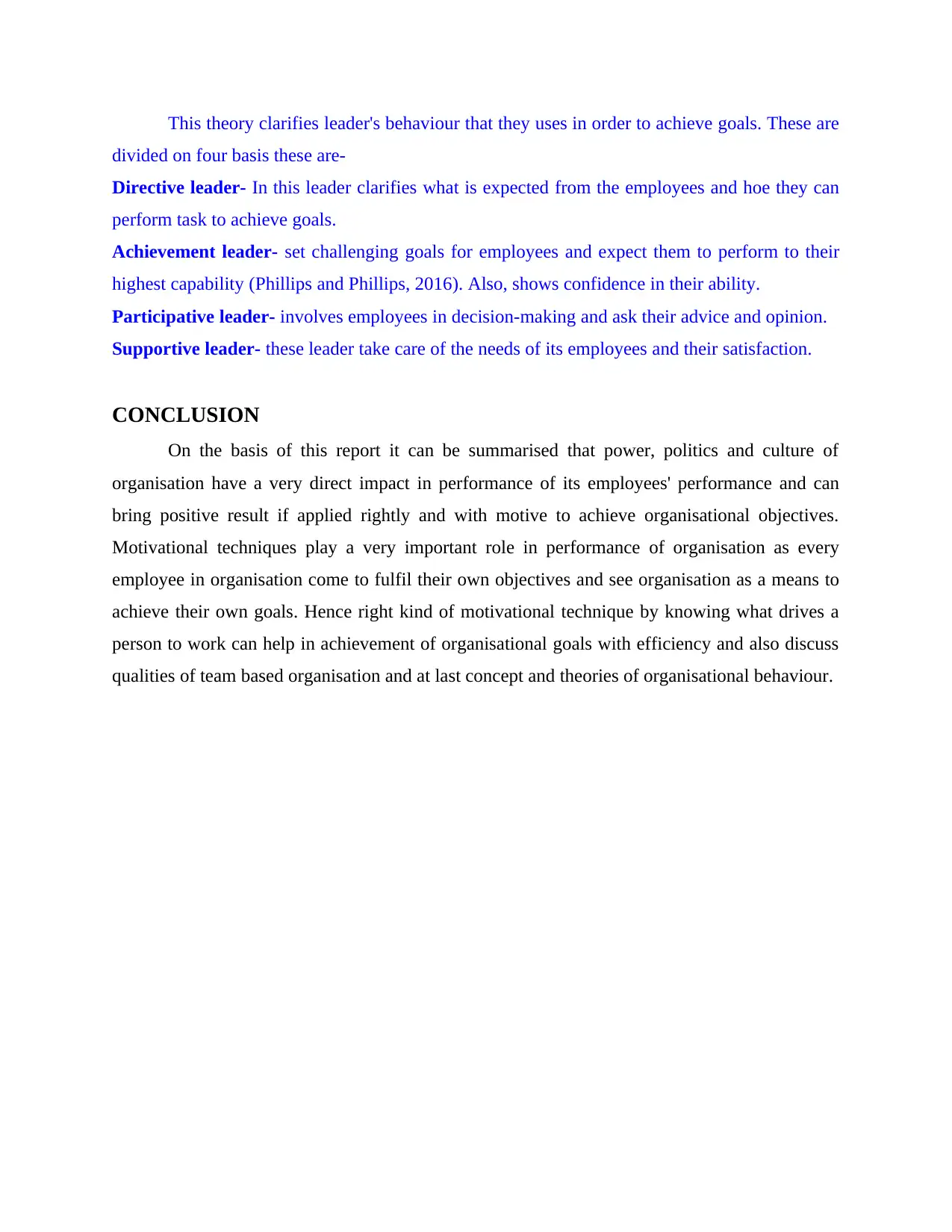
This theory clarifies leader's behaviour that they uses in order to achieve goals. These are
divided on four basis these are-
Directive leader- In this leader clarifies what is expected from the employees and hoe they can
perform task to achieve goals.
Achievement leader- set challenging goals for employees and expect them to perform to their
highest capability (Phillips and Phillips, 2016). Also, shows confidence in their ability.
Participative leader- involves employees in decision-making and ask their advice and opinion.
Supportive leader- these leader take care of the needs of its employees and their satisfaction.
CONCLUSION
On the basis of this report it can be summarised that power, politics and culture of
organisation have a very direct impact in performance of its employees' performance and can
bring positive result if applied rightly and with motive to achieve organisational objectives.
Motivational techniques play a very important role in performance of organisation as every
employee in organisation come to fulfil their own objectives and see organisation as a means to
achieve their own goals. Hence right kind of motivational technique by knowing what drives a
person to work can help in achievement of organisational goals with efficiency and also discuss
qualities of team based organisation and at last concept and theories of organisational behaviour.
divided on four basis these are-
Directive leader- In this leader clarifies what is expected from the employees and hoe they can
perform task to achieve goals.
Achievement leader- set challenging goals for employees and expect them to perform to their
highest capability (Phillips and Phillips, 2016). Also, shows confidence in their ability.
Participative leader- involves employees in decision-making and ask their advice and opinion.
Supportive leader- these leader take care of the needs of its employees and their satisfaction.
CONCLUSION
On the basis of this report it can be summarised that power, politics and culture of
organisation have a very direct impact in performance of its employees' performance and can
bring positive result if applied rightly and with motive to achieve organisational objectives.
Motivational techniques play a very important role in performance of organisation as every
employee in organisation come to fulfil their own objectives and see organisation as a means to
achieve their own goals. Hence right kind of motivational technique by knowing what drives a
person to work can help in achievement of organisational goals with efficiency and also discuss
qualities of team based organisation and at last concept and theories of organisational behaviour.

.
⊘ This is a preview!⊘
Do you want full access?
Subscribe today to unlock all pages.
Trusted by 1+ million students worldwide

1 out of 13


Related Documents


Your All-in-One AI-Powered Toolkit for Academic Success.
+13062052269
info@desklib.com
Available 24*7 on WhatsApp / Email
![[object Object]](/_next/static/media/star-bottom.7253800d.svg)
Unlock your academic potential
Copyright © 2020–2026 A2Z Services. All Rights Reserved. Developed and managed by ZUCOL.