Case Study: Product Knowledge & Brand Impact on Apple's Price Strategy
VerifiedAdded on 2023/04/03
|19
|4293
|286
Project
AI Summary
This project proposal critically analyzes the impact of product knowledge and brand name on internal price standards, focusing on Apple Inc. as a case study. It aims to understand the significance of branding, analyze factors affecting internal price standards, assess the impact of branding and product knowledge on pricing strategy, and recommend strategies for brand awareness to improve buying behavior. The literature review explores the importance of branding in the context of Apple Inc., factors affecting internal price standards such as consumer behavior, government policies, and competition, and the impact of branding and product knowledge on pricing strategies. The research methodology outlines a qualitative study approach, detailing the research design, sampling, data collection, and analysis methods, while also addressing ethical considerations. The proposal also includes a project budget, a Gantt chart for project timeline, and a comprehensive list of references.
The Impact of Product Knowledge & Brand
Name on The Internal Price Standards- A
Case Study of Apple Inc.
Name on The Internal Price Standards- A
Case Study of Apple Inc.

Paraphrase This Document
Need a fresh take? Get an instant paraphrase of this document with our AI Paraphraser
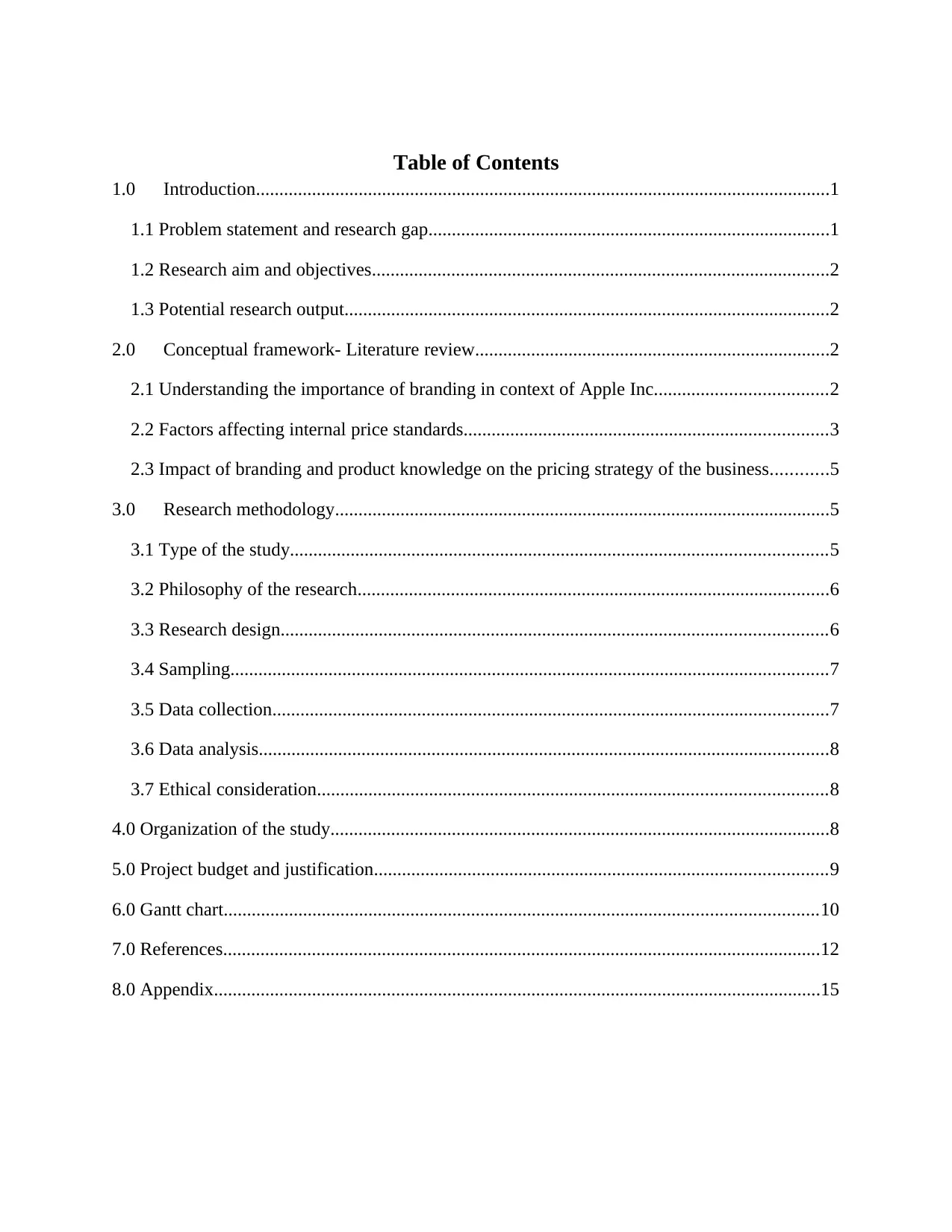
Table of Contents
1.0 Introduction...........................................................................................................................1
1.1 Problem statement and research gap......................................................................................1
1.2 Research aim and objectives..................................................................................................2
1.3 Potential research output........................................................................................................2
2.0 Conceptual framework- Literature review............................................................................2
2.1 Understanding the importance of branding in context of Apple Inc.....................................2
2.2 Factors affecting internal price standards..............................................................................3
2.3 Impact of branding and product knowledge on the pricing strategy of the business............5
3.0 Research methodology..........................................................................................................5
3.1 Type of the study...................................................................................................................5
3.2 Philosophy of the research.....................................................................................................6
3.3 Research design.....................................................................................................................6
3.4 Sampling................................................................................................................................7
3.5 Data collection.......................................................................................................................7
3.6 Data analysis..........................................................................................................................8
3.7 Ethical consideration.............................................................................................................8
4.0 Organization of the study...........................................................................................................8
5.0 Project budget and justification.................................................................................................9
6.0 Gantt chart...............................................................................................................................10
7.0 References................................................................................................................................12
8.0 Appendix..................................................................................................................................15
1.0 Introduction...........................................................................................................................1
1.1 Problem statement and research gap......................................................................................1
1.2 Research aim and objectives..................................................................................................2
1.3 Potential research output........................................................................................................2
2.0 Conceptual framework- Literature review............................................................................2
2.1 Understanding the importance of branding in context of Apple Inc.....................................2
2.2 Factors affecting internal price standards..............................................................................3
2.3 Impact of branding and product knowledge on the pricing strategy of the business............5
3.0 Research methodology..........................................................................................................5
3.1 Type of the study...................................................................................................................5
3.2 Philosophy of the research.....................................................................................................6
3.3 Research design.....................................................................................................................6
3.4 Sampling................................................................................................................................7
3.5 Data collection.......................................................................................................................7
3.6 Data analysis..........................................................................................................................8
3.7 Ethical consideration.............................................................................................................8
4.0 Organization of the study...........................................................................................................8
5.0 Project budget and justification.................................................................................................9
6.0 Gantt chart...............................................................................................................................10
7.0 References................................................................................................................................12
8.0 Appendix..................................................................................................................................15
1.0 Introduction
The achievement of success and competitive position in the market is driven by a strong store
image as well as value of the merchandize of the retailers (Gu, Park & Konana, 2012). Here, key
factors include the brand image, quality of brands, store image, pricing strategies etc. Similarly,
consumer decision making process is affected by the unique store identity which has direct
impact on the use of pricing strategies. Further, the brand familiarity plays a crucial role in the
use of pricing strategies because number of brands experiences accumulated by the consumers
(Zhu & Zhang, 2010). However, the pricing standards get affected by different factors such as
consumers knowledge, adaptability, brand image, governmental policies etc. because price
fluctuations come in the industries by existence of competition in the market place (Archak,
Ghose & Ipeirotis, 2011). On a contrary, online consumer review have impact on the sales of the
products because customers place the opinions on the basis of use and product characteristics
(Zhu & Zhang, 2010). It shows that the internal price standards influence by brand image and
knowledge of the products because the companies have to use the attractive pricing strategy to
influence the customer. Thus, the objective of the proposal is to critically analyze the impact of
brand name and product knowledge on the price standards. In this context, factors affecting price
strategies will be evaluated by using the literatures for the effectiveness of the study.
1.1 Problem statement and research gap
Branding is important because it is not merely associated with the advertising; however,
it also supports to build an impression on the consumers which allows the customers to know
about the expectations from the company (Zhu & Zhang, 2010). Here, the rationale behind
conducting the study to analyze the impact of the branding and product knowledge on the price
standards and strategies. The study is important because it shapes the consumers buying behavior
and affects the profitability of the firm. Hence, several studies have been done on the relevant
topic but emphasize has not been laid on the product knowledge and impact on the pricing. Thus,
the study is helpful to identify a gap between past studies and current scenario of branding for
the escalation of the business in the competitive market.
1
The achievement of success and competitive position in the market is driven by a strong store
image as well as value of the merchandize of the retailers (Gu, Park & Konana, 2012). Here, key
factors include the brand image, quality of brands, store image, pricing strategies etc. Similarly,
consumer decision making process is affected by the unique store identity which has direct
impact on the use of pricing strategies. Further, the brand familiarity plays a crucial role in the
use of pricing strategies because number of brands experiences accumulated by the consumers
(Zhu & Zhang, 2010). However, the pricing standards get affected by different factors such as
consumers knowledge, adaptability, brand image, governmental policies etc. because price
fluctuations come in the industries by existence of competition in the market place (Archak,
Ghose & Ipeirotis, 2011). On a contrary, online consumer review have impact on the sales of the
products because customers place the opinions on the basis of use and product characteristics
(Zhu & Zhang, 2010). It shows that the internal price standards influence by brand image and
knowledge of the products because the companies have to use the attractive pricing strategy to
influence the customer. Thus, the objective of the proposal is to critically analyze the impact of
brand name and product knowledge on the price standards. In this context, factors affecting price
strategies will be evaluated by using the literatures for the effectiveness of the study.
1.1 Problem statement and research gap
Branding is important because it is not merely associated with the advertising; however,
it also supports to build an impression on the consumers which allows the customers to know
about the expectations from the company (Zhu & Zhang, 2010). Here, the rationale behind
conducting the study to analyze the impact of the branding and product knowledge on the price
standards and strategies. The study is important because it shapes the consumers buying behavior
and affects the profitability of the firm. Hence, several studies have been done on the relevant
topic but emphasize has not been laid on the product knowledge and impact on the pricing. Thus,
the study is helpful to identify a gap between past studies and current scenario of branding for
the escalation of the business in the competitive market.
1
⊘ This is a preview!⊘
Do you want full access?
Subscribe today to unlock all pages.

Trusted by 1+ million students worldwide
1.2 Research aim and objectives
Aim- To critically analyze the impact of product knowledge and brand name on the internal
price standards- A case study of Apple Inc.
Objectives
To understand the significance of branding in context of Apple Inc.
To critically analyze the factors affecting the internal price standards
To assess the impact of branding and product knowledge on the pricing strategy of the
business
To recommend strategies for the brand awareness to reduce the effects on pricing and
improve les the buying behavior
1.3 Potential research output
The expected outcomes of the study will be in the static form such as the researchers
comes to know about the importance of branding which has direct relation with pricing
strategies. Furthermore, the study will provide the results related to factors which will be going
to affect internal price standards. At the end, the study will render the impact of branding on
pricing strategies which helps to influence the consumers.
2.0 Conceptual framework- Literature review
2.1 Understanding the importance of branding in context of Apple Inc.
According to Baumeister, Scherer & Wangenheim (2015, 574), branding has tremendous
importance in various consumer goods industries because most of the customers influences
towards the brand image for the easy excessiveness of the products. In this context, Campelo,
Aitken, Thyne & Gnoth (2014) asserted that branding is the identification of the company and
products which encourages the consumers to buy because it develops positive intentions in the
buyers. In this regard, various branding strategies are used by the organizations to influence the
customers and build a unique brand image in the competitive market (refer appendix 8.3).
However, Baumeister, Scherer & Wangenheim (2015) stated that branding is not only important
for the brand recognition; nonetheless, branding enhances the business value by providing the
organization more leverage in the industry. Additionally, branding improves the investment
2
Aim- To critically analyze the impact of product knowledge and brand name on the internal
price standards- A case study of Apple Inc.
Objectives
To understand the significance of branding in context of Apple Inc.
To critically analyze the factors affecting the internal price standards
To assess the impact of branding and product knowledge on the pricing strategy of the
business
To recommend strategies for the brand awareness to reduce the effects on pricing and
improve les the buying behavior
1.3 Potential research output
The expected outcomes of the study will be in the static form such as the researchers
comes to know about the importance of branding which has direct relation with pricing
strategies. Furthermore, the study will provide the results related to factors which will be going
to affect internal price standards. At the end, the study will render the impact of branding on
pricing strategies which helps to influence the consumers.
2.0 Conceptual framework- Literature review
2.1 Understanding the importance of branding in context of Apple Inc.
According to Baumeister, Scherer & Wangenheim (2015, 574), branding has tremendous
importance in various consumer goods industries because most of the customers influences
towards the brand image for the easy excessiveness of the products. In this context, Campelo,
Aitken, Thyne & Gnoth (2014) asserted that branding is the identification of the company and
products which encourages the consumers to buy because it develops positive intentions in the
buyers. In this regard, various branding strategies are used by the organizations to influence the
customers and build a unique brand image in the competitive market (refer appendix 8.3).
However, Baumeister, Scherer & Wangenheim (2015) stated that branding is not only important
for the brand recognition; nonetheless, branding enhances the business value by providing the
organization more leverage in the industry. Additionally, branding improves the investment
2
Paraphrase This Document
Need a fresh take? Get an instant paraphrase of this document with our AI Paraphraser
opportunities because the brand has an established place in the marketplace. Moreover,
Hollebeek (2011) notified that is branding helps to rise number of consumers towards the
organization’s products because it builds the positive impressions of the company among the
buyers. At this juncture, branding creates dependability in the consumers related to use of
products on which customers can trust in context of quality assurance. Besides this, Priyadarshi
(2011) mentioned that branding is an effective advertising technique and helps to improve the
employee satisfaction because employees believes that working for a reputed company and
focuses on the quality work. Therefore, it reflects that branding is important for the brand
identity in the market place which improves the investment opportunities. Furthermore, it also
improves workers satisfaction and develops a positive relationship among employees and
company.
2.2 Factors affecting internal price standards
2.2.1 Consumers buying behavior and loyalty, cost of products, knowledge
Jaafar, Lalp & Naba (2012) delineated that growth of personal tags in the market offers
an optional election for customer at the time of purchasing. Additionally, purchasing behavior
affects the pricing standards for the companies because it decides the existence and removal of
the products in the market. Further, Kim, Xu & Gupta (2012) asserted that perceived price gets
affected by the purchase intention of the buyers which generates the purchasing motive towards
the goods (appendix 8.1). However, Raza & Rehman (2012) mentioned that consumers loyalty is
one of the important factors which fluctuates the pricing policies because loyalty is based on the
perceived pricing. Furthermore, pricing standards changes in least time period than consumers
loyalty and buying behavior also changes. Besides this, Kaufmann, Panni & Orphanidou (2012)
stated that cost of products extensively affects the pricing internal pricing standards rather than
consumer behavior because higher the cost of production leads the pricing of goods higher.
Similarly, Friedman (2017) notified that pricing influences by the cost of product because the
firm offers the low-cost pricing goods in case of high cost of production to stand in the market.
Apart from this, Namkung & Jang (2010) examined that knowledge of the brand among
consumers has extensive impact on the pricing standards because knowledgeable people go to
identified brands even it offers costly products. Hence, it shows that knowledge of consumers
3
Hollebeek (2011) notified that is branding helps to rise number of consumers towards the
organization’s products because it builds the positive impressions of the company among the
buyers. At this juncture, branding creates dependability in the consumers related to use of
products on which customers can trust in context of quality assurance. Besides this, Priyadarshi
(2011) mentioned that branding is an effective advertising technique and helps to improve the
employee satisfaction because employees believes that working for a reputed company and
focuses on the quality work. Therefore, it reflects that branding is important for the brand
identity in the market place which improves the investment opportunities. Furthermore, it also
improves workers satisfaction and develops a positive relationship among employees and
company.
2.2 Factors affecting internal price standards
2.2.1 Consumers buying behavior and loyalty, cost of products, knowledge
Jaafar, Lalp & Naba (2012) delineated that growth of personal tags in the market offers
an optional election for customer at the time of purchasing. Additionally, purchasing behavior
affects the pricing standards for the companies because it decides the existence and removal of
the products in the market. Further, Kim, Xu & Gupta (2012) asserted that perceived price gets
affected by the purchase intention of the buyers which generates the purchasing motive towards
the goods (appendix 8.1). However, Raza & Rehman (2012) mentioned that consumers loyalty is
one of the important factors which fluctuates the pricing policies because loyalty is based on the
perceived pricing. Furthermore, pricing standards changes in least time period than consumers
loyalty and buying behavior also changes. Besides this, Kaufmann, Panni & Orphanidou (2012)
stated that cost of products extensively affects the pricing internal pricing standards rather than
consumer behavior because higher the cost of production leads the pricing of goods higher.
Similarly, Friedman (2017) notified that pricing influences by the cost of product because the
firm offers the low-cost pricing goods in case of high cost of production to stand in the market.
Apart from this, Namkung & Jang (2010) examined that knowledge of the brand among
consumers has extensive impact on the pricing standards because knowledgeable people go to
identified brands even it offers costly products. Hence, it shows that knowledge of consumers
3
regarding brands largely influence the pricing standards because it influences the purchasing
behavior.
2.2.2 Government policies and legal regulations
Blind (2012) mentioned that government policies and legal regulations affects the pricing
policies and standards of the organizations because government focuses on the belief about
product safety for use. Moreover, Pastor & Veronesi (2012) asserted that government has an
extensive support to maintain the friendliness environment and make balance between pricing
and risk. For example, in case the government has banned the availability of products in the
market place then it will be drastically reducing the pricing of the goods because to sell the
available stock from the market. In this context, Bacon (2010) pointed out that private sectors are
owned by the government and takes a specific identity in context5 of authentic operations.
Additionally, it affects the levy taxes, enforce laws, define environmental policies. Here, changes
in rules from time to time elicits the pricing reactions in the financial markets. Furthermore,
Vogel (2010) argued that changes in governmental policies does not affects the pricing strategies
every time because pricing strategies get affected at initial stage of deciding the pricing of
products which remains for long lasting. Thus, it shows that governmental policies and
regulations has significant impact on the pricing strategies because it remains associated with
legal rules and decides the pricing as per the environment.
2.2.3 Competition in the market
Sheth (2011) stated that availability of competition in the market place influence the
pricing standards because degree of competition decides the adaptability of pricing. Additionally,
competition is the major factor which value of the brand in the market and accordingly shapes
the pricing policies for the achievement of higher profitability. On the other hand, Kotler (2012)
mentioned that the competitors producing the innovative and modern products in the market then
it attracts the consumers’ buying behavior even the companies are charging the higher prices.
However, Sheth (2011) asserted that price regulations tremendously affected by the new entrance
which encourages the competition in the supply sector because new commerce focuses on the
delivery of goods at low cost. Hence, it reflects that availability of degree of competition in the
4
behavior.
2.2.2 Government policies and legal regulations
Blind (2012) mentioned that government policies and legal regulations affects the pricing
policies and standards of the organizations because government focuses on the belief about
product safety for use. Moreover, Pastor & Veronesi (2012) asserted that government has an
extensive support to maintain the friendliness environment and make balance between pricing
and risk. For example, in case the government has banned the availability of products in the
market place then it will be drastically reducing the pricing of the goods because to sell the
available stock from the market. In this context, Bacon (2010) pointed out that private sectors are
owned by the government and takes a specific identity in context5 of authentic operations.
Additionally, it affects the levy taxes, enforce laws, define environmental policies. Here, changes
in rules from time to time elicits the pricing reactions in the financial markets. Furthermore,
Vogel (2010) argued that changes in governmental policies does not affects the pricing strategies
every time because pricing strategies get affected at initial stage of deciding the pricing of
products which remains for long lasting. Thus, it shows that governmental policies and
regulations has significant impact on the pricing strategies because it remains associated with
legal rules and decides the pricing as per the environment.
2.2.3 Competition in the market
Sheth (2011) stated that availability of competition in the market place influence the
pricing standards because degree of competition decides the adaptability of pricing. Additionally,
competition is the major factor which value of the brand in the market and accordingly shapes
the pricing policies for the achievement of higher profitability. On the other hand, Kotler (2012)
mentioned that the competitors producing the innovative and modern products in the market then
it attracts the consumers’ buying behavior even the companies are charging the higher prices.
However, Sheth (2011) asserted that price regulations tremendously affected by the new entrance
which encourages the competition in the supply sector because new commerce focuses on the
delivery of goods at low cost. Hence, it reflects that availability of degree of competition in the
4
⊘ This is a preview!⊘
Do you want full access?
Subscribe today to unlock all pages.
Trusted by 1+ million students worldwide
market largely affects the pricing standards and the available parties has to change the pricing
strategies to exist in the market.
2.3 Impact of branding and product knowledge on the pricing strategy of the business
Several studies revealed that branding has an extensive impact on the pricing strategy of
the business because as per the nature of the business pricing strategy uses by the firms (Rossi,
Borges & Bakpayev, 2015; Davcik & Sharma, 2015; Kirk, Ray & Wilson, 2013). In this context,
Smutkupt, Krairit & Esichaikul (2010) asserted that an online business or brand which is
operating in digital sectors use the online pricing strategies to grab the consumer market. for
example, discounting and seasonal offers will an effective pricing strategy for the online
businesses to lead in the international market and achieve the higher sales. On the other hand,
Davcik & Sharma (2015) discovered that industrialist focuses on the application of branding
strategies carefully to ensure to meet the requirements of organizational buyers because the
consumers influence towards the brand not to price of goods. However, Kirk, Ray & Wilson
(2013) identified that product knowledge in the consumers has direct impact on the adoption of
pricing strategy of the business because knowledgeable customers shift towards brands for the
mental and physical satisfaction. Therefore, it indicates that knowledge of the products and
branding both have equal effects on the pricing strategies because in this case customers remains
alert and choose the real products on the basis of branding.
3.0 Research methodology
3.1 Type of the study
Basically, qualitative and quantitative are two research studies in the research which have
own different dimensions for the application in the research (Kumar, 2019). In this context,
Saunders (2011) stated that qualitative study is used in the research which is used for the
observation of non-numerical data. Here, investigator uses the concepts, frameworks, symbols
and proper description while using qualitative study. However, Kothari (2004) identified that
quantitative study is based on the application of scientific tools including chi-square, t-test,
regression etc. for the collection and observation of real data. Furthermore, quantitative study
relates to empirical investigation of observations by mathematical approach and computerized
techniques to obtain the static and factual data. On the contrary, qualitative study demands for
5
strategies to exist in the market.
2.3 Impact of branding and product knowledge on the pricing strategy of the business
Several studies revealed that branding has an extensive impact on the pricing strategy of
the business because as per the nature of the business pricing strategy uses by the firms (Rossi,
Borges & Bakpayev, 2015; Davcik & Sharma, 2015; Kirk, Ray & Wilson, 2013). In this context,
Smutkupt, Krairit & Esichaikul (2010) asserted that an online business or brand which is
operating in digital sectors use the online pricing strategies to grab the consumer market. for
example, discounting and seasonal offers will an effective pricing strategy for the online
businesses to lead in the international market and achieve the higher sales. On the other hand,
Davcik & Sharma (2015) discovered that industrialist focuses on the application of branding
strategies carefully to ensure to meet the requirements of organizational buyers because the
consumers influence towards the brand not to price of goods. However, Kirk, Ray & Wilson
(2013) identified that product knowledge in the consumers has direct impact on the adoption of
pricing strategy of the business because knowledgeable customers shift towards brands for the
mental and physical satisfaction. Therefore, it indicates that knowledge of the products and
branding both have equal effects on the pricing strategies because in this case customers remains
alert and choose the real products on the basis of branding.
3.0 Research methodology
3.1 Type of the study
Basically, qualitative and quantitative are two research studies in the research which have
own different dimensions for the application in the research (Kumar, 2019). In this context,
Saunders (2011) stated that qualitative study is used in the research which is used for the
observation of non-numerical data. Here, investigator uses the concepts, frameworks, symbols
and proper description while using qualitative study. However, Kothari (2004) identified that
quantitative study is based on the application of scientific tools including chi-square, t-test,
regression etc. for the collection and observation of real data. Furthermore, quantitative study
relates to empirical investigation of observations by mathematical approach and computerized
techniques to obtain the static and factual data. On the contrary, qualitative study demands for
5
Paraphrase This Document
Need a fresh take? Get an instant paraphrase of this document with our AI Paraphraser
the formation of thematic analysis for the detail overview of the issues and effects related to the
study. In this context, qualitative study will be used in the current study because the research is
related to analysis of impact of branding on the internal pricing standards which might not be
assessed by quantitative approach. All about branding and pricing will be effectively assessed by
the support of the qualitative discussion. Hence, the use of qualitative analysis will be justifiable.
3.2 Philosophy of the research
According to Duberley, Johnson & Cassell (2012), a belief about the entire research
which decides the gathering the of data and accordingly data processing takes place.
Predominantly, positivism and interpretivism are two known research philosophies which are
based on the nature of the study. In this context, positivism approach has a complete assumption
that fact is fixed and factual which can be derived from any point of view of the study. However,
interpretivism philosophy is depends on the subjective interpretation and intervention of the
reality wherein investigators are supposed to use the own interpretations and knowledge for the
analysis (Kumar, 2019). Moreover, observations remain based on the real arguments and
assumptions in interpretivism philosophy. Hence, interpretivism philosophy will be used in the
current study the impact of products knowledge can be easily identified by the dramatic
observations instead of positive statistics. Impact might be positive or negative that can be
observed by direct investigations and interpretations. Thus, the application of interpretivism
philosophy will be appropriate.
3.3 Research design
Research studies use several types of research designs for the completion of the study out
of them experimental, exploratory and descriptive are the well-known designs for the research
(Mackey & Gass, 2015). In this context, descriptive designs focus on the detail analysis of each
and every aspect of the study to reduce the chances of errors. However, experimental design
related to application of tools to identify the new concepts and insights for the study. Further,
exploratory designs supposed to expand the available knowledge and facts for the finalization of
the study (Creswell & Clark, 2017). Nonetheless, descriptive designs support to highlight the
untouched factors and use in the study for effectiveness. In this regard, descriptive designs will
be applied in the current research because information related to brand awareness and product
6
study. In this context, qualitative study will be used in the current study because the research is
related to analysis of impact of branding on the internal pricing standards which might not be
assessed by quantitative approach. All about branding and pricing will be effectively assessed by
the support of the qualitative discussion. Hence, the use of qualitative analysis will be justifiable.
3.2 Philosophy of the research
According to Duberley, Johnson & Cassell (2012), a belief about the entire research
which decides the gathering the of data and accordingly data processing takes place.
Predominantly, positivism and interpretivism are two known research philosophies which are
based on the nature of the study. In this context, positivism approach has a complete assumption
that fact is fixed and factual which can be derived from any point of view of the study. However,
interpretivism philosophy is depends on the subjective interpretation and intervention of the
reality wherein investigators are supposed to use the own interpretations and knowledge for the
analysis (Kumar, 2019). Moreover, observations remain based on the real arguments and
assumptions in interpretivism philosophy. Hence, interpretivism philosophy will be used in the
current study the impact of products knowledge can be easily identified by the dramatic
observations instead of positive statistics. Impact might be positive or negative that can be
observed by direct investigations and interpretations. Thus, the application of interpretivism
philosophy will be appropriate.
3.3 Research design
Research studies use several types of research designs for the completion of the study out
of them experimental, exploratory and descriptive are the well-known designs for the research
(Mackey & Gass, 2015). In this context, descriptive designs focus on the detail analysis of each
and every aspect of the study to reduce the chances of errors. However, experimental design
related to application of tools to identify the new concepts and insights for the study. Further,
exploratory designs supposed to expand the available knowledge and facts for the finalization of
the study (Creswell & Clark, 2017). Nonetheless, descriptive designs support to highlight the
untouched factors and use in the study for effectiveness. In this regard, descriptive designs will
be applied in the current research because information related to brand awareness and product
6
knowledge will be easily identified by in-depth analysis of the study by positive or negative
thinking.
3.4 Sampling
Basically, sampling is the approach to select the samples from the population for the data
gathering. Here, two types of sampling approaches used by the researchers such as probabilistic
and non-probabilistic sampling techniques (Kothari, 2004). By considering this, probabilistic
sampling includes the stratified, random, cluster sampling because in which each variable has
equal chances to be selected in the sample size whereas non-probabilistic sampling includes the
snowball, judgmental, self-selection, purposive etc. wherein each element does not have equal
opportunity be selected sample for the research. Here, non-probabilistic sampling will be used by
inclusion of purposive approach for the collection of data. For this motive, 5 respondents as
marketing executives of Apple Inc. would be selected for the study to collect the data because
merely employees perceived knowledge regarding the intention of consumers and impact on
pricing policies. The study has a clear objective to analyze the effects of branding on the pricing
strategies which has direct relations with consumer buying behavior. Thus, the use of purposive
sampling will be justifiable for the study.
3.5 Data collection
According to Tufford & Newman (2012), data collection methods are bifurcated into two
categories like primary and secondary sources. In this context, primary sources are used for the
gathering of new data like observation, interview, questionnaire etc. whereas secondary sources
include the literature review, case study, annual reports, web sources etc. which are already
accessed by other researchers. Here, in the current study fresh and new data will be collected by
filling of questionnaire by marketing executives of Apple Inc. and through which effective and
relevant themes will be prepared for the data analysis. Furthermore, questionnaire methods are
easy to use and convenient for all the respondents to reply on the specific criteria. Apart from
this, by using literature review secondary data will be gathered with the reference of authentic
scholars to enhance the credibility of the study. In this manner, secondary sources will be helpful
to broaden the knowledge regarding pricing standards and impact on the existence of the brand.
Hence, both methods will be applied in the recent research to assemble the data which supports
7
thinking.
3.4 Sampling
Basically, sampling is the approach to select the samples from the population for the data
gathering. Here, two types of sampling approaches used by the researchers such as probabilistic
and non-probabilistic sampling techniques (Kothari, 2004). By considering this, probabilistic
sampling includes the stratified, random, cluster sampling because in which each variable has
equal chances to be selected in the sample size whereas non-probabilistic sampling includes the
snowball, judgmental, self-selection, purposive etc. wherein each element does not have equal
opportunity be selected sample for the research. Here, non-probabilistic sampling will be used by
inclusion of purposive approach for the collection of data. For this motive, 5 respondents as
marketing executives of Apple Inc. would be selected for the study to collect the data because
merely employees perceived knowledge regarding the intention of consumers and impact on
pricing policies. The study has a clear objective to analyze the effects of branding on the pricing
strategies which has direct relations with consumer buying behavior. Thus, the use of purposive
sampling will be justifiable for the study.
3.5 Data collection
According to Tufford & Newman (2012), data collection methods are bifurcated into two
categories like primary and secondary sources. In this context, primary sources are used for the
gathering of new data like observation, interview, questionnaire etc. whereas secondary sources
include the literature review, case study, annual reports, web sources etc. which are already
accessed by other researchers. Here, in the current study fresh and new data will be collected by
filling of questionnaire by marketing executives of Apple Inc. and through which effective and
relevant themes will be prepared for the data analysis. Furthermore, questionnaire methods are
easy to use and convenient for all the respondents to reply on the specific criteria. Apart from
this, by using literature review secondary data will be gathered with the reference of authentic
scholars to enhance the credibility of the study. In this manner, secondary sources will be helpful
to broaden the knowledge regarding pricing standards and impact on the existence of the brand.
Hence, both methods will be applied in the recent research to assemble the data which supports
7
⊘ This is a preview!⊘
Do you want full access?
Subscribe today to unlock all pages.
Trusted by 1+ million students worldwide
to analyze the relationship between branding and pricing strategies. Thus, the application of both
sources will be appropriate.
3.6 Data analysis
Data analysis is the approach to analyze the collected data which are gathered by the
different sources as primary and secondary (Saunders, 2011). Data analysis is depending on the
attributes of the study as qualitative and quantitative. In this regard, qualitative analysis will be
used in the current study because the quantitative study will not be appropriate due to use of
questionnaire method for the data collection. In this context, adequate themes will be prepared
according to questionnaire and effective graphs and tables will be presented for the clear
identification of the results. Apart from this, respondents will provide the detail information in
thematic analysis by considering the own experience and knowledge. Therefore, the application
of qualitative-thematic analysis will be justifiable for the current research.
3.7 Ethical consideration
Ethical consideration confirms about the use of ethical values and rules related to
conduction of the entire study. The current study will follow the ethical standards in the entire
research and nothing will be used as per the against the rule of ethics. In this context, primary
respondents will not be forcefully involved in the research for the collection of primary
information and everything will be clearly provided to respondents regarding the requirements
and purpose of the study. Furthermore, the personal information of the participants will not be
shown to any one and all the primary information will be destroyed after the finalization of the
study. Apart from this, in case of the secondary sources, no relevant information will be directly
copied from the sources. Each information will be completely rephrased in the words of the
investigator and a competed relevant reference list will be provides with the complete report for
the authentication of the study.
4.0 Organization of the study
The structure of the research will be as follows-
Chapter 1: Research proposal- Chapter 1 will be research proposal which is outlined in
the current report. The proposal determines the prospective analysis and results of the
study.
8
sources will be appropriate.
3.6 Data analysis
Data analysis is the approach to analyze the collected data which are gathered by the
different sources as primary and secondary (Saunders, 2011). Data analysis is depending on the
attributes of the study as qualitative and quantitative. In this regard, qualitative analysis will be
used in the current study because the quantitative study will not be appropriate due to use of
questionnaire method for the data collection. In this context, adequate themes will be prepared
according to questionnaire and effective graphs and tables will be presented for the clear
identification of the results. Apart from this, respondents will provide the detail information in
thematic analysis by considering the own experience and knowledge. Therefore, the application
of qualitative-thematic analysis will be justifiable for the current research.
3.7 Ethical consideration
Ethical consideration confirms about the use of ethical values and rules related to
conduction of the entire study. The current study will follow the ethical standards in the entire
research and nothing will be used as per the against the rule of ethics. In this context, primary
respondents will not be forcefully involved in the research for the collection of primary
information and everything will be clearly provided to respondents regarding the requirements
and purpose of the study. Furthermore, the personal information of the participants will not be
shown to any one and all the primary information will be destroyed after the finalization of the
study. Apart from this, in case of the secondary sources, no relevant information will be directly
copied from the sources. Each information will be completely rephrased in the words of the
investigator and a competed relevant reference list will be provides with the complete report for
the authentication of the study.
4.0 Organization of the study
The structure of the research will be as follows-
Chapter 1: Research proposal- Chapter 1 will be research proposal which is outlined in
the current report. The proposal determines the prospective analysis and results of the
study.
8
Paraphrase This Document
Need a fresh take? Get an instant paraphrase of this document with our AI Paraphraser
Chapter 2: Introduction- Introduction chapter will introduce the entire study in a
summarized manner and will clarify the issues and problems of the study. Furthermore,
rational behind the research will be dictated in the introduction along with aim and
objectives.
Chapter 3: Literature review- Chapter 3 will describe the details regarding literature
review in which different concepts, strategies, methods will be used for the achievement
of the objectives. It will discuss about the previous studies related to impact of brand
name on the price standards.
Chapter 4: Research methodology- Chapter 4 will be related to use of different methods
and approaches for the conduction of research. Here, it will include qualitative study,
interpretivism approach, purposive sampling, descriptive design, primary & secondary
data collection, qualitative analysis and ethical considerations of the study.
Chapter 5: Findings and analysis- Chapter 5 will describe the detail information
regarding results of the study and accordingly data analysis will be done of the proposed
research by using the thematic analysis as per the questionnaire.
Chapter 6: Conclusion and recommendations- Chapter 6 will conclude the significant
results and discuss the implications by offering the strategies to improve the current
situation.
5.0 Project budget and justification
The cost estimation for the proposed study will be approximate $6000 with respect to
complete the research project in standard time 12 weeks (From June 2019 to August 2019) which
is mentioned in the Gantt chart. Hence, the budget has been specified for the following
circumstances-
The literature review will require around $2500 for the use of various text books, journals
as well as surfing of web sources for the adequate information regarding branding which
are requires to pay cost.
Research methodology and data gathering will demand for approximate $1500 for the
application of relevant research approaches.
9
summarized manner and will clarify the issues and problems of the study. Furthermore,
rational behind the research will be dictated in the introduction along with aim and
objectives.
Chapter 3: Literature review- Chapter 3 will describe the details regarding literature
review in which different concepts, strategies, methods will be used for the achievement
of the objectives. It will discuss about the previous studies related to impact of brand
name on the price standards.
Chapter 4: Research methodology- Chapter 4 will be related to use of different methods
and approaches for the conduction of research. Here, it will include qualitative study,
interpretivism approach, purposive sampling, descriptive design, primary & secondary
data collection, qualitative analysis and ethical considerations of the study.
Chapter 5: Findings and analysis- Chapter 5 will describe the detail information
regarding results of the study and accordingly data analysis will be done of the proposed
research by using the thematic analysis as per the questionnaire.
Chapter 6: Conclusion and recommendations- Chapter 6 will conclude the significant
results and discuss the implications by offering the strategies to improve the current
situation.
5.0 Project budget and justification
The cost estimation for the proposed study will be approximate $6000 with respect to
complete the research project in standard time 12 weeks (From June 2019 to August 2019) which
is mentioned in the Gantt chart. Hence, the budget has been specified for the following
circumstances-
The literature review will require around $2500 for the use of various text books, journals
as well as surfing of web sources for the adequate information regarding branding which
are requires to pay cost.
Research methodology and data gathering will demand for approximate $1500 for the
application of relevant research approaches.
9
Data analysis will need around $2000 for the structuring and analysis of the findings to
get the optimum results.
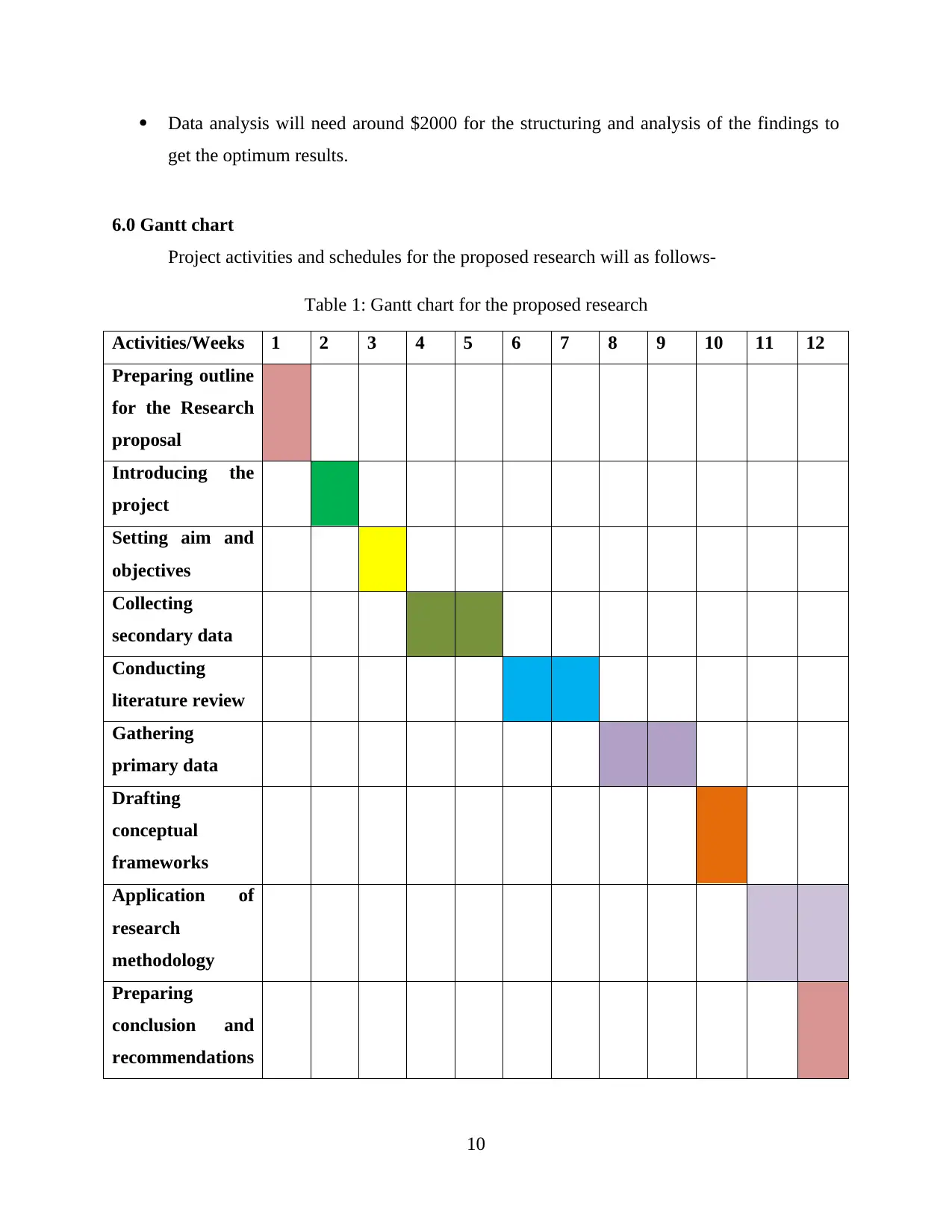
6.0 Gantt chart
Project activities and schedules for the proposed research will as follows-
Table 1: Gantt chart for the proposed research
Activities/Weeks 1 2 3 4 5 6 7 8 9 10 11 12
Preparing outline
for the Research
proposal
Introducing the
project
Setting aim and
objectives
Collecting
secondary data
Conducting
literature review
Gathering
primary data
Drafting
conceptual
frameworks
Application of
research
methodology
Preparing
conclusion and
recommendations
10
get the optimum results.
6.0 Gantt chart
Project activities and schedules for the proposed research will as follows-
Table 1: Gantt chart for the proposed research
Activities/Weeks 1 2 3 4 5 6 7 8 9 10 11 12
Preparing outline
for the Research
proposal
Introducing the
project
Setting aim and
objectives
Collecting
secondary data
Conducting
literature review
Gathering
primary data
Drafting
conceptual
frameworks
Application of
research
methodology
Preparing
conclusion and
recommendations
10
⊘ This is a preview!⊘
Do you want full access?
Subscribe today to unlock all pages.
Trusted by 1+ million students worldwide

1 out of 19


Related Documents


Your All-in-One AI-Powered Toolkit for Academic Success.
+13062052269
info@desklib.com
Available 24*7 on WhatsApp / Email
![[object Object]](/_next/static/media/star-bottom.7253800d.svg)
Unlock your academic potential
Copyright © 2020–2026 A2Z Services. All Rights Reserved. Developed and managed by ZUCOL.