AMN430: International Logistics of Apple Inc. - Supply Chain Analysis

Verified

Added on  2022/09/14

|9
|1543
|12
Report
AI Summary
This report analyzes the international logistics management of Apple, focusing on its supply chain operations. It explores Apple's use of push and pull strategies in advertising and customer engagement, highlighting how these strategies contribute to the company's brand recognition and customer loyalty. The report also examines the bullwhip effect within Apple's distribution channel, discussing the inefficiencies and financial losses stemming from supply and demand imbalances. The analysis includes the company's historical performance, supplier relationships, and challenges in maintaining environmental and employee standards. The conclusion summarizes the company's successes in advertising and customer loyalty, while also pointing out the need for improved demand-supply management and mitigation of distribution channel risks to ensure sustained operational efficiency and financial stability.
Document Page
Running head: INTERNATIONAL LOGISTICS MANAGEMENT
International Logistics Management
Name of the Student:
Name of the University:
Author Note:
tabler-icon-diamond-filled.svg

Paraphrase This Document

Need a fresh take? Get an instant paraphrase of this document with our AI Paraphraser
Document Page
1INTERNATIONAL LOGISTICS MANAGEMENT
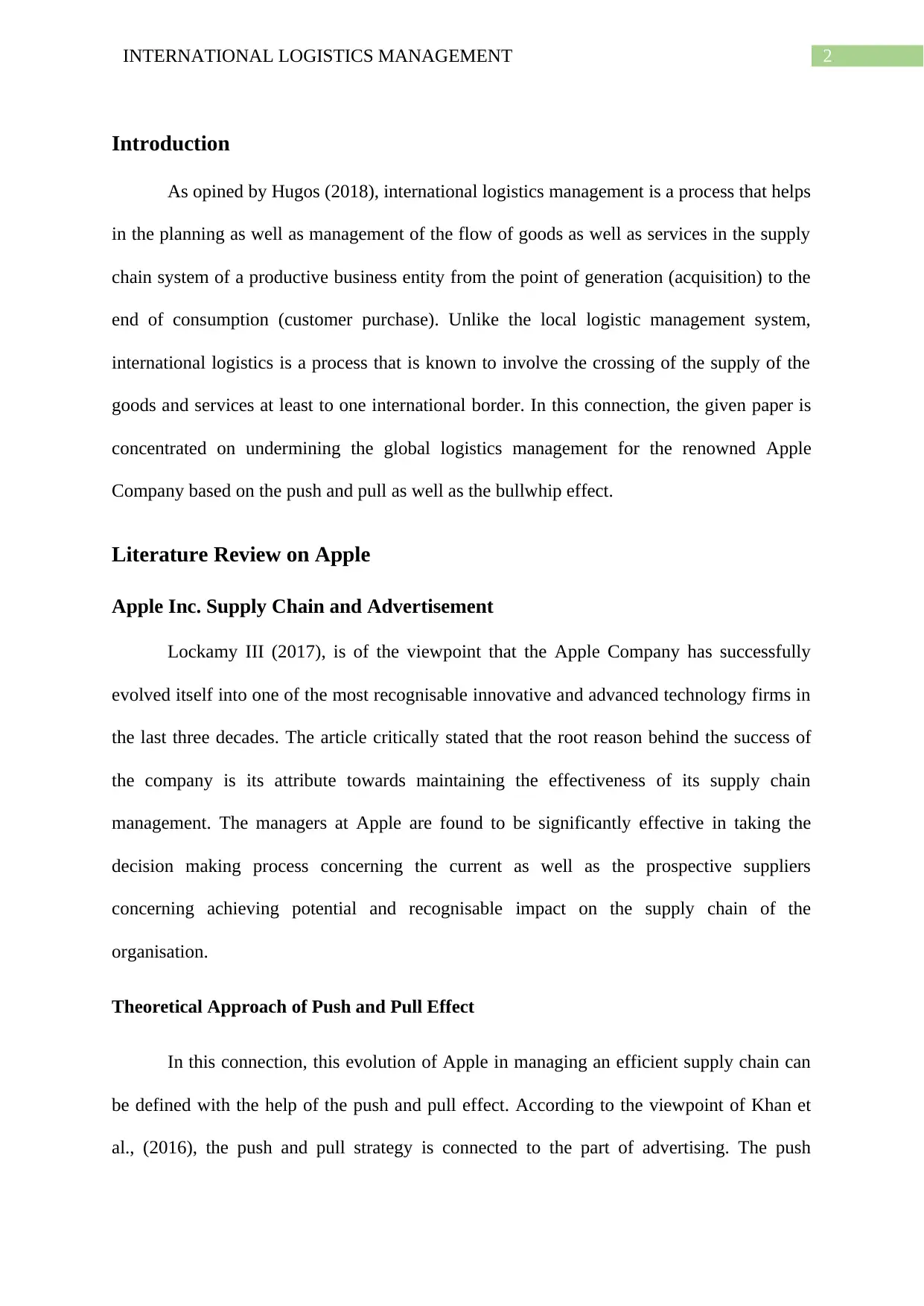
Table of Contents
Introduction................................................................................................................................2
Literature Review on Apple.......................................................................................................2
Apple Inc. Supply Chain and Advertisement.........................................................................2
The unsolved dilemma in Apple’s Supply Chain..................................................................3
Conclusion..................................................................................................................................4
References..................................................................................................................................6
Document Page
2INTERNATIONAL LOGISTICS MANAGEMENT
Introduction
As opined by Hugos (2018), international logistics management is a process that helps
in the planning as well as management of the flow of goods as well as services in the supply
chain system of a productive business entity from the point of generation (acquisition) to the
end of consumption (customer purchase). Unlike the local logistic management system,
international logistics is a process that is known to involve the crossing of the supply of the
goods and services at least to one international border. In this connection, the given paper is
concentrated on undermining the global logistics management for the renowned Apple
Company based on the push and pull as well as the bullwhip effect.
Literature Review on Apple
Apple Inc. Supply Chain and Advertisement
Lockamy III (2017), is of the viewpoint that the Apple Company has successfully
evolved itself into one of the most recognisable innovative and advanced technology firms in
the last three decades. The article critically stated that the root reason behind the success of
the company is its attribute towards maintaining the effectiveness of its supply chain
management. The managers at Apple are found to be significantly effective in taking the
decision making process concerning the current as well as the prospective suppliers
concerning achieving potential and recognisable impact on the supply chain of the
organisation.
Theoretical Approach of Push and Pull Effect
In this connection, this evolution of Apple in managing an efficient supply chain can
be defined with the help of the push and pull effect. According to the viewpoint of Khan et
al., (2016), the push and pull strategy is connected to the part of advertising. The push
Document Page
3INTERNATIONAL LOGISTICS MANAGEMENT
strategy refers to a situation when a company or a vendor is competent enough in advertising
its product and services. The same is done in consideration of gaining a significant number of
the audience's awareness. The pull strategy is implied to the aim concerned with reaching the
audience that has already shown interest in the product or services that is offered by a
business entity. Concerning to this ideology of push effect, the Apple Company is known to
advertise its high quality products and services through the most advanced means of social
media platforms. The research and development team at Apple is recognised to be efficient
enough to study and understand the fact that social media platform will help the business
entity of Apple to gain the attention of a considerable number of consumers at one given and
short span of point of time all across the globe. As opined by Pearson (2016), Apple products
are a brand in itself; the same is advertised effectively to gain a high amount of profit. On the
other hand, connecting Apple to pull effect, it can be stated that the firm measures its website
profile visits on a daily basis and keeps a validated data of its previous customers. Thus, they
maintain a continuous business relationship with their already existing business clients with
the help of contacting them through virtual messages and emails.
The unsolved dilemma in Apple’s Supply Chain
However, in lieu of this, as stated by Clarke & Boersma, (2017), Apple being the
most recognisable company in the concern of financial terms and conditions, have
significantly failed in finding a solution to the synergy of recurrent employment as well as the
retaining the environmental factors that occurs in the manufacturing units of the Apple
components. Thus, the article critically states that the organisation of Apple should focus on
the development of the global value chain on a priority basis. Moreover, the concerned firm
should also focus on solving the problems connected to the continuous recent failure of the
organisation to maintain its employees and its accountability towards the environment. This,
in turn, is recorded to leave the employees at Apple to be vulnerable in nature as well as
tabler-icon-diamond-filled.svg

Paraphrase This Document

Need a fresh take? Get an instant paraphrase of this document with our AI Paraphraser
Document Page
4INTERNATIONAL LOGISTICS MANAGEMENT
neglection in the maintenance of the environmental duties that a business organisation needs
to. The root cause behind this issue is the current chaos in the distribution channel of Apple.
Document Page
5INTERNATIONAL LOGISTICS MANAGEMENT
Theoretical Approach of Bullwhip Effect
In this context, the current inefficiency of the distribution channel prevailing in the
productive organisation of Apple can be described with the help of the bullwhip effect. As
stated by Wang & Disney (2016), the bullwhip effect is considered to be the phenomenon of
the distribution channel which helps in yielding the forecast of the inefficiency in the supply
chain system of an organisation. It specifically refers to the continuous increase in the swings
in the inventory of an organisation with regards to the shift in the demands of the customers
(considerably when one of it moves further up from the supply chain). Concerning to this
ideology of bullwhip effect, it was found that the organisation of Apple had been losing
money because of its inefficiency in anticipation of the supply they offer and the demand that
is received by the customers that initiated in the year of 2011 (Shelley, 2016). Studies show
that the Apple organisation has a dozen number of suppliers as well as distributors through
which they can recognisably maintain their supply chain processes. The statistical data shows
that Apple had suffered a huge and dramatic loss in the year of 2011, which is calculated as
almost around to 3.5 trillion because of the ineffectiveness in the supply chain management.
The improper forecast updating, the fluctuations in the price as well as the rationing and the
shortage gaming; all were recognised to be the causes of the bullwhip effect concerned with
Apple.
Conclusion
Given the findings, based on the research about the international logistics
management of a renowned company Apple, it can be seen that the company had received the
utmost top level paradigm in maintaining its supply chain activities through the help of
effective advertisement strategies. The advertising strategies used by the company helped the
same to gain a considerable number of customers and gain better customer loyalty and
Document Page
6INTERNATIONAL LOGISTICS MANAGEMENT
competitive advantage. However, in the next part of the report, it is also found that the
company has significantly failed in consideration of managing the demand and the supply
approaches in the year of 2011 which led the company to bear a considerable amount of loss.
It was seen in this case that Apple was not able to find any practical solution to mitigate the
risk caused in its distribution channel.
tabler-icon-diamond-filled.svg

Paraphrase This Document

Need a fresh take? Get an instant paraphrase of this document with our AI Paraphraser
Document Page
7INTERNATIONAL LOGISTICS MANAGEMENT
References
Clarke, T., & Boersma, M. (2017). The governance of global value chains: Unresolved
human rights, environmental and ethical dilemmas in the apple supply chain. Journal
of Business Ethics, 143(1), 111-131. Available at DOI: 10.1007/s10551-015-2781-3
Hugos, M. H. (2018). Essentials of supply chain management. John Wiley & Sons. Available
at: https://www.wiley.com/en-us/Essentials+of+Supply+Chain+Management
%2C+4th+Edition-p-9781119461104
Khan, Z., Midega, C. A., Hooper, A., & Pickett, J. (2016). Push-pull: chemical ecology-based
integrated pest management technology. Journal of chemical ecology, 42(7), 689-697.
Available at DOI: 10.1007/s10886-016-0730-y
Lockamy III, A. (2017, July). An examination of external risk factors in Apple Inc.’s supply
chain. In Supply Chain Forum: An International Journal (Vol. 18, No. 3, pp. 177-
188). Taylor & Francis. Available at DOI: 10.1080/16258312.2017.1328252
Pearson, S. (2016). Building brands directly: creating business value from customer
relationships. Springer. Available at: https://books.google.co.in/books?
hl=en&lr=&id=vNi-
DAAAQBAJ&oi=fnd&pg=PR12&dq=Apple+products+are+a+brand+in+itself,
+the+same+is+advertised+effectively+to+gain+high+amount+of+profit&ots=oXnSz
FAWaN&sig=wjQCGtpAYVJqUJPdeQGHxho_J3w&redir_esc=y#v=onepage&q&f=
false
Shelley, P. B. (2016). CAPITALISM AND ROBOTS. The Innovation Illusion: How So Little
Is Created by So Many Working So Hard, 178. https://books.google.co.in/books?
hl=en&lr=&id=cZ0qDQAAQBAJ&oi=fnd&pg=PA178&dq=Concerning+to+this+ide
Document Page
8INTERNATIONAL LOGISTICS MANAGEMENT
ology+of+bullwhip+effect+it+was+found+that+the+organisation+of+Apple+had+bee
n+losing+money+because+of+its+inefficiency+in+the+anticipation+of+the+supply+t
hey+offer+and+the+demand+that+is+received+by+the+customers+that+initiated+in+
the&ots=8OmuzZBXW3&sig=3OllpDmM5xnx6VD4G7zThLUSCyA&redir_esc=y#
v=onepage&q&f=false
Wang, X., & Disney, S. M. (2016). The bullwhip effect: Progress, trends and
directions. European Journal of Operational Research, 250(3), 691-701. Available at
DOI: 10.1016/j.ejor.2015.07.022
chevron_up_icon
1 out of 9
circle_padding
hide_on_mobile
zoom_out_icon
[object Object]