Comprehensive Report on Apple's Supply Chain Management Strategies
VerifiedAdded on 2020/04/13
|26
|6056
|48
Report
AI Summary
This report provides a comprehensive analysis of Apple's supply chain management, examining key aspects such as material management, supplier relationships, and the integration of emerging technologies. The study delves into Apple's supply chain structure, material sourcing, and the five performance measurement criteria used to evaluate its efficiency. It explores Apple's 3BL pathway, emphasizing people, plant, and profit, and how the company addresses labor practices, environmental sustainability, and waste management. The report also investigates Apple's relationships with key suppliers like Foxconn and the role of contracts in ensuring product quality and design. Furthermore, it discusses the impact of technological innovation, including collaborations with companies like SAP, on enhancing supply chain efficiency and future market advantages. The report concludes with an overview of Apple's inventory turnover management and its overall operational strategies.
Running head: APPLE SUPPLY CHAIN MANAGEMENT
Apple Supply Chain Management
Name of the Student
Name of the University
Author’s Note
Apple Supply Chain Management
Name of the Student
Name of the University
Author’s Note

Paraphrase This Document
Need a fresh take? Get an instant paraphrase of this document with our AI Paraphraser
1APPLE SUPPLY CHAIN MANAGEMENT
Executive Summary
The following report studies Apple’s supply chain in terms of material management, relationship
build up and technological innovation. It will study the structure of apple’s supply chain, and
material management process. The report further identifies the company’s partners and the
regulation Apple have over them in order to maintain the quality of their products. The final part
of the report identifies efficiency of five-step performance measurement in the supply chain. The
study also efficiency of the waste management procedure implemented by Apple, which has
considerably reduce the industrial wastage and production cost for the company. Moreover, their
operation management has maintained the innovative quality, design, and service. The report
further identifies the effective contract Apple made with their partners to ensure the high quality
and design of their products. The final part of the report identifies their new collaboration with
SAP for gaining advantage in the future market in terms of technological innovation.
Executive Summary
The following report studies Apple’s supply chain in terms of material management, relationship
build up and technological innovation. It will study the structure of apple’s supply chain, and
material management process. The report further identifies the company’s partners and the
regulation Apple have over them in order to maintain the quality of their products. The final part
of the report identifies efficiency of five-step performance measurement in the supply chain. The
study also efficiency of the waste management procedure implemented by Apple, which has
considerably reduce the industrial wastage and production cost for the company. Moreover, their
operation management has maintained the innovative quality, design, and service. The report
further identifies the effective contract Apple made with their partners to ensure the high quality
and design of their products. The final part of the report identifies their new collaboration with
SAP for gaining advantage in the future market in terms of technological innovation.
2APPLE SUPPLY CHAIN MANAGEMENT
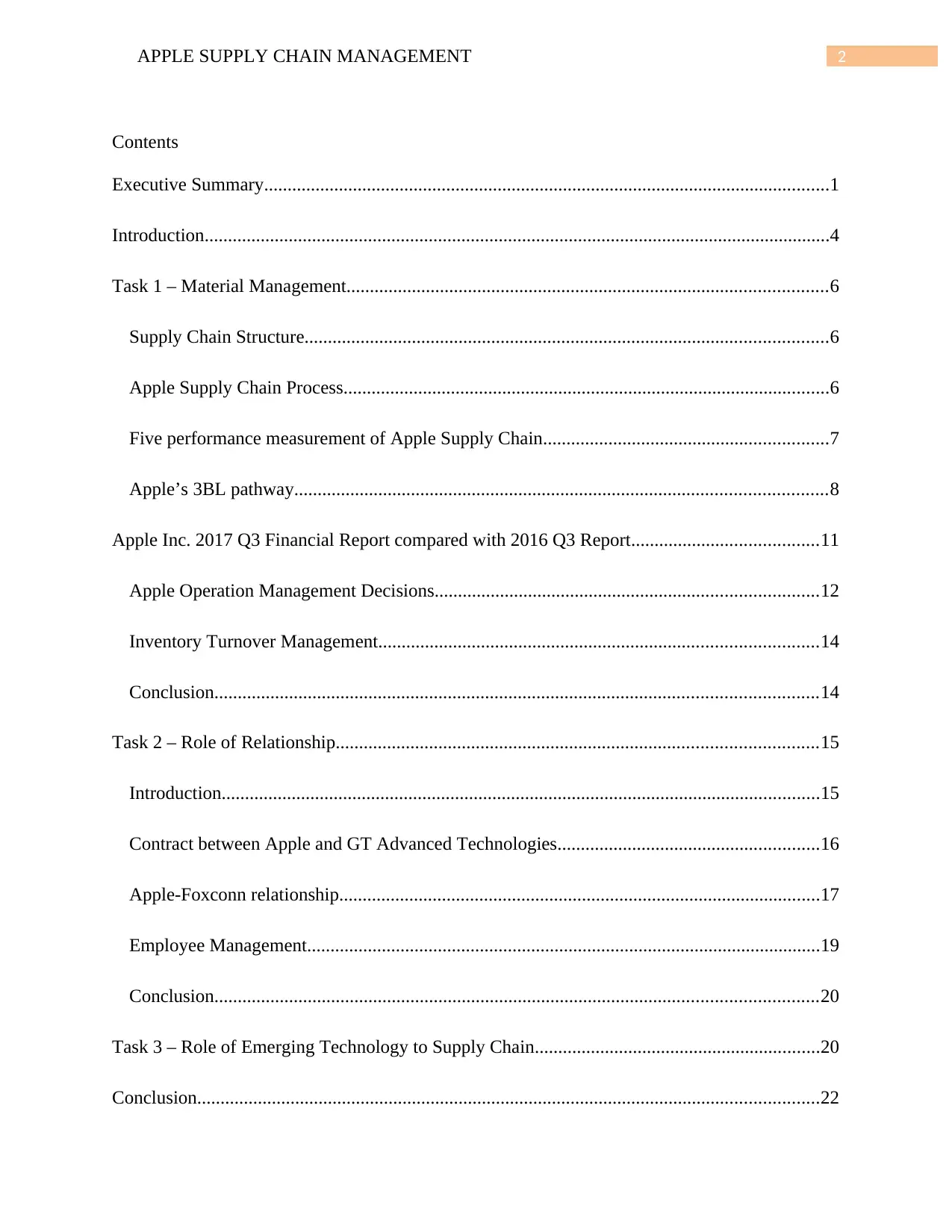
Contents
Executive Summary.........................................................................................................................1
Introduction......................................................................................................................................4
Task 1 – Material Management.......................................................................................................6
Supply Chain Structure................................................................................................................6
Apple Supply Chain Process........................................................................................................6
Five performance measurement of Apple Supply Chain.............................................................7
Apple’s 3BL pathway..................................................................................................................8
Apple Inc. 2017 Q3 Financial Report compared with 2016 Q3 Report........................................11
Apple Operation Management Decisions..................................................................................12
Inventory Turnover Management..............................................................................................14
Conclusion.................................................................................................................................14
Task 2 – Role of Relationship.......................................................................................................15
Introduction................................................................................................................................15
Contract between Apple and GT Advanced Technologies........................................................16
Apple-Foxconn relationship.......................................................................................................17
Employee Management..............................................................................................................19
Conclusion.................................................................................................................................20
Task 3 – Role of Emerging Technology to Supply Chain.............................................................20
Conclusion.....................................................................................................................................22
Contents
Executive Summary.........................................................................................................................1
Introduction......................................................................................................................................4
Task 1 – Material Management.......................................................................................................6
Supply Chain Structure................................................................................................................6
Apple Supply Chain Process........................................................................................................6
Five performance measurement of Apple Supply Chain.............................................................7
Apple’s 3BL pathway..................................................................................................................8
Apple Inc. 2017 Q3 Financial Report compared with 2016 Q3 Report........................................11
Apple Operation Management Decisions..................................................................................12
Inventory Turnover Management..............................................................................................14
Conclusion.................................................................................................................................14
Task 2 – Role of Relationship.......................................................................................................15
Introduction................................................................................................................................15
Contract between Apple and GT Advanced Technologies........................................................16
Apple-Foxconn relationship.......................................................................................................17
Employee Management..............................................................................................................19
Conclusion.................................................................................................................................20
Task 3 – Role of Emerging Technology to Supply Chain.............................................................20
Conclusion.....................................................................................................................................22
⊘ This is a preview!⊘
Do you want full access?
Subscribe today to unlock all pages.

Trusted by 1+ million students worldwide
3APPLE SUPPLY CHAIN MANAGEMENT
References......................................................................................................................................24
References......................................................................................................................................24
Paraphrase This Document
Need a fresh take? Get an instant paraphrase of this document with our AI Paraphraser
4APPLE SUPPLY CHAIN MANAGEMENT
Introduction
Steve Jobs, Steve Woznaik and Ronal Wayne started Apple Inc in their garage in April
1976. They manufactured the first generation Apple computer with a goal to provide the
customers with personal and friendly system that can be set up at either office or home. They
introduced their second-generation computer within just a year, which was far advanced than the
ones available in the market. The Apple 2 had color illustration and open engineering. They
started using floppy disk 51/4 for storing their data in second generation of Apple computers.
This computer gave them a competitive advantage and put them in the lead for the next three
years.
Two of the partners left the organization within the first decade, Woznaik in 1983
followed by Jobs in 1985. Woznaik reflected lack of enthusiasm, whereas, Jobs started his own
software company Next and computer company Pixar. Job’s exit from Apple made the company
suffer right after it gained the top position in 1990. The company felt an urgent need of operation
management that led the company to purchase Next software. The arrangement was settled in the
year 1997 and Jobs was positioned as ICEO. Jobs then focused on the product line offered by the
company and started rebuilding it. This is the period when Jobs identified the ability of Jonathan
Ive and worked together in the process of reconstructing Apple’s status. Ive and his team
introduced then introduced a new line of Apple personal computers and named it iMac in 15th
August, 1998. The company sold 800,000 iMac unites in just five months of its launch. This can
be considered as the turning point for Apple and they introduced a number of products in the
next few years.
Introduction
Steve Jobs, Steve Woznaik and Ronal Wayne started Apple Inc in their garage in April
1976. They manufactured the first generation Apple computer with a goal to provide the
customers with personal and friendly system that can be set up at either office or home. They
introduced their second-generation computer within just a year, which was far advanced than the
ones available in the market. The Apple 2 had color illustration and open engineering. They
started using floppy disk 51/4 for storing their data in second generation of Apple computers.
This computer gave them a competitive advantage and put them in the lead for the next three
years.
Two of the partners left the organization within the first decade, Woznaik in 1983
followed by Jobs in 1985. Woznaik reflected lack of enthusiasm, whereas, Jobs started his own
software company Next and computer company Pixar. Job’s exit from Apple made the company
suffer right after it gained the top position in 1990. The company felt an urgent need of operation
management that led the company to purchase Next software. The arrangement was settled in the
year 1997 and Jobs was positioned as ICEO. Jobs then focused on the product line offered by the
company and started rebuilding it. This is the period when Jobs identified the ability of Jonathan
Ive and worked together in the process of reconstructing Apple’s status. Ive and his team
introduced then introduced a new line of Apple personal computers and named it iMac in 15th
August, 1998. The company sold 800,000 iMac unites in just five months of its launch. This can
be considered as the turning point for Apple and they introduced a number of products in the
next few years.
5APPLE SUPPLY CHAIN MANAGEMENT
Jobs on his return to Apple introduced their online store in 1997, which was the first e-
store opened by Apple. They took an overall renovation of the company and entered the software
market. They introduced IPod Mp3 player and iTune in 2001 when again was a big success for
the company. The iPod was introduced on 23rd October, followed by Safari web browser and
finally the iTune music store in April 2003 that sold over 25 billion songs by 6th of February
2013.
Another remarkable success for Apple came with the introduction iPhone in 9th January
2007. This helped them reducing the gap between the customers’ expectation and the mobile
devices produced by the companies. They borrowed the concept of producing their other line of
products to manufacture the line of mobile phones. Until date, the company launched 9 of the
iPhones along with sub-divisions for each single generation. The latest mobile products
introduced by the company in 2017 comes with some of the latest technologies like 3D camera
resolution, photo capture option, face detection, wide screen without frame, wireless charging
and many other features.
The complete line of Apple produces are iPod, iPad, iPhone, Mac computers and Apple
TV. They also have a wide range of apple accessories ranging from watch, adaptor, cables, cases
and covers, chargers, headphones, illustration and design, watchbands, remotes and docks. Their
software products ranges from iTune, iPlay, Safar, iso, iMac and many more. This report will
critically review the material management, role of relationship management and the role of
emerging technologies in Apple’s supply chain.
Jobs on his return to Apple introduced their online store in 1997, which was the first e-
store opened by Apple. They took an overall renovation of the company and entered the software
market. They introduced IPod Mp3 player and iTune in 2001 when again was a big success for
the company. The iPod was introduced on 23rd October, followed by Safari web browser and
finally the iTune music store in April 2003 that sold over 25 billion songs by 6th of February
2013.
Another remarkable success for Apple came with the introduction iPhone in 9th January
2007. This helped them reducing the gap between the customers’ expectation and the mobile
devices produced by the companies. They borrowed the concept of producing their other line of
products to manufacture the line of mobile phones. Until date, the company launched 9 of the
iPhones along with sub-divisions for each single generation. The latest mobile products
introduced by the company in 2017 comes with some of the latest technologies like 3D camera
resolution, photo capture option, face detection, wide screen without frame, wireless charging
and many other features.
The complete line of Apple produces are iPod, iPad, iPhone, Mac computers and Apple
TV. They also have a wide range of apple accessories ranging from watch, adaptor, cables, cases
and covers, chargers, headphones, illustration and design, watchbands, remotes and docks. Their
software products ranges from iTune, iPlay, Safar, iso, iMac and many more. This report will
critically review the material management, role of relationship management and the role of
emerging technologies in Apple’s supply chain.
⊘ This is a preview!⊘
Do you want full access?
Subscribe today to unlock all pages.
Trusted by 1+ million students worldwide
6APPLE SUPPLY CHAIN MANAGEMENT
Task 1 – Material Management
Supply Chain Structure
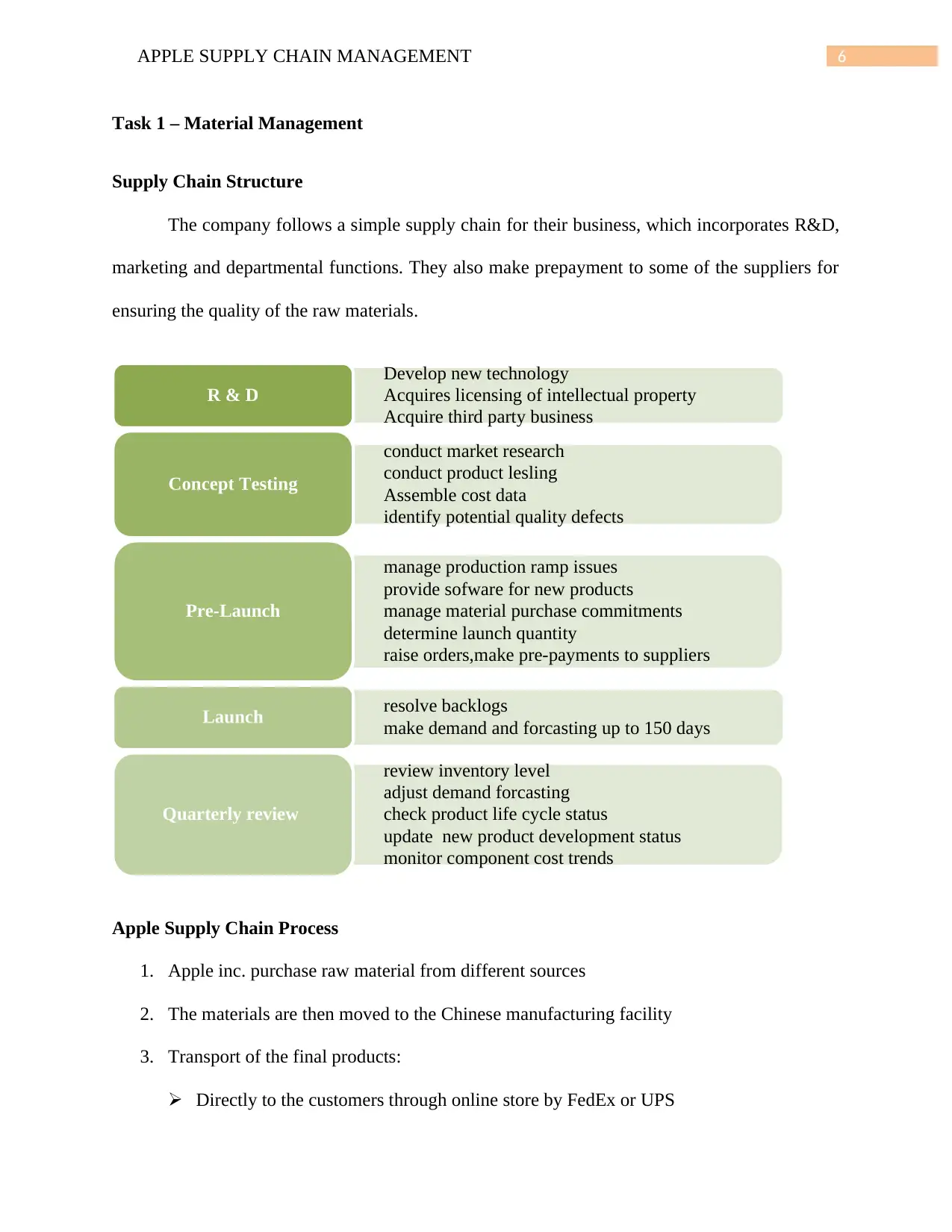
The company follows a simple supply chain for their business, which incorporates R&D,
marketing and departmental functions. They also make prepayment to some of the suppliers for
ensuring the quality of the raw materials.
Apple Supply Chain Process
1. Apple inc. purchase raw material from different sources
2. The materials are then moved to the Chinese manufacturing facility
3. Transport of the final products:
Directly to the customers through online store by FedEx or UPS
Develop new technology
Acquires licensing of intellectual property
Acquire third party business
R & D
conduct market research
conduct product lesling
Assemble cost data
identify potential quality defects
Concept Testing
manage production ramp issues
provide sofware for new products
manage material purchase commitments
determine launch quantity
raise orders,make pre-payments to suppliers
Pre-Launch
resolve backlogs
make demand and forcasting up to 150 days
Launch
review inventory level
adjust demand forcasting
check product life cycle status
update new product development status
monitor component cost trends
Quarterly review
Task 1 – Material Management
Supply Chain Structure
The company follows a simple supply chain for their business, which incorporates R&D,
marketing and departmental functions. They also make prepayment to some of the suppliers for
ensuring the quality of the raw materials.
Apple Supply Chain Process
1. Apple inc. purchase raw material from different sources
2. The materials are then moved to the Chinese manufacturing facility
3. Transport of the final products:
Directly to the customers through online store by FedEx or UPS
Develop new technology
Acquires licensing of intellectual property
Acquire third party business
R & D
conduct market research
conduct product lesling
Assemble cost data
identify potential quality defects
Concept Testing
manage production ramp issues
provide sofware for new products
manage material purchase commitments
determine launch quantity
raise orders,make pre-payments to suppliers
Pre-Launch
resolve backlogs
make demand and forcasting up to 150 days
Launch
review inventory level
adjust demand forcasting
check product life cycle status
update new product development status
monitor component cost trends
Quarterly review
Paraphrase This Document
Need a fresh take? Get an instant paraphrase of this document with our AI Paraphraser
7APPLE SUPPLY CHAIN MANAGEMENT
Transported to central warehouse in California to supply customers through other
distributers such as retail stores.
4. The products are recollected from the customers at the end of product life cycle for the
recycling purpose.
Five performance measurement of Apple Supply Chain
I. Quality – The quality assurance of Apple products undergo various steps. The quality
assurance department primarily checks the quality of the products and services and then
conducts third party audition to verify the quality being delivered to the customers. It
helps them to deliver the flawless products for satisfying the customers’ needs.
II. Speed – The current simplified supply chain is an outcome of the effort put by Steve Jibs
and Tim Cook. They successfully reduced the number of warehouses to 9 from 19 around
the world utilizing the JIT method of supply chain. Minimizing the number if sources,
transports, and warehouse enable the company to have better control over their supply
chain hat speeds up the process. They can both deliver the products at the time of need
and bring back the recyclable products that reach the end point of product life cycle.
III. Dependability – Narrowing down the supply chain to a simple one enables them to gain
complete control over their product distribution. The company now can better manage the
distribution of their products from their Chinese manufacturing facility to the markets.
Simplicity makes the process faster as they have to follow the single supply chain and
track down the product. Recycling on the other hand is the opposite of the distribution
where the company takes back the products and sends them to their Chinese facility.
Simple supply chain in this case can also help the company to track every single product
that are being taken back. Hence, it increases the dependability of the supply chain.
Transported to central warehouse in California to supply customers through other
distributers such as retail stores.
4. The products are recollected from the customers at the end of product life cycle for the
recycling purpose.
Five performance measurement of Apple Supply Chain
I. Quality – The quality assurance of Apple products undergo various steps. The quality
assurance department primarily checks the quality of the products and services and then
conducts third party audition to verify the quality being delivered to the customers. It
helps them to deliver the flawless products for satisfying the customers’ needs.
II. Speed – The current simplified supply chain is an outcome of the effort put by Steve Jibs
and Tim Cook. They successfully reduced the number of warehouses to 9 from 19 around
the world utilizing the JIT method of supply chain. Minimizing the number if sources,
transports, and warehouse enable the company to have better control over their supply
chain hat speeds up the process. They can both deliver the products at the time of need
and bring back the recyclable products that reach the end point of product life cycle.
III. Dependability – Narrowing down the supply chain to a simple one enables them to gain
complete control over their product distribution. The company now can better manage the
distribution of their products from their Chinese manufacturing facility to the markets.
Simplicity makes the process faster as they have to follow the single supply chain and
track down the product. Recycling on the other hand is the opposite of the distribution
where the company takes back the products and sends them to their Chinese facility.
Simple supply chain in this case can also help the company to track every single product
that are being taken back. Hence, it increases the dependability of the supply chain.
8APPLE SUPPLY CHAIN MANAGEMENT
IV. Flexibility – Flexibility in terms of product manufacturing is the key to address the
marketing strategy.
New product Flexibility
Volume Flexibility
Product Mix Flexibility
The company should be flexible enough to introduce new products in the market
matching the fast demand of the customers. Hence, it asks Apple to enable its factories to
reconfigure new products quickly enough to support the fast life cycle. The volume
flexibility asks the factories to increase production due to initial promotion and short life
cycle. The sales are as good as lost if the factory fails to produce the right volume in time.
The sale forecasts are notoriously inaccurate and higher in case of new product. It makes
it necessary for the factory to be prepared for a landslide, a fizzle, or anything in between.
Moreover, the company must identify the time when the product life cycle reaches its end
and manage its production accordingly to launch new product.
V. Cost – “Customer come first, cost cutting come second”. Apple charges a premium price
for enjoying high profit margins. In other words, manufacturing products within the
decided cost is not the most important consideration at the time of designing or operating
an Apple factory.
Apple’s 3BL pathway
2017 Apple progress report (supplier responsibility) reveals that the company depends on
3BL pathway that includes people, plant, and profit. Apple put people in the heart of their supply
chain structure.
IV. Flexibility – Flexibility in terms of product manufacturing is the key to address the
marketing strategy.
New product Flexibility
Volume Flexibility
Product Mix Flexibility
The company should be flexible enough to introduce new products in the market
matching the fast demand of the customers. Hence, it asks Apple to enable its factories to
reconfigure new products quickly enough to support the fast life cycle. The volume
flexibility asks the factories to increase production due to initial promotion and short life
cycle. The sales are as good as lost if the factory fails to produce the right volume in time.
The sale forecasts are notoriously inaccurate and higher in case of new product. It makes
it necessary for the factory to be prepared for a landslide, a fizzle, or anything in between.
Moreover, the company must identify the time when the product life cycle reaches its end
and manage its production accordingly to launch new product.
V. Cost – “Customer come first, cost cutting come second”. Apple charges a premium price
for enjoying high profit margins. In other words, manufacturing products within the
decided cost is not the most important consideration at the time of designing or operating
an Apple factory.
Apple’s 3BL pathway
2017 Apple progress report (supplier responsibility) reveals that the company depends on
3BL pathway that includes people, plant, and profit. Apple put people in the heart of their supply
chain structure.
⊘ This is a preview!⊘
Do you want full access?
Subscribe today to unlock all pages.
Trusted by 1+ million students worldwide
9APPLE SUPPLY CHAIN MANAGEMENT
A. People – Apple identifies changes, develops new items and plans asking the suppliers to
do things accordingly in newly prescribed ways. Apple’s safety engineers investigate on the
health, security, and natural dangers. The company then initiates the configuration of risk plan by
joining the forces with interior and exterior groups at the time when risk is identified. The
company organize regular health test for the workers to ensure the safety and guarantee that the
products manufactured in the facilities are securely manufactured.
In 2016, Apple’s procedure engineers prepared a factory readiness assessment tool for
ensuring that the industrial facilities are completely arranged to provide laborer and natural
consistency.
Bonded worker is the center infringement of Apple’s Code of Conduct and have zero
resilience for it. If some case is discovered, the company demands the provider to reimburse all
enlistment charges back to the laborer. 2016 report reveals that infringement brought about US$
2.6 million being reimbursed to more than 1000 provide representatives. Until date, an aggregate
of US$ 28.4 million has been reimbursed to more than 34,000 specialists. Essentially, all
reinforced work infringement happen amid a provider's first evaluation, which is the reason we
now incorporate this in our on boarding procedure for new providers. Rehash cases are
exceptionally uncommon—the couple of such occurrences have brought about the finish of the
business relationship.
B. Plant and Environment
Identification of Supply Chain Members – Apple first identifies the source of the materials
and the members involved in the supply chain for assisting the mining countries and
environmental protection. Apple is the first company that identifies the suppliers of 3TG that is
A. People – Apple identifies changes, develops new items and plans asking the suppliers to
do things accordingly in newly prescribed ways. Apple’s safety engineers investigate on the
health, security, and natural dangers. The company then initiates the configuration of risk plan by
joining the forces with interior and exterior groups at the time when risk is identified. The
company organize regular health test for the workers to ensure the safety and guarantee that the
products manufactured in the facilities are securely manufactured.
In 2016, Apple’s procedure engineers prepared a factory readiness assessment tool for
ensuring that the industrial facilities are completely arranged to provide laborer and natural
consistency.
Bonded worker is the center infringement of Apple’s Code of Conduct and have zero
resilience for it. If some case is discovered, the company demands the provider to reimburse all
enlistment charges back to the laborer. 2016 report reveals that infringement brought about US$
2.6 million being reimbursed to more than 1000 provide representatives. Until date, an aggregate
of US$ 28.4 million has been reimbursed to more than 34,000 specialists. Essentially, all
reinforced work infringement happen amid a provider's first evaluation, which is the reason we
now incorporate this in our on boarding procedure for new providers. Rehash cases are
exceptionally uncommon—the couple of such occurrences have brought about the finish of the
business relationship.
B. Plant and Environment
Identification of Supply Chain Members – Apple first identifies the source of the materials
and the members involved in the supply chain for assisting the mining countries and
environmental protection. Apple is the first company that identifies the suppliers of 3TG that is
Paraphrase This Document
Need a fresh take? Get an instant paraphrase of this document with our AI Paraphraser
10APPLE SUPPLY CHAIN MANAGEMENT
Tungsten, Tantalum, and Tin. The company then publishes and refines the name of the suppliers.
They also follow similar identification process for Cobalt, which gives Apple greater score in
Corporate Information Transparency Index or CITI administered by Institute of Public and
Environmental Affairs. Apple uses IPE data as third party advisor for identifying, supervising
and facilitating solution in order to improve supplier performance and initiate new direct
relationship between the suppliers and IPE.
Waste – Apple identified 20% of their produced waste in 2015 is being burnt or going for
landfills. It led the company to initiate a program in collaboration with the suppliers and
manufacturers to decrease the amount of waste by separating and recycling. They also involved
the third party named Tech-Com situated in Shanghai that is specialized in recycling every
materials using creative process. The volume of landfill waste dramatically increased over past
year. It increased from about 74,000 metric tons in 2015 to 2000,000 metric ton in 2017.
Decreased Water Consumption – Apple initiated Clean Water Program in 2013 to decrease
the freshwater consumption in their 86 supplier site. It resulted in saving of about 3.8 billion
gallon of water and 35% reuse of fresh water, which enables them to save about 8 billion gallon
of that is 18 glasses of water for every individual around the globe.
Reduction in Carbone footprint – Apple developed an objective to reduce Carbone footprint
through their supply chain and supplier sites. They plan to use renewable energy in all their
factories by 2018, which will reduce the Carbone emission by 70,00,000 metric ton every year. It
is equal of removing 1million and 500 thousand cars every year.
Using third-party audit – Apple has collaborated with China Chamber of Commerce of Metals,
Minerals and Chemicals importer and Exporter or CCCMC for creating a third-party audit for
Tungsten, Tantalum, and Tin. The company then publishes and refines the name of the suppliers.
They also follow similar identification process for Cobalt, which gives Apple greater score in
Corporate Information Transparency Index or CITI administered by Institute of Public and
Environmental Affairs. Apple uses IPE data as third party advisor for identifying, supervising
and facilitating solution in order to improve supplier performance and initiate new direct
relationship between the suppliers and IPE.
Waste – Apple identified 20% of their produced waste in 2015 is being burnt or going for
landfills. It led the company to initiate a program in collaboration with the suppliers and
manufacturers to decrease the amount of waste by separating and recycling. They also involved
the third party named Tech-Com situated in Shanghai that is specialized in recycling every
materials using creative process. The volume of landfill waste dramatically increased over past
year. It increased from about 74,000 metric tons in 2015 to 2000,000 metric ton in 2017.
Decreased Water Consumption – Apple initiated Clean Water Program in 2013 to decrease
the freshwater consumption in their 86 supplier site. It resulted in saving of about 3.8 billion
gallon of water and 35% reuse of fresh water, which enables them to save about 8 billion gallon
of that is 18 glasses of water for every individual around the globe.
Reduction in Carbone footprint – Apple developed an objective to reduce Carbone footprint
through their supply chain and supplier sites. They plan to use renewable energy in all their
factories by 2018, which will reduce the Carbone emission by 70,00,000 metric ton every year. It
is equal of removing 1million and 500 thousand cars every year.
Using third-party audit – Apple has collaborated with China Chamber of Commerce of Metals,
Minerals and Chemicals importer and Exporter or CCCMC for creating a third-party audit for
11APPLE SUPPLY CHAIN MANAGEMENT
cobalt. The program initiated in 2016 demands participation of every cobalt suppliers in a third-
party audit. This resulted into elimination of 23 suppliers from the supply chain of Apple. Apple
used third-party audit in different level of supply chain, evaluated above 500 data points
correspondent to their Code of Conduct, and turned all areas for improvement.
C. Profit
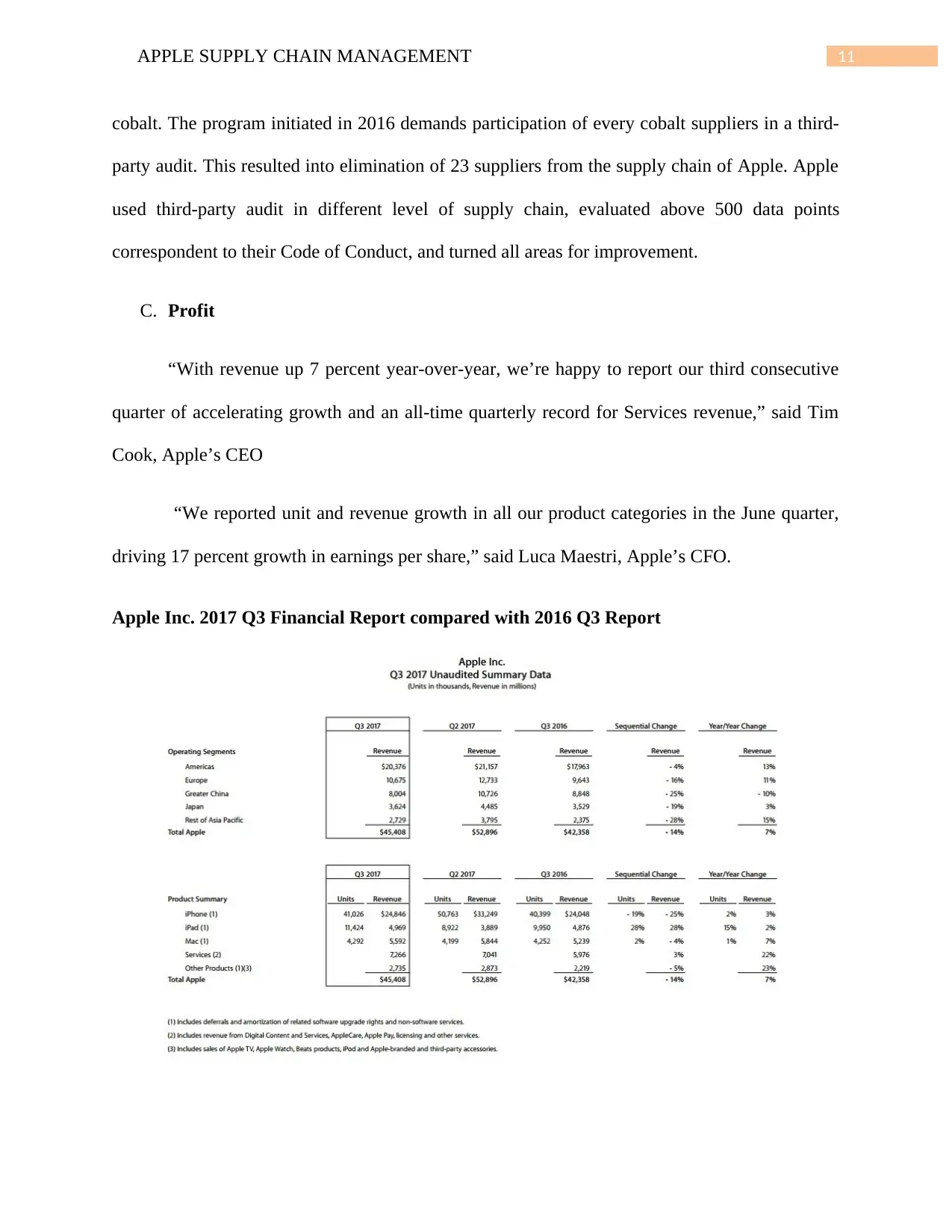
“With revenue up 7 percent year-over-year, we’re happy to report our third consecutive
quarter of accelerating growth and an all-time quarterly record for Services revenue,” said Tim
Cook, Apple’s CEO
“We reported unit and revenue growth in all our product categories in the June quarter,
driving 17 percent growth in earnings per share,” said Luca Maestri, Apple’s CFO.
Apple Inc. 2017 Q3 Financial Report compared with 2016 Q3 Report
cobalt. The program initiated in 2016 demands participation of every cobalt suppliers in a third-
party audit. This resulted into elimination of 23 suppliers from the supply chain of Apple. Apple
used third-party audit in different level of supply chain, evaluated above 500 data points
correspondent to their Code of Conduct, and turned all areas for improvement.
C. Profit
“With revenue up 7 percent year-over-year, we’re happy to report our third consecutive
quarter of accelerating growth and an all-time quarterly record for Services revenue,” said Tim
Cook, Apple’s CEO
“We reported unit and revenue growth in all our product categories in the June quarter,
driving 17 percent growth in earnings per share,” said Luca Maestri, Apple’s CFO.
Apple Inc. 2017 Q3 Financial Report compared with 2016 Q3 Report
⊘ This is a preview!⊘
Do you want full access?
Subscribe today to unlock all pages.
Trusted by 1+ million students worldwide

1 out of 26


Related Documents


Your All-in-One AI-Powered Toolkit for Academic Success.
+13062052269
info@desklib.com
Available 24*7 on WhatsApp / Email
![[object Object]](/_next/static/media/star-bottom.7253800d.svg)
Unlock your academic potential
Copyright © 2020–2026 A2Z Services. All Rights Reserved. Developed and managed by ZUCOL.