Application of Pneumatics and Hydraulics - Engineering Homework
VerifiedAdded on 2020/05/16
|16
|2663
|378
Homework Assignment
AI Summary
This assignment provides a detailed analysis of pneumatics and hydraulics applications. It begins with a calculation of suitable air main diameter based on flow rate, pressure, and pressure drop, considering various fittings and pipe lengths. The document then compares the advantages and disadvantages of steel, copper, and plastic pipes for distribution mains. It explores the impact of incorrect pipe sizing (larger or smaller than optimal) on system performance. The assignment includes calculations for determining the minimum pipe diameter for a given compressor output and pressure drop. It differentiates between macro and micro oil mist lubricators, explaining their applications. Additionally, the assignment lists potential causes of overheating in multi-stage reciprocating compressors and presents a system monitoring chart for hydraulic system performance. Finally, it outlines precautions to be taken when switching a hydraulic system from mineral oil-based fluid to fire-resistant fluid.
Application Of Pneumatics And Hydraulics 1
APPLICATION OF PNEUMATICS AND HYDRAULICS
By Name
Course
Instructor
Institution
Location
Date
APPLICATION OF PNEUMATICS AND HYDRAULICS
By Name
Course
Instructor
Institution
Location
Date

Paraphrase This Document
Need a fresh take? Get an instant paraphrase of this document with our AI Paraphraser
Application Of Pneumatics And Hydraulics 2
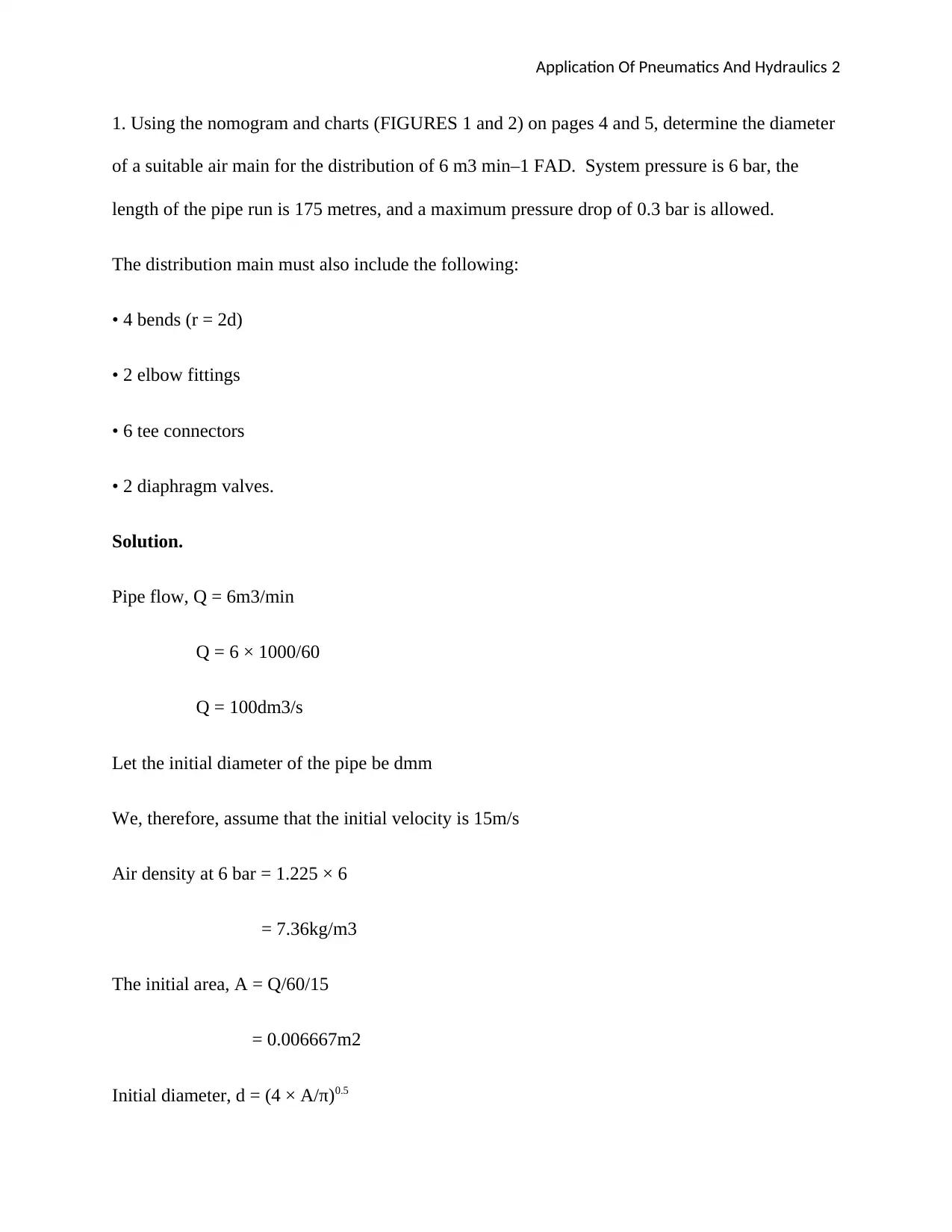
1. Using the nomogram and charts (FIGURES 1 and 2) on pages 4 and 5, determine the diameter
of a suitable air main for the distribution of 6 m3 min–1 FAD. System pressure is 6 bar, the
length of the pipe run is 175 metres, and a maximum pressure drop of 0.3 bar is allowed.
The distribution main must also include the following:
• 4 bends (r = 2d)
• 2 elbow fittings
• 6 tee connectors
• 2 diaphragm valves.
Solution.
Pipe flow, Q = 6m3/min
Q = 6 × 1000/60
Q = 100dm3/s
Let the initial diameter of the pipe be dmm
We, therefore, assume that the initial velocity is 15m/s
Air density at 6 bar = 1.225 × 6
= 7.36kg/m3
The initial area, A = Q/60/15
= 0.006667m2
Initial diameter, d = (4 × A/π)0.5
1. Using the nomogram and charts (FIGURES 1 and 2) on pages 4 and 5, determine the diameter
of a suitable air main for the distribution of 6 m3 min–1 FAD. System pressure is 6 bar, the
length of the pipe run is 175 metres, and a maximum pressure drop of 0.3 bar is allowed.
The distribution main must also include the following:
• 4 bends (r = 2d)
• 2 elbow fittings
• 6 tee connectors
• 2 diaphragm valves.
Solution.
Pipe flow, Q = 6m3/min
Q = 6 × 1000/60
Q = 100dm3/s
Let the initial diameter of the pipe be dmm
We, therefore, assume that the initial velocity is 15m/s
Air density at 6 bar = 1.225 × 6
= 7.36kg/m3
The initial area, A = Q/60/15
= 0.006667m2
Initial diameter, d = (4 × A/π)0.5
Application Of Pneumatics And Hydraulics 3
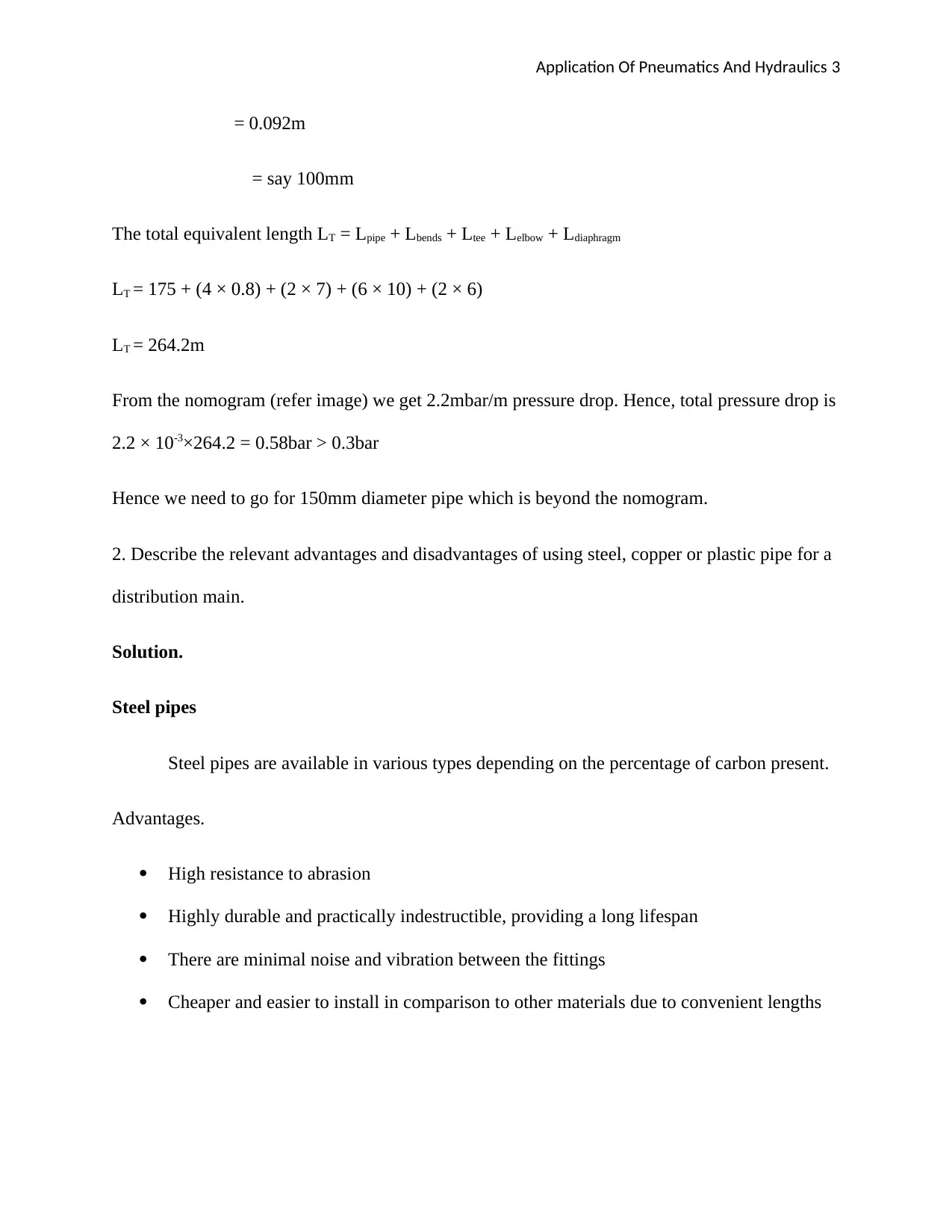
= 0.092m
= say 100mm
The total equivalent length LT = Lpipe + Lbends + Ltee + Lelbow + Ldiaphragm
LT = 175 + (4 × 0.8) + (2 × 7) + (6 × 10) + (2 × 6)
LT = 264.2m
From the nomogram (refer image) we get 2.2mbar/m pressure drop. Hence, total pressure drop is
2.2 × 10-3×264.2 = 0.58bar > 0.3bar
Hence we need to go for 150mm diameter pipe which is beyond the nomogram.
2. Describe the relevant advantages and disadvantages of using steel, copper or plastic pipe for a
distribution main.
Solution.
Steel pipes
Steel pipes are available in various types depending on the percentage of carbon present.
Advantages.
High resistance to abrasion
Highly durable and practically indestructible, providing a long lifespan
There are minimal noise and vibration between the fittings
Cheaper and easier to install in comparison to other materials due to convenient lengths
= 0.092m
= say 100mm
The total equivalent length LT = Lpipe + Lbends + Ltee + Lelbow + Ldiaphragm
LT = 175 + (4 × 0.8) + (2 × 7) + (6 × 10) + (2 × 6)
LT = 264.2m
From the nomogram (refer image) we get 2.2mbar/m pressure drop. Hence, total pressure drop is
2.2 × 10-3×264.2 = 0.58bar > 0.3bar
Hence we need to go for 150mm diameter pipe which is beyond the nomogram.
2. Describe the relevant advantages and disadvantages of using steel, copper or plastic pipe for a
distribution main.
Solution.
Steel pipes
Steel pipes are available in various types depending on the percentage of carbon present.
Advantages.
High resistance to abrasion
Highly durable and practically indestructible, providing a long lifespan
There are minimal noise and vibration between the fittings
Cheaper and easier to install in comparison to other materials due to convenient lengths
⊘ This is a preview!⊘
Do you want full access?
Subscribe today to unlock all pages.

Trusted by 1+ million students worldwide
Application Of Pneumatics And Hydraulics 4
Disadvantages.
They are heavy and require special means of transport
They not advisable to use in areas that are inaccessible
Due to heavyweight, these pipes are usually shorter in lengths thus leading to many joints
(De Volder and Reynaerts, 2010).
They are prone to corrosion due to rusting
Copper pipes
Advantages
They are easy to install
They are more flexible than most of the other materials
They are more resistant to natural forces and disasters
They have a high resale value
They have high fire resistant properties/qualities.
Disadvantages
High acquisition and installation costs
It is prone to corrosion in acidic conditions
They cannot handle extreme temperatures. This is because the pipes crack when heated
and bursts when exposed to a lot of colds.
The water gets a metallic taste due to mild reaction to the copper
Due to high thermal conductivity thorough lagging is needed (De Volder and Reynaerts,
2010).
Due to good electrical conductivity, the pipe should be grounded to avoid short-circuiting
Disadvantages.
They are heavy and require special means of transport
They not advisable to use in areas that are inaccessible
Due to heavyweight, these pipes are usually shorter in lengths thus leading to many joints
(De Volder and Reynaerts, 2010).
They are prone to corrosion due to rusting
Copper pipes
Advantages
They are easy to install
They are more flexible than most of the other materials
They are more resistant to natural forces and disasters
They have a high resale value
They have high fire resistant properties/qualities.
Disadvantages
High acquisition and installation costs
It is prone to corrosion in acidic conditions
They cannot handle extreme temperatures. This is because the pipes crack when heated
and bursts when exposed to a lot of colds.
The water gets a metallic taste due to mild reaction to the copper
Due to high thermal conductivity thorough lagging is needed (De Volder and Reynaerts,
2010).
Due to good electrical conductivity, the pipe should be grounded to avoid short-circuiting
Paraphrase This Document
Need a fresh take? Get an instant paraphrase of this document with our AI Paraphraser
Application Of Pneumatics And Hydraulics 5
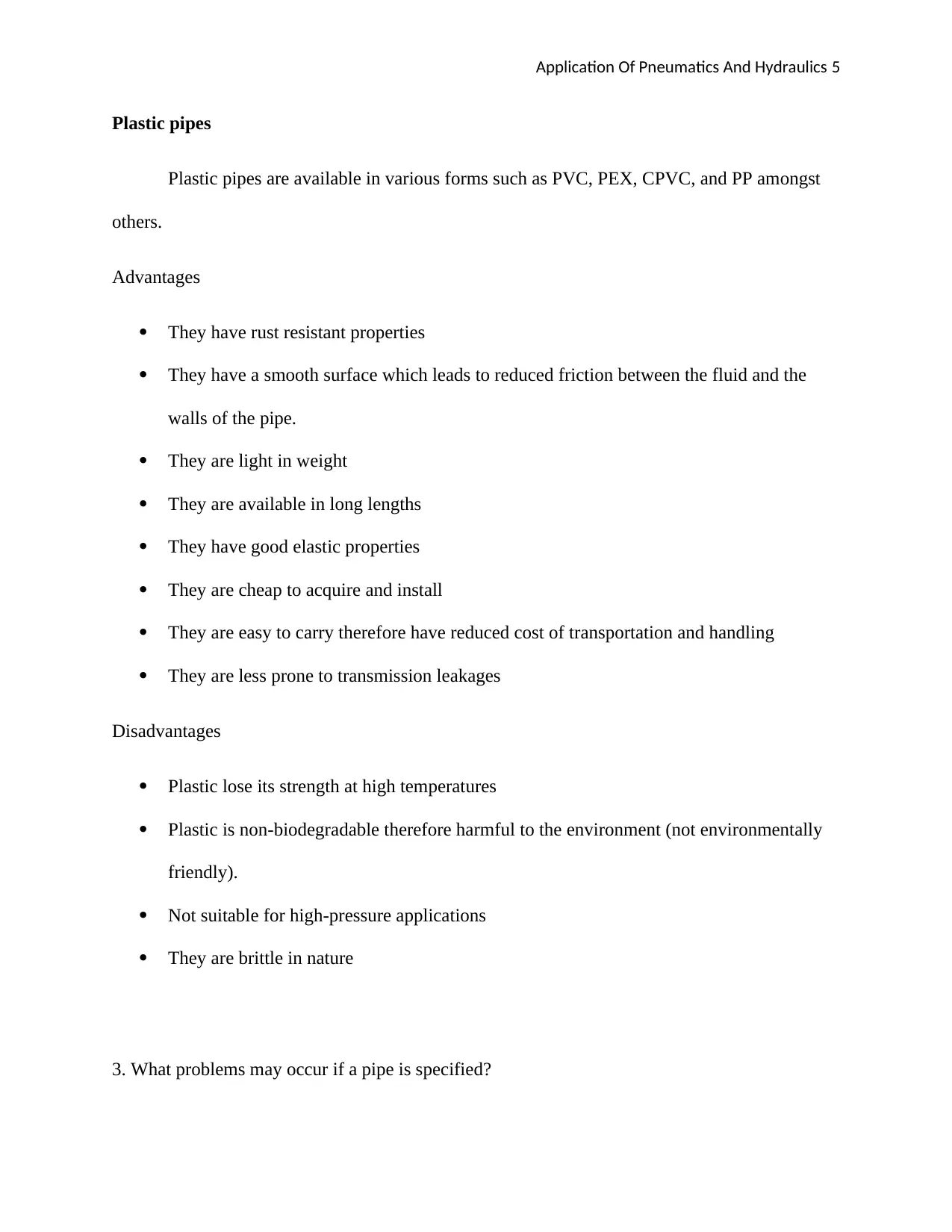
Plastic pipes
Plastic pipes are available in various forms such as PVC, PEX, CPVC, and PP amongst
others.
Advantages
They have rust resistant properties
They have a smooth surface which leads to reduced friction between the fluid and the
walls of the pipe.
They are light in weight
They are available in long lengths
They have good elastic properties
They are cheap to acquire and install
They are easy to carry therefore have reduced cost of transportation and handling
They are less prone to transmission leakages
Disadvantages
Plastic lose its strength at high temperatures
Plastic is non-biodegradable therefore harmful to the environment (not environmentally
friendly).
Not suitable for high-pressure applications
They are brittle in nature
3. What problems may occur if a pipe is specified?
Plastic pipes
Plastic pipes are available in various forms such as PVC, PEX, CPVC, and PP amongst
others.
Advantages
They have rust resistant properties
They have a smooth surface which leads to reduced friction between the fluid and the
walls of the pipe.
They are light in weight
They are available in long lengths
They have good elastic properties
They are cheap to acquire and install
They are easy to carry therefore have reduced cost of transportation and handling
They are less prone to transmission leakages
Disadvantages
Plastic lose its strength at high temperatures
Plastic is non-biodegradable therefore harmful to the environment (not environmentally
friendly).
Not suitable for high-pressure applications
They are brittle in nature
3. What problems may occur if a pipe is specified?
Application Of Pneumatics And Hydraulics 6
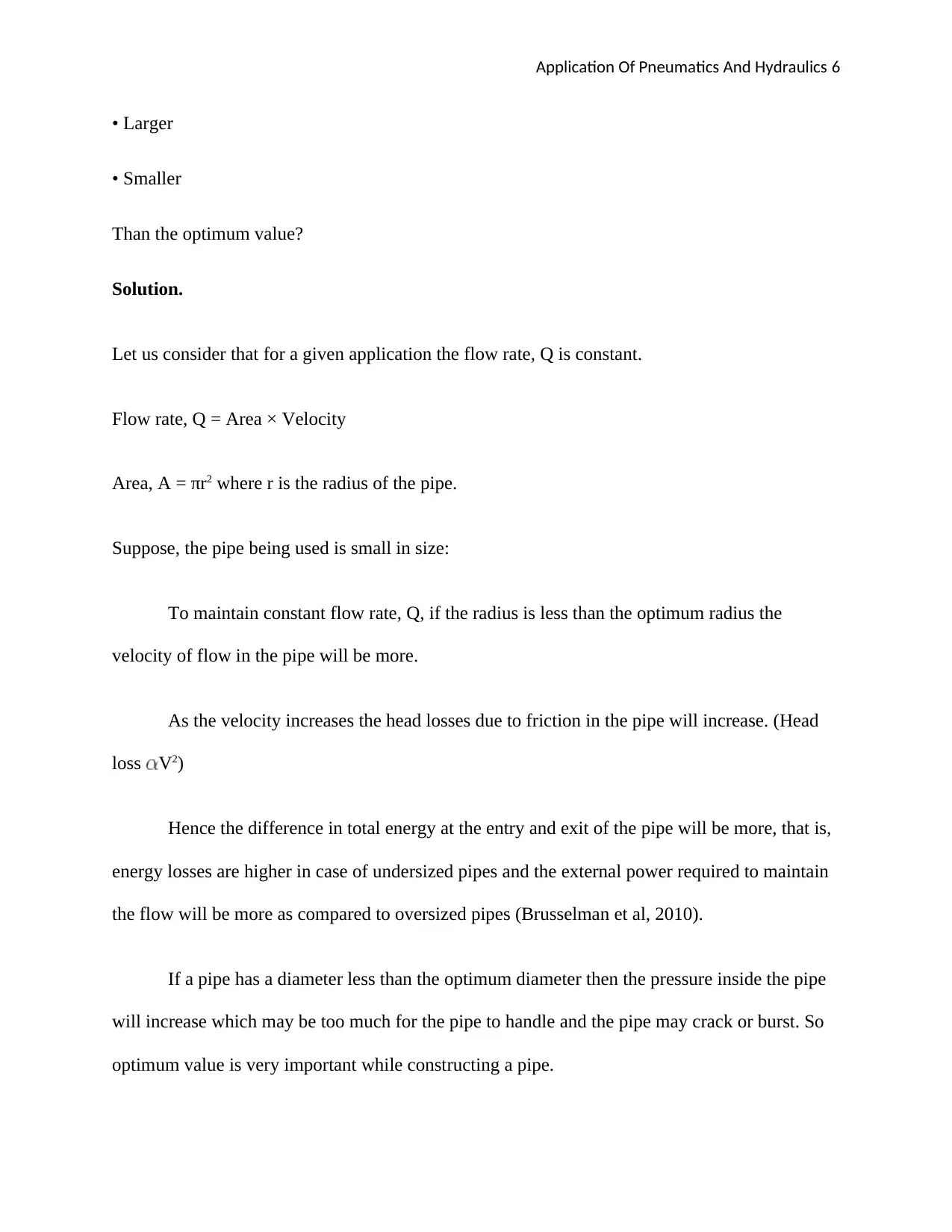
• Larger
• Smaller
Than the optimum value?
Solution.
Let us consider that for a given application the flow rate, Q is constant.
Flow rate, Q = Area × Velocity
Area, A = πr2 where r is the radius of the pipe.
Suppose, the pipe being used is small in size:
To maintain constant flow rate, Q, if the radius is less than the optimum radius the
velocity of flow in the pipe will be more.
As the velocity increases the head losses due to friction in the pipe will increase. (Head
loss V2)
Hence the difference in total energy at the entry and exit of the pipe will be more, that is,
energy losses are higher in case of undersized pipes and the external power required to maintain
the flow will be more as compared to oversized pipes (Brusselman et al, 2010).
If a pipe has a diameter less than the optimum diameter then the pressure inside the pipe
will increase which may be too much for the pipe to handle and the pipe may crack or burst. So
optimum value is very important while constructing a pipe.
• Larger
• Smaller
Than the optimum value?
Solution.
Let us consider that for a given application the flow rate, Q is constant.
Flow rate, Q = Area × Velocity
Area, A = πr2 where r is the radius of the pipe.
Suppose, the pipe being used is small in size:
To maintain constant flow rate, Q, if the radius is less than the optimum radius the
velocity of flow in the pipe will be more.
As the velocity increases the head losses due to friction in the pipe will increase. (Head
loss V2)
Hence the difference in total energy at the entry and exit of the pipe will be more, that is,
energy losses are higher in case of undersized pipes and the external power required to maintain
the flow will be more as compared to oversized pipes (Brusselman et al, 2010).
If a pipe has a diameter less than the optimum diameter then the pressure inside the pipe
will increase which may be too much for the pipe to handle and the pipe may crack or burst. So
optimum value is very important while constructing a pipe.
⊘ This is a preview!⊘
Do you want full access?
Subscribe today to unlock all pages.
Trusted by 1+ million students worldwide
Application Of Pneumatics And Hydraulics 7
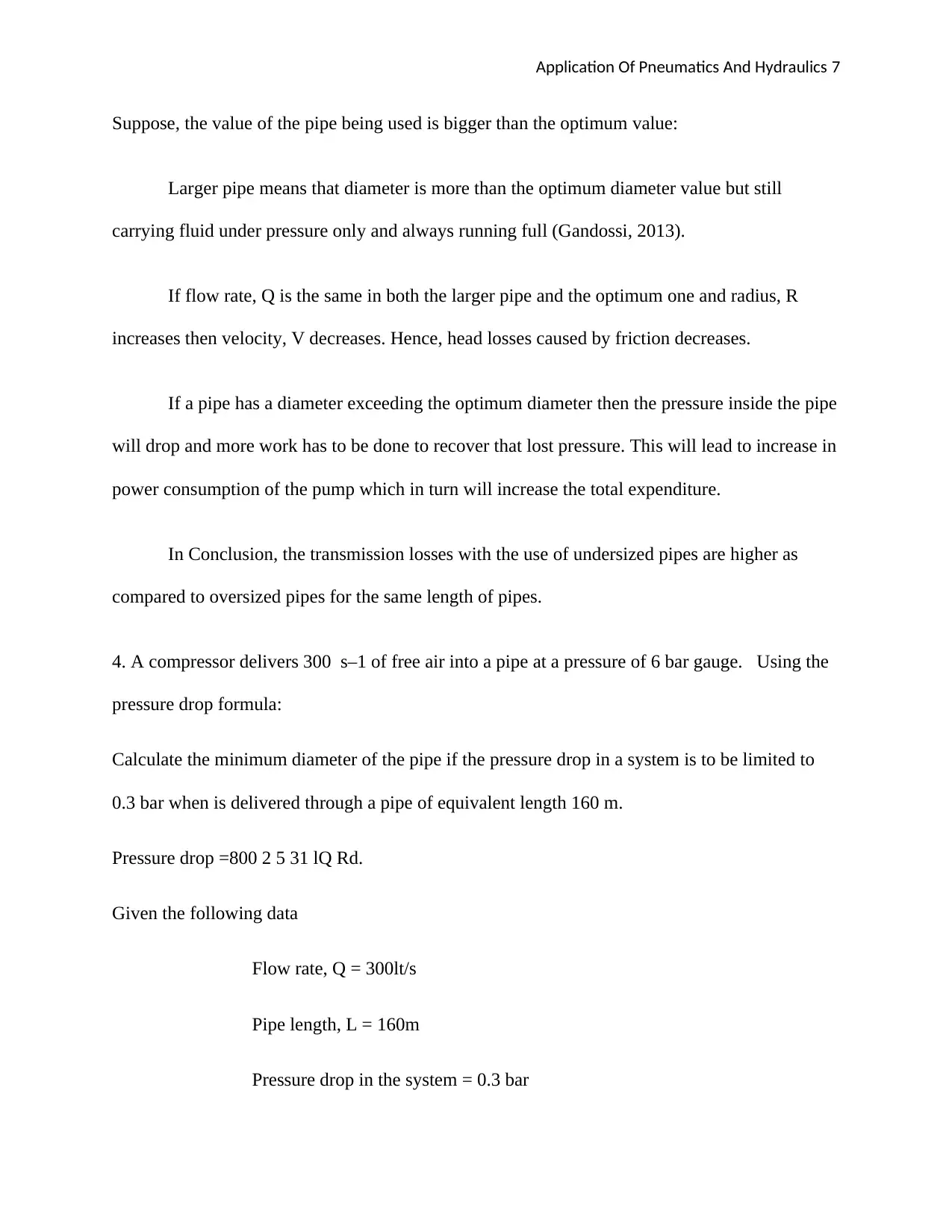
Suppose, the value of the pipe being used is bigger than the optimum value:
Larger pipe means that diameter is more than the optimum diameter value but still
carrying fluid under pressure only and always running full (Gandossi, 2013).
If flow rate, Q is the same in both the larger pipe and the optimum one and radius, R
increases then velocity, V decreases. Hence, head losses caused by friction decreases.
If a pipe has a diameter exceeding the optimum diameter then the pressure inside the pipe
will drop and more work has to be done to recover that lost pressure. This will lead to increase in
power consumption of the pump which in turn will increase the total expenditure.
In Conclusion, the transmission losses with the use of undersized pipes are higher as
compared to oversized pipes for the same length of pipes.
4. A compressor delivers 300 s–1 of free air into a pipe at a pressure of 6 bar gauge. Using the
pressure drop formula:
Calculate the minimum diameter of the pipe if the pressure drop in a system is to be limited to
0.3 bar when is delivered through a pipe of equivalent length 160 m.
Pressure drop =800 2 5 31 lQ Rd.
Given the following data
Flow rate, Q = 300lt/s
Pipe length, L = 160m
Pressure drop in the system = 0.3 bar
Suppose, the value of the pipe being used is bigger than the optimum value:
Larger pipe means that diameter is more than the optimum diameter value but still
carrying fluid under pressure only and always running full (Gandossi, 2013).
If flow rate, Q is the same in both the larger pipe and the optimum one and radius, R
increases then velocity, V decreases. Hence, head losses caused by friction decreases.
If a pipe has a diameter exceeding the optimum diameter then the pressure inside the pipe
will drop and more work has to be done to recover that lost pressure. This will lead to increase in
power consumption of the pump which in turn will increase the total expenditure.
In Conclusion, the transmission losses with the use of undersized pipes are higher as
compared to oversized pipes for the same length of pipes.
4. A compressor delivers 300 s–1 of free air into a pipe at a pressure of 6 bar gauge. Using the
pressure drop formula:
Calculate the minimum diameter of the pipe if the pressure drop in a system is to be limited to
0.3 bar when is delivered through a pipe of equivalent length 160 m.
Pressure drop =800 2 5 31 lQ Rd.
Given the following data
Flow rate, Q = 300lt/s
Pipe length, L = 160m
Pressure drop in the system = 0.3 bar
Paraphrase This Document
Need a fresh take? Get an instant paraphrase of this document with our AI Paraphraser
Application Of Pneumatics And Hydraulics 8
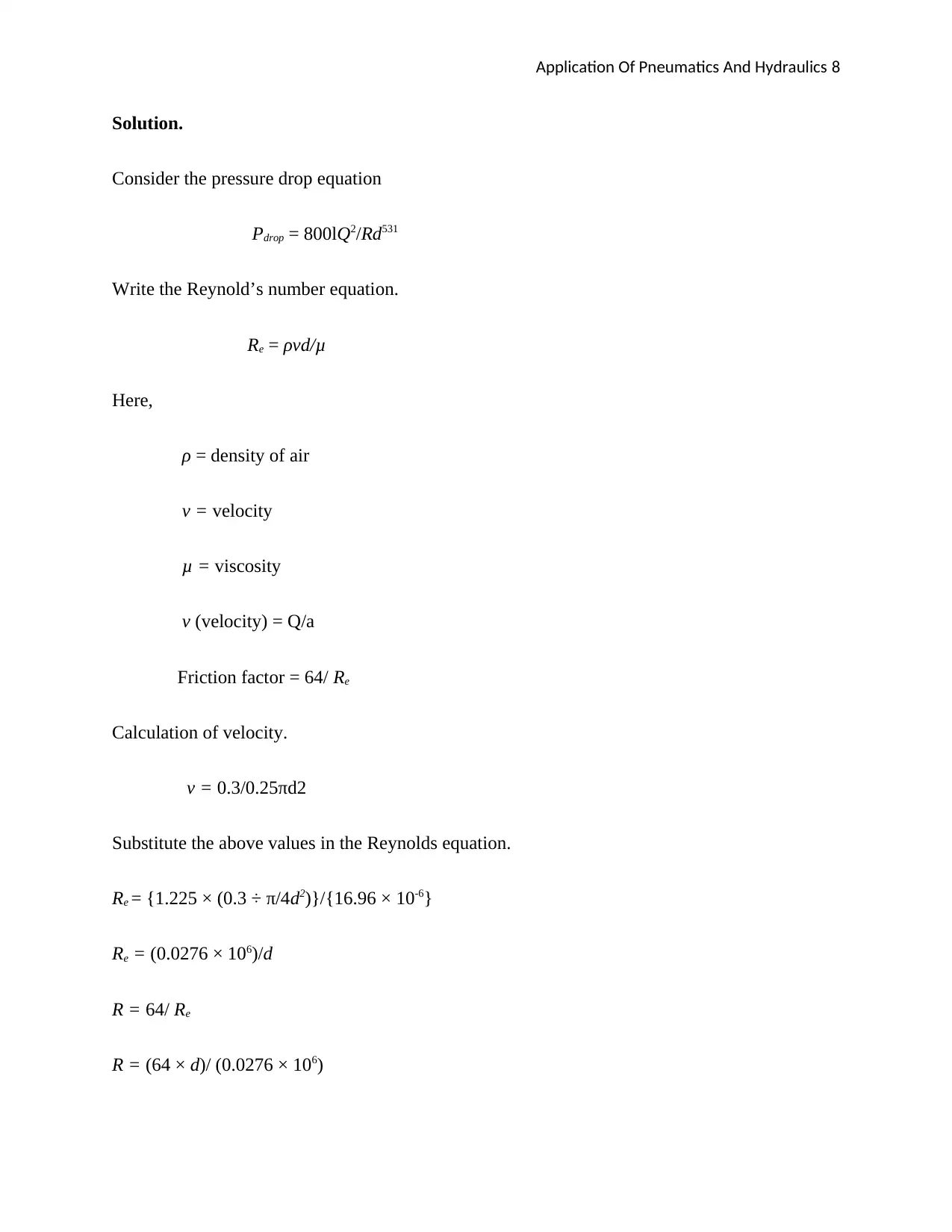
Solution.
Consider the pressure drop equation
Pdrop = 800lQ2/Rd531
Write the Reynold’s number equation.
Re = ρvd/μ
Here,
ρ = density of air
v = velocity
μ = viscosity
v (velocity) = Q/a
Friction factor = 64/ Re
Calculation of velocity.
v = 0.3/0.25πd2
Substitute the above values in the Reynolds equation.
Re = {1.225 × (0.3 ÷ π/4d2)}/{16.96 × 10-6}
Re = (0.0276 × 10⁶)/d
R = 64/ Re
R = (64 × d)/ (0.0276 × 10⁶)
Solution.
Consider the pressure drop equation
Pdrop = 800lQ2/Rd531
Write the Reynold’s number equation.
Re = ρvd/μ
Here,
ρ = density of air
v = velocity
μ = viscosity
v (velocity) = Q/a
Friction factor = 64/ Re
Calculation of velocity.
v = 0.3/0.25πd2
Substitute the above values in the Reynolds equation.
Re = {1.225 × (0.3 ÷ π/4d2)}/{16.96 × 10-6}
Re = (0.0276 × 10⁶)/d
R = 64/ Re
R = (64 × d)/ (0.0276 × 10⁶)
Application Of Pneumatics And Hydraulics 9
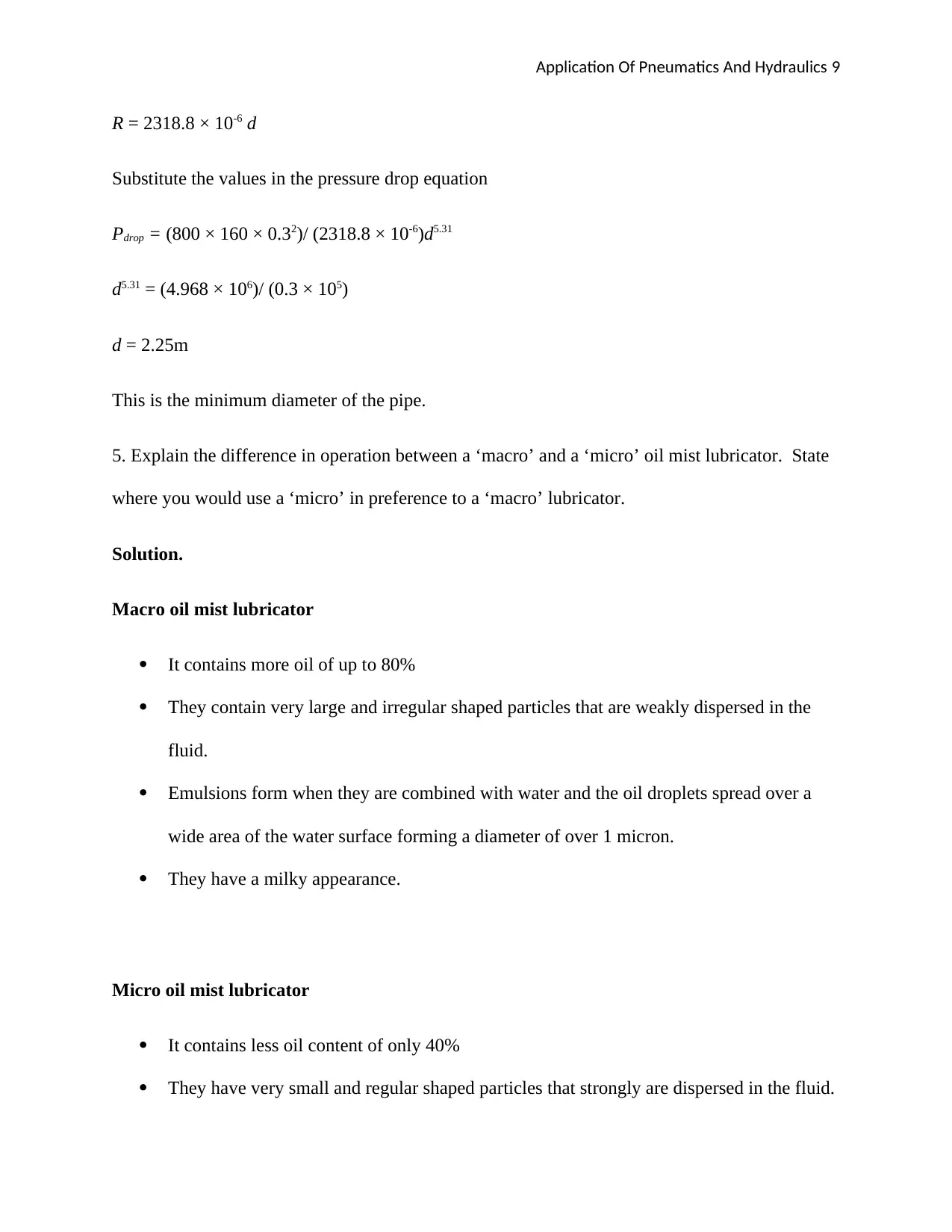
R = 2318.8 × 10-6 d
Substitute the values in the pressure drop equation
Pdrop = (800 × 160 × 0.32)/ (2318.8 × 10-6)d5.31
d5.31 = (4.968 × 10⁶)/ (0.3 × 10⁵)
d = 2.25m
This is the minimum diameter of the pipe.
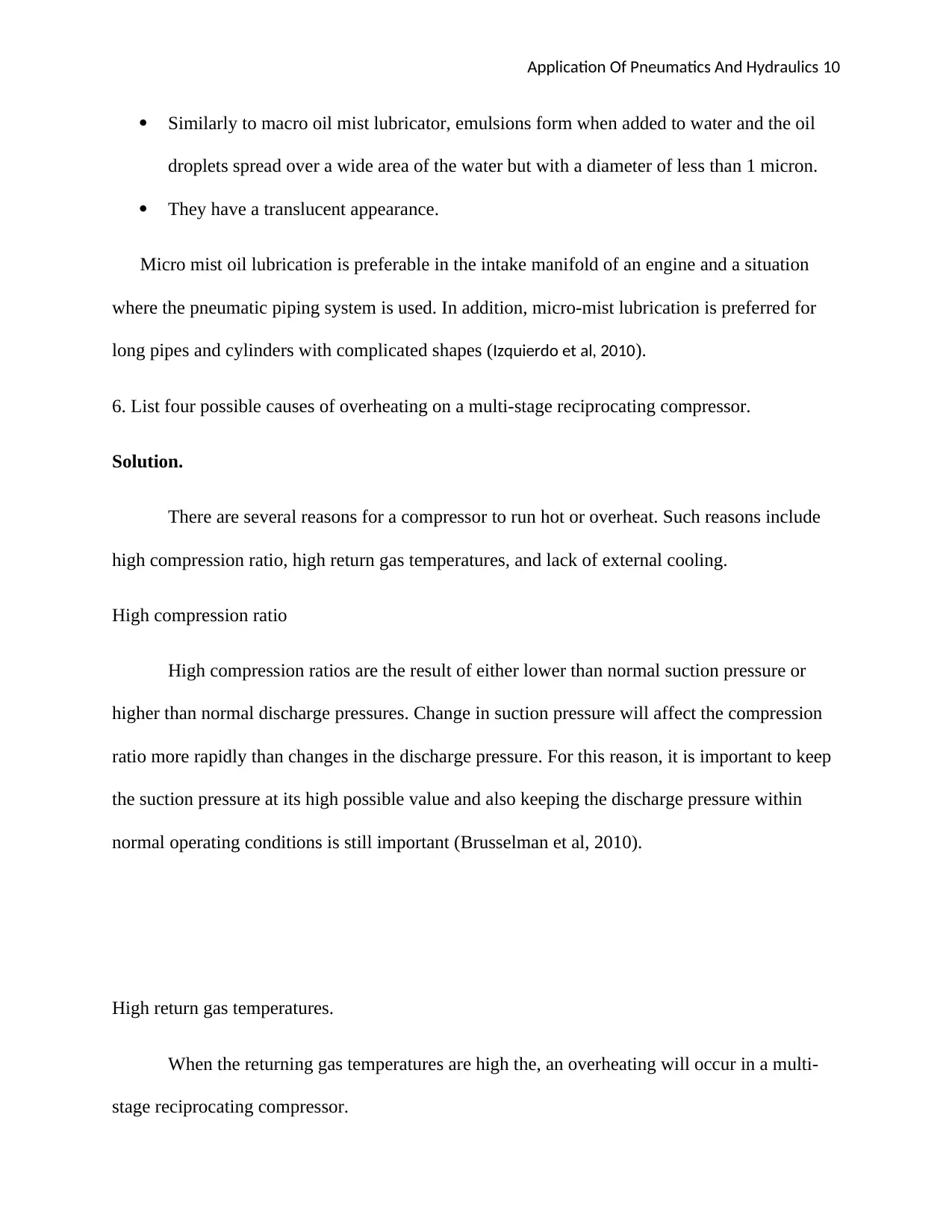
5. Explain the difference in operation between a ‘macro’ and a ‘micro’ oil mist lubricator. State
where you would use a ‘micro’ in preference to a ‘macro’ lubricator.
Solution.
Macro oil mist lubricator
It contains more oil of up to 80%
They contain very large and irregular shaped particles that are weakly dispersed in the
fluid.
Emulsions form when they are combined with water and the oil droplets spread over a
wide area of the water surface forming a diameter of over 1 micron.
They have a milky appearance.
Micro oil mist lubricator
It contains less oil content of only 40%
They have very small and regular shaped particles that strongly are dispersed in the fluid.
R = 2318.8 × 10-6 d
Substitute the values in the pressure drop equation
Pdrop = (800 × 160 × 0.32)/ (2318.8 × 10-6)d5.31
d5.31 = (4.968 × 10⁶)/ (0.3 × 10⁵)
d = 2.25m
This is the minimum diameter of the pipe.
5. Explain the difference in operation between a ‘macro’ and a ‘micro’ oil mist lubricator. State
where you would use a ‘micro’ in preference to a ‘macro’ lubricator.
Solution.
Macro oil mist lubricator
It contains more oil of up to 80%
They contain very large and irregular shaped particles that are weakly dispersed in the
fluid.
Emulsions form when they are combined with water and the oil droplets spread over a
wide area of the water surface forming a diameter of over 1 micron.
They have a milky appearance.
Micro oil mist lubricator
It contains less oil content of only 40%
They have very small and regular shaped particles that strongly are dispersed in the fluid.
⊘ This is a preview!⊘
Do you want full access?
Subscribe today to unlock all pages.
Trusted by 1+ million students worldwide
Application Of Pneumatics And Hydraulics 10
Similarly to macro oil mist lubricator, emulsions form when added to water and the oil
droplets spread over a wide area of the water but with a diameter of less than 1 micron.
They have a translucent appearance.
Micro mist oil lubrication is preferable in the intake manifold of an engine and a situation
where the pneumatic piping system is used. In addition, micro-mist lubrication is preferred for
long pipes and cylinders with complicated shapes (Izquierdo et al, 2010).
6. List four possible causes of overheating on a multi-stage reciprocating compressor.
Solution.
There are several reasons for a compressor to run hot or overheat. Such reasons include
high compression ratio, high return gas temperatures, and lack of external cooling.
High compression ratio
High compression ratios are the result of either lower than normal suction pressure or
higher than normal discharge pressures. Change in suction pressure will affect the compression
ratio more rapidly than changes in the discharge pressure. For this reason, it is important to keep
the suction pressure at its high possible value and also keeping the discharge pressure within
normal operating conditions is still important (Brusselman et al, 2010).
High return gas temperatures.
When the returning gas temperatures are high the, an overheating will occur in a multi-
stage reciprocating compressor.
Similarly to macro oil mist lubricator, emulsions form when added to water and the oil
droplets spread over a wide area of the water but with a diameter of less than 1 micron.
They have a translucent appearance.
Micro mist oil lubrication is preferable in the intake manifold of an engine and a situation
where the pneumatic piping system is used. In addition, micro-mist lubrication is preferred for
long pipes and cylinders with complicated shapes (Izquierdo et al, 2010).
6. List four possible causes of overheating on a multi-stage reciprocating compressor.
Solution.
There are several reasons for a compressor to run hot or overheat. Such reasons include
high compression ratio, high return gas temperatures, and lack of external cooling.
High compression ratio
High compression ratios are the result of either lower than normal suction pressure or
higher than normal discharge pressures. Change in suction pressure will affect the compression
ratio more rapidly than changes in the discharge pressure. For this reason, it is important to keep
the suction pressure at its high possible value and also keeping the discharge pressure within
normal operating conditions is still important (Brusselman et al, 2010).
High return gas temperatures.
When the returning gas temperatures are high the, an overheating will occur in a multi-
stage reciprocating compressor.
Paraphrase This Document
Need a fresh take? Get an instant paraphrase of this document with our AI Paraphraser
Application Of Pneumatics And Hydraulics 11
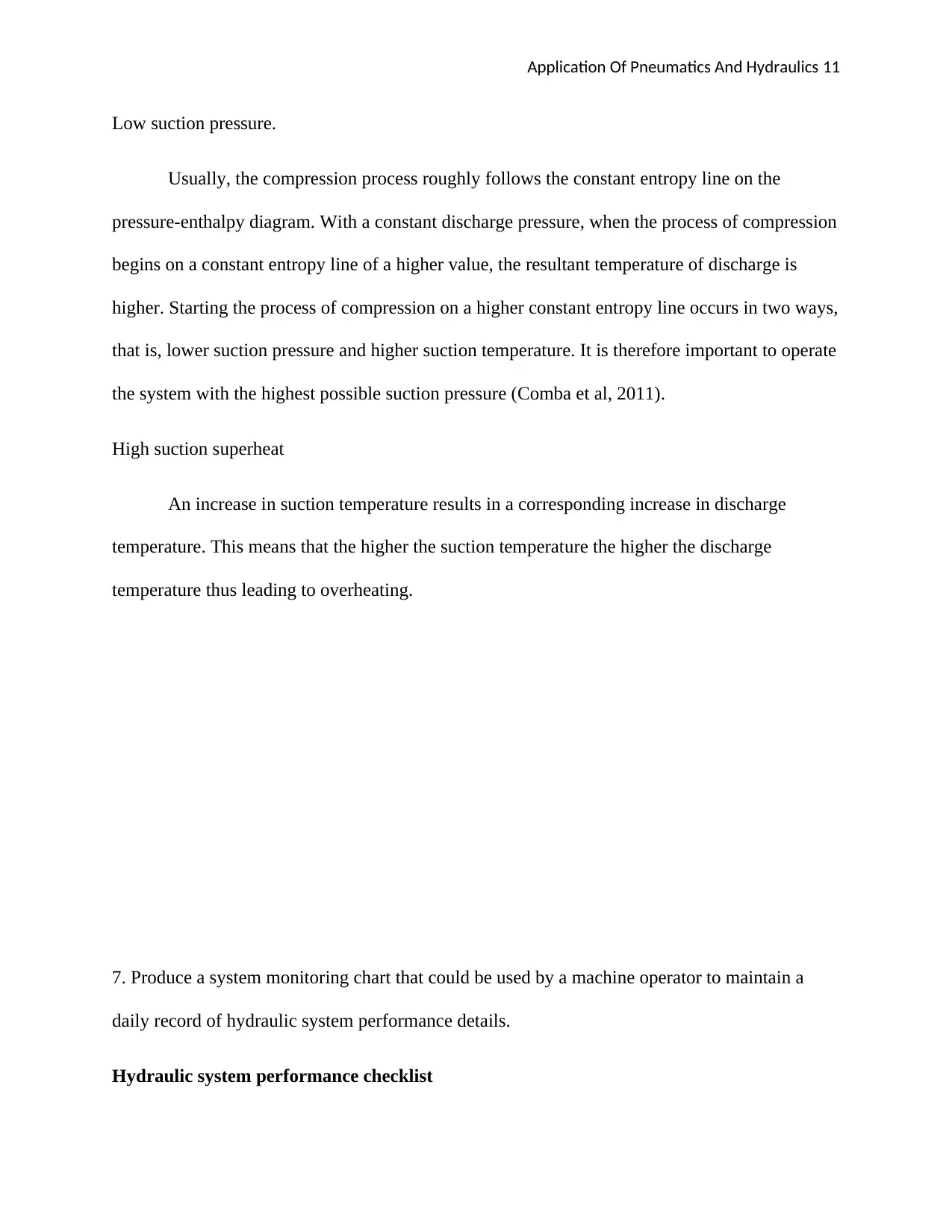
Low suction pressure.
Usually, the compression process roughly follows the constant entropy line on the
pressure-enthalpy diagram. With a constant discharge pressure, when the process of compression
begins on a constant entropy line of a higher value, the resultant temperature of discharge is
higher. Starting the process of compression on a higher constant entropy line occurs in two ways,
that is, lower suction pressure and higher suction temperature. It is therefore important to operate
the system with the highest possible suction pressure (Comba et al, 2011).
High suction superheat
An increase in suction temperature results in a corresponding increase in discharge
temperature. This means that the higher the suction temperature the higher the discharge
temperature thus leading to overheating.
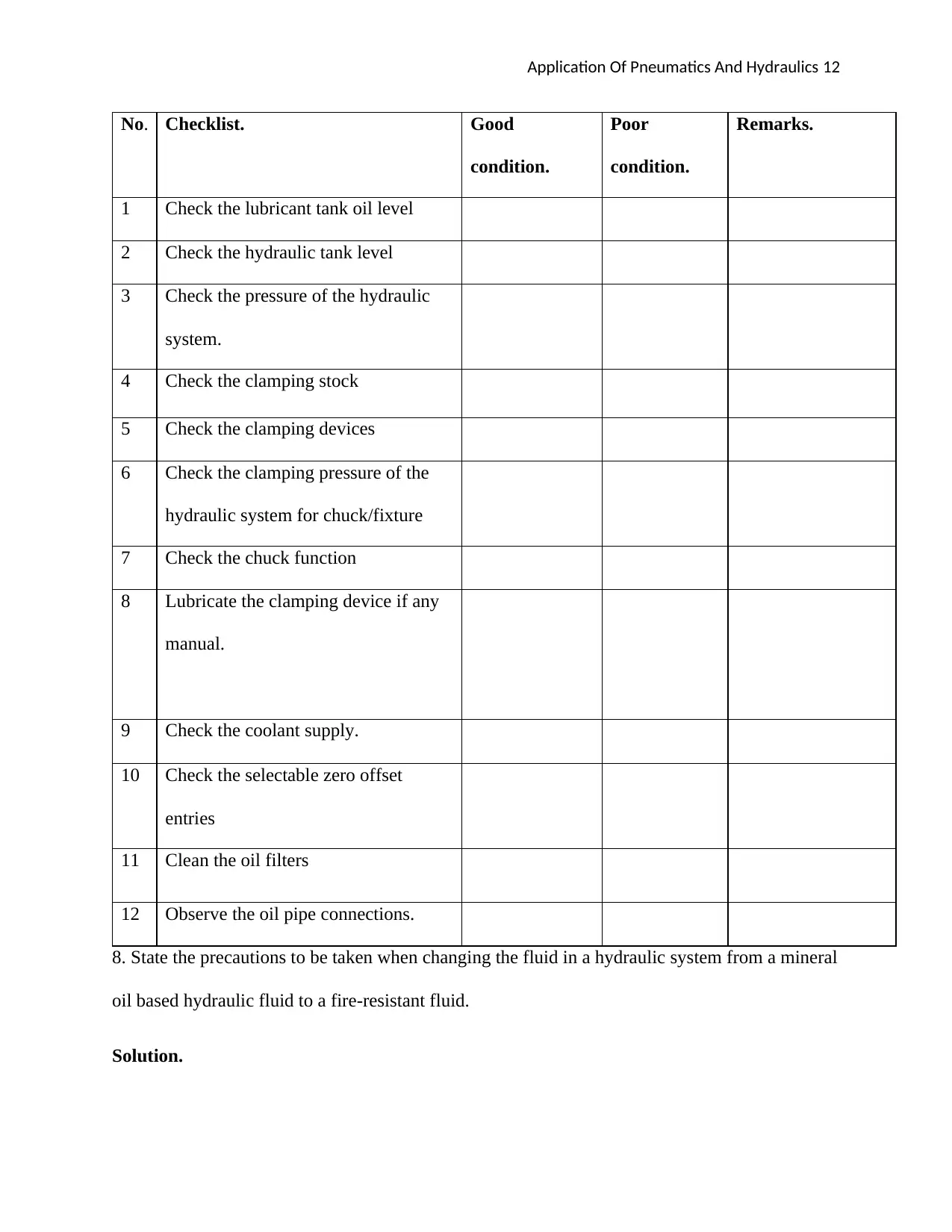
7. Produce a system monitoring chart that could be used by a machine operator to maintain a
daily record of hydraulic system performance details.
Hydraulic system performance checklist
Low suction pressure.
Usually, the compression process roughly follows the constant entropy line on the
pressure-enthalpy diagram. With a constant discharge pressure, when the process of compression
begins on a constant entropy line of a higher value, the resultant temperature of discharge is
higher. Starting the process of compression on a higher constant entropy line occurs in two ways,
that is, lower suction pressure and higher suction temperature. It is therefore important to operate
the system with the highest possible suction pressure (Comba et al, 2011).
High suction superheat
An increase in suction temperature results in a corresponding increase in discharge
temperature. This means that the higher the suction temperature the higher the discharge
temperature thus leading to overheating.
7. Produce a system monitoring chart that could be used by a machine operator to maintain a
daily record of hydraulic system performance details.
Hydraulic system performance checklist
Application Of Pneumatics And Hydraulics 12
No. Checklist. Good
condition.
Poor
condition.
Remarks.
1 Check the lubricant tank oil level
2 Check the hydraulic tank level
3 Check the pressure of the hydraulic
system.
4 Check the clamping stock
5 Check the clamping devices
6 Check the clamping pressure of the
hydraulic system for chuck/fixture
7 Check the chuck function
8 Lubricate the clamping device if any
manual.
9 Check the coolant supply.
10 Check the selectable zero offset
entries
11 Clean the oil filters
12 Observe the oil pipe connections.
8. State the precautions to be taken when changing the fluid in a hydraulic system from a mineral
oil based hydraulic fluid to a fire-resistant fluid.
Solution.
No. Checklist. Good
condition.
Poor
condition.
Remarks.
1 Check the lubricant tank oil level
2 Check the hydraulic tank level
3 Check the pressure of the hydraulic
system.
4 Check the clamping stock
5 Check the clamping devices
6 Check the clamping pressure of the
hydraulic system for chuck/fixture
7 Check the chuck function
8 Lubricate the clamping device if any
manual.
9 Check the coolant supply.
10 Check the selectable zero offset
entries
11 Clean the oil filters
12 Observe the oil pipe connections.
8. State the precautions to be taken when changing the fluid in a hydraulic system from a mineral
oil based hydraulic fluid to a fire-resistant fluid.
Solution.
⊘ This is a preview!⊘
Do you want full access?
Subscribe today to unlock all pages.
Trusted by 1+ million students worldwide

1 out of 16


Your All-in-One AI-Powered Toolkit for Academic Success.
+13062052269
info@desklib.com
Available 24*7 on WhatsApp / Email
![[object Object]](/_next/static/media/star-bottom.7253800d.svg)
Unlock your academic potential
Copyright © 2020–2026 A2Z Services. All Rights Reserved. Developed and managed by ZUCOL.