Teesside University: Pneumatics and Hydraulics Equipment Assignment

Verified

Added on  2022/11/16

|33
|5154
|89
Homework Assignment
AI Summary
This document provides a comprehensive solution to a pneumatics and hydraulics assignment. The assignment covers a range of topics including pipe flow calculations, comparing the advantages and disadvantages of steel, copper, and plastic pipes, and the impact of pipe diameter on pressure. The document also explores macro and micro-oil mist lubricators, causes of overheating in multi-stage reciprocating compressors, and the components of a hydraulic system monitoring chart. Furthermore, the assignment discusses procedures for changing fluids, and provides detailed solutions for fluid power diagrams, including the identification of symbols, the function of components, and the operation of pneumatic circuits. The solutions incorporate relevant diagrams and explanations to aid understanding.
Document Page
Pneumatics and Hydraulics 1
PNEUMATICS AND HYDRAULICS
By Name
Course
Instructor
Institution
Location
Date
tabler-icon-diamond-filled.svg

Paraphrase This Document

Need a fresh take? Get an instant paraphrase of this document with our AI Paraphraser
Document Page
Pneumatics and Hydraulics 2
TOPIC TITLE: SPECIFICATION, SELECTION AND MAINTENANCE OF
EQUIPMENT
TASK 1
Solution
Pipe flow Q= 6m3/ min
=6 × 100/60
Q= 100dm3/ s
Let the ID of the pipe be dmm
We assume a velocity of 15m/s in pipe initially
Air density at 6 bar = 1.225 x6 =7.36 kg/m3
Initial area A= Q/ 60/ 15 =0.006667 m2
Initial d = (4 × A /π)0.5 = 0.092 m ≈ 100 mm
Total equivalent length LT =Lpipe+ Lbends + Ltee + Lelbow + Ldiaphragm
LT = 175 + 4 × 0.8 +2 × 7 + 6 × 10 + 2 × 6
LT = 264.2 m
From the monogram (refer to image) we get 2.2 mbar/m pressure drops,
Hence the total pressure drop is 2.2 × 10-3 ×264.2 = o.58 bar > 0.3 bar
Hence we need to go for 150 mm diameter pipe which is beyond the monogram.
Document Page
Pneumatics and Hydraulics 3
TASK 2
Steel pipes
Advantages
They have high abrasion resistance
Are more durable and have got a practical indestructible nature that enables an extended
life span (Akers, Gassman & Smith, 2016)
Document Page
Pneumatics and Hydraulics 4
Has reduced vibration and noise between the fittings
It is cheaper and easier to install as compared to other materials
Disadvantages
Not preferred for use in places that cannot be accessed
Have a general higher weight hence often need specific modes of transport
As a result of their heavy weight, they often come in shorter lengths that leds to
increased joints (Bihlmaier & Bihlmaier, 2012)
Copper pipes
Advantages
Their installation is generally easy
Have got a higher flexibility as compared to other materials
Are highly resistant to natural disasters
Have got a higher resale value as compared to other materials (Bogdevičius et al, 2014)
Have got properties of fore resistance
Disadvantages
They lack the ability to handle extreme temperatures. The pipes crack when exposed to
high heat and burst when subjected to a lot of cold.
Plastic pipes
Advantages
Have got properties that make them resistant to rust
Generally have a lighter weight
tabler-icon-diamond-filled.svg

Paraphrase This Document

Need a fresh take? Get an instant paraphrase of this document with our AI Paraphraser
Document Page
Pneumatics and Hydraulics 5
They exist in longer lengths
Have got better elastic characteristics (Brown, 2011)
Provide reduced handling and transportation costs given that they are easy to carry
Have got a generally smooth surface resulting to reduced friction between the pipe walls
and the fluid
Disadvantages
The material tends to lose its strength when subjected to greater temperatures
It presents a greater challenge to the environment given that it does not decompose
(Butler et al, 2012).
TASK 3
Whenever a pipe has a diameter that surpasses the optimum diameter, the pressure within the
pipe will fall thus requiring a lot of work in order to recover the pressure that is lost. This will
result to a rise in the power that is consumed by the pump that further leads to higher total
expenditure (Drescher & Brüggemann, 2017).
Whenever a pipe has a diameter that is lower than the optimum diameter, the pressure within the
pipe will rise. The rise in pressure will most become a challenge to the pipe making it to burst or
crack. These behaviors therefore confirm that the optimum value is a vital feature that has to be
considered during the construction of a pipe (de Goes et al, 2015).
TASK 4
Solution
Given Q = 300 H/sec
Document Page
Pneumatics and Hydraulics 6
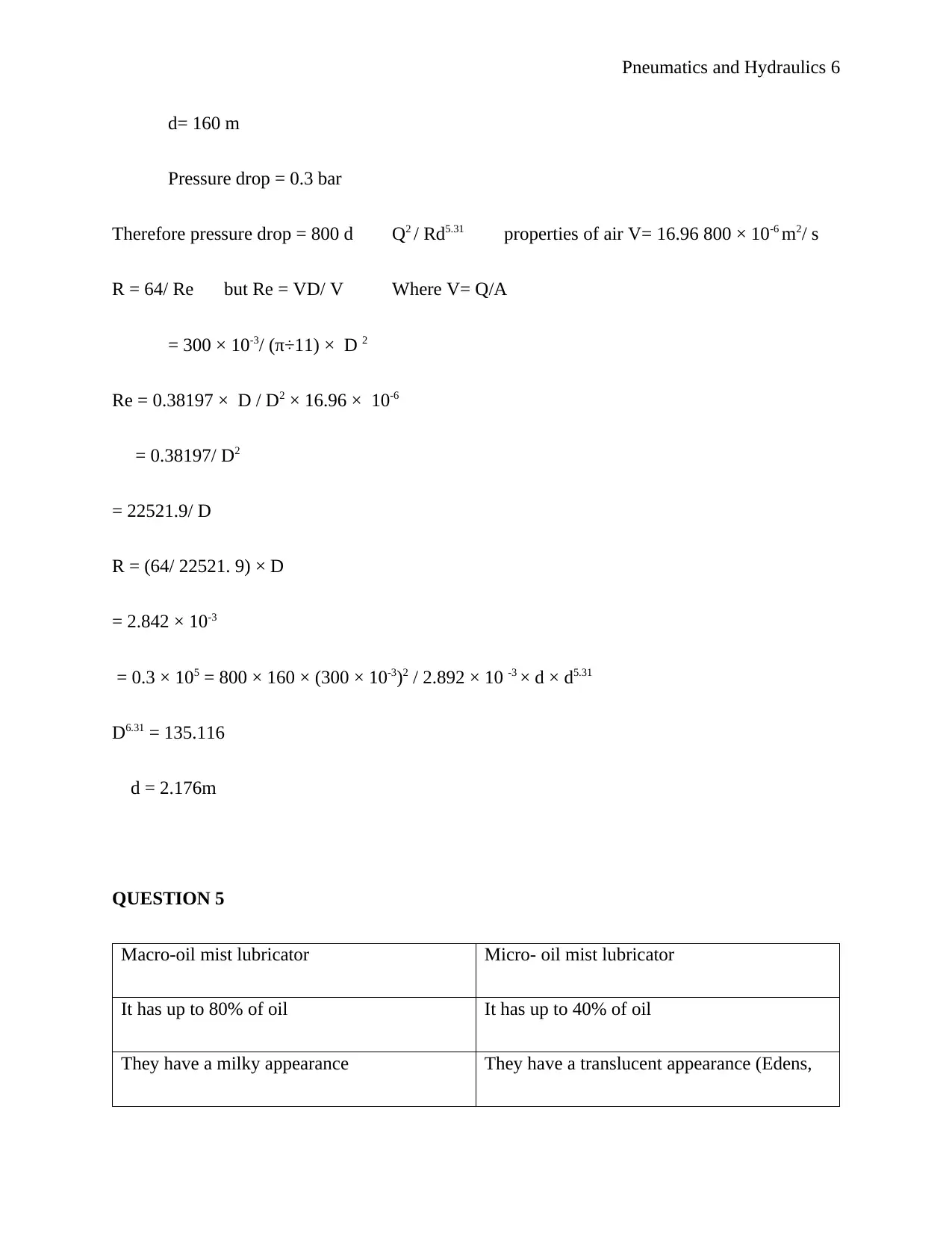
d= 160 m
Pressure drop = 0.3 bar
Therefore pressure drop = 800 d Q2 / Rd5.31 properties of air V= 16.96 800 × 10-6 m2/ s
R = 64/ Re but Re = VD/ V Where V= Q/A
= 300 × 10-3/ (π÷11) × D 2
Re = 0.38197 × D / D2 × 16.96 × 10-6
= 0.38197/ D2
= 22521.9/ D
R = (64/ 22521. 9) × D
= 2.842 × 10-3
= 0.3 × 105 = 800 × 160 × (300 × 10-3)2 / 2.892 × 10 -3 × d × d5.31
D6.31 = 135.116
d = 2.176m
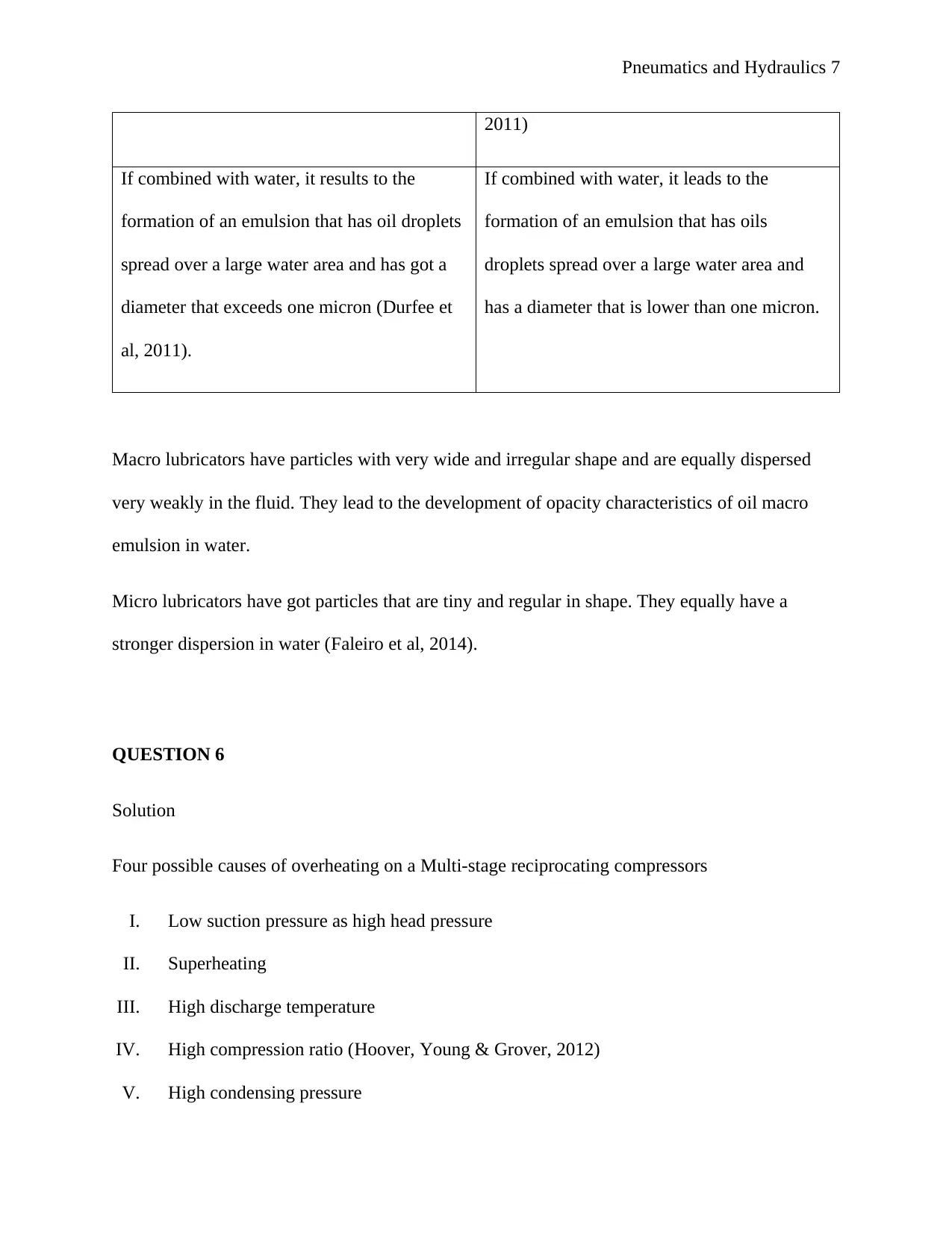
QUESTION 5
Macro-oil mist lubricator Micro- oil mist lubricator
It has up to 80% of oil It has up to 40% of oil
They have a milky appearance They have a translucent appearance (Edens,
Document Page
Pneumatics and Hydraulics 7
2011)
If combined with water, it results to the
formation of an emulsion that has oil droplets
spread over a large water area and has got a
diameter that exceeds one micron (Durfee et
al, 2011).
If combined with water, it leads to the
formation of an emulsion that has oils
droplets spread over a large water area and
has a diameter that is lower than one micron.
Macro lubricators have particles with very wide and irregular shape and are equally dispersed
very weakly in the fluid. They lead to the development of opacity characteristics of oil macro
emulsion in water.
Micro lubricators have got particles that are tiny and regular in shape. They equally have a
stronger dispersion in water (Faleiro et al, 2014).
QUESTION 6
Solution
Four possible causes of overheating on a Multi-stage reciprocating compressors
I. Low suction pressure as high head pressure
II. Superheating
III. High discharge temperature
IV. High compression ratio (Hoover, Young & Grover, 2012)
V. High condensing pressure
tabler-icon-diamond-filled.svg

Paraphrase This Document

Need a fresh take? Get an instant paraphrase of this document with our AI Paraphraser
Document Page
Pneumatics and Hydraulics 8
QUESTION 7
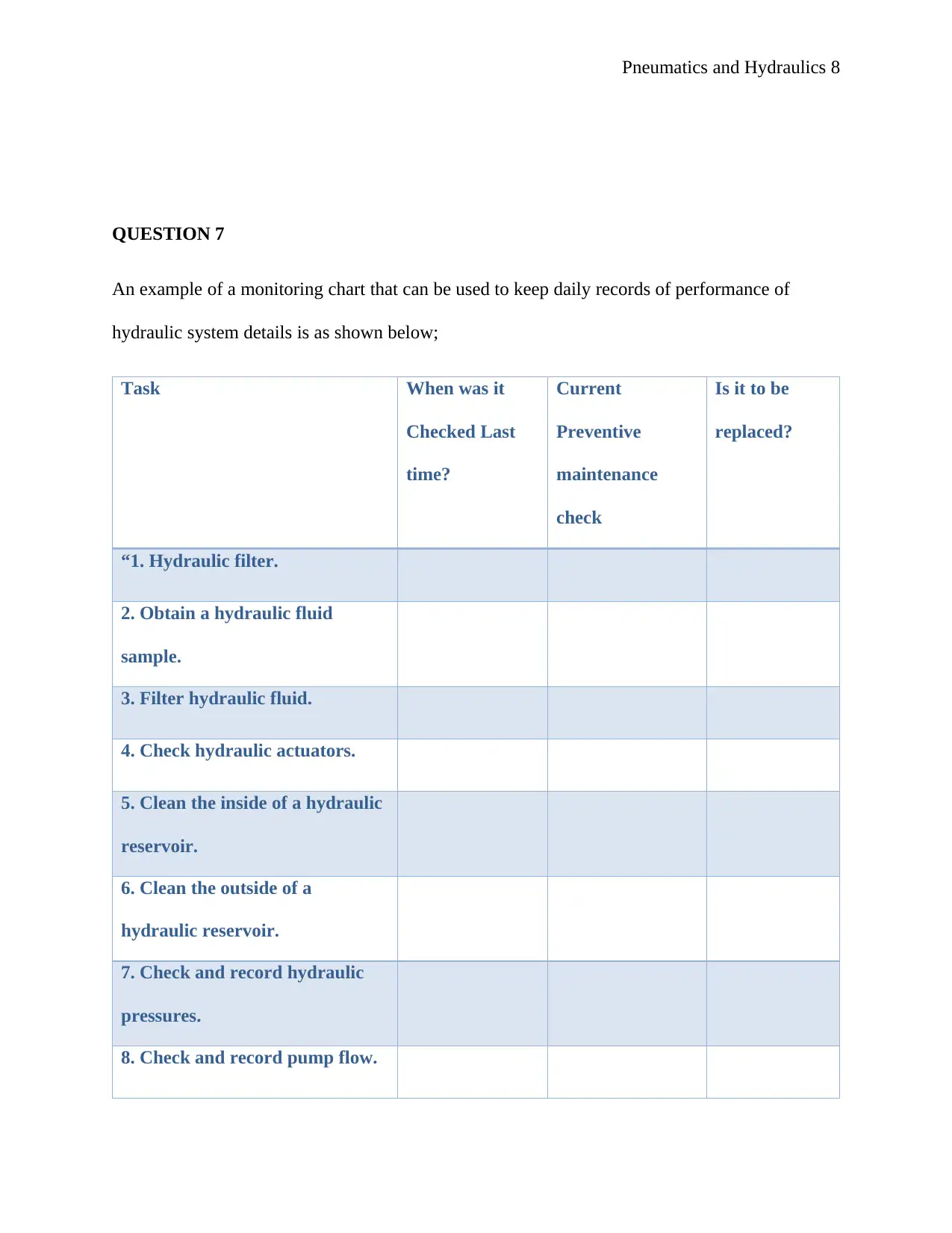
An example of a monitoring chart that can be used to keep daily records of performance of
hydraulic system details is as shown below;
Task When was it
Checked Last
time?
Current
Preventive
maintenance
check
Is it to be
replaced?
“1. Hydraulic filter.
2. Obtain a hydraulic fluid
sample.
3. Filter hydraulic fluid.
4. Check hydraulic actuators.
5. Clean the inside of a hydraulic
reservoir.
6. Clean the outside of a
hydraulic reservoir.
7. Check and record hydraulic
pressures.
8. Check and record pump flow.
Document Page
Pneumatics and Hydraulics 9
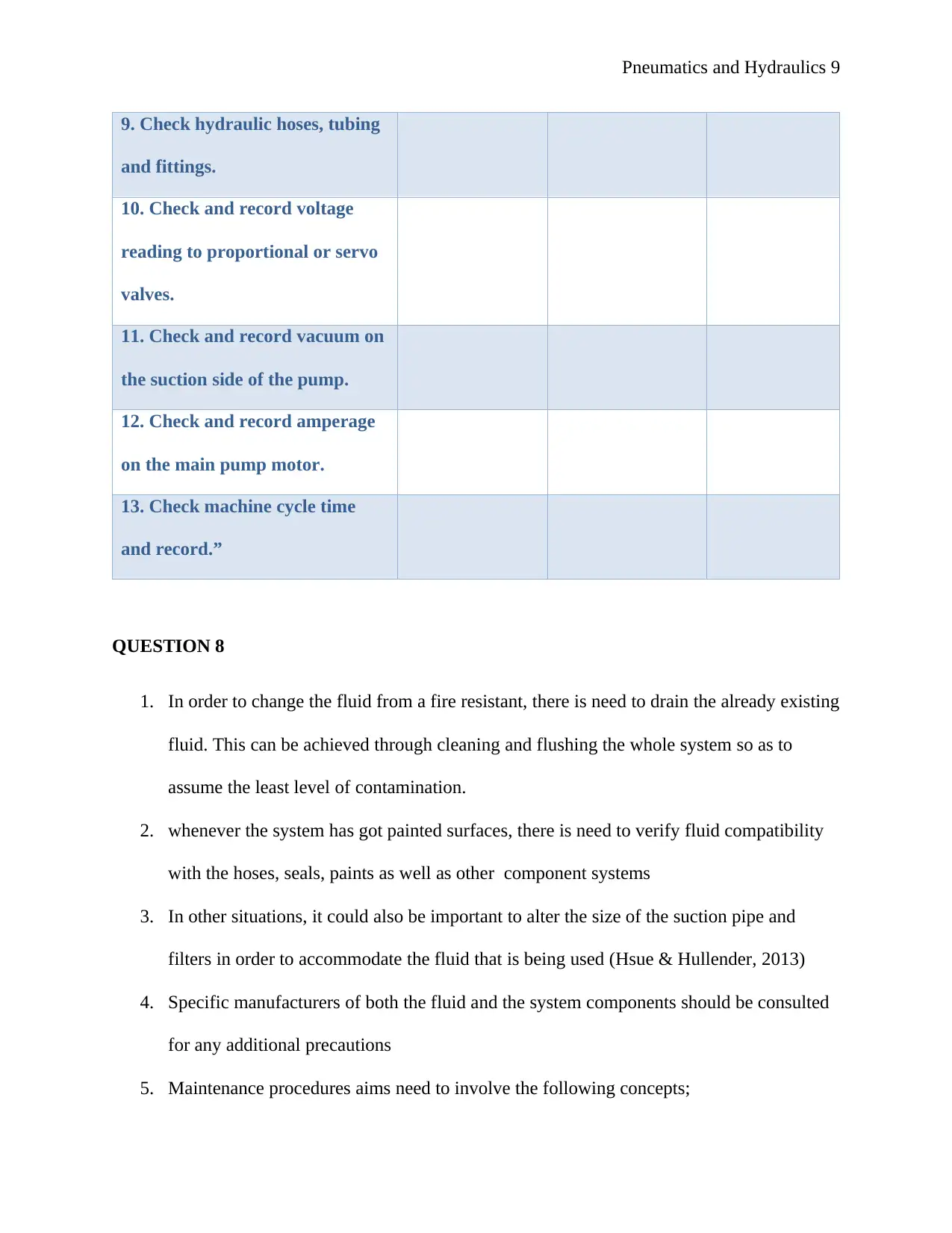
9. Check hydraulic hoses, tubing
and fittings.
10. Check and record voltage
reading to proportional or servo
valves.
11. Check and record vacuum on
the suction side of the pump.
12. Check and record amperage
on the main pump motor.
13. Check machine cycle time
and record.”
QUESTION 8
1. In order to change the fluid from a fire resistant, there is need to drain the already existing
fluid. This can be achieved through cleaning and flushing the whole system so as to
assume the least level of contamination.
2. whenever the system has got painted surfaces, there is need to verify fluid compatibility
with the hoses, seals, paints as well as other component systems
3. In other situations, it could also be important to alter the size of the suction pipe and
filters in order to accommodate the fluid that is being used (Hsue & Hullender, 2013)
4. Specific manufacturers of both the fluid and the system components should be consulted
for any additional precautions
5. Maintenance procedures aims need to involve the following concepts;
Document Page
Pneumatics and Hydraulics 10
“Keeping fluid clean/ controlling contamination
Maintaining proper temperatures
Maintaining proper oil levels
Routine inspections on the noise levels, vibration, shock loads, pressures, foaming
and temperatures” (Hung, 2014).
TOPIC TITLE: FLUID POWER DIAGRAMS
QUESTION 1
Name of the symbols used
a.
b. Main air supply
c. Output connection symbol
d. The exhaust
e. 3/2 valve is; the 3.2 valve comprises of 3 valves and 2 states
Off or un-actuated state symbol
tabler-icon-diamond-filled.svg

Paraphrase This Document

Need a fresh take? Get an instant paraphrase of this document with our AI Paraphraser
Document Page
Pneumatics and Hydraulics 11
On or actuated state symbol
f. The two way flow control symbol
g. Unidirectional flow control
h. Roller symbol
b.
In air symbol and exhaust system can consist of 3 parts. The parts each DCV are;
Part 1 is the main air supply
Part 2 is the output connection
Document Page
Pneumatics and Hydraulics 12
Part 3 is the exhaust system
c.
The components classifications in the circuit are;
The section 1 and 2 are the unidirectional flow control contains restrictor and non-return
valve. Check valve.
The section 3 and 4 are the 3/2 valve. It shows the two stage of operations with single
cylinder, exhaust system and roller
The section 5 is the 5/2 valve. T shows the two stages of operating with fire ports. The
double acting cylinders can be controlled by a sport valve (Krambrock et al, 2017).
d.
The system has a cyclical move whenever it is activated.
Valve 3 and 4 positions would be used to find out the position of valve 5 that finally
could also provide the movement direction of the piston.
The input signal can be determined by the system output
Valve 3 does open whenever the piston becomes completely retracted (Krivts & Krejnin,
2016)
The retraction enables airflow as well as operation of valve 5 which further leads to the
reversal of the piston direction
After attaining the maximum outstroke, there will be an activation of valve 4 which
further results to the reset of valve 5 to its initial position. The piston will also retract.
2 variable restrictors are used to control the speed of the piston. The restrictors are placed
on the cylinder exhaust ports (Linjama, 2011).
chevron_up_icon
1 out of 33
circle_padding
hide_on_mobile
zoom_out_icon
[object Object]