Applied Mathematics - Profit, Cost, and Optimization Analysis Homework

Verified

Added on  2022/08/17

|3
|466
|15
Homework Assignment
AI Summary
This document presents the solutions to two applied mathematics problems. The first problem focuses on maximizing profit by analyzing revenue and total cost functions, using calculus to find the optimal production level. The profit function is derived, differentiated, and set to zero to determine the production quantity that yields maximum profit. The second problem involves minimizing average cost by analyzing a given cost function. Calculus is employed to find the production level that minimizes average cost, and the relationship between average cost and marginal cost is explored. The analysis demonstrates that the average cost and marginal cost are equal at the point of minimum average cost, indicating the firm's optimal production point.
Document Page
APPLIED MATHEMATICS
STUDENT ID:
[Pick the date]
tabler-icon-diamond-filled.svg

Paraphrase This Document

Need a fresh take? Get an instant paraphrase of this document with our AI Paraphraser
Document Page
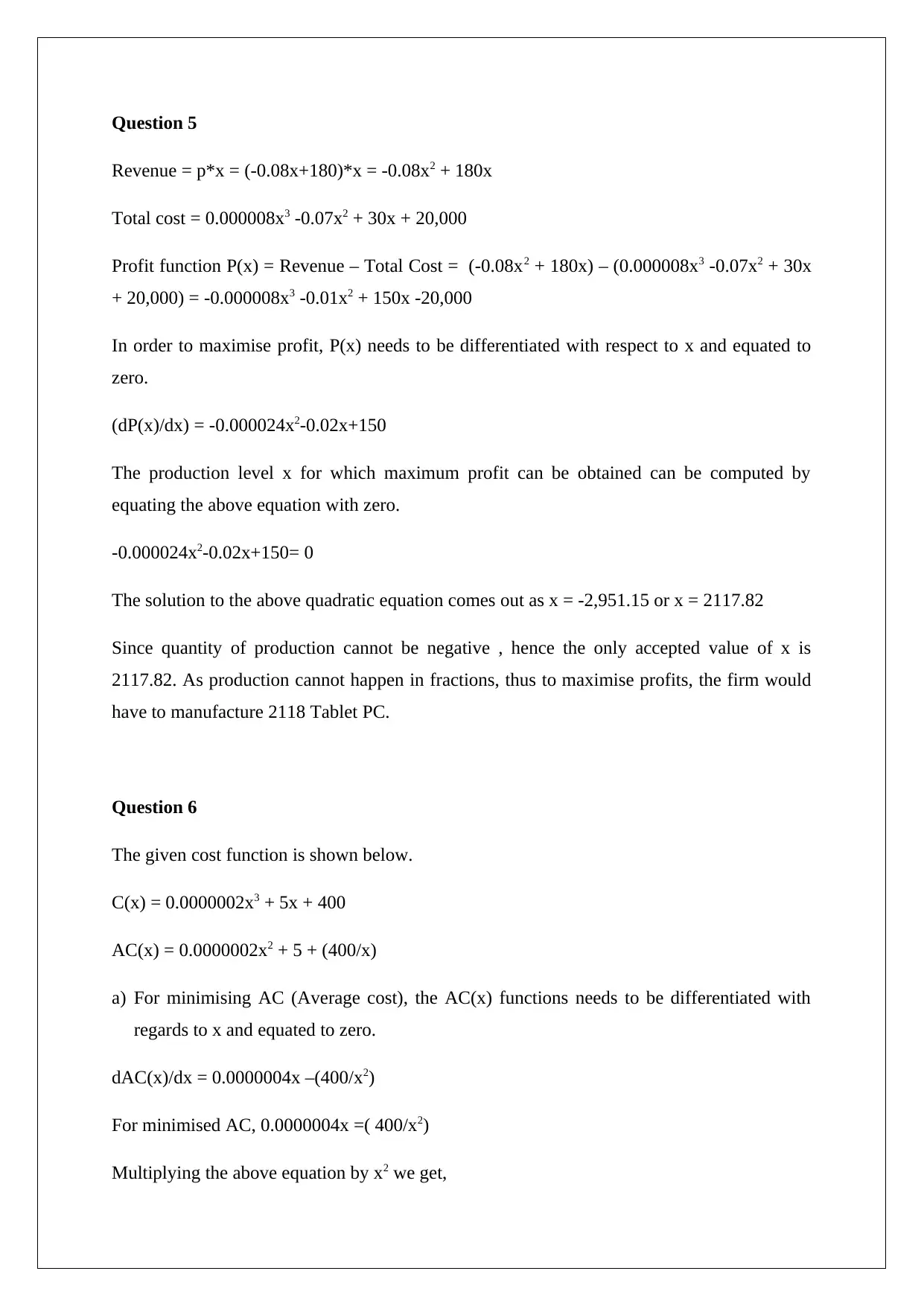
Question 5
Revenue = p*x = (-0.08x+180)*x = -0.08x2 + 180x
Total cost = 0.000008x3 -0.07x2 + 30x + 20,000
Profit function P(x) = Revenue – Total Cost = (-0.08x2 + 180x) – (0.000008x3 -0.07x2 + 30x
+ 20,000) = -0.000008x3 -0.01x2 + 150x -20,000
In order to maximise profit, P(x) needs to be differentiated with respect to x and equated to
zero.
(dP(x)/dx) = -0.000024x2-0.02x+150
The production level x for which maximum profit can be obtained can be computed by
equating the above equation with zero.
-0.000024x2-0.02x+150= 0
The solution to the above quadratic equation comes out as x = -2,951.15 or x = 2117.82
Since quantity of production cannot be negative , hence the only accepted value of x is
2117.82. As production cannot happen in fractions, thus to maximise profits, the firm would
have to manufacture 2118 Tablet PC.
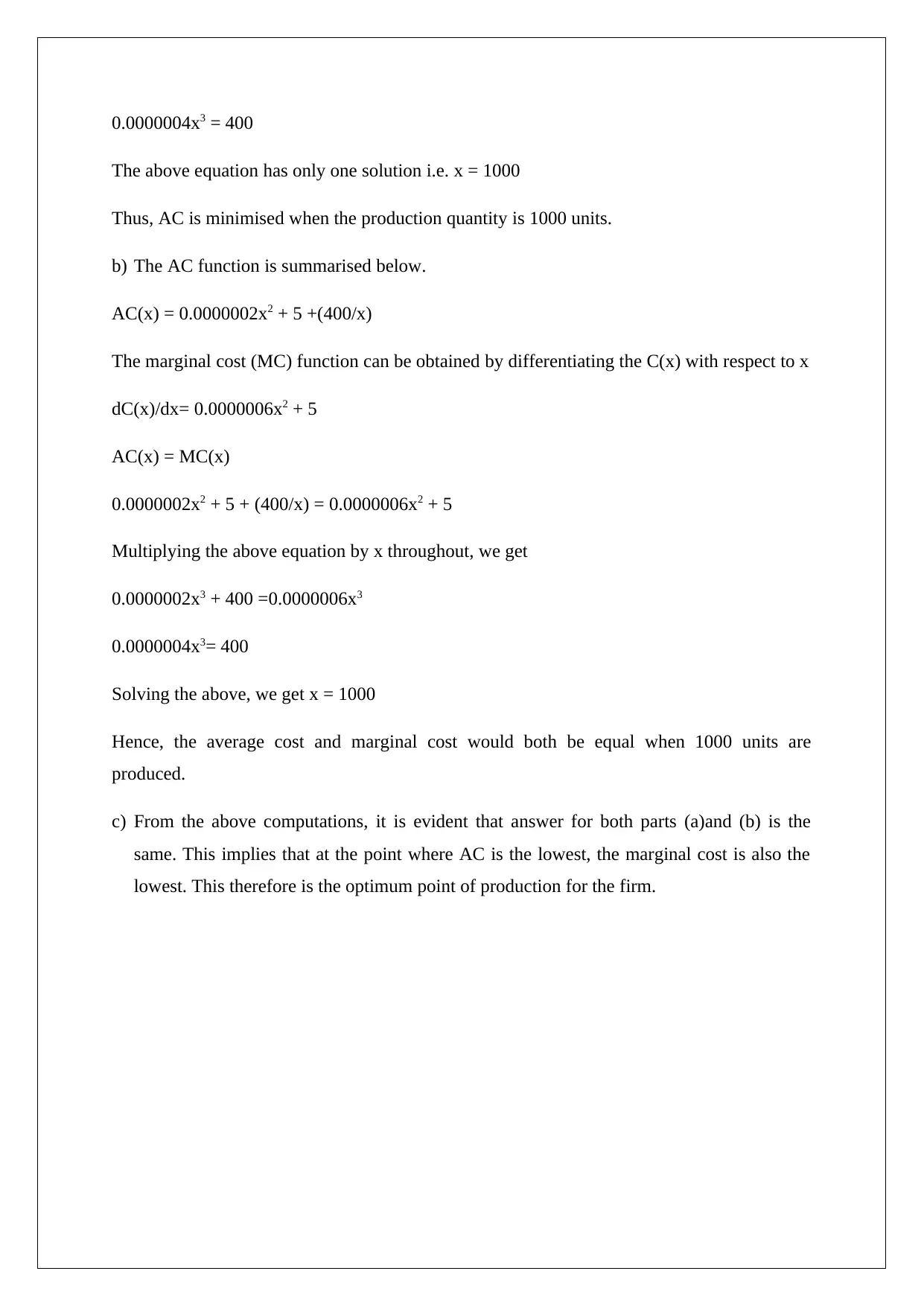
Question 6
The given cost function is shown below.
C(x) = 0.0000002x3 + 5x + 400
AC(x) = 0.0000002x2 + 5 + (400/x)
a) For minimising AC (Average cost), the AC(x) functions needs to be differentiated with
regards to x and equated to zero.
dAC(x)/dx = 0.0000004x –(400/x2)
For minimised AC, 0.0000004x =( 400/x2)
Multiplying the above equation by x2 we get,
Document Page
0.0000004x3 = 400
The above equation has only one solution i.e. x = 1000
Thus, AC is minimised when the production quantity is 1000 units.
b) The AC function is summarised below.
AC(x) = 0.0000002x2 + 5 +(400/x)
The marginal cost (MC) function can be obtained by differentiating the C(x) with respect to x
dC(x)/dx= 0.0000006x2 + 5
AC(x) = MC(x)
0.0000002x2 + 5 + (400/x) = 0.0000006x2 + 5
Multiplying the above equation by x throughout, we get
0.0000002x3 + 400 =0.0000006x3
0.0000004x3= 400
Solving the above, we get x = 1000
Hence, the average cost and marginal cost would both be equal when 1000 units are
produced.
c) From the above computations, it is evident that answer for both parts (a)and (b) is the
same. This implies that at the point where AC is the lowest, the marginal cost is also the
lowest. This therefore is the optimum point of production for the firm.
chevron_up_icon
1 out of 3
circle_padding
hide_on_mobile
zoom_out_icon
[object Object]