Analysis of Portfolio Management Models: A Comparative Study

Verified

Added on  2021/05/31

|6
|1455
|80
Project
AI Summary
This project report delves into the realm of portfolio management, commencing with an introduction to the core concepts of investment tools and strategies. It critically evaluates the Markowitz model, a foundational theory in portfolio construction, highlighting its assumptions and limitations in light of behavioral economics and practical market dynamics. Subsequently, the report introduces and applies the single index model, contrasting its simplicity and ease of implementation with the complexities of the Markowitz approach. Through a comparative analysis, the report demonstrates how the single index model can be utilized to assess portfolio performance, calculating expected returns and risk, and simplifying covariance estimations. The study incorporates scenario analysis to forecast portfolio outcomes under different conditions, ultimately concluding that the single index model offers a more streamlined and effective approach to portfolio management. The report references relevant academic literature to support its findings.
Document Page
Running Head: Applied portfolio management
1
Project Report: Applied portfolio management
tabler-icon-diamond-filled.svg

Paraphrase This Document

Need a fresh take? Get an instant paraphrase of this document with our AI Paraphraser
Document Page
Applied portfolio management 2
Contents
Introduction.......................................................................................................................3
Critique the Markowitz model..........................................................................................3
Single index model...........................................................................................................3
Scenario analysis..............................................................................................................5
Conclusion........................................................................................................................5
References.........................................................................................................................6
Document Page
Applied portfolio management 3
Introduction:
Portfolio management depicts to collection of various investment tools such as
instance, mutual funds, shares, stocks, budgets, bonds, cash, investor’s income etc. Portfolio
management is an art of selecting the right policy of investment for the individual in order to
minimize the risk and maximize the return of the portfolio. In the given report, the earlier
used Markowitz model has been criticized and the portfolio of the company has been
measured on the basis of single index model (MacKenzie, 2008). This report explains that
how both the models are different to each other and how they impact on the overall
performance of a portfolio. The better the outcome of a portfolio would be the better the
investors position would be.
Critique the Markowitz model:
Markowitz model is a modern mathematical theory to evaluate the portfolio. Being
popularly and widely used by various investment institutions, Modern portfolio theory is still
subject to criticism. The assumptions of the Markowitz theory have been criticized by the
researcher because of its relation with the behavioural economics. The research has proved
that the assumption (Investors act rationally) is wrong (Mangram, 2013). On the other hand,
the behavioural finance study explains that all the investors in the market have equal potential
returns however in normal scenario; each investor is biased and different (Guerard, 2009).
The opinion on the taxes and transaction cost also does not find true. Further, the
assumption of the investors that they could but any size of investment is also not practical.
Besides, investors always have a credit limit and they cannot borrow or lend unlimited shares.
The critics have also challenged the idea that the investor’s action doesn’t have any influence
on the market (MacKenzie, 2008). Further, the theory considers the historical data of a stock
to identify the risk and return of the stock. However, experiences investors believed that the
past performance of a stock cannot be a guarantee of forecasting and future performance of a
stock.
According to our group report, it has been evaluated that the entire above stated
assumptions have been used while calculating the risk and return of the portfolio. And thus,
the approach must be altered to evaluate the outcome of the portfolio.
Single index model:
Document Page
Applied portfolio management 4
Single index model is a simple asset pricing model which is used to measure both
the return and risk of a stock. It is a statistical model to evaluate the security return. A single
index model specifies about the two different sources of uncertainty which are systematic and
unsystematic approach. According to the researchers, single index model is way better the
Markowitz model. The main advantage of choosing the single index method over the
Markowitz model is that the implementation process of single index model is easier than
Markowitz model (Krokhmal, Zabarankin and Uryasev, 2011).
The Markowitz model offers flexibility in the modelling of covariance structure of
assets but there are huge problems in the covariance estimates whereas the single index
model is quite practical and assist the portfolio manager to separate the security analysis and
macro analysis factors. Single index model offers a benchmark for portfolio management and
the security analysis. An investor or the portfolio manager who is not informed about the
alpha values of the stock could assume it 0 and forecast the risk premium for the security
(Wong, Ip and Zhang, 2008). A portfolio manager who has forecasted the market index,
estimate the risk free rate on the basis of T bill rates, Could use the model of single index
easily in order to determine the benchmark expected return of the stock.
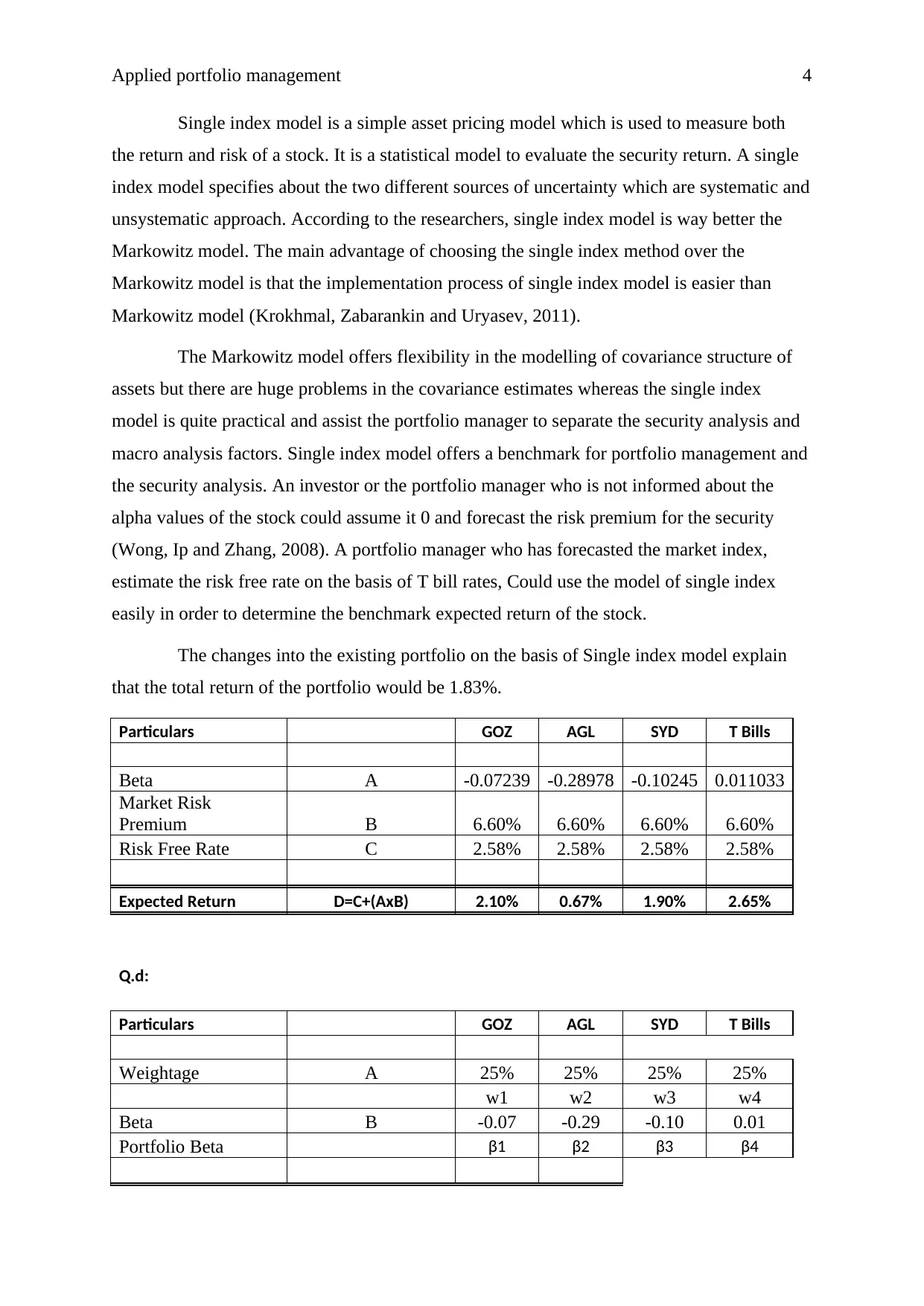
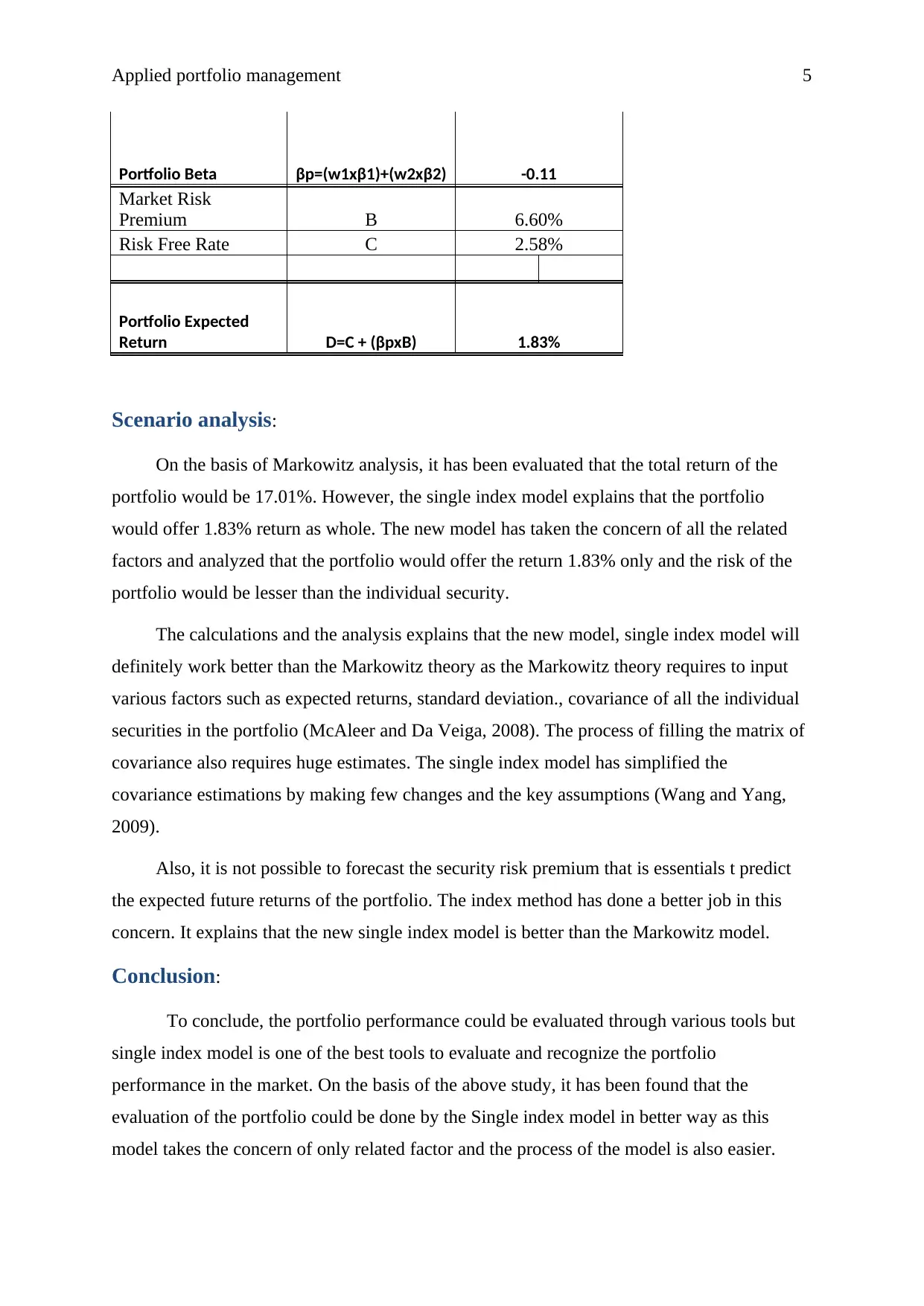
The changes into the existing portfolio on the basis of Single index model explain
that the total return of the portfolio would be 1.83%.
Particulars GOZ AGL SYD T Bills
Beta A -0.07239 -0.28978 -0.10245 0.011033
Market Risk
Premium B 6.60% 6.60% 6.60% 6.60%
Risk Free Rate C 2.58% 2.58% 2.58% 2.58%
Expected Return D=C+(AxB) 2.10% 0.67% 1.90% 2.65%
Q.d:
Particulars GOZ AGL SYD T Bills
Weightage A 25% 25% 25% 25%
w1 w2 w3 w4
Beta B -0.07 -0.29 -0.10 0.01
Portfolio Beta β1 β2 β3 β4
tabler-icon-diamond-filled.svg

Paraphrase This Document

Need a fresh take? Get an instant paraphrase of this document with our AI Paraphraser
Document Page
Applied portfolio management 5
Portfolio Beta βp=(w1xβ1)+(w2xβ2) -0.11
Market Risk
Premium B 6.60%
Risk Free Rate C 2.58%
Portfolio Expected
Return D=C + (βpxB) 1.83%
Scenario analysis:
On the basis of Markowitz analysis, it has been evaluated that the total return of the
portfolio would be 17.01%. However, the single index model explains that the portfolio
would offer 1.83% return as whole. The new model has taken the concern of all the related
factors and analyzed that the portfolio would offer the return 1.83% only and the risk of the
portfolio would be lesser than the individual security.
The calculations and the analysis explains that the new model, single index model will
definitely work better than the Markowitz theory as the Markowitz theory requires to input
various factors such as expected returns, standard deviation., covariance of all the individual
securities in the portfolio (McAleer and Da Veiga, 2008). The process of filling the matrix of
covariance also requires huge estimates. The single index model has simplified the
covariance estimations by making few changes and the key assumptions (Wang and Yang,
2009).
Also, it is not possible to forecast the security risk premium that is essentials t predict
the expected future returns of the portfolio. The index method has done a better job in this
concern. It explains that the new single index model is better than the Markowitz model.
Conclusion:
To conclude, the portfolio performance could be evaluated through various tools but
single index model is one of the best tools to evaluate and recognize the portfolio
performance in the market. On the basis of the above study, it has been found that the
evaluation of the portfolio could be done by the Single index model in better way as this
model takes the concern of only related factor and the process of the model is also easier.
Document Page
Applied portfolio management 6
References:
Guerard Jr, J.B. ed., 2009. Handbook of portfolio construction: Contemporary applications of
Markowitz techniques. Springer Science & Business Media.
Krokhmal, P., Zabarankin, M. and Uryasev, S., 2011. Modeling and optimization of
risk. Surveys in operations research and management science, 16(2), pp.49-66.
MacKenzie, D., 2008. An engine, not a camera: How financial models shape markets. Mit
Press.
Mangram, M.E., 2013. A simplified perspective of the Markowitz portfolio theory.
McAleer, M. and Da Veiga, B., 2008. Single‐index and portfolio models for forecasting
value‐at‐risk thresholds. Journal of Forecasting, 27(3), pp.217-235.
Wang, L. and Yang, L., 2009. Spline estimation of single-index models. Statistica Sinica,
pp.765-783.
Wong, H., Ip, W.C. and Zhang, R., 2008. Varying-coefficient single-index
model. Computational statistics & data analysis, 52(3), pp.1458-1476.
chevron_up_icon
1 out of 6
circle_padding
hide_on_mobile
zoom_out_icon
[object Object]