Applied Research Project Outline on Obesity in Australia (PUBH6008)

Verified

Added on  2022/10/19

|5
|514
|11
Project
AI Summary
This assignment presents a project outline focusing on the escalating rates of overweight and obesity in Australia. The research aims to investigate the causes of this public health concern, including energy imbalance, lifestyle factors, and changing food habits. The project utilizes a quantitative research design, relying on secondary data sources to analyze statistics and trends related to obesity. The outline includes a thesis statement, a description of the research methodology, and a Gantt chart for project timeline. The student's research seeks to understand the underlying factors contributing to the rise in obesity and to identify potential approaches to mitigate the problem. The project aligns with the course requirements for PUBH6008 Capstone A: Applied Research Project in Public Health, fulfilling the need to plan a research proposal, develop research skills, and apply them to a relevant public health issue.
Document Page
Running head: APPLIED RESEARCH IN PUBLIC HEALTH 1
Applied Research in Public Health
Student’s Name
Institutional Affiliation
tabler-icon-diamond-filled.svg

Paraphrase This Document

Need a fresh take? Get an instant paraphrase of this document with our AI Paraphraser
Document Page
APPLIED RESEARCH IN PUBLIC HEALTH 2
The Increased Rate of Overweight and Obesity among Australians
Overweight and obesity has become a critical public health aspect across Australia.
Recent studies have found that overweight and obesity is as a result of sustainable energy
imbalance whereby energy intake that comes from drinking and eating exceed the energy
expanded through physical activity (Goldstein, Blanco, He, & Merikangas, 2016). The imbalance
in energy is influenced by an individual’s genetic as well as biological characteristics in addition
to lifestyle factors. In the past two decades obesity among Australians has doubled from 5% in
1995 to approximately 10% in 2016. According to Australian Bureau of Statistics (2012) more
than 65% of Australian adults and children in the current age are overweight and have obesity.
This has been contributed to by the food habit and lifestyle of the people. As a result of the
change in time, most Australians have become busy with their work life hence most of them
have improper and irregular diet system which is the major contributing factors of obesity
(Grimes, Riddell, Campbell, He, & Nowson, 2016). The food habit of most Australians has
changed over the years where most people prefer fast foods, which is significantly related to
obesity. Persons from dissimilar Australian States have the same obesity ratio due to similar food
habits. For that reason, a majority of Australians are being faced by severe problems because of
food habit.
Thesis Statement
To find out the cause of increased overweight and obesity among Australians and approaches to
that could be applied to reduce obesity problem.
Research Design and Methodology
Document Page
APPLIED RESEARCH IN PUBLIC HEALTH 3
The research will be performed through a quantitative design with the strategy to realize
effective and suitable information in regards to the issue of obesity among Australian people.
The data will be gathered from secondary sources that will provide appropriate and effective
view about different statistics related to obesity.
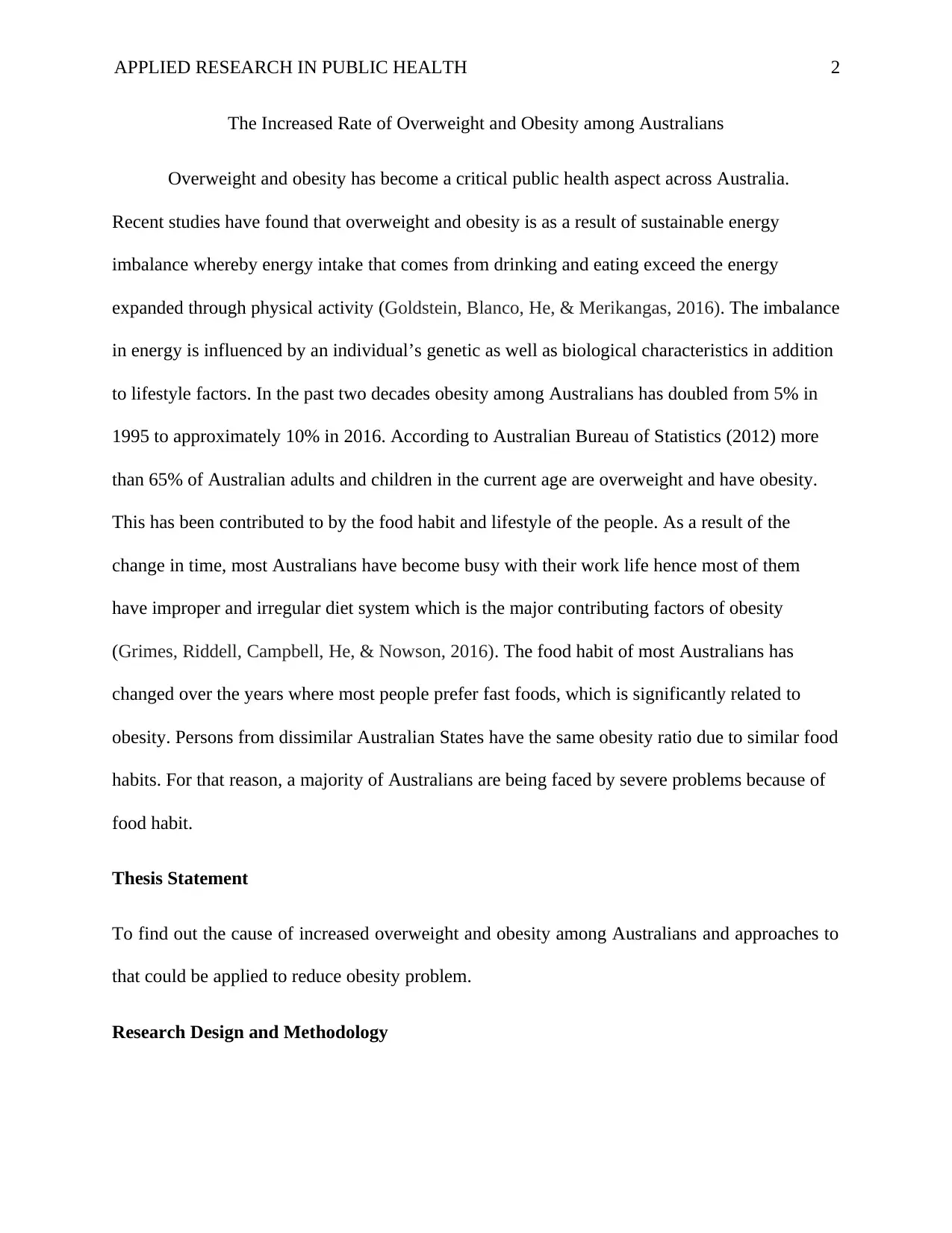
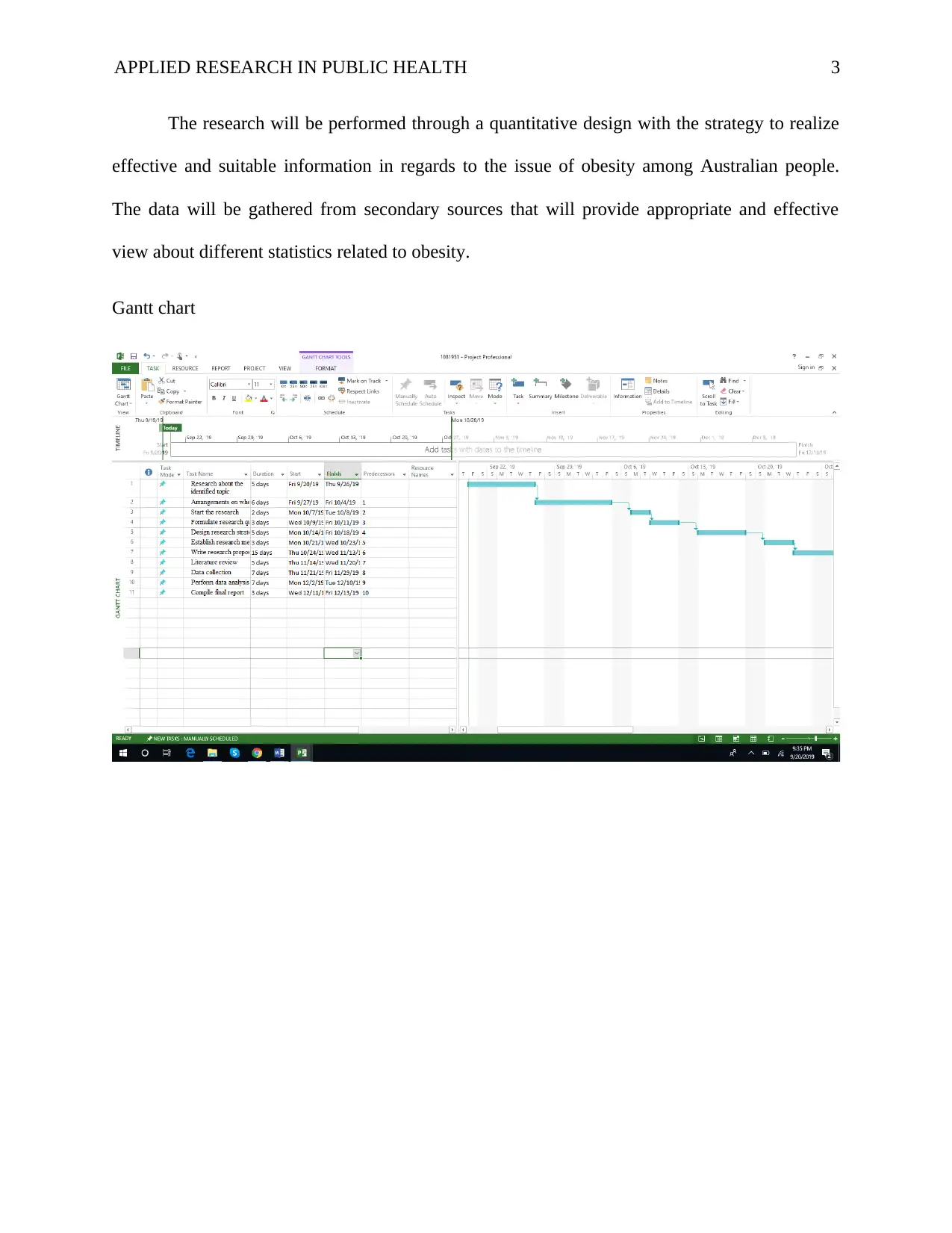
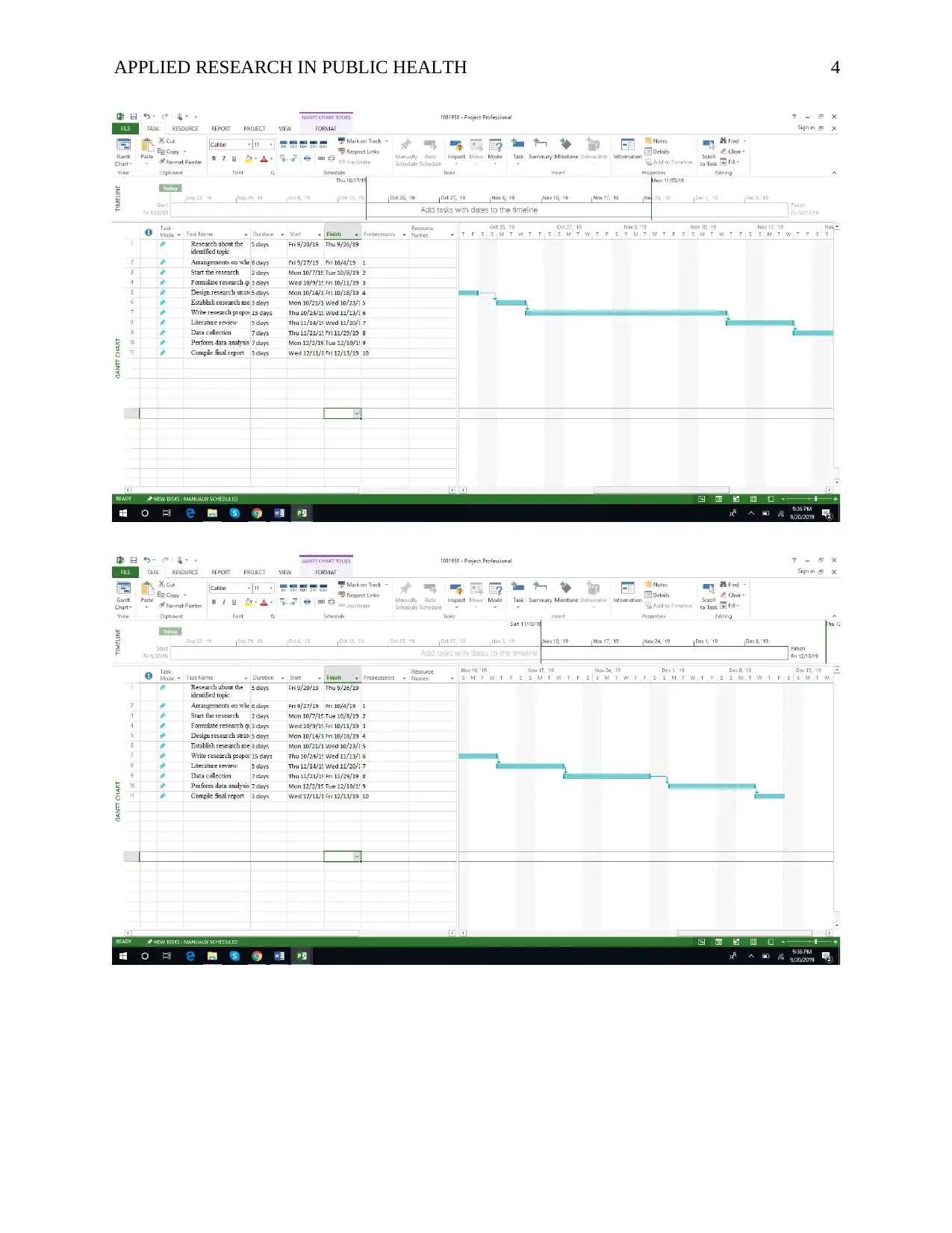
Gantt chart
Document Page
APPLIED RESEARCH IN PUBLIC HEALTH 4
tabler-icon-diamond-filled.svg

Paraphrase This Document

Need a fresh take? Get an instant paraphrase of this document with our AI Paraphraser
Document Page
APPLIED RESEARCH IN PUBLIC HEALTH 5
References
Australian Bureau of Statistics. (2012). Retrieved 20 September 2019, from
https://www.aihw.gov.au/getmedia/172fba28-785e-4a08-ab37-2da3bbae40b8/aihw-phe-
216.pdf.aspx?inline=true
Goldstein, B. I., Blanco, C., He, J. P., & Merikangas, K. (2016). Correlates of overweight and
obesity among adolescents with bipolar disorder in the National comorbidity Survey–
Adolescent supplement (NCS-A). Journal of the American Academy of Child &
Adolescent Psychiatry, 55(12), 1020-1026.
Grimes, C. A., Riddell, L. J., Campbell, K. J., He, F. J., & Nowson, C. A. (2016). 24-h urinary
sodium excretion is associated with obesity in a cross-sectional sample of Australian
schoolchildren. British Journal of Nutrition, 115(6), 1071-1079.
chevron_up_icon
1 out of 5
circle_padding
hide_on_mobile
zoom_out_icon
[object Object]