Research Methods, Data Analysis, and Interpretation Assignment
VerifiedAdded on 2022/11/15
|9
|2634
|366
Homework Assignment
AI Summary
This assignment delves into applied research methods, addressing crucial aspects such as plagiarism avoidance, the contrast between inductive and deductive reasoning, and the significance of critical and skeptical approaches in research. It explores the relationship between variables using a case study of a cafe, examining the impact of introducing hot pies on coffee sales. The assignment also covers the formulation of exploratory, descriptive, and causal research questions. Furthermore, it provides guidance on Harvard referencing and analyzes a research article, identifying variables, relationships, and measurement techniques. Finally, it critiques and improves questionnaire questions related to a bus service, offering alternative wording and response options to enhance data collection.
This assignment is designed to assist students to develop an understanding of applied
research methods.
Students should number their answers. Do not reproduce the questions. Referencing
should follow the Harvard system
=============================================================
1. Why should students avoid plagiarism?
Answer: Plagiarism is a word or idea which has already been used by others. In
other words plagiarism is a type of theft in intellectual. Plagiarism has been taken
many forms (Angélil 2014). When a person use another person’s word or idea
then it is called plagiarism. The contradiction in of student writing or writing an
assignment is that when the person wish to research and transfer the expert to
authorities, then the person is expected to write an original work (Barrón-Cedeño
.2013). It is clear and ensure that the person should clear about their own work. In
general, students from among the world face a common and general problem in
academic writing that the most of the student simply steal others work and do not
understand about plagiarism. When the student avoid plagiarism then it helps to
get in practice of working it again by the student (Gipp 2014).
(4 marks)
2. Explain and contrast the ordering of data interpretation, data analysis, data
collection and theory when research is carried out using deductive reasoning
compared to inductive reasoning.
Answer: There exists quite difference between the approaches of inductive
reasoning and deductive reasoning to carry out a research study. However, in some
cases these two are complementary (Zalaghi and Khazaei 2016). The process of
inductive reasoning start with the data collection while conducting research. In the
next step, the pattern of the data is searched and the theory is developed to match with
the data pattern. Therefore, the ordering applied under the inductive reasoning
involves data to theory to carry out the research. On the contrary, the reverse order of
the inductive reasoning to carry out a research is followed in case of the deductive
reasoning. Under the deductive research, first the theory is selected (Hanly 2014).
Then, the theory is tested on the basis of the data. The data helps to test the
implication of the theory. The application of the deductive reasoning to research is
associated with the scientific investigation. The existing theories are taken into
consideration while conducting research under the deductive approach. Then the
hypotheses are emerged from the past theories. Finally, the hypotheses are tested in
order to complete the research. Therefore, the ordering of data collection, data
interpretation, data analysis and theory is different to conduct research applying
inductive reasoning and deductive reasoning (Lee and Lo 2014).
research methods.
Students should number their answers. Do not reproduce the questions. Referencing
should follow the Harvard system
=============================================================
1. Why should students avoid plagiarism?
Answer: Plagiarism is a word or idea which has already been used by others. In
other words plagiarism is a type of theft in intellectual. Plagiarism has been taken
many forms (Angélil 2014). When a person use another person’s word or idea
then it is called plagiarism. The contradiction in of student writing or writing an
assignment is that when the person wish to research and transfer the expert to
authorities, then the person is expected to write an original work (Barrón-Cedeño
.2013). It is clear and ensure that the person should clear about their own work. In
general, students from among the world face a common and general problem in
academic writing that the most of the student simply steal others work and do not
understand about plagiarism. When the student avoid plagiarism then it helps to
get in practice of working it again by the student (Gipp 2014).
(4 marks)
2. Explain and contrast the ordering of data interpretation, data analysis, data
collection and theory when research is carried out using deductive reasoning
compared to inductive reasoning.
Answer: There exists quite difference between the approaches of inductive
reasoning and deductive reasoning to carry out a research study. However, in some
cases these two are complementary (Zalaghi and Khazaei 2016). The process of
inductive reasoning start with the data collection while conducting research. In the
next step, the pattern of the data is searched and the theory is developed to match with
the data pattern. Therefore, the ordering applied under the inductive reasoning
involves data to theory to carry out the research. On the contrary, the reverse order of
the inductive reasoning to carry out a research is followed in case of the deductive
reasoning. Under the deductive research, first the theory is selected (Hanly 2014).
Then, the theory is tested on the basis of the data. The data helps to test the
implication of the theory. The application of the deductive reasoning to research is
associated with the scientific investigation. The existing theories are taken into
consideration while conducting research under the deductive approach. Then the
hypotheses are emerged from the past theories. Finally, the hypotheses are tested in
order to complete the research. Therefore, the ordering of data collection, data
interpretation, data analysis and theory is different to conduct research applying
inductive reasoning and deductive reasoning (Lee and Lo 2014).

Paraphrase This Document
Need a fresh take? Get an instant paraphrase of this document with our AI Paraphraser
(8 marks)
3. Why is it important to have a critical and skeptical approach when viewing
research?
Answer: One of the intrinsic part of viewing research is critical and skeptical
approach. It is considered as the basic underpinning of the scientific method in a
research. To assess the claim of the research, the skeptical and critical approach is
applied (Nolder and Kadous 2018). Moreover, the weighing of the evidence can also
be checked with help of this approach. The reason behind a research is finding out the
results and it encourages to take risks to conduct the experiment. It is not possible to
know the outcome before the experiments (Moore 2013). After the outcome of the
research reveals, it is required to apply critical thinking and reason to determine the
validity of the outcome. To check the validity of the outcome when critical thinking
and reason are applied, it is known as the skepticism. Hence, it can be stated that the
skeptical and critical thinking is essential while viewing research. The skeptical and
critical approach never offer justification of a preconceived conclusion of a research
study. In addition, a supported conclusion of a research study is searched by the
skeptical and critical thinking. Therefore, the reasoning process to view a research
study can be conducted with the help of skeptical and critical thinking (Scott‐Phillips
et al. 2014).
(6 marks)
4. A café introduces hot pies to their menu. The manager observes that after the
introduction of hot pies sales of coffee also increased. What issues should a
manager consider in order to determine the likelihood that the introduction of
pies has led to increased coffee sales? (discuss your answer by thinking about
does this issue possibly show an independent and dependent variable
relationship)
Answer: In this case the dependent variable is coffee sales and the
independent variable is introduction of hot pies. The above question shows a
relationship between these variables. According to this study before the
introduction of hot pies the sales of coffee is low as compared to the introduction
of hot pies. It has been given that sales of coffee is increased when the hot pies
introduced. Hence it is cleared that there is a relationship between the coffee sale
and the introduction of hot pies. (8 marks)
5. The sales manager reviews the expense reports of the sales representatives.
The manager has a number of concerns:
The average expense reports for rural sales representatives are higher
than those of metropolitan sales representatives
The vehicle maintenance costs for rural sales representatives are higher
than those of metropolitan sales representatives
The fuel costs of rural sales representatives are higher than those of
metropolitan sales representatives
3. Why is it important to have a critical and skeptical approach when viewing
research?
Answer: One of the intrinsic part of viewing research is critical and skeptical
approach. It is considered as the basic underpinning of the scientific method in a
research. To assess the claim of the research, the skeptical and critical approach is
applied (Nolder and Kadous 2018). Moreover, the weighing of the evidence can also
be checked with help of this approach. The reason behind a research is finding out the
results and it encourages to take risks to conduct the experiment. It is not possible to
know the outcome before the experiments (Moore 2013). After the outcome of the
research reveals, it is required to apply critical thinking and reason to determine the
validity of the outcome. To check the validity of the outcome when critical thinking
and reason are applied, it is known as the skepticism. Hence, it can be stated that the
skeptical and critical thinking is essential while viewing research. The skeptical and
critical approach never offer justification of a preconceived conclusion of a research
study. In addition, a supported conclusion of a research study is searched by the
skeptical and critical thinking. Therefore, the reasoning process to view a research
study can be conducted with the help of skeptical and critical thinking (Scott‐Phillips
et al. 2014).
(6 marks)
4. A café introduces hot pies to their menu. The manager observes that after the
introduction of hot pies sales of coffee also increased. What issues should a
manager consider in order to determine the likelihood that the introduction of
pies has led to increased coffee sales? (discuss your answer by thinking about
does this issue possibly show an independent and dependent variable
relationship)
Answer: In this case the dependent variable is coffee sales and the
independent variable is introduction of hot pies. The above question shows a
relationship between these variables. According to this study before the
introduction of hot pies the sales of coffee is low as compared to the introduction
of hot pies. It has been given that sales of coffee is increased when the hot pies
introduced. Hence it is cleared that there is a relationship between the coffee sale
and the introduction of hot pies. (8 marks)
5. The sales manager reviews the expense reports of the sales representatives.
The manager has a number of concerns:
The average expense reports for rural sales representatives are higher
than those of metropolitan sales representatives
The vehicle maintenance costs for rural sales representatives are higher
than those of metropolitan sales representatives
The fuel costs of rural sales representatives are higher than those of
metropolitan sales representatives
The entertainment expenses of metropolitan sales representatives are
higher than rural sales representatives
Using the above information draft:
a. An exploratory research question
Answer: There is no relationship between the rural and metropolitan sales
representatives?
(5 marks)
b. A descriptive research question
Answer: Determine the difference between rural and metropolitan sales
representatives?
(5 marks)
c. A casual research question
Answer: Which cost factor mostly affected on the rural and metropolitan
representative?
(5 marks)
6. William Smith published an article in the Journal of imaginary studies, the
title of the article was Learning how to reference correctly. The article
appeared in volume six and issue number three. The page numbers of the
article were 202 to 210. Show how this article would appear in the reference
list using Harvard referencing.
Answer: Smith, W., (Year). Journal of imaginary studies: Learning how to
reference correctly, 6(3), pp.202-210. (5 marks)
7. Read the article by Park et al. (2019) and answer the following questions:
a. Look at the research model, Figure 1, what are the independent
variables?
Answer: The independent variables are positive perception and active
participation. (3 marks)
b. Look at the research model, Figure 1, what are the dependent
variables?
(3 marks)
Answer: The dependent variable is accounting learning.
higher than rural sales representatives
Using the above information draft:
a. An exploratory research question
Answer: There is no relationship between the rural and metropolitan sales
representatives?
(5 marks)
b. A descriptive research question
Answer: Determine the difference between rural and metropolitan sales
representatives?
(5 marks)
c. A casual research question
Answer: Which cost factor mostly affected on the rural and metropolitan
representative?
(5 marks)
6. William Smith published an article in the Journal of imaginary studies, the
title of the article was Learning how to reference correctly. The article
appeared in volume six and issue number three. The page numbers of the
article were 202 to 210. Show how this article would appear in the reference
list using Harvard referencing.
Answer: Smith, W., (Year). Journal of imaginary studies: Learning how to
reference correctly, 6(3), pp.202-210. (5 marks)
7. Read the article by Park et al. (2019) and answer the following questions:
a. Look at the research model, Figure 1, what are the independent
variables?
Answer: The independent variables are positive perception and active
participation. (3 marks)
b. Look at the research model, Figure 1, what are the dependent
variables?
(3 marks)
Answer: The dependent variable is accounting learning.
⊘ This is a preview!⊘
Do you want full access?
Subscribe today to unlock all pages.

Trusted by 1+ million students worldwide
c. Look at the research model, Figure 1, what type of variable is positive
perception?
(4 marks)
Answer: Positive perception is independent variable.
d. In what way do the authors suggest that positive perception influences
accounting learning?
Answer: With the help of regression analysis the author suggest about
the influence of positive perception and accounting learning. (4 marks)
e. Look at the research model, Figure 1, what type of relationship
between the variables does the line from active participation to
accounting learning indicate?
Answer: There is a positive relationship among the active participation
and accounting learning. (4 marks)
f. How did the authors measure active participation?
Answer: Active participation has been measured by regression and
correlation analysis. (4 marks)
g. What might be an alternative way to measure active participation?
(4 marks)
Answer: The hypothesis t test is the alternative way to measure active
participation.
h. Rewrite hypothesis one, so it is in the form of a null hypothesis.
Answer: There is no relationship between the accounting learning and
positive perception and active participation.
(4 marks)
perception?
(4 marks)
Answer: Positive perception is independent variable.
d. In what way do the authors suggest that positive perception influences
accounting learning?
Answer: With the help of regression analysis the author suggest about
the influence of positive perception and accounting learning. (4 marks)
e. Look at the research model, Figure 1, what type of relationship
between the variables does the line from active participation to
accounting learning indicate?
Answer: There is a positive relationship among the active participation
and accounting learning. (4 marks)
f. How did the authors measure active participation?
Answer: Active participation has been measured by regression and
correlation analysis. (4 marks)
g. What might be an alternative way to measure active participation?
(4 marks)
Answer: The hypothesis t test is the alternative way to measure active
participation.
h. Rewrite hypothesis one, so it is in the form of a null hypothesis.
Answer: There is no relationship between the accounting learning and
positive perception and active participation.
(4 marks)
Paraphrase This Document
Need a fresh take? Get an instant paraphrase of this document with our AI Paraphraser
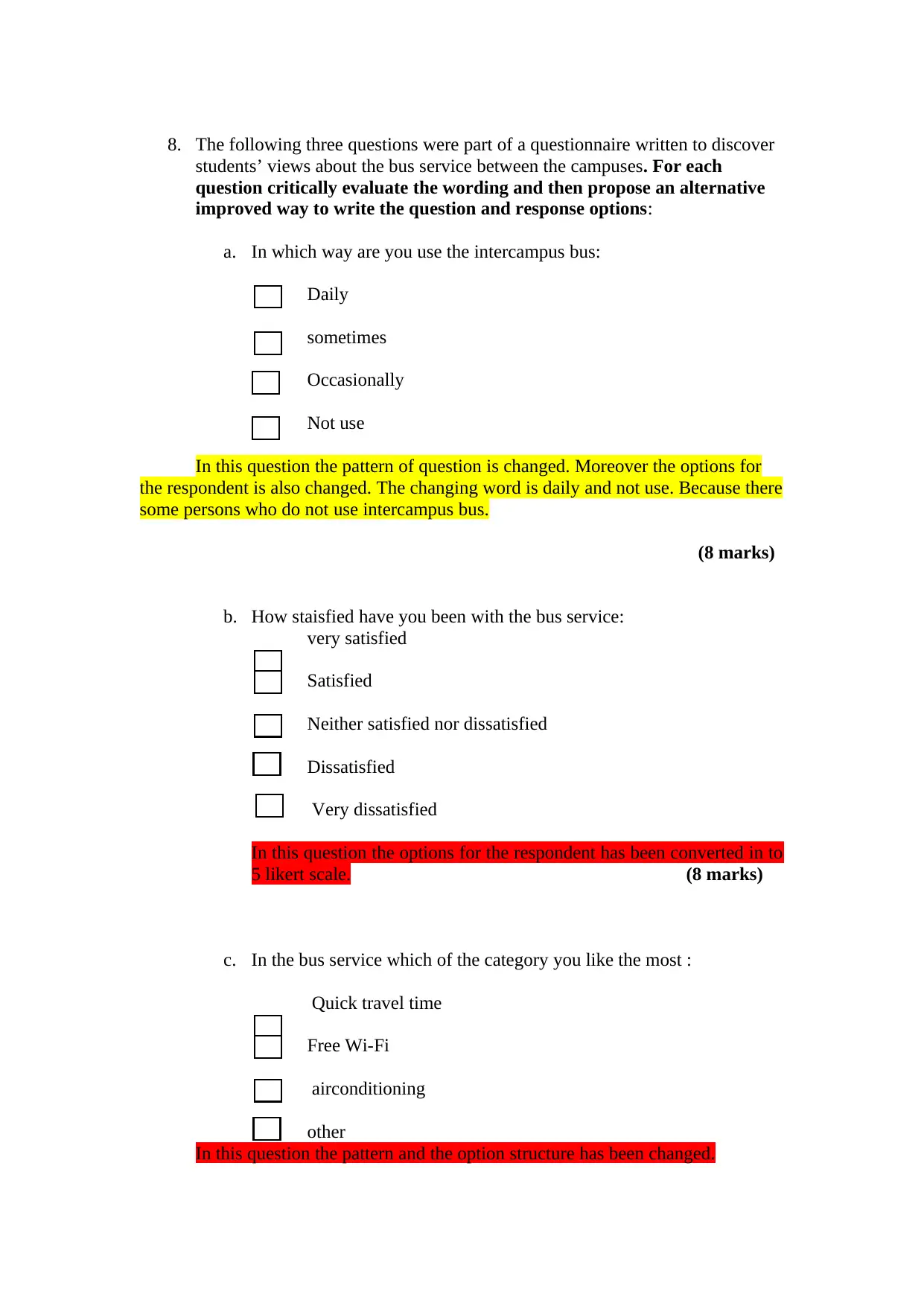
8. The following three questions were part of a questionnaire written to discover
students’ views about the bus service between the campuses. For each
question critically evaluate the wording and then propose an alternative
improved way to write the question and response options:
a. In which way are you use the intercampus bus:
Daily
sometimes
Occasionally
Not use
In this question the pattern of question is changed. Moreover the options for
the respondent is also changed. The changing word is daily and not use. Because there
some persons who do not use intercampus bus.
(8 marks)
b. How staisfied have you been with the bus service:
very satisfied
Satisfied
Neither satisfied nor dissatisfied
Dissatisfied
Very dissatisfied
In this question the options for the respondent has been converted in to
5 likert scale. (8 marks)
c. In the bus service which of the category you like the most :
Quick travel time
Free Wi-Fi
airconditioning
other
In this question the pattern and the option structure has been changed.
students’ views about the bus service between the campuses. For each
question critically evaluate the wording and then propose an alternative
improved way to write the question and response options:
a. In which way are you use the intercampus bus:
Daily
sometimes
Occasionally
Not use
In this question the pattern of question is changed. Moreover the options for
the respondent is also changed. The changing word is daily and not use. Because there
some persons who do not use intercampus bus.
(8 marks)
b. How staisfied have you been with the bus service:
very satisfied
Satisfied
Neither satisfied nor dissatisfied
Dissatisfied
Very dissatisfied
In this question the options for the respondent has been converted in to
5 likert scale. (8 marks)
c. In the bus service which of the category you like the most :
Quick travel time
Free Wi-Fi
airconditioning
other
In this question the pattern and the option structure has been changed.
(8 marks)
In all the above question some them has beeen converted in to likert scale and
some of them question pattern has been changed for helping data collection.
References and Bibliography
Angélil-Carter, S., 2014. Stolen language?: Plagiarism in writing. Routledge.
Barr, D.J., Levy, R., Scheepers, C. and Tily, H.J., 2013. Random effects structure for
confirmatory hypothesis testing: Keep it maximal. Journal of memory and language,
68(3), pp.255-278.
Barrón-Cedeño, A., Vila, M., Martí, M.A. and Rosso, P., 2013. Plagiarism meets
paraphrasing: Insights for the next generation in automatic plagiarism detection.
Computational Linguistics, 39(4), pp.917-947.
Dekker, J.C., Lybaert, N., Steijvers, T., Depaire, B. and Mercken, R., 2013. Family
firm types based on the professionalization construct: Exploratory research. Family
Business Review, 26(1), pp.81-99.
Fox, J., 2015. Applied regression analysis and generalized linear models. Sage
Publications.
Gipp, B., 2014. Citation-based plagiarism detection. In Citation-based plagiarism
detection (pp. 57-88). Springer Vieweg, Wiesbaden.
Hanly, C., 2014. The interplay of deductive and inductive reasoning in psychoanalytic
theorizing. The Psychoanalytic Quarterly, 83(4), pp.897-915.
Hardy, C.A., 2014. The messy matters of continuous assurance: Findings from
exploratory research in Australia. Journal of Information Systems, 28(2), pp.357-377.
Helgesson, G. and Eriksson, S., 2015. Plagiarism in research. Medicine, Health Care
and Philosophy, 18(1), pp.91-101.
Ifenthaler, D. and Seel, N.M., 2013. Model-based reasoning. Computers & Education,
64, pp.131-142.
In all the above question some them has beeen converted in to likert scale and
some of them question pattern has been changed for helping data collection.
References and Bibliography
Angélil-Carter, S., 2014. Stolen language?: Plagiarism in writing. Routledge.
Barr, D.J., Levy, R., Scheepers, C. and Tily, H.J., 2013. Random effects structure for
confirmatory hypothesis testing: Keep it maximal. Journal of memory and language,
68(3), pp.255-278.
Barrón-Cedeño, A., Vila, M., Martí, M.A. and Rosso, P., 2013. Plagiarism meets
paraphrasing: Insights for the next generation in automatic plagiarism detection.
Computational Linguistics, 39(4), pp.917-947.
Dekker, J.C., Lybaert, N., Steijvers, T., Depaire, B. and Mercken, R., 2013. Family
firm types based on the professionalization construct: Exploratory research. Family
Business Review, 26(1), pp.81-99.
Fox, J., 2015. Applied regression analysis and generalized linear models. Sage
Publications.
Gipp, B., 2014. Citation-based plagiarism detection. In Citation-based plagiarism
detection (pp. 57-88). Springer Vieweg, Wiesbaden.
Hanly, C., 2014. The interplay of deductive and inductive reasoning in psychoanalytic
theorizing. The Psychoanalytic Quarterly, 83(4), pp.897-915.
Hardy, C.A., 2014. The messy matters of continuous assurance: Findings from
exploratory research in Australia. Journal of Information Systems, 28(2), pp.357-377.
Helgesson, G. and Eriksson, S., 2015. Plagiarism in research. Medicine, Health Care
and Philosophy, 18(1), pp.91-101.
Ifenthaler, D. and Seel, N.M., 2013. Model-based reasoning. Computers & Education,
64, pp.131-142.
⊘ This is a preview!⊘
Do you want full access?
Subscribe today to unlock all pages.
Trusted by 1+ million students worldwide
Jarvik, G.P., Amendola, L.M., Berg, J.S., Brothers, K., Clayton, E.W., Chung, W.,
Evans, B.J., Evans, J.P., Fullerton, S.M., Gallego, C.J. and Nanibaa’A, G., 2014.
Return of genomic results to research participants: the floor, the ceiling, and the
choices in between. The American Journal of Human Genetics, 94(6), pp.818-826.
Kangasniemi, M., Utriainen, K., Ahonen, S.M., Pietilä, A.M., Jääskeläinen, P. and
Liikanen, E., 2013. Kuvaileva kirjallisuuskatsaus: eteneminen tutkimuskysymyksestä
jäsennettyyn tietoon/Narrative literature review: from a research question to
structured knowledge. Hoitotiede, 25(4), p.291.
Lantz, B., 2013. Equidistance of Likert-type scales and validation of inferential
methods using experiments and simulations. The Electronic Journal of Business
Research Methods, 11(1), pp.16-28.
Lee, V. and Lo, A., 2014. From theory to practice: Teaching management using films
through deductive and inductive processes. The International Journal of Management
Education, 12(1), pp.44-54.
Mayer, I., 2015. Qualitative research with a focus on qualitative data analysis.
International Journal of Sales, Retailing & Marketing, 4(9), pp.53-67.
Moore, T., 2013. Critical thinking: Seven definitions in search of a concept. Studies in
Higher Education, 38(4), pp.506-522.
Nemoto, T. and Beglar, D., 2014. Likert-scale questionnaires. In JALT 2013
Conference Proceedings (pp. 1-8).
Nolder, C.J. and Kadous, K., 2018. Grounding the professional skepticism construct
in mindset and attitude theory: A way forward. Accounting, Organizations and
Society, 67, pp.1-14.
Evans, B.J., Evans, J.P., Fullerton, S.M., Gallego, C.J. and Nanibaa’A, G., 2014.
Return of genomic results to research participants: the floor, the ceiling, and the
choices in between. The American Journal of Human Genetics, 94(6), pp.818-826.
Kangasniemi, M., Utriainen, K., Ahonen, S.M., Pietilä, A.M., Jääskeläinen, P. and
Liikanen, E., 2013. Kuvaileva kirjallisuuskatsaus: eteneminen tutkimuskysymyksestä
jäsennettyyn tietoon/Narrative literature review: from a research question to
structured knowledge. Hoitotiede, 25(4), p.291.
Lantz, B., 2013. Equidistance of Likert-type scales and validation of inferential
methods using experiments and simulations. The Electronic Journal of Business
Research Methods, 11(1), pp.16-28.
Lee, V. and Lo, A., 2014. From theory to practice: Teaching management using films
through deductive and inductive processes. The International Journal of Management
Education, 12(1), pp.44-54.
Mayer, I., 2015. Qualitative research with a focus on qualitative data analysis.
International Journal of Sales, Retailing & Marketing, 4(9), pp.53-67.
Moore, T., 2013. Critical thinking: Seven definitions in search of a concept. Studies in
Higher Education, 38(4), pp.506-522.
Nemoto, T. and Beglar, D., 2014. Likert-scale questionnaires. In JALT 2013
Conference Proceedings (pp. 1-8).
Nolder, C.J. and Kadous, K., 2018. Grounding the professional skepticism construct
in mindset and attitude theory: A way forward. Accounting, Organizations and
Society, 67, pp.1-14.
Paraphrase This Document
Need a fresh take? Get an instant paraphrase of this document with our AI Paraphraser
Park, Y-H, Paik, T-Y & Koo, J-H 2019, 'Effect of student activity participation on
accounting education', Journal of Open Innovation: Technology, Market, and
Complexity, vol. 5, no. 3, p. 40-50
Pears, R. and Shields, G.J., 2019. Cite them right: the essential referencing guide.
Macmillan International Higher Education.
Pears, R. and Shields, G.J., 2019. Cite them right: the essential referencing guide.
Macmillan International Higher Education.
Scott‐Phillips, T.C., Laland, K.N., Shuker, D.M., Dickins, T.E. and West, S.A., 2014.
The niche construction perspective: a critical appraisal. Evolution, 68(5), pp.1231-
1243.
Sousa, D., 2014. Validation in qualitative research: General aspects and specificities
of the descriptive phenomenological method. Qualitative Research in Psychology,
11(2), pp.211-227.
Sperandei, S., 2014. Understanding logistic regression analysis. Biochemia medica:
Biochemia medica, 24(1), pp.12-18.
Subedi, B.P., 2016. Using Likert type data in social science research: Confusion,
issues and challenges. International journal of contemporary applied sciences, 3(2),
pp.36-49.
van Eldik, E., 2019. LibGuides: NWU Harvard Referencing Guide: Text references.
Wildemuth, B.M. ed., 2016. Applications of social research methods to questions in
information and library science. ABC-CLIO.
Zalaghi, H. and Khazaei, M., 2016. The role of deductive and inductive reasoning in
accounting research and standard setting. Asian Journal of Finance & Accounting,
8(1), pp.23-37.
accounting education', Journal of Open Innovation: Technology, Market, and
Complexity, vol. 5, no. 3, p. 40-50
Pears, R. and Shields, G.J., 2019. Cite them right: the essential referencing guide.
Macmillan International Higher Education.
Pears, R. and Shields, G.J., 2019. Cite them right: the essential referencing guide.
Macmillan International Higher Education.
Scott‐Phillips, T.C., Laland, K.N., Shuker, D.M., Dickins, T.E. and West, S.A., 2014.
The niche construction perspective: a critical appraisal. Evolution, 68(5), pp.1231-
1243.
Sousa, D., 2014. Validation in qualitative research: General aspects and specificities
of the descriptive phenomenological method. Qualitative Research in Psychology,
11(2), pp.211-227.
Sperandei, S., 2014. Understanding logistic regression analysis. Biochemia medica:
Biochemia medica, 24(1), pp.12-18.
Subedi, B.P., 2016. Using Likert type data in social science research: Confusion,
issues and challenges. International journal of contemporary applied sciences, 3(2),
pp.36-49.
van Eldik, E., 2019. LibGuides: NWU Harvard Referencing Guide: Text references.
Wildemuth, B.M. ed., 2016. Applications of social research methods to questions in
information and library science. ABC-CLIO.
Zalaghi, H. and Khazaei, M., 2016. The role of deductive and inductive reasoning in
accounting research and standard setting. Asian Journal of Finance & Accounting,
8(1), pp.23-37.

Zarouali, B., Ponnet, K., Walrave, M. and Poels, K., 2017. “Do you like cookies?”
Adolescents' skeptical processing of retargeted Facebook-ads and the moderating role
of privacy concern and a textual debriefing. Computers in Human Behavior, 69,
pp.157-165.
Adolescents' skeptical processing of retargeted Facebook-ads and the moderating role
of privacy concern and a textual debriefing. Computers in Human Behavior, 69,
pp.157-165.
⊘ This is a preview!⊘
Do you want full access?
Subscribe today to unlock all pages.
Trusted by 1+ million students worldwide

1 out of 9


Related Documents


Your All-in-One AI-Powered Toolkit for Academic Success.
+13062052269
info@desklib.com
Available 24*7 on WhatsApp / Email
![[object Object]](/_next/static/media/star-bottom.7253800d.svg)
Unlock your academic potential
Copyright © 2020–2026 A2Z Services. All Rights Reserved. Developed and managed by ZUCOL.