Conflict Management: Strategies and Approaches to Conflict Resolution

Verified

Added on  2022/08/24

|5
|375
|23
Report
AI Summary
This report delves into the realm of conflict management, examining various approaches to resolve team conflicts. The report introduces five key strategies: competing, accommodating, avoiding, collaborating, and compromising. The competing approach emphasizes individual concerns, while accommodating prioritizes others' needs. Avoiding involves neglecting both personal and team concerns, whereas collaborating seeks mutually beneficial solutions. Finally, compromising involves finding a solution that satisfies both parties. The report highlights the importance of understanding these strategies for effective conflict resolution within a team setting. It provides a comprehensive overview of the strategies, along with references to relevant research in the field.
Document Page
Running head: - CONFLICT MANAGEMENT
CONFLICT MANAGEMENT
Name of the Student
Name of the University
Author Note
tabler-icon-diamond-filled.svg

Paraphrase This Document

Need a fresh take? Get an instant paraphrase of this document with our AI Paraphraser
Document Page
1CONFLICT MANAGEMENT
Table of Contents
Five approaches to conflict management...................................................................................2
References..................................................................................................................................3
Document Page
2CONFLICT MANAGEMENT
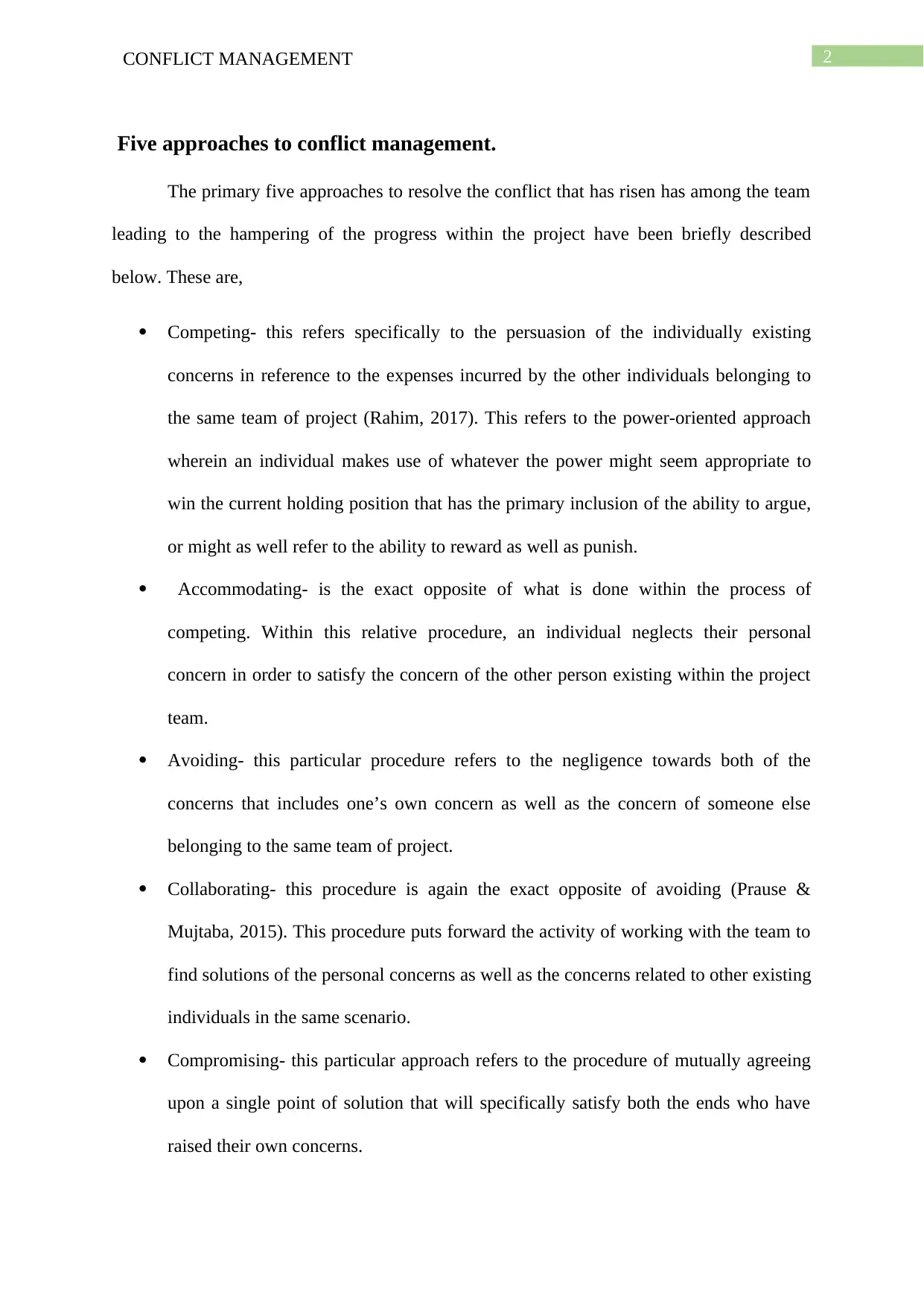
Five approaches to conflict management.
The primary five approaches to resolve the conflict that has risen has among the team
leading to the hampering of the progress within the project have been briefly described
below. These are,
Competing- this refers specifically to the persuasion of the individually existing
concerns in reference to the expenses incurred by the other individuals belonging to
the same team of project (Rahim, 2017). This refers to the power-oriented approach
wherein an individual makes use of whatever the power might seem appropriate to
win the current holding position that has the primary inclusion of the ability to argue,
or might as well refer to the ability to reward as well as punish.
Accommodating- is the exact opposite of what is done within the process of
competing. Within this relative procedure, an individual neglects their personal
concern in order to satisfy the concern of the other person existing within the project
team.
Avoiding- this particular procedure refers to the negligence towards both of the
concerns that includes one’s own concern as well as the concern of someone else
belonging to the same team of project.
Collaborating- this procedure is again the exact opposite of avoiding (Prause &
Mujtaba, 2015). This procedure puts forward the activity of working with the team to
find solutions of the personal concerns as well as the concerns related to other existing
individuals in the same scenario.
Compromising- this particular approach refers to the procedure of mutually agreeing
upon a single point of solution that will specifically satisfy both the ends who have
raised their own concerns.
Document Page
3CONFLICT MANAGEMENT
tabler-icon-diamond-filled.svg

Paraphrase This Document

Need a fresh take? Get an instant paraphrase of this document with our AI Paraphraser
Document Page
4CONFLICT MANAGEMENT
References
Prause, D., & Mujtaba, B. G. (2015). Conflict management practices for diverse
workplaces. Journal of Business Studies Quarterly, 6(3), 13.
Rahim, M. A. (2017). Managing conflict in organizations. Routledge.
chevron_up_icon
1 out of 5
circle_padding
hide_on_mobile
zoom_out_icon
[object Object]