Courage, Care, and Identity Exploration in 'April Raintree' Novel

Verified

Added on  2022/09/15

|5
|1310
|36
Essay
AI Summary
This essay delves into the themes of courage and care as depicted in Beatrice Culleton Mosionier's 'In Search of April Raintree,' focusing on the struggles of two Metis sisters, April and Cheryl, who are taken from their parents and placed in foster care. The analysis highlights how the sisters confront identity crises, racism, and internalized oppression, particularly in the context of historical Euro-Canadian dominance and cultural manipulation. The essay explores the significance of courage in overcoming self-hatred and societal pressures, referencing psychological theories and post-colonial concepts like mimicry to illustrate April's journey towards self-acceptance. Cheryl's suicide and the bond between the sisters serve as pivotal points in April's eventual embrace of her Metis heritage. The essay concludes that courage and care are essential for achieving self-love and pride in one's identity, echoing the novel's message about the importance of embracing one's true self.
Document Page
In Search of April Raintree
Courage and Care
tabler-icon-diamond-filled.svg

Paraphrase This Document

Need a fresh take? Get an instant paraphrase of this document with our AI Paraphraser
Document Page
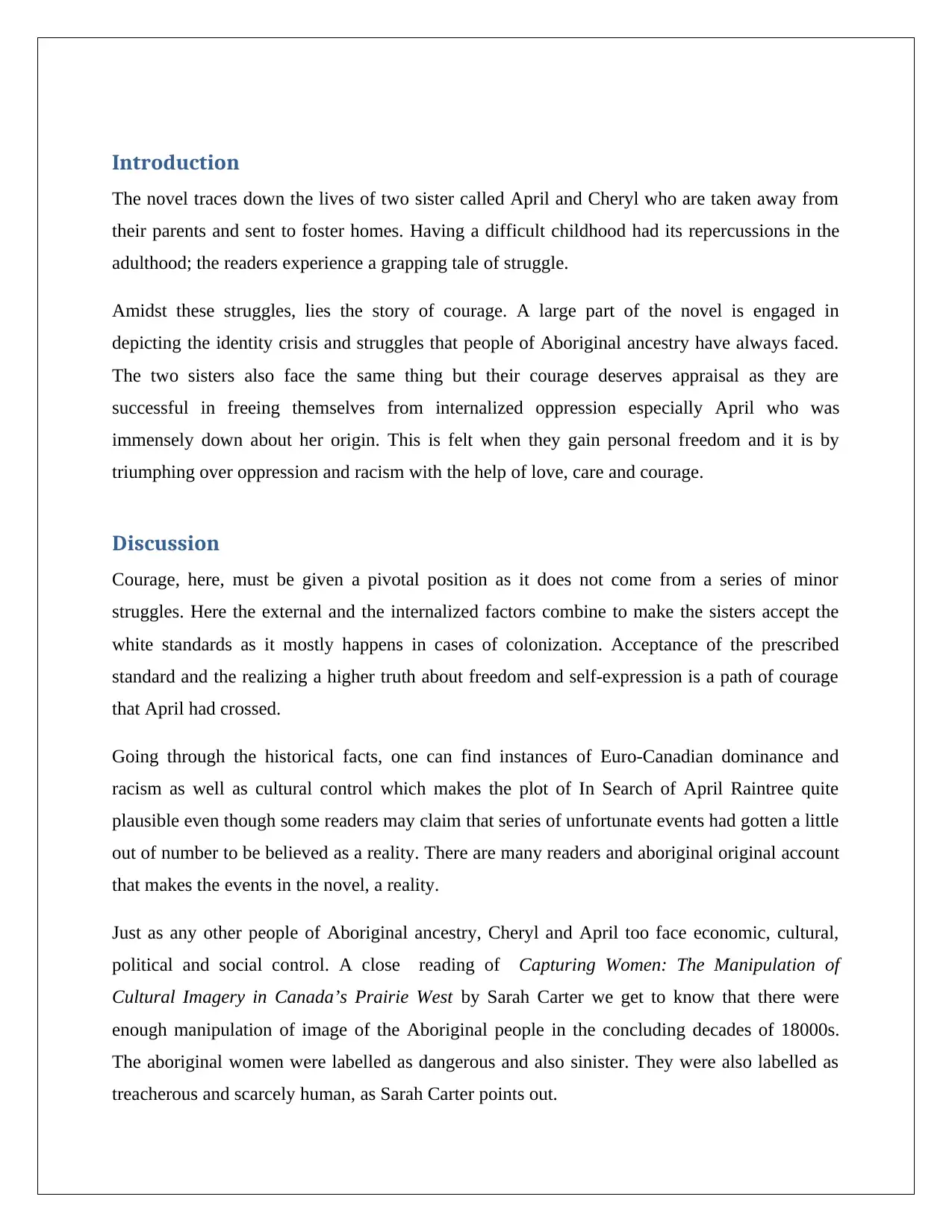
Introduction
The novel traces down the lives of two sister called April and Cheryl who are taken away from
their parents and sent to foster homes. Having a difficult childhood had its repercussions in the
adulthood; the readers experience a grapping tale of struggle.
Amidst these struggles, lies the story of courage. A large part of the novel is engaged in
depicting the identity crisis and struggles that people of Aboriginal ancestry have always faced.
The two sisters also face the same thing but their courage deserves appraisal as they are
successful in freeing themselves from internalized oppression especially April who was
immensely down about her origin. This is felt when they gain personal freedom and it is by
triumphing over oppression and racism with the help of love, care and courage.
Discussion
Courage, here, must be given a pivotal position as it does not come from a series of minor
struggles. Here the external and the internalized factors combine to make the sisters accept the
white standards as it mostly happens in cases of colonization. Acceptance of the prescribed
standard and the realizing a higher truth about freedom and self-expression is a path of courage
that April had crossed.
Going through the historical facts, one can find instances of Euro-Canadian dominance and
racism as well as cultural control which makes the plot of In Search of April Raintree quite
plausible even though some readers may claim that series of unfortunate events had gotten a little
out of number to be believed as a reality. There are many readers and aboriginal original account
that makes the events in the novel, a reality.
Just as any other people of Aboriginal ancestry, Cheryl and April too face economic, cultural,
political and social control. A close reading of Capturing Women: The Manipulation of
Cultural Imagery in Canada’s Prairie West by Sarah Carter we get to know that there were
enough manipulation of image of the Aboriginal people in the concluding decades of 18000s.
The aboriginal women were labelled as dangerous and also sinister. They were also labelled as
treacherous and scarcely human, as Sarah Carter points out.
Document Page
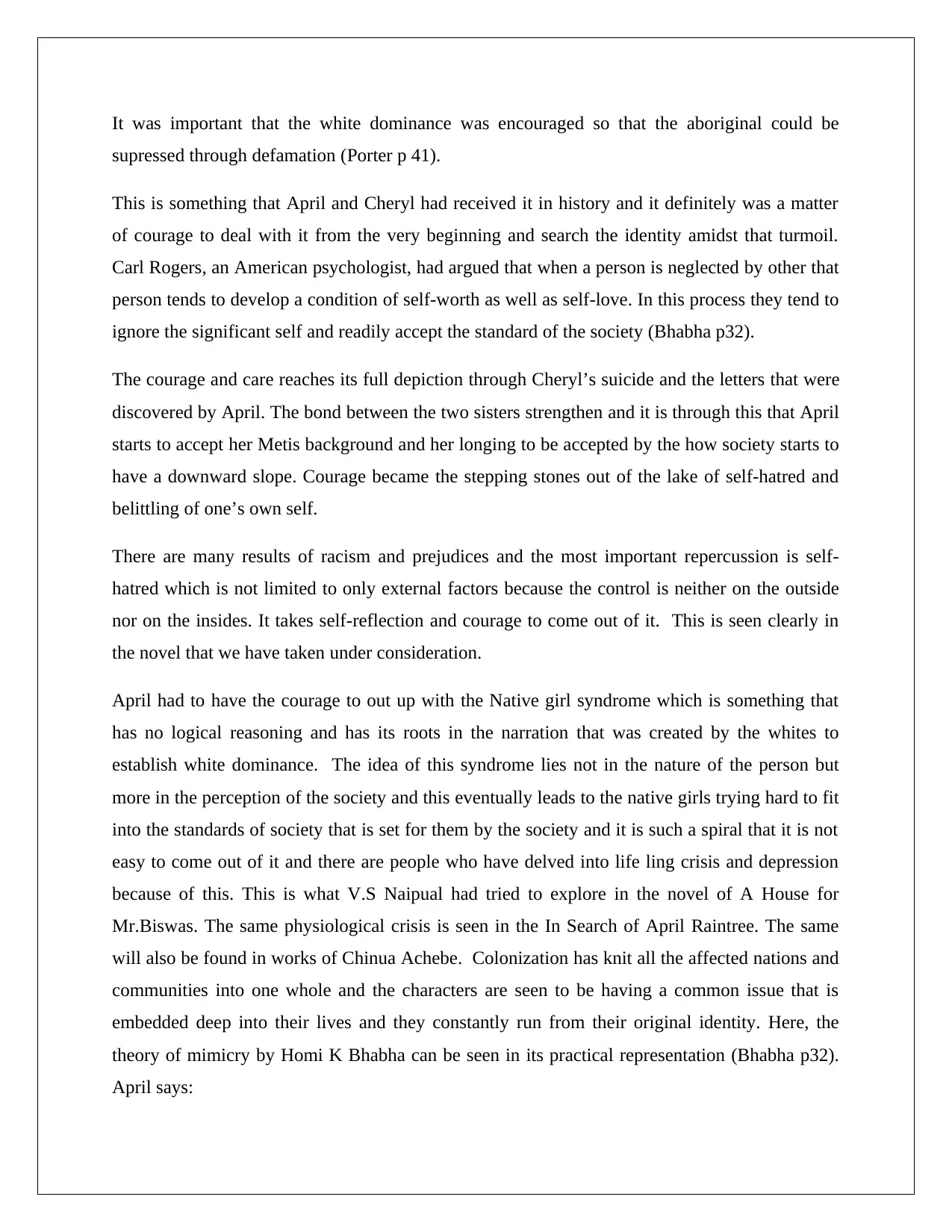
It was important that the white dominance was encouraged so that the aboriginal could be
supressed through defamation (Porter p 41).
This is something that April and Cheryl had received it in history and it definitely was a matter
of courage to deal with it from the very beginning and search the identity amidst that turmoil.
Carl Rogers, an American psychologist, had argued that when a person is neglected by other that
person tends to develop a condition of self-worth as well as self-love. In this process they tend to
ignore the significant self and readily accept the standard of the society (Bhabha p32).
The courage and care reaches its full depiction through Cheryl’s suicide and the letters that were
discovered by April. The bond between the two sisters strengthen and it is through this that April
starts to accept her Metis background and her longing to be accepted by the how society starts to
have a downward slope. Courage became the stepping stones out of the lake of self-hatred and
belittling of one’s own self.
There are many results of racism and prejudices and the most important repercussion is self-
hatred which is not limited to only external factors because the control is neither on the outside
nor on the insides. It takes self-reflection and courage to come out of it. This is seen clearly in
the novel that we have taken under consideration.
April had to have the courage to out up with the Native girl syndrome which is something that
has no logical reasoning and has its roots in the narration that was created by the whites to
establish white dominance. The idea of this syndrome lies not in the nature of the person but
more in the perception of the society and this eventually leads to the native girls trying hard to fit
into the standards of society that is set for them by the society and it is such a spiral that it is not
easy to come out of it and there are people who have delved into life ling crisis and depression
because of this. This is what V.S Naipual had tried to explore in the novel of A House for
Mr.Biswas. The same physiological crisis is seen in the In Search of April Raintree. The same
will also be found in works of Chinua Achebe. Colonization has knit all the affected nations and
communities into one whole and the characters are seen to be having a common issue that is
embedded deep into their lives and they constantly run from their original identity. Here, the
theory of mimicry by Homi K Bhabha can be seen in its practical representation (Bhabha p32).
April says:
Document Page
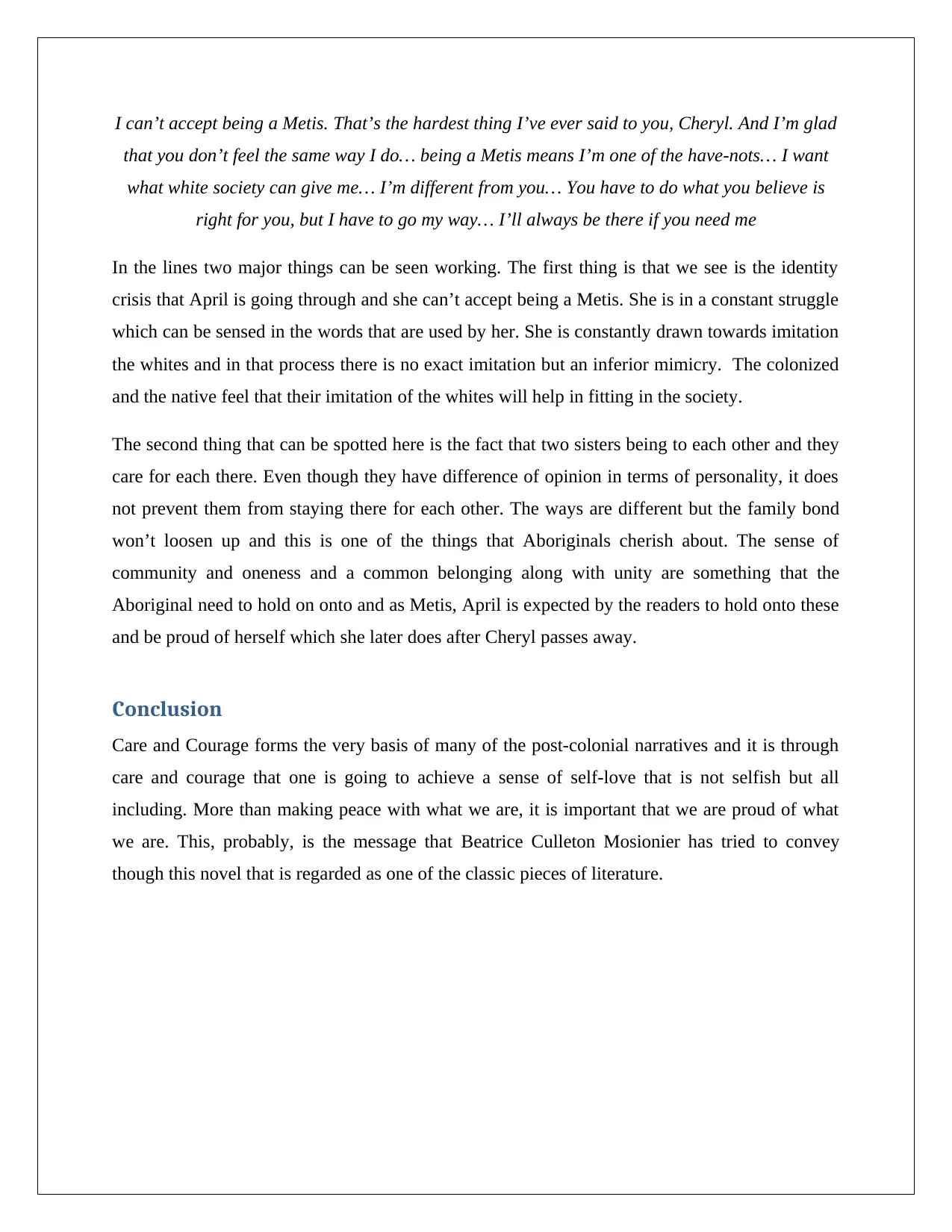
I can’t accept being a Metis. That’s the hardest thing I’ve ever said to you, Cheryl. And I’m glad
that you don’t feel the same way I do… being a Metis means I’m one of the have-nots… I want
what white society can give me… I’m different from you… You have to do what you believe is
right for you, but I have to go my way… I’ll always be there if you need me
In the lines two major things can be seen working. The first thing is that we see is the identity
crisis that April is going through and she can’t accept being a Metis. She is in a constant struggle
which can be sensed in the words that are used by her. She is constantly drawn towards imitation
the whites and in that process there is no exact imitation but an inferior mimicry. The colonized
and the native feel that their imitation of the whites will help in fitting in the society.
The second thing that can be spotted here is the fact that two sisters being to each other and they
care for each there. Even though they have difference of opinion in terms of personality, it does
not prevent them from staying there for each other. The ways are different but the family bond
won’t loosen up and this is one of the things that Aboriginals cherish about. The sense of
community and oneness and a common belonging along with unity are something that the
Aboriginal need to hold on onto and as Metis, April is expected by the readers to hold onto these
and be proud of herself which she later does after Cheryl passes away.
Conclusion
Care and Courage forms the very basis of many of the post-colonial narratives and it is through
care and courage that one is going to achieve a sense of self-love that is not selfish but all
including. More than making peace with what we are, it is important that we are proud of what
we are. This, probably, is the message that Beatrice Culleton Mosionier has tried to convey
though this novel that is regarded as one of the classic pieces of literature.
tabler-icon-diamond-filled.svg

Paraphrase This Document

Need a fresh take? Get an instant paraphrase of this document with our AI Paraphraser
Document Page
References
Bhabha, Homi K. The location of culture. routledge, 2012.
Porter, Libby. Unlearning the colonial cultures of planning. Routledge, 2016.
chevron_up_icon
1 out of 5
circle_padding
hide_on_mobile
zoom_out_icon
[object Object]