APY3703 - Understanding the Phenomena of Ritual: An Analysis

Verified

Added on  2023/06/08

|7
|1450
|229
Essay
AI Summary
This essay delves into the phenomena of ritual in contemporary society, addressing five key questions. It differentiates between a ritualist and a ritologist according to Ron Grimes, highlighting Grimes' emphasis on the process of rituals rather than just their occurrence. The essay further explores the principle difference between liminality in ritual and liminoid events, drawing on Turner's work and emphasizing the obligatory nature of liminality versus the optional nature of liminoid events. Turner's three manifestations of Sacra—deeds, demonstrations, and instructions—are examined, with examples from the Ndembu community and Vhusha rituals. The reasons why some Venda speaking women are critical of the Vhusha Ritual are also discussed. Finally, the essay argues that the Olympic Games can be considered a form of ritual, pointing to the opening ceremony, the sacred flame, and the Olympic flag as symbolic components. The essay concludes by reiterating the importance of rituals in reflecting human experience and acting as a subject of social and cultural analysis.
Document Page
1
Running head: THE PHENOMENA OF RITUAL
The Phenomena of Ritual
Student’s Name
Institution Affiliation
tabler-icon-diamond-filled.svg

Paraphrase This Document

Need a fresh take? Get an instant paraphrase of this document with our AI Paraphraser
Document Page
2
THE PHENOMENA OF RITUAL
Introduction
The concept ritual is inevitable in our society as it is a system of activities involving
objects, words, and gestures, and it is practiced in a seized place according to the system settings.
Typically, rituals are a component of human culture. For example, a religious community can
prescribe a ritual. Rituals in our society reflect the multiplicity of human experience in particular
expertise (Blommaert, & Varis, 2015). Also, a ritual is a universal aspect that is practiced both
within and between cultures. Moreover, ritual plays a critical role in the field of anthropology as
it acts as an entity of social, cultural analysis. The paper will answer five questions about the
phenomena of rituals in our contemporary society.
Question One
Difference Between a Ritualist and a Ritologist According to Ron Grimes
According to Ron Grimes, the most critical thing about rituals is how they happen and
not the fact that they happen. Grimes has played a prominent role in the field of anthropology as
he has contributed a valuable set methodology in understanding the concept of rituals. The
method has three stages; the first stage is identifying rituals at this stage one has to understand
what ritual is. The second stage is mapping the ritual concept which is very critical according to
Grimes, and the final step is ritualization. According to Ron Grimes ritualist are people who
participate in ritual activities while Ritologist are people who study ritual actions and procedures.
Question Two
The Principle Difference Between Liminality in Ritual and Liminoid Events
Document Page
3
THE PHENOMENA OF RITUAL
According to Turner Liminality is a transition stage of a specific ritual, for instance, the
nature of initiation. Turner in his study was interested in how people handle symbol, what rituals
does and how routines work. Turner argues that during the period of transition an individual is
secluded in everyday life activities. Turner in his understanding of Liminality in rituals he
compared tribal societies with western societies. He noted that the sensitivities of leisure, work,
and play differ between the two communities. The principle difference between Liminality and
Liminoid is that Liminality is obligatory in the society while Liminoid is optional. Typically,
participating in a Liminal ritual earns an individual status or property in a community while non-
participants are excluded, and they get no reward (Cohen, 2015). On the other, hand participating
in Liminoid ritual activities, such as Carnivals festival does not call for rewards or exclusion.
Also, Turner argued that Liminal aspects encompass the total social process in a defined
community while Liminoid elements are experimental and independent of the whole.
Question Three
Ritual Sacra Three Manifestations
According to Turner Sacra refers to the figurative model of the whole structure of values
and beliefs in a defined culture. He argues that Sacra is the sentiment of liminal materials.
Moreover, sacra play a vital role in the process of ritual as it is a place where liminal unfolds,
and it prevents the outcome of Liminal from disrupting the entire social structure in which it's
taking place (Kemper, 2016). Typically, there are three manifestations of Sacra. Sacra is
manifested as deeds or actions that which is done, demonstration that which is displayed, and
instructions that which is said.
Document Page
4
THE PHENOMENA OF RITUAL
Demonstrations
In the manifestation of Sacra, demonstrations take the system of objects such as
exhibitions of masks, saints, gods, and drums. For example, Turner used the Ndembu community
to understand how Sacra is manifested in the form of initiation masks (Richards, 2015). In this
case, the costumes are not meant to scare people but to focus on the process of initiation.
Instructions
Instructions refer to a step by step procedure that the ritualist says when they are
practicing the act. An example of a medium of instructions is mythology and revelation of
reality. A direction is significant in the manifestation of Sacra because it is through the
instruction that the action takes place (Robbins, 2015).
Actions
Actions are one of the manifestations of Sacra it is that which is done. For example,
dancing and singing at the Vhusha Rituals mark the opening of the ceremony.
Question Four
Reasons why some Venda Speaking Women are Critical of the Vhusha Ritual
Vhusha is a formality attended by Venda girls who have had their first mentation. Vhusha
ceremony plays a critical role among the girls in the community as young girls are taught about
etiquette and good behavior (Tavor, 2015). The ritual has strict rules where only virgins were
allowed to participate in the ceremony. The primary goal of the tradition was to teach mature
girls how to relate with their senior with respect and etiquette. The reason why Vhusha ritual was
tabler-icon-diamond-filled.svg

Paraphrase This Document

Need a fresh take? Get an instant paraphrase of this document with our AI Paraphraser
Document Page
5
THE PHENOMENA OF RITUAL
critical among the Venda women is that they were taught about sexual intercourse and that it was
only practiced among the married people. The ceremony ensured that mature girls were educated
on matters about sexual activities. Also, through the ceremony, mature girls acquired their
identity. For example, they were taught about their roles as women and even to understand their
status in the society.
Question Five
Olympic game is an international multi-sport held after every four years. Olympic games
got its roots in Olympia Greece that was inspired by the ancient Olympic sports (Giulianotti,
2015). The Olympic games have promoted unity across the globe as different people from
different cultures meet and interact. It is clear that Olympic games are a form of ritual as its
opening is marked by an artistic program the opening ceremony. The sacred flame of the game is
a component of a ritual (Jirásek, 2015). A flame is a form of a symbol that represents the
Olympic movement. Usually, the fire is lit at the beginning of the game, and it burns and snuffed
at the closing ceremony. Also, the component of ritual that exists in the game is the carrying of
the Olympic flag which is symbolic it has a white background and blue, yellow, black green and
red rings interlaced together. The flag represents five continents of the globe.
Conclusion
Rituals in our society reflect the multiplicity of human experience in particular expertise.
Also, ritual is a universal aspect that is practiced both within and between cultures. Ritual plays a
critical role in the field of anthropology as it acts as an entity of social, cultural analysis. Lastly,
Document Page
6
THE PHENOMENA OF RITUAL
the concept ritual is inevitable in our society as it is a system of activities practiced in our day to
day activities.
Document Page
7
THE PHENOMENA OF RITUAL
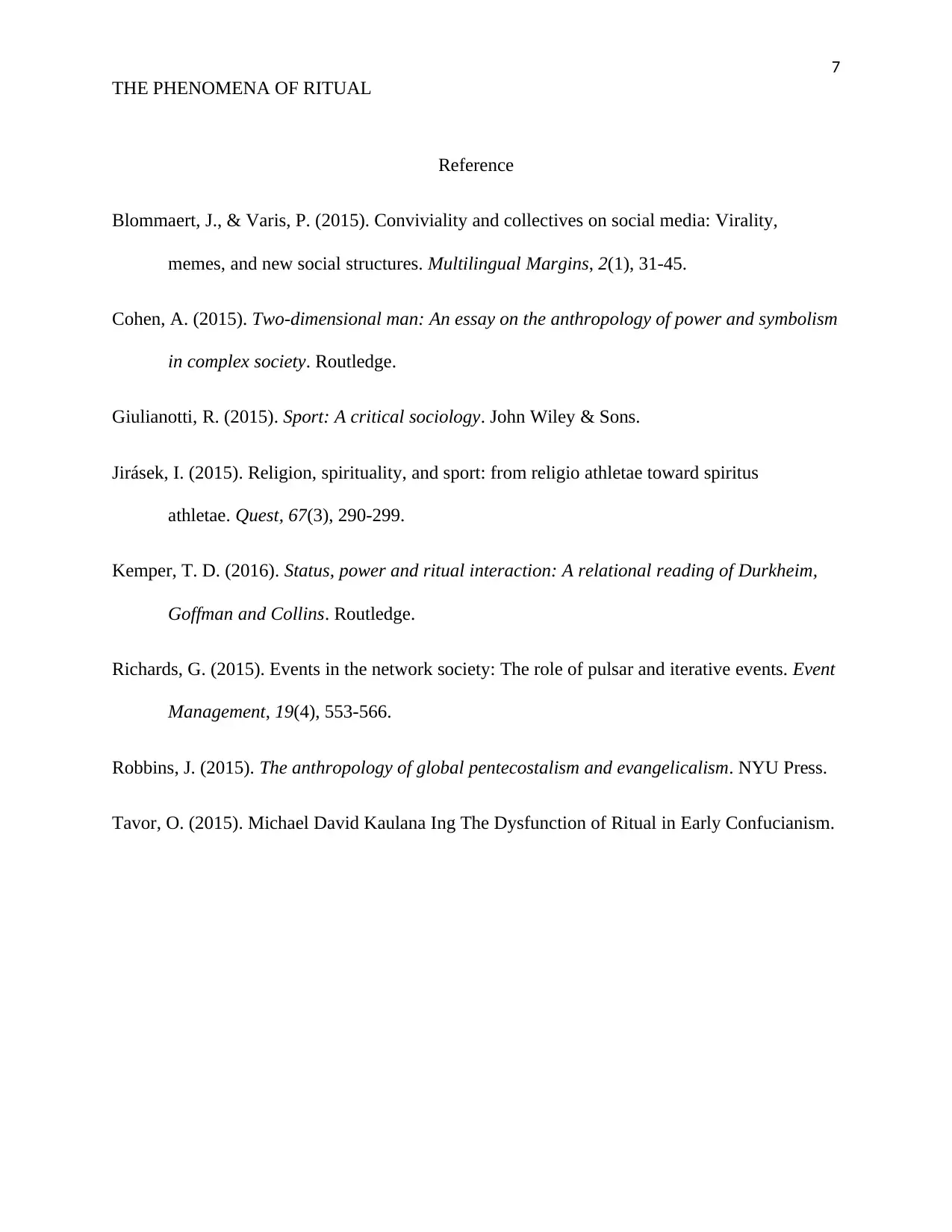
Reference
Blommaert, J., & Varis, P. (2015). Conviviality and collectives on social media: Virality,
memes, and new social structures. Multilingual Margins, 2(1), 31-45.
Cohen, A. (2015). Two-dimensional man: An essay on the anthropology of power and symbolism
in complex society. Routledge.
Giulianotti, R. (2015). Sport: A critical sociology. John Wiley & Sons.
Jirásek, I. (2015). Religion, spirituality, and sport: from religio athletae toward spiritus
athletae. Quest, 67(3), 290-299.
Kemper, T. D. (2016). Status, power and ritual interaction: A relational reading of Durkheim,
Goffman and Collins. Routledge.
Richards, G. (2015). Events in the network society: The role of pulsar and iterative events. Event
Management, 19(4), 553-566.
Robbins, J. (2015). The anthropology of global pentecostalism and evangelicalism. NYU Press.
Tavor, O. (2015). Michael David Kaulana Ing The Dysfunction of Ritual in Early Confucianism.
chevron_up_icon
1 out of 7
circle_padding
hide_on_mobile
zoom_out_icon
[object Object]