Architecture Design Technology Report: Payment and Depreciation

Verified

Added on  2020/05/16

|25
|4919
|100
Report
AI Summary
This report delves into the financial aspects of architecture design technology, covering key areas such as payment methods, depreciation techniques, and tendering processes. It begins by discussing the financial benefits of regular contractor payments and the importance of retention, outlining reasons for holding back funds on behalf of the client. The report then explores various methods of valuing works for payment, including DCF analysis and comparable company analysis. A practical calculation of an interim certificate is provided, followed by a detailed flowchart illustrating the procedure for obtaining quotes, commissioning suppliers, and making payments. The report further analyzes depreciation methods, specifically focusing on the straight-line method for a JCB, with graphical results and a discussion of the reducing balance method as an alternative. Finally, it examines the PQQ process, highlighting its importance and benefits, and contrasts competitive pricing with negotiated tendering, outlining their respective advantages. This comprehensive analysis provides valuable insights into the financial management of construction projects.
Document Page
Architecture Design Technology 1
ARCHITECTURE DESIGN TECHNOLOGY.
By Name
Course
Instructor
Institution
Location
Date
tabler-icon-diamond-filled.svg

Paraphrase This Document

Need a fresh take? Get an instant paraphrase of this document with our AI Paraphraser
Document Page
Architecture Design Technology 2
Question 1.
a.
When a contractor receives regular payments throughout the duration of the contract several
financial benefits come on board. Such financial benefits are further discussed in the following
paragraphs.
This type of payment allows the contractor to conduct their program in such a way that they
ensure they obtain regular payments that can be forecasted easily (Quartel, 2012).
It also saves the contractor from the need for expensive measurement of the works in
progress.
By simply monitoring cash flow, senior management and the other stakeholders will be able
to see and monitor the project progress. This helps them to notice difficulties and challenges
earlier (Iacob, 2012).
It offers a clear plan for rewarding work. Thus, becomes easy for the parties involved to
clearly understand the relationship between payment and performance. This boosts confidence in
the contract (Li, 2013).
The client will benefit tremendously as the contractor is encouraged to make progress by the
regular payments.
Regular payments significantly lower the costs for contractors and consultants. This is
because splitting the contract into many stages decreases the cost of the contract.
Document Page
Architecture Design Technology 3
Finally, the cost of administration is significantly lowered by removing the valuations of
unfixed materials or incomplete work as well as the aggregation of trade subcontractors claims
by the main contractor (Zhang, 2012).
b.
Importance of retention and reasons in which money is held back on behalf of the client.
Retention assures the owner of a project that the project that the contractor has signed and
agreed to work on will be completed for the contractor to be paid for the job fully. This is
because a retention agreement allows for a retention of between 5 to 10 percent of until the job is
done as agreed (Song, 2010).
Similarly, the other huge benefit that comes with retention is the items on the punch list.
A punch list is a list that contains the items that need fixing after the contractor completes the
job. Retention allows for the full completion of the items appearing on the punch list, or the
items’ list that will vary after project completion. This is important because it not only ensures
the project completion but also checks on the quality of work (Brown, 2013).
Money of between 5 to 10% is held back on behalf of the client when the agreed project
is not completed as agreed between the contractor and the owner, as well as when the items on
the punch list are not completed by the contractor as the law requires (Gimpelevich, 2011).
Document Page
Architecture Design Technology 4
c.
Methods of valuing works for payment
i. DCF analysis.
It is performed by building a financial model in excel and needs an extensive amount of detail
and analysis. It is usually the most detailed of the approaches, needs the most assumptions and
often generates a high value. The effort needed for preparing a DCF model will result in a most
accurate valuation (Mathews, 2011).
ii. Comparable company analysis
It is a relative method of valuation whereby you compare the current value of a business to other
similar businesses by looking at trading multiples (Quartel, 2010).
Question 2.
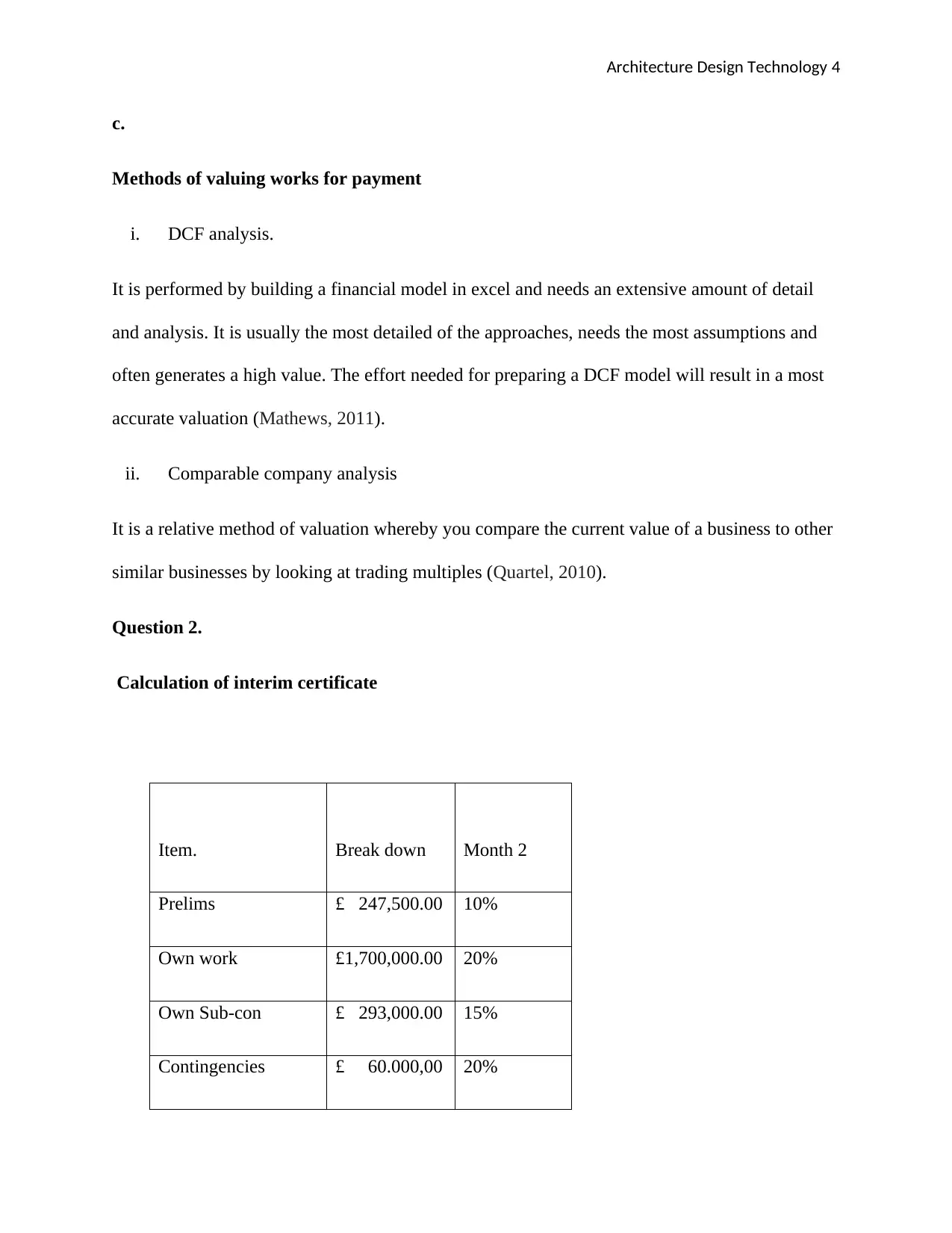
Calculation of interim certificate
Item. Break down Month 2
Prelims £ 247,500.00 10%
Own work £1,700,000.00 20%
Own Sub-con £ 293,000.00 15%
Contingencies £ 60.000,00 20%
tabler-icon-diamond-filled.svg

Paraphrase This Document

Need a fresh take? Get an instant paraphrase of this document with our AI Paraphraser
Document Page
Architecture Design Technology 5
Nom Sub-Con £ 695,000.00 25%
Nom Suppliers £ 282,500.00 20%
Day Works £ 32,000,00 Nil
Contract value £ 247,500.00
Question 3.
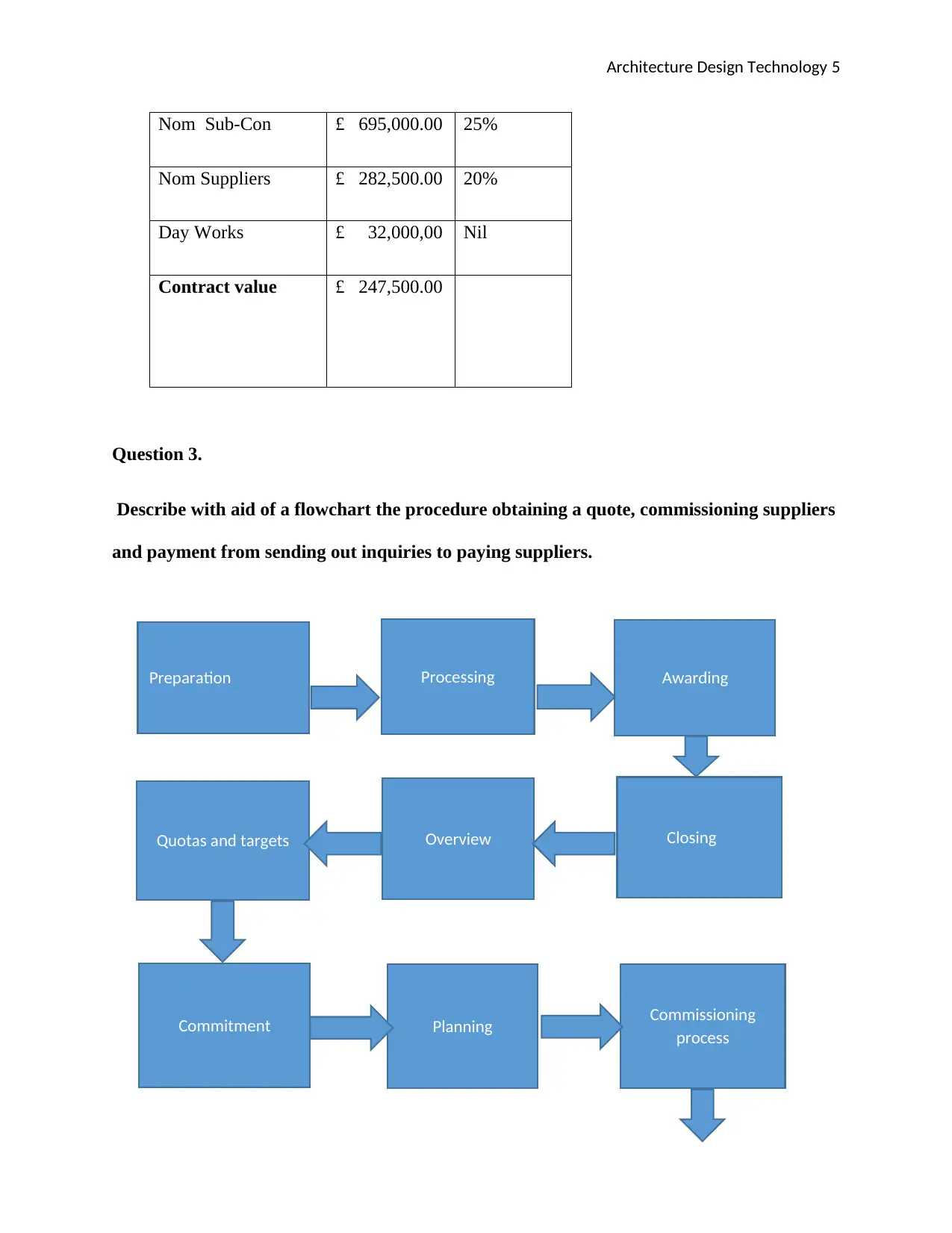
Describe with aid of a flowchart the procedure obtaining a quote, commissioning suppliers
and payment from sending out inquiries to paying suppliers.
Preparation Processing Awarding
Quotas and targets Overview Closing
Commitment Planning Commissioning
process
Document Page
Architecture Design Technology 6
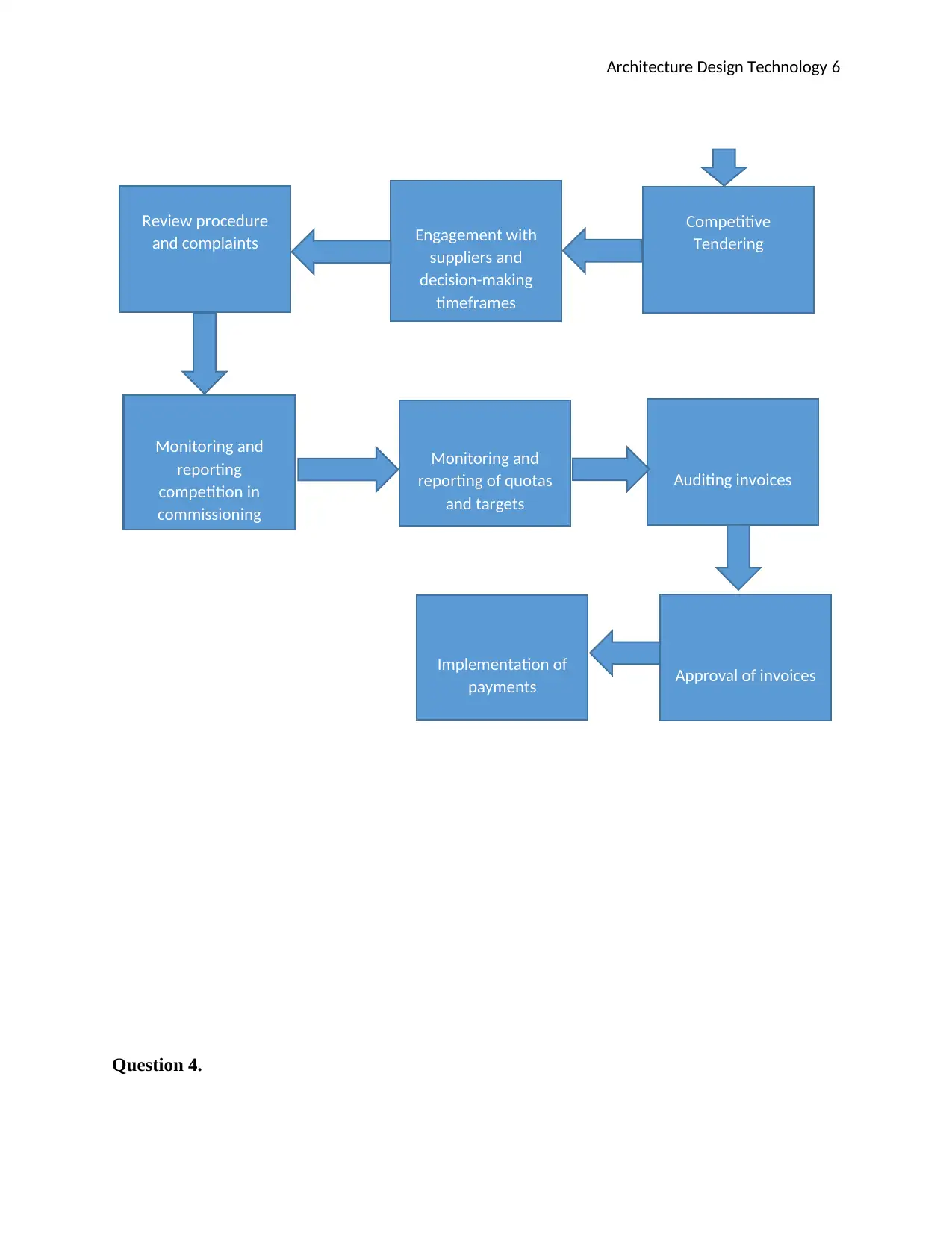
Question 4.
Competitive
Tendering
Engagement with
suppliers and
decision-making
timeframes
Review procedure
and complaints
Monitoring and
reporting
competition in
commissioning
Monitoring and
reporting of quotas
and targets
Auditing invoices
Approval of invoices
Implementation of
payments
Document Page
Architecture Design Technology 7
You have purchased a standard JCB for £95,000. The borrowed funds will be paid back
over a period of 7 years; interest will be calculated at 4% above base rate for a commercial
loan per annum.
Analyze a form of depreciation that you would consider the best way in which to write the
plant down after its expectant life.
We will use the straight-line method of calculating depreciation to write the plant down
after its useful life.
Straight-line depreciation method is a method that gradually but steadily and uniformly
reduces the value of a fixed asset throughout its expectant life. This method studies the
consumption pattern of the asset in question and is to be used when there exists no specific
pattern to the manner in which the asset is to be exhausted over time (Lankhorst, 2010).
Here the depreciation expense charged to the income statement in each of the given
periods is equal, hence the carrying amount of the asset on the balance sheet records depreciates
in a straight line (Alaeddini, 2013).
The straight line method of calculating depreciation the most commonly used method due
to its nature of simplicity. Principles of accounting require firms to depreciate the fixed assets
using a method that effectively reflects the patterns that the assets are being used and depreciated
(Doloi, 2011).
The following outlined steps are the steps used to arrive at the depreciation value of a
fixed asset using the straight-line method:
tabler-icon-diamond-filled.svg

Paraphrase This Document

Need a fresh take? Get an instant paraphrase of this document with our AI Paraphraser
Document Page
Architecture Design Technology 8
Find out the original cost of the fixed asset. This can be done by referring to the receipts
of the asset when it was purchased (Poort, 2012).
If there exists an estimated scrap value of the fixed asset, subtract it from the initial cost
recorded in the books (Bing-jun, 2010).
Find out the expectant life of the fixed asset. It is recommended to use a standard
expectant life for each class of fixed assets (Martin, 2013).
Divide the expectant life to attain the straight line depreciation rate.
Finally, find the product of the asset costa and the depreciation rate.
After calculation, record the depreciation expense on the records of accounting as a debit to
the depreciation account but a credit to the accumulated depreciation account (Leger, 2013).
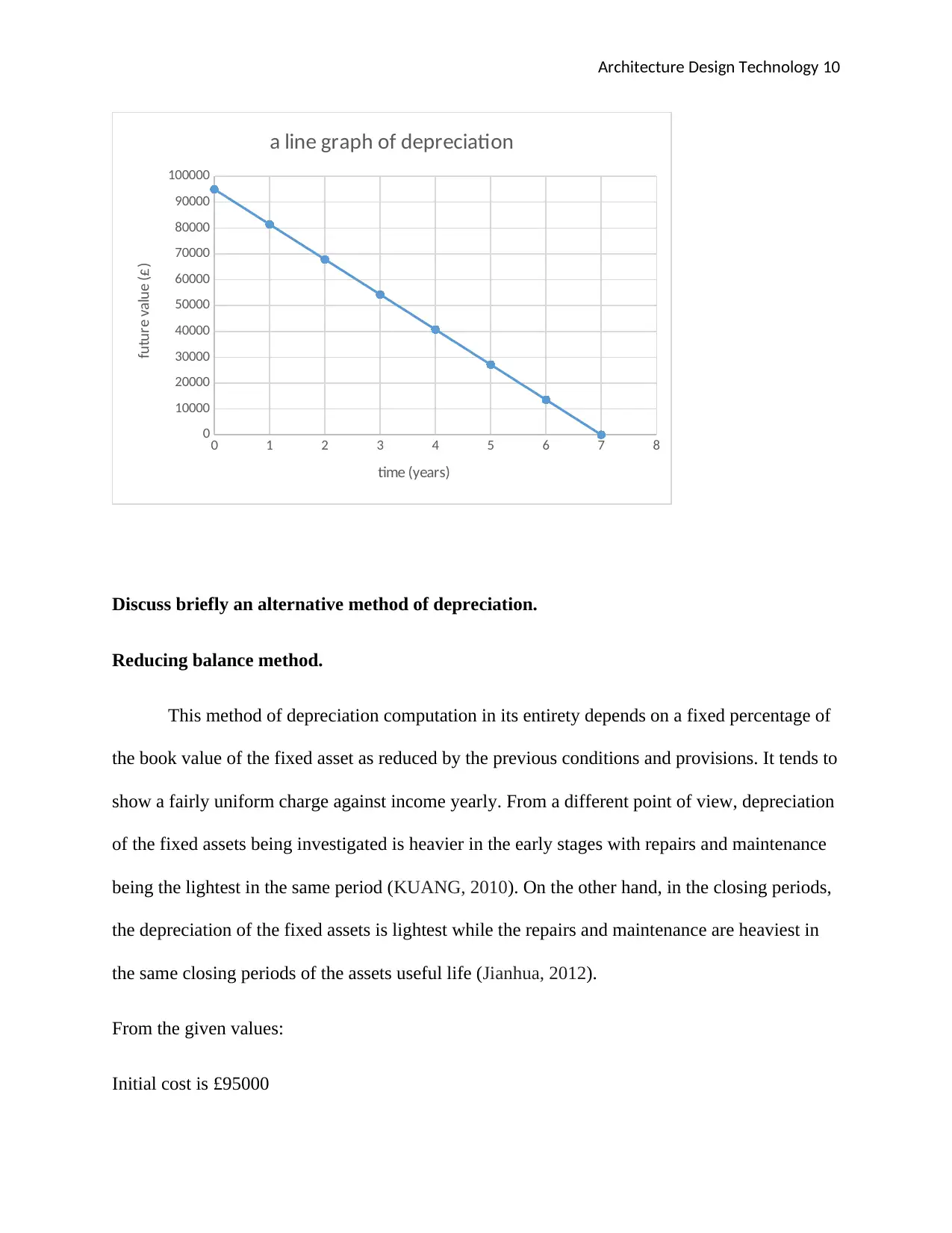
Prove all your results graphically along with any calculations you have arrived at.
Calculation of depreciation
Initial cost is £95000
Salvage value is £0
Expectant life is 7 years
Depreciable asset cost = initial cost – salvage value
£95000- £0
=£95000
Depreciation rate per annum = 1/7×100%
14.286%
Document Page
Architecture Design Technology 9
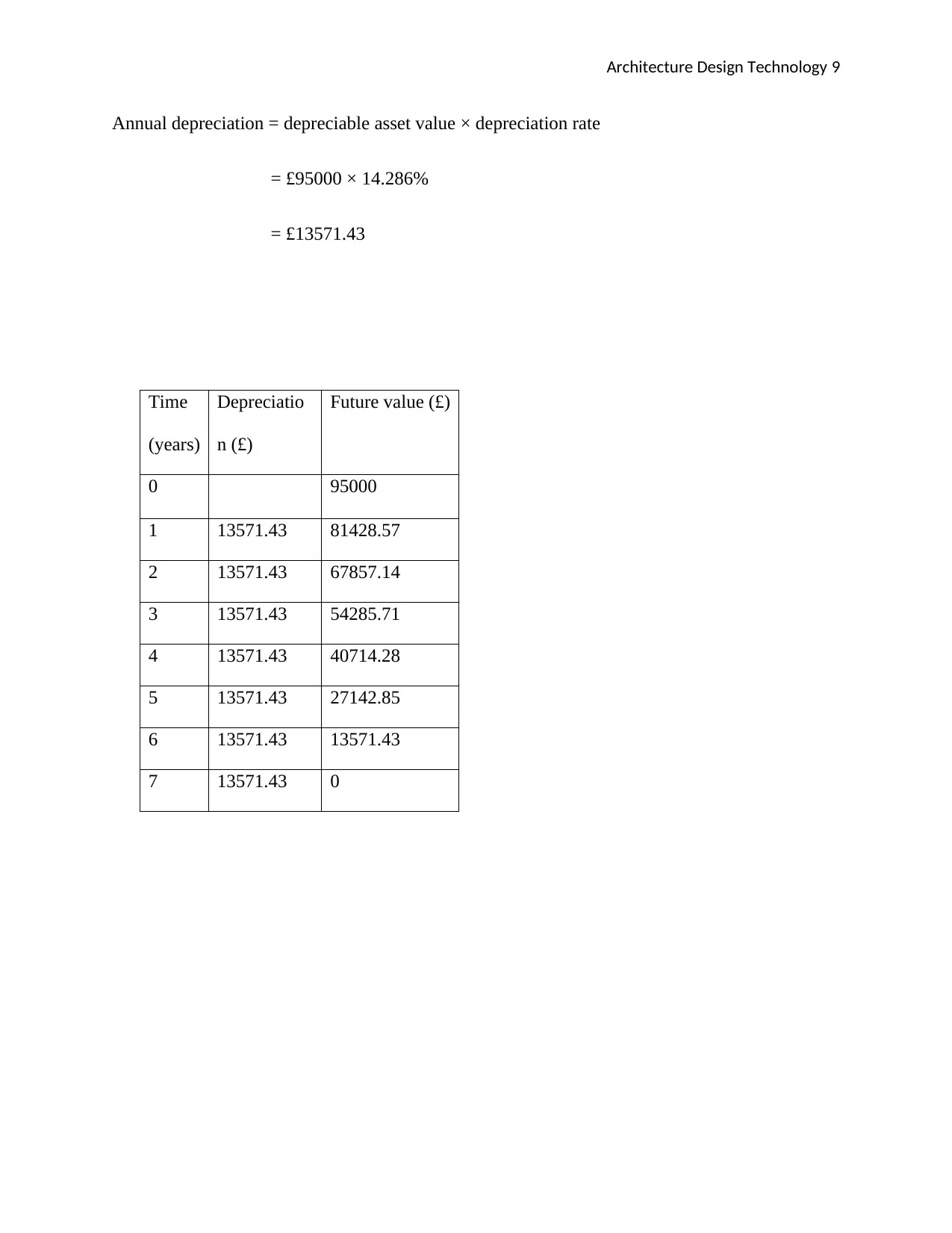
Annual depreciation = depreciable asset value × depreciation rate
= £95000 × 14.286%
= £13571.43
Time
(years)
Depreciatio
n (£)
Future value (£)
0 95000
1 13571.43 81428.57
2 13571.43 67857.14
3 13571.43 54285.71
4 13571.43 40714.28
5 13571.43 27142.85
6 13571.43 13571.43
7 13571.43 0
Document Page
Architecture Design Technology 10
0 1 2 3 4 5 6 7 8
0
10000
20000
30000
40000
50000
60000
70000
80000
90000
100000
a line graph of depreciation
time (years)
future value (£)
Discuss briefly an alternative method of depreciation.
Reducing balance method.
This method of depreciation computation in its entirety depends on a fixed percentage of
the book value of the fixed asset as reduced by the previous conditions and provisions. It tends to
show a fairly uniform charge against income yearly. From a different point of view, depreciation
of the fixed assets being investigated is heavier in the early stages with repairs and maintenance
being the lightest in the same period (KUANG, 2010). On the other hand, in the closing periods,
the depreciation of the fixed assets is lightest while the repairs and maintenance are heaviest in
the same closing periods of the assets useful life (Jianhua, 2012).
From the given values:
Initial cost is £95000
tabler-icon-diamond-filled.svg

Paraphrase This Document

Need a fresh take? Get an instant paraphrase of this document with our AI Paraphraser
Document Page
Architecture Design Technology 11
Salvage value is £0
Expectant life is 7 years
Depreciable asset cost = initial cost – salvage value
£95000- £0
=£95000
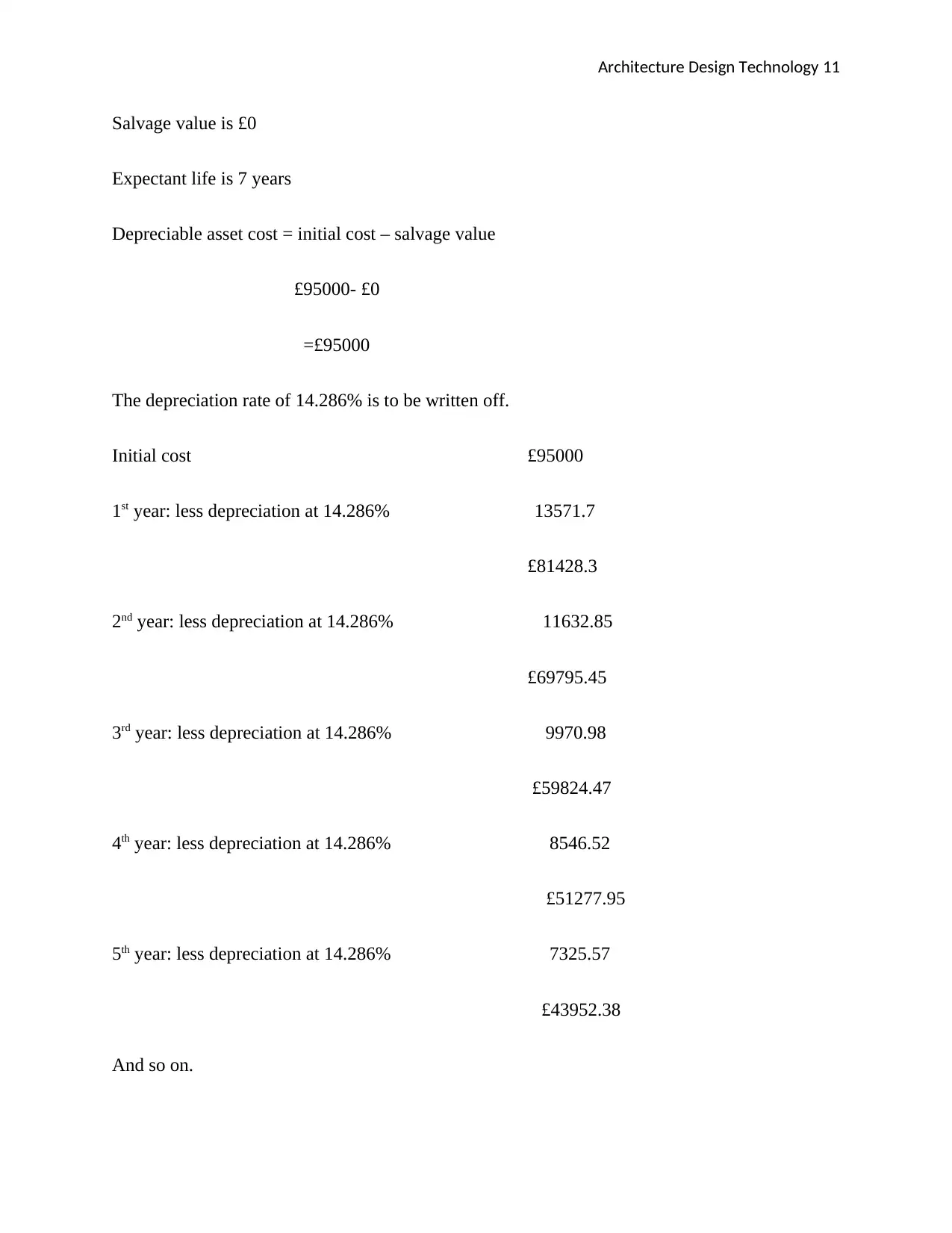
The depreciation rate of 14.286% is to be written off.
Initial cost £95000
1st year: less depreciation at 14.286% 13571.7
£81428.3
2nd year: less depreciation at 14.286% 11632.85
£69795.45
3rd year: less depreciation at 14.286% 9970.98
£59824.47
4th year: less depreciation at 14.286% 8546.52
£51277.95
5th year: less depreciation at 14.286% 7325.57
£43952.38
And so on.
Document Page
Architecture Design Technology 12
Thereafter, regardless of the method used, the ledger values are debited to the
depreciation account, and in due course, the balance is taken to the profit and loss account. The
asset account and the provision for depreciation are credited (Kongling, 2010). However, it is
preferable to ignore the former and credit the latter since the balance sheet of a limited company
is needed to exhibit the fixed assets at costs less the aggregate amount available for depreciation.
The parties involved such as the shareholders of a company, can argue basing their opinions on
the data given on the balance sheet concerning the adequacy of the provisions for depreciation.
In the event that the value of depreciation is credited to the asset account, the asset cost is
reduced annually until it varnishes, and the consequence is that the initial cost is obscured (Fei,
2011).
Question 5.
a.
PQQ is known as a prequalification questionnaire, a document that provides a series of
questions for the potential tenderers concerning their levels of experience, financial ability, and
their general capacity. The answers to the above questions enable the client to write a short list of
suppliers who qualify for the project in question, after which the shortlisted individuals may be
invited for tender. As discussed below are the importance of the information recorded in the
PQQ (Tsikalakis, 2011).
Using a PQQ enables the client to minimize the amount of evaluation work required. This
is due to the fact that a PQQ gives a more detailed information that other methods would not
offer. In addition, a more qualitative evaluation work is achieved in spite of the fact that the
amount of the work is reduced (Baldwin, 2010).
chevron_up_icon
1 out of 25
circle_padding
hide_on_mobile
zoom_out_icon
[object Object]