Architecture Design Project on Timber: Material Analysis and Design

Verified

Added on  2023/01/13

|12
|1774
|80
Project
AI Summary
This architecture design project provides a comprehensive analysis of timber as a building material, fulfilling the requirements of an Advanced Technology module. The project begins with an introduction to timber, defining its characteristics and highlighting its suitability for construction. It then delves into the production process, from felling trees to seasoning the wood. The project thoroughly examines the properties of timber, including color, odor, moisture content, shrinkage, strength, and the presence of defects, emphasizing its anisotropic nature. Sustainability is a key focus, exploring timber's renewable nature, low carbon impact, and contribution to pollution reduction, along with its role in carbon storage and biodiversity conservation. The project includes detailed case studies of built precedents, such as The Timber House and Abraham Darby Sports and Learning Community, analyzing their construction principles and typologies. A comparative analysis of timber versus concrete is also provided. The project concludes with a discussion of the timber design process and the inclusion of a timber frame diagram. References to relevant literature are provided throughout.
Document Page
Architecture design project 1
ARCHITECTURE DESIGN PROJECT
By Name
Course
Instructor
Institution
Location
Date
tabler-icon-diamond-filled.svg

Paraphrase This Document

Need a fresh take? Get an instant paraphrase of this document with our AI Paraphraser
Document Page
Architecture design project 2
TIMBER
Introduction
Timber refers to the wood which is suitable for carpentry, building or any other engineering
purposes. Timber has many essential attributes such as its attractive appearance and warm
texture which makes it suitable to be used for internal finishing as well for the main structure.
Timber is easy and flexible to work with and it can be produced in a wide range of shapes and
sizes (Adegoke, 2012, p. 563).
Production of timber (how it is made)
Timber is obtained from the trees. The process of producing timber involves felling trees and
then cut into small lengths on site before they are loaded into trucks and Lorries to be transported
to processing sites. In the processing site the logs are debarked and bucked whereby they are cut
into the required sizes (Gutkowski, 2016, p. 81). By use of different equipment they are cut into
boards and finally seasoned whereby excess water is removed.
Properties of timber
The following are the main properties of timber used in construction:
i) Color and odor
Different types of timber have different unique odor and colour for example the freshly cut teak
timber has a brown colour while the walnut timber has a general dark colour. The softwoods
timber such as pine and deodar displays a white colour (Yeomans, 2016, p. 68).
ii) Moisture content
Document Page
Architecture design project 3
All types of timber are porous to a certain extent. Also, all types of timber are hygroscopic.
Timber gains moisture content obtained from the atmosphere and at the same time loses moisture
depending on the amount of amount moisture available in their cells (Herzog, 2017, p. 69).
iii) Shrinkage and swelling
Timber losses moisture when newly cut and subject to drying. On drying, the timber undoes a
shrinkage. In the same way dry wood or timber on getting rained on they get wetted or melted
and undergoes considerable swelling (Khatib, 2017, p. 781).
iv) Strength
The most essential fact regarding to timber is that, its strength is not equal in all directions. This
has been attributed to the fact that wood is anisotropic material i.e. it has different structure in
different directions (Sunley, 2018, p. 763)
v) Presence of defects
There may be some of the artificial and natural defects in timber for instance the knots, cross-
grain and shakes. Presence of defects in timber reduces the strength of timber.
vi) Compressive strength
Timber from different types of tress are amazingly strong under the compressive loads -
500kg/cm2 to 700kg/cm2
vii) Tensile strength
Timber is known to be very strong to the tensile forces which at parallel to the grain but very
weak when these forces are made to act perpendicular to the grain. Hence the tensile
strength of majority of the timber rangers from 500 – 2000 kg/cm2 parallel to the grain.
Document Page
Architecture design project 4
Sustainability
Timber/ wood is widely used in many parts of the world because of its efficiency, durability, and
usefulness. One of the most important attribute of wood is that it is a renewable resource, it
has a low carbon impact and a low embodies energy hence they contribute to pollution. The
amount energy required for the production of wood is much less as compared to other
construction materials at the same time the carbon content in wood remains stored in wood
until the wood deteriorates or when it is burned off.
All construction materials apart from timber have a single ecosystem regarding to the reuse. For
timber there are always two ecocycles, a shorter on which involves the reuse of the material
or the components and a longer ecocycles which involves the reusing the constituent parts of
the wood material through natures ecocycles. Once timber cannot be no longer be reused t
can be used for the production of fiberboards and other materials it can be used for production
of energy through incineration, the energy obtained from this process is climate-neutral
(Weinand, 2017, p. 712).
Timber is obtained from well-managed forests, whereby new trees are planted to replace those
which have been harvested. Planting new trees plays a very important role in storing the
atmospheric carbon IV Oxide. At the same time timber is used in the production of a variety of
the construction materials from timber doors to timber decking.
Forests which are well managed have a positive effect on the biodiversity, this ensures that the
plants and animals are protected. This conserves the forests for the future use as well as ensuring
that it continuous to offer an efficient sustainable timber.
Relevant Precedent Studies
tabler-icon-diamond-filled.svg

Paraphrase This Document

Need a fresh take? Get an instant paraphrase of this document with our AI Paraphraser
Document Page
Architecture design project 5
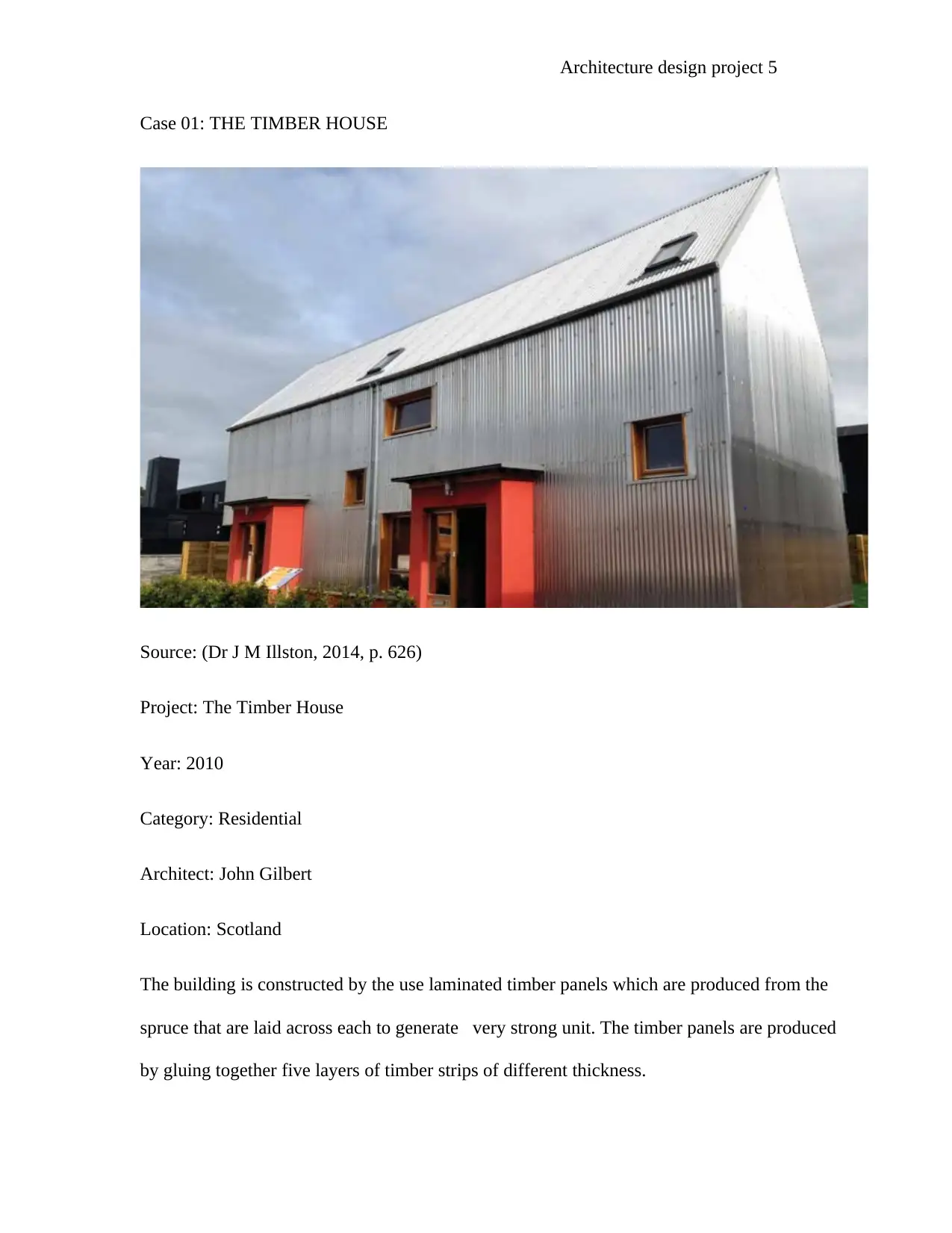
Case 01: THE TIMBER HOUSE
Source: (Dr J M Illston, 2014, p. 626)
Project: The Timber House
Year: 2010
Category: Residential
Architect: John Gilbert
Location: Scotland
The building is constructed by the use laminated timber panels which are produced from the
spruce that are laid across each to generate very strong unit. The timber panels are produced
by gluing together five layers of timber strips of different thickness.
Document Page
Architecture design project 6
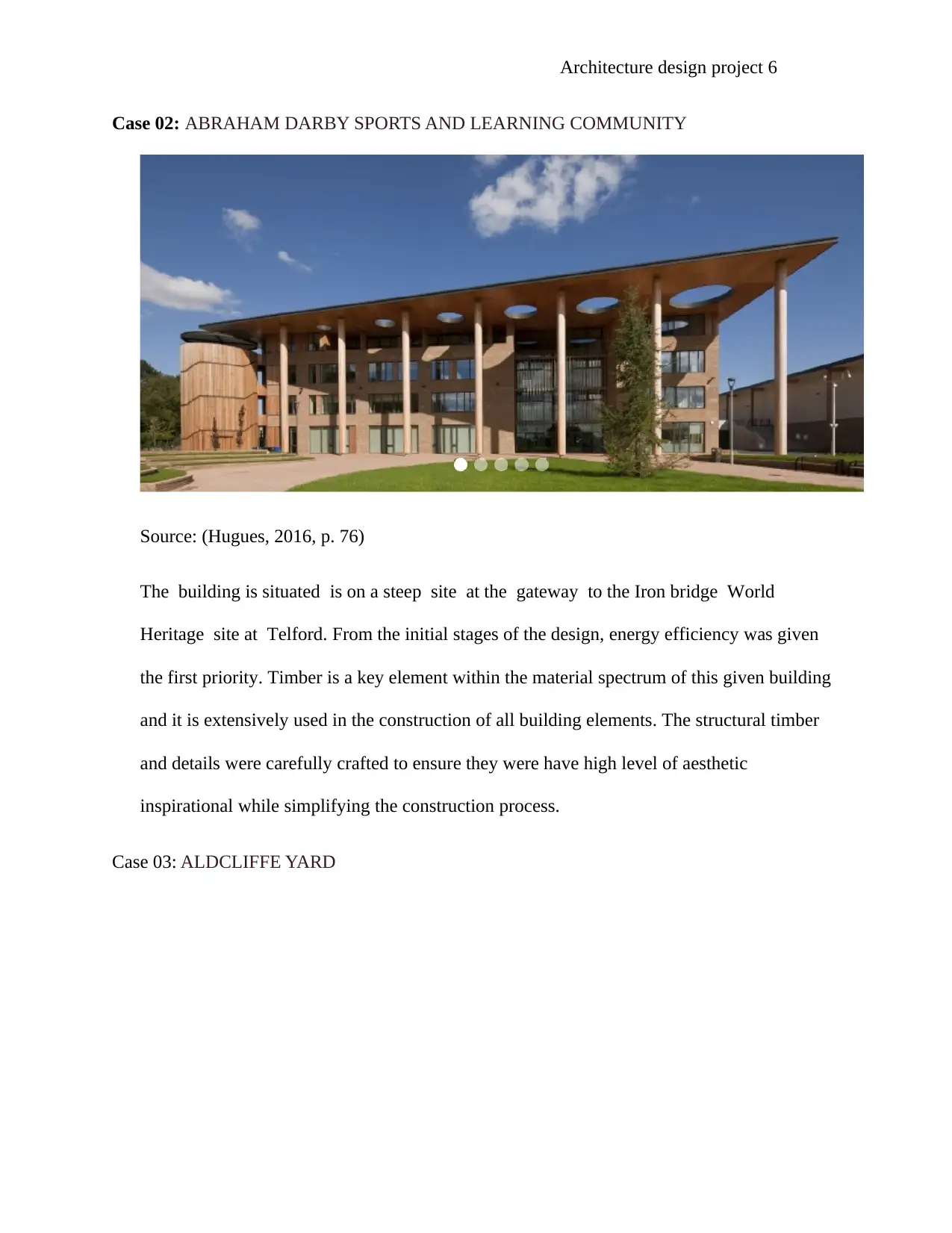
Case 02: ABRAHAM DARBY SPORTS AND LEARNING COMMUNITY
Source: (Hugues, 2016, p. 76)
The building is situated is on a steep site at the gateway to the Iron bridge World
Heritage site at Telford. From the initial stages of the design, energy efficiency was given
the first priority. Timber is a key element within the material spectrum of this given building
and it is extensively used in the construction of all building elements. The structural timber
and details were carefully crafted to ensure they were have high level of aesthetic
inspirational while simplifying the construction process.
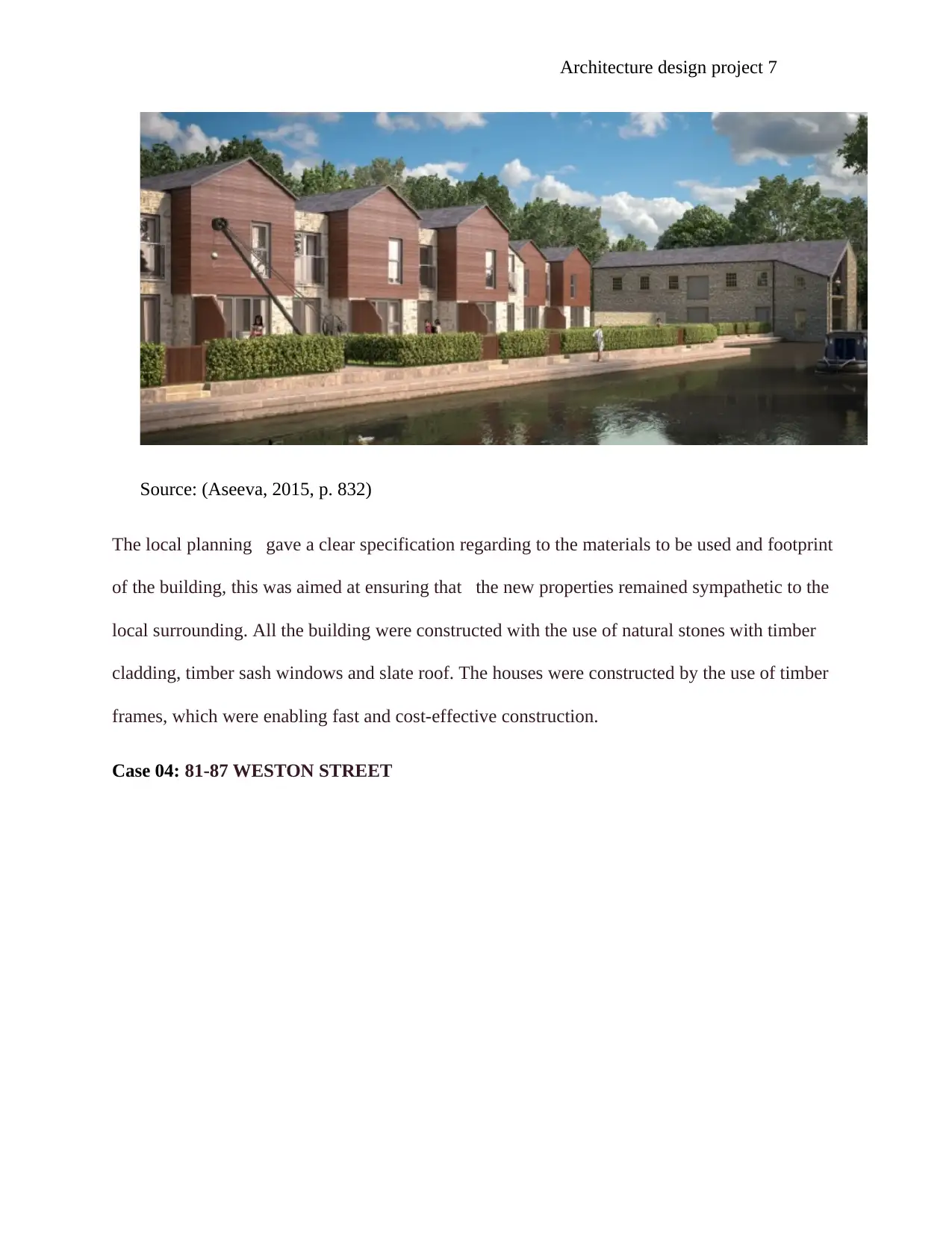
Case 03: ALDCLIFFE YARD
Document Page
Architecture design project 7
Source: (Aseeva, 2015, p. 832)
The local planning gave a clear specification regarding to the materials to be used and footprint
of the building, this was aimed at ensuring that the new properties remained sympathetic to the
local surrounding. All the building were constructed with the use of natural stones with timber
cladding, timber sash windows and slate roof. The houses were constructed by the use of timber
frames, which were enabling fast and cost-effective construction.
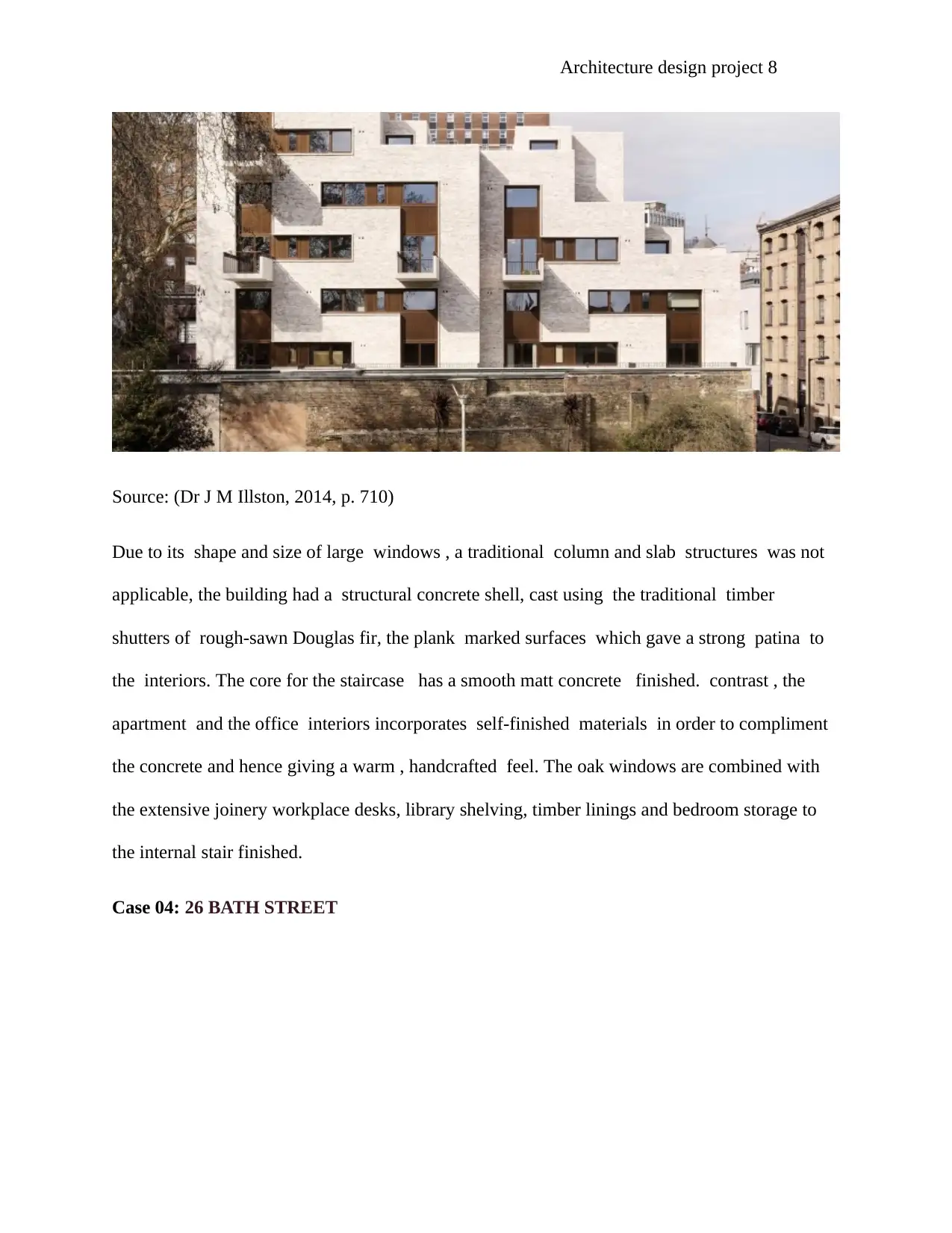
Case 04: 81-87 WESTON STREET
tabler-icon-diamond-filled.svg

Paraphrase This Document

Need a fresh take? Get an instant paraphrase of this document with our AI Paraphraser
Document Page
Architecture design project 8
Source: (Dr J M Illston, 2014, p. 710)
Due to its shape and size of large windows , a traditional column and slab structures was not
applicable, the building had a structural concrete shell, cast using the traditional timber
shutters of rough-sawn Douglas fir, the plank marked surfaces which gave a strong patina to
the interiors. The core for the staircase has a smooth matt concrete finished. contrast , the
apartment and the office interiors incorporates self-finished materials in order to compliment
the concrete and hence giving a warm , handcrafted feel. The oak windows are combined with
the extensive joinery workplace desks, library shelving, timber linings and bedroom storage to
the internal stair finished.
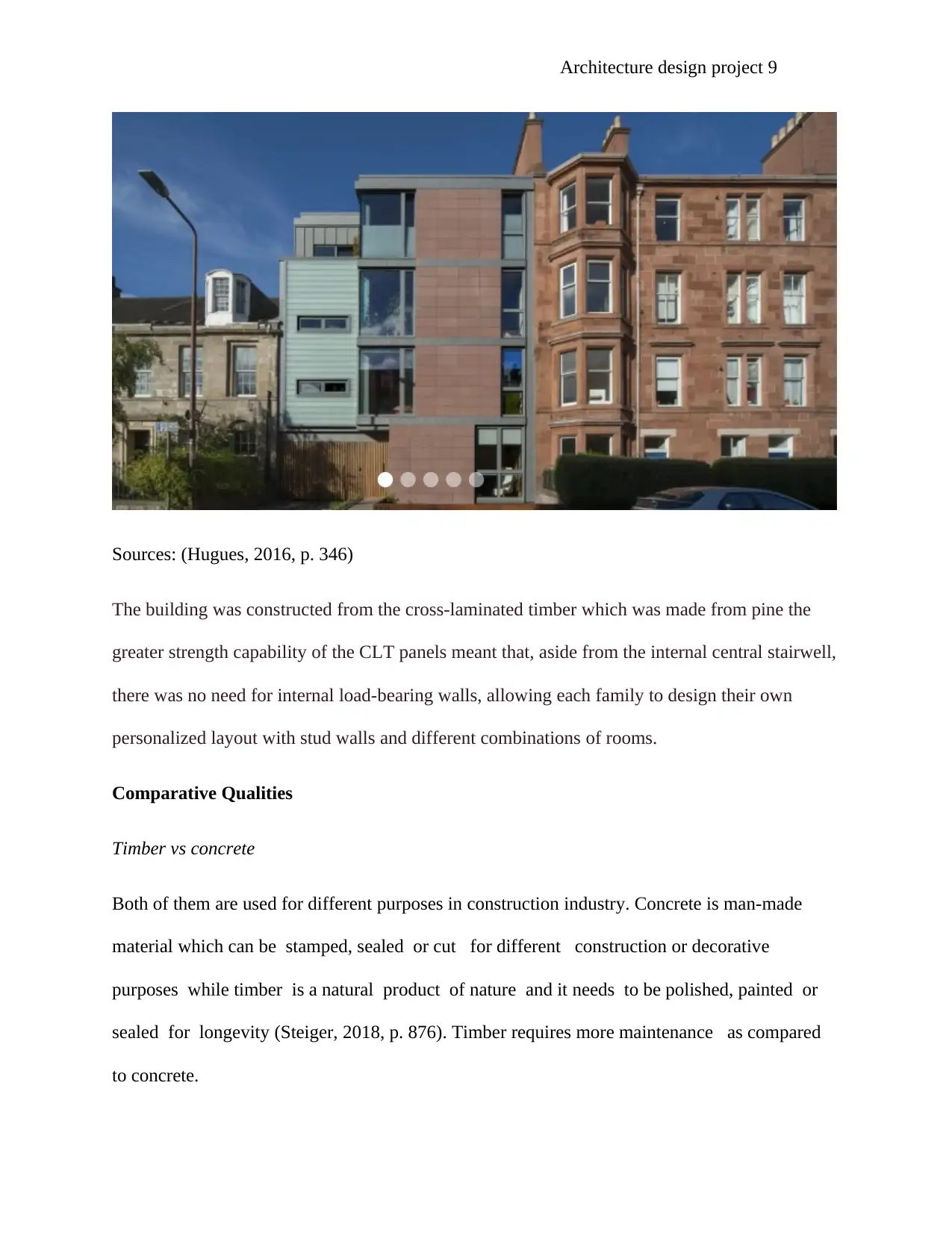
Case 04: 26 BATH STREET
Document Page
Architecture design project 9
Sources: (Hugues, 2016, p. 346)
The building was constructed from the cross-laminated timber which was made from pine the
greater strength capability of the CLT panels meant that, aside from the internal central stairwell,
there was no need for internal load-bearing walls, allowing each family to design their own
personalized layout with stud walls and different combinations of rooms.
Comparative Qualities
Timber vs concrete
Both of them are used for different purposes in construction industry. Concrete is man-made
material which can be stamped, sealed or cut for different construction or decorative
purposes while timber is a natural product of nature and it needs to be polished, painted or
sealed for longevity (Steiger, 2018, p. 876). Timber requires more maintenance as compared
to concrete.
Document Page
Architecture design project 10
Design process of timber
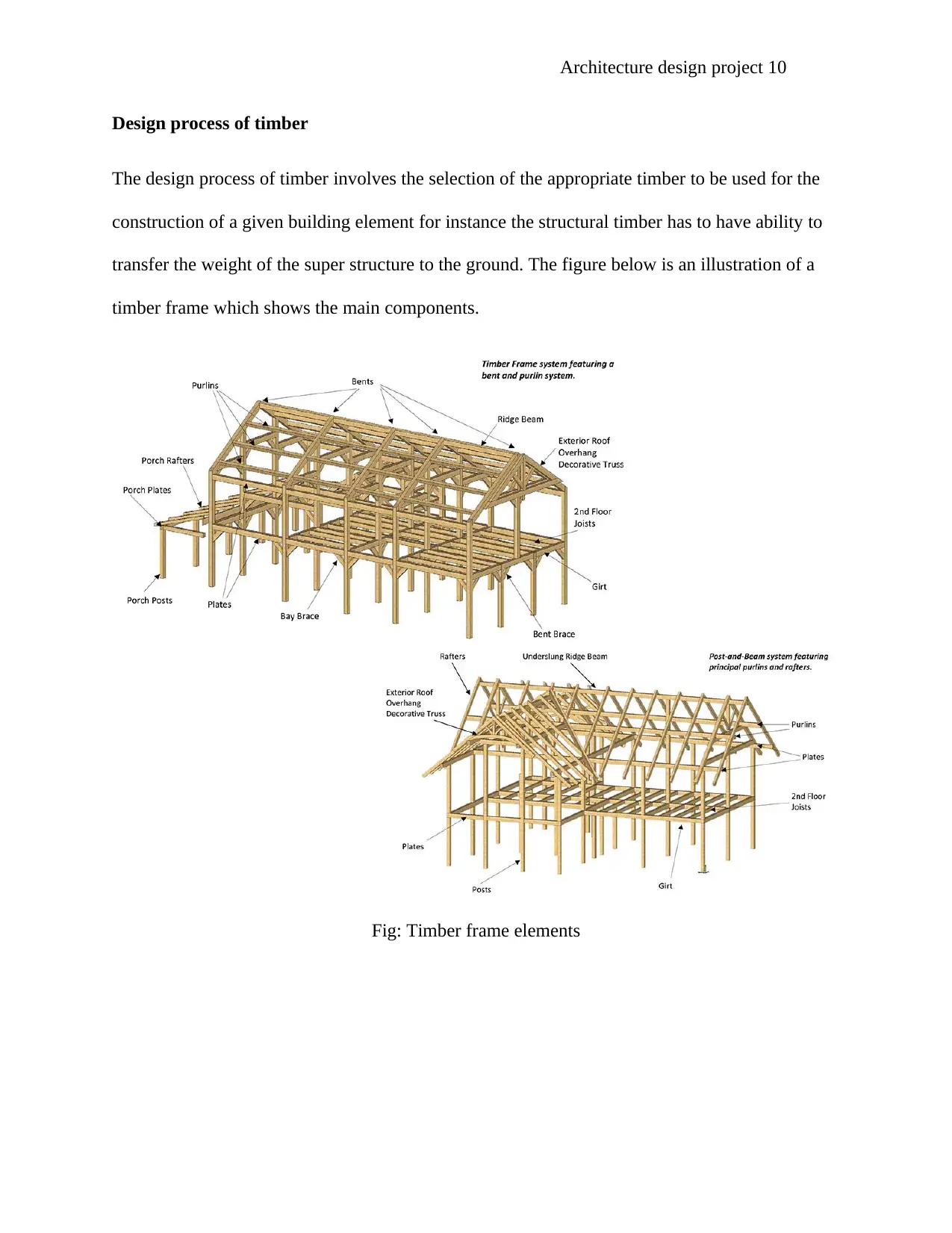
The design process of timber involves the selection of the appropriate timber to be used for the
construction of a given building element for instance the structural timber has to have ability to
transfer the weight of the super structure to the ground. The figure below is an illustration of a
timber frame which shows the main components.
Fig: Timber frame elements
tabler-icon-diamond-filled.svg

Paraphrase This Document

Need a fresh take? Get an instant paraphrase of this document with our AI Paraphraser
Document Page
Architecture design project 11
References
Adegoke, B., 2012. Assessment of Criteria for Selection of Timber as Building Material for
Building Construction Projects. 4th ed. London: GRIN Verlag.
Aseeva, R., 2015. Fire Behavior and Fire Protection in Timber Buildings. 3rd ed. Chicago:
Springer Science & Business Media.
Dr J M Illston, 2014. Construction Materials - Their Nature and Behaviour. 3rd ed. Perth: CRC
Press.
Gutkowski, R. M., 2016. Transportation Infrastructure: Environmental Challenges in Poland
and Neighboring Countries. 2nd ed. Chicago: Springer Science & Business Media.
Herzog, T., 2017. Timber Construction Manual. 1st ed. Kiev: Walter de Gruyter.
Hugues, T., 2016. Timber Construction: Details, Products, Case Studies. 2nd ed. Texas:
Princeton Architectural Press.
Khatib, J., 2017. Sustainability of Construction Materials. 5th ed. Kiev: Elsevier.
Steiger, L., 2018. Basics Timber Construction. 3rd ed. Paris: Birkhäuser.
Sunley, J., 2018. Timber in Construction. 5th ed. London: Batsford,.
Weinand, Y., 2017. Advanced Timber Structures: Architectural Designs and Digital
Dimensioning. 2nd ed. Berlin: Birkhäuser.
Yeomans, D. T., 2016. The Development of Timber as a Structural Material. 4th ed. Chicago:
Taylor & Francis.
Document Page
Architecture design project 12
chevron_up_icon
1 out of 12
circle_padding
hide_on_mobile
zoom_out_icon
[object Object]