Arsenic Poisoning in Bangladesh: Health Promotion Intervention Report
VerifiedAdded on 2020/05/04
|19
|3106
|263
Report
AI Summary
This report addresses the critical public health issue of arsenic poisoning in Bangladesh. It begins with a comprehensive background, rationale, and literature review, detailing the sources of arsenic contamination, its impact on human health, and existing mitigating techniques. The report specifically focuses on the situation in Bangladesh, highlighting the severity of the problem and the need for intervention. It outlines the aims and research questions, proposing a quantitative study design with a sample size of 1000 participants to assess the effectiveness of a hypothetical health promotion intervention. The intervention involves educating farmers and providing water purifiers. The report details the study design, sampling methods, inclusion and exclusion criteria, analysis methods, and cost-effectiveness analysis, along with anticipated outcomes and a proposed timeline. The study aims to determine if education and access to water purifiers can reduce arsenic poisoning in rural Bangladesh, addressing the urgent need for solutions to this widespread health crisis.
Running head: THE ARSENIC POISONING IN BANGLADESH
The arsenic poisoning in Bangladesh
Name of the student:
Name of the University:
Author note:
The arsenic poisoning in Bangladesh
Name of the student:
Name of the University:
Author note:

Paraphrase This Document
Need a fresh take? Get an instant paraphrase of this document with our AI Paraphraser
1THE ARSENIC POISONING IN BANGLADESH
Abstract:
The report mentions the issues associated with arsenic poisoning in Bangladesh along with a
hypothetical heath promotion intervention. Bangladesh has been facing severe threats from
arsenic pollution and has become the worst case of arsenic pollution in the world. Arsenic is
highly toxic for the human body. Humans are subjective to arsenic pollution mainly from water,
air and food with water being the major source of arsenic toxicity. The report states the aims and
objectives of the topic. The report includes the background and rationale of the topic along with
proposed hypothetical intervention. The report also mentions the budget
Table of Contents
Abstract:
The report mentions the issues associated with arsenic poisoning in Bangladesh along with a
hypothetical heath promotion intervention. Bangladesh has been facing severe threats from
arsenic pollution and has become the worst case of arsenic pollution in the world. Arsenic is
highly toxic for the human body. Humans are subjective to arsenic pollution mainly from water,
air and food with water being the major source of arsenic toxicity. The report states the aims and
objectives of the topic. The report includes the background and rationale of the topic along with
proposed hypothetical intervention. The report also mentions the budget
Table of Contents
2THE ARSENIC POISONING IN BANGLADESH
Background, rationale and brief literature review...........................................................................4
Background:.................................................................................................................................4
Literature review..........................................................................................................................4
Arsenic poisoning........................................................................................................................4
Sources of arsenic in the environment.........................................................................................5
Impact of Arsenic pollution on human health.............................................................................5
Arsenic pollution mitigating techniques......................................................................................6
Arsenic pollution in Bangladesh..................................................................................................7
Aims and research question:............................................................................................................8
Research questions:.........................................................................................................................8
Study design and Sample size..........................................................................................................8
Recruitment, intervention and assessment chart............................................................................10
Sampling methods, inclusion and exclusion criteria.....................................................................11
Analysis method and Cost-effectiveness analysis:........................................................................12
Measurements................................................................................................................................12
Data collection method:.................................................................................................................13
Ethical statement:...........................................................................................................................14
Anticipated outcomes and significance:........................................................................................14
Proposed timeline..........................................................................................................................15
References:....................................................................................................................................17
Background, rationale and brief literature review...........................................................................4
Background:.................................................................................................................................4
Literature review..........................................................................................................................4
Arsenic poisoning........................................................................................................................4
Sources of arsenic in the environment.........................................................................................5
Impact of Arsenic pollution on human health.............................................................................5
Arsenic pollution mitigating techniques......................................................................................6
Arsenic pollution in Bangladesh..................................................................................................7
Aims and research question:............................................................................................................8
Research questions:.........................................................................................................................8
Study design and Sample size..........................................................................................................8
Recruitment, intervention and assessment chart............................................................................10
Sampling methods, inclusion and exclusion criteria.....................................................................11
Analysis method and Cost-effectiveness analysis:........................................................................12
Measurements................................................................................................................................12
Data collection method:.................................................................................................................13
Ethical statement:...........................................................................................................................14
Anticipated outcomes and significance:........................................................................................14
Proposed timeline..........................................................................................................................15
References:....................................................................................................................................17
⊘ This is a preview!⊘
Do you want full access?
Subscribe today to unlock all pages.

Trusted by 1+ million students worldwide

3THE ARSENIC POISONING IN BANGLADESH
Paraphrase This Document
Need a fresh take? Get an instant paraphrase of this document with our AI Paraphraser
4THE ARSENIC POISONING IN BANGLADESH
Background, rationale and brief literature review
Background:
A major case of arsenic contamination was witnessed in Bangladesh and India in the year
1983 with a majority of causalities from Bangladesh. As per the world report around 80% of the
people in Bangladesh are affected by arsenic poisoning. It means around 19.3 million are
currently effected. From amongst the several countries affected by arsenic pollution, Bangladesh
is at the highest risk. The country has been reported to have the highest groundwater arsenic
contamination (Rahman, Dong & Naidu, 2015). The issue is highly neglected despite its
identification decades ago. It constitutes the rationale for the study. The aim of the proposal is to
develop a hypothetical health promotion intervention to mitigate the arsenic poisoning in
Bangladesh.
Literature review
Arsenic poisoning:
According to Rahman, Dong & Naidu (2015), arsenic poisoning refers to the condition
wherein the levels of arsenic exceed in the body. Arsenic poisoning is that medical condition
wherein symptoms such as vomiting, diarrhea and abdominal pain are witnessed in case of short-
term exposures. On the other hand, in case of long- term exposure, symptoms such as thickening
and darkening of skin, heart diseases and even cancer has been observed. The major reason
behind the long- term exposure to arsenic poisoning has been contaminated drinking water.
Arsenic is found in huge quantities inside the crust of Earth, which leads to contamination of
underground water. Groundwater is usually most affected from arsenic poisoning. The arsenic
Background, rationale and brief literature review
Background:
A major case of arsenic contamination was witnessed in Bangladesh and India in the year
1983 with a majority of causalities from Bangladesh. As per the world report around 80% of the
people in Bangladesh are affected by arsenic poisoning. It means around 19.3 million are
currently effected. From amongst the several countries affected by arsenic pollution, Bangladesh
is at the highest risk. The country has been reported to have the highest groundwater arsenic
contamination (Rahman, Dong & Naidu, 2015). The issue is highly neglected despite its
identification decades ago. It constitutes the rationale for the study. The aim of the proposal is to
develop a hypothetical health promotion intervention to mitigate the arsenic poisoning in
Bangladesh.
Literature review
Arsenic poisoning:
According to Rahman, Dong & Naidu (2015), arsenic poisoning refers to the condition
wherein the levels of arsenic exceed in the body. Arsenic poisoning is that medical condition
wherein symptoms such as vomiting, diarrhea and abdominal pain are witnessed in case of short-
term exposures. On the other hand, in case of long- term exposure, symptoms such as thickening
and darkening of skin, heart diseases and even cancer has been observed. The major reason
behind the long- term exposure to arsenic poisoning has been contaminated drinking water.
Arsenic is found in huge quantities inside the crust of Earth, which leads to contamination of
underground water. Groundwater is usually most affected from arsenic poisoning. The arsenic
5THE ARSENIC POISONING IN BANGLADESH
level in water is considered to be between 10 and 50 parts per billion. Usually arsenic poisoning
is usually caused accidentally.
Sources of arsenic in the environment:
According to Sidhu et al., (2015), the major source of arsenic in the environment is from
the minerals present in the crust of the Earth. Usually arsenic gets dissolved with the
underground water through the use of fertilizers, insecticides, mining activities and herbicides. A
major source of groundwater contamination is irrigation of crops especially rice. Mining
activities highly impact the freshwaters as it increases the level of arsenic content in the
freshwaters. The industrial effluents and the mining effluents affect the freshwaters, which when
gets mixed with marine waters, leads to arsenic pollution. The excessive use of insecticides,
fertilizers and pesticides has also led to soil contamination. The soil contamination becomes a
source of arsenic contamination in food especially rice. Fruits, vegetables and meat are also
affected by arsenic pollution and poses severe health hazards when humans consume those items.
Impact of Arsenic pollution on human health:
According to Yunus et al., (2016), arsenic is considered to be one of the most poisonous
elements that is extremely hazardous for the environment and the human health. Arsenic is
highly toxic for the human body. Humans are subjective to arsenic pollution mainly from water,
air and food with water being the major source of arsenic toxicity all over the world. Acute
arsenic poisoning causes several chronic problems in humans. It has cancerous effects on skin,
liver, lungs and kidney. Arsenic poisoning also affects cardiovascular, neurological, pulmonary,
immunological and endocrine disorders. Arsenic pollution adversely affects the respiratory
system of humans. Gastrointestinal irritation along with thirst, nausea and painful swallowing
level in water is considered to be between 10 and 50 parts per billion. Usually arsenic poisoning
is usually caused accidentally.
Sources of arsenic in the environment:
According to Sidhu et al., (2015), the major source of arsenic in the environment is from
the minerals present in the crust of the Earth. Usually arsenic gets dissolved with the
underground water through the use of fertilizers, insecticides, mining activities and herbicides. A
major source of groundwater contamination is irrigation of crops especially rice. Mining
activities highly impact the freshwaters as it increases the level of arsenic content in the
freshwaters. The industrial effluents and the mining effluents affect the freshwaters, which when
gets mixed with marine waters, leads to arsenic pollution. The excessive use of insecticides,
fertilizers and pesticides has also led to soil contamination. The soil contamination becomes a
source of arsenic contamination in food especially rice. Fruits, vegetables and meat are also
affected by arsenic pollution and poses severe health hazards when humans consume those items.
Impact of Arsenic pollution on human health:
According to Yunus et al., (2016), arsenic is considered to be one of the most poisonous
elements that is extremely hazardous for the environment and the human health. Arsenic is
highly toxic for the human body. Humans are subjective to arsenic pollution mainly from water,
air and food with water being the major source of arsenic toxicity all over the world. Acute
arsenic poisoning causes several chronic problems in humans. It has cancerous effects on skin,
liver, lungs and kidney. Arsenic poisoning also affects cardiovascular, neurological, pulmonary,
immunological and endocrine disorders. Arsenic pollution adversely affects the respiratory
system of humans. Gastrointestinal irritation along with thirst, nausea and painful swallowing
⊘ This is a preview!⊘
Do you want full access?
Subscribe today to unlock all pages.
Trusted by 1+ million students worldwide
6THE ARSENIC POISONING IN BANGLADESH
has been noticed in the patients suffering from arsenic pollution. Arsenic pollution has also
caused anemia and leucopenia among humans. The dermal impact includes pigmentation on
body. Several studies have found that children born to women exposed to arsenic pollution suffer
from several malformations and disorders. In Bangladesh, every one in ten people has the
probability of developing cancer due to arsenic.
Arsenic pollution mitigating techniques:
According to Chakraborti et al., (2015), there are mainly two ways of minimizing the
impact of arsenic pollution on human health. These two ways include prevention and cure. In
case of prevention, it becomes necessary to screen the tube wells and the population
contaminated with arsenic. It is also necessary to identify the level of arsenic contamination. The
Governments of the countries usually screen the tube wells. Further, the level of concentration of
arsenic is detected and compared with the acceptable limits. In accordance with the level of
arsenic contamination, the tube wells with unsafe drinking water are marked red whereas the
tube wells with safe drinking water are marked green. Several promotional campaigns are set up
to make the people aware about arsenic pollution and are encouraged to consume only arsenic
free water. Awareness is also spread to encourage use of water purifiers and filters that reduce
the level of arsenic and makes the water safe for drinking. Drinking water contaminated with
arsenic one of the major threats to humans. Therefore, it becomes necessary to mitigate arsenic
pollution to reduce the health hazards. There are several remediation techniques which include
membrane technologies, oxidation, coagulation flocculation, ion exchange, phytoremediation,
adsorption, and electro kinetics. All these techniques help in removing arsenic concentration
from drinking water.
has been noticed in the patients suffering from arsenic pollution. Arsenic pollution has also
caused anemia and leucopenia among humans. The dermal impact includes pigmentation on
body. Several studies have found that children born to women exposed to arsenic pollution suffer
from several malformations and disorders. In Bangladesh, every one in ten people has the
probability of developing cancer due to arsenic.
Arsenic pollution mitigating techniques:
According to Chakraborti et al., (2015), there are mainly two ways of minimizing the
impact of arsenic pollution on human health. These two ways include prevention and cure. In
case of prevention, it becomes necessary to screen the tube wells and the population
contaminated with arsenic. It is also necessary to identify the level of arsenic contamination. The
Governments of the countries usually screen the tube wells. Further, the level of concentration of
arsenic is detected and compared with the acceptable limits. In accordance with the level of
arsenic contamination, the tube wells with unsafe drinking water are marked red whereas the
tube wells with safe drinking water are marked green. Several promotional campaigns are set up
to make the people aware about arsenic pollution and are encouraged to consume only arsenic
free water. Awareness is also spread to encourage use of water purifiers and filters that reduce
the level of arsenic and makes the water safe for drinking. Drinking water contaminated with
arsenic one of the major threats to humans. Therefore, it becomes necessary to mitigate arsenic
pollution to reduce the health hazards. There are several remediation techniques which include
membrane technologies, oxidation, coagulation flocculation, ion exchange, phytoremediation,
adsorption, and electro kinetics. All these techniques help in removing arsenic concentration
from drinking water.
Paraphrase This Document
Need a fresh take? Get an instant paraphrase of this document with our AI Paraphraser
7THE ARSENIC POISONING IN BANGLADESH
Arsenic pollution in Bangladesh:
Arsenic pollution in Bangladesh has become a major health hazard in the recent years.
The country has more than 10 million tube- wells, which supply ground water affected by arsenic
pollution. The arsenic concentration in groundwater has been reported to be more than 50
micrograms/L, which makes the water unfit for consumption. Several reports have stated that
more than two- third of the population in Bangladesh has been affected by arsenic pollution
(Talbot & Verrinder, 2009). The major reason behind this has been late identification of the
issues and neglecting the issue. The chances of developing cancer have been very high among
the Bangladeshis along with the people of West Bengal. Contamination of arsenic in soil,
drinking water and vegetables has been a common scenario in Bangladesh. Bangladesh has been
facing severe threats from arsenic pollution and has become the worst case of arsenic pollution in
the world. Usually arsenic gets dissolved with the underground water through the use of
fertilizers, insecticides, mining activities and herbicides. A major source of groundwater
contamination is irrigation of crops especially rice in Bangladesh. Mining activities highly
impact the freshwaters as it increases the level of arsenic content in the freshwaters. The
industrial effluents and the mining effluents affect the freshwaters, which when gets mixed with
marine waters, leads to arsenic pollution. The excessive use of insecticides, fertilizers and
pesticides has also led to soil contamination in Bangladesh, which has increased the level of
arsenic contamination in food crops (Rahman, Dong & Naidu, 2015).
Arsenic pollution in Bangladesh:
Arsenic pollution in Bangladesh has become a major health hazard in the recent years.
The country has more than 10 million tube- wells, which supply ground water affected by arsenic
pollution. The arsenic concentration in groundwater has been reported to be more than 50
micrograms/L, which makes the water unfit for consumption. Several reports have stated that
more than two- third of the population in Bangladesh has been affected by arsenic pollution
(Talbot & Verrinder, 2009). The major reason behind this has been late identification of the
issues and neglecting the issue. The chances of developing cancer have been very high among
the Bangladeshis along with the people of West Bengal. Contamination of arsenic in soil,
drinking water and vegetables has been a common scenario in Bangladesh. Bangladesh has been
facing severe threats from arsenic pollution and has become the worst case of arsenic pollution in
the world. Usually arsenic gets dissolved with the underground water through the use of
fertilizers, insecticides, mining activities and herbicides. A major source of groundwater
contamination is irrigation of crops especially rice in Bangladesh. Mining activities highly
impact the freshwaters as it increases the level of arsenic content in the freshwaters. The
industrial effluents and the mining effluents affect the freshwaters, which when gets mixed with
marine waters, leads to arsenic pollution. The excessive use of insecticides, fertilizers and
pesticides has also led to soil contamination in Bangladesh, which has increased the level of
arsenic contamination in food crops (Rahman, Dong & Naidu, 2015).
8THE ARSENIC POISONING IN BANGLADESH
Aims and research question:
The aim of the study is to collect high-level evidence of whether providing education and
water purifiers can reduce arsenic poisoning in rural Bangladesh
The following are the objectives of the study:
To know the level of awareness about arsenic pollution in rural areas
Evaluate Behavioral change education for farmers in rural Bangladesh
To reduce arsenic poisoning by providing water purifiers
Research questions:
The following are the research questions:
Can education of farmers in rural areas decrease arsenic poisoning
is the intervention education, awareness campaigns and supply of water purifiers
to rural farmers cost effective?
Study design and Sample size
The study shall involve quantitative research paradigm. The rural participants (farmers)
will be directly surveyed regarding the impact of arsenic pollution on them and their nearby
surroundings. The sample size will include 1000 members including farmers. It will help to
know the level of awareness among the people regarding arsenic pollution in Bangladesh. It
is expected that more than 80% of the respondents shall provide appropriate answers. From
the percentage of people demonstrating low awareness of arsenic poisoning, few will be
selected for randomized control trial.
Aims and research question:
The aim of the study is to collect high-level evidence of whether providing education and
water purifiers can reduce arsenic poisoning in rural Bangladesh
The following are the objectives of the study:
To know the level of awareness about arsenic pollution in rural areas
Evaluate Behavioral change education for farmers in rural Bangladesh
To reduce arsenic poisoning by providing water purifiers
Research questions:
The following are the research questions:
Can education of farmers in rural areas decrease arsenic poisoning
is the intervention education, awareness campaigns and supply of water purifiers
to rural farmers cost effective?
Study design and Sample size
The study shall involve quantitative research paradigm. The rural participants (farmers)
will be directly surveyed regarding the impact of arsenic pollution on them and their nearby
surroundings. The sample size will include 1000 members including farmers. It will help to
know the level of awareness among the people regarding arsenic pollution in Bangladesh. It
is expected that more than 80% of the respondents shall provide appropriate answers. From
the percentage of people demonstrating low awareness of arsenic poisoning, few will be
selected for randomized control trial.
⊘ This is a preview!⊘
Do you want full access?
Subscribe today to unlock all pages.
Trusted by 1+ million students worldwide
9THE ARSENIC POISONING IN BANGLADESH
Based on the survey response, an effectiveness trial will be conducted among the rural
population. For this trial the intervention includes increasing awareness by education, and
provides them with water purifiers. Followed by interventions, the goal is to assess the impact of
the awareness and use of the water purifiers.
In the randomized pair, the farmers in the rural areas will be randomized in each pair.
One of the pair will be allocated to the intervention group randomly and other to the control
group. A total of 500 farmers will be included in the trial.
Based on the survey response, an effectiveness trial will be conducted among the rural
population. For this trial the intervention includes increasing awareness by education, and
provides them with water purifiers. Followed by interventions, the goal is to assess the impact of
the awareness and use of the water purifiers.
In the randomized pair, the farmers in the rural areas will be randomized in each pair.
One of the pair will be allocated to the intervention group randomly and other to the control
group. A total of 500 farmers will be included in the trial.
Paraphrase This Document
Need a fresh take? Get an instant paraphrase of this document with our AI Paraphraser
10THE ARSENIC POISONING IN BANGLADESH
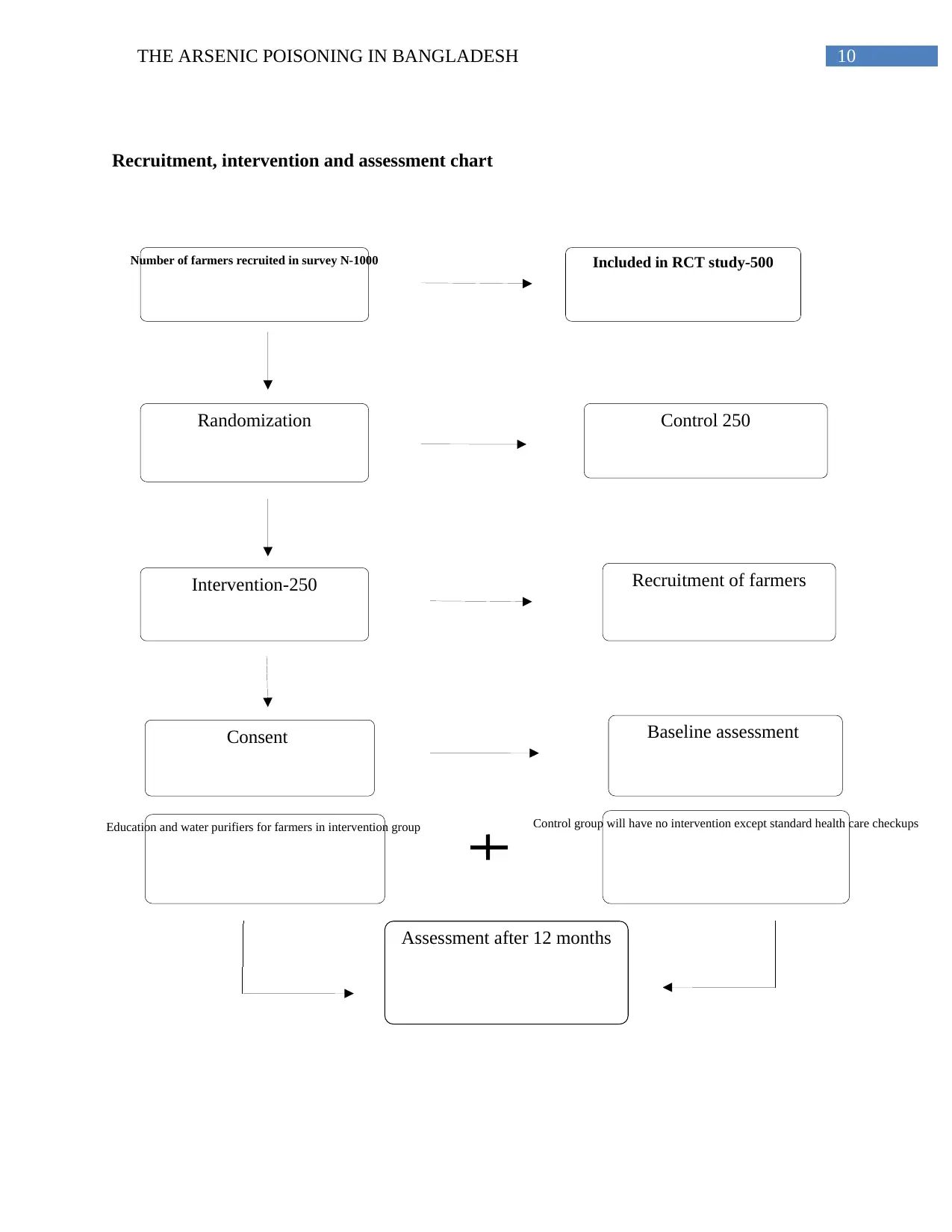
Number of farmers recruited in survey N-1000 Included in RCT study-500
Randomization Control 250
Intervention-250 Recruitment of farmers
Consent Baseline assessment
Education and water purifiers for farmers in intervention group Control group will have no intervention except standard health care checkups
Assessment after 12 months
Recruitment, intervention and assessment chart
Number of farmers recruited in survey N-1000 Included in RCT study-500
Randomization Control 250
Intervention-250 Recruitment of farmers
Consent Baseline assessment
Education and water purifiers for farmers in intervention group Control group will have no intervention except standard health care checkups
Assessment after 12 months
Recruitment, intervention and assessment chart
11THE ARSENIC POISONING IN BANGLADESH
Sampling methods, inclusion and exclusion criteria
Intervention
For randomized trial, the participants in the trial groups will be provided with education and
water purifiers to assess the impact of this method in reducing arsenic related health issues.
The intervention will be educational support and training of the farmers. Education of farmers
through books, television and videos on –
On farming techniques that can prevent arsenic poisoning and
On cautious use of the pesticides and fertilizers.
Proper use of water poisoning
Regular health check up for arsenic poisoning
Control
The participants in the control group of RCT group will receive no education or the purifiers.
Inclusion and Exclusion criteria
Farmers within age limit 25-30 years, unable to access safe water, lack awareness
as identified from the survey
Those accessing safe water or using filters or boiled water are excluded
Farmers using green manure or biofertilisers will be excluded
Sampling methods, inclusion and exclusion criteria
Intervention
For randomized trial, the participants in the trial groups will be provided with education and
water purifiers to assess the impact of this method in reducing arsenic related health issues.
The intervention will be educational support and training of the farmers. Education of farmers
through books, television and videos on –
On farming techniques that can prevent arsenic poisoning and
On cautious use of the pesticides and fertilizers.
Proper use of water poisoning
Regular health check up for arsenic poisoning
Control
The participants in the control group of RCT group will receive no education or the purifiers.
Inclusion and Exclusion criteria
Farmers within age limit 25-30 years, unable to access safe water, lack awareness
as identified from the survey
Those accessing safe water or using filters or boiled water are excluded
Farmers using green manure or biofertilisers will be excluded
⊘ This is a preview!⊘
Do you want full access?
Subscribe today to unlock all pages.
Trusted by 1+ million students worldwide

1 out of 19


Your All-in-One AI-Powered Toolkit for Academic Success.
+13062052269
info@desklib.com
Available 24*7 on WhatsApp / Email
![[object Object]](/_next/static/media/star-bottom.7253800d.svg)
Unlock your academic potential
Copyright © 2020–2026 A2Z Services. All Rights Reserved. Developed and managed by ZUCOL.