Designing an Art and Craft Play Space for Early Childhood Education
VerifiedAdded on 2021/04/17
|13
|2489
|259
Report
AI Summary
This report details the design and implementation of an art and craft play space for children aged 5-8 years. It focuses on creating an engaging and enriching environment through art and craft activities. The report discusses the selection of open-ended resources, safety considerations, and strategies to promote children's participation and engagement. It outlines how to scaffold learning, implement intentional teaching, and incorporate the Early Years Learning Framework of Australia, emphasizing the development of communication skills and agency. The report also explores strategies for children who may not wish to participate, and the importance of uninterrupted play time. It links the play space to specific outcomes and quality areas, including relationships with children, and provides practical examples of how to promote children's agency through educator interactions and the creation of a supportive learning environment. The report also references relevant theories and frameworks to inform practice.
Running head: EARLY CHILDHOOD CARE
Early Childhood Education and Care
Name of the Student:
Name of the University:
Author’s Note:
Early Childhood Education and Care
Name of the Student:
Name of the University:
Author’s Note:

Paraphrase This Document
Need a fresh take? Get an instant paraphrase of this document with our AI Paraphraser
2EARLY CHILDHOOD CARE
The specify an age group
The age group that will be selected is the children belonging in the age group of 5 to 8 years.
This is because it is at this time of the age group that children are very active and they are very
much eager in learning many new things. They are also very active towards many extracurricular
activities like dance, singing, and swimming, drawing and making crafts as well. Often teachers
get students who are not really very attentive in school. They do not find much interest in sitting
with their books for long time. It is for this reason that they try and look for something very
different and innovative. So, the education has to be imparted in a different and engaging way
(Bird and Edwards 2015).
The name of the play space. For example blocks, home corner, art & craft etc.
The play space selected is art and craft. This is an indoor play activity. It is a very good way
through which the children can be taught their lessons. Children can also be in introduced with
many different colours and shapes of objects as well. The children can learn the art of paper
cutting and it is in this way that they will also be able to learn the names of many objects like
flowers, clouds, animals and many other such things.
Give specific examples of how the experience will extend and enrich the child’s learning
and promotes agency?
The specify an age group
The age group that will be selected is the children belonging in the age group of 5 to 8 years.
This is because it is at this time of the age group that children are very active and they are very
much eager in learning many new things. They are also very active towards many extracurricular
activities like dance, singing, and swimming, drawing and making crafts as well. Often teachers
get students who are not really very attentive in school. They do not find much interest in sitting
with their books for long time. It is for this reason that they try and look for something very
different and innovative. So, the education has to be imparted in a different and engaging way
(Bird and Edwards 2015).
The name of the play space. For example blocks, home corner, art & craft etc.
The play space selected is art and craft. This is an indoor play activity. It is a very good way
through which the children can be taught their lessons. Children can also be in introduced with
many different colours and shapes of objects as well. The children can learn the art of paper
cutting and it is in this way that they will also be able to learn the names of many objects like
flowers, clouds, animals and many other such things.
Give specific examples of how the experience will extend and enrich the child’s learning
and promotes agency?
3EARLY CHILDHOOD CARE
Children are often very inattentive at class. Particularly, children belonging to the age
group of 5 to 8 years are occupied with so many things at the same time. They are very
much attached to play activities and want to do something apart from just sticking to their
text books. They might not get interest in learning the poem twinkle twinkle little star just
by reading their books but they will find interest if the teachers teach them how to make
stars and clouds with colours and paper cuttings.
The teacher can actually take up a drawing and craft session where she will teach the
students to draw the shapes of starts and clouds on papers and cut them followed by
filling them with colours. This will enrich the students in learning the art of paper cutting
and also the art of colouring. On the other hand they will also learn the poem as well.
The name of the resources (natural, recycled, open-ended) and how you intend to set up the
play space
Children are often very inattentive at class. Particularly, children belonging to the age
group of 5 to 8 years are occupied with so many things at the same time. They are very
much attached to play activities and want to do something apart from just sticking to their
text books. They might not get interest in learning the poem twinkle twinkle little star just
by reading their books but they will find interest if the teachers teach them how to make
stars and clouds with colours and paper cuttings.
The teacher can actually take up a drawing and craft session where she will teach the
students to draw the shapes of starts and clouds on papers and cut them followed by
filling them with colours. This will enrich the students in learning the art of paper cutting
and also the art of colouring. On the other hand they will also learn the poem as well.
The name of the resources (natural, recycled, open-ended) and how you intend to set up the
play space
⊘ This is a preview!⊘
Do you want full access?
Subscribe today to unlock all pages.

Trusted by 1+ million students worldwide
4EARLY CHILDHOOD CARE
The resources will be open ended. They will mainly include objects that the students will
be most comfortable with. They can use colours of any type, like pastel colour, oil
painting and also any kinds of papers that he students will be comfortable with.
Safety considerations (supervision, choosing the materials)
The safety considerations that must be maintained are strict supervision of any adult
member or teachers so that he students do not get hurt while cutting the papers with
scissors or paper cutting knifes.
How many children will be able to participate at any given time?
The number of children that can take part at a time is about 30. In other words, a class having
strength of about 50 students can take part. There must be enough space for all the students to
take their seats and concentrate on the activity (Foreman and Arthur-Kelly 2017).
1. How will you clearly define the play space?
The play space will be a large room where the teacher will be teaching her students the art and
craft activities. The space can be a classroom or even a large extra co curricular activity room
where all the required are and craft materials will be present. The room will be decorated with
many paintings and pictures all around. There will be colours of varied kinds like oil painting
colours, pastel colours, crayons. There will be scissors, cardboards, colour papers and several
guide books on art and crafts making.
The resources will be open ended. They will mainly include objects that the students will
be most comfortable with. They can use colours of any type, like pastel colour, oil
painting and also any kinds of papers that he students will be comfortable with.
Safety considerations (supervision, choosing the materials)
The safety considerations that must be maintained are strict supervision of any adult
member or teachers so that he students do not get hurt while cutting the papers with
scissors or paper cutting knifes.
How many children will be able to participate at any given time?
The number of children that can take part at a time is about 30. In other words, a class having
strength of about 50 students can take part. There must be enough space for all the students to
take their seats and concentrate on the activity (Foreman and Arthur-Kelly 2017).
1. How will you clearly define the play space?
The play space will be a large room where the teacher will be teaching her students the art and
craft activities. The space can be a classroom or even a large extra co curricular activity room
where all the required are and craft materials will be present. The room will be decorated with
many paintings and pictures all around. There will be colours of varied kinds like oil painting
colours, pastel colours, crayons. There will be scissors, cardboards, colour papers and several
guide books on art and crafts making.
Paraphrase This Document
Need a fresh take? Get an instant paraphrase of this document with our AI Paraphraser
5EARLY CHILDHOOD CARE
How will you ensure that each child can participate?
The children will be encouraged to take part in the play activity by telling them that they will
get a long break from studies. Often children of this age find it very tough to deal with the
long and boring study schedules. So, they really enjoy when they get the chance of doing
something apart from their work. There has to be a reward system for the children who
would be taking part in the activity. The rewards can be like gifting some chocolates, story
books, pencil box and other goodies that will attract the students.
How you will engage the children and sustain their interests?
I will tell that there will be no studies and only games. This will really be a huge impetus for the
children as they will surely be looking for some long breaks apart from their studies. In order to
retain their interest I will give them some gifts like chocolate, pencils and also give them a movie
break. I will try to teach them their lessons through audio visual methods. I will show them some
cartoon shows and movies so that I can keep their minds active and refreshed.
How will you scaffold learning of children and implement intentional teaching? Name one
theorist and one relevant theory about children’s learning that you will use to inform your
practice?
I will try to develop the method of intentional teaching by talking with the children
constantly and trying to know about their mental setup, their thoughts and their activities.
This will also help me to get a clear idea about their behaviors. I will always try to keep
myself very friendly and approachable so that the children can talk to me and I get to know
about all their doubts and fears.
Freud's Psychosexual Developmental Theory says that there undergoes many changes in
the behaviors of children right from their childhood. There are also many conflicts that the
How will you ensure that each child can participate?
The children will be encouraged to take part in the play activity by telling them that they will
get a long break from studies. Often children of this age find it very tough to deal with the
long and boring study schedules. So, they really enjoy when they get the chance of doing
something apart from their work. There has to be a reward system for the children who
would be taking part in the activity. The rewards can be like gifting some chocolates, story
books, pencil box and other goodies that will attract the students.
How you will engage the children and sustain their interests?
I will tell that there will be no studies and only games. This will really be a huge impetus for the
children as they will surely be looking for some long breaks apart from their studies. In order to
retain their interest I will give them some gifts like chocolate, pencils and also give them a movie
break. I will try to teach them their lessons through audio visual methods. I will show them some
cartoon shows and movies so that I can keep their minds active and refreshed.
How will you scaffold learning of children and implement intentional teaching? Name one
theorist and one relevant theory about children’s learning that you will use to inform your
practice?
I will try to develop the method of intentional teaching by talking with the children
constantly and trying to know about their mental setup, their thoughts and their activities.
This will also help me to get a clear idea about their behaviors. I will always try to keep
myself very friendly and approachable so that the children can talk to me and I get to know
about all their doubts and fears.
Freud's Psychosexual Developmental Theory says that there undergoes many changes in
the behaviors of children right from their childhood. There are also many conflicts that the
6EARLY CHILDHOOD CARE
children face at each stage of their development. So, it is essential to address all the problems
or the conflicts that they are facing. The personality of children is set at just the age of five
years. So, it is essential to support the children and know about all their conflicts right from
their childhood so that they can grow up into self regulated and mentally sound individuals
(Verywell Mind 2018).
How to involve the children in creating their own play space and allow them to initiate and
direct their own play and learning?
The children have to be sorted into groups and many group projects are to be assigned to them so
that they can work and learn together. They must be kept under adult supervision for safety
reasons but they must not be subjected to intense pressure or domination by the adults. They
have to be given full freedom so that they can play and learn on their own (McCann and
Pearlman 2015).
children face at each stage of their development. So, it is essential to address all the problems
or the conflicts that they are facing. The personality of children is set at just the age of five
years. So, it is essential to support the children and know about all their conflicts right from
their childhood so that they can grow up into self regulated and mentally sound individuals
(Verywell Mind 2018).
How to involve the children in creating their own play space and allow them to initiate and
direct their own play and learning?
The children have to be sorted into groups and many group projects are to be assigned to them so
that they can work and learn together. They must be kept under adult supervision for safety
reasons but they must not be subjected to intense pressure or domination by the adults. They
have to be given full freedom so that they can play and learn on their own (McCann and
Pearlman 2015).
⊘ This is a preview!⊘
Do you want full access?
Subscribe today to unlock all pages.
Trusted by 1+ million students worldwide
7EARLY CHILDHOOD CARE
How the play space promotes children’s agency?
The play space will be a place of freedom and enjoyment. There will be no study pressure on the
children and they will also not be under any boundaries. They will play and learn through the
same (Somerville and Williams 2015).
What strategies could you consider for those children who don’t wish to participate?
There must be no force on those children who do not want to take part in the play activity. They
must be encouraged to at least come and accompany their friends. This might instil their interest
and they might be willing to join their friends.
How the play space promotes children’s agency?
The play space will be a place of freedom and enjoyment. There will be no study pressure on the
children and they will also not be under any boundaries. They will play and learn through the
same (Somerville and Williams 2015).
What strategies could you consider for those children who don’t wish to participate?
There must be no force on those children who do not want to take part in the play activity. They
must be encouraged to at least come and accompany their friends. This might instil their interest
and they might be willing to join their friends.
Paraphrase This Document
Need a fresh take? Get an instant paraphrase of this document with our AI Paraphraser
8EARLY CHILDHOOD CARE
Why is it important to provide children with long blocks of uninterrupted time for play?
This fact has to be understood that children belonging to the age group of 5 to 8 years will be
very energetic and they will always look for this freedom. They will be very happy to get this
long uninterrupted break for playing and not being interfered by their teachers or parents for
getting back to studies (Verywell Mind 2018).
Link the play space to one outcome from the Early Years Learning Framework of
Australia
and give specific details of how and why this play space links to this outcome.(150 words)
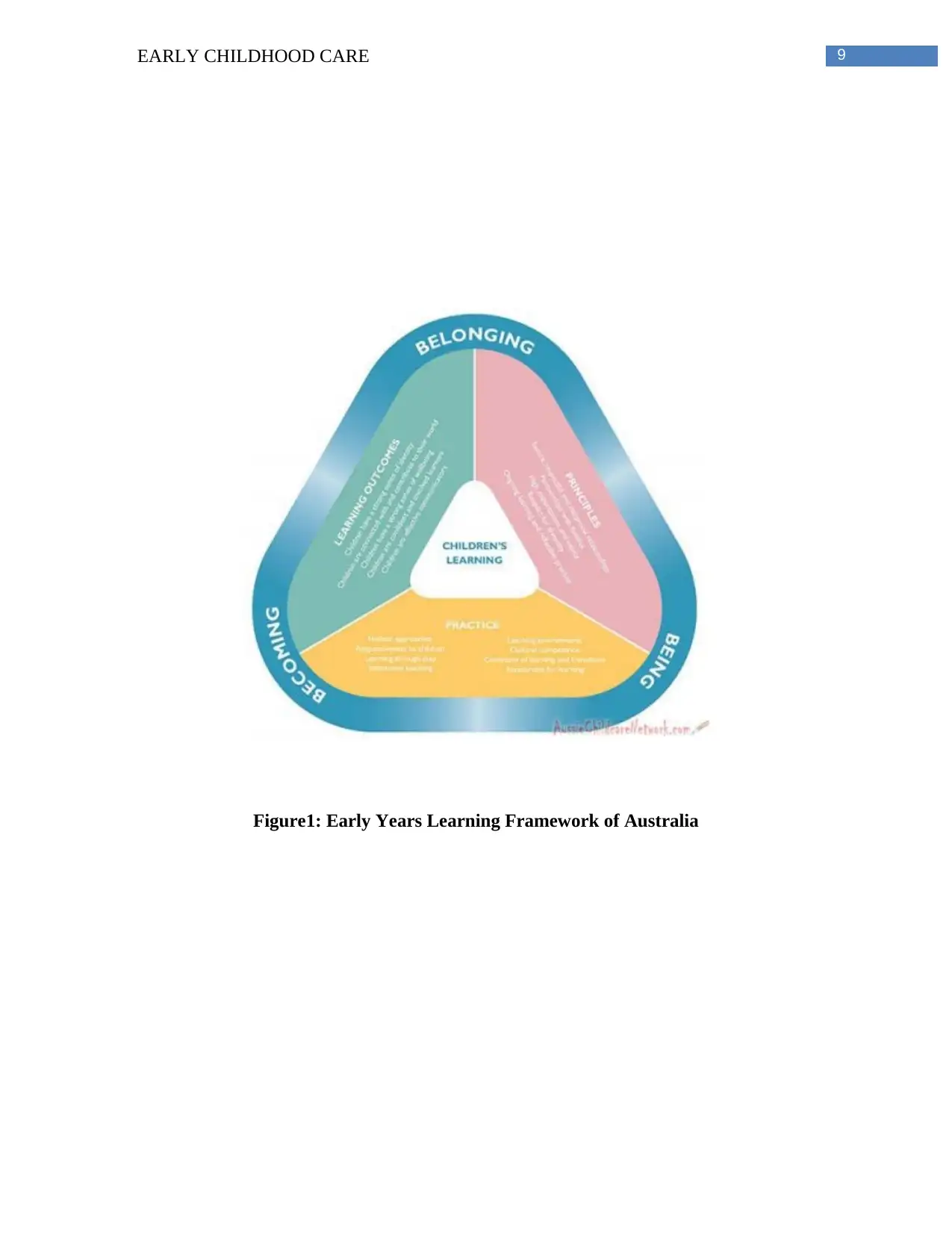
This framework tries to instil the values of belonging, being and becoming within the children. It
is at this age group that children are usually at the most active part of their learning. So, this
framework tries to help the children to learn their lessons through the method of play based
learning. The first important element is principles, followed by practice and then by the learning
outcomes. Among the learning outcomes the children will learn to be communicators. They will
develop the quality of effective communication. In the art and crafts class, the children will be
talking to each other as they will be involved in many group activities as well. They will have to
communicate with each other regarding the things that they making, the colours that they are
using and also the idea that they have against it. It is in this act of speaking that they will slowly
overcome their hesitation and will be able to mingle and converse with each other freely
(Addison and Burgess 2014).
Why is it important to provide children with long blocks of uninterrupted time for play?
This fact has to be understood that children belonging to the age group of 5 to 8 years will be
very energetic and they will always look for this freedom. They will be very happy to get this
long uninterrupted break for playing and not being interfered by their teachers or parents for
getting back to studies (Verywell Mind 2018).
Link the play space to one outcome from the Early Years Learning Framework of
Australia
and give specific details of how and why this play space links to this outcome.(150 words)
This framework tries to instil the values of belonging, being and becoming within the children. It
is at this age group that children are usually at the most active part of their learning. So, this
framework tries to help the children to learn their lessons through the method of play based
learning. The first important element is principles, followed by practice and then by the learning
outcomes. Among the learning outcomes the children will learn to be communicators. They will
develop the quality of effective communication. In the art and crafts class, the children will be
talking to each other as they will be involved in many group activities as well. They will have to
communicate with each other regarding the things that they making, the colours that they are
using and also the idea that they have against it. It is in this act of speaking that they will slowly
overcome their hesitation and will be able to mingle and converse with each other freely
(Addison and Burgess 2014).
9EARLY CHILDHOOD CARE
Figure1: Early Years Learning Framework of Australia
Figure1: Early Years Learning Framework of Australia
⊘ This is a preview!⊘
Do you want full access?
Subscribe today to unlock all pages.
Trusted by 1+ million students worldwide
10EARLY CHILDHOOD CARE
Choose one quality area, two standards and two elements from National quality Guide that
supports children’s agency. For each element give an explanation in your own words, of
how the element could be demonstrated by you to promote children’s agency, using best
practice as an Early Childhood Educator in the workplace.(300 words)
The quality area that will be chosen is relationship with children (QA5). The two elements
under this category are relationships between educators and children and self regulation.
These two elements will be easily inculcated among the children by the means of the play
activity. The early childhood education has to be started in each and every school so that the
children can be developed into good and well organized individuals after they grow up. As the
art and craft session will be started at school the children will be exposed to collaborative and
group activities right from their childhood (Wright 2015). The teachers will have to make sure
that the standard respectful and equitable relationships are maintained with each child.
This can be done as the children will be sorted into many group activities. They will have to
perform many art and craft activities in groups. Their teachers will guide them at every single
step and will make sure that none of their words are hurting the emotions of the children; if the
children are happy then they will also interact with each other in happy and a peaceful manner.
The duty of the teachers must be to promote feelings of friendliness and cooperation among the
students. This can be done by sorting them in to groups and then assigning them with group
activities. This will help them in interacting with each other and overcoming their hesitations
Choose one quality area, two standards and two elements from National quality Guide that
supports children’s agency. For each element give an explanation in your own words, of
how the element could be demonstrated by you to promote children’s agency, using best
practice as an Early Childhood Educator in the workplace.(300 words)
The quality area that will be chosen is relationship with children (QA5). The two elements
under this category are relationships between educators and children and self regulation.
These two elements will be easily inculcated among the children by the means of the play
activity. The early childhood education has to be started in each and every school so that the
children can be developed into good and well organized individuals after they grow up. As the
art and craft session will be started at school the children will be exposed to collaborative and
group activities right from their childhood (Wright 2015). The teachers will have to make sure
that the standard respectful and equitable relationships are maintained with each child.
This can be done as the children will be sorted into many group activities. They will have to
perform many art and craft activities in groups. Their teachers will guide them at every single
step and will make sure that none of their words are hurting the emotions of the children; if the
children are happy then they will also interact with each other in happy and a peaceful manner.
The duty of the teachers must be to promote feelings of friendliness and cooperation among the
students. This can be done by sorting them in to groups and then assigning them with group
activities. This will help them in interacting with each other and overcoming their hesitations
Paraphrase This Document
Need a fresh take? Get an instant paraphrase of this document with our AI Paraphraser
11EARLY CHILDHOOD CARE
(Fenichel 2014). They will help each other with their own knowledge and will also learn
something from their friends.
The other standard that has to be inculcated is each child is supported to regulate their
own behaviour, respond appropriately to the behaviour of others and communicate
effectively to resolve conflicts- This will be inculcated among the children right from their
young age of 5 to 8 years, as they will be involved in many group activities. It is through the
group activities and the group projects that the children will take up that the values of self
regulation will be instilled within them. They will know how to behave in a proper official
decorum. They will learn how to be disciplined and maintain a happy and peaceful relationship
among peers. They will be checked by the teachers whenever they become aggressive. So, they
will be trained about maintain a self control and how to maintain peace among themselves by
mutually solving the conflicts (Macintyre 2016) .
(Fenichel 2014). They will help each other with their own knowledge and will also learn
something from their friends.
The other standard that has to be inculcated is each child is supported to regulate their
own behaviour, respond appropriately to the behaviour of others and communicate
effectively to resolve conflicts- This will be inculcated among the children right from their
young age of 5 to 8 years, as they will be involved in many group activities. It is through the
group activities and the group projects that the children will take up that the values of self
regulation will be instilled within them. They will know how to behave in a proper official
decorum. They will learn how to be disciplined and maintain a happy and peaceful relationship
among peers. They will be checked by the teachers whenever they become aggressive. So, they
will be trained about maintain a self control and how to maintain peace among themselves by
mutually solving the conflicts (Macintyre 2016) .
12EARLY CHILDHOOD CARE
Reference
Addison, N. and Burgess, L., 2014. Learning to teach art and design in the secondary school:
A companion to school experience. Routledge.
Bird, J. and Edwards, S., 2015. Children learning to use technologies through play: A Digital
Play Framework. British Journal of Educational Technology, 46(6), pp.1149-1160.
Bird, J. and Edwards, S., 2015. Children learning to use technologies through play: A Digital
Play Framework. British Journal of Educational Technology, 46(6), pp.1149-1160.
Fenichel, O., 2014. The psychoanalytic theory of neurosis. Routledge.
Foreman, P. and Arthur-Kelly, M., 2017. Inclusion in Action with Student Resource Access 12
Months. Cengage AU.
Macintyre, C., 2016. Enhancing learning through play: A developmental perspective for early
years settings. Routledge.
McCann, L. and Pearlman, L.A., 2015. Psychological trauma and adult survivor theory:
Therapy and transformation. Routledge.
Somerville, M. and Williams, C., 2015. Sustainability education in early childhood: An
updated review of research in the field. Contemporary Issues in Early Childhood, 16(2),
pp.102-117.
Verywell Mind. 2018. What Are Some Theories of Child Development?. [online] Available at:
https://www.verywellmind.com/child-development-theories-2795068 [Accessed 28 Mar.
2018].
Wright, S., 2015. Children, meaning-making and the arts. Pearson Higher Education AU.
Reference
Addison, N. and Burgess, L., 2014. Learning to teach art and design in the secondary school:
A companion to school experience. Routledge.
Bird, J. and Edwards, S., 2015. Children learning to use technologies through play: A Digital
Play Framework. British Journal of Educational Technology, 46(6), pp.1149-1160.
Bird, J. and Edwards, S., 2015. Children learning to use technologies through play: A Digital
Play Framework. British Journal of Educational Technology, 46(6), pp.1149-1160.
Fenichel, O., 2014. The psychoanalytic theory of neurosis. Routledge.
Foreman, P. and Arthur-Kelly, M., 2017. Inclusion in Action with Student Resource Access 12
Months. Cengage AU.
Macintyre, C., 2016. Enhancing learning through play: A developmental perspective for early
years settings. Routledge.
McCann, L. and Pearlman, L.A., 2015. Psychological trauma and adult survivor theory:
Therapy and transformation. Routledge.
Somerville, M. and Williams, C., 2015. Sustainability education in early childhood: An
updated review of research in the field. Contemporary Issues in Early Childhood, 16(2),
pp.102-117.
Verywell Mind. 2018. What Are Some Theories of Child Development?. [online] Available at:
https://www.verywellmind.com/child-development-theories-2795068 [Accessed 28 Mar.
2018].
Wright, S., 2015. Children, meaning-making and the arts. Pearson Higher Education AU.
⊘ This is a preview!⊘
Do you want full access?
Subscribe today to unlock all pages.
Trusted by 1+ million students worldwide

1 out of 13


Related Documents


Your All-in-One AI-Powered Toolkit for Academic Success.
+13062052269
info@desklib.com
Available 24*7 on WhatsApp / Email
![[object Object]](/_next/static/media/star-bottom.7253800d.svg)
Unlock your academic potential
Copyright © 2020–2026 A2Z Services. All Rights Reserved. Developed and managed by ZUCOL.