Automation and Artificial Intelligence: Impacts and Future Trends
VerifiedAdded on 2022/08/19
|22
|6508
|15
Report
AI Summary
This report delves into the multifaceted impacts of Automation and Artificial Intelligence (AI) across diverse work fields. It begins by defining these terms, emphasizing their distinct roles and applications, particularly in sectors like healthcare and manufacturing. The report explores the positive aspects of AI and automation, such as increased efficiency and convenience, while also addressing the negative consequences, including job displacement and unemployment. It examines the different types of automation and AI, including reactive machines, limited memory systems, theory of mind, and self-aware AI. The paper further discusses how AI and automation are reshaping the job market, the potential for humans to contribute in an AI-driven future, and the importance of adapting to these technological advancements. The report concludes by highlighting the need for proactive measures to mitigate the adverse effects of AI and automation while maximizing their benefits for both individuals and society. The report also covers the role of technology and science in making human lives easier.
Running head: AUTOMATION AND ARTIFICIAL INTELLIGENCE
AUTOMATION AND ARTIFICIAL INTELLIGENCE
Name of the Student:
Name of the University:
Author Note:
AUTOMATION AND ARTIFICIAL INTELLIGENCE
Name of the Student:
Name of the University:
Author Note:

Paraphrase This Document
Need a fresh take? Get an instant paraphrase of this document with our AI Paraphraser
AUTOMATION AND ARTIFICIAL INTELLIGENCE 1
Executive Summary:
This paper intends to highlight on the terms Artificial Intelligence and Automation and the
impact that it has on various work fields. These terms are often used interchangeably but it is not
a correct method to do so. There are differences between these two terms and each one of it has a
different use and impact on work places like health care or manufacture and more. The advent of
Artificial Intelligence and Automation has aroused both positive and negative views from the
people. On one hand the development of Artificial Intelligence and Automation is making the
lives of people easier, but on the other hand it is creating employment disruption and job losses.
Executive Summary:
This paper intends to highlight on the terms Artificial Intelligence and Automation and the
impact that it has on various work fields. These terms are often used interchangeably but it is not
a correct method to do so. There are differences between these two terms and each one of it has a
different use and impact on work places like health care or manufacture and more. The advent of
Artificial Intelligence and Automation has aroused both positive and negative views from the
people. On one hand the development of Artificial Intelligence and Automation is making the
lives of people easier, but on the other hand it is creating employment disruption and job losses.
2AUTOMATION AND ARTIFICIAL INTELLIGENCE
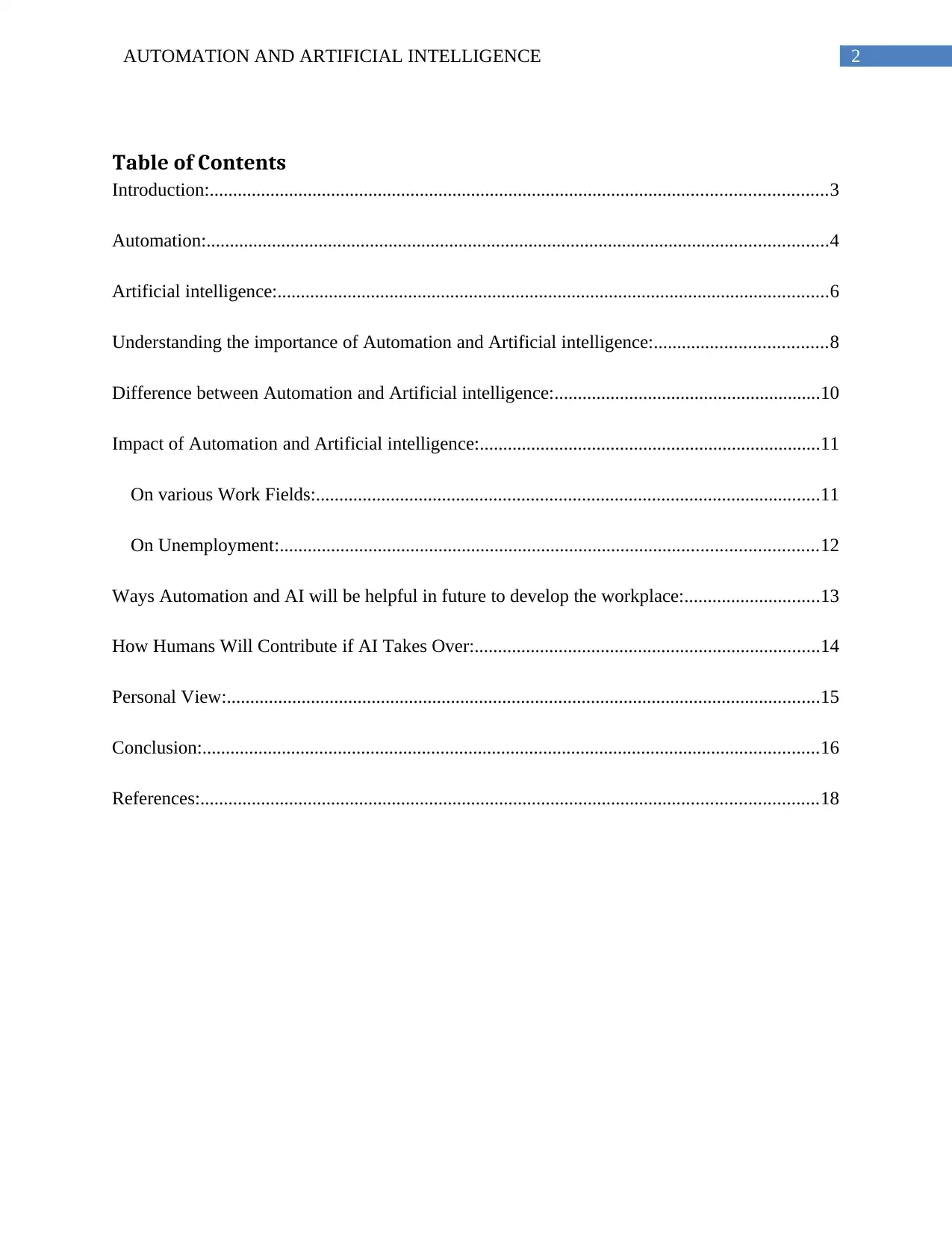
Table of Contents
Introduction:....................................................................................................................................3
Automation:.....................................................................................................................................4
Artificial intelligence:......................................................................................................................6
Understanding the importance of Automation and Artificial intelligence:.....................................8
Difference between Automation and Artificial intelligence:.........................................................10
Impact of Automation and Artificial intelligence:.........................................................................11
On various Work Fields:............................................................................................................11
On Unemployment:...................................................................................................................12
Ways Automation and AI will be helpful in future to develop the workplace:.............................13
How Humans Will Contribute if AI Takes Over:..........................................................................14
Personal View:...............................................................................................................................15
Conclusion:....................................................................................................................................16
References:....................................................................................................................................18
Table of Contents
Introduction:....................................................................................................................................3
Automation:.....................................................................................................................................4
Artificial intelligence:......................................................................................................................6
Understanding the importance of Automation and Artificial intelligence:.....................................8
Difference between Automation and Artificial intelligence:.........................................................10
Impact of Automation and Artificial intelligence:.........................................................................11
On various Work Fields:............................................................................................................11
On Unemployment:...................................................................................................................12
Ways Automation and AI will be helpful in future to develop the workplace:.............................13
How Humans Will Contribute if AI Takes Over:..........................................................................14
Personal View:...............................................................................................................................15
Conclusion:....................................................................................................................................16
References:....................................................................................................................................18
⊘ This is a preview!⊘
Do you want full access?
Subscribe today to unlock all pages.

Trusted by 1+ million students worldwide
3AUTOMATION AND ARTIFICIAL INTELLIGENCE
Introduction:
Science and technology have become an important part of human lives and starting from
the morning till the night, science and technology plays its part to make the lives of people
easier. The alarm clock, the lights, the television and many more such objects of luxury are
contribution of science and technology to the humankind. As a result of such development of
technology and science, tasks are done in much shorter time (Vermeulen et al., 2018). Each day
technology is coming up with some ideas that are helping the humans’ life more comfortable and
easier.
The 21st century has allowed humans to witness a tremendous development in the
technology and science. Gordon Moore, who was an engineer at the time of the year 1960,
predicted that transistors would not remain in such a humongous size and every two year they
would shrink in their size and such has been the case till the present date (Kovalchick & Dawson,
2004). Keeping the advancement of science and technology in all its fields, the aspect of
artificial intelligence and automation of machines is something that has been making leaps and
bound. Once Apple launched Siri, the artificial intelligence of Apple, the competitors were not
far behind and thus Amazon brought its own artificial intelligence, Echo. The Automatic
shopping terminals have also helped in making life easy for both the corporations as well as the
consumers (Tsugawa et al., 1979). Artificial Intelligence and Automation with the advent and
development of science and technology are also changing and in fact developing with rapid pace
and replacing humans in many fields of work. Artificial Intelligence, on one hand reflects the
intelligence that is similar to human and thus are relieving the humans from tasks of learning,
planning, and problem –solving, reasoning and more. Automation, on the other hand is
Introduction:
Science and technology have become an important part of human lives and starting from
the morning till the night, science and technology plays its part to make the lives of people
easier. The alarm clock, the lights, the television and many more such objects of luxury are
contribution of science and technology to the humankind. As a result of such development of
technology and science, tasks are done in much shorter time (Vermeulen et al., 2018). Each day
technology is coming up with some ideas that are helping the humans’ life more comfortable and
easier.
The 21st century has allowed humans to witness a tremendous development in the
technology and science. Gordon Moore, who was an engineer at the time of the year 1960,
predicted that transistors would not remain in such a humongous size and every two year they
would shrink in their size and such has been the case till the present date (Kovalchick & Dawson,
2004). Keeping the advancement of science and technology in all its fields, the aspect of
artificial intelligence and automation of machines is something that has been making leaps and
bound. Once Apple launched Siri, the artificial intelligence of Apple, the competitors were not
far behind and thus Amazon brought its own artificial intelligence, Echo. The Automatic
shopping terminals have also helped in making life easy for both the corporations as well as the
consumers (Tsugawa et al., 1979). Artificial Intelligence and Automation with the advent and
development of science and technology are also changing and in fact developing with rapid pace
and replacing humans in many fields of work. Artificial Intelligence, on one hand reflects the
intelligence that is similar to human and thus are relieving the humans from tasks of learning,
planning, and problem –solving, reasoning and more. Automation, on the other hand is
Paraphrase This Document
Need a fresh take? Get an instant paraphrase of this document with our AI Paraphraser
4AUTOMATION AND ARTIFICIAL INTELLIGENCE
exceedingly replacing human labor in different fields of works. Almost in every industry,
automation has made its place and covers the monotonous tasks; however, there are negative
sides of the advancement of both Artificial Intelligence and Automation, since it is leading to job
loss and people are losing their livelihoods (Smith & Carayon, 1995). Although the advancement
of technology and Artificial Intelligence is intended to make positive changes in the lives of
human, but the advancement is also creating what is known as disruptive employment. This
paper intends to highlight the impact that both Artificial Intelligence and Automation has on
various work fields along with the impact that it has on unemployment and establish the
disruption that it brings in the employees.
Automation:
Automation can be defined as a technology through which a process or any kind of
procedure is performed with the help of minimal assistance from human. Automation which is
also known as auto control, is basically the use of different kinds of control systems for the
operating of equipment like machinery, switching on the networks of telephone, boilers and heat
in ovens, aircraft and other applications but there is minimal human assistance or it can also be
said that these applications reduce the interventions of the human.Since the year 2010,
automation has been accused of job losses and downward mobility and these accusations have
been cited as one of the factors which helped in the resurgence of protectionist and nationalist
politics in UK, France and US(Manyika, 2017).
Manufacturing is an area where Automation is more prevalent since this field has more
tasks that require the intervention of labor and also it has repetitive tasks which Automation can
cover almost accurately with much more efficiency that is usually not the case with human labor.
exceedingly replacing human labor in different fields of works. Almost in every industry,
automation has made its place and covers the monotonous tasks; however, there are negative
sides of the advancement of both Artificial Intelligence and Automation, since it is leading to job
loss and people are losing their livelihoods (Smith & Carayon, 1995). Although the advancement
of technology and Artificial Intelligence is intended to make positive changes in the lives of
human, but the advancement is also creating what is known as disruptive employment. This
paper intends to highlight the impact that both Artificial Intelligence and Automation has on
various work fields along with the impact that it has on unemployment and establish the
disruption that it brings in the employees.
Automation:
Automation can be defined as a technology through which a process or any kind of
procedure is performed with the help of minimal assistance from human. Automation which is
also known as auto control, is basically the use of different kinds of control systems for the
operating of equipment like machinery, switching on the networks of telephone, boilers and heat
in ovens, aircraft and other applications but there is minimal human assistance or it can also be
said that these applications reduce the interventions of the human.Since the year 2010,
automation has been accused of job losses and downward mobility and these accusations have
been cited as one of the factors which helped in the resurgence of protectionist and nationalist
politics in UK, France and US(Manyika, 2017).
Manufacturing is an area where Automation is more prevalent since this field has more
tasks that require the intervention of labor and also it has repetitive tasks which Automation can
cover almost accurately with much more efficiency that is usually not the case with human labor.
5AUTOMATION AND ARTIFICIAL INTELLIGENCE
Thus, Automation helps in the improvement of labor with greater control of quality and
moreover in much shorter time than the involvement of human labor. There are four types of
Automation which are Numerical control, Computer Aided Manufacturing or CAM, Flexible
Manufacturing Systems also known as FMS and finally Industrial Robot.
Numerical Control is the type of Automation which is basically some programmed
machine tools that help in the performance of repetitive tasks which is seen to be frequently
showing up in the field of manufacturing. Examples of Numerical Control Automation include
3D printing, Drills, Embroidery Machines, Glass cutting and more (Li & Du, 2017). The CAM
or Computer Aided Manufacturing is a type of Automation that utilizes the computer software in
order to control the machinery. This type of automation is frequently utilized to automate the
schedule and flow of the task of manufacturing. Instances of CAM include in Computer Aided
Design or CAD, in CADD or Computer Aided Design and Drafting and also in certain Computer
programs which are focused on planning through the step of production.Flexible Manufacturing
System o FMS is used to combine numerical control systems or other industrial tools of
automation into one single system of sophistication. Within the range of its uses, Flexible
Manufacturing System allows customization and flexibility; FMS are often seen in the field of
automobile manufacturing in order to make some customized parts or some other similar parts
for different models of vehicles (Arthur et al., 1992). Other application of FMS includes the task
of metal cutting, welding and joining and also in treatment of surface.Finally, the Industrial
Robot types of Automation are actually Industrial robots which can be programmed and also
manipulated in the form of three or more axes and may have the potentiality to operate in some
fixed applications or some mobile applications. Industrial Robot types of Automation have
actually expansive and far reaching uses and are primarily based on movements. Some common
Thus, Automation helps in the improvement of labor with greater control of quality and
moreover in much shorter time than the involvement of human labor. There are four types of
Automation which are Numerical control, Computer Aided Manufacturing or CAM, Flexible
Manufacturing Systems also known as FMS and finally Industrial Robot.
Numerical Control is the type of Automation which is basically some programmed
machine tools that help in the performance of repetitive tasks which is seen to be frequently
showing up in the field of manufacturing. Examples of Numerical Control Automation include
3D printing, Drills, Embroidery Machines, Glass cutting and more (Li & Du, 2017). The CAM
or Computer Aided Manufacturing is a type of Automation that utilizes the computer software in
order to control the machinery. This type of automation is frequently utilized to automate the
schedule and flow of the task of manufacturing. Instances of CAM include in Computer Aided
Design or CAD, in CADD or Computer Aided Design and Drafting and also in certain Computer
programs which are focused on planning through the step of production.Flexible Manufacturing
System o FMS is used to combine numerical control systems or other industrial tools of
automation into one single system of sophistication. Within the range of its uses, Flexible
Manufacturing System allows customization and flexibility; FMS are often seen in the field of
automobile manufacturing in order to make some customized parts or some other similar parts
for different models of vehicles (Arthur et al., 1992). Other application of FMS includes the task
of metal cutting, welding and joining and also in treatment of surface.Finally, the Industrial
Robot types of Automation are actually Industrial robots which can be programmed and also
manipulated in the form of three or more axes and may have the potentiality to operate in some
fixed applications or some mobile applications. Industrial Robot types of Automation have
actually expansive and far reaching uses and are primarily based on movements. Some common
⊘ This is a preview!⊘
Do you want full access?
Subscribe today to unlock all pages.
Trusted by 1+ million students worldwide
6AUTOMATION AND ARTIFICIAL INTELLIGENCE
areas include assembly, palletizing, welding and handling materials (Cassiolato & Schmitz,
2002). Automation is, thus taking over the monotonous, boring, repetitive and unsafe jobs and
helping the human beings to save their time and invest their creativity in other aspects of the
work and most importantly, it is giving the ability to manufacture or do the designated task in a
safe and efficient manner.
Artificial intelligence:
Artificial Intelligence can be defined as the stimulation of the intelligence of the humans
in machines which are programmed to think and mimic the actions of the humans. This term can
also be applied to any machine which shows traits that is associated with the mind of a human
like the abilities of solving problem and learning(Kokina & Davenport, 2017).Machines are
becoming increasingly capable with the advent and development of technology and due to this
task, which are considered to require “intelligence” are more than often removed from the
definition of Artificial Intelligence. This is a phenomenon which is known as the ‘AI effect’.
Artificial Intelligence has significant use in many work fields, but healthcare is a field where the
system of Artificial Intelligence has some significant use; it would help in a lot of tasks like
quick diagnosis and more. If Artificial Intelligence gains such sophistication, it would have the
capability to operate on patients without even the supervision of humans. As a matter of fact,
there are certain technological surgeries which are operating without human interference.
Artificial Intelligence is probably one of the fastest growing development in the world of
science, innovation and technology. And to top the fact, many of the experts have believes that
Artificial Intelligence would have the ability to solve major challenges and severe situations of
crisis. Just like Automation, Artificial Intelligence is also of four types, which are Reactive
areas include assembly, palletizing, welding and handling materials (Cassiolato & Schmitz,
2002). Automation is, thus taking over the monotonous, boring, repetitive and unsafe jobs and
helping the human beings to save their time and invest their creativity in other aspects of the
work and most importantly, it is giving the ability to manufacture or do the designated task in a
safe and efficient manner.
Artificial intelligence:
Artificial Intelligence can be defined as the stimulation of the intelligence of the humans
in machines which are programmed to think and mimic the actions of the humans. This term can
also be applied to any machine which shows traits that is associated with the mind of a human
like the abilities of solving problem and learning(Kokina & Davenport, 2017).Machines are
becoming increasingly capable with the advent and development of technology and due to this
task, which are considered to require “intelligence” are more than often removed from the
definition of Artificial Intelligence. This is a phenomenon which is known as the ‘AI effect’.
Artificial Intelligence has significant use in many work fields, but healthcare is a field where the
system of Artificial Intelligence has some significant use; it would help in a lot of tasks like
quick diagnosis and more. If Artificial Intelligence gains such sophistication, it would have the
capability to operate on patients without even the supervision of humans. As a matter of fact,
there are certain technological surgeries which are operating without human interference.
Artificial Intelligence is probably one of the fastest growing development in the world of
science, innovation and technology. And to top the fact, many of the experts have believes that
Artificial Intelligence would have the ability to solve major challenges and severe situations of
crisis. Just like Automation, Artificial Intelligence is also of four types, which are Reactive
Paraphrase This Document
Need a fresh take? Get an instant paraphrase of this document with our AI Paraphraser
7AUTOMATION AND ARTIFICIAL INTELLIGENCE
Machines, Limited Memory, Theory of Mind and finally Self -awareness. The Reactive
Machines are the ones that react to certain situations. One of the best examples of such Artificial
Intelligence is the Deep Blue, the chess program of IBM; what was most noteworthy about the
program was that it won against a popular chess legend, Garry Kasparov. However, these
machines do not have memory and has no ability of using the past memories to use in the future
tactics. Reactive Machines just analyses all the best potential alternatives and then chooses the
best one out of all (Kitnao et al., 1997). The second type of Artificial Intelligence is the Limited
Memory and these Artificial Intelligence systems are capable of utilizing the past experiences
unlike the Reactive Machines, so that it can inform some future ones. One such good instance of
Limited Memory is the Self -Driving cars; such cars are known to have some decision -making
systems and these cars can make actions like changing of lanes by their own. It is noteworthy
that the actions came from previous observations made by the machine; although there is no
permanent storage where the observations can be stored (Stankiewicz, 1995). The third type of
Artificial Intelligence is the Theory of Mind and these systems of Artificial Intelligence have the
capability to understand others; in simple terms this means that it is a machines that understands
all the beliefs, desires, opinions and intentions of the others, but there are no machines invented
yet which is capable doing so. The fourth type of Artificial Intelligence is in fact the most
sophisticated level of AI; it is assumed that such system would have its own sense of self along
with the awareness, consciousness and also the emotions. This type of technology has not been
in existence yet but it will be a revolution once this kind of technology is invented.
Machines, Limited Memory, Theory of Mind and finally Self -awareness. The Reactive
Machines are the ones that react to certain situations. One of the best examples of such Artificial
Intelligence is the Deep Blue, the chess program of IBM; what was most noteworthy about the
program was that it won against a popular chess legend, Garry Kasparov. However, these
machines do not have memory and has no ability of using the past memories to use in the future
tactics. Reactive Machines just analyses all the best potential alternatives and then chooses the
best one out of all (Kitnao et al., 1997). The second type of Artificial Intelligence is the Limited
Memory and these Artificial Intelligence systems are capable of utilizing the past experiences
unlike the Reactive Machines, so that it can inform some future ones. One such good instance of
Limited Memory is the Self -Driving cars; such cars are known to have some decision -making
systems and these cars can make actions like changing of lanes by their own. It is noteworthy
that the actions came from previous observations made by the machine; although there is no
permanent storage where the observations can be stored (Stankiewicz, 1995). The third type of
Artificial Intelligence is the Theory of Mind and these systems of Artificial Intelligence have the
capability to understand others; in simple terms this means that it is a machines that understands
all the beliefs, desires, opinions and intentions of the others, but there are no machines invented
yet which is capable doing so. The fourth type of Artificial Intelligence is in fact the most
sophisticated level of AI; it is assumed that such system would have its own sense of self along
with the awareness, consciousness and also the emotions. This type of technology has not been
in existence yet but it will be a revolution once this kind of technology is invented.
8AUTOMATION AND ARTIFICIAL INTELLIGENCE
Understanding the importance of Automation and Artificial intelligence:
Man, in fact has feared the rise of Machines since they were afraid of the fact that their
own creation would become smarter and more intelligent than them. The Artificial Intelligence
systems that are new have such abilities that are beyond the cognitive abilities of the human
(McGovern et al., 2017). Many of the humankind are of the opinion that Artificial Intelligence
has the potentiality of dehumanizing the future of work and this is something that is scary for
many of the people. In the future, Artificial Intelligence will indeed automate most of the
physical and the repetitive tasks; however, by doing such thing Artificial Intelligence and
Automation will improve the skills of humans into something that will help in unique outcome;
for instance, when AI and Automation will cover the repetitive tasks, humans will have the time
and scope to be innovative, creative and have enhanced social abilities which machines can
never automate.
Artificial Intelligence is creating new jobs as well and to view it as a source of job loss is
not the whole face of the truth. It has been said that whilst some repetitive jobs will disappear
from the view of the humans, but instead of those repetitive jobs, many more jobs will appear
which are less repetitive and more creative (Bolton et al., 2018). Hence, Artificial Intelligence
will create jobs and provide the people with the opportunity to focus only on those parts of their
occupation which are satisfying to them. Artificial Intelligence also has the ability to bridge the
division of language; Artificial Intelligence is in fact bridging the gap between social and cultural
divisions within a workplace through AI powered language tools like Skype or Duolingo.
Artificial Intelligence in fact has the potentiality to transform the government. Taking the work
of Artificial Intelligence in mind, it helps in less paperwork and thus the government will be
quick in their responses and thus it will lead to a more efficient bureaucracy. As a matter of fact,
Understanding the importance of Automation and Artificial intelligence:
Man, in fact has feared the rise of Machines since they were afraid of the fact that their
own creation would become smarter and more intelligent than them. The Artificial Intelligence
systems that are new have such abilities that are beyond the cognitive abilities of the human
(McGovern et al., 2017). Many of the humankind are of the opinion that Artificial Intelligence
has the potentiality of dehumanizing the future of work and this is something that is scary for
many of the people. In the future, Artificial Intelligence will indeed automate most of the
physical and the repetitive tasks; however, by doing such thing Artificial Intelligence and
Automation will improve the skills of humans into something that will help in unique outcome;
for instance, when AI and Automation will cover the repetitive tasks, humans will have the time
and scope to be innovative, creative and have enhanced social abilities which machines can
never automate.
Artificial Intelligence is creating new jobs as well and to view it as a source of job loss is
not the whole face of the truth. It has been said that whilst some repetitive jobs will disappear
from the view of the humans, but instead of those repetitive jobs, many more jobs will appear
which are less repetitive and more creative (Bolton et al., 2018). Hence, Artificial Intelligence
will create jobs and provide the people with the opportunity to focus only on those parts of their
occupation which are satisfying to them. Artificial Intelligence also has the ability to bridge the
division of language; Artificial Intelligence is in fact bridging the gap between social and cultural
divisions within a workplace through AI powered language tools like Skype or Duolingo.
Artificial Intelligence in fact has the potentiality to transform the government. Taking the work
of Artificial Intelligence in mind, it helps in less paperwork and thus the government will be
quick in their responses and thus it will lead to a more efficient bureaucracy. As a matter of fact,
⊘ This is a preview!⊘
Do you want full access?
Subscribe today to unlock all pages.
Trusted by 1+ million students worldwide
9AUTOMATION AND ARTIFICIAL INTELLIGENCE
Artificial Intelligence has the power drastically change the public administration but this
technology comes with both opportunities as well as risks which needs to be evaluated and
understood with utmost importance. As mentioned before, the importance of Artificial
Intelligence also is seen in the field of Healthcare since it has the potential to make it more
affordable and accessible (Makridakis, 2017).
Automation has become a necessity in every field of work too, not only because it seeks
improvement in the quality of life for the human beings both at home and also at work, but also it
allows the distribution of both services and quality products to be made easily available at faster
rates which reduces the scope of human error and also the time (Hackett et al., 2008). It is for
this reason that great industries are taking the help of automation to be more efficient in their
production. However, it becomes a challenge for many people to accept that feeling which makes
them realize that a part of their autonomy is being diminished with the progress of technology
and people are being more and more dependent on Automation. It is true that Automation
disperses certain jobs, but it is also true that Automation is creating many possibilities for them
as well. Automation makes the jobs safe for the humans by doing all the unsafe jobs itself, for
instance smelting of metals and just like Artificial Intelligence it reduces the errors that are
usually made by humans and allows the humans to have production of more goods per capita.
Difference between Automation and Artificial intelligence:
The two terms Artificial Intelligence and Automation are often confused with each other
but these two terms are completely different. The primary difference lies in the fact that Artificial
Intelligence mimics or copies the intelligence of humans, their decisions and actions. On the
other hand, Automation has its focus on the tasks that are repetitive and instructive(Acemoglu &
Artificial Intelligence has the power drastically change the public administration but this
technology comes with both opportunities as well as risks which needs to be evaluated and
understood with utmost importance. As mentioned before, the importance of Artificial
Intelligence also is seen in the field of Healthcare since it has the potential to make it more
affordable and accessible (Makridakis, 2017).
Automation has become a necessity in every field of work too, not only because it seeks
improvement in the quality of life for the human beings both at home and also at work, but also it
allows the distribution of both services and quality products to be made easily available at faster
rates which reduces the scope of human error and also the time (Hackett et al., 2008). It is for
this reason that great industries are taking the help of automation to be more efficient in their
production. However, it becomes a challenge for many people to accept that feeling which makes
them realize that a part of their autonomy is being diminished with the progress of technology
and people are being more and more dependent on Automation. It is true that Automation
disperses certain jobs, but it is also true that Automation is creating many possibilities for them
as well. Automation makes the jobs safe for the humans by doing all the unsafe jobs itself, for
instance smelting of metals and just like Artificial Intelligence it reduces the errors that are
usually made by humans and allows the humans to have production of more goods per capita.
Difference between Automation and Artificial intelligence:
The two terms Artificial Intelligence and Automation are often confused with each other
but these two terms are completely different. The primary difference lies in the fact that Artificial
Intelligence mimics or copies the intelligence of humans, their decisions and actions. On the
other hand, Automation has its focus on the tasks that are repetitive and instructive(Acemoglu &
Paraphrase This Document
Need a fresh take? Get an instant paraphrase of this document with our AI Paraphraser
10AUTOMATION AND ARTIFICIAL INTELLIGENCE
Restrepo, 2018). Automation is meant to save time and money that are otherwise spent on
voluminous and monotonous tasks and thus in turn, automation gives the workers an opportunity
to engage themselves in much more complex task.
It is because of the Automated systems that businesses do not have to feel obligated to
copy and paste millions of individual marketing emails to their respective customers and this is
what the training companies do in order to manage their courses of the delegates. In simple
terms, Automation has one single purpose which is to let the machines perform their monotonous
and repetitive tasks so that humans can have some free time to utilize in some more vital tasks.
On the other hand, artificial intelligence’s point is to create some technologies that will copy
whatever a human says, thinks and does. As a matter of fact, Artificial Intelligence are systems
of technologies that were meant to think for themselves. It is designed in such a way that it can
seek patterns just like that of the humans and then learn from then experience gained from it;
Artificial Intelligence would also have the option of self -select of the appropriate responses in
situations that are handled by the humans.
Another important difference in between Artificial Intelligence and Automation lies in the data;
Automated machines are made to collate the data as per the instructions from the humans and
Artificial Intelligence system has to understand the same data (Siau, 2017). This is the core
difference between the Artificial intelligence system and the automated machines that actually
complement each other perfectly. Artificial Intelligence is expected to be able to analyse as well
as apply new information to react to appropriate situations. On the other hand, Automation refers
to the technology which is powered by bots that are programmable. And most importantly,
Automation follows rules in order to handle tasks that are straightforward and are unable to react
to any kind of new situations. However, it is also said that, due to the differences existing
Restrepo, 2018). Automation is meant to save time and money that are otherwise spent on
voluminous and monotonous tasks and thus in turn, automation gives the workers an opportunity
to engage themselves in much more complex task.
It is because of the Automated systems that businesses do not have to feel obligated to
copy and paste millions of individual marketing emails to their respective customers and this is
what the training companies do in order to manage their courses of the delegates. In simple
terms, Automation has one single purpose which is to let the machines perform their monotonous
and repetitive tasks so that humans can have some free time to utilize in some more vital tasks.
On the other hand, artificial intelligence’s point is to create some technologies that will copy
whatever a human says, thinks and does. As a matter of fact, Artificial Intelligence are systems
of technologies that were meant to think for themselves. It is designed in such a way that it can
seek patterns just like that of the humans and then learn from then experience gained from it;
Artificial Intelligence would also have the option of self -select of the appropriate responses in
situations that are handled by the humans.
Another important difference in between Artificial Intelligence and Automation lies in the data;
Automated machines are made to collate the data as per the instructions from the humans and
Artificial Intelligence system has to understand the same data (Siau, 2017). This is the core
difference between the Artificial intelligence system and the automated machines that actually
complement each other perfectly. Artificial Intelligence is expected to be able to analyse as well
as apply new information to react to appropriate situations. On the other hand, Automation refers
to the technology which is powered by bots that are programmable. And most importantly,
Automation follows rules in order to handle tasks that are straightforward and are unable to react
to any kind of new situations. However, it is also said that, due to the differences existing
11AUTOMATION AND ARTIFICIAL INTELLIGENCE
between them, Artificial Intelligence and automation are being increasingly integrated; as a
result, users are noticed to inject Automation into Artificial Intelligence with the intent of
developing it to another level.
Impact of Automation and Artificial intelligence:
On various Work Fields:
Artificial Intelligence or any type of Automation of tasks has huge potentiality to bring
benefits in terms of economy. There are both optimistic and pessimistic views regarding this
matter and it is better to explore both of it (West, 2018). The impact of AI and Automation will
not only bring economic benefits but it will also bring job loss.With the automation, there has
been various changes in the workplace. The humankind, in today’s world has become so
dependent on science and technology that it is difficult to imagine life without the existence of
science and the technology. Artificial Intelligence and Automation are rapidly growing and
changing and somehow it is leading to the Fourth Industrial Revolution. With proper
development of AI, people would get an accurate, safe and also convenient answer in just few
moments and that would save the provider of the health care’s money too. It can be said that
Artificial Intelligence refers to the smart technology which has to deal with conceptual ideas and
also with uncertainty. There has been a significant changes observed in the workplace with the
introduction of automation. Automation has helped in the increase of the production rate of the
organisation. Moreover, the production was high in quality compared to the production that has
been achieved earlier. It has reduced the duties and responsibilities of the employees increasing
efficiency of the employees in the workplace.
between them, Artificial Intelligence and automation are being increasingly integrated; as a
result, users are noticed to inject Automation into Artificial Intelligence with the intent of
developing it to another level.
Impact of Automation and Artificial intelligence:
On various Work Fields:
Artificial Intelligence or any type of Automation of tasks has huge potentiality to bring
benefits in terms of economy. There are both optimistic and pessimistic views regarding this
matter and it is better to explore both of it (West, 2018). The impact of AI and Automation will
not only bring economic benefits but it will also bring job loss.With the automation, there has
been various changes in the workplace. The humankind, in today’s world has become so
dependent on science and technology that it is difficult to imagine life without the existence of
science and the technology. Artificial Intelligence and Automation are rapidly growing and
changing and somehow it is leading to the Fourth Industrial Revolution. With proper
development of AI, people would get an accurate, safe and also convenient answer in just few
moments and that would save the provider of the health care’s money too. It can be said that
Artificial Intelligence refers to the smart technology which has to deal with conceptual ideas and
also with uncertainty. There has been a significant changes observed in the workplace with the
introduction of automation. Automation has helped in the increase of the production rate of the
organisation. Moreover, the production was high in quality compared to the production that has
been achieved earlier. It has reduced the duties and responsibilities of the employees increasing
efficiency of the employees in the workplace.
⊘ This is a preview!⊘
Do you want full access?
Subscribe today to unlock all pages.
Trusted by 1+ million students worldwide

1 out of 22


Related Documents


Your All-in-One AI-Powered Toolkit for Academic Success.
+13062052269
info@desklib.com
Available 24*7 on WhatsApp / Email
![[object Object]](/_next/static/media/star-bottom.7253800d.svg)
Unlock your academic potential
Copyright © 2020–2026 A2Z Services. All Rights Reserved. Developed and managed by ZUCOL.