Discussion Board: Examining AI and the Human-Machine Relationship

Verified

Added on  2020/02/24

|3
|433
|161
Discussion Board Post
AI Summary
This discussion board post examines the ethical implications of artificial intelligence, drawing upon the Star Trek episode "The Measure of a Man." The author explores the contrasting viewpoints of Captain Picard and Maddox regarding the nature of sentience and the mind-body problem in relation to the android Data. Picard views Data as a sentient being, while Maddox questions Data's capacity for true emotion and consciousness, arguing that Data is merely a complex machine. The post critiques Maddox's criteria for sentience, highlighting the importance of creativity and critical thinking. It also considers the future of AI and the need for ethical guidelines to govern human interactions with advanced machines, referencing relevant literature on artificial intelligence and its principles. The author emphasizes the need to set up rules to govern the way machines are treated by the human beings to avoid misuse.
Document Page
Running Head: DISCUSSION BOARD 1
Discussion Board
Name:
Affiliation:
tabler-icon-diamond-filled.svg

Paraphrase This Document

Need a fresh take? Get an instant paraphrase of this document with our AI Paraphraser
Document Page
Discussion Board 2
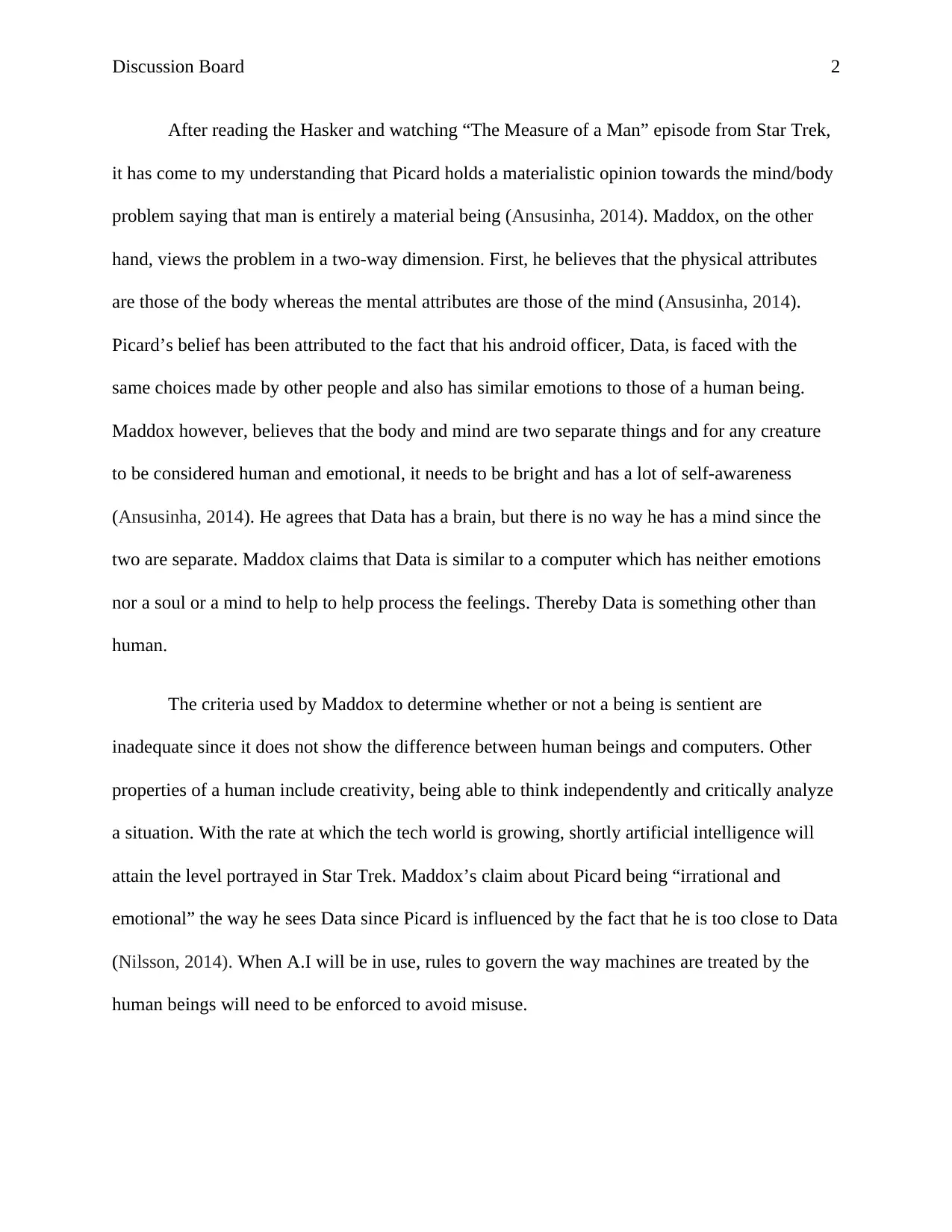
After reading the Hasker and watching “The Measure of a Man” episode from Star Trek,
it has come to my understanding that Picard holds a materialistic opinion towards the mind/body
problem saying that man is entirely a material being (Ansusinha, 2014). Maddox, on the other
hand, views the problem in a two-way dimension. First, he believes that the physical attributes
are those of the body whereas the mental attributes are those of the mind (Ansusinha, 2014).
Picard’s belief has been attributed to the fact that his android officer, Data, is faced with the
same choices made by other people and also has similar emotions to those of a human being.
Maddox however, believes that the body and mind are two separate things and for any creature
to be considered human and emotional, it needs to be bright and has a lot of self-awareness
(Ansusinha, 2014). He agrees that Data has a brain, but there is no way he has a mind since the
two are separate. Maddox claims that Data is similar to a computer which has neither emotions
nor a soul or a mind to help to help process the feelings. Thereby Data is something other than
human.
The criteria used by Maddox to determine whether or not a being is sentient are
inadequate since it does not show the difference between human beings and computers. Other
properties of a human include creativity, being able to think independently and critically analyze
a situation. With the rate at which the tech world is growing, shortly artificial intelligence will
attain the level portrayed in Star Trek. Maddox’s claim about Picard being “irrational and
emotional” the way he sees Data since Picard is influenced by the fact that he is too close to Data
(Nilsson, 2014). When A.I will be in use, rules to govern the way machines are treated by the
human beings will need to be enforced to avoid misuse.
Document Page
Discussion Board 3
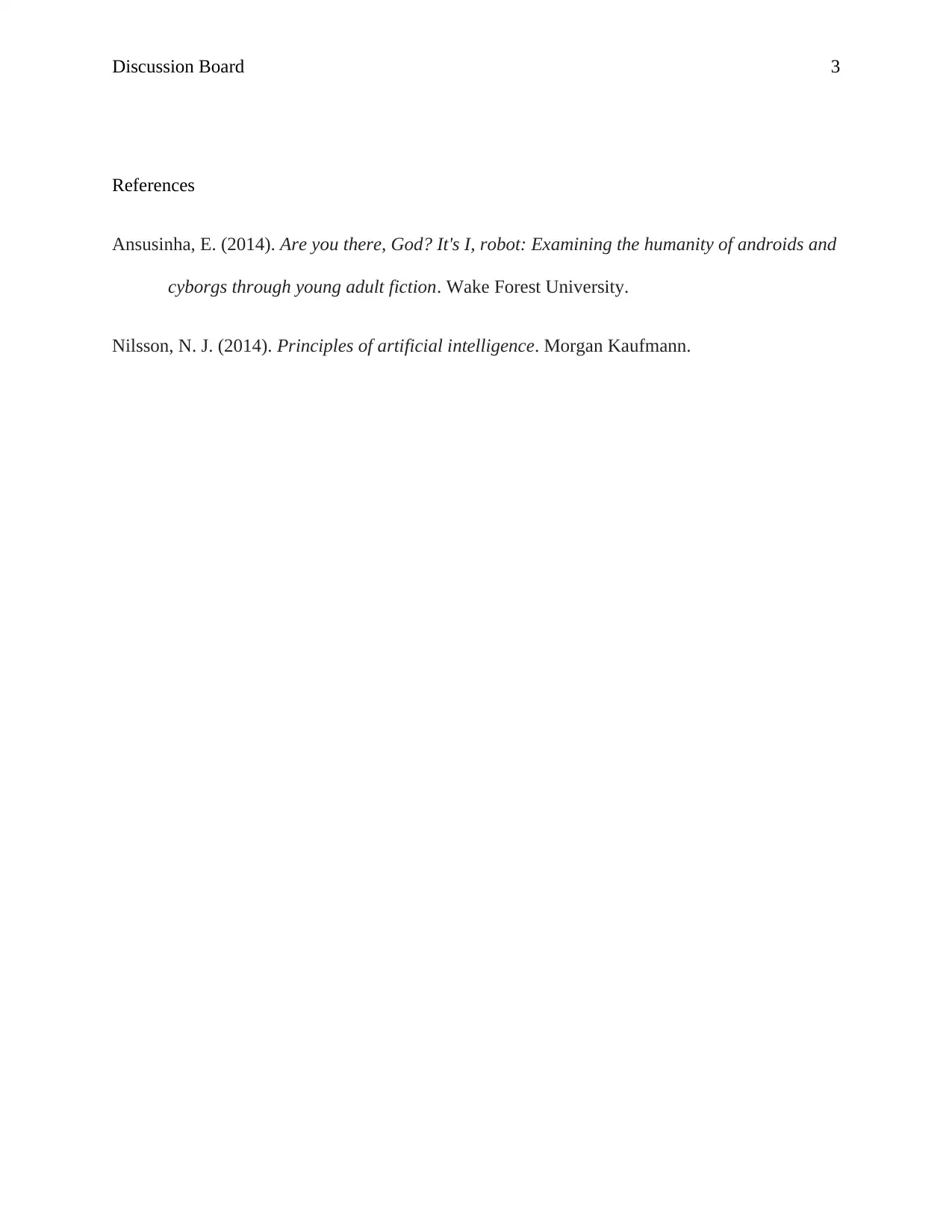
References
Ansusinha, E. (2014). Are you there, God? It's I, robot: Examining the humanity of androids and
cyborgs through young adult fiction. Wake Forest University.
Nilsson, N. J. (2014). Principles of artificial intelligence. Morgan Kaufmann.
chevron_up_icon
1 out of 3
circle_padding
hide_on_mobile
zoom_out_icon
[object Object]