Artificial Intelligence: Current Capabilities and Applications

Verified

Added on  2023/03/30

|2
|572
|250
Report
AI Summary
This report delves into the current capabilities of artificial intelligence, emphasizing its advancements in deep learning and its impact on various industries. It highlights AI's role in automating tasks, improving data analysis through neural networks, and enhancing existing technologies like computer vision. The report explores real-world applications such as self-driving cars and fraud detection systems, illustrating how AI is transforming different sectors. It also mentions the importance of AI in cognitive computing and the development of AI-driven algorithms. The report references several sources and provides a comprehensive overview of AI's current state and future potential.
Document Page
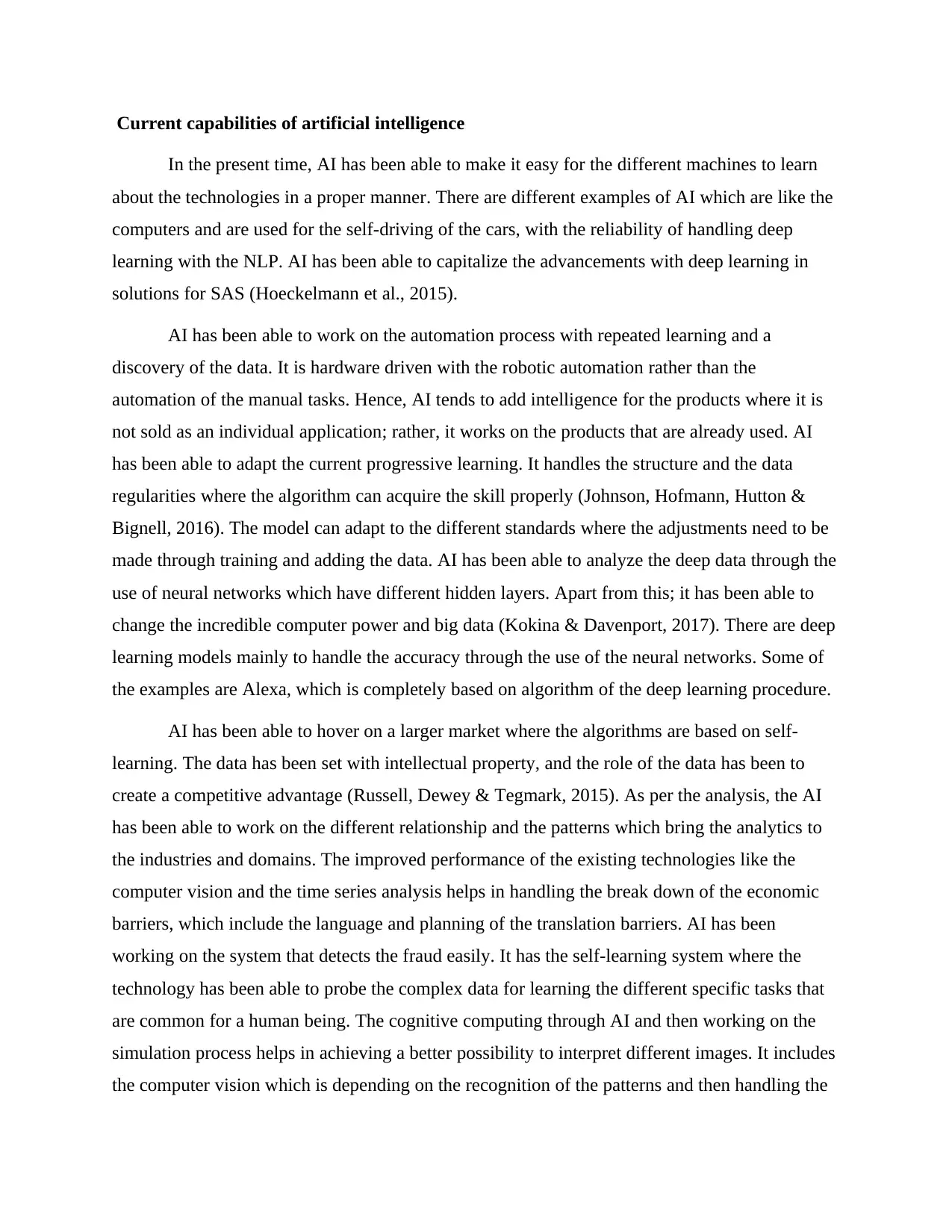
Current capabilities of artificial intelligence
In the present time, AI has been able to make it easy for the different machines to learn
about the technologies in a proper manner. There are different examples of AI which are like the
computers and are used for the self-driving of the cars, with the reliability of handling deep
learning with the NLP. AI has been able to capitalize the advancements with deep learning in
solutions for SAS (Hoeckelmann et al., 2015).
AI has been able to work on the automation process with repeated learning and a
discovery of the data. It is hardware driven with the robotic automation rather than the
automation of the manual tasks. Hence, AI tends to add intelligence for the products where it is
not sold as an individual application; rather, it works on the products that are already used. AI
has been able to adapt the current progressive learning. It handles the structure and the data
regularities where the algorithm can acquire the skill properly (Johnson, Hofmann, Hutton &
Bignell, 2016). The model can adapt to the different standards where the adjustments need to be
made through training and adding the data. AI has been able to analyze the deep data through the
use of neural networks which have different hidden layers. Apart from this; it has been able to
change the incredible computer power and big data (Kokina & Davenport, 2017). There are deep
learning models mainly to handle the accuracy through the use of the neural networks. Some of
the examples are Alexa, which is completely based on algorithm of the deep learning procedure.
AI has been able to hover on a larger market where the algorithms are based on self-
learning. The data has been set with intellectual property, and the role of the data has been to
create a competitive advantage (Russell, Dewey & Tegmark, 2015). As per the analysis, the AI
has been able to work on the different relationship and the patterns which bring the analytics to
the industries and domains. The improved performance of the existing technologies like the
computer vision and the time series analysis helps in handling the break down of the economic
barriers, which include the language and planning of the translation barriers. AI has been
working on the system that detects the fraud easily. It has the self-learning system where the
technology has been able to probe the complex data for learning the different specific tasks that
are common for a human being. The cognitive computing through AI and then working on the
simulation process helps in achieving a better possibility to interpret different images. It includes
the computer vision which is depending on the recognition of the patterns and then handling the
tabler-icon-diamond-filled.svg

Paraphrase This Document

Need a fresh take? Get an instant paraphrase of this document with our AI Paraphraser
Document Page
deep learning standards that is for recognizing on how the machines can process and then
analyze the different images.
References
Hoeckelmann, M., Rudas, I. J., Fiorini, P., Kirchner, F., & Haidegger, T. (2015). Current
capabilities and development potential in surgical robotics. International Journal of
Advanced Robotic Systems, 12(5), 61.
Johnson, M., Hofmann, K., Hutton, T., & Bignell, D. (2016, July). The Malmo Platform for
Artificial Intelligence Experimentation. In IJCAI (pp. 4246-4247).
Kokina, J., & Davenport, T. H. (2017). The emergence of artificial intelligence: How automation
is changing auditing. Journal of Emerging Technologies in Accounting, 14(1), 115-122.
Russell, S., Dewey, D., & Tegmark, M. (2015). Research priorities for robust and beneficial
artificial intelligence. Ai Magazine, 36(4), 105-114.
chevron_up_icon
1 out of 2
circle_padding
hide_on_mobile
zoom_out_icon
[object Object]