Consequences of Social Interactions at School for Students with ASD
VerifiedAdded on 2023/01/12
|17
|4004
|1
Project
AI Summary
This project explores the learning consequences of social interactions for students with Autism Spectrum Disorder (ASD) in a primary school setting. The author, an educator, aims to analyze the impact of social interactions on students with ASD, focusing on their communication difficulties, behavioral patterns, and overall well-being within the school environment. The rationale highlights the importance of early intervention and inclusive education, emphasizing the benefits of integrating children with ASD into mainstream schools. The project acknowledges the unique characteristics of ASD, including challenges with social communication, sensory sensitivities, and uneven intellectual development. It also emphasizes the importance of creating supportive learning environments and adapting educational programs to meet the needs of students with ASD. The project addresses the prevalence of bullying and social isolation experienced by students with ASD and proposes strategies to improve their social integration and academic performance. The project will involve 6th-grade students with ASD, examining their experiences and challenges within the school setting. The author is working on reframing the project to be more ethical and creative, focusing on building affirmative relations through creative activities rather than making diagnoses. The project aims to contribute to the understanding of ASD and promote inclusive practices in education, ultimately improving the learning outcomes and social experiences of students with ASD.


Paraphrase This Document
Need a fresh take? Get an instant paraphrase of this document with our AI Paraphraser
Topic: What is the (learning) consequence of social interactions at school for
students who have ASD?
Introduction
For almost six years I have been working in education sector. Back in my
home country I have been working as early childhood educator. When I have
moved to Australia, first, I was working as an educator for outside school hour’s
care. Later on, I got promotion to be a coordinator of the program. With
promotion I got more responsibilities and obligations. Now I am responsible for
designing and delivering high quality program to children. My obligations
include family support and maintaining communication with school
management.
Outside school hours care service operates every weekday during school
year as well as school holidays. Our service is to foresters the week
performance of children’s their wellbeing, development and learning.
We try to provide a safe and healthy environment where we run a range
of activities that promotes involvement for all children and sense of wellbeing.
Also, we are working on building a secure, trusting, caring environment for all
children. In our program we understand that each child is unique with their own
individual interests, abilities, beliefs, customs and culture. In our service we
pursue main goals for children that include following:
1. To develop understanding of themselves and others
2. To develop emotionally, socially, physically, culturally
students who have ASD?
Introduction
For almost six years I have been working in education sector. Back in my
home country I have been working as early childhood educator. When I have
moved to Australia, first, I was working as an educator for outside school hour’s
care. Later on, I got promotion to be a coordinator of the program. With
promotion I got more responsibilities and obligations. Now I am responsible for
designing and delivering high quality program to children. My obligations
include family support and maintaining communication with school
management.
Outside school hours care service operates every weekday during school
year as well as school holidays. Our service is to foresters the week
performance of children’s their wellbeing, development and learning.
We try to provide a safe and healthy environment where we run a range
of activities that promotes involvement for all children and sense of wellbeing.
Also, we are working on building a secure, trusting, caring environment for all
children. In our program we understand that each child is unique with their own
individual interests, abilities, beliefs, customs and culture. In our service we
pursue main goals for children that include following:
1. To develop understanding of themselves and others
2. To develop emotionally, socially, physically, culturally
3. To grow in independence, confidence
4. To participate in independent learning
5. To develop essential skills and knowledge
6. To develop relationship based on trust and respect
Outside school hours care service is directly connected with primary
school.
The service follows values and sticks to rules that are announced by
primary school. On daily basis the service exchanges information with the
school in order to provide the best care for children. On daily basis we are
obliged to fill observations on each child that attends our service and also
observations on activities of the day. From time to time we ask children to write
their thoughts about the service and their suggestions for improvement.
Outside school hours care program includes variety of activities such as
sports, craft and learning. The service includes children aged from six to
thirteen from different backgrounds. In addition, the service includes children
with ASD, attention deficit hyperactivity disorder (ADHD), anxiety disorders
and others. Sometimes children have not only diagnosed with one disorder but
combination of two or three of them Our main goal is to provide Safe
environment for all children and make Sure that they are heard and understood
(Ashwood, Tye, Azadi, Cartwright, Asherson, Bolton,2015).
Rationale
The main objective of the research is to critically analyse the behaviour of primary
school student with ASD (Autism Spectrum Disorder) which have a major problem of
communication and expressing their view point. I will run my project on the primary
school basis. ASD is a mental disorder characterized by pronounced deficiency of
personal, social, speech and other aspect s of development and communication skill s
(About Autism spectrum disorder, 2020). There i s no certain answer about cause of
ASD. Experts believe that important factor is hereditary factor. However, central
nervous system can be damaged during intrauterine development and also during early
childhood years (Baird, Douglas & Murphy, 2011). In case if child has ASD it is highly
recommended to start professional therapy as soon as possible to avoid symptoms
4. To participate in independent learning
5. To develop essential skills and knowledge
6. To develop relationship based on trust and respect
Outside school hours care service is directly connected with primary
school.
The service follows values and sticks to rules that are announced by
primary school. On daily basis the service exchanges information with the
school in order to provide the best care for children. On daily basis we are
obliged to fill observations on each child that attends our service and also
observations on activities of the day. From time to time we ask children to write
their thoughts about the service and their suggestions for improvement.
Outside school hours care program includes variety of activities such as
sports, craft and learning. The service includes children aged from six to
thirteen from different backgrounds. In addition, the service includes children
with ASD, attention deficit hyperactivity disorder (ADHD), anxiety disorders
and others. Sometimes children have not only diagnosed with one disorder but
combination of two or three of them Our main goal is to provide Safe
environment for all children and make Sure that they are heard and understood
(Ashwood, Tye, Azadi, Cartwright, Asherson, Bolton,2015).
Rationale
The main objective of the research is to critically analyse the behaviour of primary
school student with ASD (Autism Spectrum Disorder) which have a major problem of
communication and expressing their view point. I will run my project on the primary
school basis. ASD is a mental disorder characterized by pronounced deficiency of
personal, social, speech and other aspect s of development and communication skill s
(About Autism spectrum disorder, 2020). There i s no certain answer about cause of
ASD. Experts believe that important factor is hereditary factor. However, central
nervous system can be damaged during intrauterine development and also during early
childhood years (Baird, Douglas & Murphy, 2011). In case if child has ASD it is highly
recommended to start professional therapy as soon as possible to avoid symptoms
⊘ This is a preview!⊘
Do you want full access?
Subscribe today to unlock all pages.

Trusted by 1+ million students worldwide
worsening worse (Tsao, Davenport & Schmiege, 2012).
Connolly and Gersch (2016) strongly believe that school years play
important role in the formation of children’s personality. In most cases children
with ASD come to primary school already after years of therapy and parents
hard work. Children with ASD integrate into new more complicated society that
they used to. They get not only knowledge and learn essential skills but also
rules of life. In addition, they learn how to “read” normal behaviour patterns.
This is why school period is an important step and a path to new opportunities.
According to Baird, Dougl as & Murphy (2011) all children with ASD are
not so different from the other children and only specialist can tell the
difference. But still more often the characteristics of children with ASD are
clearly seen when communicating with them (Baird, Douglas & Murphy, 2011).
Redshaw and Smith (2014) in their research raise awareness of early symptoms
of ASD. Also,
Connolly and Gersch (2016) strongly believe that school years play
important role in the formation of children’s personality. In most cases children
with ASD come to primary school already after years of therapy and parents
hard work. Children with ASD integrate into new more complicated society that
they used to. They get not only knowledge and learn essential skills but also
rules of life. In addition, they learn how to “read” normal behaviour patterns.
This is why school period is an important step and a path to new opportunities.
According to Baird, Dougl as & Murphy (2011) all children with ASD are
not so different from the other children and only specialist can tell the
difference. But still more often the characteristics of children with ASD are
clearly seen when communicating with them (Baird, Douglas & Murphy, 2011).
Redshaw and Smith (2014) in their research raise awareness of early symptoms
of ASD. Also,
Paraphrase This Document
Need a fresh take? Get an instant paraphrase of this document with our AI Paraphraser
Redshaw and Smith (2014) claim that it is highly important to recognize ASD
symptoms at the first stage.
Allison and Baron-Cohen (2018) in their article take a deeper look on
conditions that may occur in children with A SD. The child with ASD may not
look at you and avoid any eye contact and avoid answering questions during
conversation so it can seem that they do not hear you and understand (Allison &
Baron-Cohen, 2018).
On the other hand, there is a reverse situation, a child with ASD can talk
on the topics of interest without stopping and will not notice that the other
person has lost any interest in conversation and wants to complete it (Pop-
Jordanova, 2008).
In most ca ses children with ASD do not understand hidden moti ves of other
people actions or figurative meanings and jokes. Most often, children with ASD
have features of speech development which can vary from complete lack of
speech to small features in intonation. The theory of neurodiversity is that
developmental disorders such as autism and ADHD stem from regular, natural
variability of the human species. It reflects a modern and radically different way
of thinking at diseases that have historically been pathologized; it is a point of
view that is not widely recognized, if evidence is gradually endorsing it. The
research shows disorders such as autism have robust occurrence as far ago as
we can calculate in the human population. We understand that autism, ADHD
and other disorders occur from a mixture of hereditary predisposition and
contact with the environment; they are not the result of disease or accident.
These are still others that, although accepting some elements of the idea of
neurodiversity when applicable to autism, claim that certain autistic children's
specific problems work best into a more traditional treatment paradigm. Some
of these are teachers of autistic kids or disabled people who fail considerably in
any setting, who have practically no vocabulary, who have serious cognitive
disabilities, who suffer from stomach distress or seizures, who seem to be in
agony for no particular cause, or who assault himself or someone else. The
importance of this for the discussion on neurodiversity is that although we delve
symptoms at the first stage.
Allison and Baron-Cohen (2018) in their article take a deeper look on
conditions that may occur in children with A SD. The child with ASD may not
look at you and avoid any eye contact and avoid answering questions during
conversation so it can seem that they do not hear you and understand (Allison &
Baron-Cohen, 2018).
On the other hand, there is a reverse situation, a child with ASD can talk
on the topics of interest without stopping and will not notice that the other
person has lost any interest in conversation and wants to complete it (Pop-
Jordanova, 2008).
In most ca ses children with ASD do not understand hidden moti ves of other
people actions or figurative meanings and jokes. Most often, children with ASD
have features of speech development which can vary from complete lack of
speech to small features in intonation. The theory of neurodiversity is that
developmental disorders such as autism and ADHD stem from regular, natural
variability of the human species. It reflects a modern and radically different way
of thinking at diseases that have historically been pathologized; it is a point of
view that is not widely recognized, if evidence is gradually endorsing it. The
research shows disorders such as autism have robust occurrence as far ago as
we can calculate in the human population. We understand that autism, ADHD
and other disorders occur from a mixture of hereditary predisposition and
contact with the environment; they are not the result of disease or accident.
These are still others that, although accepting some elements of the idea of
neurodiversity when applicable to autism, claim that certain autistic children's
specific problems work best into a more traditional treatment paradigm. Some
of these are teachers of autistic kids or disabled people who fail considerably in
any setting, who have practically no vocabulary, who have serious cognitive
disabilities, who suffer from stomach distress or seizures, who seem to be in
agony for no particular cause, or who assault himself or someone else. The
importance of this for the discussion on neurodiversity is that although we delve
into the broad variety of characteristics found in autism, we will identify
discrepancies and conditions (both consistent with the definition of
neurodiversity), but we will find instances of illnesses and even disorders which
are more aligned with a paradigm of psychiatry than neurodiversity.
Some children with ASD learn to read quite early even before they go to
school. Children with ASD can show serious interest in one particular subject
such as history that they will know no worse than a teacher (Allison & Baron-
Cohen, 2018).
However, in most cases intellectual development occurs unevenly. Such features as visual
perception, attention to details, mechanical memory are often strengths of children with ASD.
Weaknesses often include such features as a lack of understanding of the general meaning of the text,
retelling text that was read, fragmentary perception of oral speech (Pop-Jordanova, 2008).
Many children with ASD have features in the development of the sensory
sphere (Maskey, Warnell, Parr, Couteur & McConachie, 2013). For instance,
some children do not tolerate loud sounds or bright light, a smell or touch can
also become irritant. In most cases strange behaviour of child with ASD is
reaction to sensory stimuli causing great inconvenience or even pain for a child.
discrepancies and conditions (both consistent with the definition of
neurodiversity), but we will find instances of illnesses and even disorders which
are more aligned with a paradigm of psychiatry than neurodiversity.
Some children with ASD learn to read quite early even before they go to
school. Children with ASD can show serious interest in one particular subject
such as history that they will know no worse than a teacher (Allison & Baron-
Cohen, 2018).
However, in most cases intellectual development occurs unevenly. Such features as visual
perception, attention to details, mechanical memory are often strengths of children with ASD.
Weaknesses often include such features as a lack of understanding of the general meaning of the text,
retelling text that was read, fragmentary perception of oral speech (Pop-Jordanova, 2008).
Many children with ASD have features in the development of the sensory
sphere (Maskey, Warnell, Parr, Couteur & McConachie, 2013). For instance,
some children do not tolerate loud sounds or bright light, a smell or touch can
also become irritant. In most cases strange behaviour of child with ASD is
reaction to sensory stimuli causing great inconvenience or even pain for a child.
⊘ This is a preview!⊘
Do you want full access?
Subscribe today to unlock all pages.
Trusted by 1+ million students worldwide
Children with ASD can calm themselves down with habitual stimulation
(Maskey, Warnell, Parr, Couteur & McConachie, 2013). For example, when
they are exposed to bright light or loud music, some children can start shake
their hands or bounce in place or roll wheels of favourite car. The mechanisms
of these actions are very similar to those that we demonstrate by shaking leg or
twisting hair on a finger while having unpleasant conversation or during long
wait.
To summarise ASD is characterised by some symptoms such as:
1. Avoid eye contact
2. Do not like to start conversation
3. Rapidly repeat of phases and words that give wrong impression of mental
retardation
4. Do not show sympathy
5. Have delays in learning
6. Do not understand figurative meanings and jokes
7. Do not tolerate loud sounds or bright light
However, not all children with ASD have these symptoms. Symptoms
can differ from case to case (Redshaw & Smith, 2014). In my practice I have
met 5- year old child that was extremely talented in mathematics he could easily
memorise and name any numbers. With years he succeeded in mathematics, but
he completely failed in learning language. Experts believe that earlier child will
be diagnosed with ASD is better as it raises chances to correct behaviour,
provide needed help and integrate child into society (Allison & Baron-
Cohen,2018).
It is highly recommended for children with ASD attend school and be in
society in order to prepare them for future life (Starr, Popovic & McCall, 2016).
Children with ASD can attend school as all other kids however they will require
some special educational conditions. Set of these educational conditions may
vary depending on individual characteristics of child (Peters, 2016). For
instance, some children just need little support from teaching stuff. On the other
(Maskey, Warnell, Parr, Couteur & McConachie, 2013). For example, when
they are exposed to bright light or loud music, some children can start shake
their hands or bounce in place or roll wheels of favourite car. The mechanisms
of these actions are very similar to those that we demonstrate by shaking leg or
twisting hair on a finger while having unpleasant conversation or during long
wait.
To summarise ASD is characterised by some symptoms such as:
1. Avoid eye contact
2. Do not like to start conversation
3. Rapidly repeat of phases and words that give wrong impression of mental
retardation
4. Do not show sympathy
5. Have delays in learning
6. Do not understand figurative meanings and jokes
7. Do not tolerate loud sounds or bright light
However, not all children with ASD have these symptoms. Symptoms
can differ from case to case (Redshaw & Smith, 2014). In my practice I have
met 5- year old child that was extremely talented in mathematics he could easily
memorise and name any numbers. With years he succeeded in mathematics, but
he completely failed in learning language. Experts believe that earlier child will
be diagnosed with ASD is better as it raises chances to correct behaviour,
provide needed help and integrate child into society (Allison & Baron-
Cohen,2018).
It is highly recommended for children with ASD attend school and be in
society in order to prepare them for future life (Starr, Popovic & McCall, 2016).
Children with ASD can attend school as all other kids however they will require
some special educational conditions. Set of these educational conditions may
vary depending on individual characteristics of child (Peters, 2016). For
instance, some children just need little support from teaching stuff. On the other
Paraphrase This Document
Need a fresh take? Get an instant paraphrase of this document with our AI Paraphraser

hand, there
are children who require more attention from teachers especially if in addition
to ASD they for example have intellectual disabilities, obsessive-compulsive
disorder or any other (Anonymous,2011). Some schools have special educators
who specialise on communicating with children diagnosed with ASD. It is
highly important for teaching stuff to know about ASD diagnose as soon as
possible as it will help them in building communication with child
(Anonymous,2011).
Presence of child with ASD in school does not guarantee effective
learning progress. But by creating special conditions such as an adapted
program, teachers additional help helps child with ASD be more successful in
mastering the school curriculum, contributing to the formation of
communicative behaviour, expanding life experience and better
socialisatiaduating from school children with ASD will have to live in the same
society as all other graduates. The sooner they get to know each other the higher
chances that they will understand and interact between each other (Mandy,
Murin, Baykaner, Staunton, Hellriegel, Anderson, & Skuse, 2016). Child with
ASD that will attend ordinary school will find it much easier to integrate into
society than the one who will attend special correctional school or be on home
learning. The benefits of inclusive education for ordinary children have been
proven by many experts. For example, it has been proven that school children of
inclusive schools have developed better communication skills, they better
understand others and demonstrate greater flexibility and creativity. In addition,
by working in an inclusive classroom teacher receive unique experience. In a
school where children from early age learn to understand each other’s
differences develop such qualities as tolerance, justice, kindness.
Participants of research
For my project I have selected from group of children from 10-year to 15
years those are basically studying in 6th grade concerning with ASD. I have
chosen this group for my project as many children’s in last few months have not
gone through any treatment relevant to ASD. They experiences troubles while
to ASD they for example have intellectual disabilities, obsessive-compulsive
disorder or any other (Anonymous,2011). Some schools have special educators
who specialise on communicating with children diagnosed with ASD. It is
highly important for teaching stuff to know about ASD diagnose as soon as
possible as it will help them in building communication with child
(Anonymous,2011).
Presence of child with ASD in school does not guarantee effective
learning progress. But by creating special conditions such as an adapted
program, teachers additional help helps child with ASD be more successful in
mastering the school curriculum, contributing to the formation of
communicative behaviour, expanding life experience and better
socialisatiaduating from school children with ASD will have to live in the same
society as all other graduates. The sooner they get to know each other the higher
chances that they will understand and interact between each other (Mandy,
Murin, Baykaner, Staunton, Hellriegel, Anderson, & Skuse, 2016). Child with
ASD that will attend ordinary school will find it much easier to integrate into
society than the one who will attend special correctional school or be on home
learning. The benefits of inclusive education for ordinary children have been
proven by many experts. For example, it has been proven that school children of
inclusive schools have developed better communication skills, they better
understand others and demonstrate greater flexibility and creativity. In addition,
by working in an inclusive classroom teacher receive unique experience. In a
school where children from early age learn to understand each other’s
differences develop such qualities as tolerance, justice, kindness.
Participants of research
For my project I have selected from group of children from 10-year to 15
years those are basically studying in 6th grade concerning with ASD. I have
chosen this group for my project as many children’s in last few months have not
gone through any treatment relevant to ASD. They experiences troubles while
⊘ This is a preview!⊘
Do you want full access?
Subscribe today to unlock all pages.
Trusted by 1+ million students worldwide
Teachers Group
member
expressing themselves, understanding social behaviour patterns,
communicating with other school children due to that they become highly
irritated and impact their health condition. Many times situation is so bad that
because of their unusual behavior they used to get is exposed to bullying from
their school mates of higher graders or even by children’s living near their
houses. The condition is that even they find struggles to make any friends in the
society which influence their performance and they start thinking that they are
not good for anything. Furthermore they also find hard to learn anything which
delay their works. As a result parents of these group children are also concerns
and have taken many steps to remove these difficulties such as changing school
again and again so that their children can learn and remain happy. In addition, in
future parents have also made an intention to start therapy with specialist. It can
be analyses that these groups of children’s require more attention from
teachers, parents and different approach than other children which can help to
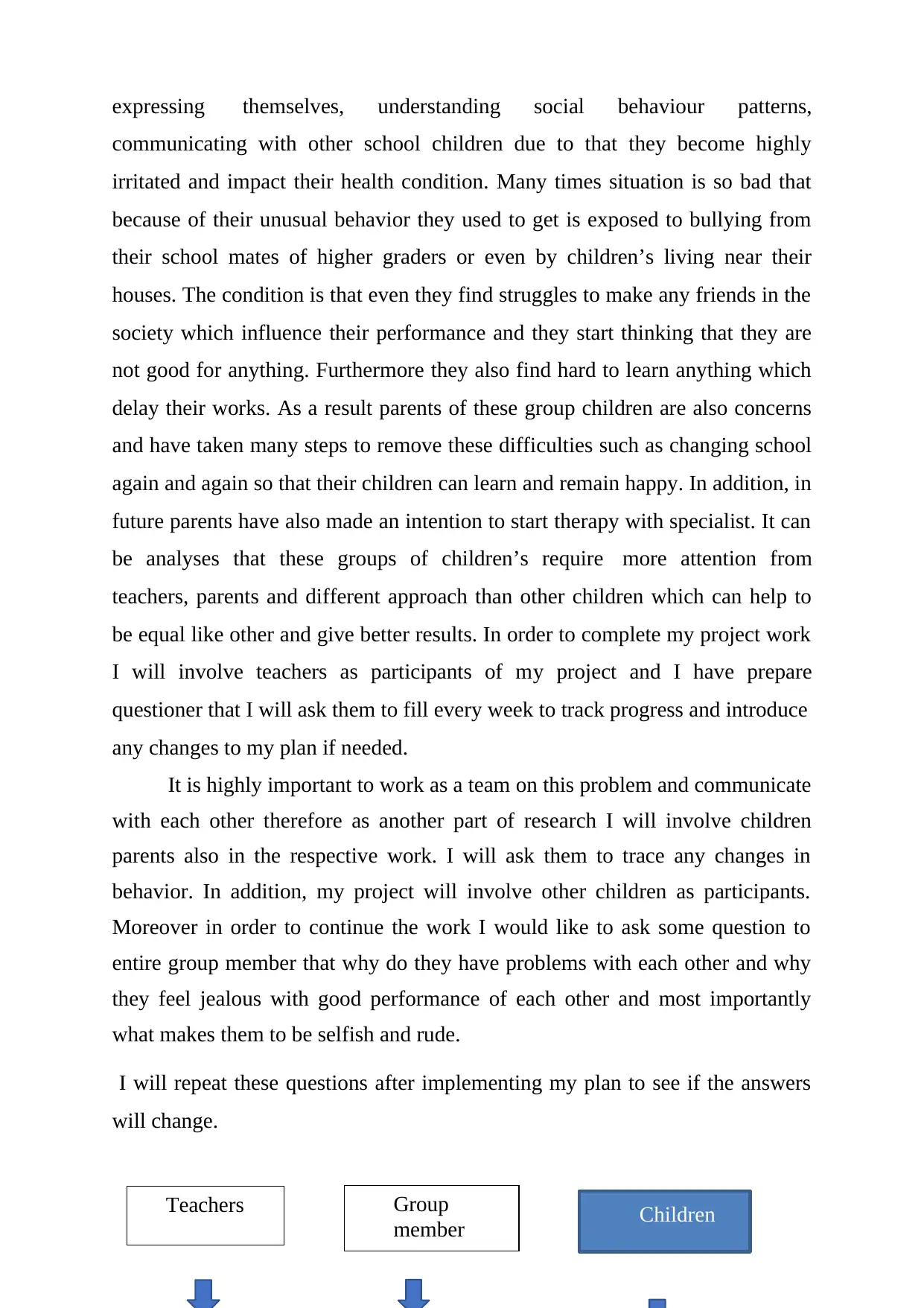
be equal like other and give better results. In order to complete my project work
I will involve teachers as participants of my project and I have prepare
questioner that I will ask them to fill every week to track progress and introduce
any changes to my plan if needed.
It is highly important to work as a team on this problem and communicate
with each other therefore as another part of research I will involve children
parents also in the respective work. I will ask them to trace any changes in
behavior. In addition, my project will involve other children as participants.
Moreover in order to continue the work I would like to ask some question to
entire group member that why do they have problems with each other and why
they feel jealous with good performance of each other and most importantly
what makes them to be selfish and rude.
I will repeat these questions after implementing my plan to see if the answers
will change.
Children
member
expressing themselves, understanding social behaviour patterns,
communicating with other school children due to that they become highly
irritated and impact their health condition. Many times situation is so bad that
because of their unusual behavior they used to get is exposed to bullying from
their school mates of higher graders or even by children’s living near their
houses. The condition is that even they find struggles to make any friends in the
society which influence their performance and they start thinking that they are
not good for anything. Furthermore they also find hard to learn anything which
delay their works. As a result parents of these group children are also concerns
and have taken many steps to remove these difficulties such as changing school
again and again so that their children can learn and remain happy. In addition, in
future parents have also made an intention to start therapy with specialist. It can
be analyses that these groups of children’s require more attention from
teachers, parents and different approach than other children which can help to
be equal like other and give better results. In order to complete my project work
I will involve teachers as participants of my project and I have prepare
questioner that I will ask them to fill every week to track progress and introduce
any changes to my plan if needed.
It is highly important to work as a team on this problem and communicate
with each other therefore as another part of research I will involve children
parents also in the respective work. I will ask them to trace any changes in
behavior. In addition, my project will involve other children as participants.
Moreover in order to continue the work I would like to ask some question to
entire group member that why do they have problems with each other and why
they feel jealous with good performance of each other and most importantly
what makes them to be selfish and rude.
I will repeat these questions after implementing my plan to see if the answers
will change.
Children
Paraphrase This Document
Need a fresh take? Get an instant paraphrase of this document with our AI Paraphraser
Research Procedure
For the purpose of my research I have chosen primary school and outside
school hours care centre. As a coordinator of outside school hours program, I
have already understanding and knowledge about the service. As well as I have
a good contact with principal, teachers, children and their parents. The chosen
school is catholic and includes children aged 6-13 years that have different
background. The school itself is not big and has around 500 students that in
most cases know each other very well. The teaching stuff includes 12 highly
qualified teachers one of which is specialist in working with special children.
To start my project I took the permission from school principle by sending
an official email regarding the art project in which main respondent will be a
group of children. I n w h i c h t o t a l detailed description about the respective
projects, overall intentions and brief plan have been disclosed. Also, I want to
ask the principal to allow me to be present during school time to analyses the
behavior of children’s during their classes. At the same time, I will have a
meeting with parents to tell them about my project and ask for permission to
include their child in it. After receiving official permission from the school
principal and parents, I will start preparation for my project.
As the fir st stage, I will gather primary information from teacher s
and parents about their children’s mainly focusing on their behavior, beliefs and
moral values. Based on the data that I have already and that I will collect from
teachers and parents I will create personalised learning plan as well as
functional behaviour support plan. My next step is to have a brief and detailed
meeting with the entire group member in order to define the idea of project and
making an approval from their side that the might do not have any problem.
After approving my plan, I will start implementing it. I will be tracing changes
in girl’s behaviour as well as I will be regularly collecting data from teachers
and parents. Also, I am planning to have a conversation with other children the
group to figure out what repels them from her.
For the purpose of my research I have chosen primary school and outside
school hours care centre. As a coordinator of outside school hours program, I
have already understanding and knowledge about the service. As well as I have
a good contact with principal, teachers, children and their parents. The chosen
school is catholic and includes children aged 6-13 years that have different
background. The school itself is not big and has around 500 students that in
most cases know each other very well. The teaching stuff includes 12 highly
qualified teachers one of which is specialist in working with special children.
To start my project I took the permission from school principle by sending
an official email regarding the art project in which main respondent will be a
group of children. I n w h i c h t o t a l detailed description about the respective
projects, overall intentions and brief plan have been disclosed. Also, I want to
ask the principal to allow me to be present during school time to analyses the
behavior of children’s during their classes. At the same time, I will have a
meeting with parents to tell them about my project and ask for permission to
include their child in it. After receiving official permission from the school
principal and parents, I will start preparation for my project.
As the fir st stage, I will gather primary information from teacher s
and parents about their children’s mainly focusing on their behavior, beliefs and
moral values. Based on the data that I have already and that I will collect from
teachers and parents I will create personalised learning plan as well as
functional behaviour support plan. My next step is to have a brief and detailed
meeting with the entire group member in order to define the idea of project and
making an approval from their side that the might do not have any problem.
After approving my plan, I will start implementing it. I will be tracing changes
in girl’s behaviour as well as I will be regularly collecting data from teachers
and parents. Also, I am planning to have a conversation with other children the
group to figure out what repels them from her.
Research approach
To conduct my research, I will be using creative research methods. In the
context of creative approach of research both quantitative and qualitative methods are
implemented that help to will provide deeper understanding of the problem.
On the first stage of my project I will evaluate the general state of the
problem and highlight the questions for which answers have already been
found. Also, I will highlight parts of the problem that are contentious and
unresolved. In addition, I will find relevant literature and articles to have better
understanding of the problem.
Other than this I will be conducting interviews with focus group that will
include teachers, parents and some of children.
The main part of my research will be conducted through role play. I will
simulate different situations for the participant and see how she will behave.
Each time I will change part of simulation in order to understand triggers and
how to avoid it.
Research questions
The main purpose of research is to figure out what difficulties children
with ASD face while interacting with others at the basis of primary school.
1. What are the major impacts of ASD on an individual while communicating with
others?
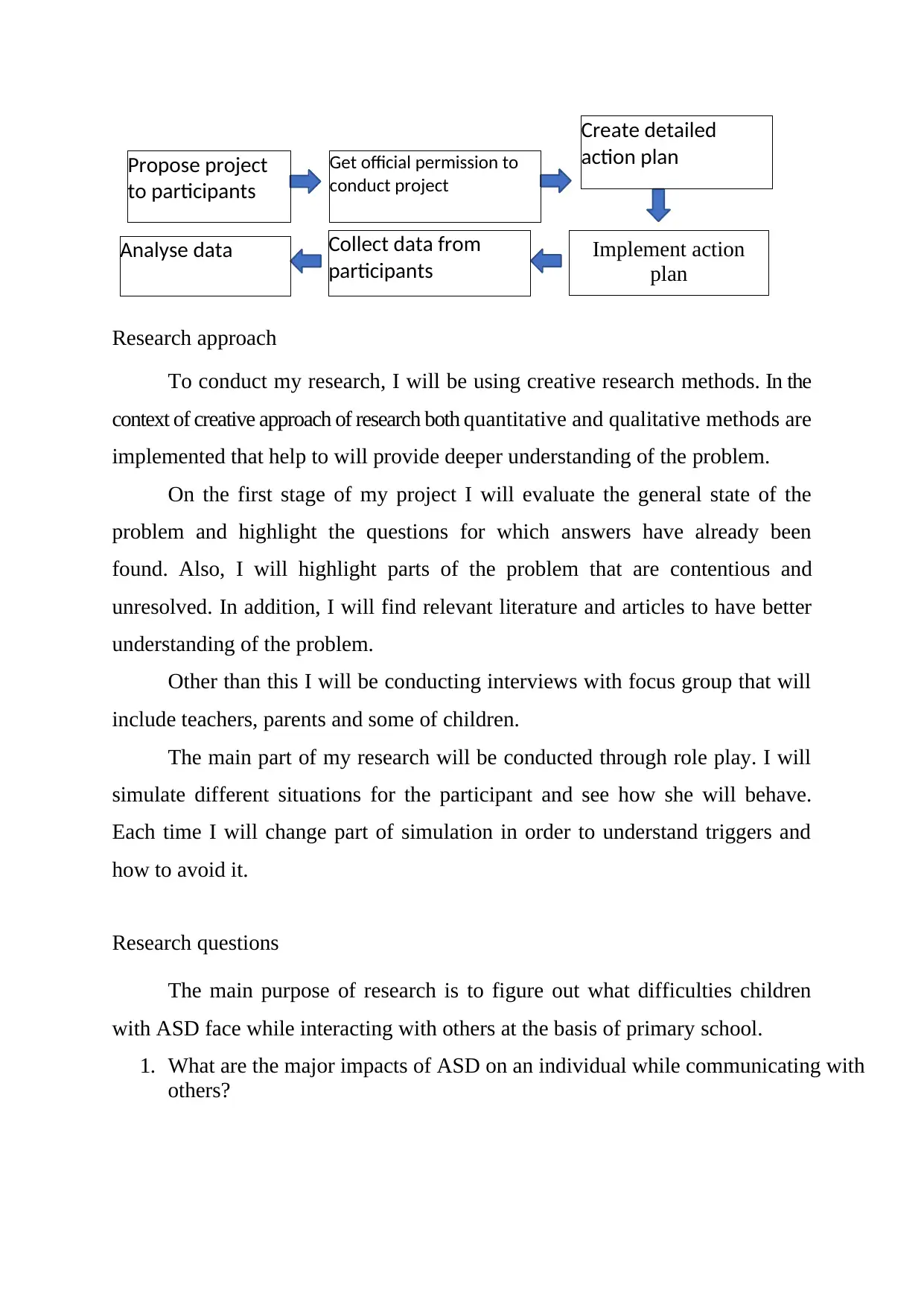
Propose project
to participants
Get official permission to
conduct project
Create detailed
action plan
Analyse data Collect data from
participants
Implement action
plan
To conduct my research, I will be using creative research methods. In the
context of creative approach of research both quantitative and qualitative methods are
implemented that help to will provide deeper understanding of the problem.
On the first stage of my project I will evaluate the general state of the
problem and highlight the questions for which answers have already been
found. Also, I will highlight parts of the problem that are contentious and
unresolved. In addition, I will find relevant literature and articles to have better
understanding of the problem.
Other than this I will be conducting interviews with focus group that will
include teachers, parents and some of children.
The main part of my research will be conducted through role play. I will
simulate different situations for the participant and see how she will behave.
Each time I will change part of simulation in order to understand triggers and
how to avoid it.
Research questions
The main purpose of research is to figure out what difficulties children
with ASD face while interacting with others at the basis of primary school.
1. What are the major impacts of ASD on an individual while communicating with
others?
Propose project
to participants
Get official permission to
conduct project
Create detailed
action plan
Analyse data Collect data from
participants
Implement action
plan
⊘ This is a preview!⊘
Do you want full access?
Subscribe today to unlock all pages.
Trusted by 1+ million students worldwide

1 out of 17


Related Documents


Your All-in-One AI-Powered Toolkit for Academic Success.
+13062052269
info@desklib.com
Available 24*7 on WhatsApp / Email
![[object Object]](/_next/static/media/star-bottom.7253800d.svg)
Unlock your academic potential
Copyright © 2020–2026 A2Z Services. All Rights Reserved. Developed and managed by ZUCOL.