Comprehensive Analysis of ASDA's Business Environment and Factors
VerifiedAdded on 2020/06/05
|13
|3638
|124
Report
AI Summary
This report provides a detailed analysis of the business environment influencing ASDA, a British supermarket retailer. It begins with an introduction to the concept of the business environment, encompassing internal and external factors, and highlights the dynamic nature of these factors. The report then delves into Task 1, exploring the interrelationships between organizational functions using ASDA as an example. It examines organizational structure, collaboration, and customer-centric approaches. Task 2 investigates the impact of the macro environment using PESTEL analysis, evaluating political, economic, social, technological, environmental, and legal factors. The report also discusses the positive and negative impacts of these factors on ASDA. Furthermore, it includes an internal and external analysis, including SWOT analysis, and explores how these factors affect decision-making within the organization. The report concludes with a summary of the key findings and references relevant sources.
BUSINESS
ENVIRONMENT
ENVIRONMENT

Paraphrase This Document
Need a fresh take? Get an instant paraphrase of this document with our AI Paraphraser
TABLE OF CONTENTS
INTRODUCTION................................................................................................................................3
TASK 1.................................................................................................................................................3
Covered in PPT...........................................................................................................................3
P3 Relationship between Organisational Functions....................................................................3
M2 Advantages and Disadvantages of interrelationships...........................................................5
D1 Critical Analysis of complexities of different types..............................................................5
TASK 2.................................................................................................................................................6
P4 Positive and negative impacts of macro environment...........................................................6
M3 Model to analyse macro environment with the organisation................................................7
D2 Evaluating both micro and macro factors.............................................................................7
P5 Internal and External Analysis...............................................................................................8
M4 How SWOT analysis affects decision making.....................................................................9
P6 Relation of macro factors with strengths and weakness........................................................9
CONCLUSION..................................................................................................................................10
REFERENCES...................................................................................................................................12
ILLUSTRATION INDEX
Illustration 1: Aim of ASDA.............................................................................................................7
INTRODUCTION................................................................................................................................3
TASK 1.................................................................................................................................................3
Covered in PPT...........................................................................................................................3
P3 Relationship between Organisational Functions....................................................................3
M2 Advantages and Disadvantages of interrelationships...........................................................5
D1 Critical Analysis of complexities of different types..............................................................5
TASK 2.................................................................................................................................................6
P4 Positive and negative impacts of macro environment...........................................................6
M3 Model to analyse macro environment with the organisation................................................7
D2 Evaluating both micro and macro factors.............................................................................7
P5 Internal and External Analysis...............................................................................................8
M4 How SWOT analysis affects decision making.....................................................................9
P6 Relation of macro factors with strengths and weakness........................................................9
CONCLUSION..................................................................................................................................10
REFERENCES...................................................................................................................................12
ILLUSTRATION INDEX
Illustration 1: Aim of ASDA.............................................................................................................7
INTRODUCTION
All the internal and external factors that are affecting or influencing the business is termed
as Business Environment. Internal factors consists of internal elements of the organisation which
are affecting the business. External factors constitutes political, economic related, social and
mechanization factors. The business environment keeps on changing from time to time and these
changes are unpredictable. In every region, place or area, it differs. It has its own importance as it
provides a path for success or growth of the business. ASDA is a British Supermarket Retailer
which deals with fresh grocery items, online shopping, clothing, insurance etc. This report is about
the analysis of the current environmental factors influencing the organisation.
TASK 1
Covered in PPT
P3 Relationship between Organisational Functions
As a Business Analyst, here I will explain how functions of an organisation interrelate to the
whole organisational structure. Taking an example of ASDA.
Organisation Brief : ASDA expands to Aircraft Situation Display to Industry. Transportation
department of US provides this service. The brook constitutes elements which helps in showing the
position and plain activities of all the air planes in the US. These elements include location,
airspeed, destination, estimated and the real time of departure and arrival.
All the internal and external factors that are affecting or influencing the business is termed
as Business Environment. Internal factors consists of internal elements of the organisation which
are affecting the business. External factors constitutes political, economic related, social and
mechanization factors. The business environment keeps on changing from time to time and these
changes are unpredictable. In every region, place or area, it differs. It has its own importance as it
provides a path for success or growth of the business. ASDA is a British Supermarket Retailer
which deals with fresh grocery items, online shopping, clothing, insurance etc. This report is about
the analysis of the current environmental factors influencing the organisation.
TASK 1
Covered in PPT
P3 Relationship between Organisational Functions
As a Business Analyst, here I will explain how functions of an organisation interrelate to the
whole organisational structure. Taking an example of ASDA.
Organisation Brief : ASDA expands to Aircraft Situation Display to Industry. Transportation
department of US provides this service. The brook constitutes elements which helps in showing the
position and plain activities of all the air planes in the US. These elements include location,
airspeed, destination, estimated and the real time of departure and arrival.
⊘ This is a preview!⊘
Do you want full access?
Subscribe today to unlock all pages.

Trusted by 1+ million students worldwide
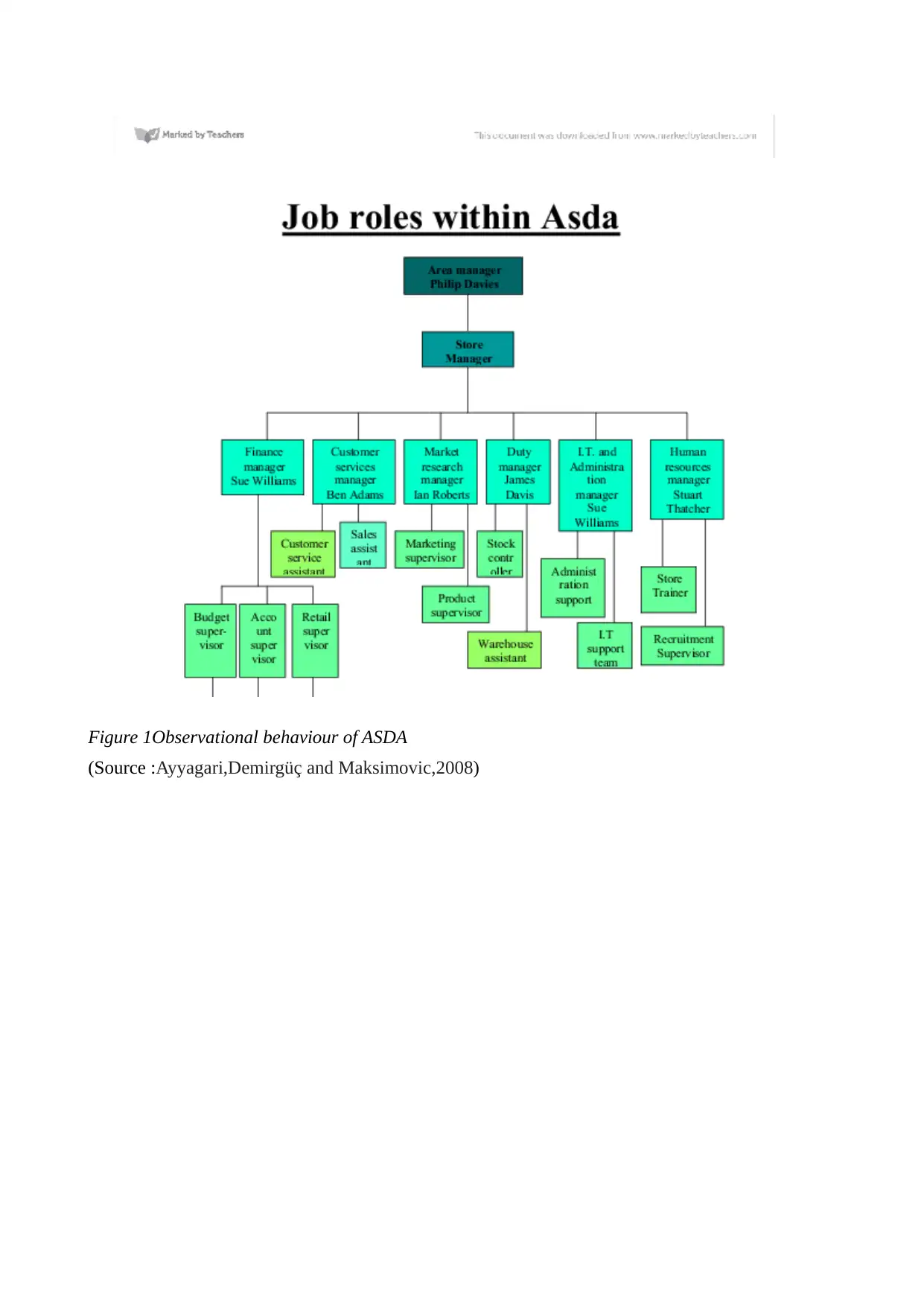
Figure 1Observational behaviour of ASDA
(Source :Ayyagari,Demirgüç and Maksimovic,2008)
(Source :Ayyagari,Demirgüç and Maksimovic,2008)
Paraphrase This Document
Need a fresh take? Get an instant paraphrase of this document with our AI Paraphraser
As illustrated the main objectives of the organisation, it believes in connecting employees
throughout the country. For any feedback or suggestions, we can talk to ASDA employees directly.
Developing new and improving stories about the organisation itself and the employees. No
discrimination is being faced to anyone. All the staff members and the employees are treated
equally and are motivated from time to time to work harder. Various departments are working
together in the same organisation for their growth and expenditure. The departments who work in
the organisation are HR, marketing, sales, B2B sales, customer service and the product planning.
HR department selects the employees they think that are capable of working in the company. Sales
department manages all the sales from the company to outside whether in markets or home
deliveries etc. Customer Service department is here to satisfy the customers and help them if they
are facing any troubles in purchasing or anything. The product planning department first plans the
product they have to include in their list for marketing and then manages to produce and then
forward it to sales.
Organisational Approach and Culture -
1. Collaboration : The connection between the employees sharing experiences with each other.
2. Celebration : The organisation has developed a culture that is seems so user friendly that
employees are very connected to each other (Poon,2000).
3. Openness : The activities inside the organisation are open to the world. Nothing is hidden. In
fact the organisation invites other people also to join.
4. Customer centric : It focuses on feedbacks and suggestions from the customers.
5. Inspirational : The employees to be promoted should be motivated and inspirational.
M2 Advantages and Disadvantages of interrelationships
The merits and demerits are described as under :
Merits: 1. Specialisation : It guarantees proper division of labour and organised to take advantages
of specialisation of various functions.
2. More efficiency : Efficiency is increased from before because they are getting continuous
suggestions from specialists (Ayyagari,Demirgüç and Maksimovic,2008).
3. Expansion : This offers a huge scope and it helps in expanding the business.
De-Merits:
1. Confusion : Functional organisation is quite difficult and its operations are complicated.
Employees are being supervised by a number of seniors which cause some stress and some
throughout the country. For any feedback or suggestions, we can talk to ASDA employees directly.
Developing new and improving stories about the organisation itself and the employees. No
discrimination is being faced to anyone. All the staff members and the employees are treated
equally and are motivated from time to time to work harder. Various departments are working
together in the same organisation for their growth and expenditure. The departments who work in
the organisation are HR, marketing, sales, B2B sales, customer service and the product planning.
HR department selects the employees they think that are capable of working in the company. Sales
department manages all the sales from the company to outside whether in markets or home
deliveries etc. Customer Service department is here to satisfy the customers and help them if they
are facing any troubles in purchasing or anything. The product planning department first plans the
product they have to include in their list for marketing and then manages to produce and then
forward it to sales.
Organisational Approach and Culture -
1. Collaboration : The connection between the employees sharing experiences with each other.
2. Celebration : The organisation has developed a culture that is seems so user friendly that
employees are very connected to each other (Poon,2000).
3. Openness : The activities inside the organisation are open to the world. Nothing is hidden. In
fact the organisation invites other people also to join.
4. Customer centric : It focuses on feedbacks and suggestions from the customers.
5. Inspirational : The employees to be promoted should be motivated and inspirational.
M2 Advantages and Disadvantages of interrelationships
The merits and demerits are described as under :
Merits: 1. Specialisation : It guarantees proper division of labour and organised to take advantages
of specialisation of various functions.
2. More efficiency : Efficiency is increased from before because they are getting continuous
suggestions from specialists (Ayyagari,Demirgüç and Maksimovic,2008).
3. Expansion : This offers a huge scope and it helps in expanding the business.
De-Merits:
1. Confusion : Functional organisation is quite difficult and its operations are complicated.
Employees are being supervised by a number of seniors which cause some stress and some
confusion too.
2. Difficult to fix responsibility : When an employee does not know what the problem is, it will be
tough for them to fix it.
D1 Critical Analysis of complexities of different types
After analysing the different business structures, it says the strategy means vision or
governance which helps as a comparative advantage. The structure includes power and authority,
information flow and it also organises roles. Business professes and lateral links consists of
networks, processes teams and interface roles (Poon, 2000). The opening and the subsequent
registration of any business with the government has many different factors. Various and best
applying business structure are, Investors and partners, having partner can dictate the type of
business structure because of two different thinking, and project size of the business, the size of
business can impact things like shareholders, deduction , tax brackets or liabilities.
TASK 2
P4 Positive and negative impacts of macro environment
Here I am explaining the advantages and disadvantages of macro environment on the
organisation using PESTEL analysis. It analyses the macro environmental factors that are affecting
the business.
1. Political : The impact of national, international and other all directives that affects
employment are same as any other organisation. On a company's decision making,
unreliability also draws some impact. Political environment outside is being constantly
being monitored.
2. Economic : Some factors are very essential to be considered like cost of credit, pay has a
huge impact on the organisation. These actually effects pricing strategies of the organisation
effectively (Highsmith and Cockburn,2001).
3. Social : Growing population, following of people, pressure for the growing competition,
major supply and demand of products etc. are very important to consider because
understanding these social factors will help in introducing new products that will satisfy the
customer needs.
4. Technological : Effective online strategies, apps and portals for their online business are
important for serving and collecting the products to and from the customers and suppliers
2. Difficult to fix responsibility : When an employee does not know what the problem is, it will be
tough for them to fix it.
D1 Critical Analysis of complexities of different types
After analysing the different business structures, it says the strategy means vision or
governance which helps as a comparative advantage. The structure includes power and authority,
information flow and it also organises roles. Business professes and lateral links consists of
networks, processes teams and interface roles (Poon, 2000). The opening and the subsequent
registration of any business with the government has many different factors. Various and best
applying business structure are, Investors and partners, having partner can dictate the type of
business structure because of two different thinking, and project size of the business, the size of
business can impact things like shareholders, deduction , tax brackets or liabilities.
TASK 2
P4 Positive and negative impacts of macro environment
Here I am explaining the advantages and disadvantages of macro environment on the
organisation using PESTEL analysis. It analyses the macro environmental factors that are affecting
the business.
1. Political : The impact of national, international and other all directives that affects
employment are same as any other organisation. On a company's decision making,
unreliability also draws some impact. Political environment outside is being constantly
being monitored.
2. Economic : Some factors are very essential to be considered like cost of credit, pay has a
huge impact on the organisation. These actually effects pricing strategies of the organisation
effectively (Highsmith and Cockburn,2001).
3. Social : Growing population, following of people, pressure for the growing competition,
major supply and demand of products etc. are very important to consider because
understanding these social factors will help in introducing new products that will satisfy the
customer needs.
4. Technological : Effective online strategies, apps and portals for their online business are
important for serving and collecting the products to and from the customers and suppliers
⊘ This is a preview!⊘
Do you want full access?
Subscribe today to unlock all pages.
Trusted by 1+ million students worldwide
because all the firms and organisations making full use of technology these days, so ASDA
is also working more so that they can be able to compete with the others.
5. Environmental : A healthy and green economy, pollution free environment and organic foods
are the main requirements of ASDA for a healthier environment so that they can prepare
products from honest ingredients (Kennerley and Neely, 2003).
6. Legal : The organisation follows all the rules and regulations properly that are according to
the law. As in the law, ASDA does not pays any employee less than the minimum wage in
UK. Similarly, it cannot dismiss any employee without any reason because the dis-mission
may affect the family conditions of the the employee.
According to a theory around 177 million tonnes of waste is producing every year in
England, The system is making every single possible efforts they can to reduce the waste
production and saving the environment. With the increase in the environment awareness and the
assets to save the environment every company is working to reduce the most waste they can to save
the environment. Plantation processes and cleaning should be regularly done near the supermarkets
to reduce the effects of the waste produced in the area due to supermarkets.
The supermarkets are not considered as much friendly to the environment because of its
adverse effects, Packaging , transport and the production of food impacts the environment majorly.
The organisation working for the transportation of food are not very eco-friendly.
As according to the report from a publicity funded “Consumer Watchdog”, ASDA is least
among the five major supermarket chains (Highsmith and Cockburn,2001). In the past two years its
performance has worsened ASDA is using little packing certified by the forest 'Stewardship
council', and had also reduced 38 per cent of organic produce.
In 2006 a standard grading was set by the government for the analysis of how much eco-
friendly the organisation is, as the grading are from 'A to E'. In the survey about the supermarkets
ASDA was downgraded from C to D on the standard grading.
Also the coolants for the use of refrigerators and Air conditioners contains HFC gas which
has very adverse effects on the environment and in the supermarkets where the food and the other
are products are stored in big refrigerators which produces huge impact on the environment and to
run the supermarkets lots of use of electricity is required for the food store and other products
(Shetzer,Stackman and Moore,1991). Now when everyone are trying to save environments lots of
efforts are produce by the supermarkets to reduce the pollution and for that the use of plastic bags
and others are totally avoided as much as possible. Also for the delivery of food and the products by
the supermarkets they are putting great focus on using eco- friendly way of transportation. Notice
that the infrastructure of the supermarkets does not affect the environment by any reason, for the
is also working more so that they can be able to compete with the others.
5. Environmental : A healthy and green economy, pollution free environment and organic foods
are the main requirements of ASDA for a healthier environment so that they can prepare
products from honest ingredients (Kennerley and Neely, 2003).
6. Legal : The organisation follows all the rules and regulations properly that are according to
the law. As in the law, ASDA does not pays any employee less than the minimum wage in
UK. Similarly, it cannot dismiss any employee without any reason because the dis-mission
may affect the family conditions of the the employee.
According to a theory around 177 million tonnes of waste is producing every year in
England, The system is making every single possible efforts they can to reduce the waste
production and saving the environment. With the increase in the environment awareness and the
assets to save the environment every company is working to reduce the most waste they can to save
the environment. Plantation processes and cleaning should be regularly done near the supermarkets
to reduce the effects of the waste produced in the area due to supermarkets.
The supermarkets are not considered as much friendly to the environment because of its
adverse effects, Packaging , transport and the production of food impacts the environment majorly.
The organisation working for the transportation of food are not very eco-friendly.
As according to the report from a publicity funded “Consumer Watchdog”, ASDA is least
among the five major supermarket chains (Highsmith and Cockburn,2001). In the past two years its
performance has worsened ASDA is using little packing certified by the forest 'Stewardship
council', and had also reduced 38 per cent of organic produce.
In 2006 a standard grading was set by the government for the analysis of how much eco-
friendly the organisation is, as the grading are from 'A to E'. In the survey about the supermarkets
ASDA was downgraded from C to D on the standard grading.
Also the coolants for the use of refrigerators and Air conditioners contains HFC gas which
has very adverse effects on the environment and in the supermarkets where the food and the other
are products are stored in big refrigerators which produces huge impact on the environment and to
run the supermarkets lots of use of electricity is required for the food store and other products
(Shetzer,Stackman and Moore,1991). Now when everyone are trying to save environments lots of
efforts are produce by the supermarkets to reduce the pollution and for that the use of plastic bags
and others are totally avoided as much as possible. Also for the delivery of food and the products by
the supermarkets they are putting great focus on using eco- friendly way of transportation. Notice
that the infrastructure of the supermarkets does not affect the environment by any reason, for the
Paraphrase This Document
Need a fresh take? Get an instant paraphrase of this document with our AI Paraphraser
building of infrastructure if the trees are being cut new plants should be planted around, the use of
any type of plastic should be avoided instead of that paper bags can be used and make sure the
recycling of paper and other products took place as much as possible.
M3 Model to analyse macro environment with the organisation
The analysis of macro environment can be done by doing a pestle analysis. The Political
factors are being constantly monitored on a regular basis by the authorities so that if there will be
any change in the political behaviour, it may be analysed as soon as possible. Cost of credit and pay
scale will have a positive impact, thus increasing the rate of the economic factors as well.
Understanding the social factors helps in giving more satisfaction to the customers (Kennerley and
Neely,2003). Socialisation acts as an important tool that is being developed by efficient interactions
and good communication. Online portals are also necessary for the ease of customers. The digital
technology has advanced various factors which have helped in an increased rate of doing activities.
There should be a healthy and user friendly environment. ASDA follows all the rules and
regulations of the UK government.
D2 Evaluating both micro and macro factors
The effects on every organisation i.e. local, national, international, are same for all. Some
economic factors are very essential to consider like credit cost etc. Online marketing is important as
well which helps the customers in ordering online direct from home. Social factors helps in
providing more satisfaction to the customers. There are online portals also which helps the
customers to order the products from home itself (Shetzer,Stackman and Moore,1991). It is in
favour of those who because of any reasons, cannot be able to visit the shop. These factors
influence the customers a lot by providing them so much facilities. ASDA also follows proper rules
and regulations which have been directed by the UK government. This will help the organisation as
they do not have to fill any fines and non required formality.
P5 Internal and External Analysis
As a Business Analyst, I have to consider the internal and external factors that influence the
decision making process of an organisation. First I will describe the internal analysis of ASDA.
Internal Analysis – It includes checking the operations of a company with its advantages and the
disadvantages. It includes Inbound Logistics which mean whenever a comparison is being done
with other retailers, ASDA comes as the cheapest retailer in the UK. There is an efficient ordering
system and company's economies of scale in ASDA which ensures that the company is successful in
selling products at a lower price and achieving more profit. In Outbound Logistics, it believes on
any type of plastic should be avoided instead of that paper bags can be used and make sure the
recycling of paper and other products took place as much as possible.
M3 Model to analyse macro environment with the organisation
The analysis of macro environment can be done by doing a pestle analysis. The Political
factors are being constantly monitored on a regular basis by the authorities so that if there will be
any change in the political behaviour, it may be analysed as soon as possible. Cost of credit and pay
scale will have a positive impact, thus increasing the rate of the economic factors as well.
Understanding the social factors helps in giving more satisfaction to the customers (Kennerley and
Neely,2003). Socialisation acts as an important tool that is being developed by efficient interactions
and good communication. Online portals are also necessary for the ease of customers. The digital
technology has advanced various factors which have helped in an increased rate of doing activities.
There should be a healthy and user friendly environment. ASDA follows all the rules and
regulations of the UK government.
D2 Evaluating both micro and macro factors
The effects on every organisation i.e. local, national, international, are same for all. Some
economic factors are very essential to consider like credit cost etc. Online marketing is important as
well which helps the customers in ordering online direct from home. Social factors helps in
providing more satisfaction to the customers. There are online portals also which helps the
customers to order the products from home itself (Shetzer,Stackman and Moore,1991). It is in
favour of those who because of any reasons, cannot be able to visit the shop. These factors
influence the customers a lot by providing them so much facilities. ASDA also follows proper rules
and regulations which have been directed by the UK government. This will help the organisation as
they do not have to fill any fines and non required formality.
P5 Internal and External Analysis
As a Business Analyst, I have to consider the internal and external factors that influence the
decision making process of an organisation. First I will describe the internal analysis of ASDA.
Internal Analysis – It includes checking the operations of a company with its advantages and the
disadvantages. It includes Inbound Logistics which mean whenever a comparison is being done
with other retailers, ASDA comes as the cheapest retailer in the UK. There is an efficient ordering
system and company's economies of scale in ASDA which ensures that the company is successful in
selling products at a lower price and achieving more profit. In Outbound Logistics, it believes on
not depending on the physical stores. They also have a online portal which helps the customers to
select and purchase products (Ayyagari,Demirgüç and Maksimovic,2008). It is specially beneficial
to those people who have no access or means to go to the store.
External Analysis – This can be explained by defining PESTEL analysis here.
Political Factors – As most of the barriers of trade have been removed, The European Government
has allowed ASDA to expand its business in the European Market. China's coming to the WTO i.e.
World Trade Organisation has helped the company to expand the market and can also import sale
products from China (Highsmith and Cockburn,2001).
Economic factors – Customers always want best products and that too at a reasonable price. ASDA
makes it possible for the customers. So, people are buying products from it more rather than the
other companies (Highsmith and Cockburn,2001).
Social factors – Customers want organic food items and in order to complete the demands of the
customers, ASDA is focusing more and more on the ingredients that must be organic so that the
people will be satisfied with that.
Technological factors – Various new technological features if implemented in any company can
help in achieving their goals fast. So ASDA is also considering these factors by developing an
online portal and e- marketing for those customers who are not able to go to the stores.
Environmental factors – The company should be in a place that is user friendly and the environment
inside also matters a lot. The company uses recycled products for packaging etc. So, it seems a very
good idea of taking full use of the resources (Kennerley and Neely,2003).
Legal factors – As ASDA is in UK, it have to be sure of the fact that it is following all the rules and
regulations under the UK government. This way no fines would be imposed.
M4 How SWOT analysis affects decision making
ASDA provides a wide range of products and services to its customers, but when compared
to the other competitors, it has a limited global presence. These days it is also expanding its
business in various other firms as pharmacy, optics etc. They offer products at a very cheap price
which can result in future troubles with other competitors. The analysis of SWOT will help in a way
that in the process of decision making, it will be easy to do the classification on the basis of
strengths, weaknesses, opportunities and the threatening factors. The threatening factors are need to
be classified so that the process may get aware of them before the happening of some risk.
select and purchase products (Ayyagari,Demirgüç and Maksimovic,2008). It is specially beneficial
to those people who have no access or means to go to the store.
External Analysis – This can be explained by defining PESTEL analysis here.
Political Factors – As most of the barriers of trade have been removed, The European Government
has allowed ASDA to expand its business in the European Market. China's coming to the WTO i.e.
World Trade Organisation has helped the company to expand the market and can also import sale
products from China (Highsmith and Cockburn,2001).
Economic factors – Customers always want best products and that too at a reasonable price. ASDA
makes it possible for the customers. So, people are buying products from it more rather than the
other companies (Highsmith and Cockburn,2001).
Social factors – Customers want organic food items and in order to complete the demands of the
customers, ASDA is focusing more and more on the ingredients that must be organic so that the
people will be satisfied with that.
Technological factors – Various new technological features if implemented in any company can
help in achieving their goals fast. So ASDA is also considering these factors by developing an
online portal and e- marketing for those customers who are not able to go to the stores.
Environmental factors – The company should be in a place that is user friendly and the environment
inside also matters a lot. The company uses recycled products for packaging etc. So, it seems a very
good idea of taking full use of the resources (Kennerley and Neely,2003).
Legal factors – As ASDA is in UK, it have to be sure of the fact that it is following all the rules and
regulations under the UK government. This way no fines would be imposed.
M4 How SWOT analysis affects decision making
ASDA provides a wide range of products and services to its customers, but when compared
to the other competitors, it has a limited global presence. These days it is also expanding its
business in various other firms as pharmacy, optics etc. They offer products at a very cheap price
which can result in future troubles with other competitors. The analysis of SWOT will help in a way
that in the process of decision making, it will be easy to do the classification on the basis of
strengths, weaknesses, opportunities and the threatening factors. The threatening factors are need to
be classified so that the process may get aware of them before the happening of some risk.
⊘ This is a preview!⊘
Do you want full access?
Subscribe today to unlock all pages.
Trusted by 1+ million students worldwide
P6 Relation of macro factors with strengths and weakness
In ASDA, the relationship of strengths and weakness of the company with the macro factors
is quite different. I will explain the relationship between the two with SWOT analysis.
In brief the marketing analysis of ASDA :
Walmart : Parent Company
Retail Industry : Category
Lifestyle And Retail : Sector
Money Saving Every Day : Slogan
Connection With Their Customers Via Some Means : USP
Explaining SWOT analysis of the factors :
Strengths :
1. Provides a huge range of products and services to their customers. It also includes financial
services.
2. It has done amazing campaigns of marketing. It often organises campaigns for marketing.
3. Constantly takes feedback from the customers etc. They never lay back in this feature as
some other companies does not care what customers are thinking about their products.
4. CSR initiatives are there.
5. Provides employability to many people as almost 140,000 people are working under this
organisation.
Weakness :
1. When compared to other competitors, they have a sufficient global presence (Highsmith and
Cockburn,2001).
2. The country is afraid of the competition between the local vendors.
Opportunities
1. The organisation is expanding its business in many other fields too as in pharmacy, jewellery,
optics's etc.
2. Enterprising into growing markets like China, India etc (Ayyagari,Demirgüç and
Maksimovic,2008).
Threats :
In ASDA, the relationship of strengths and weakness of the company with the macro factors
is quite different. I will explain the relationship between the two with SWOT analysis.
In brief the marketing analysis of ASDA :
Walmart : Parent Company
Retail Industry : Category
Lifestyle And Retail : Sector
Money Saving Every Day : Slogan
Connection With Their Customers Via Some Means : USP
Explaining SWOT analysis of the factors :
Strengths :
1. Provides a huge range of products and services to their customers. It also includes financial
services.
2. It has done amazing campaigns of marketing. It often organises campaigns for marketing.
3. Constantly takes feedback from the customers etc. They never lay back in this feature as
some other companies does not care what customers are thinking about their products.
4. CSR initiatives are there.
5. Provides employability to many people as almost 140,000 people are working under this
organisation.
Weakness :
1. When compared to other competitors, they have a sufficient global presence (Highsmith and
Cockburn,2001).
2. The country is afraid of the competition between the local vendors.
Opportunities
1. The organisation is expanding its business in many other fields too as in pharmacy, jewellery,
optics's etc.
2. Enterprising into growing markets like China, India etc (Ayyagari,Demirgüç and
Maksimovic,2008).
Threats :
Paraphrase This Document
Need a fresh take? Get an instant paraphrase of this document with our AI Paraphraser
1.They offer good products at a cheaper price, so they can have a war with other retailers about
pricing issue.
2. It can also go under pressure of maintaining low prices from along time.
3. Central government sometimes changes policies which can also be a threat to the organisation.
CONCLUSION
From the report, it is concluded that the Business Environment combines all the internal and
external factors that affects the business in one or other way. There are various types of organisation
in a Business Environment such as public, private, voluntary etc. Public organisations include
governmental structure whereas private organisations consist to non governmental structures. Tesco
is a very famous public organisation whereas ALDI is a private organisation. Voluntary organisation
such as Cancer research UK deals with the minimisation of the deaths caused by cancer. All the
organisations have their scope in the international market. The factors also have some internal and
external factors which affects the decision making of the organisation.
pricing issue.
2. It can also go under pressure of maintaining low prices from along time.
3. Central government sometimes changes policies which can also be a threat to the organisation.
CONCLUSION
From the report, it is concluded that the Business Environment combines all the internal and
external factors that affects the business in one or other way. There are various types of organisation
in a Business Environment such as public, private, voluntary etc. Public organisations include
governmental structure whereas private organisations consist to non governmental structures. Tesco
is a very famous public organisation whereas ALDI is a private organisation. Voluntary organisation
such as Cancer research UK deals with the minimisation of the deaths caused by cancer. All the
organisations have their scope in the international market. The factors also have some internal and
external factors which affects the decision making of the organisation.
REFERENCES
Books and Journals
Ayyagari, M., Demirgüç-Kunt, A. and Maksimovic, V., 2010. How important are financing
constraints? The role of finance in the business environment.The world bank economic
review.22(3).pp.483-516.
Child, J. and Möllering, G., 2011. Contextual confidence and active trust development in the
Chinese business environment. Organization Science.14(1).pp.69-80.
Eifert, B., Gelb, A. and Ramachandran, V., 2014. Business environment and comparative advantage
in Africa: Evidence from the investment climate data.Banque Mondiale, Washington: DC.
pp.195-233.
Gabriel, S. A. and Rosenthal, S. S., 2014. Quality of the business environment versus quality of life:
do firms and households like the same cities?. Review of Economics and Statistics.86(1).
pp.438-444.
Highsmith, J. and Cockburn, A., 2013. Agile software development: The business of
innovation. Computer.34(9).pp.120-127.
Keiningham, T. L., Perkins-Munn, T. and Evans, H., 2016. The impact of customer satisfaction on
share-of-wallet in a business-to-business environment. Journal of Service
Research. 6(1).pp.37-50.
Kennerley, M. and Neely, A., 2015. Measuring performance in a changing business
environment. International Journal of Operations & Production
Management.23(2).pp.213-229.
Klapper, L. F. and Parker, S. C., 2010. Gender and the business environment for new firm
creation. The World Bank Research Observer. 26(2). pp.237-257.
Mohamed, E. K. and Lashine, S. H., 2014. Accounting knowledge and skills and the challenges of a
global business environment. Managerial Finance.29(7).pp.3-16.
Poon, S., 2016. Business environment and internet commerce benefit—a small business
perspective. European Journal of Information Systems. 9(2). pp.72-81.
Selling, T. I. and Stickney, C. P., 2016. The effects of business environment and strategy on a firm’s
rate of return on assets. Financial Analysts Journal.45(1). pp.43-52.
Shetzer, L., Stackman, R. W. and Moore, L. F., 2012. Business-environment attitudes and the new
environmental paradigm. The Journal of Environmental Education.22(4).pp.14-21.
Books and Journals
Ayyagari, M., Demirgüç-Kunt, A. and Maksimovic, V., 2010. How important are financing
constraints? The role of finance in the business environment.The world bank economic
review.22(3).pp.483-516.
Child, J. and Möllering, G., 2011. Contextual confidence and active trust development in the
Chinese business environment. Organization Science.14(1).pp.69-80.
Eifert, B., Gelb, A. and Ramachandran, V., 2014. Business environment and comparative advantage
in Africa: Evidence from the investment climate data.Banque Mondiale, Washington: DC.
pp.195-233.
Gabriel, S. A. and Rosenthal, S. S., 2014. Quality of the business environment versus quality of life:
do firms and households like the same cities?. Review of Economics and Statistics.86(1).
pp.438-444.
Highsmith, J. and Cockburn, A., 2013. Agile software development: The business of
innovation. Computer.34(9).pp.120-127.
Keiningham, T. L., Perkins-Munn, T. and Evans, H., 2016. The impact of customer satisfaction on
share-of-wallet in a business-to-business environment. Journal of Service
Research. 6(1).pp.37-50.
Kennerley, M. and Neely, A., 2015. Measuring performance in a changing business
environment. International Journal of Operations & Production
Management.23(2).pp.213-229.
Klapper, L. F. and Parker, S. C., 2010. Gender and the business environment for new firm
creation. The World Bank Research Observer. 26(2). pp.237-257.
Mohamed, E. K. and Lashine, S. H., 2014. Accounting knowledge and skills and the challenges of a
global business environment. Managerial Finance.29(7).pp.3-16.
Poon, S., 2016. Business environment and internet commerce benefit—a small business
perspective. European Journal of Information Systems. 9(2). pp.72-81.
Selling, T. I. and Stickney, C. P., 2016. The effects of business environment and strategy on a firm’s
rate of return on assets. Financial Analysts Journal.45(1). pp.43-52.
Shetzer, L., Stackman, R. W. and Moore, L. F., 2012. Business-environment attitudes and the new
environmental paradigm. The Journal of Environmental Education.22(4).pp.14-21.
⊘ This is a preview!⊘
Do you want full access?
Subscribe today to unlock all pages.
Trusted by 1+ million students worldwide

1 out of 13


Related Documents


Your All-in-One AI-Powered Toolkit for Academic Success.
+13062052269
info@desklib.com
Available 24*7 on WhatsApp / Email
![[object Object]](/_next/static/media/star-bottom.7253800d.svg)
Unlock your academic potential
Copyright © 2020–2026 A2Z Services. All Rights Reserved. Developed and managed by ZUCOL.