Organisational Behaviour: Culture, Motivation, and Power Analysis
VerifiedAdded on 2023/01/12
|15
|3919
|32
Report
AI Summary
This report provides an in-depth analysis of organisational behaviour within the context of Asda, a leading UK supermarket chain. It examines the influence of organisational culture, politics, and power dynamics on individual and team behaviour and performance, referencing Handy's cultural framework and various types of organisational power. The report further evaluates motivation theories, including both content theories like Maslow's hierarchy of needs and process theories such as Vroom's expectancy theory, to understand how Asda motivates its employees. The analysis explores how these factors impact employee performance and contributes to the overall effectiveness of the organisation. The report also discusses the importance of positive political behaviour within the organisation and how it can impact employee performance. The report also provides recommendations for Asda on how to improve employee motivation and performance.

Organisational Behaviour

Paraphrase This Document
Need a fresh take? Get an instant paraphrase of this document with our AI Paraphraser
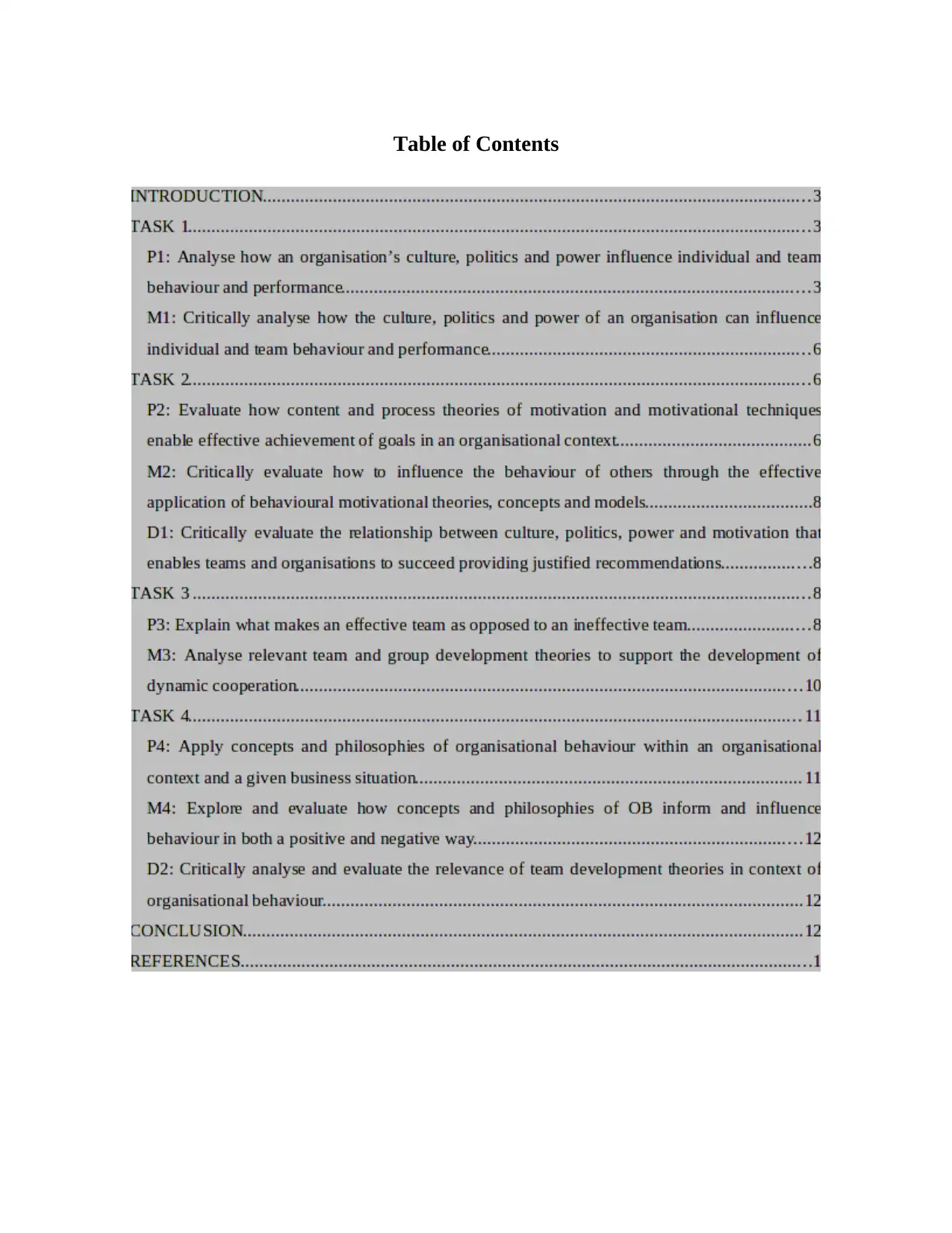
Table of Contents
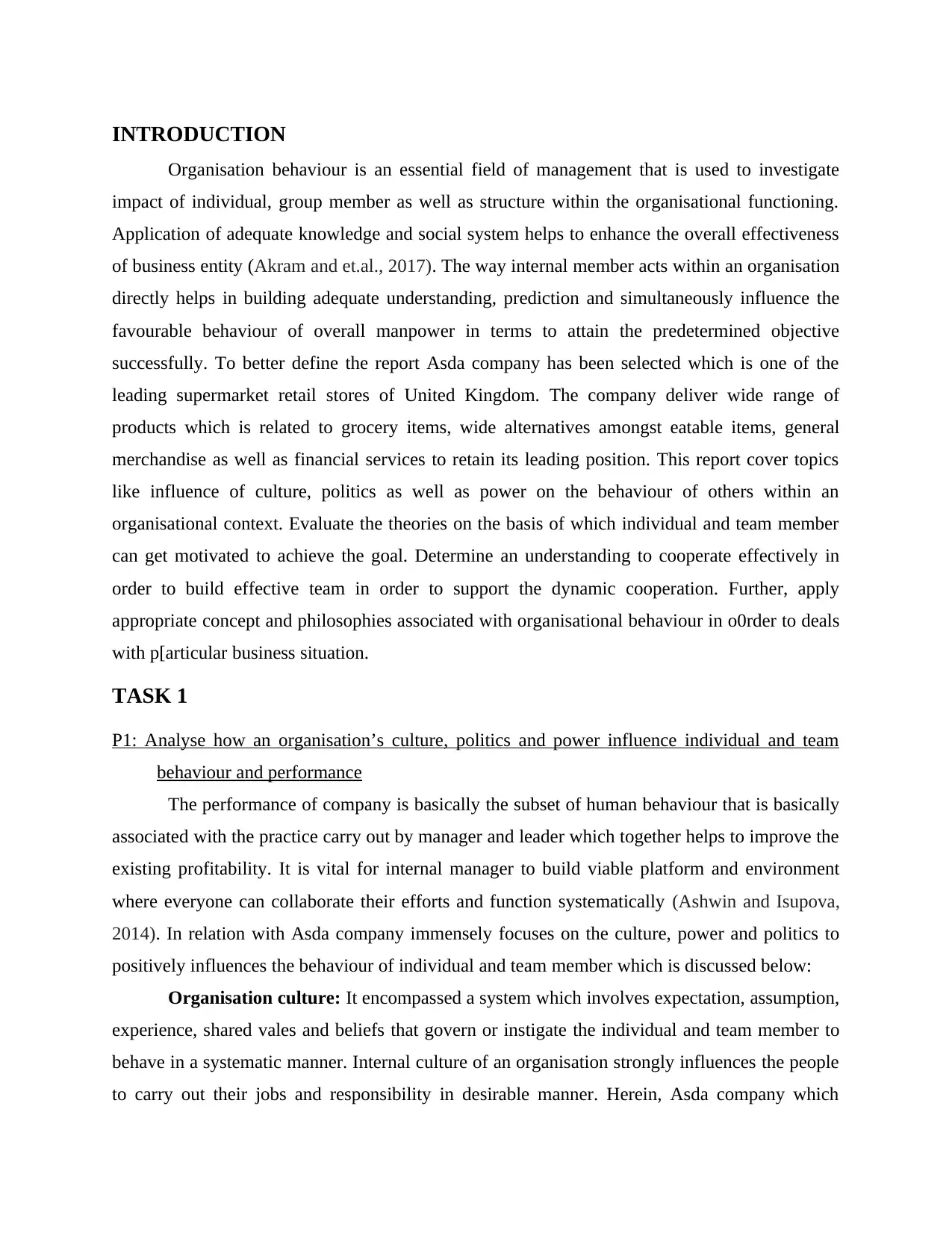
INTRODUCTION
Organisation behaviour is an essential field of management that is used to investigate
impact of individual, group member as well as structure within the organisational functioning.
Application of adequate knowledge and social system helps to enhance the overall effectiveness
of business entity (Akram and et.al., 2017). The way internal member acts within an organisation
directly helps in building adequate understanding, prediction and simultaneously influence the
favourable behaviour of overall manpower in terms to attain the predetermined objective
successfully. To better define the report Asda company has been selected which is one of the
leading supermarket retail stores of United Kingdom. The company deliver wide range of
products which is related to grocery items, wide alternatives amongst eatable items, general
merchandise as well as financial services to retain its leading position. This report cover topics
like influence of culture, politics as well as power on the behaviour of others within an
organisational context. Evaluate the theories on the basis of which individual and team member
can get motivated to achieve the goal. Determine an understanding to cooperate effectively in
order to build effective team in order to support the dynamic cooperation. Further, apply
appropriate concept and philosophies associated with organisational behaviour in o0rder to deals
with p[articular business situation.
TASK 1
P1: Analyse how an organisation’s culture, politics and power influence individual and team
behaviour and performance
The performance of company is basically the subset of human behaviour that is basically
associated with the practice carry out by manager and leader which together helps to improve the
existing profitability. It is vital for internal manager to build viable platform and environment
where everyone can collaborate their efforts and function systematically (Ashwin and Isupova,
2014). In relation with Asda company immensely focuses on the culture, power and politics to
positively influences the behaviour of individual and team member which is discussed below:
Organisation culture: It encompassed a system which involves expectation, assumption,
experience, shared vales and beliefs that govern or instigate the individual and team member to
behave in a systematic manner. Internal culture of an organisation strongly influences the people
to carry out their jobs and responsibility in desirable manner. Herein, Asda company which
Organisation behaviour is an essential field of management that is used to investigate
impact of individual, group member as well as structure within the organisational functioning.
Application of adequate knowledge and social system helps to enhance the overall effectiveness
of business entity (Akram and et.al., 2017). The way internal member acts within an organisation
directly helps in building adequate understanding, prediction and simultaneously influence the
favourable behaviour of overall manpower in terms to attain the predetermined objective
successfully. To better define the report Asda company has been selected which is one of the
leading supermarket retail stores of United Kingdom. The company deliver wide range of
products which is related to grocery items, wide alternatives amongst eatable items, general
merchandise as well as financial services to retain its leading position. This report cover topics
like influence of culture, politics as well as power on the behaviour of others within an
organisational context. Evaluate the theories on the basis of which individual and team member
can get motivated to achieve the goal. Determine an understanding to cooperate effectively in
order to build effective team in order to support the dynamic cooperation. Further, apply
appropriate concept and philosophies associated with organisational behaviour in o0rder to deals
with p[articular business situation.
TASK 1
P1: Analyse how an organisation’s culture, politics and power influence individual and team
behaviour and performance
The performance of company is basically the subset of human behaviour that is basically
associated with the practice carry out by manager and leader which together helps to improve the
existing profitability. It is vital for internal manager to build viable platform and environment
where everyone can collaborate their efforts and function systematically (Ashwin and Isupova,
2014). In relation with Asda company immensely focuses on the culture, power and politics to
positively influences the behaviour of individual and team member which is discussed below:
Organisation culture: It encompassed a system which involves expectation, assumption,
experience, shared vales and beliefs that govern or instigate the individual and team member to
behave in a systematic manner. Internal culture of an organisation strongly influences the people
to carry out their jobs and responsibility in desirable manner. Herein, Asda company which
⊘ This is a preview!⊘
Do you want full access?
Subscribe today to unlock all pages.

Trusted by 1+ million students worldwide
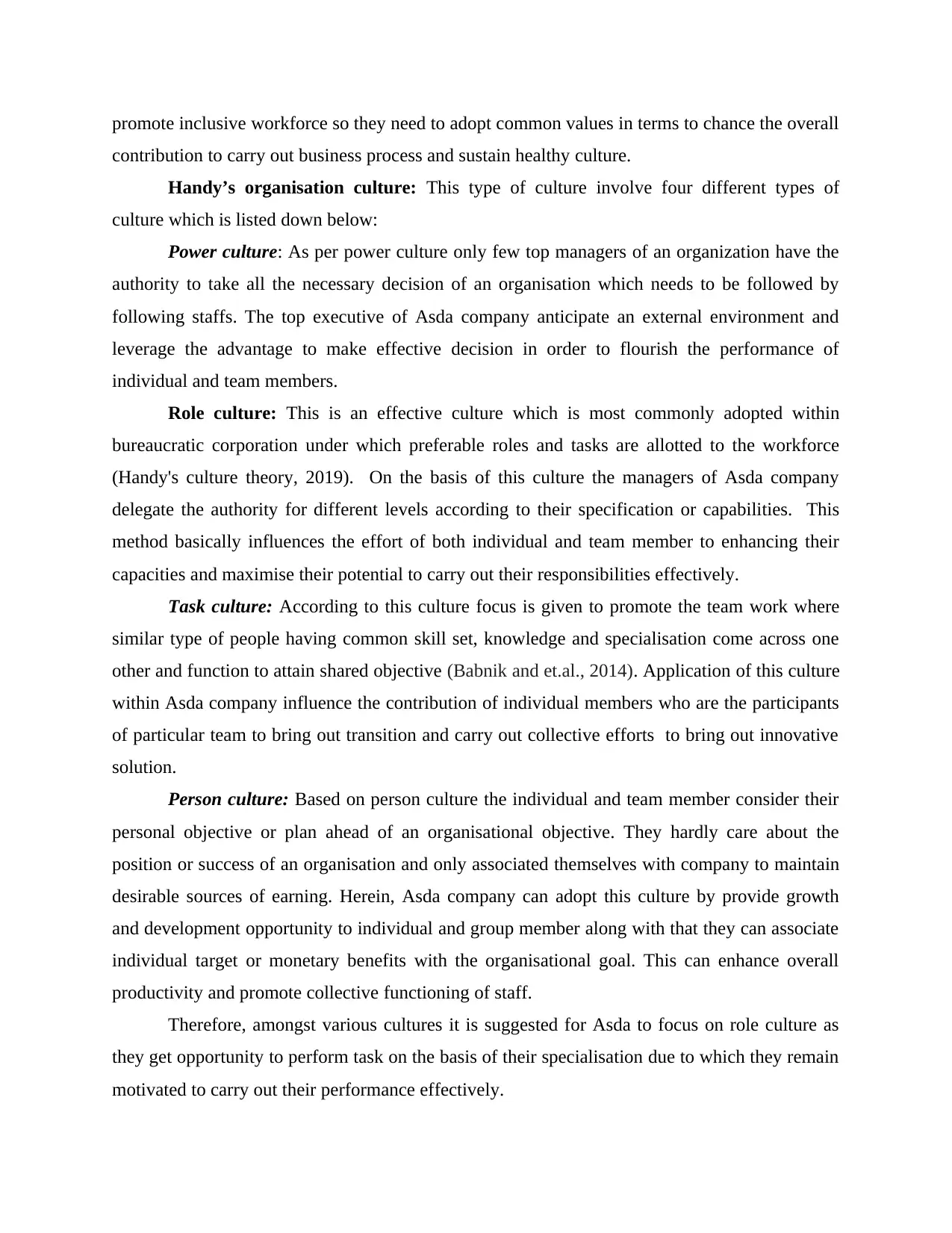
promote inclusive workforce so they need to adopt common values in terms to chance the overall
contribution to carry out business process and sustain healthy culture.
Handy’s organisation culture: This type of culture involve four different types of
culture which is listed down below:
Power culture: As per power culture only few top managers of an organization have the
authority to take all the necessary decision of an organisation which needs to be followed by
following staffs. The top executive of Asda company anticipate an external environment and
leverage the advantage to make effective decision in order to flourish the performance of
individual and team members.
Role culture: This is an effective culture which is most commonly adopted within
bureaucratic corporation under which preferable roles and tasks are allotted to the workforce
(Handy's culture theory, 2019). On the basis of this culture the managers of Asda company
delegate the authority for different levels according to their specification or capabilities. This
method basically influences the effort of both individual and team member to enhancing their
capacities and maximise their potential to carry out their responsibilities effectively.
Task culture: According to this culture focus is given to promote the team work where
similar type of people having common skill set, knowledge and specialisation come across one
other and function to attain shared objective (Babnik and et.al., 2014). Application of this culture
within Asda company influence the contribution of individual members who are the participants
of particular team to bring out transition and carry out collective efforts to bring out innovative
solution.
Person culture: Based on person culture the individual and team member consider their
personal objective or plan ahead of an organisational objective. They hardly care about the
position or success of an organisation and only associated themselves with company to maintain
desirable sources of earning. Herein, Asda company can adopt this culture by provide growth
and development opportunity to individual and group member along with that they can associate
individual target or monetary benefits with the organisational goal. This can enhance overall
productivity and promote collective functioning of staff.
Therefore, amongst various cultures it is suggested for Asda to focus on role culture as
they get opportunity to perform task on the basis of their specialisation due to which they remain
motivated to carry out their performance effectively.
contribution to carry out business process and sustain healthy culture.
Handy’s organisation culture: This type of culture involve four different types of
culture which is listed down below:
Power culture: As per power culture only few top managers of an organization have the
authority to take all the necessary decision of an organisation which needs to be followed by
following staffs. The top executive of Asda company anticipate an external environment and
leverage the advantage to make effective decision in order to flourish the performance of
individual and team members.
Role culture: This is an effective culture which is most commonly adopted within
bureaucratic corporation under which preferable roles and tasks are allotted to the workforce
(Handy's culture theory, 2019). On the basis of this culture the managers of Asda company
delegate the authority for different levels according to their specification or capabilities. This
method basically influences the effort of both individual and team member to enhancing their
capacities and maximise their potential to carry out their responsibilities effectively.
Task culture: According to this culture focus is given to promote the team work where
similar type of people having common skill set, knowledge and specialisation come across one
other and function to attain shared objective (Babnik and et.al., 2014). Application of this culture
within Asda company influence the contribution of individual members who are the participants
of particular team to bring out transition and carry out collective efforts to bring out innovative
solution.
Person culture: Based on person culture the individual and team member consider their
personal objective or plan ahead of an organisational objective. They hardly care about the
position or success of an organisation and only associated themselves with company to maintain
desirable sources of earning. Herein, Asda company can adopt this culture by provide growth
and development opportunity to individual and group member along with that they can associate
individual target or monetary benefits with the organisational goal. This can enhance overall
productivity and promote collective functioning of staff.
Therefore, amongst various cultures it is suggested for Asda to focus on role culture as
they get opportunity to perform task on the basis of their specialisation due to which they remain
motivated to carry out their performance effectively.
Paraphrase This Document
Need a fresh take? Get an instant paraphrase of this document with our AI Paraphraser
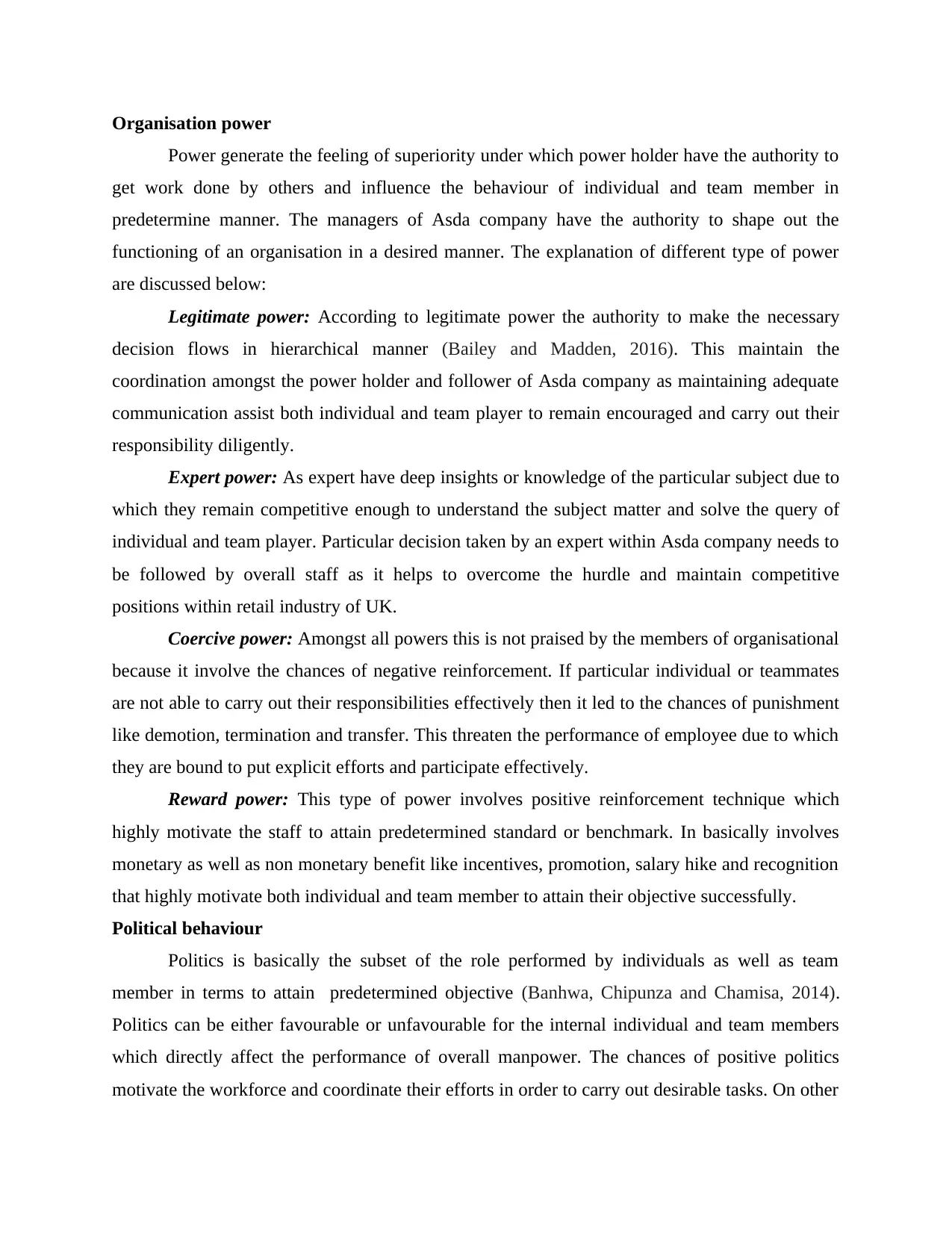
Organisation power
Power generate the feeling of superiority under which power holder have the authority to
get work done by others and influence the behaviour of individual and team member in
predetermine manner. The managers of Asda company have the authority to shape out the
functioning of an organisation in a desired manner. The explanation of different type of power
are discussed below:
Legitimate power: According to legitimate power the authority to make the necessary
decision flows in hierarchical manner (Bailey and Madden, 2016). This maintain the
coordination amongst the power holder and follower of Asda company as maintaining adequate
communication assist both individual and team player to remain encouraged and carry out their
responsibility diligently.
Expert power: As expert have deep insights or knowledge of the particular subject due to
which they remain competitive enough to understand the subject matter and solve the query of
individual and team player. Particular decision taken by an expert within Asda company needs to
be followed by overall staff as it helps to overcome the hurdle and maintain competitive
positions within retail industry of UK.
Coercive power: Amongst all powers this is not praised by the members of organisational
because it involve the chances of negative reinforcement. If particular individual or teammates
are not able to carry out their responsibilities effectively then it led to the chances of punishment
like demotion, termination and transfer. This threaten the performance of employee due to which
they are bound to put explicit efforts and participate effectively.
Reward power: This type of power involves positive reinforcement technique which
highly motivate the staff to attain predetermined standard or benchmark. In basically involves
monetary as well as non monetary benefit like incentives, promotion, salary hike and recognition
that highly motivate both individual and team member to attain their objective successfully.
Political behaviour
Politics is basically the subset of the role performed by individuals as well as team
member in terms to attain predetermined objective (Banhwa, Chipunza and Chamisa, 2014).
Politics can be either favourable or unfavourable for the internal individual and team members
which directly affect the performance of overall manpower. The chances of positive politics
motivate the workforce and coordinate their efforts in order to carry out desirable tasks. On other
Power generate the feeling of superiority under which power holder have the authority to
get work done by others and influence the behaviour of individual and team member in
predetermine manner. The managers of Asda company have the authority to shape out the
functioning of an organisation in a desired manner. The explanation of different type of power
are discussed below:
Legitimate power: According to legitimate power the authority to make the necessary
decision flows in hierarchical manner (Bailey and Madden, 2016). This maintain the
coordination amongst the power holder and follower of Asda company as maintaining adequate
communication assist both individual and team player to remain encouraged and carry out their
responsibility diligently.
Expert power: As expert have deep insights or knowledge of the particular subject due to
which they remain competitive enough to understand the subject matter and solve the query of
individual and team player. Particular decision taken by an expert within Asda company needs to
be followed by overall staff as it helps to overcome the hurdle and maintain competitive
positions within retail industry of UK.
Coercive power: Amongst all powers this is not praised by the members of organisational
because it involve the chances of negative reinforcement. If particular individual or teammates
are not able to carry out their responsibilities effectively then it led to the chances of punishment
like demotion, termination and transfer. This threaten the performance of employee due to which
they are bound to put explicit efforts and participate effectively.
Reward power: This type of power involves positive reinforcement technique which
highly motivate the staff to attain predetermined standard or benchmark. In basically involves
monetary as well as non monetary benefit like incentives, promotion, salary hike and recognition
that highly motivate both individual and team member to attain their objective successfully.
Political behaviour
Politics is basically the subset of the role performed by individuals as well as team
member in terms to attain predetermined objective (Banhwa, Chipunza and Chamisa, 2014).
Politics can be either favourable or unfavourable for the internal individual and team members
which directly affect the performance of overall manpower. The chances of positive politics
motivate the workforce and coordinate their efforts in order to carry out desirable tasks. On other
side, chances of negative politic generate insecurities amongst the people due to which they lack
to perform sustainable objective.
M1: Critically analyse how the culture, politics and power of an organisation can influence
individual and team behaviour and performance
An organisation comprises of desirable culture, politics and power that helps in carrying
out desirable function and incorporate favourable decision by maintaining smooth internal
operations. In context to Asda company the manager adopt role culture under which desirable
tasks is allotted to different functional unit. This helps the individual and team member to
leverage the opportunity to work according to their capabilities but on other side to cope up with
dynamic situation they may not take time to acquire new abilities and adopt new working pattern
(Boddy, 2015). Along with that dependency on rewards power benefits the individual to gain
additional benefit but at the same time they may become causal and vice versa for coercive
power. Precautions needs to be taken to encourage positive politics over negative ones as it
affect the productivity and profitability of an organisation.
TASK 2
P2: Evaluation of theories of motivation
Motivation is commitment, dedication towards achievement of goals of an organisation.
It is used by management of Asda to motivate its employees and deriving performance. The
types of motivation are-
Extrinsic motivation- It is a type of motivation which is initiated by rewards which are
external in nature such as monetary bonus, financial incentives etc. It can be used by Asda's
management to morally boost its employees to increase their performance.
Intrinsic motivation- This motivation is channelised by internal rewards such as
attainment of higher-order needs of an individual. Management of Asda can motivate employees
to set challenging goals for themselves which will help them in achieving organisational goals.
Content theories- These theories explore certain factors which motivate employees
towards performance. They identify those elements which satisfy the needs and demands of
workers of an organisation (Dhar, 2015). Different content theories are given by Maslow,
Herzberg and Alderfer. The management of Asda uses Maslow's Need Hierarchy Theory
to perform sustainable objective.
M1: Critically analyse how the culture, politics and power of an organisation can influence
individual and team behaviour and performance
An organisation comprises of desirable culture, politics and power that helps in carrying
out desirable function and incorporate favourable decision by maintaining smooth internal
operations. In context to Asda company the manager adopt role culture under which desirable
tasks is allotted to different functional unit. This helps the individual and team member to
leverage the opportunity to work according to their capabilities but on other side to cope up with
dynamic situation they may not take time to acquire new abilities and adopt new working pattern
(Boddy, 2015). Along with that dependency on rewards power benefits the individual to gain
additional benefit but at the same time they may become causal and vice versa for coercive
power. Precautions needs to be taken to encourage positive politics over negative ones as it
affect the productivity and profitability of an organisation.
TASK 2
P2: Evaluation of theories of motivation
Motivation is commitment, dedication towards achievement of goals of an organisation.
It is used by management of Asda to motivate its employees and deriving performance. The
types of motivation are-
Extrinsic motivation- It is a type of motivation which is initiated by rewards which are
external in nature such as monetary bonus, financial incentives etc. It can be used by Asda's
management to morally boost its employees to increase their performance.
Intrinsic motivation- This motivation is channelised by internal rewards such as
attainment of higher-order needs of an individual. Management of Asda can motivate employees
to set challenging goals for themselves which will help them in achieving organisational goals.
Content theories- These theories explore certain factors which motivate employees
towards performance. They identify those elements which satisfy the needs and demands of
workers of an organisation (Dhar, 2015). Different content theories are given by Maslow,
Herzberg and Alderfer. The management of Asda uses Maslow's Need Hierarchy Theory
⊘ This is a preview!⊘
Do you want full access?
Subscribe today to unlock all pages.
Trusted by 1+ million students worldwide
because it divides needs into a pyramid starting from bottom-level needs to superior-level needs.
It facilitates the managers to focus on these needs and try to fulfil them to motivate the workers.
Maslow's need hierarchy theory- It is a theory of motivation which divides needs of
humans into different tiers. In the context of Asda, use of this theory is stated as below-
Physiological needs- It refers to most basic needs of a humans such as food, shelter,
water etc. Management of Asda needs to focus on these needs because their fulfilment
drives employees towards achieving performance and motivates them to do better in
tasks.
Safety needs- These are financial security and a feeling of being well-secured in their
job. Asda' managers should fulfil these needs because workers are motivated to do better
when they are well-assured about their job.
Social needs- These are social security needs. Asda should try and fulfil them because
when an employee is loved and respected in an organisation it derives maximum
potential of performance and motivation of workers is increased.
Esteem needs- They are related with self-respect, esteem of workers. Asda's
management should focus on them because workers deserve respect for the work done by
them and it is something which motivates them to do even better in the future (Gonzales,
Martinez and Ordu, 2014).
Self-actualisation needs- These are top-tier needs of a person. Managers of Asda can
motivate employees to set challenging goals for themselves and achieve them which will
enhance organisational productivity and boost morale of workers.
Process theories- These theories explain various reasons of initiation of different type of
behaviours of an employee in an organisation. Various process theories have been given by
Vroom, Adams and Latham and Locke. Asda uses Vroom's expectancy theory as it analyses
manner by which individuals will behave in organisation when they select a particular behaviour
over others.
Vroom's expectancy theory- It has a behaviour assumption resulting from selection
from a choice of alternatives available. Its application in the context of Asda is as follows-
Expectancy- It is a belief that when individuals increase their efforts it will increase their
performance. Asda's managers should provide right resources, skills to employees which will
motivate them and increase their productivity. The company's management applies the theory by
It facilitates the managers to focus on these needs and try to fulfil them to motivate the workers.
Maslow's need hierarchy theory- It is a theory of motivation which divides needs of
humans into different tiers. In the context of Asda, use of this theory is stated as below-
Physiological needs- It refers to most basic needs of a humans such as food, shelter,
water etc. Management of Asda needs to focus on these needs because their fulfilment
drives employees towards achieving performance and motivates them to do better in
tasks.
Safety needs- These are financial security and a feeling of being well-secured in their
job. Asda' managers should fulfil these needs because workers are motivated to do better
when they are well-assured about their job.
Social needs- These are social security needs. Asda should try and fulfil them because
when an employee is loved and respected in an organisation it derives maximum
potential of performance and motivation of workers is increased.
Esteem needs- They are related with self-respect, esteem of workers. Asda's
management should focus on them because workers deserve respect for the work done by
them and it is something which motivates them to do even better in the future (Gonzales,
Martinez and Ordu, 2014).
Self-actualisation needs- These are top-tier needs of a person. Managers of Asda can
motivate employees to set challenging goals for themselves and achieve them which will
enhance organisational productivity and boost morale of workers.
Process theories- These theories explain various reasons of initiation of different type of
behaviours of an employee in an organisation. Various process theories have been given by
Vroom, Adams and Latham and Locke. Asda uses Vroom's expectancy theory as it analyses
manner by which individuals will behave in organisation when they select a particular behaviour
over others.
Vroom's expectancy theory- It has a behaviour assumption resulting from selection
from a choice of alternatives available. Its application in the context of Asda is as follows-
Expectancy- It is a belief that when individuals increase their efforts it will increase their
performance. Asda's managers should provide right resources, skills to employees which will
motivate them and increase their productivity. The company's management applies the theory by
Paraphrase This Document
Need a fresh take? Get an instant paraphrase of this document with our AI Paraphraser
providing regular training to workers which enhances their skills leading to achievement of
goals. For example- Sessions are held in Asda to improve employees' productivity.
Instrumentality- This belief means that best performance is derived when a significant
outcome is achieved. Management of Asda should motivate its workers when they achieve small
but significant goals which will boost their efficiency and effectiveness. Achievement of small
goals by Asda's workers implies that they will achieve its long-term goals in future. For
example- Asda rewards its employees on achieving even small goals and targets.
Valence- Importance of an individual towards outcomes of work is known as valence.
The management of Asda should understand different factors which motivate employees. If these
factors are applied in right context it will facilitate achievement of goals of company. For
example- Some of them maybe motivated by time off while others will value extra money.
M2: Critical evaluation of behaviour of individuals using motivational theories and techniques
Behavioural theories and concepts impact individuals as they directly affect the
performance. If managers of Asda use these theories effectively and motivate their employees in
the right manner then it will initiate positivity in them. Their productivity, efficiency and
effectiveness increases and they will be channelised to attain goals and objectives of the
company. It will help firm in the long-run (Griffioen, Doppenberg and Oostdam, 2018). Also
application of these concepts is essential for finding the problems individuals face in
environment of organisation and solving them.
D1: Critically evaluate the relationship between culture, politics, power and motivation that
enables teams and organisations to succeed providing justified recommendations
Effective culture, power and polities shared amongst Asda company motivate the
personnel of different management level to carry out their functioning effectively. This helps in
buil;ding up efefctiove team so it uis terh nrespsosissbility of representatives of Asda company
that tehry should avoid the chances of negataive poilities. For this meetings and effective
communicataion can take place to enahmnec eth feeling of job security (Inuwa, 2016).
TASK 3
P3: Explain what makes an effective team as opposed to an ineffective team
Teams represent the collective efforts of like minded people that collectively work
together in order to perform common task or objective. It include people that have common type
goals. For example- Sessions are held in Asda to improve employees' productivity.
Instrumentality- This belief means that best performance is derived when a significant
outcome is achieved. Management of Asda should motivate its workers when they achieve small
but significant goals which will boost their efficiency and effectiveness. Achievement of small
goals by Asda's workers implies that they will achieve its long-term goals in future. For
example- Asda rewards its employees on achieving even small goals and targets.
Valence- Importance of an individual towards outcomes of work is known as valence.
The management of Asda should understand different factors which motivate employees. If these
factors are applied in right context it will facilitate achievement of goals of company. For
example- Some of them maybe motivated by time off while others will value extra money.
M2: Critical evaluation of behaviour of individuals using motivational theories and techniques
Behavioural theories and concepts impact individuals as they directly affect the
performance. If managers of Asda use these theories effectively and motivate their employees in
the right manner then it will initiate positivity in them. Their productivity, efficiency and
effectiveness increases and they will be channelised to attain goals and objectives of the
company. It will help firm in the long-run (Griffioen, Doppenberg and Oostdam, 2018). Also
application of these concepts is essential for finding the problems individuals face in
environment of organisation and solving them.
D1: Critically evaluate the relationship between culture, politics, power and motivation that
enables teams and organisations to succeed providing justified recommendations
Effective culture, power and polities shared amongst Asda company motivate the
personnel of different management level to carry out their functioning effectively. This helps in
buil;ding up efefctiove team so it uis terh nrespsosissbility of representatives of Asda company
that tehry should avoid the chances of negataive poilities. For this meetings and effective
communicataion can take place to enahmnec eth feeling of job security (Inuwa, 2016).
TASK 3
P3: Explain what makes an effective team as opposed to an ineffective team
Teams represent the collective efforts of like minded people that collectively work
together in order to perform common task or objective. It include people that have common type
of skill, knowledge and expertise in order to carry out business objective within stipulated time
period.
Basis of difference Effective team Ineffective team
Meaning Effective team significantly
understand the objective and
mission of an organisation due to
which they make discussion and
share viable responsibilities.
High positive of vague objective led
the team members to go out of track
due to which they less likely achieve
objective.
Characteristics The members of effective team are
responsible, set desirable authorities
and effectively manage priories due
to which they remain competitive
enough to attain objective.
Ineffective team due to less interest
are least responsible to manage the
task and cooperate efforts with one
other that certainly leads to delay.
Belbin typology theory: This theory include different type of roles which is explained in
context to Asda company.
Action Oriented Roles:
Shaper: It include the team members that are passionate enough and have strong desire
to perform their core responsibilities and attain feasible targets effectively. This method
assist team members of Asda company to carry out systematic performance and
incorporate desirable action. Implementer: To formulate effective team, such team members effectively deal with the
dynamic environment and practically bring out changes in order to overcome particular
problems (Jaakson and et.al., 2017). It helps Asda company to overcome chances
associated with complexity while undergoing business activities.
People Oriented Roles:
Coordinator: Coordinator within Asda company effectively understand the goal and
contribute their efforts in order to flourish organisational operation.
period.
Basis of difference Effective team Ineffective team
Meaning Effective team significantly
understand the objective and
mission of an organisation due to
which they make discussion and
share viable responsibilities.
High positive of vague objective led
the team members to go out of track
due to which they less likely achieve
objective.
Characteristics The members of effective team are
responsible, set desirable authorities
and effectively manage priories due
to which they remain competitive
enough to attain objective.
Ineffective team due to less interest
are least responsible to manage the
task and cooperate efforts with one
other that certainly leads to delay.
Belbin typology theory: This theory include different type of roles which is explained in
context to Asda company.
Action Oriented Roles:
Shaper: It include the team members that are passionate enough and have strong desire
to perform their core responsibilities and attain feasible targets effectively. This method
assist team members of Asda company to carry out systematic performance and
incorporate desirable action. Implementer: To formulate effective team, such team members effectively deal with the
dynamic environment and practically bring out changes in order to overcome particular
problems (Jaakson and et.al., 2017). It helps Asda company to overcome chances
associated with complexity while undergoing business activities.
People Oriented Roles:
Coordinator: Coordinator within Asda company effectively understand the goal and
contribute their efforts in order to flourish organisational operation.
⊘ This is a preview!⊘
Do you want full access?
Subscribe today to unlock all pages.
Trusted by 1+ million students worldwide
Team worker: It involve supportive team member that are highly specialised in terms to
function together and face diverse situation significantly. The competitive team of Asda
company are highly efficient enough to tackle extreme situation significantly.
Cerebral oriented roles
Plant: It involve team members that are creative thinkers and can develop desirable plan
to bring out favourable changes (Belbin typology, 2019.). Asda company in terms to remain
competitive bring revolution in terms to effectively conduct diverse business operations.
Monitor evaluator: Such team member plays an essential role like they critically analyse
the real situation due to their serious minded ability. This assist Asda company to take significant
precaution in order to avoid the chances of error or misleading situations.
M3: Analyse relevant team and group development theories to support the development of
dynamic cooperation
Effective team and focusing on building desirable group assist the organisation to carry
out significant changes and participate in the dynamic environment to gain immense success.
Application of certain theories like Tuckman's theory helps in developing competitive team
member that together bring innovative solution and remain encouraged to adopt the new working
style by welcoming changes. It is vital for Asda company to enhance their operations and apply
Tuckmnan's theory that comprises of different elements discussed below:
Forming: The team members of Asda company meet for first time and introduce
themselves to become comfortable with one other and together attain overall business goals .
Storming: Within this stage discussion takes place amongst team members which may
leads to the chances of conflict or clashes due to different opinion (Oishi and Kesebir, 2015).
Norming: Efforts are taken by team member to resolve the conflict and maintain
interpersonal relationship where every one understand diverse options and come to most suitable
alternative.
Performing: This is considered as a transition stage as here roles are assigned to team
members in order to successfully achieve predetermine goals within specific time duration.
Meetings are conduct frequently to analyse the progress.
function together and face diverse situation significantly. The competitive team of Asda
company are highly efficient enough to tackle extreme situation significantly.
Cerebral oriented roles
Plant: It involve team members that are creative thinkers and can develop desirable plan
to bring out favourable changes (Belbin typology, 2019.). Asda company in terms to remain
competitive bring revolution in terms to effectively conduct diverse business operations.
Monitor evaluator: Such team member plays an essential role like they critically analyse
the real situation due to their serious minded ability. This assist Asda company to take significant
precaution in order to avoid the chances of error or misleading situations.
M3: Analyse relevant team and group development theories to support the development of
dynamic cooperation
Effective team and focusing on building desirable group assist the organisation to carry
out significant changes and participate in the dynamic environment to gain immense success.
Application of certain theories like Tuckman's theory helps in developing competitive team
member that together bring innovative solution and remain encouraged to adopt the new working
style by welcoming changes. It is vital for Asda company to enhance their operations and apply
Tuckmnan's theory that comprises of different elements discussed below:
Forming: The team members of Asda company meet for first time and introduce
themselves to become comfortable with one other and together attain overall business goals .
Storming: Within this stage discussion takes place amongst team members which may
leads to the chances of conflict or clashes due to different opinion (Oishi and Kesebir, 2015).
Norming: Efforts are taken by team member to resolve the conflict and maintain
interpersonal relationship where every one understand diverse options and come to most suitable
alternative.
Performing: This is considered as a transition stage as here roles are assigned to team
members in order to successfully achieve predetermine goals within specific time duration.
Meetings are conduct frequently to analyse the progress.
Paraphrase This Document
Need a fresh take? Get an instant paraphrase of this document with our AI Paraphraser
Adjourning: At the ending stage after achieve the objective the whole team gets
dissolved. The team member of Asda company may feel bad if they share goods bond with one
other as they need to disperse and carry out other activities.
TASK 4
P4: Application of concepts and philosophies of organisational behaviour
Path-goal theory specifies in particular that leaders will adopt in dealing with different
type of situations in an organisation. The leaders in Asda have to use this theory as it displays
different paths which they can take to solve problems in the company. Explanation of this theory
in the context of Asda is as follows-
Leadership styles-
Directive- A directive leader is the one who informs subordinates about what is expected
from them and displays the path to achieve goals. If leaders of Asda use this style then it
will help in achievement of targets in organisation. This style will influence the
employees to be more efficient in their work and will increase their performance. For
example- Setting targets for subordinates by superiors (Shipton and et.al., 2016).
Supportive- A supportive leader is the one who supports the subordinates in all
situations and resolves their grievances if any. Leaders of Asda can adopt this style which
will extend support to workers and allow them to work effectively. This will influence
behaviour of individuals in an organisation as they can freely approach their leaders. For
example- Solving of issues related to employees by leaders of company.
Participative- A participative leader allows participation of employees in decision-
making process. Leaders of Asda can use this approach which will ensure participation of
workers in decision-making and thus will enhance their abilities. This will enhance the
decision-taking skills of workers. For example- Consulting different teams of
organisation before taking a major decision.
Achievement-oriented- An achievement-oriented leader focuses on achievement of
goals of an organisation. Such a leader sets challenging targets for employees. Asda's
leaders can use this approach which will enhance productivity in the organisation. This
will influence the workers as they will focus on achievement of tasks (Waterson, 2018).
For example- Setting production standards which have to be achieved in the company.
dissolved. The team member of Asda company may feel bad if they share goods bond with one
other as they need to disperse and carry out other activities.
TASK 4
P4: Application of concepts and philosophies of organisational behaviour
Path-goal theory specifies in particular that leaders will adopt in dealing with different
type of situations in an organisation. The leaders in Asda have to use this theory as it displays
different paths which they can take to solve problems in the company. Explanation of this theory
in the context of Asda is as follows-
Leadership styles-
Directive- A directive leader is the one who informs subordinates about what is expected
from them and displays the path to achieve goals. If leaders of Asda use this style then it
will help in achievement of targets in organisation. This style will influence the
employees to be more efficient in their work and will increase their performance. For
example- Setting targets for subordinates by superiors (Shipton and et.al., 2016).
Supportive- A supportive leader is the one who supports the subordinates in all
situations and resolves their grievances if any. Leaders of Asda can adopt this style which
will extend support to workers and allow them to work effectively. This will influence
behaviour of individuals in an organisation as they can freely approach their leaders. For
example- Solving of issues related to employees by leaders of company.
Participative- A participative leader allows participation of employees in decision-
making process. Leaders of Asda can use this approach which will ensure participation of
workers in decision-making and thus will enhance their abilities. This will enhance the
decision-taking skills of workers. For example- Consulting different teams of
organisation before taking a major decision.
Achievement-oriented- An achievement-oriented leader focuses on achievement of
goals of an organisation. Such a leader sets challenging targets for employees. Asda's
leaders can use this approach which will enhance productivity in the organisation. This
will influence the workers as they will focus on achievement of tasks (Waterson, 2018).
For example- Setting production standards which have to be achieved in the company.
Asda's leaders should use participative path as it allows employees to be a part of decision-
making process. This can help in getting their valuable inputs for the organisation which can
benefit it in the long-run. Also, it helps in identifying workers with high potential and need for
achievement. Taking suggestions from subordinates enhances a superior's image. This also helps
them in meeting the standards set for performance in the enterprise which will ultimately benefit
the company in meeting its long-term objectives.
M4: Evaluation of positive and negative impact of organisational behaviour theories
The path-goal theory though effective has certain positive and negative impact in an
organisation. In the context of Asda, its positive impact can be improvement in efficiency of
workers through proper leadership and its suitability in different type of situations. However its
negative impact can be that some of its paths can be undemocratic for the employees (Veloen,
2016). Also, this theory is not useful for implementation if the leader has certain flaws in
leadership. Thus application of this theory in a company will have both positive and negative
impact on subordinates.
D2: Critically analyse and evaluate the relevance of team development theories in context of
organisational behaviour
Diverse types of team like problem solving come together in order to incorporate out
organisational success. The objective of establish team is to include people that can collectively
perform the creative functioning in order to attain objective successfully. Application of Belbin
theory involves different types of nine element which encompasses the efforts of individual and
team member and carry out their responsibility in desirable manner (Yıldız and Şaylıkay, 2014).
Like, resource investigator being extrovert are suitable enough to develop contacts and examine
external opportunity. Similarly, different elements enhances overall operations of an
organisation.
CONCLUSION
Based on above report it has been concluded that organisation behaviour influence the
behaviour of both individual and team members to improve their job performances and motivate
them to carry out their actions successfully. Application of effective culture, power and
favourable politics influences overall staff to function effectively on the basis of company's
guideline. The internal manager of an organisation need to apply appropriate motivation theories
making process. This can help in getting their valuable inputs for the organisation which can
benefit it in the long-run. Also, it helps in identifying workers with high potential and need for
achievement. Taking suggestions from subordinates enhances a superior's image. This also helps
them in meeting the standards set for performance in the enterprise which will ultimately benefit
the company in meeting its long-term objectives.
M4: Evaluation of positive and negative impact of organisational behaviour theories
The path-goal theory though effective has certain positive and negative impact in an
organisation. In the context of Asda, its positive impact can be improvement in efficiency of
workers through proper leadership and its suitability in different type of situations. However its
negative impact can be that some of its paths can be undemocratic for the employees (Veloen,
2016). Also, this theory is not useful for implementation if the leader has certain flaws in
leadership. Thus application of this theory in a company will have both positive and negative
impact on subordinates.
D2: Critically analyse and evaluate the relevance of team development theories in context of
organisational behaviour
Diverse types of team like problem solving come together in order to incorporate out
organisational success. The objective of establish team is to include people that can collectively
perform the creative functioning in order to attain objective successfully. Application of Belbin
theory involves different types of nine element which encompasses the efforts of individual and
team member and carry out their responsibility in desirable manner (Yıldız and Şaylıkay, 2014).
Like, resource investigator being extrovert are suitable enough to develop contacts and examine
external opportunity. Similarly, different elements enhances overall operations of an
organisation.
CONCLUSION
Based on above report it has been concluded that organisation behaviour influence the
behaviour of both individual and team members to improve their job performances and motivate
them to carry out their actions successfully. Application of effective culture, power and
favourable politics influences overall staff to function effectively on the basis of company's
guideline. The internal manager of an organisation need to apply appropriate motivation theories
⊘ This is a preview!⊘
Do you want full access?
Subscribe today to unlock all pages.
Trusted by 1+ million students worldwide

1 out of 15


Related Documents


Your All-in-One AI-Powered Toolkit for Academic Success.
+13062052269
info@desklib.com
Available 24*7 on WhatsApp / Email
![[object Object]](/_next/static/media/star-bottom.7253800d.svg)
Unlock your academic potential
Copyright © 2020–2026 A2Z Services. All Rights Reserved. Developed and managed by ZUCOL.