Asda Case Study: Value Chain Management Practices and Profitability
VerifiedAdded on 2023/06/15
|14
|4028
|221
Case Study
AI Summary
This case study examines the impact of value chain management practices on the profitability of ASDA, a leading UK supermarket. It investigates the concept of value chain management, its effect on ASDA's profit margins, and the benefits derived by the company. The study utilizes a deductive research approach, employing a survey strategy to gather and analyze data. The literature review highlights the importance of value chain management in enhancing efficiency, reducing costs, and improving overall productivity. ASDA's implementation of value chain practices, including inbound and outbound logistics, operations, marketing, and service, are analyzed in relation to their effect on profitability and market competitiveness. The research methodology outlines the data collection and analysis methods used to assess the impact of these practices on ASDA's success.

Evaluating the impact of value chain management practices on profitability groceries on Asda

Paraphrase This Document
Need a fresh take? Get an instant paraphrase of this document with our AI Paraphraser
Abstract
Value chain management refers to the integration of all the necessary resources in order to attain
the business goals in an efficient manner. The main aim of the entity is to identify the impact of
value chain on the profitability of ASDA. It is found that the company is getting ample of
benefits in terms of increasing productivity and profitability due to effective value chain
management system. A detailed research methodology has been applied to attain the pre-defined
research goals.
Value chain management refers to the integration of all the necessary resources in order to attain
the business goals in an efficient manner. The main aim of the entity is to identify the impact of
value chain on the profitability of ASDA. It is found that the company is getting ample of
benefits in terms of increasing productivity and profitability due to effective value chain
management system. A detailed research methodology has been applied to attain the pre-defined
research goals.
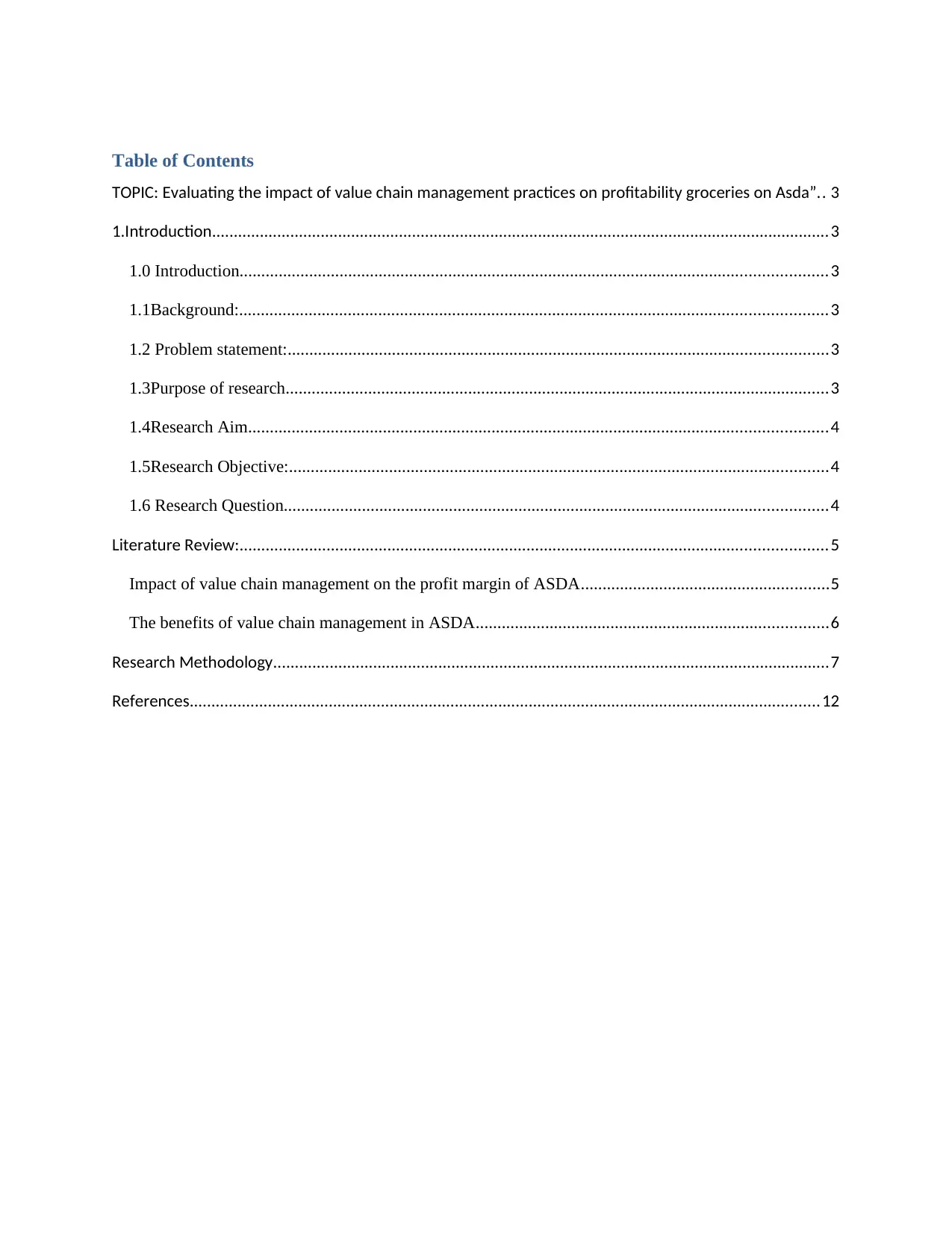
Table of Contents
TOPIC: Evaluating the impact of value chain management practices on profitability groceries on Asda”.. 3
1.Introduction..............................................................................................................................................3
1.0 Introduction.......................................................................................................................................3
1.1Background:.......................................................................................................................................3
1.2 Problem statement:............................................................................................................................3
1.3Purpose of research.............................................................................................................................3
1.4Research Aim.....................................................................................................................................4
1.5Research Objective:............................................................................................................................4
1.6 Research Question.............................................................................................................................4
Literature Review:.......................................................................................................................................5
Impact of value chain management on the profit margin of ASDA.........................................................5
The benefits of value chain management in ASDA.................................................................................6
Research Methodology................................................................................................................................7
References.................................................................................................................................................12
TOPIC: Evaluating the impact of value chain management practices on profitability groceries on Asda”.. 3
1.Introduction..............................................................................................................................................3
1.0 Introduction.......................................................................................................................................3
1.1Background:.......................................................................................................................................3
1.2 Problem statement:............................................................................................................................3
1.3Purpose of research.............................................................................................................................3
1.4Research Aim.....................................................................................................................................4
1.5Research Objective:............................................................................................................................4
1.6 Research Question.............................................................................................................................4
Literature Review:.......................................................................................................................................5
Impact of value chain management on the profit margin of ASDA.........................................................5
The benefits of value chain management in ASDA.................................................................................6
Research Methodology................................................................................................................................7
References.................................................................................................................................................12
⊘ This is a preview!⊘
Do you want full access?
Subscribe today to unlock all pages.

Trusted by 1+ million students worldwide
TOPIC: “Evaluating the impact of value chain management practices on profitability in UK
retail grocery sector. A case study on Asda”.
1.Introduction
1.0 Introduction
Value chain management refers to the integration of all the necessary resources in order
to attain the business goals in an efficient manner. It combines material, labor, logistics and
more. In other words, value chain management is about managing all the components including
procurement, quality, production, distribution and more. In value chain, all the necessary
elements are combined in such a manner that the organization can accomplish its pre-defined
goals efficiently. In addition, value chain management makes it possible to maintain a continous
flow of good & services in the market so that the entity can meet with the market demand
efficiently. Also, the value chain has direct link with the profitability of business. It not only
improves the market share but also inflate the overall profit margin (Lee and Tang, 2018). The
present study is based on ASDA that is renowned supermarket company based on UK. It was
started in 1949 and offers general items and groceries across the world. It is headquartered in UK
and known as one of the leading supermarket of the country. The main aim of the entity is to
identify the impact of value chain on the profitability of the respective organization.
Additionally, it will cover the benefits related to the value chain management that are being
faced by the respective company. Further, the study will also comprise relevant methods of data
collection & analysis in order to draw meaningful conclusion out of the research.
1.1Background: The research study is based on the impact of value chain management practices
on the profitability in retail segment. For this purpose, ASDA is taken into consideration that is a
well-known company of retail industry. The study will assess benefits of value chain
management and its impact on the profitability of the respective organization.
1.2 Problem statement: The study aims to identify the how the value chain management is
affecting the profitability of companies working in the retail segment of UK with specific focus
on ASDA.
retail grocery sector. A case study on Asda”.
1.Introduction
1.0 Introduction
Value chain management refers to the integration of all the necessary resources in order
to attain the business goals in an efficient manner. It combines material, labor, logistics and
more. In other words, value chain management is about managing all the components including
procurement, quality, production, distribution and more. In value chain, all the necessary
elements are combined in such a manner that the organization can accomplish its pre-defined
goals efficiently. In addition, value chain management makes it possible to maintain a continous
flow of good & services in the market so that the entity can meet with the market demand
efficiently. Also, the value chain has direct link with the profitability of business. It not only
improves the market share but also inflate the overall profit margin (Lee and Tang, 2018). The
present study is based on ASDA that is renowned supermarket company based on UK. It was
started in 1949 and offers general items and groceries across the world. It is headquartered in UK
and known as one of the leading supermarket of the country. The main aim of the entity is to
identify the impact of value chain on the profitability of the respective organization.
Additionally, it will cover the benefits related to the value chain management that are being
faced by the respective company. Further, the study will also comprise relevant methods of data
collection & analysis in order to draw meaningful conclusion out of the research.
1.1Background: The research study is based on the impact of value chain management practices
on the profitability in retail segment. For this purpose, ASDA is taken into consideration that is a
well-known company of retail industry. The study will assess benefits of value chain
management and its impact on the profitability of the respective organization.
1.2 Problem statement: The study aims to identify the how the value chain management is
affecting the profitability of companies working in the retail segment of UK with specific focus
on ASDA.
Paraphrase This Document
Need a fresh take? Get an instant paraphrase of this document with our AI Paraphraser
1.3Purpose of research
Value chain management is the integration of different components so that an entity can
effectively manage the business operations. It allows a business entity to capture the
requirements of markets and the customers in order to attain maximum level of satisfaction in an
efficient manner (Hasan and et. al., 2019). The main rational of the existing project is to identify
the different aspects of value chain so that it will be possible to identify the issue related to value
chain management. Here, the detailed knowledge of value chain management will enable the
researcher in order to identify the impact of value chain on the profitability of the company.
Further, it will also expand the knowledge of the investigator in terms of getting growth in the
profession. Here, the researcher can prepare significant strategies related to value chain
management for future growth & enhancement.
1.4Research Aim: “Evaluating the impact of value chain management practices on profitability
in UK retail grocery sector. A case study on Asda”.
1.5Research Objective:
To identify the concept of value chain management.
To evaluate the impact of value chain management on the profit margin of ASDA.
To identify the benefits of value chain management of ASDA.
1.6 Research Question
What is the concept of value chain management?
How value chain management affects the profit margin of ASDA?
What are the benefits of value chain management for ASDA?
Value chain management is the integration of different components so that an entity can
effectively manage the business operations. It allows a business entity to capture the
requirements of markets and the customers in order to attain maximum level of satisfaction in an
efficient manner (Hasan and et. al., 2019). The main rational of the existing project is to identify
the different aspects of value chain so that it will be possible to identify the issue related to value
chain management. Here, the detailed knowledge of value chain management will enable the
researcher in order to identify the impact of value chain on the profitability of the company.
Further, it will also expand the knowledge of the investigator in terms of getting growth in the
profession. Here, the researcher can prepare significant strategies related to value chain
management for future growth & enhancement.
1.4Research Aim: “Evaluating the impact of value chain management practices on profitability
in UK retail grocery sector. A case study on Asda”.
1.5Research Objective:
To identify the concept of value chain management.
To evaluate the impact of value chain management on the profit margin of ASDA.
To identify the benefits of value chain management of ASDA.
1.6 Research Question
What is the concept of value chain management?
How value chain management affects the profit margin of ASDA?
What are the benefits of value chain management for ASDA?
Literature Review:
It refers the collection necessary data from the previous studies which have been done by
authors. Through analyzing the previous literature, it is possible to gain deep insights of a
particular topic that will assist the researcher in order to reach at meaningful conclusion.
Concept of value chain management
According to Sushil, 2018, Value chain management is the process through which
different components of manufacturing such as procurement, production, quality, control &
distribution are monitored as well as managed efficiently. Due to enhancement in the global
boundaries of business, significance of value chain has increased. In this context, companies are
likely to classify their activities in two parts and further focus on the core competencies and
outsource the other related activities. The main aim of this strategy is to allow the entity to only
focus on some specific tasks in order to improve the future efficiency and productivity. In other
words, the value chain management aims to enhance the overall efficiency, deliver the superior
quality products to the customers and minimize the overall cost in significant manner. Effective
value chain management makes a company enable to reduce down the overall production cost in
order to offer goods to customers at affordable price. Additionally, value chain helps the
company in using the available resources appropriately for the future growth. It is also known as
the supply chain management and associate with the appropriate use of logistics resources so that
the customers receive the products or services in timely manner. Here, it is imperative to keep an
eye on each and every activity of value chain so that the company can deal with the complexities
and maintain a positive image in the market. In context of ASDA, they follow the value chain
management system so that they can utilize the available resources in the best possible way. In
this context, the primary activities are inbound logistics, operations, outbound logistics, service,
marketing and more. On other side, there are certain secondary activities such as infrastructure,
technology, procurement and more.
Impact of value chain management on the profit margin of ASDA
According to Bunce, 2021, Value chain makes an organization enable to understand the
different activities in a profound way. They can easily evaluate the impact of different functions
It refers the collection necessary data from the previous studies which have been done by
authors. Through analyzing the previous literature, it is possible to gain deep insights of a
particular topic that will assist the researcher in order to reach at meaningful conclusion.
Concept of value chain management
According to Sushil, 2018, Value chain management is the process through which
different components of manufacturing such as procurement, production, quality, control &
distribution are monitored as well as managed efficiently. Due to enhancement in the global
boundaries of business, significance of value chain has increased. In this context, companies are
likely to classify their activities in two parts and further focus on the core competencies and
outsource the other related activities. The main aim of this strategy is to allow the entity to only
focus on some specific tasks in order to improve the future efficiency and productivity. In other
words, the value chain management aims to enhance the overall efficiency, deliver the superior
quality products to the customers and minimize the overall cost in significant manner. Effective
value chain management makes a company enable to reduce down the overall production cost in
order to offer goods to customers at affordable price. Additionally, value chain helps the
company in using the available resources appropriately for the future growth. It is also known as
the supply chain management and associate with the appropriate use of logistics resources so that
the customers receive the products or services in timely manner. Here, it is imperative to keep an
eye on each and every activity of value chain so that the company can deal with the complexities
and maintain a positive image in the market. In context of ASDA, they follow the value chain
management system so that they can utilize the available resources in the best possible way. In
this context, the primary activities are inbound logistics, operations, outbound logistics, service,
marketing and more. On other side, there are certain secondary activities such as infrastructure,
technology, procurement and more.
Impact of value chain management on the profit margin of ASDA
According to Bunce, 2021, Value chain makes an organization enable to understand the
different activities in a profound way. They can easily evaluate the impact of different functions
⊘ This is a preview!⊘
Do you want full access?
Subscribe today to unlock all pages.
Trusted by 1+ million students worldwide
on the operations of the entity. It helps the company in identifying the suitable ways to reduce
down the cost. Here, they can easily find out the ways to reduce down the cost which further
enable the organization to offer the product to the customers at lower price. It enhances the
overall sales of the entity and further lead towards higher profitability. Additionally, value chain
management also improves the overall efficiency of the business organization so that they can
easily produce the good at minimum cost. Further value chain management also plays a crucial
role in minimizing the wastage and enhances the profit margin efficiently. While doing so, the
organization can easily find out the best ways to increase the value, reduce the cost or enhance
the production. As a result, customers can enjoy the good quality products at reasonable price. In
context of ASDA, they implement the value chain practices in business. Here, the company is
able to keep a control on the wastage and use of resourced by value chain management. It allows
the managers to efficiently utilize the resources so that the company can produce higher quality
products or services for the end users. Additionally, it also focuses on marketing and other
relevant service. Marketing has direct link with the sales which allows the company to earn
higher profit. By promoting products, ASDA can easily inflate the revenue and earn potential
amount of profit. Also, increasing productivity also minimizes the expenses so that the respective
business entity can earn significant amount of profit.
The benefits of value chain management in ASDA
According to Kravit, 2020, Value chain management has several benefits for business as
it helps in improving the overall productivity and lead the business entity towards success. It also
assists the business managers in taking better & effective decisions which can generate benefits
in the future period of time. A firm can easily improve their ability to track and manage
marketing & customer requirements to perform design, planning, production and other activities
efficiently. Additionally, an appropriate VCM comprises developing an efficient team that have
the capability to plan, deliver and deliver quality products or services to the end users. It reduces
down the product cost and improves the quality in an efficient manner. Additionally, it makes the
company enable to effectively plan and implement the projects by managing resources & funds
in an efficient manner. Basically, the major benefit of VCM is improving the efficiency so that
the entity can produce high quality good within least possible cost. In context of ASDA, value
chain management helps the organization in performing different activities in a cost effective
manner. It helps them to improve the overall efficiency. As a result, the organization can offer
down the cost. Here, they can easily find out the ways to reduce down the cost which further
enable the organization to offer the product to the customers at lower price. It enhances the
overall sales of the entity and further lead towards higher profitability. Additionally, value chain
management also improves the overall efficiency of the business organization so that they can
easily produce the good at minimum cost. Further value chain management also plays a crucial
role in minimizing the wastage and enhances the profit margin efficiently. While doing so, the
organization can easily find out the best ways to increase the value, reduce the cost or enhance
the production. As a result, customers can enjoy the good quality products at reasonable price. In
context of ASDA, they implement the value chain practices in business. Here, the company is
able to keep a control on the wastage and use of resourced by value chain management. It allows
the managers to efficiently utilize the resources so that the company can produce higher quality
products or services for the end users. Additionally, it also focuses on marketing and other
relevant service. Marketing has direct link with the sales which allows the company to earn
higher profit. By promoting products, ASDA can easily inflate the revenue and earn potential
amount of profit. Also, increasing productivity also minimizes the expenses so that the respective
business entity can earn significant amount of profit.
The benefits of value chain management in ASDA
According to Kravit, 2020, Value chain management has several benefits for business as
it helps in improving the overall productivity and lead the business entity towards success. It also
assists the business managers in taking better & effective decisions which can generate benefits
in the future period of time. A firm can easily improve their ability to track and manage
marketing & customer requirements to perform design, planning, production and other activities
efficiently. Additionally, an appropriate VCM comprises developing an efficient team that have
the capability to plan, deliver and deliver quality products or services to the end users. It reduces
down the product cost and improves the quality in an efficient manner. Additionally, it makes the
company enable to effectively plan and implement the projects by managing resources & funds
in an efficient manner. Basically, the major benefit of VCM is improving the efficiency so that
the entity can produce high quality good within least possible cost. In context of ASDA, value
chain management helps the organization in performing different activities in a cost effective
manner. It helps them to improve the overall efficiency. As a result, the organization can offer
Paraphrase This Document
Need a fresh take? Get an instant paraphrase of this document with our AI Paraphraser
quality goods to the end user. Apart from this, VCM also allows an entity to receive the
competitive advantage in the market place. Further, the company can utilize the available
resources appropriately which make them enable in producing the quality goods at minimum
possible price. Therefore, effective VCM improve the profitability, productivity, market
reputation and makes the entity able to survive in the competitive environment for longer
duration.
Research Methodology
Research methodology is a crucial part of the overall research that not only helps and
data collection but also play a crucial role in analyzing the data. For the purpose of present study,
data have been gathered via primary or secondary sources that will help in future success of
research project . In this context ,different elements of research methodology are mentioned
below.
Research philosophy: The research philosophy is known as the process that is used to
gather as well as evaluate the data for a specific study. Basically, it demonstrates the way to
conduct a complete research on a particular topic (Kumar, 2018). For this purpose, there are two
types of research philosophy which are interpretivism and positivism. In, the present study,
positivism approach is applied as it used quantitative information for the purpose of data
collection and evaluation. Hence, it is possible to get reliable outcomes in least time and effort.
Research approach: The main purpose of research approach is to assess the data of a
particular topic. It is a crucial part of the overall research methodology and includes a step by
step procedure along with the wider assumptions of data collection interpretation and analysis.
Inductive and deductive are the two major types of research approaches (Eisend and Kuss, 2019).
The current research is based on deductive approach as it is easy to get tested and numerical data
by use of this approach. Therefore, it helps in testing and evaluating the data within minimum
possible time and cost.
Research strategy: The research strategy signifies the overall plan which is prepared to
conduct research on a given topic. It includes a step by step procedure for collecting, interpreting
and analysing the data ( Boyd and et. al., 2019). The widely used research strategies are case
competitive advantage in the market place. Further, the company can utilize the available
resources appropriately which make them enable in producing the quality goods at minimum
possible price. Therefore, effective VCM improve the profitability, productivity, market
reputation and makes the entity able to survive in the competitive environment for longer
duration.
Research Methodology
Research methodology is a crucial part of the overall research that not only helps and
data collection but also play a crucial role in analyzing the data. For the purpose of present study,
data have been gathered via primary or secondary sources that will help in future success of
research project . In this context ,different elements of research methodology are mentioned
below.
Research philosophy: The research philosophy is known as the process that is used to
gather as well as evaluate the data for a specific study. Basically, it demonstrates the way to
conduct a complete research on a particular topic (Kumar, 2018). For this purpose, there are two
types of research philosophy which are interpretivism and positivism. In, the present study,
positivism approach is applied as it used quantitative information for the purpose of data
collection and evaluation. Hence, it is possible to get reliable outcomes in least time and effort.
Research approach: The main purpose of research approach is to assess the data of a
particular topic. It is a crucial part of the overall research methodology and includes a step by
step procedure along with the wider assumptions of data collection interpretation and analysis.
Inductive and deductive are the two major types of research approaches (Eisend and Kuss, 2019).
The current research is based on deductive approach as it is easy to get tested and numerical data
by use of this approach. Therefore, it helps in testing and evaluating the data within minimum
possible time and cost.
Research strategy: The research strategy signifies the overall plan which is prepared to
conduct research on a given topic. It includes a step by step procedure for collecting, interpreting
and analysing the data ( Boyd and et. al., 2019). The widely used research strategies are case
study, survey, questionnaire and so on. For the present study, survey has chosen as the research
strategy. Here, survey will help in collection of true and fair opinion of the huge number of
respondents.
Data collection methods:
Primary data: In primary data collection, row information is gathered by the researcher
with own efforts. Here, the information is first handed and completely raw as it is collected by
the researcher without taking help of any external source (Iovino and Tsitsianis, 2020). The
major sources of primary data are questionnaire, survey, observation and more. However, the
primary data is completely raw and authentic but there is requirement of huge time and effort to
collect the primary information. In primary method, it is possible to maintain direct interaction
with the respondent which enable the researcher to get the detailed and in depth information.
Secondary Method: This is a widely used method of data collection. It helps in
collecting wide range of information within minimum possible time and cost. Secondary
information is generally gathered via websites, journals, articles and more. This information is
crucial in order to conduct the research (Fay, 2018). However, it is less reliable and authentic.
With the use of secondary information, it is possible to conduct a research in time and cost
effective manner.
In the given scenario, primary information will be drawn through questionnaire. Also, the
investigator will gather secondary information through authentic websites, articles, journals and
more.
Sampling method: Sampling refers to select some units from the entire population of
research. These units further represent the entire population for the purpose of a particular study.
To collect the sample, probability and non probability sampling techniques can be applied
(Bluestein, 2018). In the given scenario, probability sampling is used as it will help in receiving
true and fair results. In this, equal opportunity will be given to each and every unit to become a
part of sample.
Target group: In contest of the present research, target population is identified as the
entire group of individuals who are also being considered as the samples. Here, the individuals
strategy. Here, survey will help in collection of true and fair opinion of the huge number of
respondents.
Data collection methods:
Primary data: In primary data collection, row information is gathered by the researcher
with own efforts. Here, the information is first handed and completely raw as it is collected by
the researcher without taking help of any external source (Iovino and Tsitsianis, 2020). The
major sources of primary data are questionnaire, survey, observation and more. However, the
primary data is completely raw and authentic but there is requirement of huge time and effort to
collect the primary information. In primary method, it is possible to maintain direct interaction
with the respondent which enable the researcher to get the detailed and in depth information.
Secondary Method: This is a widely used method of data collection. It helps in
collecting wide range of information within minimum possible time and cost. Secondary
information is generally gathered via websites, journals, articles and more. This information is
crucial in order to conduct the research (Fay, 2018). However, it is less reliable and authentic.
With the use of secondary information, it is possible to conduct a research in time and cost
effective manner.
In the given scenario, primary information will be drawn through questionnaire. Also, the
investigator will gather secondary information through authentic websites, articles, journals and
more.
Sampling method: Sampling refers to select some units from the entire population of
research. These units further represent the entire population for the purpose of a particular study.
To collect the sample, probability and non probability sampling techniques can be applied
(Bluestein, 2018). In the given scenario, probability sampling is used as it will help in receiving
true and fair results. In this, equal opportunity will be given to each and every unit to become a
part of sample.
Target group: In contest of the present research, target population is identified as the
entire group of individuals who are also being considered as the samples. Here, the individuals
⊘ This is a preview!⊘
Do you want full access?
Subscribe today to unlock all pages.
Trusted by 1+ million students worldwide
who are included in the sample will be referred as participants(De Costa, Crowther and Maloney,
2019). In this contest, the information will be drawn from the employees of ASDA. They will
help in providing adequate piece of information to conduct the research effectively.
Data Analysis: It is a process through which data is analysed, evaluate to get the valuable
inferences in order to take suitable business decisions. For this purpose, data analysis tools are
applied by the investigator so that they can attain the business objectives. In the given scenario,
descriptive data analysis technique is applied. In this context, the researcher will describe and
summaries the entire information which has been gathered throughout the research from the
target population.
Ethical issues in research: It is imperative to consider the ethical considerations while
undertaking a research. However, a researcher have to face ample of ethical issue during the
research study. The first and the foremost issue is related to study design and ethical approval.
For the purpose of research, it is imperative to get the necessary approval from the authorities.
Additionally, the researcher has the responsibility to analyze the data efficiently. Inappropriate
analysis can become the reason of misinterpretation and misleading of the readers. Sometimes,
the issues related to conflict of interest also get arise during the research (Purdon and Thornton,
2019). In context of the present study, the investigator will face different issues related to data
analysis, conflict of interest and more. It is imperative for the researcher to address all these
issues appropriately in order to get positive outcomes out of the research study.
Validity and reliability in research: In any research work, it is imperative to ensure that
the data is reliable & valid. Here, the reliability and validation is imperative to get valuable
results out of research. In this context, the methods which can be used are described below:
Internal Validity: It is applied in the situation when there is requirement to establish
causal relationship between two different variables. It also comprises the degree to which it is
possible to make necessary references about this causal relationship (Charbonneau-Dahlen,
2020). It is applied when the investigator that the effects of the study occurred due to the
manipulation not due to the another factor.
Construct validity: This validity method is based on the accuracy of operational
measures which are used to make valid inferences out of research. Here, the investigator can
2019). In this contest, the information will be drawn from the employees of ASDA. They will
help in providing adequate piece of information to conduct the research effectively.
Data Analysis: It is a process through which data is analysed, evaluate to get the valuable
inferences in order to take suitable business decisions. For this purpose, data analysis tools are
applied by the investigator so that they can attain the business objectives. In the given scenario,
descriptive data analysis technique is applied. In this context, the researcher will describe and
summaries the entire information which has been gathered throughout the research from the
target population.
Ethical issues in research: It is imperative to consider the ethical considerations while
undertaking a research. However, a researcher have to face ample of ethical issue during the
research study. The first and the foremost issue is related to study design and ethical approval.
For the purpose of research, it is imperative to get the necessary approval from the authorities.
Additionally, the researcher has the responsibility to analyze the data efficiently. Inappropriate
analysis can become the reason of misinterpretation and misleading of the readers. Sometimes,
the issues related to conflict of interest also get arise during the research (Purdon and Thornton,
2019). In context of the present study, the investigator will face different issues related to data
analysis, conflict of interest and more. It is imperative for the researcher to address all these
issues appropriately in order to get positive outcomes out of the research study.
Validity and reliability in research: In any research work, it is imperative to ensure that
the data is reliable & valid. Here, the reliability and validation is imperative to get valuable
results out of research. In this context, the methods which can be used are described below:
Internal Validity: It is applied in the situation when there is requirement to establish
causal relationship between two different variables. It also comprises the degree to which it is
possible to make necessary references about this causal relationship (Charbonneau-Dahlen,
2020). It is applied when the investigator that the effects of the study occurred due to the
manipulation not due to the another factor.
Construct validity: This validity method is based on the accuracy of operational
measures which are used to make valid inferences out of research. Here, the investigator can
Paraphrase This Document
Need a fresh take? Get an instant paraphrase of this document with our AI Paraphraser
claim that it is possible to make valid inferences through operational measures for the theoretical
constructs they were based.
Inter-rater reliability: It is based on the rating given by the different researchers to the
same phenomenon. Here, different investigators observe and give consistent estimated to the
same concept. Basically, it refers to the extend two or more person are agree. If ample of
investigator show their consent with the same phenomenon, the study is considered reliable. On
other side, lack of consent of other researchers shows that the research is lacking in terms of
reliability (Mohan, Carvajal-Millan and Ravishankar, 2018).
Test-rated reliability: This method is applied in order to administer the same test on
different occasions. Here, it is assumed that there are no major changes between the two
occasions. Here, the correlation in the two variable is also measured in order to check the
reliability in an efficient manner.
Therefore, the researcher will apply the above-stated methods to check whether the
results of the study are reliable & Valid or not. It will further help in improving the reliability
and validation of the research study in an efficient manner.
Limitation of research: In research, there are several limitations associated with the
study. These limitations put a profound impact on the overall research outcomes. In the given
scenario, there are limitations related to availability of information. While gathering the data
from the respondents, they are not likely to respond properly. Also, scarcity of resources is also
one of the major issues that is being faced by the investigator and will affect the overall research
results. In addition to this, time constraint can affect the research work in longer run and will also
cause delay in data collection and drawing necessary recommendations.
Time schedule: In each and every research project, a particular time period is followed.
Here, it is imperative to prepare & follow the appropriate schedule so that the research work can
be completed in timely manner. A researcher needs to stay careful while preparing the schedule.
There is requirement to analyze the activities which need to complete for the accomplishment of
research work. Additionally, time schedule includes different activities such as identifying the
aims, gathering the literature, collecting and analyzing the data, drawing conclusion and more. In
this context, Gantt chart will be prepared that will include the schedule along with different roles
constructs they were based.
Inter-rater reliability: It is based on the rating given by the different researchers to the
same phenomenon. Here, different investigators observe and give consistent estimated to the
same concept. Basically, it refers to the extend two or more person are agree. If ample of
investigator show their consent with the same phenomenon, the study is considered reliable. On
other side, lack of consent of other researchers shows that the research is lacking in terms of
reliability (Mohan, Carvajal-Millan and Ravishankar, 2018).
Test-rated reliability: This method is applied in order to administer the same test on
different occasions. Here, it is assumed that there are no major changes between the two
occasions. Here, the correlation in the two variable is also measured in order to check the
reliability in an efficient manner.
Therefore, the researcher will apply the above-stated methods to check whether the
results of the study are reliable & Valid or not. It will further help in improving the reliability
and validation of the research study in an efficient manner.
Limitation of research: In research, there are several limitations associated with the
study. These limitations put a profound impact on the overall research outcomes. In the given
scenario, there are limitations related to availability of information. While gathering the data
from the respondents, they are not likely to respond properly. Also, scarcity of resources is also
one of the major issues that is being faced by the investigator and will affect the overall research
results. In addition to this, time constraint can affect the research work in longer run and will also
cause delay in data collection and drawing necessary recommendations.
Time schedule: In each and every research project, a particular time period is followed.
Here, it is imperative to prepare & follow the appropriate schedule so that the research work can
be completed in timely manner. A researcher needs to stay careful while preparing the schedule.
There is requirement to analyze the activities which need to complete for the accomplishment of
research work. Additionally, time schedule includes different activities such as identifying the
aims, gathering the literature, collecting and analyzing the data, drawing conclusion and more. In
this context, Gantt chart will be prepared that will include the schedule along with different roles
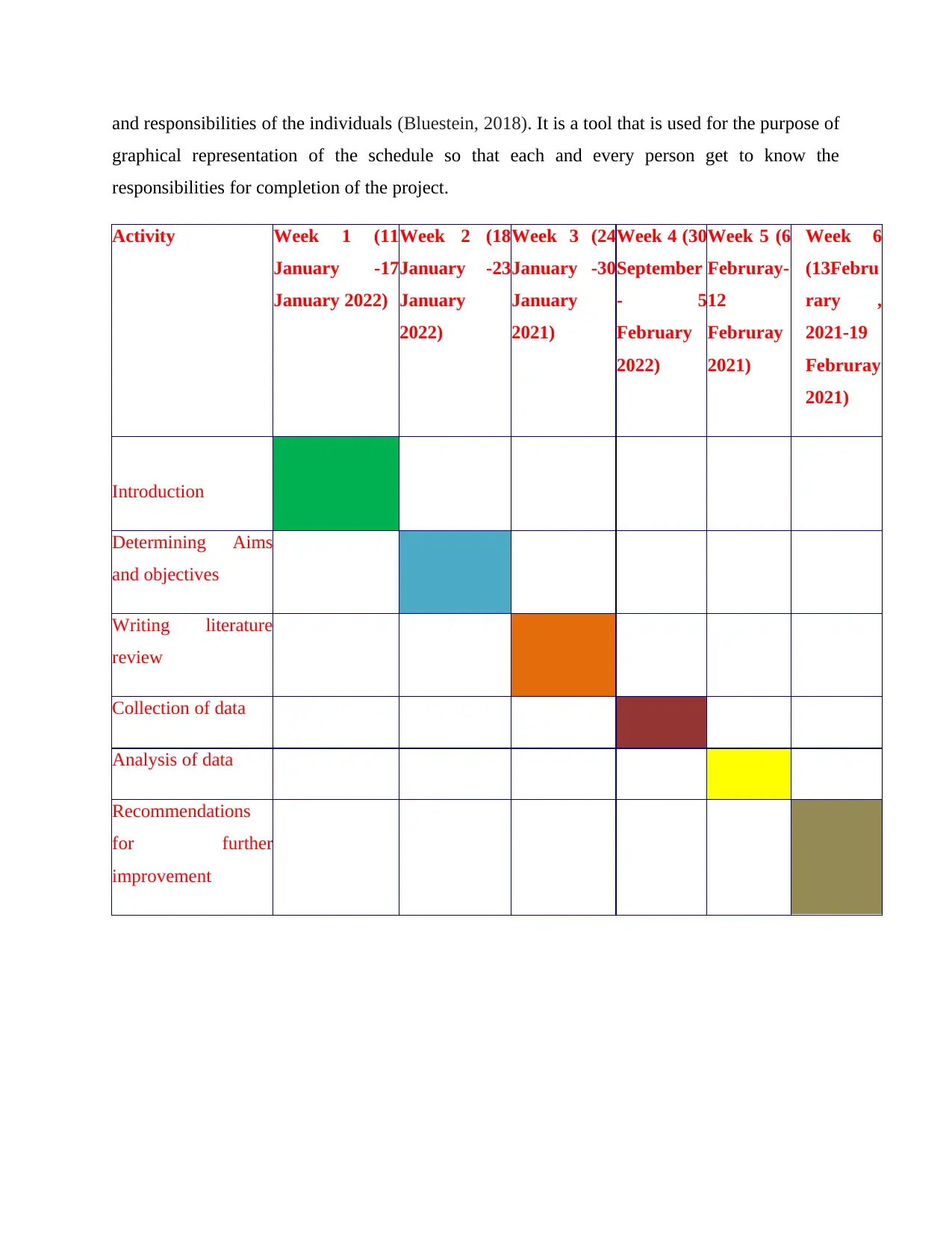
and responsibilities of the individuals (Bluestein, 2018). It is a tool that is used for the purpose of
graphical representation of the schedule so that each and every person get to know the
responsibilities for completion of the project.
Activity Week 1 (11
January -17
January 2022)
Week 2 (18
January -23
January
2022)
Week 3 (24
January -30
January
2021)
Week 4 (30
September
- 5
February
2022)
Week 5 (6
Februray-
12
Februray
2021)
Week 6
(13Febru
rary ,
2021-19
Februray
2021)
Introduction
Determining Aims
and objectives
Writing literature
review
Collection of data
Analysis of data
Recommendations
for further
improvement
graphical representation of the schedule so that each and every person get to know the
responsibilities for completion of the project.
Activity Week 1 (11
January -17
January 2022)
Week 2 (18
January -23
January
2022)
Week 3 (24
January -30
January
2021)
Week 4 (30
September
- 5
February
2022)
Week 5 (6
Februray-
12
Februray
2021)
Week 6
(13Febru
rary ,
2021-19
Februray
2021)
Introduction
Determining Aims
and objectives
Writing literature
review
Collection of data
Analysis of data
Recommendations
for further
improvement
⊘ This is a preview!⊘
Do you want full access?
Subscribe today to unlock all pages.
Trusted by 1+ million students worldwide

1 out of 14


Related Documents


Your All-in-One AI-Powered Toolkit for Academic Success.
+13062052269
info@desklib.com
Available 24*7 on WhatsApp / Email
![[object Object]](/_next/static/media/star-bottom.7253800d.svg)
Unlock your academic potential
Copyright © 2020–2026 A2Z Services. All Rights Reserved. Developed and managed by ZUCOL.