Strategic Analysis of ASOS Plc.: Mission, Strategy, and Analysis
VerifiedAdded on 2020/04/21
|10
|2419
|109
Report
AI Summary
This report provides a comprehensive strategic analysis of ASOS Plc., an online fashion retailer. It begins with an overview of ASOS's mission and vision, emphasizing its goals to become a leading e-commerce destination. The report then delves into industry analysis using Porter's Five Forces, evaluating the competitive landscape, including industry rivalry, buyer and supplier power, and threats of new entrants and substitutes. Furthermore, the report examines ASOS's resources and capabilities through the value chain framework, analyzing primary activities like inbound and outbound logistics, operations, marketing and sales, and service, as well as supporting activities such as human resource management, infrastructure, and technology. Finally, the report discusses ASOS's business and corporate strategies, highlighting the importance of IT strategy, customer relationship management, and effective market entry strategies to achieve sustainable competitive advantage in the global market. The report concludes by referencing relevant sources to support the analysis.
Running Head: STRATEGIC ANALYSIS 1
Strategic Management Analysis: ASOS
Plc.
Strategic Management Analysis: ASOS
Plc.

Paraphrase This Document
Need a fresh take? Get an instant paraphrase of this document with our AI Paraphraser
STRATEGIC ANALYSIS 2
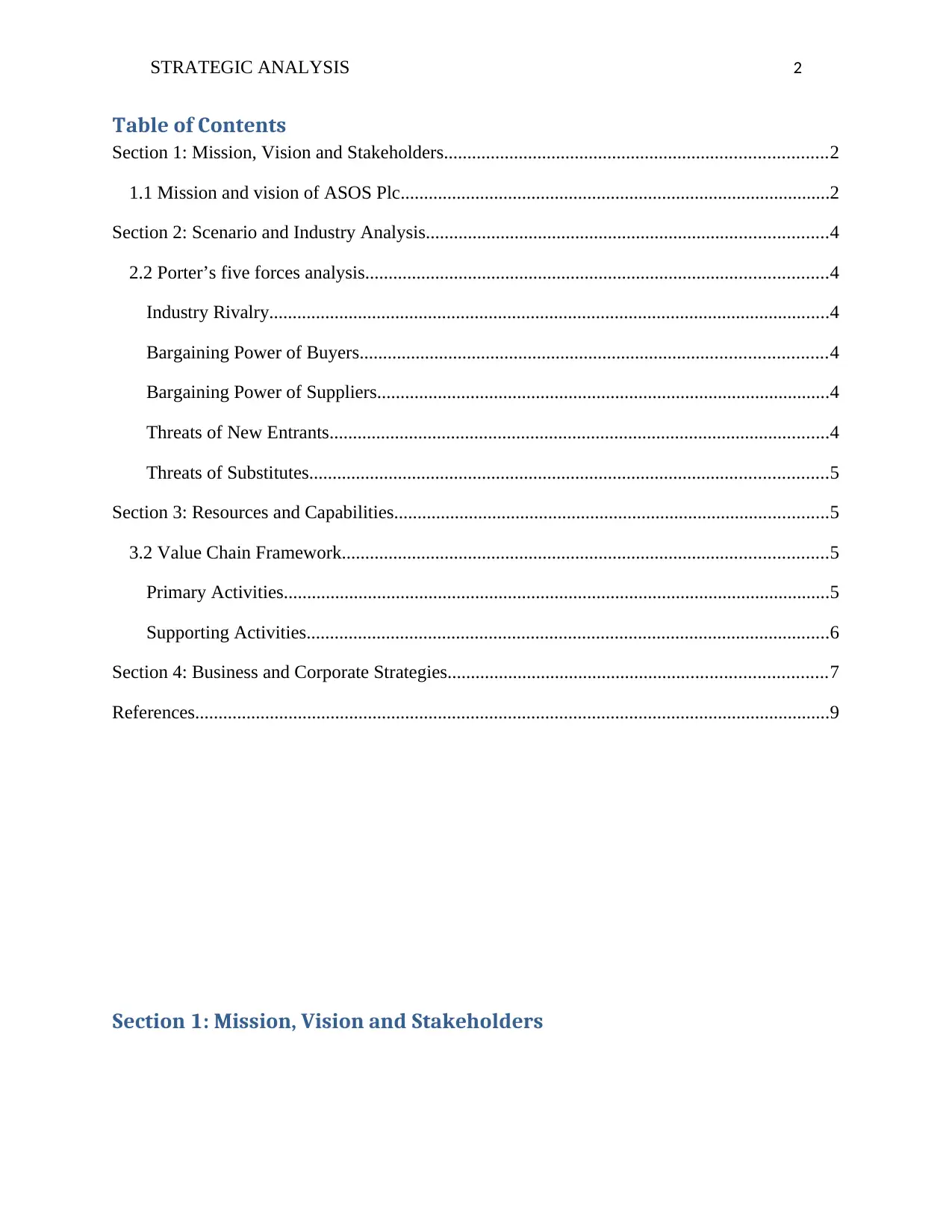
Table of Contents
Section 1: Mission, Vision and Stakeholders..................................................................................2
1.1 Mission and vision of ASOS Plc............................................................................................2
Section 2: Scenario and Industry Analysis......................................................................................4
2.2 Porter’s five forces analysis...................................................................................................4
Industry Rivalry........................................................................................................................4
Bargaining Power of Buyers....................................................................................................4
Bargaining Power of Suppliers.................................................................................................4
Threats of New Entrants...........................................................................................................4
Threats of Substitutes...............................................................................................................5
Section 3: Resources and Capabilities.............................................................................................5
3.2 Value Chain Framework........................................................................................................5
Primary Activities.....................................................................................................................5
Supporting Activities................................................................................................................6
Section 4: Business and Corporate Strategies.................................................................................7
References........................................................................................................................................9
Section 1: Mission, Vision and Stakeholders
Table of Contents
Section 1: Mission, Vision and Stakeholders..................................................................................2
1.1 Mission and vision of ASOS Plc............................................................................................2
Section 2: Scenario and Industry Analysis......................................................................................4
2.2 Porter’s five forces analysis...................................................................................................4
Industry Rivalry........................................................................................................................4
Bargaining Power of Buyers....................................................................................................4
Bargaining Power of Suppliers.................................................................................................4
Threats of New Entrants...........................................................................................................4
Threats of Substitutes...............................................................................................................5
Section 3: Resources and Capabilities.............................................................................................5
3.2 Value Chain Framework........................................................................................................5
Primary Activities.....................................................................................................................5
Supporting Activities................................................................................................................6
Section 4: Business and Corporate Strategies.................................................................................7
References........................................................................................................................................9
Section 1: Mission, Vision and Stakeholders
STRATEGIC ANALYSIS 3
1.1 Mission and vision of ASOS Plc
ASOS Plc is an online beauty and fashion store in United Kingdom and offers menswear, women
wear, accessories, and footwear, jewelry and beauty products. Founded in 2000, ASOS is
headquartered in Camden Town at Greater London House (Marques, 2015). The company sells
more than 80000 own-brand products online and via mobile experiences. It aims at young adults
and sells more than 850 brands and its own range of accessories and clothes. For the financial
year 2015, the revenue of ASOS was £1,119.9 million and net assets of £237.3 million. The
websites of ASOS is targeting different countries, like; USA, Australia, UK, Spain, Russia,
Germany, Italy, Franca and China. In addition to this, the company delivers its products to more
than 140 nations from distribution centers in the Europe, United States, China and United
Kingdom (Jon, 2017).
The mission statement of ASOS is to become the number one e-commerce shopping destination
in the world for the people, who love and passionate about the fashion. To attain this, the
company is a multi-platform and unique, which truly booms with the customers, who use the
products, because it is created by them (Bhardwaj, and Fairhurst, 2010). The company is
working to attain this mission by implementing effective marketing strategies.
Under its vision statement, ASOS aims to become synonymous to the fashion for the people
between the age group of 16 and 25 like; Facebook is for social media networking and Google is
for making search. Moreover, its targets to provide best shopping experience to its potential
customers in the expectations that they will get return each and every day (Cole, 2013).
The above-stated statements will definitely assist the organization in attaining sustainable
competitive advantage against it competitors. Under these statements, ASOS is aiming on
providing most engaging shopping experience and expanding its business globally. The
organization is available for twenty-something’s, wherever they are across the globe. In addition
to this, this entity is providing highly effective and efficient retailing. For this, it is executing a
faster supply chain for delivering the desired fashion at appropriate prices and on appropriate
time. By doing this, it is attracting a maximum customer base inside and outside its home
country. The customers will be satisfied with its great services, as they are getting their desired
fashion products at their home. Thus, incorporation of these factors in mission and vision will
assist ASOS in gaining sustainable competitive advantage (DesJardins, and McCall, 2014).
1.1 Mission and vision of ASOS Plc
ASOS Plc is an online beauty and fashion store in United Kingdom and offers menswear, women
wear, accessories, and footwear, jewelry and beauty products. Founded in 2000, ASOS is
headquartered in Camden Town at Greater London House (Marques, 2015). The company sells
more than 80000 own-brand products online and via mobile experiences. It aims at young adults
and sells more than 850 brands and its own range of accessories and clothes. For the financial
year 2015, the revenue of ASOS was £1,119.9 million and net assets of £237.3 million. The
websites of ASOS is targeting different countries, like; USA, Australia, UK, Spain, Russia,
Germany, Italy, Franca and China. In addition to this, the company delivers its products to more
than 140 nations from distribution centers in the Europe, United States, China and United
Kingdom (Jon, 2017).
The mission statement of ASOS is to become the number one e-commerce shopping destination
in the world for the people, who love and passionate about the fashion. To attain this, the
company is a multi-platform and unique, which truly booms with the customers, who use the
products, because it is created by them (Bhardwaj, and Fairhurst, 2010). The company is
working to attain this mission by implementing effective marketing strategies.
Under its vision statement, ASOS aims to become synonymous to the fashion for the people
between the age group of 16 and 25 like; Facebook is for social media networking and Google is
for making search. Moreover, its targets to provide best shopping experience to its potential
customers in the expectations that they will get return each and every day (Cole, 2013).
The above-stated statements will definitely assist the organization in attaining sustainable
competitive advantage against it competitors. Under these statements, ASOS is aiming on
providing most engaging shopping experience and expanding its business globally. The
organization is available for twenty-something’s, wherever they are across the globe. In addition
to this, this entity is providing highly effective and efficient retailing. For this, it is executing a
faster supply chain for delivering the desired fashion at appropriate prices and on appropriate
time. By doing this, it is attracting a maximum customer base inside and outside its home
country. The customers will be satisfied with its great services, as they are getting their desired
fashion products at their home. Thus, incorporation of these factors in mission and vision will
assist ASOS in gaining sustainable competitive advantage (DesJardins, and McCall, 2014).
⊘ This is a preview!⊘
Do you want full access?
Subscribe today to unlock all pages.

Trusted by 1+ million students worldwide
STRATEGIC ANALYSIS 4
Section 2: Scenario and Industry Analysis
2.2 Porter’s five forces analysis
Porter’s five forces analysis is a tool of marketing that is conducted to analyze the trends and
competition in the prospective industry. It includes five forces, which may impact the growth of
company in that particular market. Porter’s five forces analysis for ASOS is stated below;
Industry Rivalry
In the fashion industry, there are so many competitors, which are posing intense competition on
ASOS Plc. From these competitors, Amazon.com is the most popular online retail for fashion
and apparel and Marks & Spencer is on the top rank among multi-channel retailers in the world.
It indicates that ASOS is operating its business in very competitive fashion industry (Eden, &
Ackermann, 2013). This competition takes the toll on long term productivity of this company.
Apart from these above stated competitors, there are some other British fashion retailers, who
offered cloths online, such as; Boohoo, Next, Net-a-Porter, Missguided, Topshop and My-
wardrobe. These organizations are generation significant revenues and profits against ASOS Plc.
Bargaining Power of Buyers
In the fashion and clothing industry, the customers have increased demands. They generally
prefer to purchase best products by paying minimum prices. This fact is putting pressure on the
profitability of the players in the industry (Gordon, 2012). If the customer base of ASOS will be
smaller and stronger, there will be higher bargaining power of buyers and their ability for
seeking the offers and discounts will be comparatively higher.
Bargaining Power of Suppliers
All the firms in fashion industry can purchase there raw material from several suppliers. The
leading suppliers can decrease the margins of ASOS that it can generate in the retail market. In
the customer’s service sector, strong suppliers utilize their selling power to excerpt higher prices
from the companies in fashion and retail industry. In the fashion industry, the bargaining power
of suppliers is very high, thus it decreases the profitability of retail and clothing companies (Hill,
Jones and Schilling, 2014).
Threats of New Entrants
Threat of new entrants in fashion industry is also high as the new entrants bring some new and
innovative things, which put pressure on the existing companies including ASOS Plc. new
Section 2: Scenario and Industry Analysis
2.2 Porter’s five forces analysis
Porter’s five forces analysis is a tool of marketing that is conducted to analyze the trends and
competition in the prospective industry. It includes five forces, which may impact the growth of
company in that particular market. Porter’s five forces analysis for ASOS is stated below;
Industry Rivalry
In the fashion industry, there are so many competitors, which are posing intense competition on
ASOS Plc. From these competitors, Amazon.com is the most popular online retail for fashion
and apparel and Marks & Spencer is on the top rank among multi-channel retailers in the world.
It indicates that ASOS is operating its business in very competitive fashion industry (Eden, &
Ackermann, 2013). This competition takes the toll on long term productivity of this company.
Apart from these above stated competitors, there are some other British fashion retailers, who
offered cloths online, such as; Boohoo, Next, Net-a-Porter, Missguided, Topshop and My-
wardrobe. These organizations are generation significant revenues and profits against ASOS Plc.
Bargaining Power of Buyers
In the fashion and clothing industry, the customers have increased demands. They generally
prefer to purchase best products by paying minimum prices. This fact is putting pressure on the
profitability of the players in the industry (Gordon, 2012). If the customer base of ASOS will be
smaller and stronger, there will be higher bargaining power of buyers and their ability for
seeking the offers and discounts will be comparatively higher.
Bargaining Power of Suppliers
All the firms in fashion industry can purchase there raw material from several suppliers. The
leading suppliers can decrease the margins of ASOS that it can generate in the retail market. In
the customer’s service sector, strong suppliers utilize their selling power to excerpt higher prices
from the companies in fashion and retail industry. In the fashion industry, the bargaining power
of suppliers is very high, thus it decreases the profitability of retail and clothing companies (Hill,
Jones and Schilling, 2014).
Threats of New Entrants
Threat of new entrants in fashion industry is also high as the new entrants bring some new and
innovative things, which put pressure on the existing companies including ASOS Plc. new
Paraphrase This Document
Need a fresh take? Get an instant paraphrase of this document with our AI Paraphraser
STRATEGIC ANALYSIS 5
companies are engaged in implementing cost effective strategy, reducing costs and offering
innovative value proposition to people (Hollensen, 2015).
Threats of Substitutes
Clothing is one of the basic requirements of human life. It is the necessity, for which it is very
hard to get any substitute to replace this. So, the threat of substitute in the industry is
comparatively low. Substitution in the fashion and apparel industry is just competition.
From the above industry analysis, it can be concluded that attractiveness of this industry is
moderate. It can be seen that the company has some threats and some advantages as there is no
substitute to the fashion and clothing. It is not much attractive as the buyers have higher indirect
bargaining power with lots of leading competitors that make it hard to make a place in the
fashion industry (Kunz, Karpova, & Garner, 2016).
Section 3: Resources and Capabilities
3.2 Value Chain Framework
Primary Activities
Inbound Logistics
These are the activities, which are related to storing and distributing the raw materials that go
under the process of manufacturing. ASOS has an effective supply chain process and established
fulfillment and distribution center in different countries. Generally, it fulfills the orders from its
automated picking warehouse. Now, it is planning to expand its warehousing operations.
Operations
ASOS is working for enhancing its operations and customer experience. It is planning to expand
its warehouse operations in United States. The customers are able to opt for the home delivery or
utilize the Pick-Up-Drop-Off network of its various store locations for collection of products. In
addition, it is making huge investment in customer service. The delivery services of the company
are very effective (Neville, 2013).
Outbound Logistics
companies are engaged in implementing cost effective strategy, reducing costs and offering
innovative value proposition to people (Hollensen, 2015).
Threats of Substitutes
Clothing is one of the basic requirements of human life. It is the necessity, for which it is very
hard to get any substitute to replace this. So, the threat of substitute in the industry is
comparatively low. Substitution in the fashion and apparel industry is just competition.
From the above industry analysis, it can be concluded that attractiveness of this industry is
moderate. It can be seen that the company has some threats and some advantages as there is no
substitute to the fashion and clothing. It is not much attractive as the buyers have higher indirect
bargaining power with lots of leading competitors that make it hard to make a place in the
fashion industry (Kunz, Karpova, & Garner, 2016).
Section 3: Resources and Capabilities
3.2 Value Chain Framework
Primary Activities
Inbound Logistics
These are the activities, which are related to storing and distributing the raw materials that go
under the process of manufacturing. ASOS has an effective supply chain process and established
fulfillment and distribution center in different countries. Generally, it fulfills the orders from its
automated picking warehouse. Now, it is planning to expand its warehousing operations.
Operations
ASOS is working for enhancing its operations and customer experience. It is planning to expand
its warehouse operations in United States. The customers are able to opt for the home delivery or
utilize the Pick-Up-Drop-Off network of its various store locations for collection of products. In
addition, it is making huge investment in customer service. The delivery services of the company
are very effective (Neville, 2013).
Outbound Logistics
STRATEGIC ANALYSIS 6
ASOS offers a great shopping experience through online media. The company is continuously
inventing in warehousing and distribution centers. The delivery system is different in different
countries, like; the company offer next day delivery at a premium in France, Germany, Italy,
Spain and Belgium. It is offering the return facility, if the customers are not satisfied with the
products. ASOS is emphasizing on merging the warehouse to create distribution and supply
chain more effective and efficient.
Marketing and Sales
Marketing and sales assist in creating customer awareness and satisfying the customers for
buying the products and services (Su, & Tong, 2015). The company is interacting with the
customers via social media, e-mail, Facebook, Twitter, ASOS website, Instagram, Youtube and
Fashion Up mobile app. This online experience has enhanced the customer engagement and
increased its customer base.
Service
Services are the major activities, which are offered by the company and enhanced value of
products and services. The company understood that it is very important to maintain the loyalty
among customers. For this, it is important to provide quality services to customers, so company
is enhancing its online retailing services.
Supporting Activities
Human Resource Management
Human resource management at organization is very effective at ASOS. All the related
departments are managed by allocating separate roles and responsibilities. It provides training to
the people, who manage the apps and website and the people, who deliver the products to final
customer.
Infrastructure
In addition, the company is making focus on expanding the infrastructure to support its profits
and revenues. At the center of infrastructure is the Information Technology. Under infrastructure
development, it focuses on HR, transportation, supply chain and some other divisions (Turker,
and Altuntas, 2014).
ASOS offers a great shopping experience through online media. The company is continuously
inventing in warehousing and distribution centers. The delivery system is different in different
countries, like; the company offer next day delivery at a premium in France, Germany, Italy,
Spain and Belgium. It is offering the return facility, if the customers are not satisfied with the
products. ASOS is emphasizing on merging the warehouse to create distribution and supply
chain more effective and efficient.
Marketing and Sales
Marketing and sales assist in creating customer awareness and satisfying the customers for
buying the products and services (Su, & Tong, 2015). The company is interacting with the
customers via social media, e-mail, Facebook, Twitter, ASOS website, Instagram, Youtube and
Fashion Up mobile app. This online experience has enhanced the customer engagement and
increased its customer base.
Service
Services are the major activities, which are offered by the company and enhanced value of
products and services. The company understood that it is very important to maintain the loyalty
among customers. For this, it is important to provide quality services to customers, so company
is enhancing its online retailing services.
Supporting Activities
Human Resource Management
Human resource management at organization is very effective at ASOS. All the related
departments are managed by allocating separate roles and responsibilities. It provides training to
the people, who manage the apps and website and the people, who deliver the products to final
customer.
Infrastructure
In addition, the company is making focus on expanding the infrastructure to support its profits
and revenues. At the center of infrastructure is the Information Technology. Under infrastructure
development, it focuses on HR, transportation, supply chain and some other divisions (Turker,
and Altuntas, 2014).
⊘ This is a preview!⊘
Do you want full access?
Subscribe today to unlock all pages.
Trusted by 1+ million students worldwide
STRATEGIC ANALYSIS 7
Technology
ASOS emphasizes on the development of information technology. The company is using
advanced technology for delivering the products to customers. The supply chain of the company
is linked through information flow. It has developed digital presence all over the world. These
activities are creating value to the customers.
The company is creating the value by implementing these resources and capabilities effectively.
Primarily, it is focusing on developing and upgrading the technology for providing great
customer experience (Su, & Tong, 2015). In the future, the company can implement some
effective strategies for improving them. It should enhance its operation plan and execute
marketing strategies.
Section 4: Business and Corporate Strategies
In the global competitive environment, ASOS Plc. should implement some specific strategies to
attain sustainable competitive advantage. The senior management in the organization should
implement effective IT strategy, which will enable them in managing the information systems in
a better way. It will reduce the costs and enhance the effectiveness and efficiency of the business
operations (Zott, Amit and Massa, 2011). It will aid the back office operations, like; purchasing,
placing an order, merchandizing and execution of the processes. In addition, the company should
use low cost model for entering to the global market. For gaining sustainable competitive
advantage, ASOS should understand the needs and preferences of the customers.
They should understand the current trends in the market and updated fashion trends. Moreover, it
should emphasize on the Customer Relationship Management via social networking sites, like;
Facebook, Twitter etc. It will make the organization able in getting customer feedback about
their products and services (Kotlar, & Armstrong, 2012). Although, the company has 24 hours
customer support that will offer ASOS the increased competitive advantage. In the global
competitive market, ASOS should use effective market entry strategies, which will assist it in
establishing its business operations in the new market. These strategies will help ASOS Plc. in
getting over the global economic crisis and enhance its operations in other countries.
Technology
ASOS emphasizes on the development of information technology. The company is using
advanced technology for delivering the products to customers. The supply chain of the company
is linked through information flow. It has developed digital presence all over the world. These
activities are creating value to the customers.
The company is creating the value by implementing these resources and capabilities effectively.
Primarily, it is focusing on developing and upgrading the technology for providing great
customer experience (Su, & Tong, 2015). In the future, the company can implement some
effective strategies for improving them. It should enhance its operation plan and execute
marketing strategies.
Section 4: Business and Corporate Strategies
In the global competitive environment, ASOS Plc. should implement some specific strategies to
attain sustainable competitive advantage. The senior management in the organization should
implement effective IT strategy, which will enable them in managing the information systems in
a better way. It will reduce the costs and enhance the effectiveness and efficiency of the business
operations (Zott, Amit and Massa, 2011). It will aid the back office operations, like; purchasing,
placing an order, merchandizing and execution of the processes. In addition, the company should
use low cost model for entering to the global market. For gaining sustainable competitive
advantage, ASOS should understand the needs and preferences of the customers.
They should understand the current trends in the market and updated fashion trends. Moreover, it
should emphasize on the Customer Relationship Management via social networking sites, like;
Facebook, Twitter etc. It will make the organization able in getting customer feedback about
their products and services (Kotlar, & Armstrong, 2012). Although, the company has 24 hours
customer support that will offer ASOS the increased competitive advantage. In the global
competitive market, ASOS should use effective market entry strategies, which will assist it in
establishing its business operations in the new market. These strategies will help ASOS Plc. in
getting over the global economic crisis and enhance its operations in other countries.
Paraphrase This Document
Need a fresh take? Get an instant paraphrase of this document with our AI Paraphraser

STRATEGIC ANALYSIS 8
STRATEGIC ANALYSIS 9
References
Bhardwaj, V. and Fairhurst, A., 2010. Fast fashion: response to changes in the fashion
industry. The International Review of Retail, Distribution and Consumer Research, 20(1), pp.165-
173.
Cole, G.A., 2013, Strategic Management, Cengage Learning.
DesJardins, J.R. and McCall, J.J., 2014. Contemporary issues in business ethics. Cengage
Learning.
Eden, C., & Ackermann, F., 2013, Making strategy: The journey of strategic management. Sage.
Gordon, R., 2012, Re-thinking and re-tooling the social marketing mix. Australasian Marketing
Journal (AMJ), 20(2), 122-126.
Hill, C.W., Jones, G.R. and Schilling, M.A., 2014. Strategic management: theory: an integrated
approach. Cengage Learning.
Hollensen, S., 2015, Marketing management: A relationship approach. Pearson Education.
Jon, C., 2017, "Growing Business Success Stories – ASOS". Retrieved from
Growingbusiness.co.uk.
Kotlar, P. & Armstrong, G., 2012, Principles of Marketing (14 edition). Pearson Education, Inc.
Kunz, G. I., Karpova, E., & Garner, M. B., 2016, Going global: The textile and apparel industry.
Fairchild Books.
Marques, M.B., 2015. Equity valuation Asos PLC (Doctoral dissertation).
Neville, S., 2013,. Asos pulls belts in radioactive scare". The Guardian.
Su, J., & Tong, X., 2015, Brand personality and brand equity: evidence from the sportswear
industry. Journal of Product & Brand Management, 24(2), 124-133.
References
Bhardwaj, V. and Fairhurst, A., 2010. Fast fashion: response to changes in the fashion
industry. The International Review of Retail, Distribution and Consumer Research, 20(1), pp.165-
173.
Cole, G.A., 2013, Strategic Management, Cengage Learning.
DesJardins, J.R. and McCall, J.J., 2014. Contemporary issues in business ethics. Cengage
Learning.
Eden, C., & Ackermann, F., 2013, Making strategy: The journey of strategic management. Sage.
Gordon, R., 2012, Re-thinking and re-tooling the social marketing mix. Australasian Marketing
Journal (AMJ), 20(2), 122-126.
Hill, C.W., Jones, G.R. and Schilling, M.A., 2014. Strategic management: theory: an integrated
approach. Cengage Learning.
Hollensen, S., 2015, Marketing management: A relationship approach. Pearson Education.
Jon, C., 2017, "Growing Business Success Stories – ASOS". Retrieved from
Growingbusiness.co.uk.
Kotlar, P. & Armstrong, G., 2012, Principles of Marketing (14 edition). Pearson Education, Inc.
Kunz, G. I., Karpova, E., & Garner, M. B., 2016, Going global: The textile and apparel industry.
Fairchild Books.
Marques, M.B., 2015. Equity valuation Asos PLC (Doctoral dissertation).
Neville, S., 2013,. Asos pulls belts in radioactive scare". The Guardian.
Su, J., & Tong, X., 2015, Brand personality and brand equity: evidence from the sportswear
industry. Journal of Product & Brand Management, 24(2), 124-133.
⊘ This is a preview!⊘
Do you want full access?
Subscribe today to unlock all pages.
Trusted by 1+ million students worldwide
STRATEGIC ANALYSIS 10
Turker, D. and Altuntas, C., 2014. Sustainable supply chain management in the fast fashion
industry: An analysis of corporate reports. European Management Journal, 32(5), pp.837-849.
Zott, C., Amit, R. and Massa, L., 2011. The business model: recent developments and future
research. Journal of management, 37(4), pp.1019-1042.
Turker, D. and Altuntas, C., 2014. Sustainable supply chain management in the fast fashion
industry: An analysis of corporate reports. European Management Journal, 32(5), pp.837-849.
Zott, C., Amit, R. and Massa, L., 2011. The business model: recent developments and future
research. Journal of management, 37(4), pp.1019-1042.

1 out of 10


Related Documents


Your All-in-One AI-Powered Toolkit for Academic Success.
+13062052269
info@desklib.com
Available 24*7 on WhatsApp / Email
![[object Object]](/_next/static/media/star-bottom.7253800d.svg)
Unlock your academic potential
Copyright © 2020–2026 A2Z Services. All Rights Reserved. Developed and managed by ZUCOL.