Child Obesity: Assessing and Addressing Health Needs in Children
VerifiedAdded on 2020/01/28
|18
|6075
|118
Report
AI Summary
This report provides a comprehensive assessment of child obesity, focusing on identifying and addressing the health needs of children. It begins by establishing the background of child obesity in the UK, citing statistics and relevant research. The report then delves into identifying health needs through a review of existing studies, including methodologies and findings related to parental perceptions and effective interventions. Following this, the report applies health need theories such as Maslow's Hierarchy of Needs, Seedhouse's needs theory, and Doyal and Gough's needs theory to analyze the specific requirements of obese children. The report continues by prioritizing health needs using Bradshaw's theory, outlining normative and felt needs. Finally, it proposes a strategy to address these needs, including health promotion activities, resource allocation, evaluation methods, and a detailed action plan to combat child obesity.
Assessing and
Addressing Child
Obesity in
Children's
Addressing Child
Obesity in
Children's

Paraphrase This Document
Need a fresh take? Get an instant paraphrase of this document with our AI Paraphraser
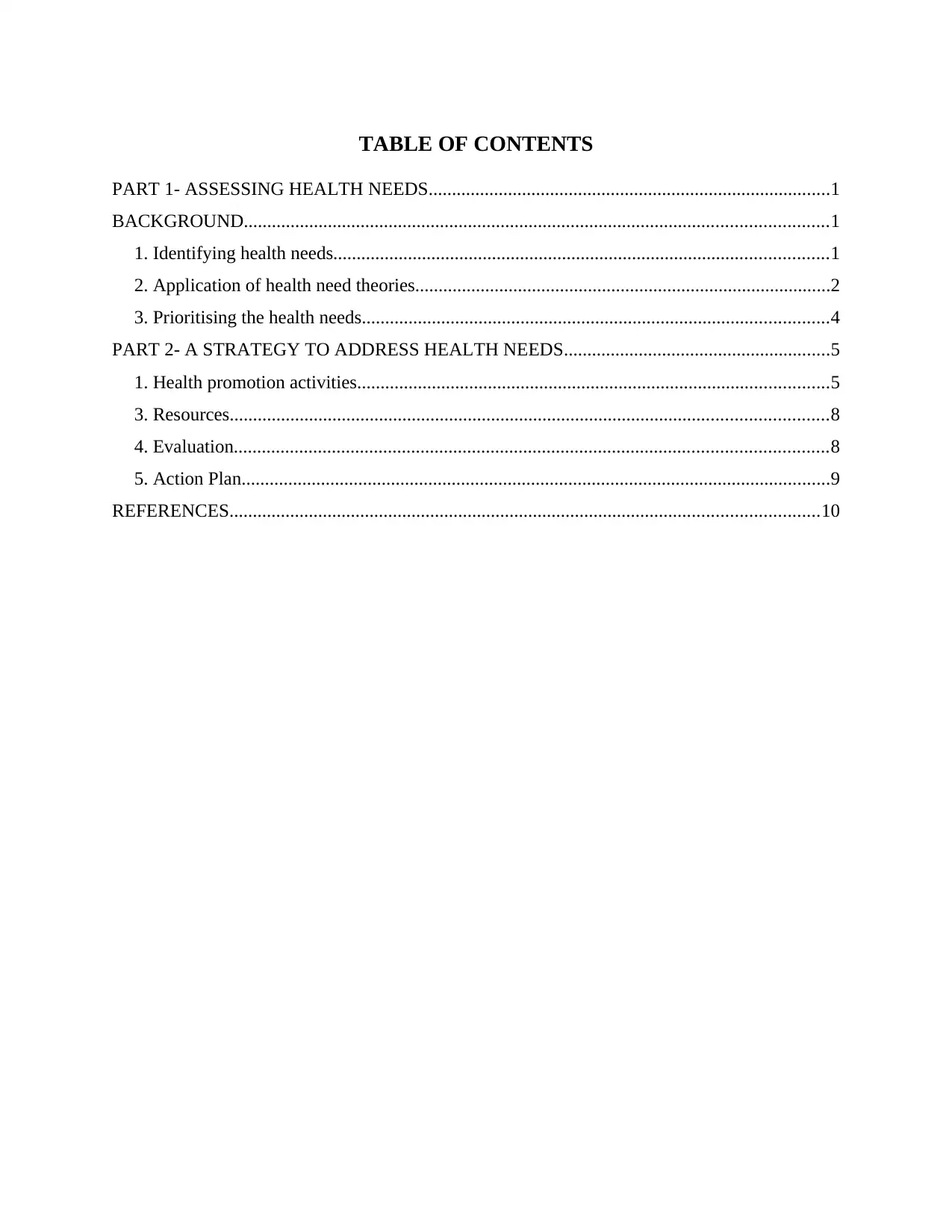
TABLE OF CONTENTS
PART 1- ASSESSING HEALTH NEEDS......................................................................................1
BACKGROUND.............................................................................................................................1
1. Identifying health needs..........................................................................................................1
2. Application of health need theories.........................................................................................2
3. Prioritising the health needs....................................................................................................4
PART 2- A STRATEGY TO ADDRESS HEALTH NEEDS.........................................................5
1. Health promotion activities.....................................................................................................5
3. Resources................................................................................................................................8
4. Evaluation...............................................................................................................................8
5. Action Plan..............................................................................................................................9
REFERENCES..............................................................................................................................10
PART 1- ASSESSING HEALTH NEEDS......................................................................................1
BACKGROUND.............................................................................................................................1
1. Identifying health needs..........................................................................................................1
2. Application of health need theories.........................................................................................2
3. Prioritising the health needs....................................................................................................4
PART 2- A STRATEGY TO ADDRESS HEALTH NEEDS.........................................................5
1. Health promotion activities.....................................................................................................5
3. Resources................................................................................................................................8
4. Evaluation...............................................................................................................................8
5. Action Plan..............................................................................................................................9
REFERENCES..............................................................................................................................10
PART 1- ASSESSING HEALTH NEEDS
BACKGROUND
Health issues have been the major concern of each and every country in order to reduce
the amount of incidents that have been spreading day by day. It has been analysed that child
obesity in children's has been witnessed in high amount in UK. The WHO depicts that child
obesity is the global concern that is causing severe health challenges for the current era. It can be
defined as a phenomenon wherein the children or adolescents have gained extra weight and are
generally fat. This problem is likely to be taken further until they are adults. The recent statistics
from NCMP has showed that 19.8% of the children between the age group of 10 to 11 are obese
and the rest 14.3% are overweighted (Cunningham, Kramer and Narayan, 2014). This data has
been acquired by the National Child Measurement Programme wherein the authoritative visit
millions of school in England each year to measure the height and weight of students.
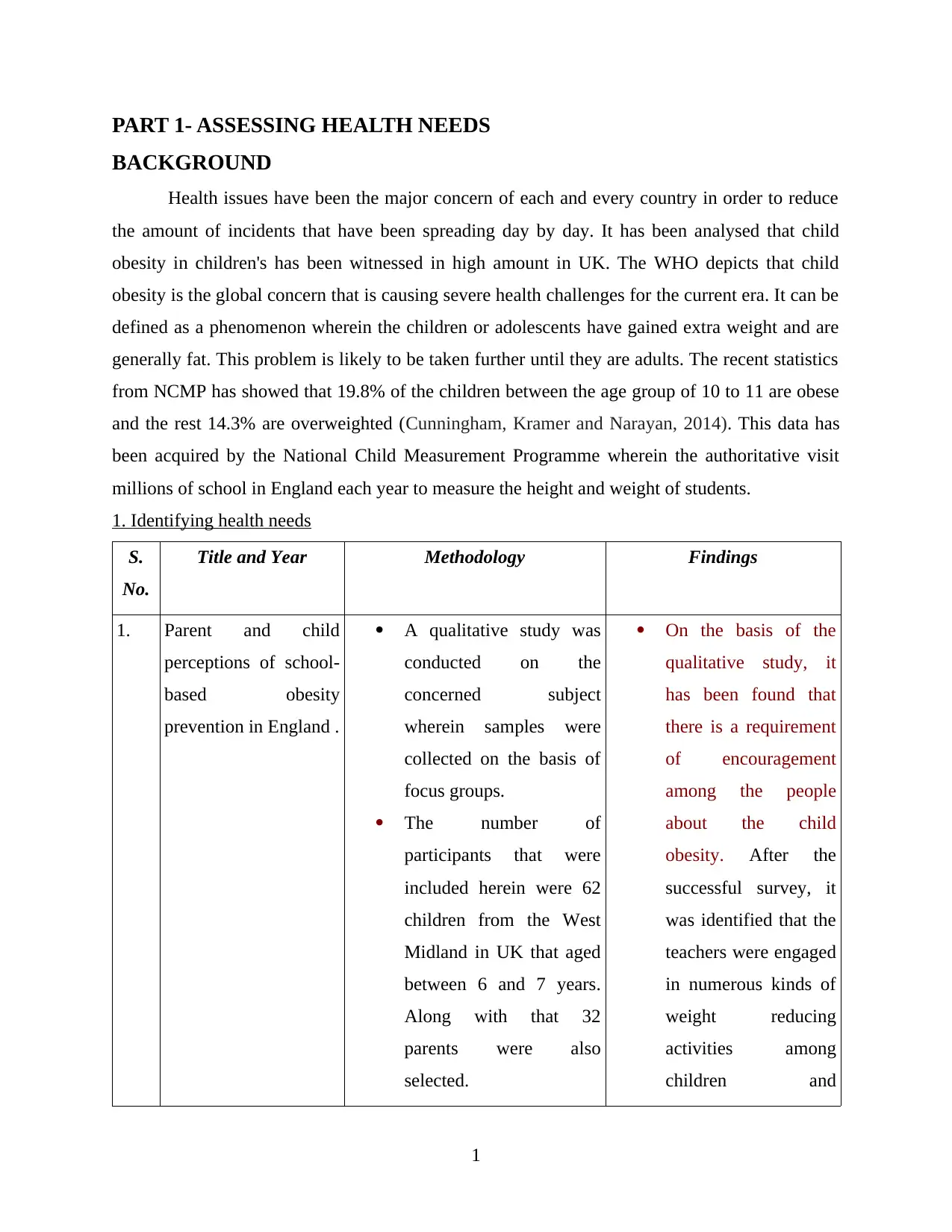
1. Identifying health needs
S.
No.
Title and Year Methodology Findings
1. Parent and child
perceptions of school-
based obesity
prevention in England .
A qualitative study was
conducted on the
concerned subject
wherein samples were
collected on the basis of
focus groups.
The number of
participants that were
included herein were 62
children from the West
Midland in UK that aged
between 6 and 7 years.
Along with that 32
parents were also
selected.
On the basis of the
qualitative study, it
has been found that
there is a requirement
of encouragement
among the people
about the child
obesity. After the
successful survey, it
was identified that the
teachers were engaged
in numerous kinds of
weight reducing
activities among
children and
1
BACKGROUND
Health issues have been the major concern of each and every country in order to reduce
the amount of incidents that have been spreading day by day. It has been analysed that child
obesity in children's has been witnessed in high amount in UK. The WHO depicts that child
obesity is the global concern that is causing severe health challenges for the current era. It can be
defined as a phenomenon wherein the children or adolescents have gained extra weight and are
generally fat. This problem is likely to be taken further until they are adults. The recent statistics
from NCMP has showed that 19.8% of the children between the age group of 10 to 11 are obese
and the rest 14.3% are overweighted (Cunningham, Kramer and Narayan, 2014). This data has
been acquired by the National Child Measurement Programme wherein the authoritative visit
millions of school in England each year to measure the height and weight of students.
1. Identifying health needs
S.
No.
Title and Year Methodology Findings
1. Parent and child
perceptions of school-
based obesity
prevention in England .
A qualitative study was
conducted on the
concerned subject
wherein samples were
collected on the basis of
focus groups.
The number of
participants that were
included herein were 62
children from the West
Midland in UK that aged
between 6 and 7 years.
Along with that 32
parents were also
selected.
On the basis of the
qualitative study, it
has been found that
there is a requirement
of encouragement
among the people
about the child
obesity. After the
successful survey, it
was identified that the
teachers were engaged
in numerous kinds of
weight reducing
activities among
children and
1
⊘ This is a preview!⊘
Do you want full access?
Subscribe today to unlock all pages.

Trusted by 1+ million students worldwide
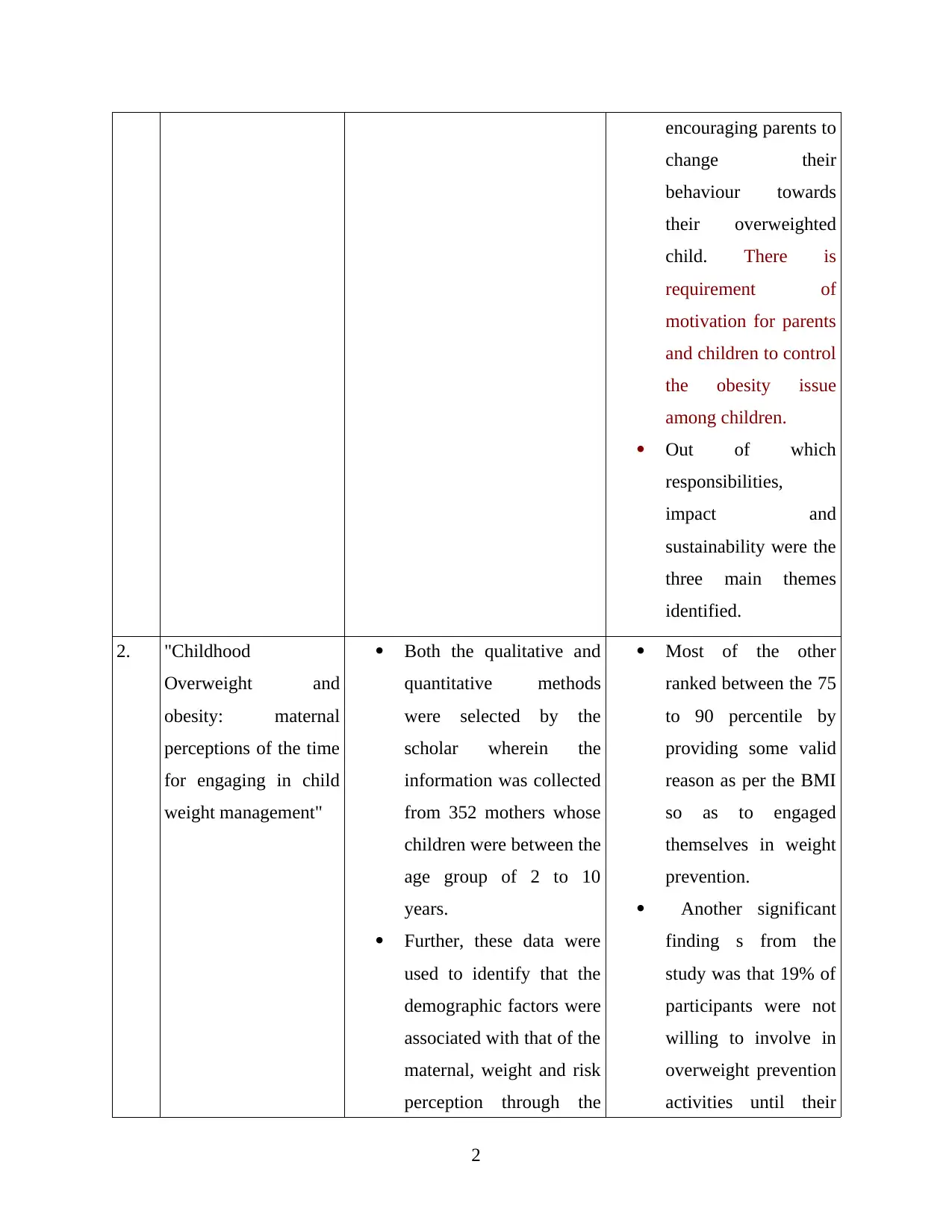
encouraging parents to
change their
behaviour towards
their overweighted
child. There is
requirement of
motivation for parents
and children to control
the obesity issue
among children.
Out of which
responsibilities,
impact and
sustainability were the
three main themes
identified.
2. "Childhood
Overweight and
obesity: maternal
perceptions of the time
for engaging in child
weight management"
Both the qualitative and
quantitative methods
were selected by the
scholar wherein the
information was collected
from 352 mothers whose
children were between the
age group of 2 to 10
years.
Further, these data were
used to identify that the
demographic factors were
associated with that of the
maternal, weight and risk
perception through the
Most of the other
ranked between the 75
to 90 percentile by
providing some valid
reason as per the BMI
so as to engaged
themselves in weight
prevention.
Another significant
finding s from the
study was that 19% of
participants were not
willing to involve in
overweight prevention
activities until their
2
change their
behaviour towards
their overweighted
child. There is
requirement of
motivation for parents
and children to control
the obesity issue
among children.
Out of which
responsibilities,
impact and
sustainability were the
three main themes
identified.
2. "Childhood
Overweight and
obesity: maternal
perceptions of the time
for engaging in child
weight management"
Both the qualitative and
quantitative methods
were selected by the
scholar wherein the
information was collected
from 352 mothers whose
children were between the
age group of 2 to 10
years.
Further, these data were
used to identify that the
demographic factors were
associated with that of the
maternal, weight and risk
perception through the
Most of the other
ranked between the 75
to 90 percentile by
providing some valid
reason as per the BMI
so as to engaged
themselves in weight
prevention.
Another significant
finding s from the
study was that 19% of
participants were not
willing to involve in
overweight prevention
activities until their
2
Paraphrase This Document
Need a fresh take? Get an instant paraphrase of this document with our AI Paraphraser
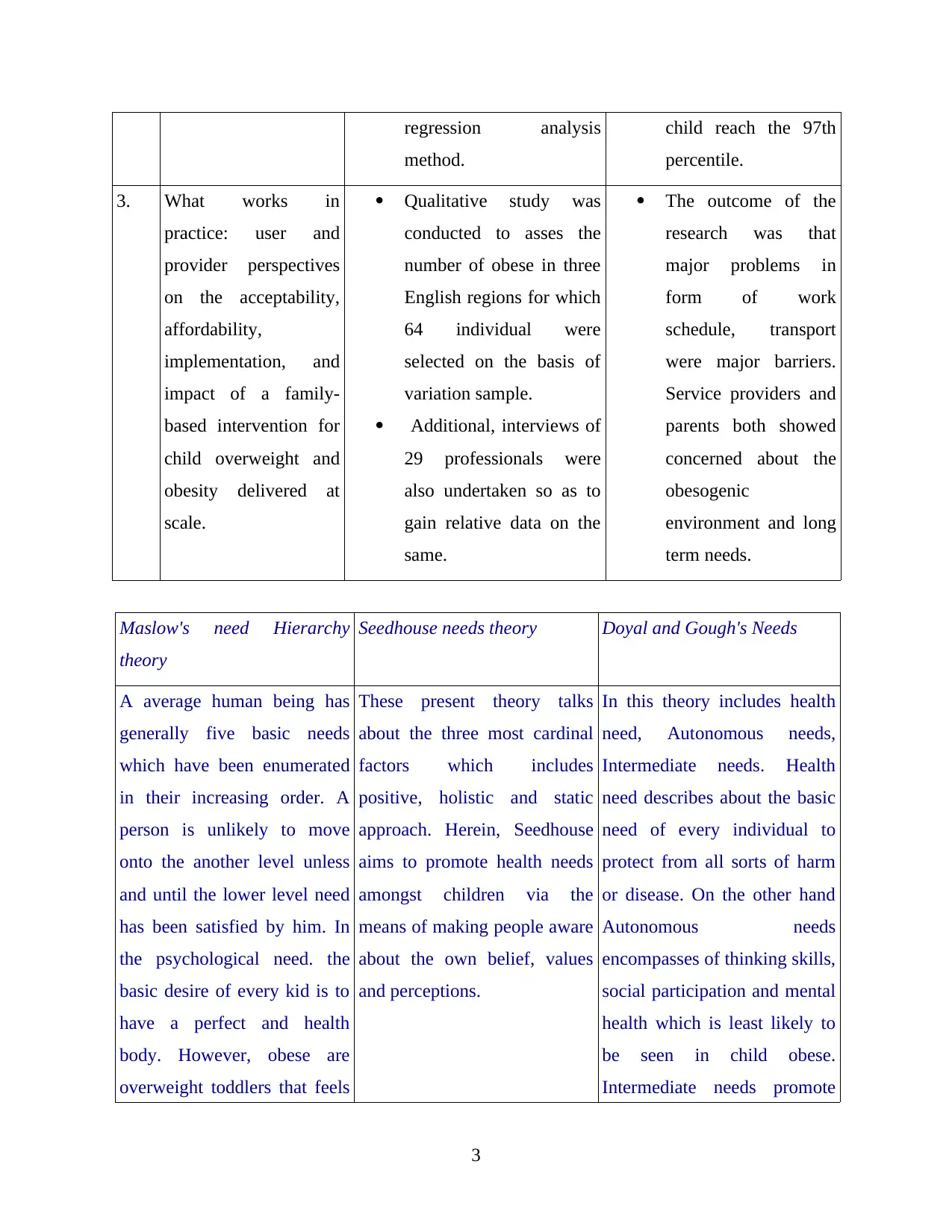
regression analysis
method.
child reach the 97th
percentile.
3. What works in
practice: user and
provider perspectives
on the acceptability,
affordability,
implementation, and
impact of a family-
based intervention for
child overweight and
obesity delivered at
scale.
Qualitative study was
conducted to asses the
number of obese in three
English regions for which
64 individual were
selected on the basis of
variation sample.
Additional, interviews of
29 professionals were
also undertaken so as to
gain relative data on the
same.
The outcome of the
research was that
major problems in
form of work
schedule, transport
were major barriers.
Service providers and
parents both showed
concerned about the
obesogenic
environment and long
term needs.
Maslow's need Hierarchy
theory
Seedhouse needs theory Doyal and Gough's Needs
A average human being has
generally five basic needs
which have been enumerated
in their increasing order. A
person is unlikely to move
onto the another level unless
and until the lower level need
has been satisfied by him. In
the psychological need. the
basic desire of every kid is to
have a perfect and health
body. However, obese are
overweight toddlers that feels
These present theory talks
about the three most cardinal
factors which includes
positive, holistic and static
approach. Herein, Seedhouse
aims to promote health needs
amongst children via the
means of making people aware
about the own belief, values
and perceptions.
In this theory includes health
need, Autonomous needs,
Intermediate needs. Health
need describes about the basic
need of every individual to
protect from all sorts of harm
or disease. On the other hand
Autonomous needs
encompasses of thinking skills,
social participation and mental
health which is least likely to
be seen in child obese.
Intermediate needs promote
3
method.
child reach the 97th
percentile.
3. What works in
practice: user and
provider perspectives
on the acceptability,
affordability,
implementation, and
impact of a family-
based intervention for
child overweight and
obesity delivered at
scale.
Qualitative study was
conducted to asses the
number of obese in three
English regions for which
64 individual were
selected on the basis of
variation sample.
Additional, interviews of
29 professionals were
also undertaken so as to
gain relative data on the
same.
The outcome of the
research was that
major problems in
form of work
schedule, transport
were major barriers.
Service providers and
parents both showed
concerned about the
obesogenic
environment and long
term needs.
Maslow's need Hierarchy
theory
Seedhouse needs theory Doyal and Gough's Needs
A average human being has
generally five basic needs
which have been enumerated
in their increasing order. A
person is unlikely to move
onto the another level unless
and until the lower level need
has been satisfied by him. In
the psychological need. the
basic desire of every kid is to
have a perfect and health
body. However, obese are
overweight toddlers that feels
These present theory talks
about the three most cardinal
factors which includes
positive, holistic and static
approach. Herein, Seedhouse
aims to promote health needs
amongst children via the
means of making people aware
about the own belief, values
and perceptions.
In this theory includes health
need, Autonomous needs,
Intermediate needs. Health
need describes about the basic
need of every individual to
protect from all sorts of harm
or disease. On the other hand
Autonomous needs
encompasses of thinking skills,
social participation and mental
health which is least likely to
be seen in child obese.
Intermediate needs promote
3
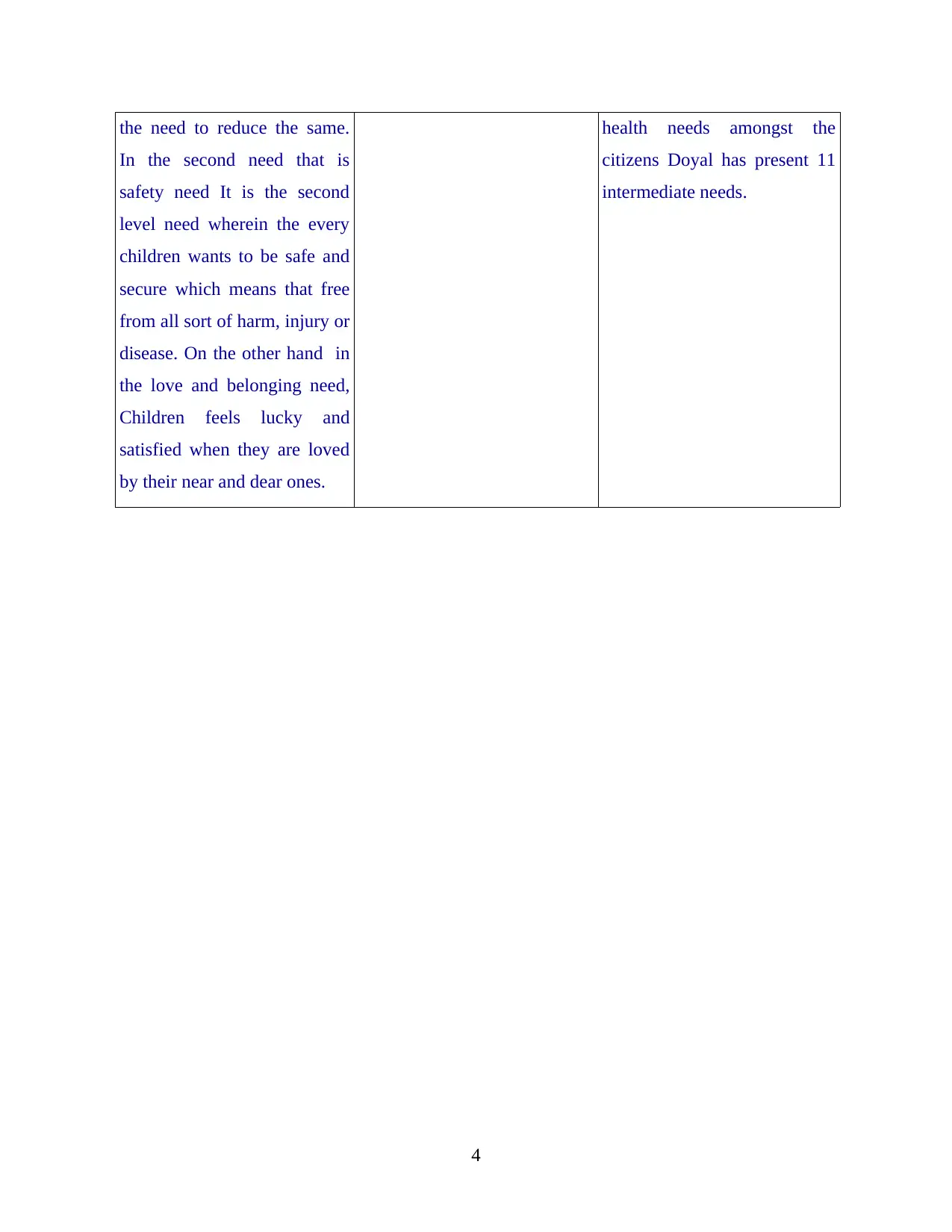
the need to reduce the same.
In the second need that is
safety need It is the second
level need wherein the every
children wants to be safe and
secure which means that free
from all sort of harm, injury or
disease. On the other hand in
the love and belonging need,
Children feels lucky and
satisfied when they are loved
by their near and dear ones.
health needs amongst the
citizens Doyal has present 11
intermediate needs.
4
In the second need that is
safety need It is the second
level need wherein the every
children wants to be safe and
secure which means that free
from all sort of harm, injury or
disease. On the other hand in
the love and belonging need,
Children feels lucky and
satisfied when they are loved
by their near and dear ones.
health needs amongst the
citizens Doyal has present 11
intermediate needs.
4
⊘ This is a preview!⊘
Do you want full access?
Subscribe today to unlock all pages.
Trusted by 1+ million students worldwide
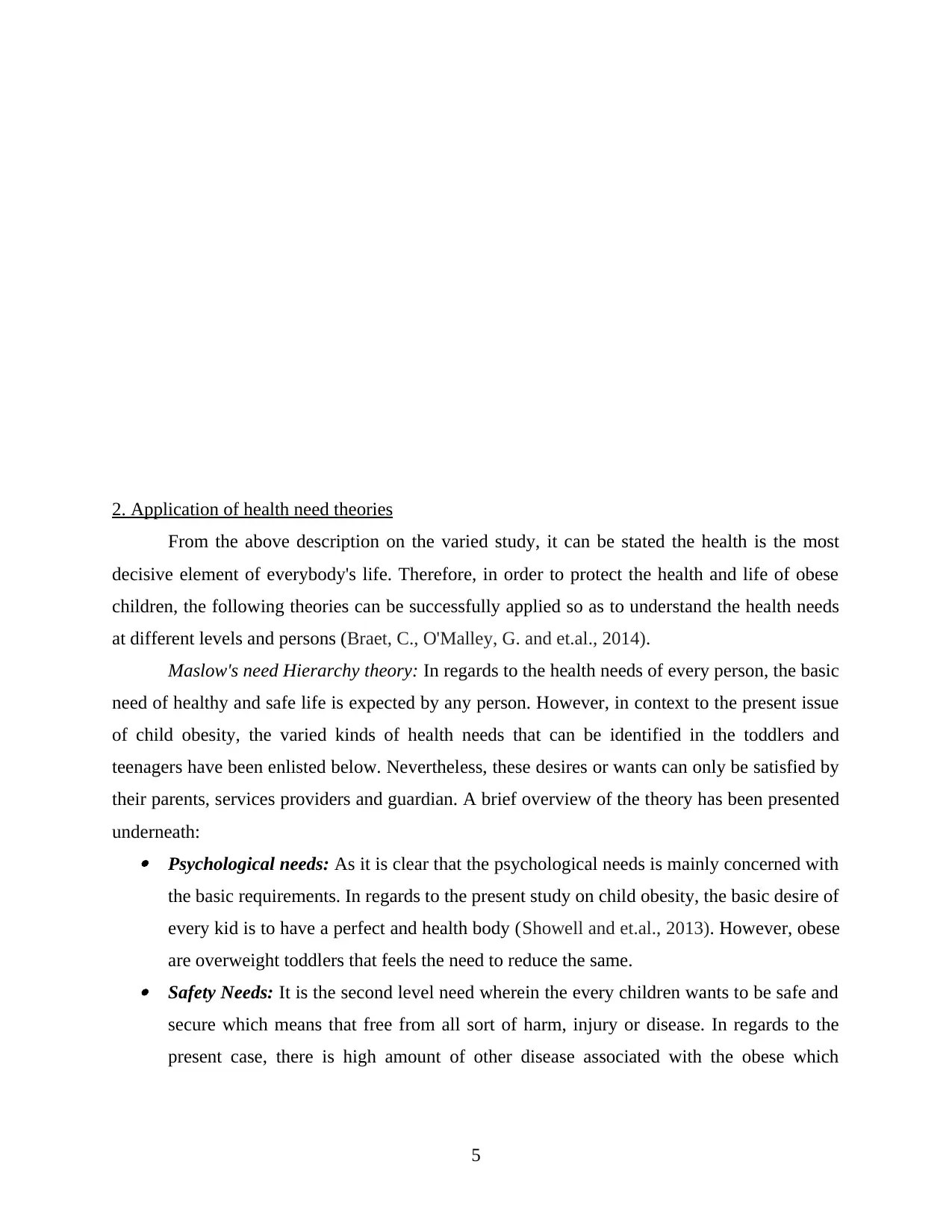
2. Application of health need theories
From the above description on the varied study, it can be stated the health is the most
decisive element of everybody's life. Therefore, in order to protect the health and life of obese
children, the following theories can be successfully applied so as to understand the health needs
at different levels and persons (Braet, C., O'Malley, G. and et.al., 2014).
Maslow's need Hierarchy theory: In regards to the health needs of every person, the basic
need of healthy and safe life is expected by any person. However, in context to the present issue
of child obesity, the varied kinds of health needs that can be identified in the toddlers and
teenagers have been enlisted below. Nevertheless, these desires or wants can only be satisfied by
their parents, services providers and guardian. A brief overview of the theory has been presented
underneath: Psychological needs: As it is clear that the psychological needs is mainly concerned with
the basic requirements. In regards to the present study on child obesity, the basic desire of
every kid is to have a perfect and health body (Showell and et.al., 2013). However, obese
are overweight toddlers that feels the need to reduce the same. Safety Needs: It is the second level need wherein the every children wants to be safe and
secure which means that free from all sort of harm, injury or disease. In regards to the
present case, there is high amount of other disease associated with the obese which
5
From the above description on the varied study, it can be stated the health is the most
decisive element of everybody's life. Therefore, in order to protect the health and life of obese
children, the following theories can be successfully applied so as to understand the health needs
at different levels and persons (Braet, C., O'Malley, G. and et.al., 2014).
Maslow's need Hierarchy theory: In regards to the health needs of every person, the basic
need of healthy and safe life is expected by any person. However, in context to the present issue
of child obesity, the varied kinds of health needs that can be identified in the toddlers and
teenagers have been enlisted below. Nevertheless, these desires or wants can only be satisfied by
their parents, services providers and guardian. A brief overview of the theory has been presented
underneath: Psychological needs: As it is clear that the psychological needs is mainly concerned with
the basic requirements. In regards to the present study on child obesity, the basic desire of
every kid is to have a perfect and health body (Showell and et.al., 2013). However, obese
are overweight toddlers that feels the need to reduce the same. Safety Needs: It is the second level need wherein the every children wants to be safe and
secure which means that free from all sort of harm, injury or disease. In regards to the
present case, there is high amount of other disease associated with the obese which
5
Paraphrase This Document
Need a fresh take? Get an instant paraphrase of this document with our AI Paraphraser
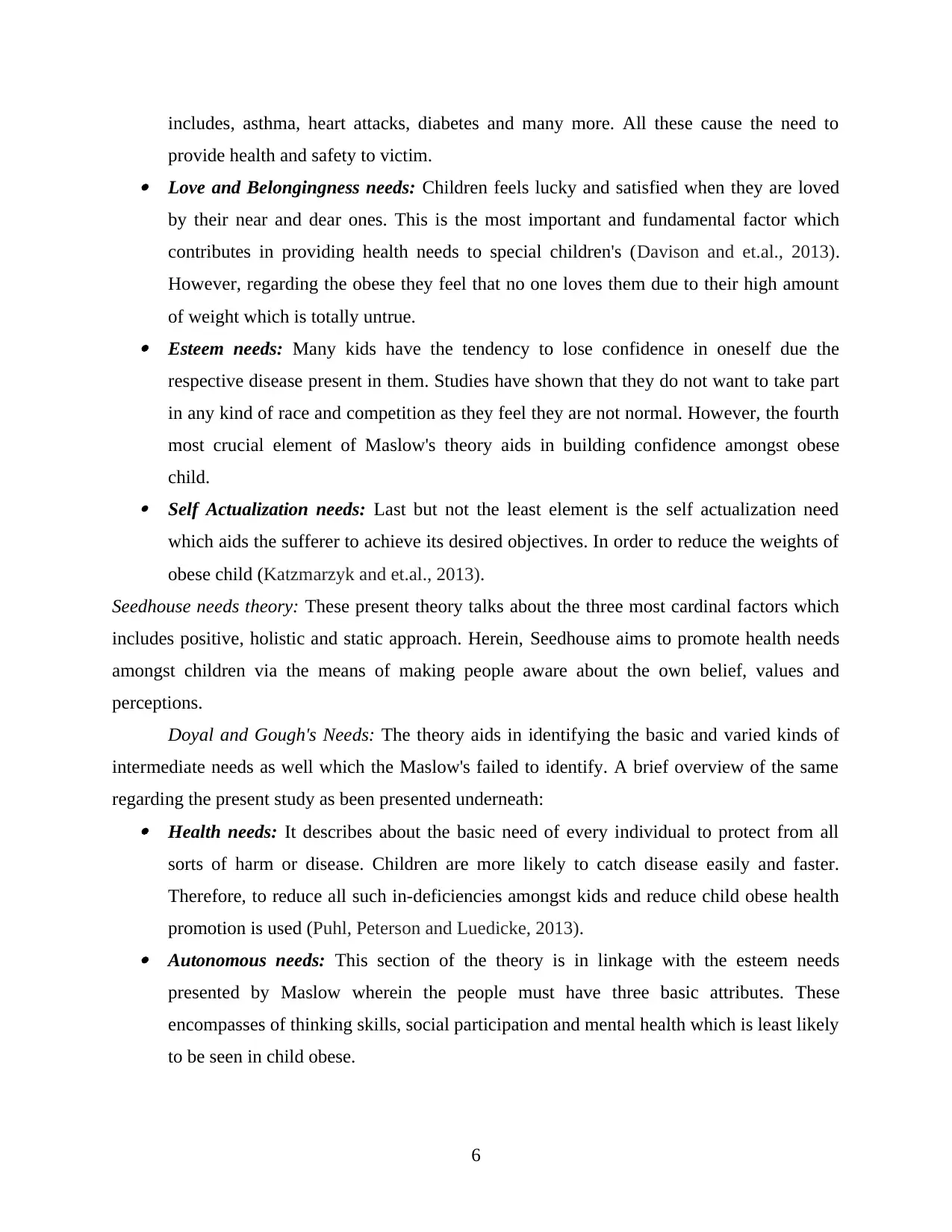
includes, asthma, heart attacks, diabetes and many more. All these cause the need to
provide health and safety to victim. Love and Belongingness needs: Children feels lucky and satisfied when they are loved
by their near and dear ones. This is the most important and fundamental factor which
contributes in providing health needs to special children's (Davison and et.al., 2013).
However, regarding the obese they feel that no one loves them due to their high amount
of weight which is totally untrue. Esteem needs: Many kids have the tendency to lose confidence in oneself due the
respective disease present in them. Studies have shown that they do not want to take part
in any kind of race and competition as they feel they are not normal. However, the fourth
most crucial element of Maslow's theory aids in building confidence amongst obese
child. Self Actualization needs: Last but not the least element is the self actualization need
which aids the sufferer to achieve its desired objectives. In order to reduce the weights of
obese child (Katzmarzyk and et.al., 2013).
Seedhouse needs theory: These present theory talks about the three most cardinal factors which
includes positive, holistic and static approach. Herein, Seedhouse aims to promote health needs
amongst children via the means of making people aware about the own belief, values and
perceptions.
Doyal and Gough's Needs: The theory aids in identifying the basic and varied kinds of
intermediate needs as well which the Maslow's failed to identify. A brief overview of the same
regarding the present study as been presented underneath: Health needs: It describes about the basic need of every individual to protect from all
sorts of harm or disease. Children are more likely to catch disease easily and faster.
Therefore, to reduce all such in-deficiencies amongst kids and reduce child obese health
promotion is used (Puhl, Peterson and Luedicke, 2013). Autonomous needs: This section of the theory is in linkage with the esteem needs
presented by Maslow wherein the people must have three basic attributes. These
encompasses of thinking skills, social participation and mental health which is least likely
to be seen in child obese.
6
provide health and safety to victim. Love and Belongingness needs: Children feels lucky and satisfied when they are loved
by their near and dear ones. This is the most important and fundamental factor which
contributes in providing health needs to special children's (Davison and et.al., 2013).
However, regarding the obese they feel that no one loves them due to their high amount
of weight which is totally untrue. Esteem needs: Many kids have the tendency to lose confidence in oneself due the
respective disease present in them. Studies have shown that they do not want to take part
in any kind of race and competition as they feel they are not normal. However, the fourth
most crucial element of Maslow's theory aids in building confidence amongst obese
child. Self Actualization needs: Last but not the least element is the self actualization need
which aids the sufferer to achieve its desired objectives. In order to reduce the weights of
obese child (Katzmarzyk and et.al., 2013).
Seedhouse needs theory: These present theory talks about the three most cardinal factors which
includes positive, holistic and static approach. Herein, Seedhouse aims to promote health needs
amongst children via the means of making people aware about the own belief, values and
perceptions.
Doyal and Gough's Needs: The theory aids in identifying the basic and varied kinds of
intermediate needs as well which the Maslow's failed to identify. A brief overview of the same
regarding the present study as been presented underneath: Health needs: It describes about the basic need of every individual to protect from all
sorts of harm or disease. Children are more likely to catch disease easily and faster.
Therefore, to reduce all such in-deficiencies amongst kids and reduce child obese health
promotion is used (Puhl, Peterson and Luedicke, 2013). Autonomous needs: This section of the theory is in linkage with the esteem needs
presented by Maslow wherein the people must have three basic attributes. These
encompasses of thinking skills, social participation and mental health which is least likely
to be seen in child obese.
6
Intermediate needs: In order to promote health needs amongst the citizens Doyal has
present 11 intermediate needs. Out of this the main that relates to the present study
includes nutritional factor, security, protective housing, proper relationship, cross culture
(Gurnani, Birken and Hamilton, 2015).
3. Prioritising the health needs
Bradshaw's has presented a need prioritising theory which aid the people to understand
the significance of need assessment. For this purpose four factors has been categorized by him.
Children health and obesity is the major concern prevailing in every country. Therefore, to
overcome the said issue, appropriate planning as well as management is the key to promote
health prioritising concept. This can be done by the means of proper resource allocation,
improving healthcare and equity. The four essential concept has been discussed underneath: Normative need: Such kind of need is most likely to arise in those cases when the person
itself fails to accomplish or meet the requisite standards (Findholt, Davis and Michael,
2013). In regards to the child obesity, these kids are overweight and fails the issue to
reduce weight. Therefore, it becomes essential to promote health awareness amongst the
measures or ways to reduce the same. By identifying the needs and requirement among
the children to overcome the obesity, anyone can easily promote the health of children.
As per this normative needs, it is very important to provide the knowledge to those
people who are fail to understand the obesity issue among children. Felt need: Herein, the perception and attributes of the people is most likely to influence
the measures undertaken by the healthcare. Furthermore, the information or remedies
received in the following case shall be conveyed and promoted in a proper manner. This
kind of need is also very important to overcome the issue of children obesity. In this
aspect, there is requirement to provide the proper information about the remedies to
overcome the issue of obesity among the children. Comparative need: It is likely to arise when the 2 groups with akin characteristics is not
been able to receive related services. There may be varied regions which may not be able
to get adequate amount of services to remove child obesity therefore it is essential to
prioritise the need to make promotion in the respective region. With help of this kind of
need among the community, there may arise the proper health promotion because by this
need, priorities can effectively acknowledge among the people.
7
present 11 intermediate needs. Out of this the main that relates to the present study
includes nutritional factor, security, protective housing, proper relationship, cross culture
(Gurnani, Birken and Hamilton, 2015).
3. Prioritising the health needs
Bradshaw's has presented a need prioritising theory which aid the people to understand
the significance of need assessment. For this purpose four factors has been categorized by him.
Children health and obesity is the major concern prevailing in every country. Therefore, to
overcome the said issue, appropriate planning as well as management is the key to promote
health prioritising concept. This can be done by the means of proper resource allocation,
improving healthcare and equity. The four essential concept has been discussed underneath: Normative need: Such kind of need is most likely to arise in those cases when the person
itself fails to accomplish or meet the requisite standards (Findholt, Davis and Michael,
2013). In regards to the child obesity, these kids are overweight and fails the issue to
reduce weight. Therefore, it becomes essential to promote health awareness amongst the
measures or ways to reduce the same. By identifying the needs and requirement among
the children to overcome the obesity, anyone can easily promote the health of children.
As per this normative needs, it is very important to provide the knowledge to those
people who are fail to understand the obesity issue among children. Felt need: Herein, the perception and attributes of the people is most likely to influence
the measures undertaken by the healthcare. Furthermore, the information or remedies
received in the following case shall be conveyed and promoted in a proper manner. This
kind of need is also very important to overcome the issue of children obesity. In this
aspect, there is requirement to provide the proper information about the remedies to
overcome the issue of obesity among the children. Comparative need: It is likely to arise when the 2 groups with akin characteristics is not
been able to receive related services. There may be varied regions which may not be able
to get adequate amount of services to remove child obesity therefore it is essential to
prioritise the need to make promotion in the respective region. With help of this kind of
need among the community, there may arise the proper health promotion because by this
need, priorities can effectively acknowledge among the people.
7
⊘ This is a preview!⊘
Do you want full access?
Subscribe today to unlock all pages.
Trusted by 1+ million students worldwide
Expressed needs: This is more likely to experienced in those cases wherein more and
more children or their guardians want to avail respective services so as to cure the
children from respective disease (Ling and et.al., 2014).
Therefore, from the above analysis of Bradshaw's model on prioritising needs it can be stated
that it is essential to dispose appropriate amount of resources, services and information to all the
regions especially that are underdeveloped so as to remove the disease from its root cause. Along
with that to promote health needs and problems related to child obesity that may be dangerous to
ones own health.
PART 2- A STRATEGY TO ADDRESS HEALTH NEEDS
Theories of Healthcare
Medical journals and research funders are mainly concerned with practical factual research, not with
research that develops theories.” This widespread view includes several assumptions: that research
and facts can be separated from theory; that considering theories is not necessarily practical or useful;
and that thinking about theories means developing them.
Positivism and social medicine
Positivist theories in social medicine take some account of context but tend to see the social in
physical terms, like seeing how people’s estimations and expressions of pain differ by age, sex, or
race. The separate parts are still emphasised, as separate variables, rather than the meanings of all the
parts and the whole being connected. Positivist concern with cause and effect, like the pain caused by
burns, tends to perceive responses as predictable reactions rather than personal choices and motives
Social construction
A contrasting approach to positivism is to believe that there is not a single view or truth, and that a
range of views can be valid in different ways. It is then possible to attend to different voices. Instead
of being treated as agreed facts like a solid road, phenomena are seen as more like part of an ocean
affected by tides and currents, shifting lights and opaque depths.
Critical theory
Showing how people make different but valid sense of experience makes critical theory possible as a
rational framework. Critical theory does not see society as a well functioning organism—it sees
society as a collection of many factions competing for power and resources. Doctors are partly agents
of social control with divided loyalties that face them when, for example, they decide who is eligible
for medical or psychiatric treatment for pain, or for sickness benefits.
8
more children or their guardians want to avail respective services so as to cure the
children from respective disease (Ling and et.al., 2014).
Therefore, from the above analysis of Bradshaw's model on prioritising needs it can be stated
that it is essential to dispose appropriate amount of resources, services and information to all the
regions especially that are underdeveloped so as to remove the disease from its root cause. Along
with that to promote health needs and problems related to child obesity that may be dangerous to
ones own health.
PART 2- A STRATEGY TO ADDRESS HEALTH NEEDS
Theories of Healthcare
Medical journals and research funders are mainly concerned with practical factual research, not with
research that develops theories.” This widespread view includes several assumptions: that research
and facts can be separated from theory; that considering theories is not necessarily practical or useful;
and that thinking about theories means developing them.
Positivism and social medicine
Positivist theories in social medicine take some account of context but tend to see the social in
physical terms, like seeing how people’s estimations and expressions of pain differ by age, sex, or
race. The separate parts are still emphasised, as separate variables, rather than the meanings of all the
parts and the whole being connected. Positivist concern with cause and effect, like the pain caused by
burns, tends to perceive responses as predictable reactions rather than personal choices and motives
Social construction
A contrasting approach to positivism is to believe that there is not a single view or truth, and that a
range of views can be valid in different ways. It is then possible to attend to different voices. Instead
of being treated as agreed facts like a solid road, phenomena are seen as more like part of an ocean
affected by tides and currents, shifting lights and opaque depths.
Critical theory
Showing how people make different but valid sense of experience makes critical theory possible as a
rational framework. Critical theory does not see society as a well functioning organism—it sees
society as a collection of many factions competing for power and resources. Doctors are partly agents
of social control with divided loyalties that face them when, for example, they decide who is eligible
for medical or psychiatric treatment for pain, or for sickness benefits.
8
Paraphrase This Document
Need a fresh take? Get an instant paraphrase of this document with our AI Paraphraser
Aims: To assess the impact of child obesity and the ways to reduce the same- a study on children
of England.
SMART Objectives:
Specific- To assess the impact of child obesity and the ways to reduce the same.
Measurable- To analyse the diseases or health issues associated with child obesity
Attainable- To develop the ways through which obesity issue among the children can
overcome
Relevant- To identify the ways or strategies in which the obese can be taken care by their
guardian
Time- To design the strategies to overcome the impact of obesity upon the children
within 6 months
Beattie's model applied
As discussed above, obesity is a kind of disease that is likely to arise due to the high
consumption of food and energy. This is most likely to experience amongst children, women or
people from the racial group (Mier and et.al., 2013). Sometimes the reason behind obesity is due
to high amount of genetic changes. Therefore, it is essential to make people aware about the
health needs and increase awareness amongst people. For this purpose, Beattie's model has been
applied to achieve the above demonstrated objectives in the following manner. The model has
basically four quadrants wherein promotional measures are either undertaken by the individual,
government, professionals via the means of techniques that has been enumerated below:
Health Persuasion: Herein the health personnels will be engaged in promoting the health
related needs in order to attain the above laid objectives (Taormina and Gao, 2013). For this
purpose, schools from different regions of England will be selected so as to involve in health
promotional activities. Herein, the professionals will conduct surveys or session in which the
knowledge regarding reducing weight is being provided to the children. The teachers will be
engaged in demonstrating lessons about healthy and unhealthy food (Thompson, Kreuter, and
Boyum, 2016). Furthermore, the sessions will be especially taken for the primary students so as
to make them aware about different nutrients. In addition to the above, sessions will be held for
the kids to taste different dishes and healthy food so that they can get used to the diverse tastes
9
of England.
SMART Objectives:
Specific- To assess the impact of child obesity and the ways to reduce the same.
Measurable- To analyse the diseases or health issues associated with child obesity
Attainable- To develop the ways through which obesity issue among the children can
overcome
Relevant- To identify the ways or strategies in which the obese can be taken care by their
guardian
Time- To design the strategies to overcome the impact of obesity upon the children
within 6 months
Beattie's model applied
As discussed above, obesity is a kind of disease that is likely to arise due to the high
consumption of food and energy. This is most likely to experience amongst children, women or
people from the racial group (Mier and et.al., 2013). Sometimes the reason behind obesity is due
to high amount of genetic changes. Therefore, it is essential to make people aware about the
health needs and increase awareness amongst people. For this purpose, Beattie's model has been
applied to achieve the above demonstrated objectives in the following manner. The model has
basically four quadrants wherein promotional measures are either undertaken by the individual,
government, professionals via the means of techniques that has been enumerated below:
Health Persuasion: Herein the health personnels will be engaged in promoting the health
related needs in order to attain the above laid objectives (Taormina and Gao, 2013). For this
purpose, schools from different regions of England will be selected so as to involve in health
promotional activities. Herein, the professionals will conduct surveys or session in which the
knowledge regarding reducing weight is being provided to the children. The teachers will be
engaged in demonstrating lessons about healthy and unhealthy food (Thompson, Kreuter, and
Boyum, 2016). Furthermore, the sessions will be especially taken for the primary students so as
to make them aware about different nutrients. In addition to the above, sessions will be held for
the kids to taste different dishes and healthy food so that they can get used to the diverse tastes
9
and vegetables. The above activity will approximately take 3 months, in order to visit to each and
every school of England and dispersing sessions on the respective area.
Justification: The above strategy is selected by the personnel of healthcare because it has
been analysed that schools are the key towards removing or preventing child obesity (Herlitz
and Horan, 2016). Kids have the habit of grabbing things more faster at school premises which
further assist the teachers in making them aware about the need to consume health and diet food.
Furthermore, the children that are already overweighted will try to consume nutrients that are
lacking in them. Apart from this, toddlers at primary level will stop consuming junk foods that
may literally gain weight in future. Therefore, schools sessions are the best means to make
children differentiate about healthy foods.
Legislative action: In order to perform this activity, government plays a very crucial role
as it can develop such effective legislation, regulation and code of conduct by which restaurant,
hotels, fast food organisation fast food centres etc always consider the health of customer at the
time of deliver food services and products to customers in the market. Through imposing policies
and procedures, child obesity in England can significantly be reduced. Government plays a major
role by imposing norms and other practices that are beneficial for the society. Some of the
actions that can be undertaken by the authoritative of government is through the means of
making collective partnership with the fast food centres. The major cause of child obesity is high
amount of salt being present in junk foods. Therefore, the government can ask these outlets to
use low volume of salts and other spices while preparing the dishes (Koch and Buch-Hansen,
2016). Certain other actions that can be taken by the government includes specifying the contents
to be used in making meals or by reducing the amount of dishes from the menu card of canteens.
Furthermore, the school principles and other authoritative may take necessary actions to stop the
primary students and adolescent from going out of school campus while intervals. This will aid
in consuming the healthy and diet conscious food by the children's. Last but not the least packed
lunches can be subsidised by the government to those houses which have single parent or stays
under guardians. Supply of fresh fruits and vegetables to the country through making contracts
with the suppliers is also an imperative health promotional step undertaken by the regime.
Justification: These policies and practices are selected in the best interest so as to
promote the citizens of England aware about the health needs. In addition to the above, removing
10
every school of England and dispersing sessions on the respective area.
Justification: The above strategy is selected by the personnel of healthcare because it has
been analysed that schools are the key towards removing or preventing child obesity (Herlitz
and Horan, 2016). Kids have the habit of grabbing things more faster at school premises which
further assist the teachers in making them aware about the need to consume health and diet food.
Furthermore, the children that are already overweighted will try to consume nutrients that are
lacking in them. Apart from this, toddlers at primary level will stop consuming junk foods that
may literally gain weight in future. Therefore, schools sessions are the best means to make
children differentiate about healthy foods.
Legislative action: In order to perform this activity, government plays a very crucial role
as it can develop such effective legislation, regulation and code of conduct by which restaurant,
hotels, fast food organisation fast food centres etc always consider the health of customer at the
time of deliver food services and products to customers in the market. Through imposing policies
and procedures, child obesity in England can significantly be reduced. Government plays a major
role by imposing norms and other practices that are beneficial for the society. Some of the
actions that can be undertaken by the authoritative of government is through the means of
making collective partnership with the fast food centres. The major cause of child obesity is high
amount of salt being present in junk foods. Therefore, the government can ask these outlets to
use low volume of salts and other spices while preparing the dishes (Koch and Buch-Hansen,
2016). Certain other actions that can be taken by the government includes specifying the contents
to be used in making meals or by reducing the amount of dishes from the menu card of canteens.
Furthermore, the school principles and other authoritative may take necessary actions to stop the
primary students and adolescent from going out of school campus while intervals. This will aid
in consuming the healthy and diet conscious food by the children's. Last but not the least packed
lunches can be subsidised by the government to those houses which have single parent or stays
under guardians. Supply of fresh fruits and vegetables to the country through making contracts
with the suppliers is also an imperative health promotional step undertaken by the regime.
Justification: These policies and practices are selected in the best interest so as to
promote the citizens of England aware about the health needs. In addition to the above, removing
10
⊘ This is a preview!⊘
Do you want full access?
Subscribe today to unlock all pages.
Trusted by 1+ million students worldwide

1 out of 18


Related Documents


Your All-in-One AI-Powered Toolkit for Academic Success.
+13062052269
info@desklib.com
Available 24*7 on WhatsApp / Email
![[object Object]](/_next/static/media/star-bottom.7253800d.svg)
Unlock your academic potential
Copyright © 2020–2026 A2Z Services. All Rights Reserved. Developed and managed by ZUCOL.