Diploma of Nursing: CHCDIV001 Assignment on Cultural Diversity
VerifiedAdded on 2023/01/07
|27
|8971
|48
Homework Assignment
AI Summary
This assignment, addressing the Diploma of Nursing unit CHCDIV001, explores cultural diversity in healthcare. It begins with definitions of key concepts like cultural awareness, cultural safety, and cultural competence, along with an examination of diversity in Australia, including political, socio-cultural, and economic factors. The assignment delves into Commonwealth and state laws protecting against discrimination, the Universal Declaration of Human Rights, and its relevance to healthcare, including examples of breaches and responses. It further covers human rights frameworks, approaches in aged care, and the rights and responsibilities of employers, employees, and residents. The document also differentiates between culture, race, and ethnicity, providing examples, and examines the impact of disabilities on older people, as well as the differences between spirituality and religious beliefs. The assignment includes case studies and simulation-based assessments to apply the learned concepts.
Work with diverse people

Paraphrase This Document
Need a fresh take? Get an instant paraphrase of this document with our AI Paraphraser
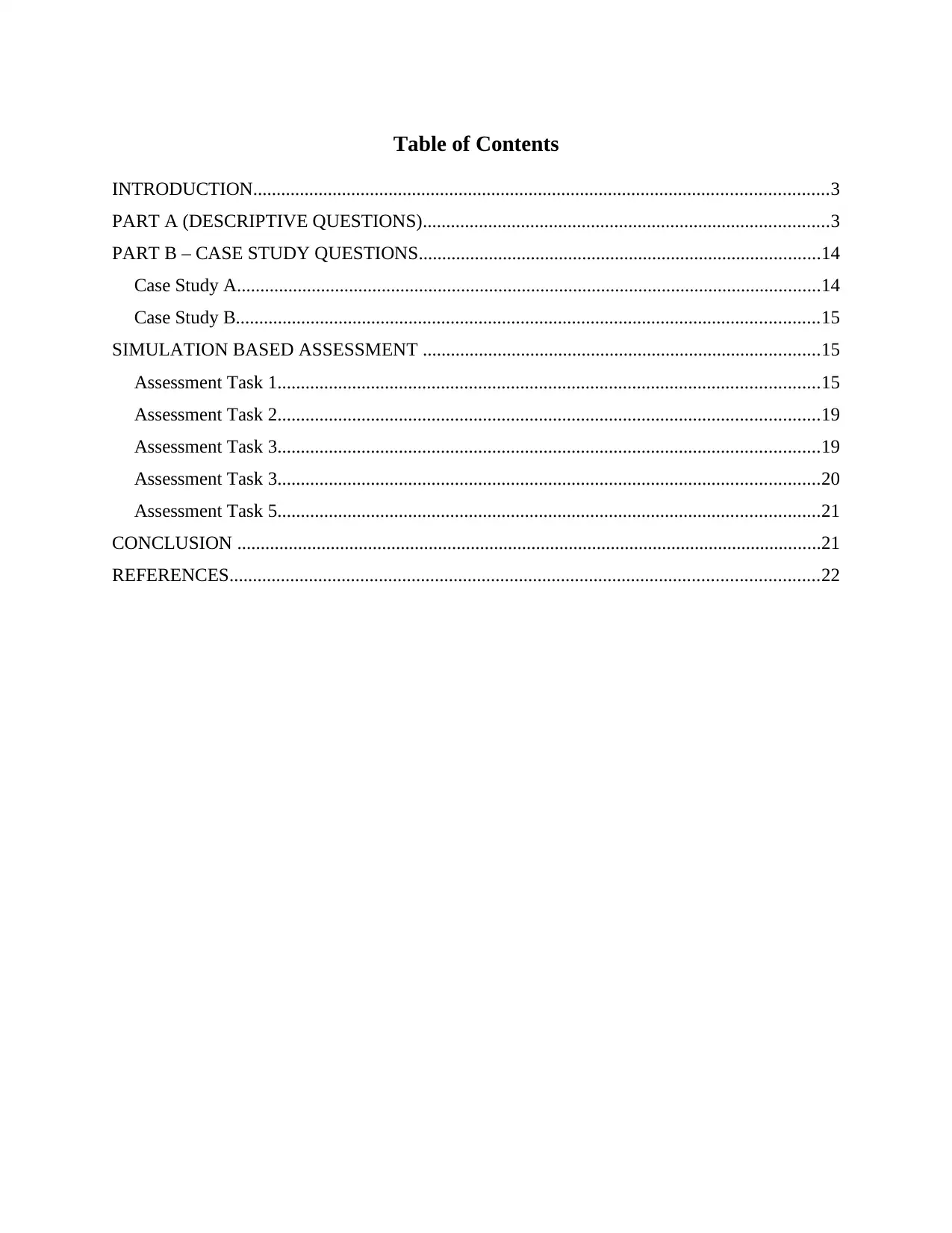
Table of Contents
INTRODUCTION...........................................................................................................................3
PART A (DESCRIPTIVE QUESTIONS).......................................................................................3
PART B – CASE STUDY QUESTIONS......................................................................................14
Case Study A.............................................................................................................................14
Case Study B.............................................................................................................................15
SIMULATION BASED ASSESSMENT .....................................................................................15
Assessment Task 1....................................................................................................................15
Assessment Task 2....................................................................................................................19
Assessment Task 3....................................................................................................................19
Assessment Task 3....................................................................................................................20
Assessment Task 5....................................................................................................................21
CONCLUSION .............................................................................................................................21
REFERENCES..............................................................................................................................22
INTRODUCTION...........................................................................................................................3
PART A (DESCRIPTIVE QUESTIONS).......................................................................................3
PART B – CASE STUDY QUESTIONS......................................................................................14
Case Study A.............................................................................................................................14
Case Study B.............................................................................................................................15
SIMULATION BASED ASSESSMENT .....................................................................................15
Assessment Task 1....................................................................................................................15
Assessment Task 2....................................................................................................................19
Assessment Task 3....................................................................................................................19
Assessment Task 3....................................................................................................................20
Assessment Task 5....................................................................................................................21
CONCLUSION .............................................................................................................................21
REFERENCES..............................................................................................................................22
INTRODUCTION
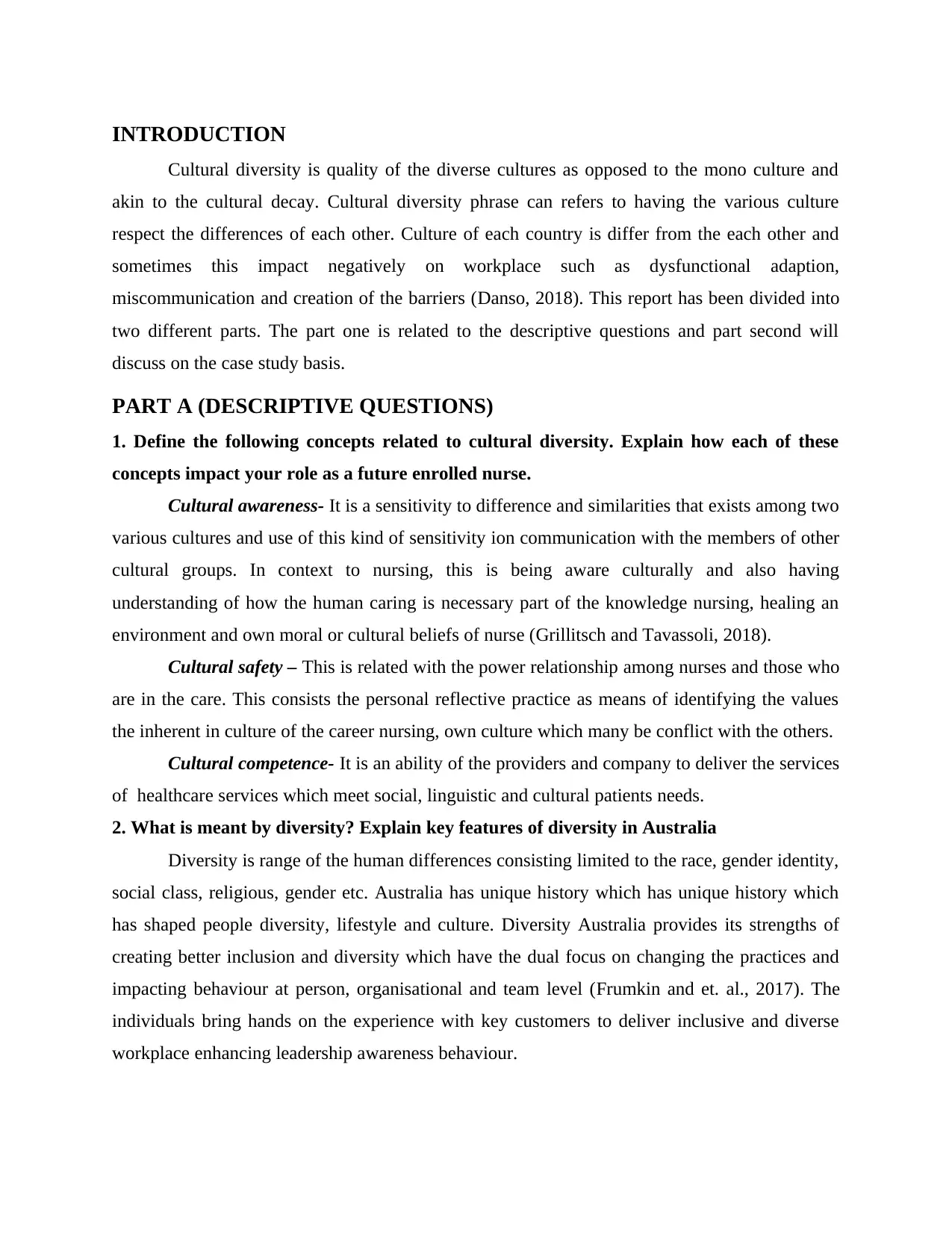
Cultural diversity is quality of the diverse cultures as opposed to the mono culture and
akin to the cultural decay. Cultural diversity phrase can refers to having the various culture
respect the differences of each other. Culture of each country is differ from the each other and
sometimes this impact negatively on workplace such as dysfunctional adaption,
miscommunication and creation of the barriers (Danso, 2018). This report has been divided into
two different parts. The part one is related to the descriptive questions and part second will
discuss on the case study basis.
PART A (DESCRIPTIVE QUESTIONS)
1. Define the following concepts related to cultural diversity. Explain how each of these
concepts impact your role as a future enrolled nurse.
Cultural awareness- It is a sensitivity to difference and similarities that exists among two
various cultures and use of this kind of sensitivity ion communication with the members of other
cultural groups. In context to nursing, this is being aware culturally and also having
understanding of how the human caring is necessary part of the knowledge nursing, healing an
environment and own moral or cultural beliefs of nurse (Grillitsch and Tavassoli, 2018).
Cultural safety – This is related with the power relationship among nurses and those who
are in the care. This consists the personal reflective practice as means of identifying the values
the inherent in culture of the career nursing, own culture which many be conflict with the others.
Cultural competence- It is an ability of the providers and company to deliver the services
of healthcare services which meet social, linguistic and cultural patients needs.
2. What is meant by diversity? Explain key features of diversity in Australia
Diversity is range of the human differences consisting limited to the race, gender identity,
social class, religious, gender etc. Australia has unique history which has unique history which
has shaped people diversity, lifestyle and culture. Diversity Australia provides its strengths of
creating better inclusion and diversity which have the dual focus on changing the practices and
impacting behaviour at person, organisational and team level (Frumkin and et. al., 2017). The
individuals bring hands on the experience with key customers to deliver inclusive and diverse
workplace enhancing leadership awareness behaviour.
Cultural diversity is quality of the diverse cultures as opposed to the mono culture and
akin to the cultural decay. Cultural diversity phrase can refers to having the various culture
respect the differences of each other. Culture of each country is differ from the each other and
sometimes this impact negatively on workplace such as dysfunctional adaption,
miscommunication and creation of the barriers (Danso, 2018). This report has been divided into
two different parts. The part one is related to the descriptive questions and part second will
discuss on the case study basis.
PART A (DESCRIPTIVE QUESTIONS)
1. Define the following concepts related to cultural diversity. Explain how each of these
concepts impact your role as a future enrolled nurse.
Cultural awareness- It is a sensitivity to difference and similarities that exists among two
various cultures and use of this kind of sensitivity ion communication with the members of other
cultural groups. In context to nursing, this is being aware culturally and also having
understanding of how the human caring is necessary part of the knowledge nursing, healing an
environment and own moral or cultural beliefs of nurse (Grillitsch and Tavassoli, 2018).
Cultural safety – This is related with the power relationship among nurses and those who
are in the care. This consists the personal reflective practice as means of identifying the values
the inherent in culture of the career nursing, own culture which many be conflict with the others.
Cultural competence- It is an ability of the providers and company to deliver the services
of healthcare services which meet social, linguistic and cultural patients needs.
2. What is meant by diversity? Explain key features of diversity in Australia
Diversity is range of the human differences consisting limited to the race, gender identity,
social class, religious, gender etc. Australia has unique history which has unique history which
has shaped people diversity, lifestyle and culture. Diversity Australia provides its strengths of
creating better inclusion and diversity which have the dual focus on changing the practices and
impacting behaviour at person, organisational and team level (Frumkin and et. al., 2017). The
individuals bring hands on the experience with key customers to deliver inclusive and diverse
workplace enhancing leadership awareness behaviour.
⊘ This is a preview!⊘
Do you want full access?
Subscribe today to unlock all pages.

Trusted by 1+ million students worldwide
3. Discuss how each of political factors, socio-cultural factors and economic factors in
Australia impact different areas of work and life for people from a range of backgrounds
in this country.
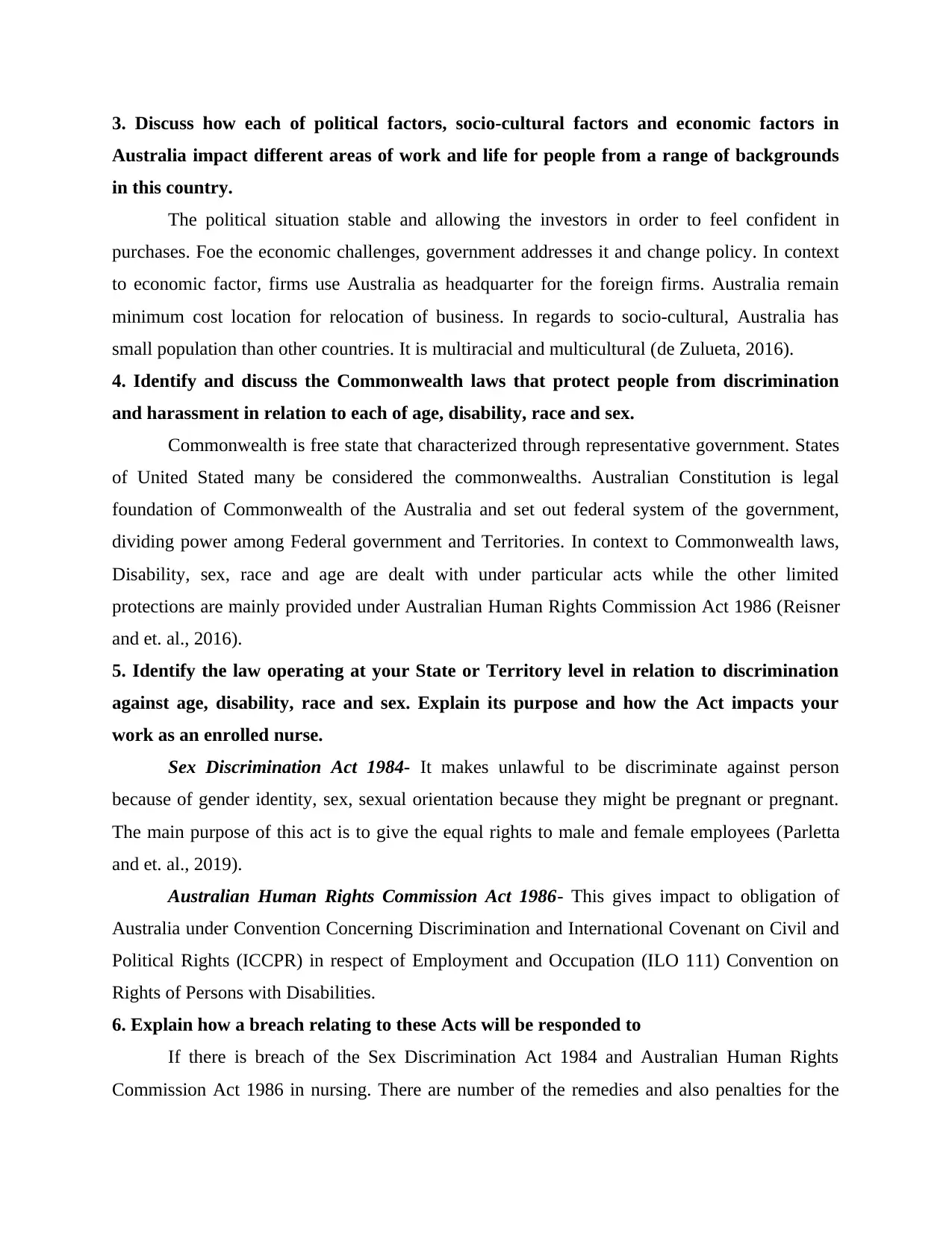
The political situation stable and allowing the investors in order to feel confident in
purchases. Foe the economic challenges, government addresses it and change policy. In context
to economic factor, firms use Australia as headquarter for the foreign firms. Australia remain
minimum cost location for relocation of business. In regards to socio-cultural, Australia has
small population than other countries. It is multiracial and multicultural (de Zulueta, 2016).
4. Identify and discuss the Commonwealth laws that protect people from discrimination
and harassment in relation to each of age, disability, race and sex.
Commonwealth is free state that characterized through representative government. States
of United Stated many be considered the commonwealths. Australian Constitution is legal
foundation of Commonwealth of the Australia and set out federal system of the government,
dividing power among Federal government and Territories. In context to Commonwealth laws,
Disability, sex, race and age are dealt with under particular acts while the other limited
protections are mainly provided under Australian Human Rights Commission Act 1986 (Reisner
and et. al., 2016).
5. Identify the law operating at your State or Territory level in relation to discrimination
against age, disability, race and sex. Explain its purpose and how the Act impacts your
work as an enrolled nurse.
Sex Discrimination Act 1984- It makes unlawful to be discriminate against person
because of gender identity, sex, sexual orientation because they might be pregnant or pregnant.
The main purpose of this act is to give the equal rights to male and female employees (Parletta
and et. al., 2019).
Australian Human Rights Commission Act 1986- This gives impact to obligation of
Australia under Convention Concerning Discrimination and International Covenant on Civil and
Political Rights (ICCPR) in respect of Employment and Occupation (ILO 111) Convention on
Rights of Persons with Disabilities.
6. Explain how a breach relating to these Acts will be responded to
If there is breach of the Sex Discrimination Act 1984 and Australian Human Rights
Commission Act 1986 in nursing. There are number of the remedies and also penalties for the
Australia impact different areas of work and life for people from a range of backgrounds
in this country.
The political situation stable and allowing the investors in order to feel confident in
purchases. Foe the economic challenges, government addresses it and change policy. In context
to economic factor, firms use Australia as headquarter for the foreign firms. Australia remain
minimum cost location for relocation of business. In regards to socio-cultural, Australia has
small population than other countries. It is multiracial and multicultural (de Zulueta, 2016).
4. Identify and discuss the Commonwealth laws that protect people from discrimination
and harassment in relation to each of age, disability, race and sex.
Commonwealth is free state that characterized through representative government. States
of United Stated many be considered the commonwealths. Australian Constitution is legal
foundation of Commonwealth of the Australia and set out federal system of the government,
dividing power among Federal government and Territories. In context to Commonwealth laws,
Disability, sex, race and age are dealt with under particular acts while the other limited
protections are mainly provided under Australian Human Rights Commission Act 1986 (Reisner
and et. al., 2016).
5. Identify the law operating at your State or Territory level in relation to discrimination
against age, disability, race and sex. Explain its purpose and how the Act impacts your
work as an enrolled nurse.
Sex Discrimination Act 1984- It makes unlawful to be discriminate against person
because of gender identity, sex, sexual orientation because they might be pregnant or pregnant.
The main purpose of this act is to give the equal rights to male and female employees (Parletta
and et. al., 2019).
Australian Human Rights Commission Act 1986- This gives impact to obligation of
Australia under Convention Concerning Discrimination and International Covenant on Civil and
Political Rights (ICCPR) in respect of Employment and Occupation (ILO 111) Convention on
Rights of Persons with Disabilities.
6. Explain how a breach relating to these Acts will be responded to
If there is breach of the Sex Discrimination Act 1984 and Australian Human Rights
Commission Act 1986 in nursing. There are number of the remedies and also penalties for the
Paraphrase This Document
Need a fresh take? Get an instant paraphrase of this document with our AI Paraphraser
adverse actions on the discriminatory grounds. Maximum penalty for the contravention of
unlawful discrimination protection $63,000 per contravention for corporation and $12,600 per
contravention for person (Barnett and et. al., 2018).
7. Explain what the Universal Declaration of Human Rights is.
Universal Declaration of Human Rights is document that adopted through United Nations
General Assembly which establishes the principles for freedoms and rights of people. It is
drafted through representatives with various legal as well as cultural backgrounds from all
regions. Declaration was mainly proclaimed through United Nations General Assembly in the
Paris on December 10, 1948 as common standard for the achievements for all the people. Other
than this, Universal Declaration of Human Rights 1948 stated health as part of right to effective
living standard (Fertman and Allensworth, 2016).
8. Give an example of a breach of the Universal Declaration of Human Rights in a health
and community care context. How could you, as an enrolled nurse, respond to this breach?
In context to health and community care context, healthcare organisations should not
disclose the personal and health information of patients without the permission. Without consent,
firm can not do any thing to patient. Breach of Universal Declaration of Human Rights in a
health and community care context related to the disclose the information related to patient in
front of other person. In this case, as an enrolled nurse a disciplinary action can be taken or
suspended if accidental breach was result of the careless error (Bailey and et. al., 2016).
9. Explain the relationship between human rights and human needs.
Human right and the human needs are mainly connected. The human rights apply for
every individual because they are human and can seen as the rights to fulfilment the human
needs. Needs give grounding for the human rights (Wang and Kosinski, 2018). Human needs is
mainly appeal to the charity while the human rights translated requirements into entitlement
matter with the proper dignity. The Universal access to the modern energy services fall with
purview of the conversation related to human rights.
10. Explain the purpose of Australia's human rights framework
Australian Government has been developed Human Rights Framework to increase
protection as well as promotion of the human rights in Australia. In this, Government will give
the $18.3 million over the four years in order to implement measures in framework. It will
underpin the future government action on matters of human rights. The main purpose of
unlawful discrimination protection $63,000 per contravention for corporation and $12,600 per
contravention for person (Barnett and et. al., 2018).
7. Explain what the Universal Declaration of Human Rights is.
Universal Declaration of Human Rights is document that adopted through United Nations
General Assembly which establishes the principles for freedoms and rights of people. It is
drafted through representatives with various legal as well as cultural backgrounds from all
regions. Declaration was mainly proclaimed through United Nations General Assembly in the
Paris on December 10, 1948 as common standard for the achievements for all the people. Other
than this, Universal Declaration of Human Rights 1948 stated health as part of right to effective
living standard (Fertman and Allensworth, 2016).
8. Give an example of a breach of the Universal Declaration of Human Rights in a health
and community care context. How could you, as an enrolled nurse, respond to this breach?
In context to health and community care context, healthcare organisations should not
disclose the personal and health information of patients without the permission. Without consent,
firm can not do any thing to patient. Breach of Universal Declaration of Human Rights in a
health and community care context related to the disclose the information related to patient in
front of other person. In this case, as an enrolled nurse a disciplinary action can be taken or
suspended if accidental breach was result of the careless error (Bailey and et. al., 2016).
9. Explain the relationship between human rights and human needs.
Human right and the human needs are mainly connected. The human rights apply for
every individual because they are human and can seen as the rights to fulfilment the human
needs. Needs give grounding for the human rights (Wang and Kosinski, 2018). Human needs is
mainly appeal to the charity while the human rights translated requirements into entitlement
matter with the proper dignity. The Universal access to the modern energy services fall with
purview of the conversation related to human rights.
10. Explain the purpose of Australia's human rights framework
Australian Government has been developed Human Rights Framework to increase
protection as well as promotion of the human rights in Australia. In this, Government will give
the $18.3 million over the four years in order to implement measures in framework. It will
underpin the future government action on matters of human rights. The main purpose of
Australia's human rights is to protect as well as promote the human rights in Australia. It
conciliate the complaints of discrimination and also hold the public inquiries (Copen, Chandra
and Febo-Vazquez, 2016).
11. Explain approaches and instruments used in aged care facilities to uphold human
rights.
Person oriented- It is a main approach in the aged care facilities. This consists the service
providers which working in the collaboration with the residents to identify services and care on
the basis of values, preferences and rights.
Palliative care- This is an approach that helps in improving quality of the patients life
and families which facing issue related with the life-threatening illness by prevention and also
suffering relief through means of the early identification and also impeccable the assessment and
also pain treatment and some other issues (Patterson, 2017).
12. Discuss three (3) rights and three (3) responsibilities of employers in a health care
service context
Rights of employer in health care service context
The right of employer is to access information concerned with the potential hazards.
Employer should participate in the workplace inspections.
Employer refuse work that put staff in the danger.
Responsibilities of employer in health care service context
It is the responsibility of employer to provide the essential health and safety instruction,
training and supervision (Brotto and Yule, 2017).
Employer should provide the important protective gear and also equipments.
Employer needs to maintaining register of all the injuries at workplace.
13. Discuss three (3) rights and three (3) responsibilities of workers/employees in a health
care service context
Rights of employee in health care service context
Employees have the right to stop the work and leave work area if there is any reasonable
concerns regarding safety (Roselli, 2018).
Employees provides with personal protective as well as safety equipment charge fee.
Staff members have the time to tell employer regarding any safety and health related
concerned they have.
conciliate the complaints of discrimination and also hold the public inquiries (Copen, Chandra
and Febo-Vazquez, 2016).
11. Explain approaches and instruments used in aged care facilities to uphold human
rights.
Person oriented- It is a main approach in the aged care facilities. This consists the service
providers which working in the collaboration with the residents to identify services and care on
the basis of values, preferences and rights.
Palliative care- This is an approach that helps in improving quality of the patients life
and families which facing issue related with the life-threatening illness by prevention and also
suffering relief through means of the early identification and also impeccable the assessment and
also pain treatment and some other issues (Patterson, 2017).
12. Discuss three (3) rights and three (3) responsibilities of employers in a health care
service context
Rights of employer in health care service context
The right of employer is to access information concerned with the potential hazards.
Employer should participate in the workplace inspections.
Employer refuse work that put staff in the danger.
Responsibilities of employer in health care service context
It is the responsibility of employer to provide the essential health and safety instruction,
training and supervision (Brotto and Yule, 2017).
Employer should provide the important protective gear and also equipments.
Employer needs to maintaining register of all the injuries at workplace.
13. Discuss three (3) rights and three (3) responsibilities of workers/employees in a health
care service context
Rights of employee in health care service context
Employees have the right to stop the work and leave work area if there is any reasonable
concerns regarding safety (Roselli, 2018).
Employees provides with personal protective as well as safety equipment charge fee.
Staff members have the time to tell employer regarding any safety and health related
concerned they have.
⊘ This is a preview!⊘
Do you want full access?
Subscribe today to unlock all pages.
Trusted by 1+ million students worldwide
Responsibilities of employee in health care service context
It is a responsibility of employee to take care of own safety and health.
Employees need to avoid to wearing the jewellery if operating the machinery.
Employees have the responsibility to cooperate with employer and assure to get the
proper training and also follow safety policies of firm.
14. Discuss three (3) rights and three (3) responsibilities of residents in an aged care service
setting
Rights of employee in health care service context
It is the right of resident to be high and safe quality of the care services.
There have control over and also make the choices regarding care, social and personal
life consisting where choices include personal risk (Assari, 2019).
Complain freely from the reprisal and have complaints to deal fairly as well as promptly.
Responsibilities of employee in health care service context
It is a responsibility to assure that exercising of individual rights which does not impact
the individual right of others consisting those which providing care.
There should be respect employees rights to work in environment free from the
harassment.
It is the responsibility to care for own health as well as well being.
15. Explain an appropriate response from employers if an employee consistently fails to
carry out responsibilities entrusted to him or breaches others’ rights
It is necessary for the employee to carry out the responsibilities that given by
management or employer effectively (Sanders and et. al., 2017). If in case, employee is not able
to carry out the responsibilities in a better manner then employer will not give any responsibility
in future and also force him to give the resign because that employee will not be valuable for
company.
16. Discuss the difference between ‘culture’, ‘race’ and ‘ethnicity’. Provide an example of
each.
Culture is shared system of the learned as well as shared values, riles and beliefs of
conduct which make the people behave in certain manner. Race is related with the biology that
connected with the physical characteristics like hair texture and skin colour. This is regarded
through several to predominantly social construct. Ethnicity is concerned with the identification
It is a responsibility of employee to take care of own safety and health.
Employees need to avoid to wearing the jewellery if operating the machinery.
Employees have the responsibility to cooperate with employer and assure to get the
proper training and also follow safety policies of firm.
14. Discuss three (3) rights and three (3) responsibilities of residents in an aged care service
setting
Rights of employee in health care service context
It is the right of resident to be high and safe quality of the care services.
There have control over and also make the choices regarding care, social and personal
life consisting where choices include personal risk (Assari, 2019).
Complain freely from the reprisal and have complaints to deal fairly as well as promptly.
Responsibilities of employee in health care service context
It is a responsibility to assure that exercising of individual rights which does not impact
the individual right of others consisting those which providing care.
There should be respect employees rights to work in environment free from the
harassment.
It is the responsibility to care for own health as well as well being.
15. Explain an appropriate response from employers if an employee consistently fails to
carry out responsibilities entrusted to him or breaches others’ rights
It is necessary for the employee to carry out the responsibilities that given by
management or employer effectively (Sanders and et. al., 2017). If in case, employee is not able
to carry out the responsibilities in a better manner then employer will not give any responsibility
in future and also force him to give the resign because that employee will not be valuable for
company.
16. Discuss the difference between ‘culture’, ‘race’ and ‘ethnicity’. Provide an example of
each.
Culture is shared system of the learned as well as shared values, riles and beliefs of
conduct which make the people behave in certain manner. Race is related with the biology that
connected with the physical characteristics like hair texture and skin colour. This is regarded
through several to predominantly social construct. Ethnicity is concerned with the identification
Paraphrase This Document
Need a fresh take? Get an instant paraphrase of this document with our AI Paraphraser
as well as cultural expression. This is related to the cultural or behavioural characteristics like
customers or religion (Ferguson and et. al., 2017).
17. Discuss an example of the effect of physical disabilities and sensory disabilities on an
older person.
Older person age more than 75 years and also enhanced with the advancing age. This is
related with the long-term adverse health-related outcomes like enhanced geriatric syndromes
risk, hospitalisation, morality and disability. On the other hand sensory disabilities enhance with
the age and compromise ability of old person in order to carried out the daily activities (Molloy
and et. al., 2017).
18. How does spirituality differ from religious beliefs? How do religious or spiritual beliefs
of an older person affect the services they receive in a health care facility?
The religion is set of the organised practices and beliefs shared through community or a
group. On the other hand, spiritually is individual practice and has do with having peace sense
and objective. This is aspect of the humanity that means a way people seek as well as expresses
meaning. On the other hand, religion many provide psychological advantages to older people in
health care facility such as positive as well as hopefulness about illness that predicts the
improved health benefits and less morality rate (Cunneen, 2020).
19. Discuss the difference between transgender and intersex.
Transgender- These are the people who have gender identity that different from sex.
Some of the transgender people desire medical assistance to the transition from one sex to other
determined as the transsexual.
Intersex- It is group of the situations where there is discrepancy among internal genitals
and external genitals. These are the people born with many variations in sex characteristics
consisting gonads, chromosomes and sex hormones. The intersex people have reproductive
anatomy which do not fit the female or male often discovered at birth time (Melody and et. al.,
2016).
20. Explain how generational factors might affect one’s interactions with other people in a
health care workplace.
Multifaceted complexities of health care environment and the workforce of today,
intergenerational issues develop the uncharted territory for the healthcare leaders. This is
necessary for the leaders of healthcare to astute of existing generational group diversity to mote
customers or religion (Ferguson and et. al., 2017).
17. Discuss an example of the effect of physical disabilities and sensory disabilities on an
older person.
Older person age more than 75 years and also enhanced with the advancing age. This is
related with the long-term adverse health-related outcomes like enhanced geriatric syndromes
risk, hospitalisation, morality and disability. On the other hand sensory disabilities enhance with
the age and compromise ability of old person in order to carried out the daily activities (Molloy
and et. al., 2017).
18. How does spirituality differ from religious beliefs? How do religious or spiritual beliefs
of an older person affect the services they receive in a health care facility?
The religion is set of the organised practices and beliefs shared through community or a
group. On the other hand, spiritually is individual practice and has do with having peace sense
and objective. This is aspect of the humanity that means a way people seek as well as expresses
meaning. On the other hand, religion many provide psychological advantages to older people in
health care facility such as positive as well as hopefulness about illness that predicts the
improved health benefits and less morality rate (Cunneen, 2020).
19. Discuss the difference between transgender and intersex.
Transgender- These are the people who have gender identity that different from sex.
Some of the transgender people desire medical assistance to the transition from one sex to other
determined as the transsexual.
Intersex- It is group of the situations where there is discrepancy among internal genitals
and external genitals. These are the people born with many variations in sex characteristics
consisting gonads, chromosomes and sex hormones. The intersex people have reproductive
anatomy which do not fit the female or male often discovered at birth time (Melody and et. al.,
2016).
20. Explain how generational factors might affect one’s interactions with other people in a
health care workplace.
Multifaceted complexities of health care environment and the workforce of today,
intergenerational issues develop the uncharted territory for the healthcare leaders. This is
necessary for the leaders of healthcare to astute of existing generational group diversity to mote
company towards mission and vision. On the other hand, issues arise from the generational
differences that effective collaboration among workforce and health care leaders (Zhao and et.
al., 2017).
21. What is meant by sexual orientation?
It is an enduring pattern of the sexual or romantic attraction to individual of opposite
gender, same sex or both sexes. This is sexual identity of person in context to gender under
which they are mainly attracted towards bisexual, heterosexual or homosexual. In context to this,
sexuality is necessary part of humans. Beyond ability to be reproduce, sexuality explained how
to see people themselves and how they related to the others physically (Hendrickx and et. al.,
2018).
22. Discuss the terms lesbian, gay, bisexual and heterosexual that are used to describe a
person’s sexual orientation.
Lesbian- This is homosexual women. It is women in context to sexual identity regardless
of sexual orientation. Lesbian concept differentiate women with shared sexual orientation
evolved in 20th century.
Gay- It is a term that related to homosexual person. This mainly related to homosexual
person or trait of being to be homosexual. Gay was young man or a boy that serving to the male
clients (Rennie and et. al., 2016).
Bisexual – This is sexual attraction and the romantic attraction towards females and
males or more than one gender. It may explained as sexual attractant to people of the any gender
identity.
Heterosexual – This is romantic attraction and the sexual behaviour among person of
opposite sex. This is related to sense of person identity on the basis of behaviours, attraction and
the membership in community of the others which share those attractions.
23. Two key aspects of Australia’s Aboriginal and/or Torres Strait Islander cultures are
provided below. Explain these
The Dreaming or the Dreamtime- It is Aboriginal understanding of world. This is
starting of knowledge that came legislations of an existence. Dreamtime represents time when
Ancestral Spirits progressed over land and the create life
Kinship- This is feature of the Aboriginal social firm and the family relationship across
the Central Australia. It is complex system that identify how the people related with each other
differences that effective collaboration among workforce and health care leaders (Zhao and et.
al., 2017).
21. What is meant by sexual orientation?
It is an enduring pattern of the sexual or romantic attraction to individual of opposite
gender, same sex or both sexes. This is sexual identity of person in context to gender under
which they are mainly attracted towards bisexual, heterosexual or homosexual. In context to this,
sexuality is necessary part of humans. Beyond ability to be reproduce, sexuality explained how
to see people themselves and how they related to the others physically (Hendrickx and et. al.,
2018).
22. Discuss the terms lesbian, gay, bisexual and heterosexual that are used to describe a
person’s sexual orientation.
Lesbian- This is homosexual women. It is women in context to sexual identity regardless
of sexual orientation. Lesbian concept differentiate women with shared sexual orientation
evolved in 20th century.
Gay- It is a term that related to homosexual person. This mainly related to homosexual
person or trait of being to be homosexual. Gay was young man or a boy that serving to the male
clients (Rennie and et. al., 2016).
Bisexual – This is sexual attraction and the romantic attraction towards females and
males or more than one gender. It may explained as sexual attractant to people of the any gender
identity.
Heterosexual – This is romantic attraction and the sexual behaviour among person of
opposite sex. This is related to sense of person identity on the basis of behaviours, attraction and
the membership in community of the others which share those attractions.
23. Two key aspects of Australia’s Aboriginal and/or Torres Strait Islander cultures are
provided below. Explain these
The Dreaming or the Dreamtime- It is Aboriginal understanding of world. This is
starting of knowledge that came legislations of an existence. Dreamtime represents time when
Ancestral Spirits progressed over land and the create life
Kinship- This is feature of the Aboriginal social firm and the family relationship across
the Central Australia. It is complex system that identify how the people related with each other
⊘ This is a preview!⊘
Do you want full access?
Subscribe today to unlock all pages.
Trusted by 1+ million students worldwide
and their roles, obligations and responsibilities in context to ceremonial business (Sinclair and et.
al., 2016).
24. Explain the socio-cultural, political and economic issues affecting Aboriginal and/or
Torres Strait Islander people.
The significant risk factors which impact on social emotional well-being of the
Aboriginal and Torres Strait Islander communities consists widespread grief and the loss. This
also impact of Stolen Generations and removal of the children. In context to political issues, this
is little wonder that Aboriginal and Torres Strait Islander women have victim of the domestic
violence, workplace lateral violence, high sexism violence and also racism. Other than this,
Indigenous Australians have the minimum economic status of all the Australians (Jaravani and
et. al., 2016).
25. Explain how various western systems and structures impact on the Aboriginal and/or
Torres Strait Islander people in your region and their engagement with services.
This has been seen that Aboriginal custom rules and then traditional authority are mainly
impacted through settlement and dispossession process. Main reason behind it disruption of the
traditional authority is deep as comparison to those because of mass media influences. In context
to this, Aborigines seeking education fort children and find that the Western education mainly
tends to be undermine the social structure and traditional lifestyle (Kildea and et. al., 2016).
26. Explain the impact of European settlement on the Aboriginal and/or Torres Strait
Islander people and communities in relation to loss of land and culture. How could this
cultural aspect impact the Aboriginal people’s engagement with health and community
care services?
European settlement has serve as well as devastating impact on the Indigenous persons.
In this, their dispossession on land, involvement in conflicts, exposure to the new diseased and
results in death of many Aboriginal people (Kildea and et. al., 2017). On the other hand,
immediate consequence of the colonisation was wave of the epidemic disease consisting
smallpox, influenza and measles that spread ahead of frontier and also annihilated several
indigenous communities. The communities lack of disability and medical services which often
have no home or the community care. Other than this, there might be not any dental care and
there is also no professional medical care.
al., 2016).
24. Explain the socio-cultural, political and economic issues affecting Aboriginal and/or
Torres Strait Islander people.
The significant risk factors which impact on social emotional well-being of the
Aboriginal and Torres Strait Islander communities consists widespread grief and the loss. This
also impact of Stolen Generations and removal of the children. In context to political issues, this
is little wonder that Aboriginal and Torres Strait Islander women have victim of the domestic
violence, workplace lateral violence, high sexism violence and also racism. Other than this,
Indigenous Australians have the minimum economic status of all the Australians (Jaravani and
et. al., 2016).
25. Explain how various western systems and structures impact on the Aboriginal and/or
Torres Strait Islander people in your region and their engagement with services.
This has been seen that Aboriginal custom rules and then traditional authority are mainly
impacted through settlement and dispossession process. Main reason behind it disruption of the
traditional authority is deep as comparison to those because of mass media influences. In context
to this, Aborigines seeking education fort children and find that the Western education mainly
tends to be undermine the social structure and traditional lifestyle (Kildea and et. al., 2016).
26. Explain the impact of European settlement on the Aboriginal and/or Torres Strait
Islander people and communities in relation to loss of land and culture. How could this
cultural aspect impact the Aboriginal people’s engagement with health and community
care services?
European settlement has serve as well as devastating impact on the Indigenous persons.
In this, their dispossession on land, involvement in conflicts, exposure to the new diseased and
results in death of many Aboriginal people (Kildea and et. al., 2017). On the other hand,
immediate consequence of the colonisation was wave of the epidemic disease consisting
smallpox, influenza and measles that spread ahead of frontier and also annihilated several
indigenous communities. The communities lack of disability and medical services which often
have no home or the community care. Other than this, there might be not any dental care and
there is also no professional medical care.
Paraphrase This Document
Need a fresh take? Get an instant paraphrase of this document with our AI Paraphraser
27. People can be marginalised because of a range of factors. Discuss an example of a need
that may be experienced by people marginalised because of:
a. Physical factors- Due to marginalised, people feel physical disappointed. This will
impact on people by increasing aloneness, reducing job opportunities etc. This increase the
Physical violence among different religious and cultural groups .
b. Mental factors- Those female who are marginalised, as an effect of discrimination as
well as disadvantage, are at specific risk of experiencing mental ill-health and frequently face
higher barriers or difficulties to accessing services (Bach Kull and Rangan, 2019).
c. Emotional factors- One of the most arduous feelings to rid persona of is the emotional
turmoil related with state marginalized by an individual or group within the position of power.
Feelings and affection of anger and confusedness are often applied with those of inferiority.
28. Discuss an example of the protective factors required for physical, emotional and
mental health issues or health care needs.
a. Physical protective factors include- The protective factors were the strong social
relationship and the physical activity. It includes networks, green space and minimization of
alcohol and diet (Race and et. al., 2016).
b. Emotional protective factors include- Ability to make the friends, secure attachment,
supervision and monitoring etc.
c. Mental protective factors include- Sexual abuse, head injury, irritability, difficult
temperament, fearfulness etc.
29. Explain the impacts of discrimination, trauma, exclusion and negative attitudes on
marginalised groups. Discuss three (3) considerations for working with these people.
In this, perceived discrimination has been shown related with the diminished mental
health. The negative impact can lead to be inaccurate assessment of the personal characteristics
of people. They may lead the institution for developing procedures, policies and also practices
related to decision making which exclude people with the mental health addictions and
disabilities (Cairney and et. al., 2017). Other than this, trauma focusing on people experiences
that experience the inequities health. Process of the malignant grief which occurs in the
Aboriginal and Torres Strait Islander communities as intergenerational trauma result and stress.
Exclusion damages the ability to control the impulsive behaviour consisting aggression. This is
that may be experienced by people marginalised because of:
a. Physical factors- Due to marginalised, people feel physical disappointed. This will
impact on people by increasing aloneness, reducing job opportunities etc. This increase the
Physical violence among different religious and cultural groups .
b. Mental factors- Those female who are marginalised, as an effect of discrimination as
well as disadvantage, are at specific risk of experiencing mental ill-health and frequently face
higher barriers or difficulties to accessing services (Bach Kull and Rangan, 2019).
c. Emotional factors- One of the most arduous feelings to rid persona of is the emotional
turmoil related with state marginalized by an individual or group within the position of power.
Feelings and affection of anger and confusedness are often applied with those of inferiority.
28. Discuss an example of the protective factors required for physical, emotional and
mental health issues or health care needs.
a. Physical protective factors include- The protective factors were the strong social
relationship and the physical activity. It includes networks, green space and minimization of
alcohol and diet (Race and et. al., 2016).
b. Emotional protective factors include- Ability to make the friends, secure attachment,
supervision and monitoring etc.
c. Mental protective factors include- Sexual abuse, head injury, irritability, difficult
temperament, fearfulness etc.
29. Explain the impacts of discrimination, trauma, exclusion and negative attitudes on
marginalised groups. Discuss three (3) considerations for working with these people.
In this, perceived discrimination has been shown related with the diminished mental
health. The negative impact can lead to be inaccurate assessment of the personal characteristics
of people. They may lead the institution for developing procedures, policies and also practices
related to decision making which exclude people with the mental health addictions and
disabilities (Cairney and et. al., 2017). Other than this, trauma focusing on people experiences
that experience the inequities health. Process of the malignant grief which occurs in the
Aboriginal and Torres Strait Islander communities as intergenerational trauma result and stress.
Exclusion damages the ability to control the impulsive behaviour consisting aggression. This is
possible that the people which frequently excluded tend to be see the ambiguous action of the
others.
30. Discuss three (3) examples of situations when a client in your care may need an
interpreter.
There are some situations when client in care may require an interpreter given below:
Interpreters are used in the condition with deficiencies of communication in psychiatric
and somatic emergency care.
Wishes to be communicate in preferred language (D’Aprano and et. al., 2016).
In case when client in care respond only in limited way.
31. Discuss three (3) considerations you must be aware of when booking an interpreter.
If there is specific interpreter need for any reason like continuity of care then assure that
there should be the name of interpreter included in booking. When booking an interpreter,
additional information is required like name, telephone number in case an interpreter is to be
running late. Other than this, there are some considerations must be aware when booking an
interpreter like correct dialect, sex of an interpreter and ethnicity of interpreter (Lydeamore and
et. al., 2018).
32. Explain the role of cultural interpreters in a health and community care environment.
The main role of an interpreter is to enable the communication to be taken place among
two or more than two people which are not able to understand another because they do not able
to speak similar language. It is necessary if providing to interpreting services into healthcare
setting. Health care interpreters also facilitate the communication among the patients with the
Limited English Proficiency (LEP) and Deaf and Hard of Hearing and also their nurses,
physician and some other providers in healthcare (Ramos and del Mar, 2016).
33. How could enrolled nurses use visual imagery as a resource to support clients?
Enrolled nurse is professional who completed diploma qualification at minimum. They
working significant role but has the less authority in hospital. Visual imagery is memory
technique that consists constructing the mental images when learning the new information to
better recall information later. Other than this, guided imagery is self help technique that several
people search in minimising the physical and mental stress. Through following suggestions on
CD, patients will develop own mental images in order to keep them relax and also manage the
emotional and mental stress ( Muñoz-Miquel, Ezpeleta-Piorno and Saiz-Hontangas, 2018).
others.
30. Discuss three (3) examples of situations when a client in your care may need an
interpreter.
There are some situations when client in care may require an interpreter given below:
Interpreters are used in the condition with deficiencies of communication in psychiatric
and somatic emergency care.
Wishes to be communicate in preferred language (D’Aprano and et. al., 2016).
In case when client in care respond only in limited way.
31. Discuss three (3) considerations you must be aware of when booking an interpreter.
If there is specific interpreter need for any reason like continuity of care then assure that
there should be the name of interpreter included in booking. When booking an interpreter,
additional information is required like name, telephone number in case an interpreter is to be
running late. Other than this, there are some considerations must be aware when booking an
interpreter like correct dialect, sex of an interpreter and ethnicity of interpreter (Lydeamore and
et. al., 2018).
32. Explain the role of cultural interpreters in a health and community care environment.
The main role of an interpreter is to enable the communication to be taken place among
two or more than two people which are not able to understand another because they do not able
to speak similar language. It is necessary if providing to interpreting services into healthcare
setting. Health care interpreters also facilitate the communication among the patients with the
Limited English Proficiency (LEP) and Deaf and Hard of Hearing and also their nurses,
physician and some other providers in healthcare (Ramos and del Mar, 2016).
33. How could enrolled nurses use visual imagery as a resource to support clients?
Enrolled nurse is professional who completed diploma qualification at minimum. They
working significant role but has the less authority in hospital. Visual imagery is memory
technique that consists constructing the mental images when learning the new information to
better recall information later. Other than this, guided imagery is self help technique that several
people search in minimising the physical and mental stress. Through following suggestions on
CD, patients will develop own mental images in order to keep them relax and also manage the
emotional and mental stress ( Muñoz-Miquel, Ezpeleta-Piorno and Saiz-Hontangas, 2018).
⊘ This is a preview!⊘
Do you want full access?
Subscribe today to unlock all pages.
Trusted by 1+ million students worldwide

1 out of 27


Related Documents


Your All-in-One AI-Powered Toolkit for Academic Success.
+13062052269
info@desklib.com
Available 24*7 on WhatsApp / Email
![[object Object]](/_next/static/media/star-bottom.7253800d.svg)
Unlock your academic potential
Copyright © 2020–2026 A2Z Services. All Rights Reserved. Developed and managed by ZUCOL.