Comparative Study: Diagnostic, Formative, Summative Assessment Methods

Verified

Added on  2023/04/22

|7
|1187
|69
Essay
AI Summary
This essay provides a detailed analysis of three distinct assessment methods: diagnostic, formative, and summative. Diagnostic assessment is used to identify an individual's existing knowledge, skills, and potential misconceptions before instruction or a project begins, utilizing pre-tests, self-assessments, discussion boards, and interviews to gather direct evidence. Formative assessment focuses on providing feedback throughout the learning process to monitor student progress and inform instruction, employing observations, exercises, reflective journals, and question/answer sessions to collect indirect evidence. Summative assessment occurs at the end of a learning period to evaluate overall learning outcomes against predetermined standards, using examinations, term papers, projects, and portfolios to gather supplementary evidence. The essay emphasizes the importance of valid, sufficient, and reliable data in all assessment methods to ensure accurate evaluation and informed decision-making. Desklib offers a range of resources, including solved assignments and past papers, to support students in understanding and applying these assessment methods effectively.
Document Page
Running Head: IDENTIFY THREE DIFFERENT ASSESSMENT METHODS
Identify three different assessment methods
[Name]
[Institute’s Name]
[Date]
tabler-icon-diamond-filled.svg

Paraphrase This Document

Need a fresh take? Get an instant paraphrase of this document with our AI Paraphraser
Document Page
IDENTIFY THREE DIFFERENT ASSESSMENT METHODS
Table of Contents
Identify three different assessment methods....................................................................................
Diagnostic....................................................................................................................................
Why you would use this method.............................................................................................
Describe the evidence that would be collected using this method..........................................
Identify the type of evidence (direct, indirect, or supplementary)..........................................
Formative.....................................................................................................................................
Why you would use this method.............................................................................................
Describe the evidence that would be collected using this method..........................................
Identify the type of evidence (direct, indirect, or supplementary)..........................................
Summative...................................................................................................................................
Why you would use this method.............................................................................................
Describe the evidence that would be collected using this method..........................................
Identify the type of evidence (direct, indirect, or supplementary)..........................................
References........................................................................................................................................
Document Page
IDENTIFY THREE DIFFERENT ASSESSMENT METHODS
Identify three different assessment methods
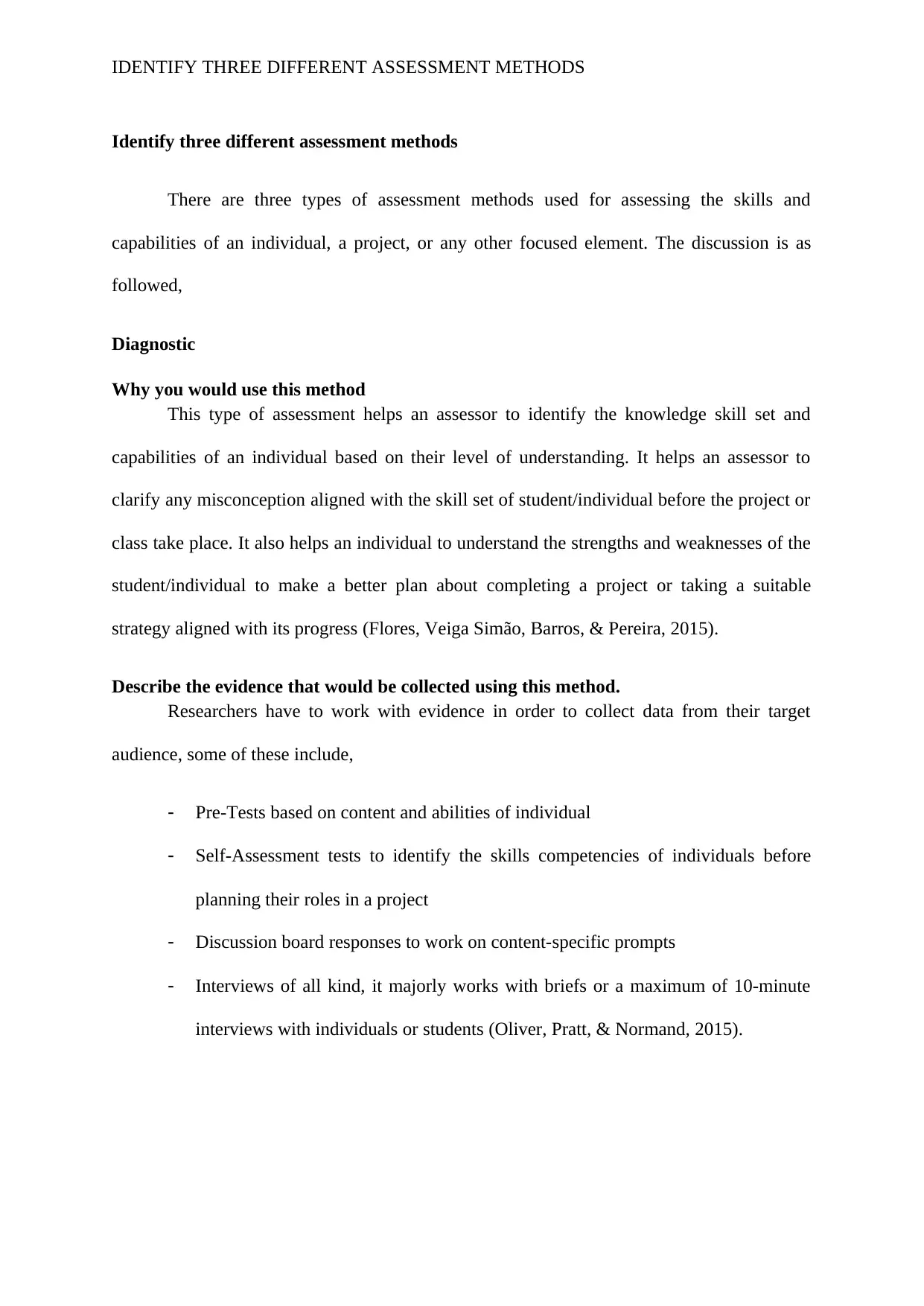
There are three types of assessment methods used for assessing the skills and
capabilities of an individual, a project, or any other focused element. The discussion is as
followed,
Diagnostic
Why you would use this method
This type of assessment helps an assessor to identify the knowledge skill set and
capabilities of an individual based on their level of understanding. It helps an assessor to
clarify any misconception aligned with the skill set of student/individual before the project or
class take place. It also helps an individual to understand the strengths and weaknesses of the
student/individual to make a better plan about completing a project or taking a suitable
strategy aligned with its progress (Flores, Veiga Simão, Barros, & Pereira, 2015).
Describe the evidence that would be collected using this method.
Researchers have to work with evidence in order to collect data from their target
audience, some of these include,
- Pre-Tests based on content and abilities of individual
- Self-Assessment tests to identify the skills competencies of individuals before
planning their roles in a project
- Discussion board responses to work on content-specific prompts
- Interviews of all kind, it majorly works with briefs or a maximum of 10-minute
interviews with individuals or students (Oliver, Pratt, & Normand, 2015).
Document Page
IDENTIFY THREE DIFFERENT ASSESSMENT METHODS
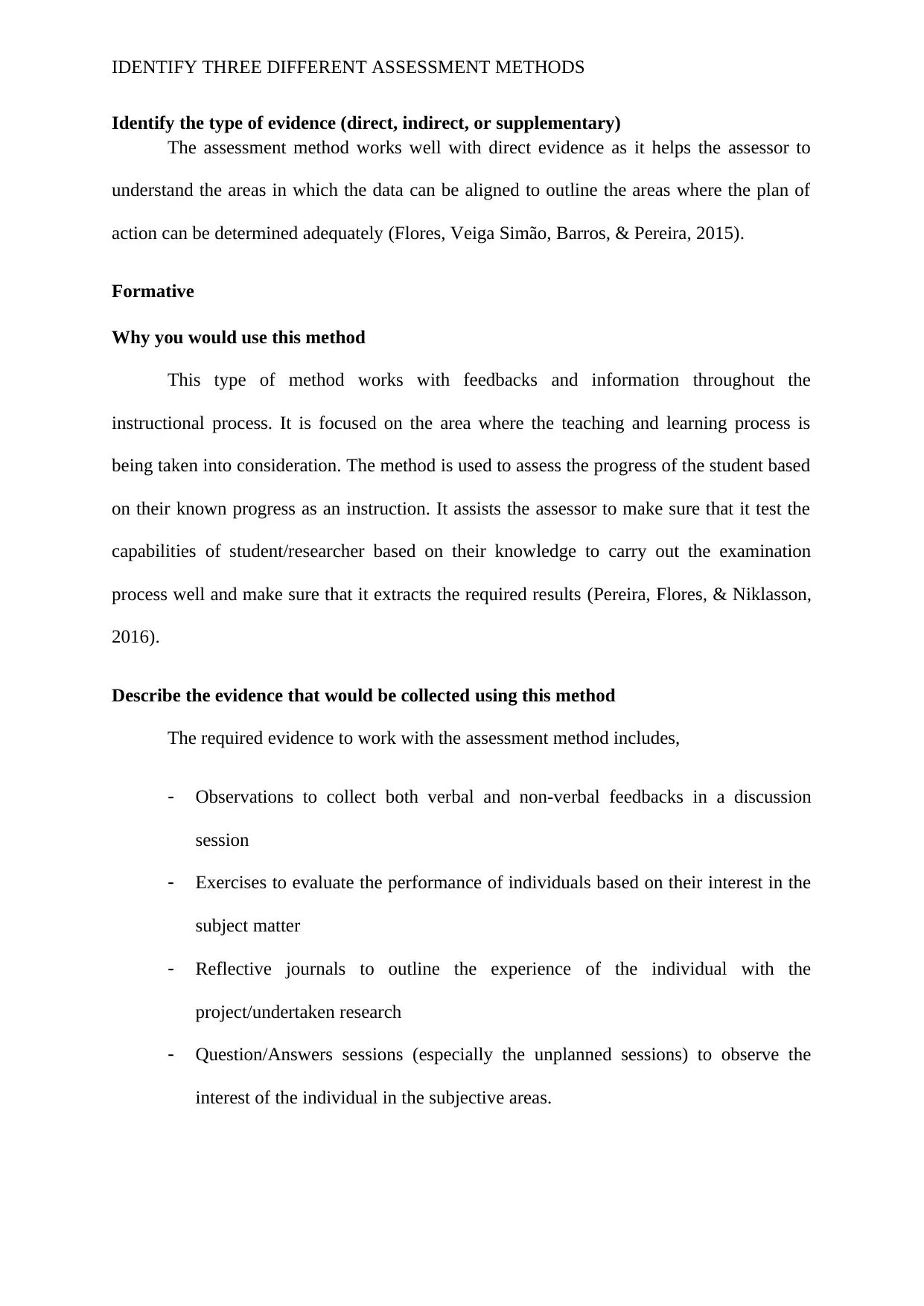
Identify the type of evidence (direct, indirect, or supplementary)
The assessment method works well with direct evidence as it helps the assessor to
understand the areas in which the data can be aligned to outline the areas where the plan of
action can be determined adequately (Flores, Veiga Simão, Barros, & Pereira, 2015).
Formative
Why you would use this method
This type of method works with feedbacks and information throughout the
instructional process. It is focused on the area where the teaching and learning process is
being taken into consideration. The method is used to assess the progress of the student based
on their known progress as an instruction. It assists the assessor to make sure that it test the
capabilities of student/researcher based on their knowledge to carry out the examination
process well and make sure that it extracts the required results (Pereira, Flores, & Niklasson,
2016).
Describe the evidence that would be collected using this method
The required evidence to work with the assessment method includes,
- Observations to collect both verbal and non-verbal feedbacks in a discussion
session
- Exercises to evaluate the performance of individuals based on their interest in the
subject matter
- Reflective journals to outline the experience of the individual with the
project/undertaken research
- Question/Answers sessions (especially the unplanned sessions) to observe the
interest of the individual in the subjective areas.
tabler-icon-diamond-filled.svg

Paraphrase This Document

Need a fresh take? Get an instant paraphrase of this document with our AI Paraphraser
Document Page
IDENTIFY THREE DIFFERENT ASSESSMENT METHODS
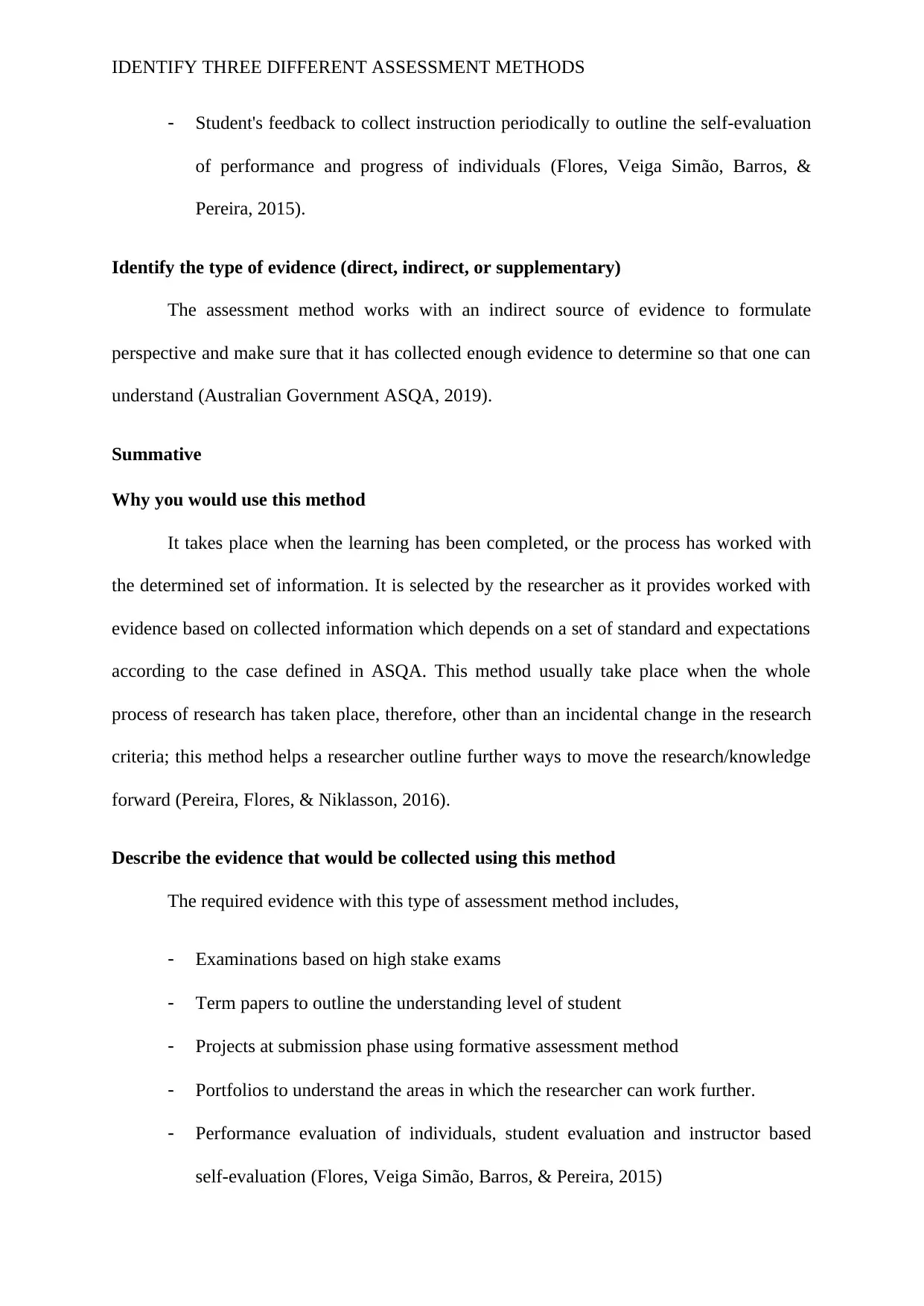
- Student's feedback to collect instruction periodically to outline the self-evaluation
of performance and progress of individuals (Flores, Veiga Simão, Barros, &
Pereira, 2015).
Identify the type of evidence (direct, indirect, or supplementary)
The assessment method works with an indirect source of evidence to formulate
perspective and make sure that it has collected enough evidence to determine so that one can
understand (Australian Government ASQA, 2019).
Summative
Why you would use this method
It takes place when the learning has been completed, or the process has worked with
the determined set of information. It is selected by the researcher as it provides worked with
evidence based on collected information which depends on a set of standard and expectations
according to the case defined in ASQA. This method usually take place when the whole
process of research has taken place, therefore, other than an incidental change in the research
criteria; this method helps a researcher outline further ways to move the research/knowledge
forward (Pereira, Flores, & Niklasson, 2016).
Describe the evidence that would be collected using this method
The required evidence with this type of assessment method includes,
- Examinations based on high stake exams
- Term papers to outline the understanding level of student
- Projects at submission phase using formative assessment method
- Portfolios to understand the areas in which the researcher can work further.
- Performance evaluation of individuals, student evaluation and instructor based
self-evaluation (Flores, Veiga Simão, Barros, & Pereira, 2015)
Document Page
IDENTIFY THREE DIFFERENT ASSESSMENT METHODS
Identify the type of evidence (direct, indirect, or supplementary)
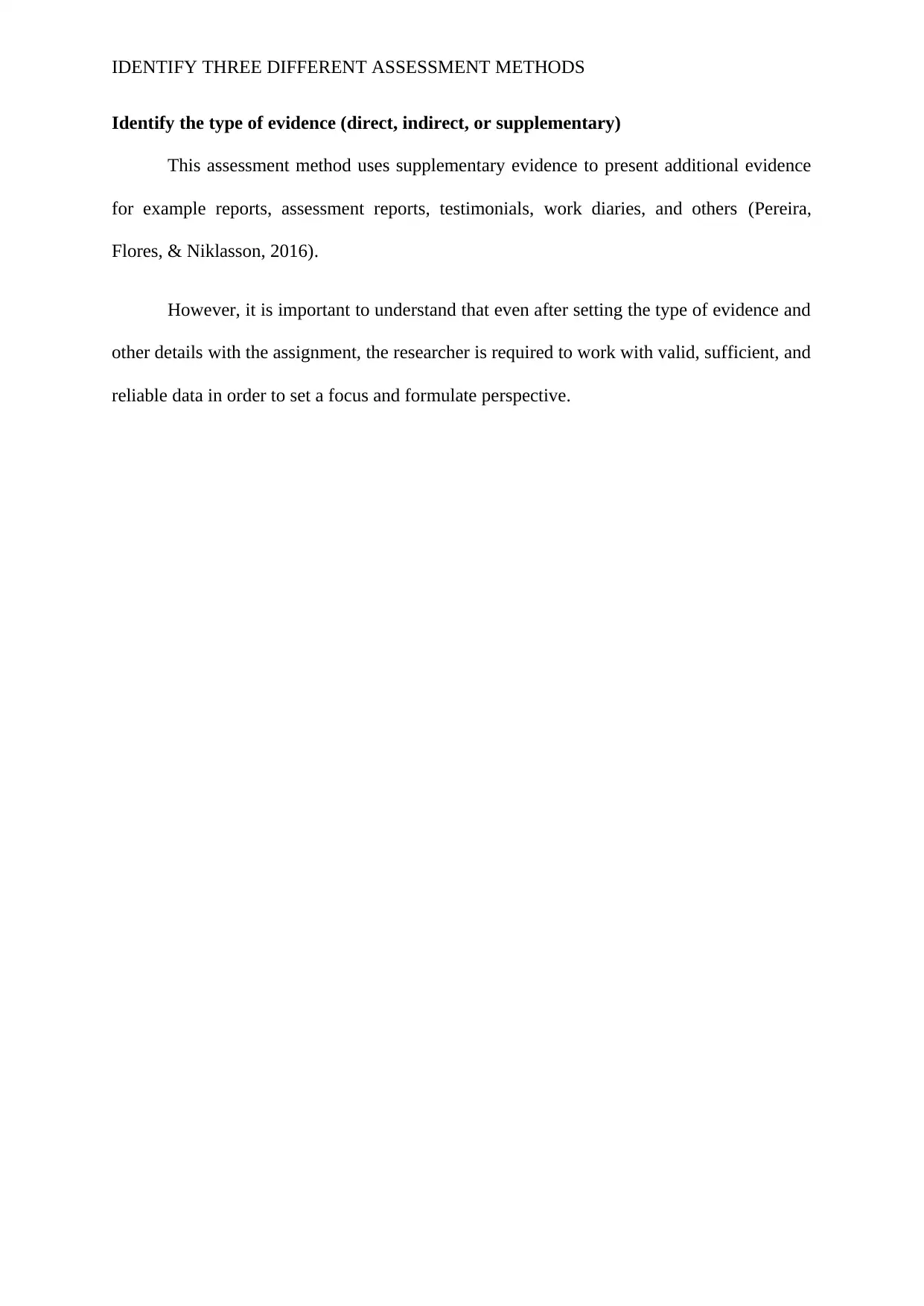
This assessment method uses supplementary evidence to present additional evidence
for example reports, assessment reports, testimonials, work diaries, and others (Pereira,
Flores, & Niklasson, 2016).
However, it is important to understand that even after setting the type of evidence and
other details with the assignment, the researcher is required to work with valid, sufficient, and
reliable data in order to set a focus and formulate perspective.
Document Page
IDENTIFY THREE DIFFERENT ASSESSMENT METHODS
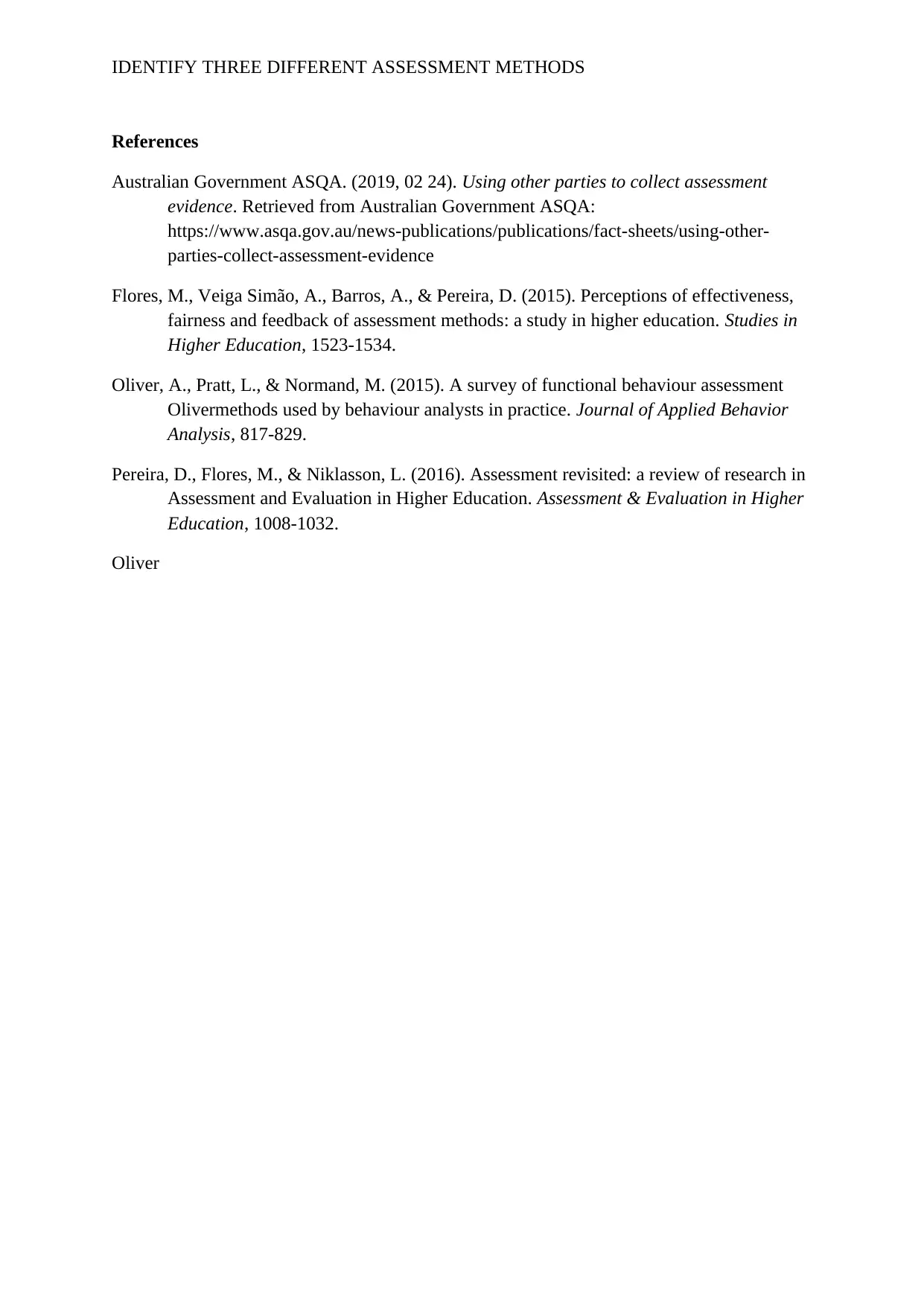
References
Australian Government ASQA. (2019, 02 24). Using other parties to collect assessment
evidence. Retrieved from Australian Government ASQA:
https://www.asqa.gov.au/news-publications/publications/fact-sheets/using-other-
parties-collect-assessment-evidence
Flores, M., Veiga Simão, A., Barros, A., & Pereira, D. (2015). Perceptions of effectiveness,
fairness and feedback of assessment methods: a study in higher education. Studies in
Higher Education, 1523-1534.
Oliver, A., Pratt, L., & Normand, M. (2015). A survey of functional behaviour assessment
Olivermethods used by behaviour analysts in practice. Journal of Applied Behavior
Analysis, 817-829.
Pereira, D., Flores, M., & Niklasson, L. (2016). Assessment revisited: a review of research in
Assessment and Evaluation in Higher Education. Assessment & Evaluation in Higher
Education, 1008-1032.
Oliver
chevron_up_icon
1 out of 7
circle_padding
hide_on_mobile
zoom_out_icon
[object Object]