TEACH310: Report on Assessment in Mathematics (Various Methods)
VerifiedAdded on 2022/09/25
|5
|1280
|22
Report
AI Summary
This report delves into the realm of mathematics assessment, exploring three pivotal methods: summative, formative, and diagnostic assessments. It begins by defining assessments as systematic tools used to track student progress and improve learning outcomes. The report then elaborates on each assessment type, detailing their applications and implications. Summative assessments, traditionally used for grading, are contrasted with formative assessments, which focus on in-process learning and identifying areas for improvement. Diagnostic assessments, implemented before instruction, are highlighted for their role in understanding students' existing knowledge and skills, thereby informing lesson planning. The report discusses the practical implementation of each method, including considerations for content coverage, administration, and feedback. It evaluates the advantages and disadvantages of each approach, offering insights into their effectiveness and cost-efficiency. Finally, the report considers dimensions of assessment such as functionality, time considerations, evidence characteristics, and scoring methods, to provide a comprehensive overview of assessment practices in mathematics education.
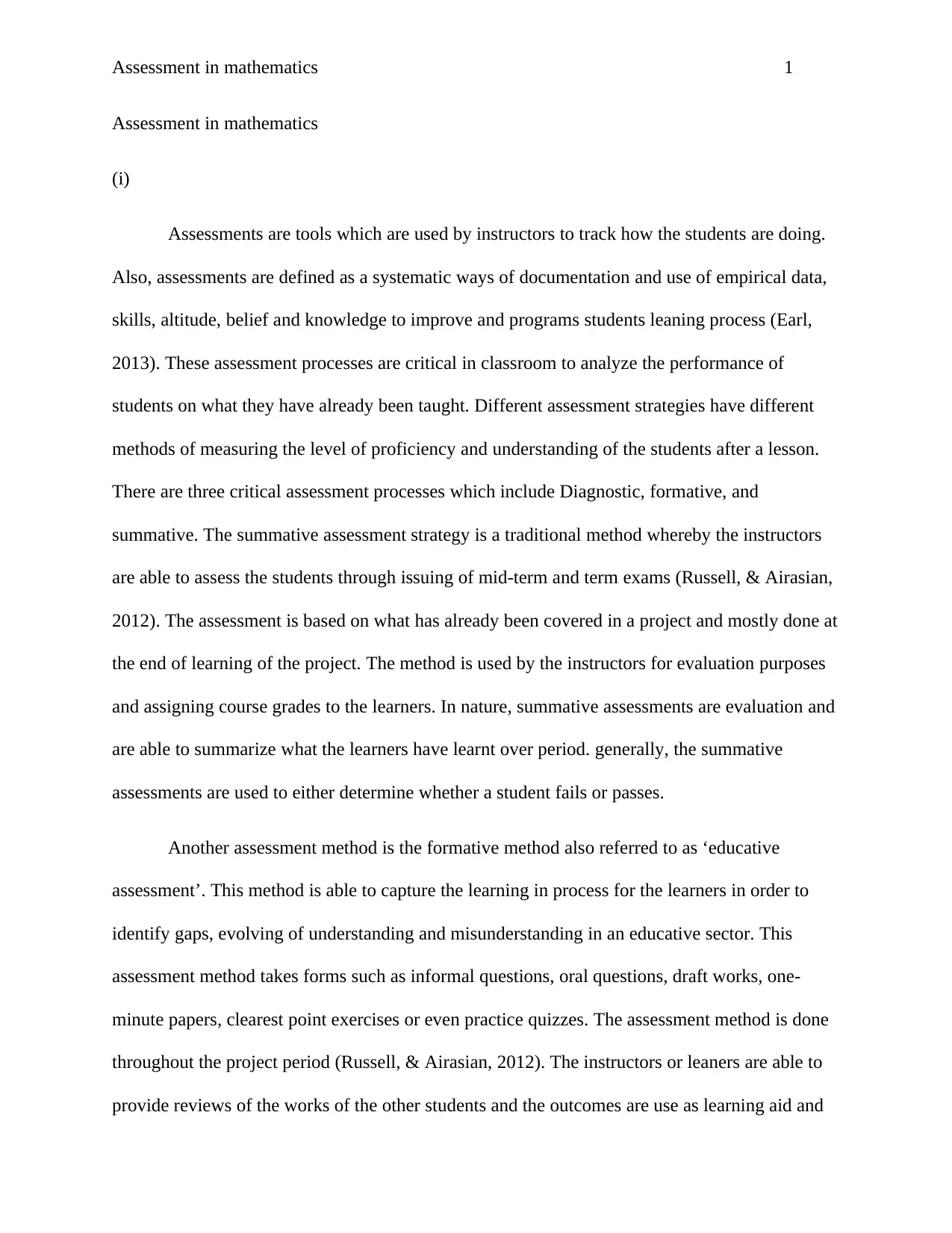
Assessment in mathematics 1
Assessment in mathematics
(i)
Assessments are tools which are used by instructors to track how the students are doing.
Also, assessments are defined as a systematic ways of documentation and use of empirical data,
skills, altitude, belief and knowledge to improve and programs students leaning process (Earl,
2013). These assessment processes are critical in classroom to analyze the performance of
students on what they have already been taught. Different assessment strategies have different
methods of measuring the level of proficiency and understanding of the students after a lesson.
There are three critical assessment processes which include Diagnostic, formative, and
summative. The summative assessment strategy is a traditional method whereby the instructors
are able to assess the students through issuing of mid-term and term exams (Russell, & Airasian,
2012). The assessment is based on what has already been covered in a project and mostly done at
the end of learning of the project. The method is used by the instructors for evaluation purposes
and assigning course grades to the learners. In nature, summative assessments are evaluation and
are able to summarize what the learners have learnt over period. generally, the summative
assessments are used to either determine whether a student fails or passes.
Another assessment method is the formative method also referred to as ‘educative
assessment’. This method is able to capture the learning in process for the learners in order to
identify gaps, evolving of understanding and misunderstanding in an educative sector. This
assessment method takes forms such as informal questions, oral questions, draft works, one-
minute papers, clearest point exercises or even practice quizzes. The assessment method is done
throughout the project period (Russell, & Airasian, 2012). The instructors or leaners are able to
provide reviews of the works of the other students and the outcomes are use as learning aid and
Assessment in mathematics
(i)
Assessments are tools which are used by instructors to track how the students are doing.
Also, assessments are defined as a systematic ways of documentation and use of empirical data,
skills, altitude, belief and knowledge to improve and programs students leaning process (Earl,
2013). These assessment processes are critical in classroom to analyze the performance of
students on what they have already been taught. Different assessment strategies have different
methods of measuring the level of proficiency and understanding of the students after a lesson.
There are three critical assessment processes which include Diagnostic, formative, and
summative. The summative assessment strategy is a traditional method whereby the instructors
are able to assess the students through issuing of mid-term and term exams (Russell, & Airasian,
2012). The assessment is based on what has already been covered in a project and mostly done at
the end of learning of the project. The method is used by the instructors for evaluation purposes
and assigning course grades to the learners. In nature, summative assessments are evaluation and
are able to summarize what the learners have learnt over period. generally, the summative
assessments are used to either determine whether a student fails or passes.
Another assessment method is the formative method also referred to as ‘educative
assessment’. This method is able to capture the learning in process for the learners in order to
identify gaps, evolving of understanding and misunderstanding in an educative sector. This
assessment method takes forms such as informal questions, oral questions, draft works, one-
minute papers, clearest point exercises or even practice quizzes. The assessment method is done
throughout the project period (Russell, & Airasian, 2012). The instructors or leaners are able to
provide reviews of the works of the other students and the outcomes are use as learning aid and
Paraphrase This Document
Need a fresh take? Get an instant paraphrase of this document with our AI Paraphraser

Assessment in mathematics 2
not for grading purposes. Generally, the assessment through this method can be used to evaluate
whether students understand the instructions. Lastly, another critical assessment method is the
diagnostic assessment process (Suskie, 2014). This method is carried prior to leaning process and
allows the tutors to determine the strength, weakness, knowledge and skills of the students before
the instructions. The major aim of this method is to evaluate the hitches which the students are
able to face and therefore guide in planning of the lessons and curriculum.
(ii)
When implementing the summative assessment, the teachers need consider the level of
the content which has already been covered. This tutors will then set the assessment up to the
level where study has been done. To administer the assessment, the tutors will then base their
content which has been done. Moreover, the tutors are not mandated to response to the answers
but decide on the trading method (Allen, 2014). The second method of formative assessment is
done through progressive review of the learner’s progress. Oral questions, informal questions,
oral questions, draft works, one-minute papers, clearest point exercises or even practice quizzes
are administered to the learners. The tutors are able to give the assessments progressively and
monitor the performance of the learners. In addition, the assessments are administered all
through the project life. The tutors also have the chance to answer back to the answers which the
learners provide and provide further guidance. The diagnostic assessment is usually administered
before the project begins. The tutors are able to ask questions on the course to be covered and
therefore able to determine the knowledge of the topic to the tutors. The tutor’s assessment is
based on the content to be covered only.
(iii)
not for grading purposes. Generally, the assessment through this method can be used to evaluate
whether students understand the instructions. Lastly, another critical assessment method is the
diagnostic assessment process (Suskie, 2014). This method is carried prior to leaning process and
allows the tutors to determine the strength, weakness, knowledge and skills of the students before
the instructions. The major aim of this method is to evaluate the hitches which the students are
able to face and therefore guide in planning of the lessons and curriculum.
(ii)
When implementing the summative assessment, the teachers need consider the level of
the content which has already been covered. This tutors will then set the assessment up to the
level where study has been done. To administer the assessment, the tutors will then base their
content which has been done. Moreover, the tutors are not mandated to response to the answers
but decide on the trading method (Allen, 2014). The second method of formative assessment is
done through progressive review of the learner’s progress. Oral questions, informal questions,
oral questions, draft works, one-minute papers, clearest point exercises or even practice quizzes
are administered to the learners. The tutors are able to give the assessments progressively and
monitor the performance of the learners. In addition, the assessments are administered all
through the project life. The tutors also have the chance to answer back to the answers which the
learners provide and provide further guidance. The diagnostic assessment is usually administered
before the project begins. The tutors are able to ask questions on the course to be covered and
therefore able to determine the knowledge of the topic to the tutors. The tutor’s assessment is
based on the content to be covered only.
(iii)

Assessment in mathematics 3
The summative assessment method is considered to be a cost effective method, is good
for grading the learners and does not consume a lot of time. The method is cost effective because
only test papers need to be prepared for learners to answer. The method has its demerits and it is
considered as ineffective method for helping the learners since it is considered as a lazy method
of assessment (Bennett, 2015). The method does not provide any feedback to the learners or
instructors for further improvement. It therefore lacks to provide a platform for the learners to
learn. The formative assessment, major merit is that the tutors will offer platform for the tutors to
offer comments to the tutor’s responses. This is because the learners and the tutors will be able to
discuss the answers and assessments together. The tutors have to consider on ways to improve
the learning for the leaners because the process is interactive (Madaus, & Airasian, 2015). The
major demerit with the method is that it is time consuming and expensive. The discussions with
the learners is time consuming and costly. The major merits with the diagnostic assessment is
that it allows the tutors and learners to plan well and give them time to focus on lessons with
prior knowledge. This is because both the tutor and the learners have time to review and
familiarize themselves with the content of the projects. It also gives the tutors room to
individualize instructions by giving them room to focus on areas where learners are weak. The
tutors are should also consider and identify any misconceptions which are available on the
content to be covered. In order to make informed teaching decisions, the tutors are expected to
consider which content will be covered and make informed decisions on covering the same.
(iv)
The assessment methods are done considering several dimensions of their functionality,
time consideration, characteristic of the evidence and gathering techniques (Miller, Linn, &
Gronlund, 2013). Also other dimensions considered include the sampling methods, scoring and
The summative assessment method is considered to be a cost effective method, is good
for grading the learners and does not consume a lot of time. The method is cost effective because
only test papers need to be prepared for learners to answer. The method has its demerits and it is
considered as ineffective method for helping the learners since it is considered as a lazy method
of assessment (Bennett, 2015). The method does not provide any feedback to the learners or
instructors for further improvement. It therefore lacks to provide a platform for the learners to
learn. The formative assessment, major merit is that the tutors will offer platform for the tutors to
offer comments to the tutor’s responses. This is because the learners and the tutors will be able to
discuss the answers and assessments together. The tutors have to consider on ways to improve
the learning for the leaners because the process is interactive (Madaus, & Airasian, 2015). The
major demerit with the method is that it is time consuming and expensive. The discussions with
the learners is time consuming and costly. The major merits with the diagnostic assessment is
that it allows the tutors and learners to plan well and give them time to focus on lessons with
prior knowledge. This is because both the tutor and the learners have time to review and
familiarize themselves with the content of the projects. It also gives the tutors room to
individualize instructions by giving them room to focus on areas where learners are weak. The
tutors are should also consider and identify any misconceptions which are available on the
content to be covered. In order to make informed teaching decisions, the tutors are expected to
consider which content will be covered and make informed decisions on covering the same.
(iv)
The assessment methods are done considering several dimensions of their functionality,
time consideration, characteristic of the evidence and gathering techniques (Miller, Linn, &
Gronlund, 2013). Also other dimensions considered include the sampling methods, scoring and
⊘ This is a preview!⊘
Do you want full access?
Subscribe today to unlock all pages.

Trusted by 1+ million students worldwide

Assessment in mathematics 4
reporting, standards achieved, reliability and validity of the outcomes. The tutors are able to
determine, value, describe or even classify different aspects of the learners through these
methods.
reporting, standards achieved, reliability and validity of the outcomes. The tutors are able to
determine, value, describe or even classify different aspects of the learners through these
methods.
Paraphrase This Document
Need a fresh take? Get an instant paraphrase of this document with our AI Paraphraser

Assessment in mathematics 5
References
Earl, L. (2013). Assessment as Learning: Using Classroom Assessment to Maximise Student
Learning. Thousand Oaks, CA, Corwin Press.
Miller, D. M., Linn, R. L., & Gronlund, N. E. (2013). Measurement and Assessment in Teaching
(11th ed.). Boston, MA: Pearson.
Russell, M. K., & Airasian, P. W. (2012). Classroom Assessment: Concepts and Applications
(7th ed.). New York: McGraw Hill.
Bennett, R. E. (2015). The changing nature of educational assessment. Review of Research in
Education, 39(1), 370-407.
Allen, M.J. (2014). Assessing Academic Programs in Higher Education. San Francisco: Jossey-
Bass.
Suskie, L. (2014). Assessing Student Learning. Bolton, MA: Anker.
Madaus, George F.; Airasian, Peter W. (2015). "Placement, Formative, Diagnostic, and
Summative Evaluation of Classroom Learning", Seattle Post-Intelligencer.
References
Earl, L. (2013). Assessment as Learning: Using Classroom Assessment to Maximise Student
Learning. Thousand Oaks, CA, Corwin Press.
Miller, D. M., Linn, R. L., & Gronlund, N. E. (2013). Measurement and Assessment in Teaching
(11th ed.). Boston, MA: Pearson.
Russell, M. K., & Airasian, P. W. (2012). Classroom Assessment: Concepts and Applications
(7th ed.). New York: McGraw Hill.
Bennett, R. E. (2015). The changing nature of educational assessment. Review of Research in
Education, 39(1), 370-407.
Allen, M.J. (2014). Assessing Academic Programs in Higher Education. San Francisco: Jossey-
Bass.
Suskie, L. (2014). Assessing Student Learning. Bolton, MA: Anker.
Madaus, George F.; Airasian, Peter W. (2015). "Placement, Formative, Diagnostic, and
Summative Evaluation of Classroom Learning", Seattle Post-Intelligencer.
1 out of 5
Related Documents
Your All-in-One AI-Powered Toolkit for Academic Success.
+13062052269
info@desklib.com
Available 24*7 on WhatsApp / Email
Unlock your academic potential
Copyright © 2020–2026 A2Z Services. All Rights Reserved. Developed and managed by ZUCOL.