Assessment Report: BSBLED808 - Career Development Session, ICoT
VerifiedAdded on 2022/12/05
|20
|5179
|265
Homework Assignment
AI Summary
This document presents a comprehensive assessment report for the BSBLED808 unit, focusing on conducting career development sessions. The report delves into various career development theories and models, including Trait and Factor Theory, Holland's Theory, and Super's Theory, explaining their core concepts and applications. It analyzes the impact of thinking, feeling, and behavior patterns on career choices and outlines essential skills for delivering effective career development sessions, such as presentation, communication, and building rapport. The assessment also covers service provision, lifelong learning, holistic career development, and career decision-making principles. The document provides detailed answers to written questions, an executive summary, and a discussion of career development theories, making it a valuable resource for students studying career development.
Assessment Resource Summary
Unit Details BSBLED808 - Conduct a career development session
Assessment Type This is a summative assessment, this assessment needs adequate practice
prior to undertaking this assessment.
Assessment
Methods
Written Questions Assessment 1
Written Report and Presentation Assessment 2
Presentation Assessment 3
Role Play and Written Report Assessment 4
Unit Details BSBLED808 - Conduct a career development session
Assessment Type This is a summative assessment, this assessment needs adequate practice
prior to undertaking this assessment.
Assessment
Methods
Written Questions Assessment 1
Written Report and Presentation Assessment 2
Presentation Assessment 3
Role Play and Written Report Assessment 4

Paraphrase This Document
Need a fresh take? Get an instant paraphrase of this document with our AI Paraphraser
BSB80615 – Sep 2019
Table of content
Assessment 1 written question................................................................................................3
Question 1...............................................................................................................................3
Question 2...............................................................................................................................6
Question 3...............................................................................................................................7
Question 4...............................................................................................................................8
Question 5...............................................................................................................................9
Question 6.............................................................................................................................11
Question 7.............................................................................................................................12
Question 8.............................................................................................................................12
Assessment 2 Report and presentation................................................................................13
a. Executive summery.......................................................................................................13
b. Types of career development theories and models.......................................................13
c. Best suited career development theories for the college and why?..............................15
d. Best suitable for individuals and overall group.............................................................16
e. Relation of development model with recent case.........................................................16
f. Relation of this model with the principles of diversity at the college...........................17
g. Conclusion.....................................................................................................................17
References...............................................................................................................................18
TAS-GDAT-V2-06092018 © International College of Tasmania Page 2 |
20
Table of content
Assessment 1 written question................................................................................................3
Question 1...............................................................................................................................3
Question 2...............................................................................................................................6
Question 3...............................................................................................................................7
Question 4...............................................................................................................................8
Question 5...............................................................................................................................9
Question 6.............................................................................................................................11
Question 7.............................................................................................................................12
Question 8.............................................................................................................................12
Assessment 2 Report and presentation................................................................................13
a. Executive summery.......................................................................................................13
b. Types of career development theories and models.......................................................13
c. Best suited career development theories for the college and why?..............................15
d. Best suitable for individuals and overall group.............................................................16
e. Relation of development model with recent case.........................................................16
f. Relation of this model with the principles of diversity at the college...........................17
g. Conclusion.....................................................................................................................17
References...............................................................................................................................18
TAS-GDAT-V2-06092018 © International College of Tasmania Page 2 |
20
BSB80615 – Sep 2019
Assessment 1 written question
Question 1
Explain the major career development theories and models client care.
Trait and factor theory
Let us now discuss the few popular career development theories and models which helps an
individual in shaping their career. The trait and factor theory demonstrate that an individual
tends to make their career according to their traits and personality. One of the finest authors
named Frank Parsons, proposed that one tends to make a choice of her career based on three
factors. One is knowledge of one’s own education and experience; another is the knowledge
which comes from job description and specifications and the third one is the ability to make a
proper match between the two.
There are two basic assumptions which goes behind the success of trait and factor theory. It is
said that the traits of an individual and trait required for doing job should be matched.
Another assumption is that there is a positive relation between achievement on job and
satisfaction of oneself. Pearson feels that when somebody is being assigned with the task of
his or her interest and traits, person will be able to handle that task more diligently. The
observation says that one needs to attain expertise in his career no matter what, and that’s
what make them to go to their comfortable field and zone. The disadvantage to this career
development plan is that people hesitate to go beyond their expertise, they tend to perform
tasks which are according to their skills and knowledge (Giobbi, 2018).
TAS-GDAT-V2-06092018 © International College of Tasmania Page 3 |
20
Assessment 1 written question
Question 1
Explain the major career development theories and models client care.
Trait and factor theory
Let us now discuss the few popular career development theories and models which helps an
individual in shaping their career. The trait and factor theory demonstrate that an individual
tends to make their career according to their traits and personality. One of the finest authors
named Frank Parsons, proposed that one tends to make a choice of her career based on three
factors. One is knowledge of one’s own education and experience; another is the knowledge
which comes from job description and specifications and the third one is the ability to make a
proper match between the two.
There are two basic assumptions which goes behind the success of trait and factor theory. It is
said that the traits of an individual and trait required for doing job should be matched.
Another assumption is that there is a positive relation between achievement on job and
satisfaction of oneself. Pearson feels that when somebody is being assigned with the task of
his or her interest and traits, person will be able to handle that task more diligently. The
observation says that one needs to attain expertise in his career no matter what, and that’s
what make them to go to their comfortable field and zone. The disadvantage to this career
development plan is that people hesitate to go beyond their expertise, they tend to perform
tasks which are according to their skills and knowledge (Giobbi, 2018).
TAS-GDAT-V2-06092018 © International College of Tasmania Page 3 |
20
⊘ This is a preview!⊘
Do you want full access?
Subscribe today to unlock all pages.

Trusted by 1+ million students worldwide
BSB80615 – Sep 2019
Hollands theory
In Hollands theory, author suggests that people who get job according to their personality can
function better in future and gains more satisfaction. There are two assumptions that goes
along with this particular theory. First says that an individual selects the career which reflects
their personality because they feel more confident and surer about outcomes (Yılmaz, 2017).
This theory focuses more on behavioural style or personality types of an individual while
developing a career choice. So there are some common themes which build the base the
theory such as occupation choice is commonly based on personality, people belongs to
common group tend to behave in similar pattern, individual belong to particular group tend to
react to any problem or situation in similar way, occupational achievement and satisfaction
are depended on one’s personality and work culture.
(N.A, 2018)
Basically, there are six types of personality identified as a part of the Hollands theory. People
belong to the group of realistic tend to be more practical, stable and sensitive, seen in the
field of construction, farming etc. In the same line, an individual belongs to investigative
group tends to be more social and analytical by behaviour, seen in the field of programming
and medical science. Person who are more social tend to show characteristics of being more
cooperative and friendly. Similar way, enterprising and conventional personalities are seen in
the field of business and data entry respectively.
TAS-GDAT-V2-06092018 © International College of Tasmania Page 4 |
20
Hollands theory
In Hollands theory, author suggests that people who get job according to their personality can
function better in future and gains more satisfaction. There are two assumptions that goes
along with this particular theory. First says that an individual selects the career which reflects
their personality because they feel more confident and surer about outcomes (Yılmaz, 2017).
This theory focuses more on behavioural style or personality types of an individual while
developing a career choice. So there are some common themes which build the base the
theory such as occupation choice is commonly based on personality, people belongs to
common group tend to behave in similar pattern, individual belong to particular group tend to
react to any problem or situation in similar way, occupational achievement and satisfaction
are depended on one’s personality and work culture.
(N.A, 2018)
Basically, there are six types of personality identified as a part of the Hollands theory. People
belong to the group of realistic tend to be more practical, stable and sensitive, seen in the
field of construction, farming etc. In the same line, an individual belongs to investigative
group tends to be more social and analytical by behaviour, seen in the field of programming
and medical science. Person who are more social tend to show characteristics of being more
cooperative and friendly. Similar way, enterprising and conventional personalities are seen in
the field of business and data entry respectively.
TAS-GDAT-V2-06092018 © International College of Tasmania Page 4 |
20
Paraphrase This Document
Need a fresh take? Get an instant paraphrase of this document with our AI Paraphraser
BSB80615 – Sep 2019
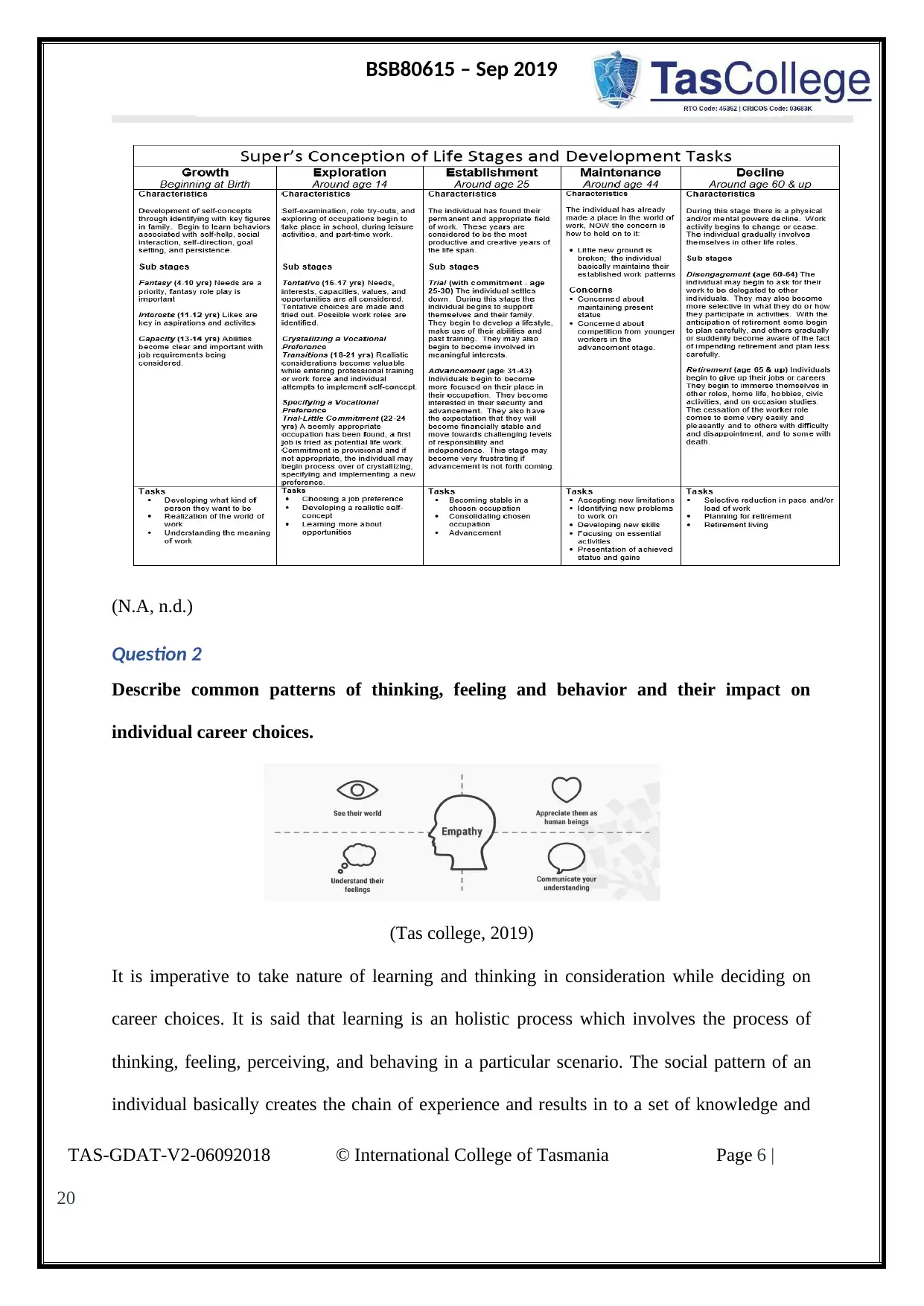
Super’s theory
Super theory basically talks about the common behavior that changes all around the ages. The
author feels that people get mature as time goes and their choices with respect to career even
changes with the time. There are six major factors being introduced as a part of vocational
maturity (careers.govt.nz, 2019).
The factors are self-awareness, decision-making skills, sources of information, General career
information and the preference to the particular occupation. Now let us take an example of
A, how an individual pass through different stages of life and react to their occupational
choices. Let’s say A took a birth on this earth, in the beginning A is traying to figure out the
members of the family, learning different course of social interaction, and developing the
skills and abilities. Now, when he reaches to the stage of exploration, A has attained the age
around 14, where he has developed the set of abilities and traits, now he is moving forward to
capitalise on the prevailing opportunities. As and when A reaches to the age of 25, he tends to
try out different career options and selects what is good for him. He establishes his job
according to his expertise and interest. As an when A reaches to age of 40s, he enters in the
maintenance phase, here an individual tends to be more conscious about their status quo and
position. They tend to learn a new work pattern and work culture with to match with the
upcoming generation’s lifestyle. The last phase of life where A is seen to enter in the decline
stage, where he is observed to be more pessimistic at work and tends to be selective in the
task he is doing. Now, he reaches to stage where he attains the retirement age and trying to
spare time for relaxation.
TAS-GDAT-V2-06092018 © International College of Tasmania Page 5 |
20
Super’s theory
Super theory basically talks about the common behavior that changes all around the ages. The
author feels that people get mature as time goes and their choices with respect to career even
changes with the time. There are six major factors being introduced as a part of vocational
maturity (careers.govt.nz, 2019).
The factors are self-awareness, decision-making skills, sources of information, General career
information and the preference to the particular occupation. Now let us take an example of
A, how an individual pass through different stages of life and react to their occupational
choices. Let’s say A took a birth on this earth, in the beginning A is traying to figure out the
members of the family, learning different course of social interaction, and developing the
skills and abilities. Now, when he reaches to the stage of exploration, A has attained the age
around 14, where he has developed the set of abilities and traits, now he is moving forward to
capitalise on the prevailing opportunities. As and when A reaches to the age of 25, he tends to
try out different career options and selects what is good for him. He establishes his job
according to his expertise and interest. As an when A reaches to age of 40s, he enters in the
maintenance phase, here an individual tends to be more conscious about their status quo and
position. They tend to learn a new work pattern and work culture with to match with the
upcoming generation’s lifestyle. The last phase of life where A is seen to enter in the decline
stage, where he is observed to be more pessimistic at work and tends to be selective in the
task he is doing. Now, he reaches to stage where he attains the retirement age and trying to
spare time for relaxation.
TAS-GDAT-V2-06092018 © International College of Tasmania Page 5 |
20
BSB80615 – Sep 2019
(N.A, n.d.)
Question 2
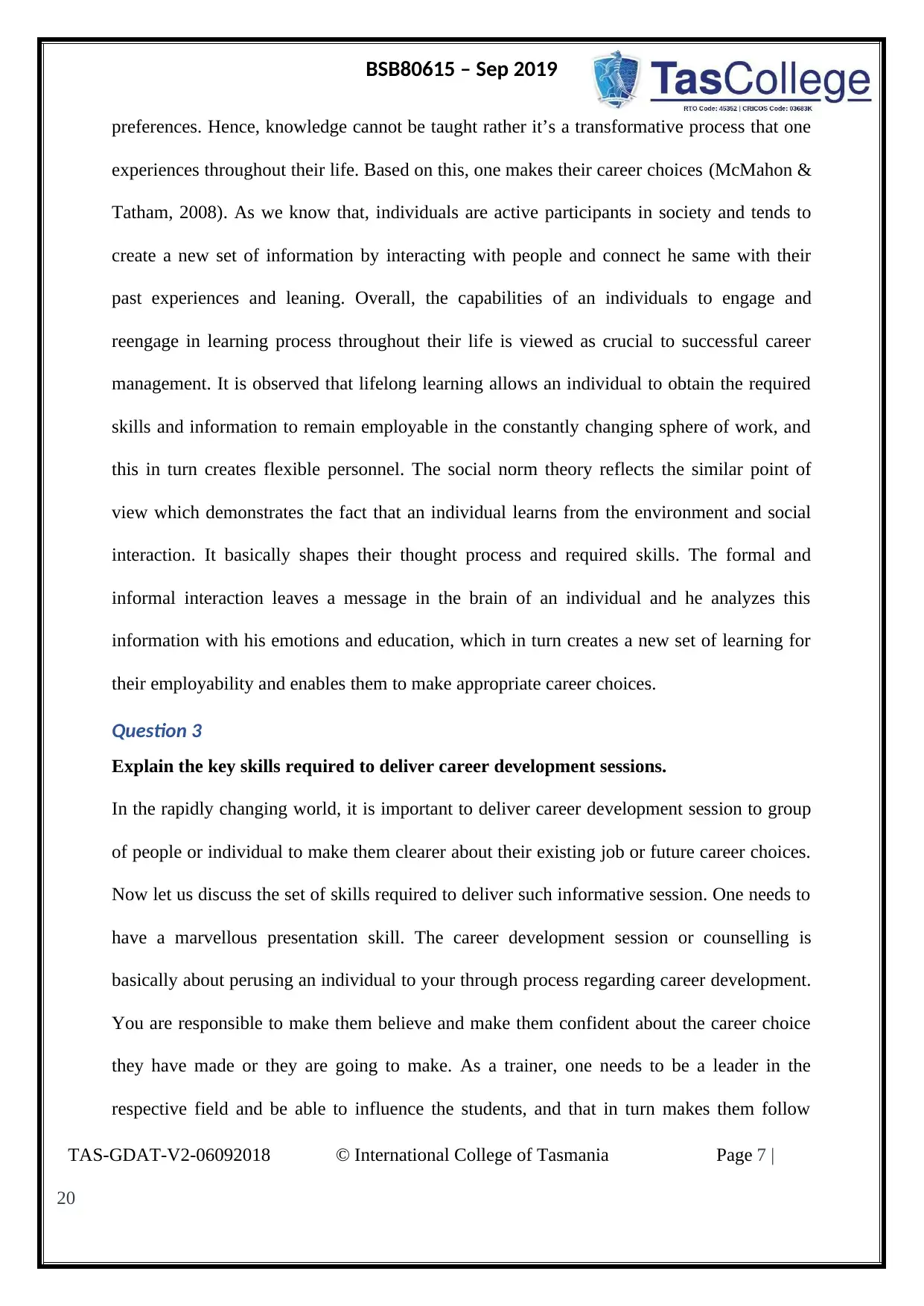
Describe common patterns of thinking, feeling and behavior and their impact on
individual career choices.
(Tas college, 2019)
It is imperative to take nature of learning and thinking in consideration while deciding on
career choices. It is said that learning is an holistic process which involves the process of
thinking, feeling, perceiving, and behaving in a particular scenario. The social pattern of an
individual basically creates the chain of experience and results in to a set of knowledge and
TAS-GDAT-V2-06092018 © International College of Tasmania Page 6 |
20
(N.A, n.d.)
Question 2
Describe common patterns of thinking, feeling and behavior and their impact on
individual career choices.
(Tas college, 2019)
It is imperative to take nature of learning and thinking in consideration while deciding on
career choices. It is said that learning is an holistic process which involves the process of
thinking, feeling, perceiving, and behaving in a particular scenario. The social pattern of an
individual basically creates the chain of experience and results in to a set of knowledge and
TAS-GDAT-V2-06092018 © International College of Tasmania Page 6 |
20
⊘ This is a preview!⊘
Do you want full access?
Subscribe today to unlock all pages.
Trusted by 1+ million students worldwide
BSB80615 – Sep 2019
preferences. Hence, knowledge cannot be taught rather it’s a transformative process that one
experiences throughout their life. Based on this, one makes their career choices (McMahon &
Tatham, 2008). As we know that, individuals are active participants in society and tends to
create a new set of information by interacting with people and connect he same with their
past experiences and leaning. Overall, the capabilities of an individuals to engage and
reengage in learning process throughout their life is viewed as crucial to successful career
management. It is observed that lifelong learning allows an individual to obtain the required
skills and information to remain employable in the constantly changing sphere of work, and
this in turn creates flexible personnel. The social norm theory reflects the similar point of
view which demonstrates the fact that an individual learns from the environment and social
interaction. It basically shapes their thought process and required skills. The formal and
informal interaction leaves a message in the brain of an individual and he analyzes this
information with his emotions and education, which in turn creates a new set of learning for
their employability and enables them to make appropriate career choices.
Question 3
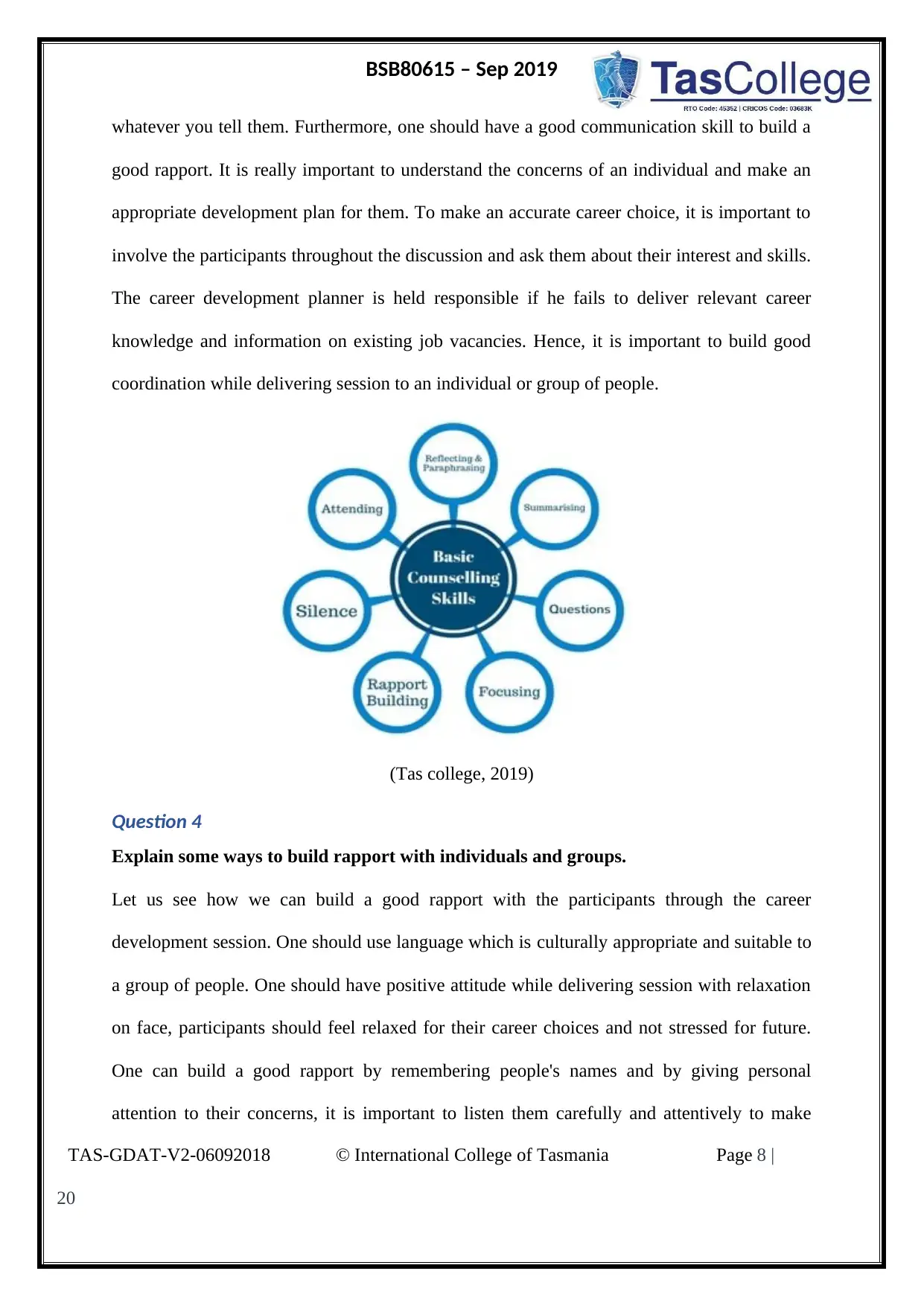
Explain the key skills required to deliver career development sessions.
In the rapidly changing world, it is important to deliver career development session to group
of people or individual to make them clearer about their existing job or future career choices.
Now let us discuss the set of skills required to deliver such informative session. One needs to
have a marvellous presentation skill. The career development session or counselling is
basically about perusing an individual to your through process regarding career development.
You are responsible to make them believe and make them confident about the career choice
they have made or they are going to make. As a trainer, one needs to be a leader in the
respective field and be able to influence the students, and that in turn makes them follow
TAS-GDAT-V2-06092018 © International College of Tasmania Page 7 |
20
preferences. Hence, knowledge cannot be taught rather it’s a transformative process that one
experiences throughout their life. Based on this, one makes their career choices (McMahon &
Tatham, 2008). As we know that, individuals are active participants in society and tends to
create a new set of information by interacting with people and connect he same with their
past experiences and leaning. Overall, the capabilities of an individuals to engage and
reengage in learning process throughout their life is viewed as crucial to successful career
management. It is observed that lifelong learning allows an individual to obtain the required
skills and information to remain employable in the constantly changing sphere of work, and
this in turn creates flexible personnel. The social norm theory reflects the similar point of
view which demonstrates the fact that an individual learns from the environment and social
interaction. It basically shapes their thought process and required skills. The formal and
informal interaction leaves a message in the brain of an individual and he analyzes this
information with his emotions and education, which in turn creates a new set of learning for
their employability and enables them to make appropriate career choices.
Question 3
Explain the key skills required to deliver career development sessions.
In the rapidly changing world, it is important to deliver career development session to group
of people or individual to make them clearer about their existing job or future career choices.
Now let us discuss the set of skills required to deliver such informative session. One needs to
have a marvellous presentation skill. The career development session or counselling is
basically about perusing an individual to your through process regarding career development.
You are responsible to make them believe and make them confident about the career choice
they have made or they are going to make. As a trainer, one needs to be a leader in the
respective field and be able to influence the students, and that in turn makes them follow
TAS-GDAT-V2-06092018 © International College of Tasmania Page 7 |
20
Paraphrase This Document
Need a fresh take? Get an instant paraphrase of this document with our AI Paraphraser
BSB80615 – Sep 2019
whatever you tell them. Furthermore, one should have a good communication skill to build a
good rapport. It is really important to understand the concerns of an individual and make an
appropriate development plan for them. To make an accurate career choice, it is important to
involve the participants throughout the discussion and ask them about their interest and skills.
The career development planner is held responsible if he fails to deliver relevant career
knowledge and information on existing job vacancies. Hence, it is important to build good
coordination while delivering session to an individual or group of people.
(Tas college, 2019)
Question 4
Explain some ways to build rapport with individuals and groups.
Let us see how we can build a good rapport with the participants through the career
development session. One should use language which is culturally appropriate and suitable to
a group of people. One should have positive attitude while delivering session with relaxation
on face, participants should feel relaxed for their career choices and not stressed for future.
One can build a good rapport by remembering people's names and by giving personal
attention to their concerns, it is important to listen them carefully and attentively to make
TAS-GDAT-V2-06092018 © International College of Tasmania Page 8 |
20
whatever you tell them. Furthermore, one should have a good communication skill to build a
good rapport. It is really important to understand the concerns of an individual and make an
appropriate development plan for them. To make an accurate career choice, it is important to
involve the participants throughout the discussion and ask them about their interest and skills.
The career development planner is held responsible if he fails to deliver relevant career
knowledge and information on existing job vacancies. Hence, it is important to build good
coordination while delivering session to an individual or group of people.
(Tas college, 2019)
Question 4
Explain some ways to build rapport with individuals and groups.
Let us see how we can build a good rapport with the participants through the career
development session. One should use language which is culturally appropriate and suitable to
a group of people. One should have positive attitude while delivering session with relaxation
on face, participants should feel relaxed for their career choices and not stressed for future.
One can build a good rapport by remembering people's names and by giving personal
attention to their concerns, it is important to listen them carefully and attentively to make
TAS-GDAT-V2-06092018 © International College of Tasmania Page 8 |
20
BSB80615 – Sep 2019
them involved with your discussion. Furthermore, one can start building rapport by intiating
the discussion on common ground. Finding common ground for discussion can be anytime a
good technique to start a discussion and build good rapport by the time the topic changes.
Moreover, one can be empathetic while listening their concerns and share the similar
experiences if he or she had in the past. It is essential to be humble while delivering the
session and that kindness would help a trainer to build good coordination in the class. It is
observed that asking frequent questions also helps trainer to obtain more participation from
the students and apologize at the very moment if required. Overall, we can say that the
discussed techniques will enable trainer to build a good rapport throughout the career
development session (KHATOON, 2016).
(Tas college, 2019)
Question 5
Outline concepts and principles relating to:
Service provision
The act of performing task for a person or a business in exchange of compensation is called
service provision. It needs to have set of qualified staff members to perform the particular job
at work. Such as university needs full time employee to deliver education services to their
students (CICA, 2007).
TAS-GDAT-V2-06092018 © International College of Tasmania Page 9 |
20
them involved with your discussion. Furthermore, one can start building rapport by intiating
the discussion on common ground. Finding common ground for discussion can be anytime a
good technique to start a discussion and build good rapport by the time the topic changes.
Moreover, one can be empathetic while listening their concerns and share the similar
experiences if he or she had in the past. It is essential to be humble while delivering the
session and that kindness would help a trainer to build good coordination in the class. It is
observed that asking frequent questions also helps trainer to obtain more participation from
the students and apologize at the very moment if required. Overall, we can say that the
discussed techniques will enable trainer to build a good rapport throughout the career
development session (KHATOON, 2016).
(Tas college, 2019)
Question 5
Outline concepts and principles relating to:
Service provision
The act of performing task for a person or a business in exchange of compensation is called
service provision. It needs to have set of qualified staff members to perform the particular job
at work. Such as university needs full time employee to deliver education services to their
students (CICA, 2007).
TAS-GDAT-V2-06092018 © International College of Tasmania Page 9 |
20
⊘ This is a preview!⊘
Do you want full access?
Subscribe today to unlock all pages.
Trusted by 1+ million students worldwide
BSB80615 – Sep 2019
Including lifelong learning
Lifelong learning is about learning throughout the life. It is ongoing and voluntary knowledge
which enhances self-motivation and competitiveness in the industry. It does not improve only
social interaction but improve employability in rapid changing world (N.A, 2012).
Holistic career development
Holistic career development talks about identifying the connect between mind, body and
spirit and consider it while developing set of skills. Such as teachers at play center look after
overall development of a kid; along with analyzing their cognitive abilities (LOCEY, 2019).
Career decision-making
Career decision making is the process of exploring an individual’s areas of interest and
values, link it with your educational qualification and career opportunities, and gradually
decide on job to join which meets your vision for life. Career decision making process is a
lengthy process which links every sphere of life to the occupational attainment
(career.fsu.edu, n.d.).
Career coaching
Career coaching enables you to take responsibilities of your dreams and outcomes related
with the same. Coaching makes us confident about the career development and enables us to
prepare precise strategies for the same (simmons.edu, 2015).
Career maintenance
There are two ways which defines the way you maintain your career. One is to accept what
comes around and see what happens after obtaining particular option. Second one is to
proactively work on the career choices and precisely take decision based on interest and skill
set (Dries, 2013).
TAS-GDAT-V2-06092018 © International College of Tasmania Page 10 |
20
Including lifelong learning
Lifelong learning is about learning throughout the life. It is ongoing and voluntary knowledge
which enhances self-motivation and competitiveness in the industry. It does not improve only
social interaction but improve employability in rapid changing world (N.A, 2012).
Holistic career development
Holistic career development talks about identifying the connect between mind, body and
spirit and consider it while developing set of skills. Such as teachers at play center look after
overall development of a kid; along with analyzing their cognitive abilities (LOCEY, 2019).
Career decision-making
Career decision making is the process of exploring an individual’s areas of interest and
values, link it with your educational qualification and career opportunities, and gradually
decide on job to join which meets your vision for life. Career decision making process is a
lengthy process which links every sphere of life to the occupational attainment
(career.fsu.edu, n.d.).
Career coaching
Career coaching enables you to take responsibilities of your dreams and outcomes related
with the same. Coaching makes us confident about the career development and enables us to
prepare precise strategies for the same (simmons.edu, 2015).
Career maintenance
There are two ways which defines the way you maintain your career. One is to accept what
comes around and see what happens after obtaining particular option. Second one is to
proactively work on the career choices and precisely take decision based on interest and skill
set (Dries, 2013).
TAS-GDAT-V2-06092018 © International College of Tasmania Page 10 |
20
Paraphrase This Document
Need a fresh take? Get an instant paraphrase of this document with our AI Paraphraser
BSB80615 – Sep 2019
Work satisfaction
The extent to which one is contented and motivated about the current work. Work satisfaction
is a positive feeling that one gets throughout their life or while walking on right career path.
One feels independent, and comfortable with the existing job in the respective field.
Employability
Employability is about having set of skills and capabilities to get initial placement in a
company. The word generally refers to the freshers, the capacity to match your qualification
and skills with the requirement of the company.
Enterprising
It is about having an ability and experience to think about new projects and new ways of
doing same things, which ultimately helps us to reach the success point.
Positive uncertainty
Positive uncertainty is a philosophy for making appropriate actions to deal with future
ambiguity. It is 2*4 plans which helps us to take appropriate decision involving rational and
intuitive point of view (Gelatt, n.d.).
Planned happenstance.
This viewpoint particularly helps us to create new opportunities out of curiosity.
Question 6
Explain what career development standards are and their impact on career counselling.
Let us discuss the code of conduct and career development standards which impacts majorly
on career counselling process. It is important for a trainer or a counselor to have such career
development competencies and skills set which is authorised by a national body. One should
follow a specific code of ethics while counselling session. It is important to treat an
individual without any biasness and pre-defined judgement. Your advice to them should be
TAS-GDAT-V2-06092018 © International College of Tasmania Page 11 |
20
Work satisfaction
The extent to which one is contented and motivated about the current work. Work satisfaction
is a positive feeling that one gets throughout their life or while walking on right career path.
One feels independent, and comfortable with the existing job in the respective field.
Employability
Employability is about having set of skills and capabilities to get initial placement in a
company. The word generally refers to the freshers, the capacity to match your qualification
and skills with the requirement of the company.
Enterprising
It is about having an ability and experience to think about new projects and new ways of
doing same things, which ultimately helps us to reach the success point.
Positive uncertainty
Positive uncertainty is a philosophy for making appropriate actions to deal with future
ambiguity. It is 2*4 plans which helps us to take appropriate decision involving rational and
intuitive point of view (Gelatt, n.d.).
Planned happenstance.
This viewpoint particularly helps us to create new opportunities out of curiosity.
Question 6
Explain what career development standards are and their impact on career counselling.
Let us discuss the code of conduct and career development standards which impacts majorly
on career counselling process. It is important for a trainer or a counselor to have such career
development competencies and skills set which is authorised by a national body. One should
follow a specific code of ethics while counselling session. It is important to treat an
individual without any biasness and pre-defined judgement. Your advice to them should be
TAS-GDAT-V2-06092018 © International College of Tasmania Page 11 |
20
BSB80615 – Sep 2019
free from any perception of their appearance or caste. Considering their skillset, education
and personality, he should be advised for particular career choices to make. He should be
given detailed career development plan which is beneficial for him and in turns the society
and business. One should strictly follow the code of ethics; the unethical behaviour may lead
unfortunate consequences. It is important to provide quality assurance to the public, take
them in confidence and convey relevant information to the stake holder in the industry. As a
part of provisional standards, the counsellor is held responsible to identify and evaluate the
diverse skills and knowledge of career development (Tas college, 2019).
Question 7
Outline legislative and regulatory requirements relevant to career counselling.
Based on the several study materials, it was concluded that councilor should be certified in
the respective domain and compliance. It is imperative for trainer to follow certain ethical
and legal framework for career counselling, however there are no standard legal framework
which exists but councilor should be from a renowned organization and authorized institutes
(Rich Engelhorn, n.d.).
Question 8
Outline Organizational policies relating to career counselling.
Each and every organization has a different set of policy and procedures for career
counselling. It is observed that most of the organization schedules career counseling every
quarter. Furthermore, they prepare action plan based on the feedback to fine tune the
performance. And experts advise and train an individual and group of people after a period of
time (Ke, et al., 2015).
TAS-GDAT-V2-06092018 © International College of Tasmania Page 12 |
20
free from any perception of their appearance or caste. Considering their skillset, education
and personality, he should be advised for particular career choices to make. He should be
given detailed career development plan which is beneficial for him and in turns the society
and business. One should strictly follow the code of ethics; the unethical behaviour may lead
unfortunate consequences. It is important to provide quality assurance to the public, take
them in confidence and convey relevant information to the stake holder in the industry. As a
part of provisional standards, the counsellor is held responsible to identify and evaluate the
diverse skills and knowledge of career development (Tas college, 2019).
Question 7
Outline legislative and regulatory requirements relevant to career counselling.
Based on the several study materials, it was concluded that councilor should be certified in
the respective domain and compliance. It is imperative for trainer to follow certain ethical
and legal framework for career counselling, however there are no standard legal framework
which exists but councilor should be from a renowned organization and authorized institutes
(Rich Engelhorn, n.d.).
Question 8
Outline Organizational policies relating to career counselling.
Each and every organization has a different set of policy and procedures for career
counselling. It is observed that most of the organization schedules career counseling every
quarter. Furthermore, they prepare action plan based on the feedback to fine tune the
performance. And experts advise and train an individual and group of people after a period of
time (Ke, et al., 2015).
TAS-GDAT-V2-06092018 © International College of Tasmania Page 12 |
20
⊘ This is a preview!⊘
Do you want full access?
Subscribe today to unlock all pages.
Trusted by 1+ million students worldwide

1 out of 20


Your All-in-One AI-Powered Toolkit for Academic Success.
+13062052269
info@desklib.com
Available 24*7 on WhatsApp / Email
![[object Object]](/_next/static/media/star-bottom.7253800d.svg)
Unlock your academic potential
Copyright © 2020–2026 A2Z Services. All Rights Reserved. Developed and managed by ZUCOL.