Detailed Analysis of Asset and Maintenance Management Report
VerifiedAdded on 2020/07/23
|10
|2225
|42
Report
AI Summary
This report provides a comprehensive analysis of asset and maintenance management, leadership, and the asset life cycle. The report begins by defining management and leadership, outlining their fundamental elements, similarities, and differences. It then delves into the asset life cycle within an organization, using Aston Martin as a case study, and identifies stages with significant impacts. The report also discusses the concept of total cost of ownership and the role of maintenance management in optimizing costs and efficiency. The report concludes by summarizing key findings and insights into effective asset management strategies and the importance of leadership in driving success. The report also includes illustrations and references to support the analysis.
Introduction to
Asset
and
Maintenance
Management
Asset
and
Maintenance
Management

Paraphrase This Document
Need a fresh take? Get an instant paraphrase of this document with our AI Paraphraser
Table of Contents
EXECUTIVE SUMMARY.............................................................................................................1
QUESTION 1...................................................................................................................................1
1. Defining management and leadership.....................................................................................1
2. Fundamental element of management and leadership............................................................1
3. Similarities..............................................................................................................................3
4. Differences..............................................................................................................................3
QUESTION 2...................................................................................................................................4
1. Asset life cycle of an organisation..........................................................................................4
2. Stage make great impact on the organisation..........................................................................5
3. Omitted stage by the organisation...........................................................................................5
4. Immediate stage which are directly involved..........................................................................5
5. Immediate stage which are not directly involved...................................................................5
6. True cost of maintenance in asset acquisition process............................................................5
QUESTION 3...................................................................................................................................6
1. Concept of Total cost of ownership........................................................................................6
2. Role of maintenance management..........................................................................................6
CONCLUSION................................................................................................................................6
REFERENCES................................................................................................................................7
Illustration Index
Illustration 1: Elements of Management..........................................................................................2
Illustration 2: Asset Life Cycle........................................................................................................4
EXECUTIVE SUMMARY.............................................................................................................1
QUESTION 1...................................................................................................................................1
1. Defining management and leadership.....................................................................................1
2. Fundamental element of management and leadership............................................................1
3. Similarities..............................................................................................................................3
4. Differences..............................................................................................................................3
QUESTION 2...................................................................................................................................4
1. Asset life cycle of an organisation..........................................................................................4
2. Stage make great impact on the organisation..........................................................................5
3. Omitted stage by the organisation...........................................................................................5
4. Immediate stage which are directly involved..........................................................................5
5. Immediate stage which are not directly involved...................................................................5
6. True cost of maintenance in asset acquisition process............................................................5
QUESTION 3...................................................................................................................................6
1. Concept of Total cost of ownership........................................................................................6
2. Role of maintenance management..........................................................................................6
CONCLUSION................................................................................................................................6
REFERENCES................................................................................................................................7
Illustration Index
Illustration 1: Elements of Management..........................................................................................2
Illustration 2: Asset Life Cycle........................................................................................................4
EXECUTIVE SUMMARY
Management is a process which includes various managerial functions such as planning,
organising, coordinating and controlling of every activity in an organisation. Assets includes all
those physical and tangible items which have some value (Abiri-Jahromi, Parvania, Bouffard and
Fotuhi-Firuzabad, 2013). It is essential to maintain the all the commodities so that a firm can
manage its activity by an effective manner. This report presents the relationship between
management and leadership. It also explained the life cycle of assets in Aston Martin car
manufacturer company UK. At last, it also explained the concept of total cost of ownership and
role of maintenance management in an organisation.
QUESTION 1
1. Defining management and leadership
Management: It is a process which includes proper coordination of each managerial
activity of a business in order to achieve their goals and objectives. It is consider as a basic task
of a business which is mixture of both marketing and innovation activity (Campbell and Reyes-
Picknell, 2015). It can be said that, it is a process by which manager of a company can create
various policies, planning and make proper direction or control on various resources in order top
achieve desire goals and objectives.
Leadership: It is a activity which is performed buy a person whose main role is to lead
the managerial activity in an organisation. It includes creating a clear or definite vision of a
company, sharing the ideas which is related to the vision, providing information to the
employees and make proper communication with them. Hence, it can be said the whole process
can be performed by the leader in order to achieve organisation's goals or objectives.
2. Fundamental element of management and leadership
Elements of Management: There are mainly five elements of management process
which are essential for every kinds of business. These are:
Planning: It is a primary function in a managerial process which includes various actions
such as determining a plan which can be implemented in what procedure, which timing and how
or where can be implemented etc. process are included in it.
1
Management is a process which includes various managerial functions such as planning,
organising, coordinating and controlling of every activity in an organisation. Assets includes all
those physical and tangible items which have some value (Abiri-Jahromi, Parvania, Bouffard and
Fotuhi-Firuzabad, 2013). It is essential to maintain the all the commodities so that a firm can
manage its activity by an effective manner. This report presents the relationship between
management and leadership. It also explained the life cycle of assets in Aston Martin car
manufacturer company UK. At last, it also explained the concept of total cost of ownership and
role of maintenance management in an organisation.
QUESTION 1
1. Defining management and leadership
Management: It is a process which includes proper coordination of each managerial
activity of a business in order to achieve their goals and objectives. It is consider as a basic task
of a business which is mixture of both marketing and innovation activity (Campbell and Reyes-
Picknell, 2015). It can be said that, it is a process by which manager of a company can create
various policies, planning and make proper direction or control on various resources in order top
achieve desire goals and objectives.
Leadership: It is a activity which is performed buy a person whose main role is to lead
the managerial activity in an organisation. It includes creating a clear or definite vision of a
company, sharing the ideas which is related to the vision, providing information to the
employees and make proper communication with them. Hence, it can be said the whole process
can be performed by the leader in order to achieve organisation's goals or objectives.
2. Fundamental element of management and leadership
Elements of Management: There are mainly five elements of management process
which are essential for every kinds of business. These are:
Planning: It is a primary function in a managerial process which includes various actions
such as determining a plan which can be implemented in what procedure, which timing and how
or where can be implemented etc. process are included in it.
1
⊘ This is a preview!⊘
Do you want full access?
Subscribe today to unlock all pages.

Trusted by 1+ million students worldwide
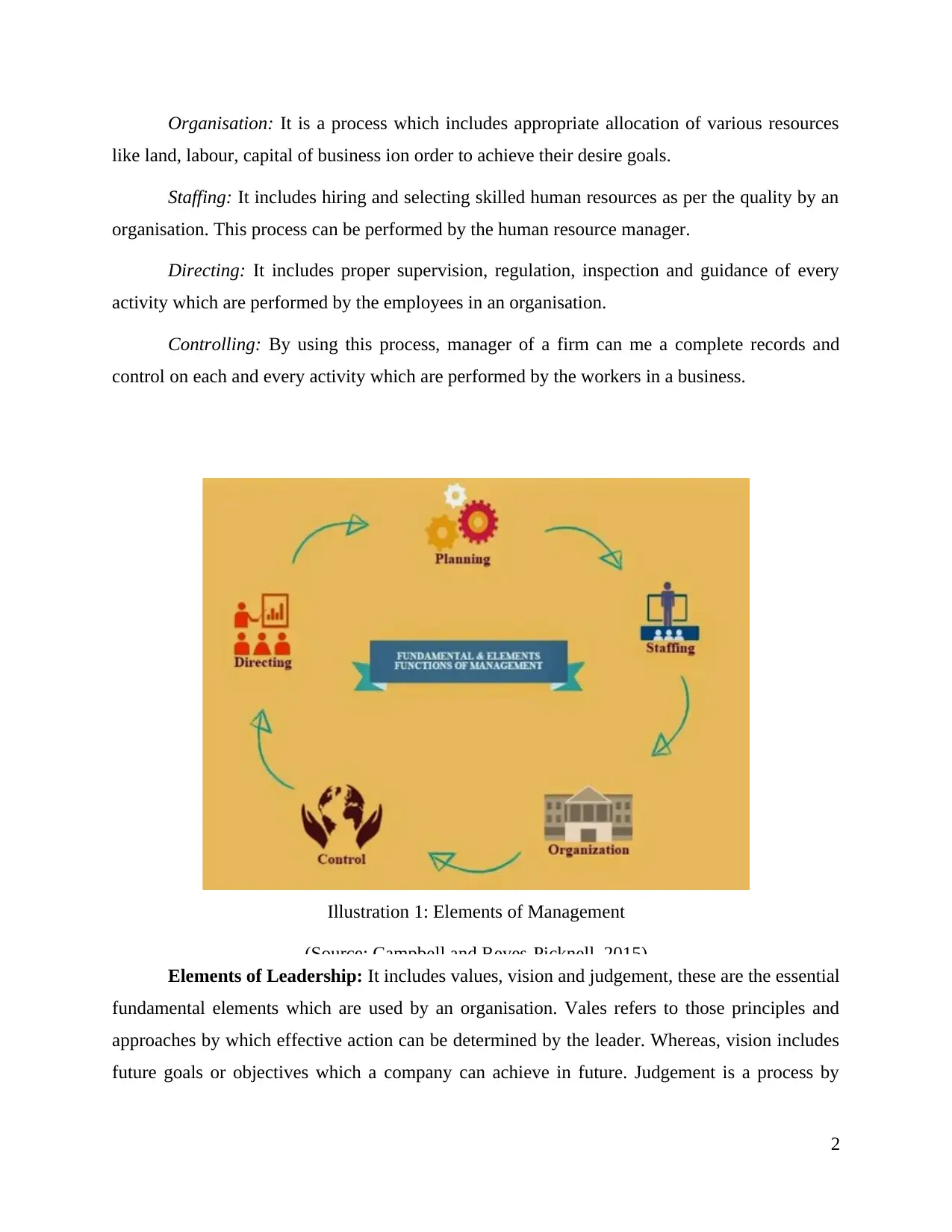
Organisation: It is a process which includes appropriate allocation of various resources
like land, labour, capital of business ion order to achieve their desire goals.
Staffing: It includes hiring and selecting skilled human resources as per the quality by an
organisation. This process can be performed by the human resource manager.
Directing: It includes proper supervision, regulation, inspection and guidance of every
activity which are performed by the employees in an organisation.
Controlling: By using this process, manager of a firm can me a complete records and
control on each and every activity which are performed by the workers in a business.
Elements of Leadership: It includes values, vision and judgement, these are the essential
fundamental elements which are used by an organisation. Vales refers to those principles and
approaches by which effective action can be determined by the leader. Whereas, vision includes
future goals or objectives which a company can achieve in future. Judgement is a process by
2
Illustration 1: Elements of Management
(Source: Campbell and Reyes-Picknell, 2015)
like land, labour, capital of business ion order to achieve their desire goals.
Staffing: It includes hiring and selecting skilled human resources as per the quality by an
organisation. This process can be performed by the human resource manager.
Directing: It includes proper supervision, regulation, inspection and guidance of every
activity which are performed by the employees in an organisation.
Controlling: By using this process, manager of a firm can me a complete records and
control on each and every activity which are performed by the workers in a business.
Elements of Leadership: It includes values, vision and judgement, these are the essential
fundamental elements which are used by an organisation. Vales refers to those principles and
approaches by which effective action can be determined by the leader. Whereas, vision includes
future goals or objectives which a company can achieve in future. Judgement is a process by
2
Illustration 1: Elements of Management
(Source: Campbell and Reyes-Picknell, 2015)
Paraphrase This Document
Need a fresh take? Get an instant paraphrase of this document with our AI Paraphraser
which a leader can determine its action and plan that they will execute as per the determined plan
or not.
3. Similarities
Management and leadership both are working with people and it relates the people only.
Both of the process create a function structure of an organisation.
Management and leading activity maker impact on structure's work and environment.
Both activity is highly concerned with achievement of goals or objectives.
4. Differences
Basic for comparison Leadership Management
Basis It is a skill which is related to
the trust.
It is an art by which effective
control of activity can be done.
Power Leadership has a influencing
power.
Management has ruling power
of people.
Focus It is a process which is mainly
focus on encouraging the
changes in an organisation.
It mainly focuses on providing
stability in a managerial
activity.
Strategy Leading activity adopt
proactive strategy.
It adopt reactive strategy for
implementing the managerial
functions (Honda, Kishi and
Yamamoto, 2017).
Formulation It can be formulated as per the
describing principles and
guidelines.
It is a process which can be
formulated by already set
policies and procedures.
3
or not.
3. Similarities
Management and leadership both are working with people and it relates the people only.
Both of the process create a function structure of an organisation.
Management and leading activity maker impact on structure's work and environment.
Both activity is highly concerned with achievement of goals or objectives.
4. Differences
Basic for comparison Leadership Management
Basis It is a skill which is related to
the trust.
It is an art by which effective
control of activity can be done.
Power Leadership has a influencing
power.
Management has ruling power
of people.
Focus It is a process which is mainly
focus on encouraging the
changes in an organisation.
It mainly focuses on providing
stability in a managerial
activity.
Strategy Leading activity adopt
proactive strategy.
It adopt reactive strategy for
implementing the managerial
functions (Honda, Kishi and
Yamamoto, 2017).
Formulation It can be formulated as per the
describing principles and
guidelines.
It is a process which can be
formulated by already set
policies and procedures.
3
QUESTION 2
1. Asset life cycle of an organisation
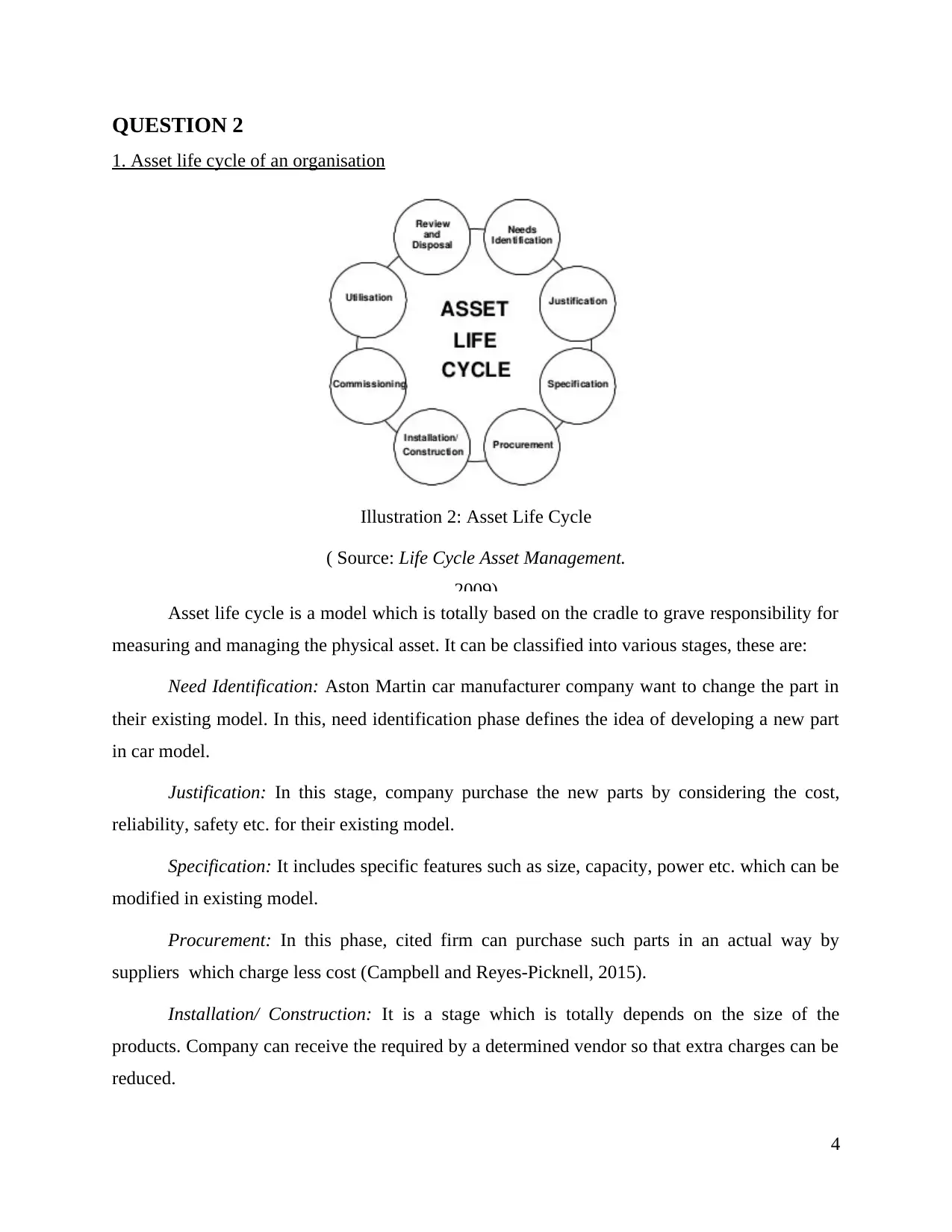
Illustration 2: Asset Life Cycle
( Source: Life Cycle Asset Management.
2009)
Asset life cycle is a model which is totally based on the cradle to grave responsibility for
measuring and managing the physical asset. It can be classified into various stages, these are:
Need Identification: Aston Martin car manufacturer company want to change the part in
their existing model. In this, need identification phase defines the idea of developing a new part
in car model.
Justification: In this stage, company purchase the new parts by considering the cost,
reliability, safety etc. for their existing model.
Specification: It includes specific features such as size, capacity, power etc. which can be
modified in existing model.
Procurement: In this phase, cited firm can purchase such parts in an actual way by
suppliers which charge less cost (Campbell and Reyes-Picknell, 2015).
Installation/ Construction: It is a stage which is totally depends on the size of the
products. Company can receive the required by a determined vendor so that extra charges can be
reduced.
4
1. Asset life cycle of an organisation
Illustration 2: Asset Life Cycle
( Source: Life Cycle Asset Management.
2009)
Asset life cycle is a model which is totally based on the cradle to grave responsibility for
measuring and managing the physical asset. It can be classified into various stages, these are:
Need Identification: Aston Martin car manufacturer company want to change the part in
their existing model. In this, need identification phase defines the idea of developing a new part
in car model.
Justification: In this stage, company purchase the new parts by considering the cost,
reliability, safety etc. for their existing model.
Specification: It includes specific features such as size, capacity, power etc. which can be
modified in existing model.
Procurement: In this phase, cited firm can purchase such parts in an actual way by
suppliers which charge less cost (Campbell and Reyes-Picknell, 2015).
Installation/ Construction: It is a stage which is totally depends on the size of the
products. Company can receive the required by a determined vendor so that extra charges can be
reduced.
4
⊘ This is a preview!⊘
Do you want full access?
Subscribe today to unlock all pages.
Trusted by 1+ million students worldwide
Commissioning: It this stage company tested the ready equipment and checked all the
specification which is suitable for their existing model of car.
Utilisation: This is a stage in which company can sold out their car by launching them in
a market for the use of their customers.
Review and disposal: In this company analysis the car's performance by analysing the
review from customers and make some modification as per the need of them.
2. Stage make great impact on the organisation
While analysing the life cycle of car, Aston Martin car manufacturer company finds that
needs identification, procurement and disposal is the main process which highly affect the asset
life cycle process.
3. Omitted stage by the organisation
By analysis the various steps in life cycle of asset, it is found that company omitted the
specification stage. It is so because company already set up their plan to make some modification
in their car model. Hence, owner of the firm can not find essential to provide specification of a
particular part.
4. Immediate stage which are directly involved
Need identification and disposal or review is the stage which is directly involved in the
life cycle process. It is important for the cited firm to make a correct plan related with the need of
modification in the existing car. It is also necessary for the business to check the feedback by
getting the review from customers so that it can make some changes as per the requirements
(Honda, Kishi and Yamamoto, 2017).
5. Immediate stage which are not directly involved
Specification was the stage which not directly involved in the activity because to present
the unique feature such as size, capacity of a part is not essential for a firm to present publically.
By launching the special feature publically, cited company face the fear of theft of ideas by their
competitors.
6. True cost of maintenance in asset acquisition process
From the above analysis of assets life cycle which are used by Aston Martin car
manufacturer company, it can be said that firm utilizes the cost of maintenance in their assets. It
5
specification which is suitable for their existing model of car.
Utilisation: This is a stage in which company can sold out their car by launching them in
a market for the use of their customers.
Review and disposal: In this company analysis the car's performance by analysing the
review from customers and make some modification as per the need of them.
2. Stage make great impact on the organisation
While analysing the life cycle of car, Aston Martin car manufacturer company finds that
needs identification, procurement and disposal is the main process which highly affect the asset
life cycle process.
3. Omitted stage by the organisation
By analysis the various steps in life cycle of asset, it is found that company omitted the
specification stage. It is so because company already set up their plan to make some modification
in their car model. Hence, owner of the firm can not find essential to provide specification of a
particular part.
4. Immediate stage which are directly involved
Need identification and disposal or review is the stage which is directly involved in the
life cycle process. It is important for the cited firm to make a correct plan related with the need of
modification in the existing car. It is also necessary for the business to check the feedback by
getting the review from customers so that it can make some changes as per the requirements
(Honda, Kishi and Yamamoto, 2017).
5. Immediate stage which are not directly involved
Specification was the stage which not directly involved in the activity because to present
the unique feature such as size, capacity of a part is not essential for a firm to present publically.
By launching the special feature publically, cited company face the fear of theft of ideas by their
competitors.
6. True cost of maintenance in asset acquisition process
From the above analysis of assets life cycle which are used by Aston Martin car
manufacturer company, it can be said that firm utilizes the cost of maintenance in their assets. It
5
Paraphrase This Document
Need a fresh take? Get an instant paraphrase of this document with our AI Paraphraser
is analysed that manager of a company adopt the cyclic process of asset so that they can identify
the demand and actual position in a market. By proper management of all the function proves
that firm effectively used their maintenance cost for development of existing products.
QUESTION 3
1. Concept of Total cost of ownership
It is a financial estimation which enables the buyers and owners to determine the indirect
and direct cost of a product. In a managerial activities, there are various kinds of costs invested
for a production of a particular product (Love, Matthews, Simpson, Hill and Olatunji, 2014). By
determining the total cost ownership, financial benefit can be easily analysed on the basis of total
economic value of an investment.
2. Role of maintenance management
a) By analysing the life cycle of asset, at the end maintenance management of Aston Martin car
manufacturer company, identify the operating cost which is related to the replacement or
modification of a particular part in an existing product.
b) There are various kinds of technology and process by which Aston Martin car manufacturer
company can utilize the cost effectively. These are:
Maintenance management of Aston Martin car manufacturer company need to decide a
plant layout appropriately.
It is a duty of a company to estimate the energy demand p[er unit which is related with
the production of a car (Maletič, Maletič, Al-Najjar and Gomišček, 2014).
Cited firm also adopt recycle process by which it can reuse the material in a unique way.
CONCLUSION
As per the above detailed report, it can be concluded that asset management and its
maintenance is a difficult task which are performed by a company. This report discovered the
role of management and leadership by analysing the various fundamental elements which make
positive impact on their planned growth. By making comparison and similarities between
management/leadership, their role can be discovered in the report. Taking an example of car
manufacturing company, asset life cycle also explained which shows its importance for the
company's operations.
6
the demand and actual position in a market. By proper management of all the function proves
that firm effectively used their maintenance cost for development of existing products.
QUESTION 3
1. Concept of Total cost of ownership
It is a financial estimation which enables the buyers and owners to determine the indirect
and direct cost of a product. In a managerial activities, there are various kinds of costs invested
for a production of a particular product (Love, Matthews, Simpson, Hill and Olatunji, 2014). By
determining the total cost ownership, financial benefit can be easily analysed on the basis of total
economic value of an investment.
2. Role of maintenance management
a) By analysing the life cycle of asset, at the end maintenance management of Aston Martin car
manufacturer company, identify the operating cost which is related to the replacement or
modification of a particular part in an existing product.
b) There are various kinds of technology and process by which Aston Martin car manufacturer
company can utilize the cost effectively. These are:
Maintenance management of Aston Martin car manufacturer company need to decide a
plant layout appropriately.
It is a duty of a company to estimate the energy demand p[er unit which is related with
the production of a car (Maletič, Maletič, Al-Najjar and Gomišček, 2014).
Cited firm also adopt recycle process by which it can reuse the material in a unique way.
CONCLUSION
As per the above detailed report, it can be concluded that asset management and its
maintenance is a difficult task which are performed by a company. This report discovered the
role of management and leadership by analysing the various fundamental elements which make
positive impact on their planned growth. By making comparison and similarities between
management/leadership, their role can be discovered in the report. Taking an example of car
manufacturing company, asset life cycle also explained which shows its importance for the
company's operations.
6
REFERENCES
Journals and Books
Abiri-Jahromi, A., Parvania, M., Bouffard, F. and Fotuhi-Firuzabad, M., 2013. A two-stage
framework for power transformer asset maintenance management—Part I: Models and
formulations. IEEE Transactions on Power Systems. 28(2). pp.1395-1403.
Campbell, J. D. and Reyes-Picknell, J. V., 2015. Uptime: Strategies for excellence in
maintenance management. CRC Press.
Campbell, J. D., Jardine, A. K. and McGlynn, J. eds., 2016. Asset management excellence:
optimizing equipment life-cycle decisions. CRC Press.
Honda, M., Kishi, T. and Yamamoto, H., 2017. Study of Asset Management Method for
Galvanized Steel Railway Electrification Infrastructure in JR-EAST. Procedia CIRP. 59.
pp.47-52.
Love, P. E., Matthews, J., Simpson, I., Hill, A. and Olatunji, O. A., 2014. A benefits realization
management building information modeling framework for asset owners. Automation in
construction. 37. pp.1-10.
Maletič, D., Maletič, M., Al-Najjar, B. and Gomišček, B., 2014. The role of maintenance in
improving company's competitiveness and profitability: a case study in a textile company.
Journal of Manufacturing Technology Management. 25(4). pp.441-456.
Online
Life Cycle Asset Management. 2009. Accessed through < https://www.lce.com/Life-Cycle-Asset-
Management-1112.html>. [Accessed on 22 August 2017].
7
Journals and Books
Abiri-Jahromi, A., Parvania, M., Bouffard, F. and Fotuhi-Firuzabad, M., 2013. A two-stage
framework for power transformer asset maintenance management—Part I: Models and
formulations. IEEE Transactions on Power Systems. 28(2). pp.1395-1403.
Campbell, J. D. and Reyes-Picknell, J. V., 2015. Uptime: Strategies for excellence in
maintenance management. CRC Press.
Campbell, J. D., Jardine, A. K. and McGlynn, J. eds., 2016. Asset management excellence:
optimizing equipment life-cycle decisions. CRC Press.
Honda, M., Kishi, T. and Yamamoto, H., 2017. Study of Asset Management Method for
Galvanized Steel Railway Electrification Infrastructure in JR-EAST. Procedia CIRP. 59.
pp.47-52.
Love, P. E., Matthews, J., Simpson, I., Hill, A. and Olatunji, O. A., 2014. A benefits realization
management building information modeling framework for asset owners. Automation in
construction. 37. pp.1-10.
Maletič, D., Maletič, M., Al-Najjar, B. and Gomišček, B., 2014. The role of maintenance in
improving company's competitiveness and profitability: a case study in a textile company.
Journal of Manufacturing Technology Management. 25(4). pp.441-456.
Online
Life Cycle Asset Management. 2009. Accessed through < https://www.lce.com/Life-Cycle-Asset-
Management-1112.html>. [Accessed on 22 August 2017].
7
⊘ This is a preview!⊘
Do you want full access?
Subscribe today to unlock all pages.
Trusted by 1+ million students worldwide

8

1 out of 10


Related Documents


Your All-in-One AI-Powered Toolkit for Academic Success.
+13062052269
info@desklib.com
Available 24*7 on WhatsApp / Email
![[object Object]](/_next/static/media/star-bottom.7253800d.svg)
Unlock your academic potential
Copyright © 2020–2026 A2Z Services. All Rights Reserved. Developed and managed by ZUCOL.