Business Case Report: Cloud Implementation for Asset Management System
VerifiedAdded on 2020/11/23
|13
|3934
|359
Report
AI Summary
This report presents a comprehensive business case for implementing cloud technology within an asset management system. It begins with an executive summary outlining the current situation, the desired future state, and the financial benefits of cloud implementation, including flexibility, efficiency, and enhanced security. The report details the problems associated with traditional data storage methods, such as data security, redundancy, and lack of flexibility, and proposes a shift to a cloud-based system. It includes planning assumptions, explores various cloud implementation options like public, private, and hybrid models, and suggests proposed developments and acquisitions. Financial analysis, including NPV, IRR, and payback period, is conducted to justify the investment. The report also addresses non-financial benefits, project risk considerations, and change management, concluding with a recommendation for cloud implementation to improve operational efficiency, data management, and online marketing capabilities. The report emphasizes the benefits of a hybrid cloud model to maximize the benefits of both public and private cloud options.
Asset Management
System(Asset and
Maintenance
Management)
System(Asset and
Maintenance
Management)

Paraphrase This Document
Need a fresh take? Get an instant paraphrase of this document with our AI Paraphraser

EXECUTIVE SUMMARY
Cloud Implementation is process of executing and implementing the software of cloud
computing in a business organisation in order to provide benefits of secure information and easy
serving system. In this project report, an understanding about the process of cloud
implementation is discussed along with the cost of its implementation. This project is the
continuation of project one in which overview of cloud implementation is discussed along with
the summary which states current situation analysis and desired future state (Austerberry, 2012).
In order to implement the technology of cloud computing, organisation will require various
sources such as skills related to information technology, ample of funds and virtual solutions. By
using investment analysis, this organisation can prepare budgets for the process of cloud
implementation and ascertain profits which can be earned by this procedure such as NPV, IRR
and payback period. This procedure is proposed in this company due to its various benefits such
as flexibility, efficiency and security. A business case is created in this project report which will
be focused to developing a proposal for cloud implementation in a business organisation.
Cloud Implementation is process of executing and implementing the software of cloud
computing in a business organisation in order to provide benefits of secure information and easy
serving system. In this project report, an understanding about the process of cloud
implementation is discussed along with the cost of its implementation. This project is the
continuation of project one in which overview of cloud implementation is discussed along with
the summary which states current situation analysis and desired future state (Austerberry, 2012).
In order to implement the technology of cloud computing, organisation will require various
sources such as skills related to information technology, ample of funds and virtual solutions. By
using investment analysis, this organisation can prepare budgets for the process of cloud
implementation and ascertain profits which can be earned by this procedure such as NPV, IRR
and payback period. This procedure is proposed in this company due to its various benefits such
as flexibility, efficiency and security. A business case is created in this project report which will
be focused to developing a proposal for cloud implementation in a business organisation.
⊘ This is a preview!⊘
Do you want full access?
Subscribe today to unlock all pages.

Trusted by 1+ million students worldwide
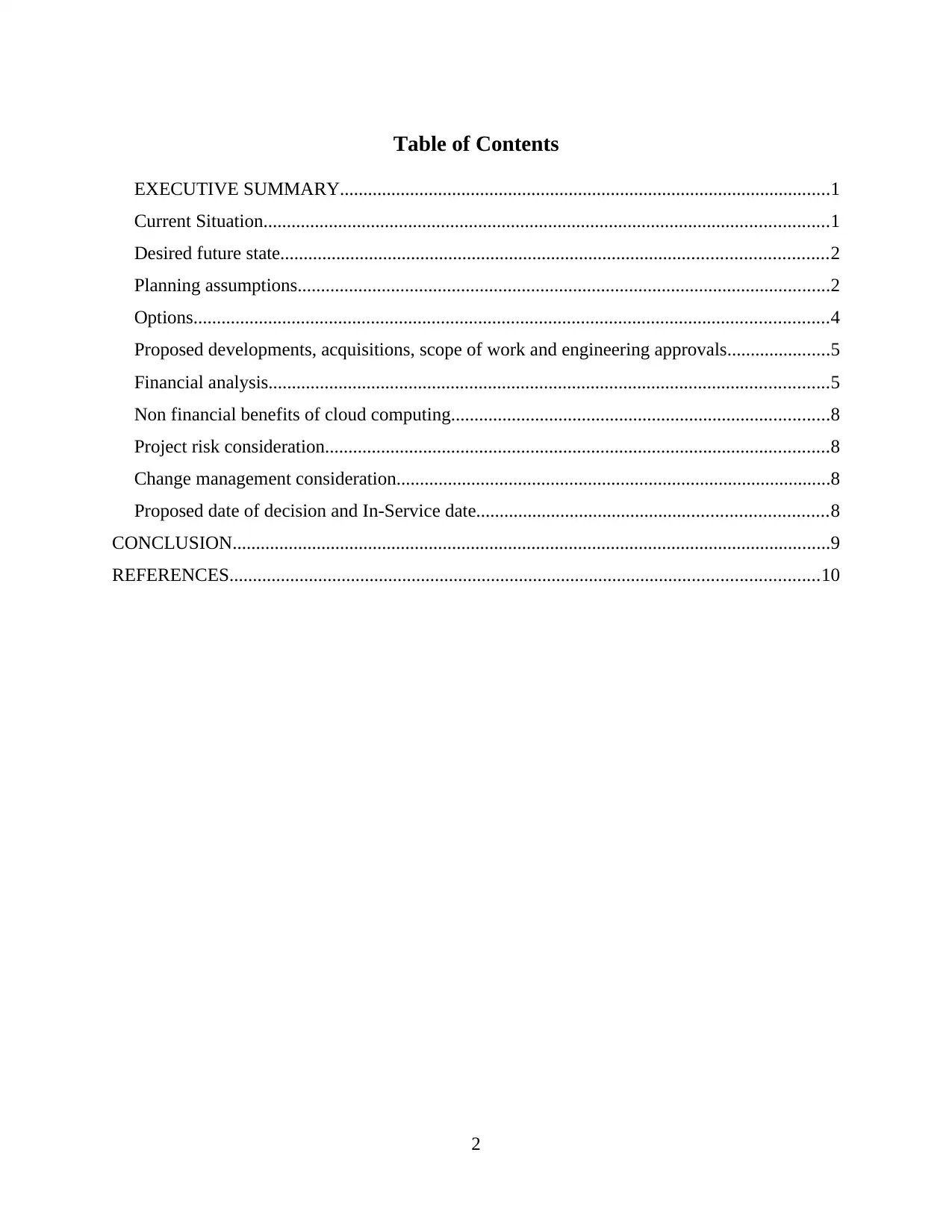
Table of Contents
EXECUTIVE SUMMARY.........................................................................................................1
Current Situation.........................................................................................................................1
Desired future state.....................................................................................................................2
Planning assumptions..................................................................................................................2
Options........................................................................................................................................4
Proposed developments, acquisitions, scope of work and engineering approvals......................5
Financial analysis........................................................................................................................5
Non financial benefits of cloud computing.................................................................................8
Project risk consideration............................................................................................................8
Change management consideration.............................................................................................8
Proposed date of decision and In-Service date...........................................................................8
CONCLUSION................................................................................................................................9
REFERENCES..............................................................................................................................10
2
EXECUTIVE SUMMARY.........................................................................................................1
Current Situation.........................................................................................................................1
Desired future state.....................................................................................................................2
Planning assumptions..................................................................................................................2
Options........................................................................................................................................4
Proposed developments, acquisitions, scope of work and engineering approvals......................5
Financial analysis........................................................................................................................5
Non financial benefits of cloud computing.................................................................................8
Project risk consideration............................................................................................................8
Change management consideration.............................................................................................8
Proposed date of decision and In-Service date...........................................................................8
CONCLUSION................................................................................................................................9
REFERENCES..............................................................................................................................10
2
Paraphrase This Document
Need a fresh take? Get an instant paraphrase of this document with our AI Paraphraser
INTRODUCTION
Asset management is systematic process which includes activities related to developing,
operating, maintaining, upgrading and disposing of assets cost-effectively. This is most
important aspect as this will aid in financial sector regarding description of people and
companies who manage investments and behalf of others. The main purpose of report is to
implement cloud technology within organisation to improve efficiency of organisation.
This report includes description of business case which aid in implementation of cloud
technology within the organisation effectively after consideration of many aspects like current
situation, desired future state, options available and proposed developments.
Current Situation
Current situation of the workplace is concerned with using traditional methods of data
storage due to which they has to face various issues regarding safety and security of the data.
Data which is collected by the company is used to store in flat files as records which are not
flexible and can not be easily assessed and amended. These data are labelled manually so that
they can be identified when needed. Problems which are faced by the company by using this
traditional approach is data security, data redundancy, data isolation and lack of flexibility. Data
which is stored in flat files are easily accessible but not secure enough which brings out security
issue (Bishop and Pagiola, 2012). According to the issue of data redundancy, there are which
chances that an information is recorded in more than two files and data is overlapping due to
more data is stored. Data isolation refers to the concept where data which is stored is scattered
due to which related information is not accessible when it is needed. The another problem with
traditional method is lack of flexibility due to which huge efforts are required to access
unanticipated data.
Reason of the above issues is the traditional approach which is used by the company. The
company records their information by using ledgers, notes and graphs which are developed by
managers and supervisors of the company. Apart from operational data, managerial and financial
reports and data is also prepared by using manual handwritings and manual formats of journals,
ledgers and financial statements. According to the current situations of the company, business
operations are affected due to the above issues such as data security, data redundancy, data
isolation and lack of flexibility.
3
Asset management is systematic process which includes activities related to developing,
operating, maintaining, upgrading and disposing of assets cost-effectively. This is most
important aspect as this will aid in financial sector regarding description of people and
companies who manage investments and behalf of others. The main purpose of report is to
implement cloud technology within organisation to improve efficiency of organisation.
This report includes description of business case which aid in implementation of cloud
technology within the organisation effectively after consideration of many aspects like current
situation, desired future state, options available and proposed developments.
Current Situation
Current situation of the workplace is concerned with using traditional methods of data
storage due to which they has to face various issues regarding safety and security of the data.
Data which is collected by the company is used to store in flat files as records which are not
flexible and can not be easily assessed and amended. These data are labelled manually so that
they can be identified when needed. Problems which are faced by the company by using this
traditional approach is data security, data redundancy, data isolation and lack of flexibility. Data
which is stored in flat files are easily accessible but not secure enough which brings out security
issue (Bishop and Pagiola, 2012). According to the issue of data redundancy, there are which
chances that an information is recorded in more than two files and data is overlapping due to
more data is stored. Data isolation refers to the concept where data which is stored is scattered
due to which related information is not accessible when it is needed. The another problem with
traditional method is lack of flexibility due to which huge efforts are required to access
unanticipated data.
Reason of the above issues is the traditional approach which is used by the company. The
company records their information by using ledgers, notes and graphs which are developed by
managers and supervisors of the company. Apart from operational data, managerial and financial
reports and data is also prepared by using manual handwritings and manual formats of journals,
ledgers and financial statements. According to the current situations of the company, business
operations are affected due to the above issues such as data security, data redundancy, data
isolation and lack of flexibility.
3
Desired future state
Company is said to face various challenges and problems due to traditional approach of
data collection and storage. Future state of the company is desired to use modern approach of
data collection and storage which is cloud. Future position of the company is desired to purely
online systems with automation capabilities (Bulut, and et. al., 2012). Cloud implementation is
said to be acquired by the company in order to provide various benefits such as effective payroll
system, employee management system and customer relationship model system. Using this cloud
technology in the company, organisation can even establish an online portal for their product
marketing and selling. Cloud implementation is a process of cloud computing which should be
used by all the businesses in order to bring efficiency in the process of data collection and
storing. The main aim behind implementing the cloud computing software and process is to
bring effectiveness and efficiency in the business operations of a organisation. By using cloud
computing, desired future state of this company is to manage all the data and information which
acquired through numerous process such as employee payroll, inventory management, financial
statements and many more. By implementing the proposal of cloud, organisation and its
managers has desired a position where they can manage their all the data so that no overlapping
of work issues can occur in their company.
Planning assumptions
In this business case, a proposal is required to be developed which has various planning
assumptions. Planning assumptions are the estimates which are created by this company to
decide level of usage of available sources. Few sources along with their appropriate estimates are
discussed below in order to plan assumptions for cloud implementation:
Level of service required – Cloud implementation is proposed in an organisation which
requires various services and skills to be executed effectively. The concept of cloud is new for a
company which has using traditional approaches for a long period of time (Campbell, Jardine
and McGlynn, 2016). In order to aware this company with the benefits of cloud computing it is
important to acquire services such as conducting several workshops such as schedule workshops
and functional design workshops. Apart from training and development of the employees,
implementation of cloud computing requires services such as licensing and suitable skills related
to information technology. An estimation for this company for the services required can include
services related to configure, validate, transition and realisation.
4
Company is said to face various challenges and problems due to traditional approach of
data collection and storage. Future state of the company is desired to use modern approach of
data collection and storage which is cloud. Future position of the company is desired to purely
online systems with automation capabilities (Bulut, and et. al., 2012). Cloud implementation is
said to be acquired by the company in order to provide various benefits such as effective payroll
system, employee management system and customer relationship model system. Using this cloud
technology in the company, organisation can even establish an online portal for their product
marketing and selling. Cloud implementation is a process of cloud computing which should be
used by all the businesses in order to bring efficiency in the process of data collection and
storing. The main aim behind implementing the cloud computing software and process is to
bring effectiveness and efficiency in the business operations of a organisation. By using cloud
computing, desired future state of this company is to manage all the data and information which
acquired through numerous process such as employee payroll, inventory management, financial
statements and many more. By implementing the proposal of cloud, organisation and its
managers has desired a position where they can manage their all the data so that no overlapping
of work issues can occur in their company.
Planning assumptions
In this business case, a proposal is required to be developed which has various planning
assumptions. Planning assumptions are the estimates which are created by this company to
decide level of usage of available sources. Few sources along with their appropriate estimates are
discussed below in order to plan assumptions for cloud implementation:
Level of service required – Cloud implementation is proposed in an organisation which
requires various services and skills to be executed effectively. The concept of cloud is new for a
company which has using traditional approaches for a long period of time (Campbell, Jardine
and McGlynn, 2016). In order to aware this company with the benefits of cloud computing it is
important to acquire services such as conducting several workshops such as schedule workshops
and functional design workshops. Apart from training and development of the employees,
implementation of cloud computing requires services such as licensing and suitable skills related
to information technology. An estimation for this company for the services required can include
services related to configure, validate, transition and realisation.
4
⊘ This is a preview!⊘
Do you want full access?
Subscribe today to unlock all pages.
Trusted by 1+ million students worldwide
Availability of relevant items – It is a clear concept, that a single organisation can not
have all the sources which are required by them. An estimation for this company has created that
states half of the sources are also already present to the company but half of them such as
specialised cloud computing skills and some funds has to be procured by the company in order to
effectively execute and implement the procedure of cloud computing (El-Akruti, Dwight and
Zhang, 2013). Items such as equipment and utilities are needed to be procured from external
sources of cloud implementation.
Demand assumptions – Proposed plan of cloud implementing is proposed for this
organisation which is required to maintain their data from cloud and can also attain advantage
from online marketing and sales services. From the efficiencies of cloud computing it has been
recognised and assumed that the company can gain demand high after implementing cloud in
their business operations. Cloud implementation will result in proper online marketing and sales
operations of the company. Due to online marketing on social media platforms like Facebook,
Instagram and many more, this company can gain more orders from the youth audience which
are considered as heavy users of online social media sites. After implementing cloud, demand for
the products and services are expected to rise by 50%.
Price assumptions – Cloud implementation requires ample of initial investment which is
required to be repaid by the business operations. Due to heavy expenses and investments on the
process of cloud implementation, prices of the organisational products and services will also rise.
These prices are the estimates which are attained from assumed costs of cloud implementation
expenses and investments. As an assumption it can be said that prices of goods and services of a
company can rise to 12% after implementation of cloud (Evans and et. al., 2012).
Above are the some assumptions which are developed for this organisation in order to
create estimates that what will be the position of the company after implementing cloud for their
business operations.
Options
In the case of cloud computing, an organisation is facilitated by few options which are
available to them according to base case option. Base case option is a approach where a company
selects the most appropriate option available to them suitable to their base case. There are three
types of options which are available to them. Cloud implementation requires a cloud model. As a
product and service provider, an organisation has three base options which are,
5
have all the sources which are required by them. An estimation for this company has created that
states half of the sources are also already present to the company but half of them such as
specialised cloud computing skills and some funds has to be procured by the company in order to
effectively execute and implement the procedure of cloud computing (El-Akruti, Dwight and
Zhang, 2013). Items such as equipment and utilities are needed to be procured from external
sources of cloud implementation.
Demand assumptions – Proposed plan of cloud implementing is proposed for this
organisation which is required to maintain their data from cloud and can also attain advantage
from online marketing and sales services. From the efficiencies of cloud computing it has been
recognised and assumed that the company can gain demand high after implementing cloud in
their business operations. Cloud implementation will result in proper online marketing and sales
operations of the company. Due to online marketing on social media platforms like Facebook,
Instagram and many more, this company can gain more orders from the youth audience which
are considered as heavy users of online social media sites. After implementing cloud, demand for
the products and services are expected to rise by 50%.
Price assumptions – Cloud implementation requires ample of initial investment which is
required to be repaid by the business operations. Due to heavy expenses and investments on the
process of cloud implementation, prices of the organisational products and services will also rise.
These prices are the estimates which are attained from assumed costs of cloud implementation
expenses and investments. As an assumption it can be said that prices of goods and services of a
company can rise to 12% after implementation of cloud (Evans and et. al., 2012).
Above are the some assumptions which are developed for this organisation in order to
create estimates that what will be the position of the company after implementing cloud for their
business operations.
Options
In the case of cloud computing, an organisation is facilitated by few options which are
available to them according to base case option. Base case option is a approach where a company
selects the most appropriate option available to them suitable to their base case. There are three
types of options which are available to them. Cloud implementation requires a cloud model. As a
product and service provider, an organisation has three base options which are,
5
Paraphrase This Document
Need a fresh take? Get an instant paraphrase of this document with our AI Paraphraser
Public cloud – The first most option of for the organisation in cloud implementation is
public cloud model. In this option, whole cloud is computed under the company's premises but it
also provides a benefit of communicating. Organisation can attain feedback from their clients for
their produced and distributed products and services. Drawback of this model is that all the
information of the company is accessible to the other parties such as their clients from which
they have communicated (Green and Haines, 2015).
Private cloud – This model also provides same benefits as the public cloud such as
effectiveness in data collection and storage but this model is not compatible with client
communication. After choosing this model, this organisation can not communicate with their
clients and their data is also not disclosed to their clients. Benefit of this model is that data which
is collected and stored is securely recorded in cloud and no client or any other party can access
that data.
Hybrid cloud – This model is the most expensive software to be acquired by the
company. This model is most beneficial as it has benefits of both the above models. This model
has the benefit of security of data of private model and also has the ability to communicate with
the clients in order to attain feedback which is a feature of public model. Few more advantages
of this model is elastic scalability and ability to handle constant shifts in demand (Jacobsen,
Schlenker and Edwards, 2012).
The above three models are the options of base case which are available to the company.
All these costs has their own advantages, disadvantages and cost involvement.
In order to provide maximum benefit to organisation, management of the company
should prefer hybrid cloud model option. The reason behind selecting this option is that this
option allows an organisation to be facilitated from the benefits of both models that is public and
private. By using and implementing hybrid model, this organisation can get benefited as they can
securely store all their information about their operations and human resources. Even after
storing all these information, they can also communicate with external parties such as clients.
Proposed developments, acquisitions, scope of work and engineering approvals
Cloud computing is an asset which is required to be implemented and managed by an
organisation. In order to conduct cloud implementation, various developments, acquisitions and
scope of work are required to be proposed. Developments which are proposed for this
organisation after implementing cloud are as follows. Company can develop their online
6
public cloud model. In this option, whole cloud is computed under the company's premises but it
also provides a benefit of communicating. Organisation can attain feedback from their clients for
their produced and distributed products and services. Drawback of this model is that all the
information of the company is accessible to the other parties such as their clients from which
they have communicated (Green and Haines, 2015).
Private cloud – This model also provides same benefits as the public cloud such as
effectiveness in data collection and storage but this model is not compatible with client
communication. After choosing this model, this organisation can not communicate with their
clients and their data is also not disclosed to their clients. Benefit of this model is that data which
is collected and stored is securely recorded in cloud and no client or any other party can access
that data.
Hybrid cloud – This model is the most expensive software to be acquired by the
company. This model is most beneficial as it has benefits of both the above models. This model
has the benefit of security of data of private model and also has the ability to communicate with
the clients in order to attain feedback which is a feature of public model. Few more advantages
of this model is elastic scalability and ability to handle constant shifts in demand (Jacobsen,
Schlenker and Edwards, 2012).
The above three models are the options of base case which are available to the company.
All these costs has their own advantages, disadvantages and cost involvement.
In order to provide maximum benefit to organisation, management of the company
should prefer hybrid cloud model option. The reason behind selecting this option is that this
option allows an organisation to be facilitated from the benefits of both models that is public and
private. By using and implementing hybrid model, this organisation can get benefited as they can
securely store all their information about their operations and human resources. Even after
storing all these information, they can also communicate with external parties such as clients.
Proposed developments, acquisitions, scope of work and engineering approvals
Cloud computing is an asset which is required to be implemented and managed by an
organisation. In order to conduct cloud implementation, various developments, acquisitions and
scope of work are required to be proposed. Developments which are proposed for this
organisation after implementing cloud are as follows. Company can develop their online
6
marketing services and can also improve their sales number by getting feedbacks from hybrid
cloud model. Another development which is proposed by the organisation is improved sales and
demand (Komonen, Kortelainen and Räikkönen, 2012). Due to online marketing and effective
management of the company will result into higher sales.
Proposed acquisition for this company is acquisition of hybrid cloud model along with
licenses. These acquisition are proposed as they are mandatory to be acquired for an organisation
which is planning to implement cloud in their business operations.
Proposed scope of work is the variety of activities and operations which are estimated
that they will be required to be performed by the company if they implement cloud technology.
Few of the proposed scope of work can include setup applications, validate configuration, build
integrations and implement security. Apart from these activities few other operations which has
scope after cloud implementation are update set-ups, migrate integrations reconcile data, gain
acceptance and implement the cloud model in the organisation.
Engineering approvals are the licenses which should be attained by an organisation while
implementing the cloud technology. In the case of cloud implementation, there are few
configuration and customisation requirements which are needed to get approved.
Financial analysis
Cloud implementation is a process where model of cloud is used by an organisation in
order to gain benefits of the cloud technology. Proposal of cloud implementation requires ample
of funds and has to incur various costs such as acquisition, development, operations, logistics
and may more. Option which is selected for this organisation is hybrid model as it will allow to
attain various benefits of both public and private models. Various costs involved in cloud
implementation for this hybrid model option along with its estimations are discussed below:
Acquisition and Development costs:
Acquisition cost means cost of acquiring and installing new asset for business, which is
cloud implementation in this case. Development cost means cost incurred in researching,
growing and introducing new technology, such as research and development cost. For example:
Estimated acquisition cost of cloud implementing is $400 for one server, in case of fully hosted
network cost is $100 per desktop, plus cost of implementation data migration and ongoing
storage.
Project implementation costs:
7
cloud model. Another development which is proposed by the organisation is improved sales and
demand (Komonen, Kortelainen and Räikkönen, 2012). Due to online marketing and effective
management of the company will result into higher sales.
Proposed acquisition for this company is acquisition of hybrid cloud model along with
licenses. These acquisition are proposed as they are mandatory to be acquired for an organisation
which is planning to implement cloud in their business operations.
Proposed scope of work is the variety of activities and operations which are estimated
that they will be required to be performed by the company if they implement cloud technology.
Few of the proposed scope of work can include setup applications, validate configuration, build
integrations and implement security. Apart from these activities few other operations which has
scope after cloud implementation are update set-ups, migrate integrations reconcile data, gain
acceptance and implement the cloud model in the organisation.
Engineering approvals are the licenses which should be attained by an organisation while
implementing the cloud technology. In the case of cloud implementation, there are few
configuration and customisation requirements which are needed to get approved.
Financial analysis
Cloud implementation is a process where model of cloud is used by an organisation in
order to gain benefits of the cloud technology. Proposal of cloud implementation requires ample
of funds and has to incur various costs such as acquisition, development, operations, logistics
and may more. Option which is selected for this organisation is hybrid model as it will allow to
attain various benefits of both public and private models. Various costs involved in cloud
implementation for this hybrid model option along with its estimations are discussed below:
Acquisition and Development costs:
Acquisition cost means cost of acquiring and installing new asset for business, which is
cloud implementation in this case. Development cost means cost incurred in researching,
growing and introducing new technology, such as research and development cost. For example:
Estimated acquisition cost of cloud implementing is $400 for one server, in case of fully hosted
network cost is $100 per desktop, plus cost of implementation data migration and ongoing
storage.
Project implementation costs:
7
⊘ This is a preview!⊘
Do you want full access?
Subscribe today to unlock all pages.
Trusted by 1+ million students worldwide
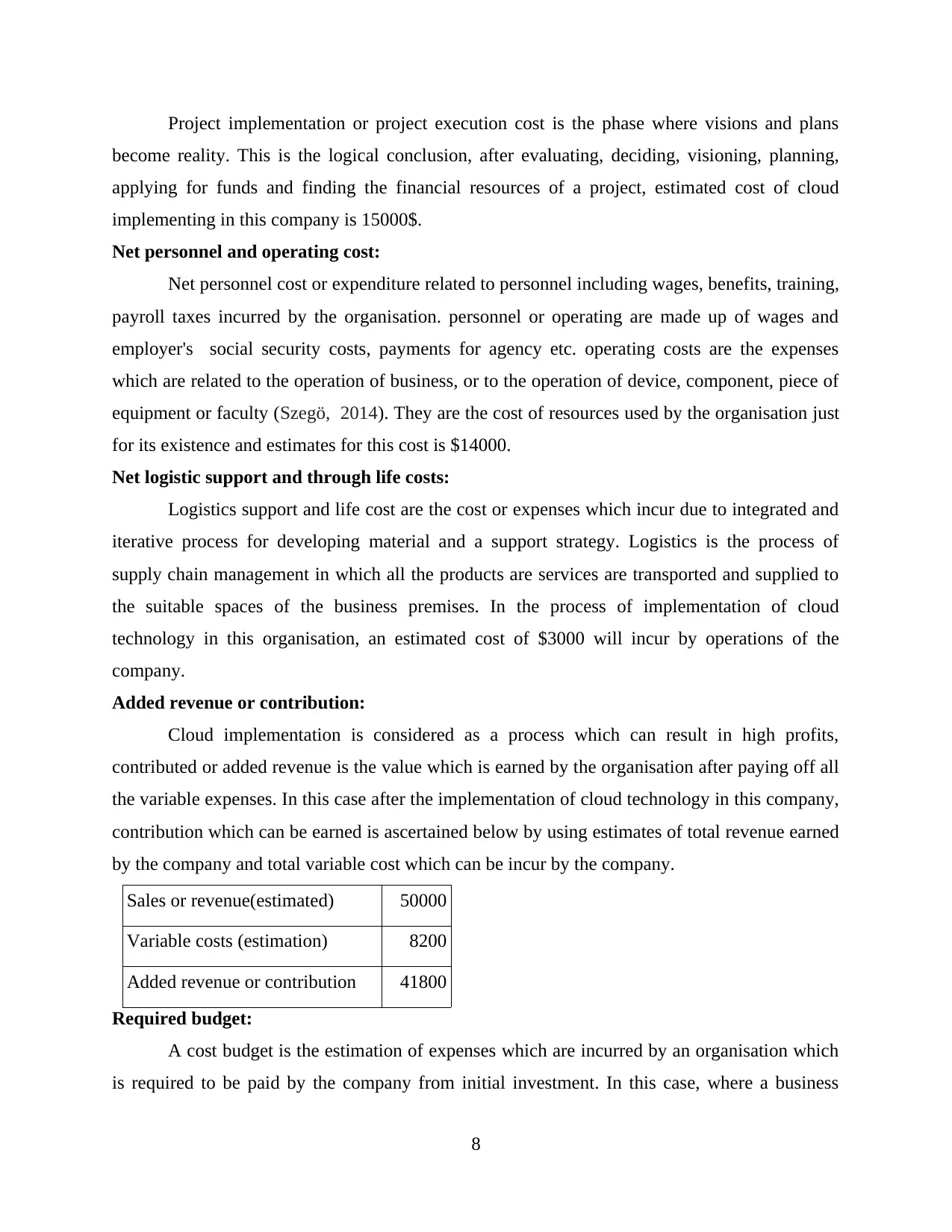
Project implementation or project execution cost is the phase where visions and plans
become reality. This is the logical conclusion, after evaluating, deciding, visioning, planning,
applying for funds and finding the financial resources of a project, estimated cost of cloud
implementing in this company is 15000$.
Net personnel and operating cost:
Net personnel cost or expenditure related to personnel including wages, benefits, training,
payroll taxes incurred by the organisation. personnel or operating are made up of wages and
employer's social security costs, payments for agency etc. operating costs are the expenses
which are related to the operation of business, or to the operation of device, component, piece of
equipment or faculty (Szegö, 2014). They are the cost of resources used by the organisation just
for its existence and estimates for this cost is $14000.
Net logistic support and through life costs:
Logistics support and life cost are the cost or expenses which incur due to integrated and
iterative process for developing material and a support strategy. Logistics is the process of
supply chain management in which all the products are services are transported and supplied to
the suitable spaces of the business premises. In the process of implementation of cloud
technology in this organisation, an estimated cost of $3000 will incur by operations of the
company.
Added revenue or contribution:
Cloud implementation is considered as a process which can result in high profits,
contributed or added revenue is the value which is earned by the organisation after paying off all
the variable expenses. In this case after the implementation of cloud technology in this company,
contribution which can be earned is ascertained below by using estimates of total revenue earned
by the company and total variable cost which can be incur by the company.
Sales or revenue(estimated) 50000
Variable costs (estimation) 8200
Added revenue or contribution 41800
Required budget:
A cost budget is the estimation of expenses which are incurred by an organisation which
is required to be paid by the company from initial investment. In this case, where a business
8
become reality. This is the logical conclusion, after evaluating, deciding, visioning, planning,
applying for funds and finding the financial resources of a project, estimated cost of cloud
implementing in this company is 15000$.
Net personnel and operating cost:
Net personnel cost or expenditure related to personnel including wages, benefits, training,
payroll taxes incurred by the organisation. personnel or operating are made up of wages and
employer's social security costs, payments for agency etc. operating costs are the expenses
which are related to the operation of business, or to the operation of device, component, piece of
equipment or faculty (Szegö, 2014). They are the cost of resources used by the organisation just
for its existence and estimates for this cost is $14000.
Net logistic support and through life costs:
Logistics support and life cost are the cost or expenses which incur due to integrated and
iterative process for developing material and a support strategy. Logistics is the process of
supply chain management in which all the products are services are transported and supplied to
the suitable spaces of the business premises. In the process of implementation of cloud
technology in this organisation, an estimated cost of $3000 will incur by operations of the
company.
Added revenue or contribution:
Cloud implementation is considered as a process which can result in high profits,
contributed or added revenue is the value which is earned by the organisation after paying off all
the variable expenses. In this case after the implementation of cloud technology in this company,
contribution which can be earned is ascertained below by using estimates of total revenue earned
by the company and total variable cost which can be incur by the company.
Sales or revenue(estimated) 50000
Variable costs (estimation) 8200
Added revenue or contribution 41800
Required budget:
A cost budget is the estimation of expenses which are incurred by an organisation which
is required to be paid by the company from initial investment. In this case, where a business
8
Paraphrase This Document
Need a fresh take? Get an instant paraphrase of this document with our AI Paraphraser
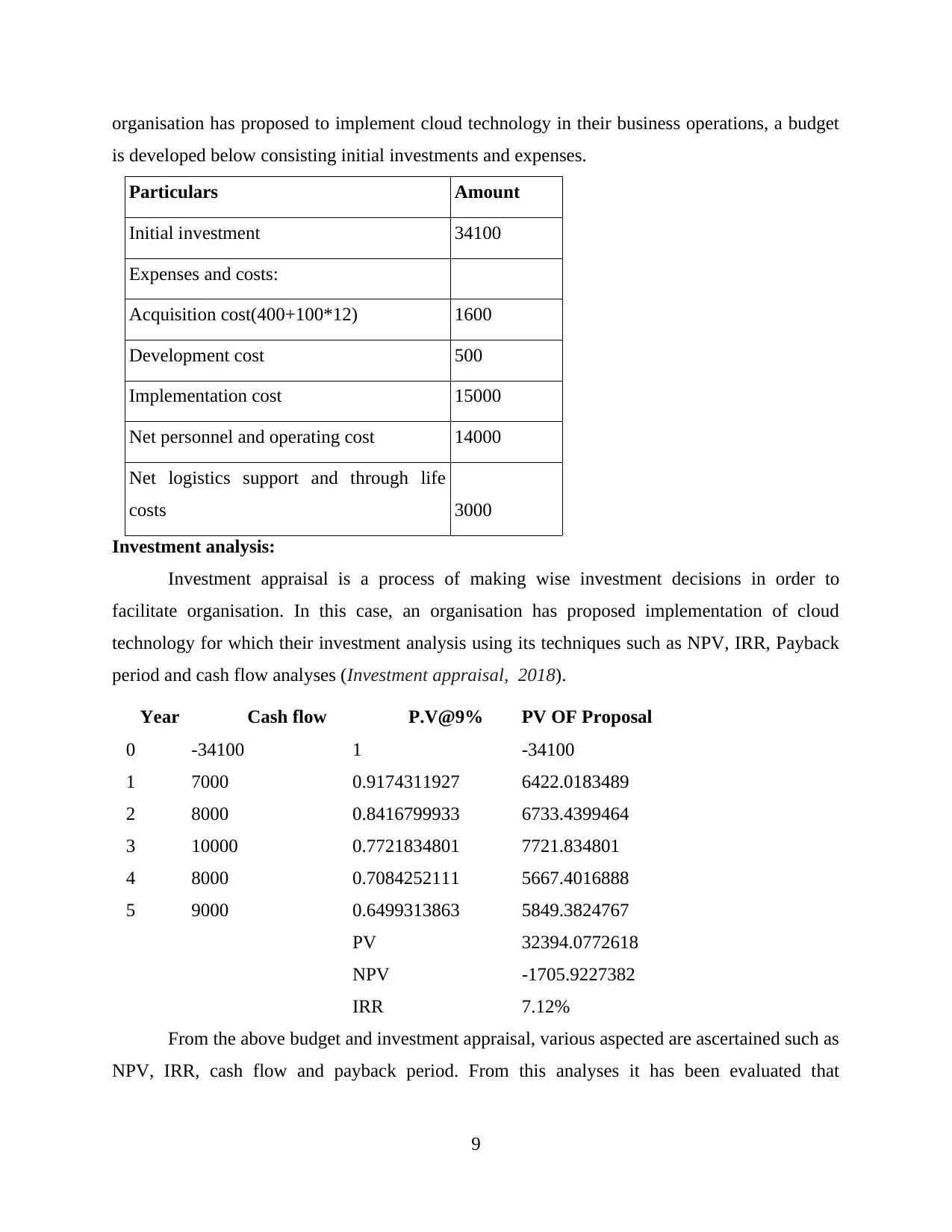
organisation has proposed to implement cloud technology in their business operations, a budget
is developed below consisting initial investments and expenses.
Particulars Amount
Initial investment 34100
Expenses and costs:
Acquisition cost(400+100*12) 1600
Development cost 500
Implementation cost 15000
Net personnel and operating cost 14000
Net logistics support and through life
costs 3000
Investment analysis:
Investment appraisal is a process of making wise investment decisions in order to
facilitate organisation. In this case, an organisation has proposed implementation of cloud
technology for which their investment analysis using its techniques such as NPV, IRR, Payback
period and cash flow analyses (Investment appraisal, 2018).
Year Cash flow P.V@9% PV OF Proposal
0 -34100 1 -34100
1 7000 0.9174311927 6422.0183489
2 8000 0.8416799933 6733.4399464
3 10000 0.7721834801 7721.834801
4 8000 0.7084252111 5667.4016888
5 9000 0.6499313863 5849.3824767
PV 32394.0772618
NPV -1705.9227382
IRR 7.12%
From the above budget and investment appraisal, various aspected are ascertained such as
NPV, IRR, cash flow and payback period. From this analyses it has been evaluated that
9
is developed below consisting initial investments and expenses.
Particulars Amount
Initial investment 34100
Expenses and costs:
Acquisition cost(400+100*12) 1600
Development cost 500
Implementation cost 15000
Net personnel and operating cost 14000
Net logistics support and through life
costs 3000
Investment analysis:
Investment appraisal is a process of making wise investment decisions in order to
facilitate organisation. In this case, an organisation has proposed implementation of cloud
technology for which their investment analysis using its techniques such as NPV, IRR, Payback
period and cash flow analyses (Investment appraisal, 2018).
Year Cash flow P.V@9% PV OF Proposal
0 -34100 1 -34100
1 7000 0.9174311927 6422.0183489
2 8000 0.8416799933 6733.4399464
3 10000 0.7721834801 7721.834801
4 8000 0.7084252111 5667.4016888
5 9000 0.6499313863 5849.3824767
PV 32394.0772618
NPV -1705.9227382
IRR 7.12%
From the above budget and investment appraisal, various aspected are ascertained such as
NPV, IRR, cash flow and payback period. From this analyses it has been evaluated that
9
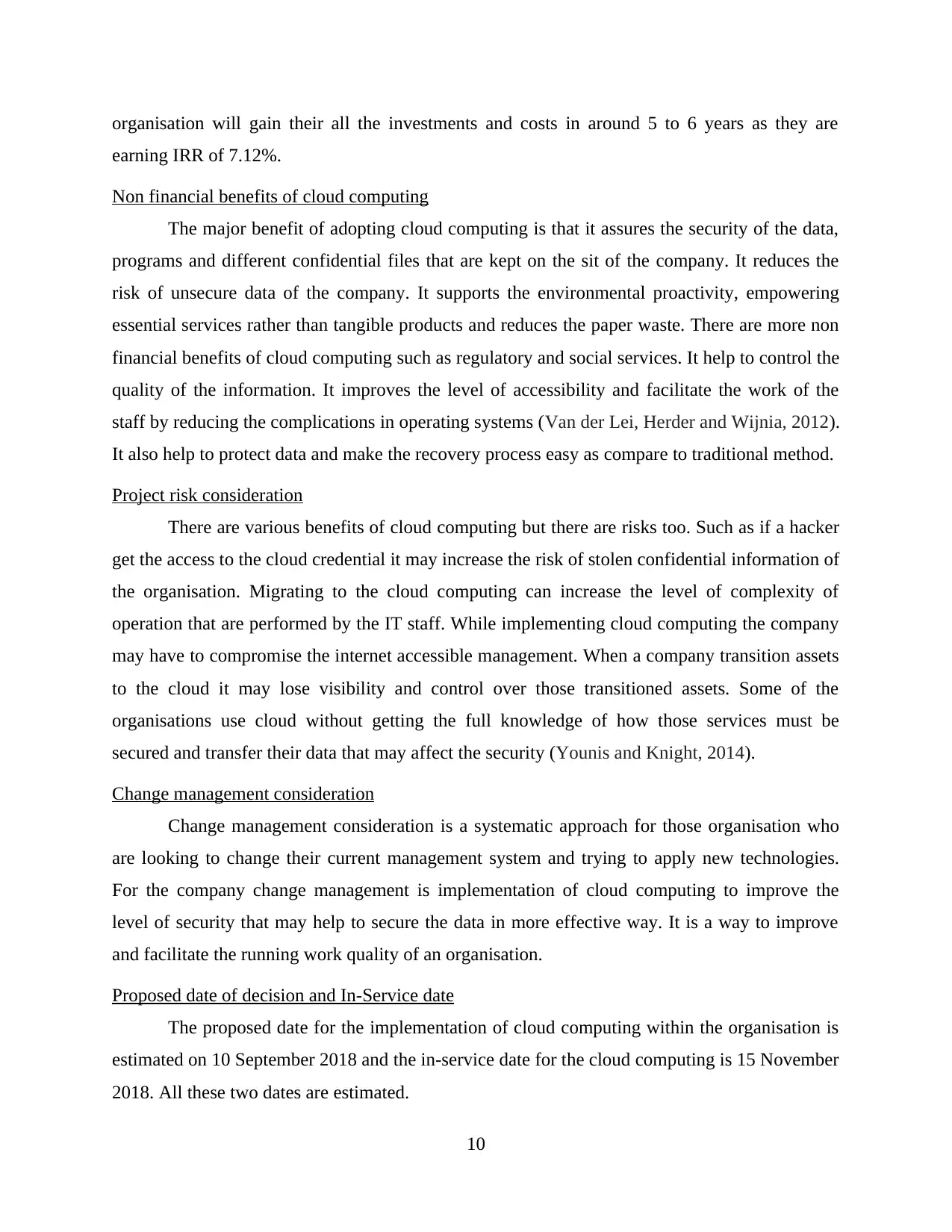
organisation will gain their all the investments and costs in around 5 to 6 years as they are
earning IRR of 7.12%.
Non financial benefits of cloud computing
The major benefit of adopting cloud computing is that it assures the security of the data,
programs and different confidential files that are kept on the sit of the company. It reduces the
risk of unsecure data of the company. It supports the environmental proactivity, empowering
essential services rather than tangible products and reduces the paper waste. There are more non
financial benefits of cloud computing such as regulatory and social services. It help to control the
quality of the information. It improves the level of accessibility and facilitate the work of the
staff by reducing the complications in operating systems (Van der Lei, Herder and Wijnia, 2012).
It also help to protect data and make the recovery process easy as compare to traditional method.
Project risk consideration
There are various benefits of cloud computing but there are risks too. Such as if a hacker
get the access to the cloud credential it may increase the risk of stolen confidential information of
the organisation. Migrating to the cloud computing can increase the level of complexity of
operation that are performed by the IT staff. While implementing cloud computing the company
may have to compromise the internet accessible management. When a company transition assets
to the cloud it may lose visibility and control over those transitioned assets. Some of the
organisations use cloud without getting the full knowledge of how those services must be
secured and transfer their data that may affect the security (Younis and Knight, 2014).
Change management consideration
Change management consideration is a systematic approach for those organisation who
are looking to change their current management system and trying to apply new technologies.
For the company change management is implementation of cloud computing to improve the
level of security that may help to secure the data in more effective way. It is a way to improve
and facilitate the running work quality of an organisation.
Proposed date of decision and In-Service date
The proposed date for the implementation of cloud computing within the organisation is
estimated on 10 September 2018 and the in-service date for the cloud computing is 15 November
2018. All these two dates are estimated.
10
earning IRR of 7.12%.
Non financial benefits of cloud computing
The major benefit of adopting cloud computing is that it assures the security of the data,
programs and different confidential files that are kept on the sit of the company. It reduces the
risk of unsecure data of the company. It supports the environmental proactivity, empowering
essential services rather than tangible products and reduces the paper waste. There are more non
financial benefits of cloud computing such as regulatory and social services. It help to control the
quality of the information. It improves the level of accessibility and facilitate the work of the
staff by reducing the complications in operating systems (Van der Lei, Herder and Wijnia, 2012).
It also help to protect data and make the recovery process easy as compare to traditional method.
Project risk consideration
There are various benefits of cloud computing but there are risks too. Such as if a hacker
get the access to the cloud credential it may increase the risk of stolen confidential information of
the organisation. Migrating to the cloud computing can increase the level of complexity of
operation that are performed by the IT staff. While implementing cloud computing the company
may have to compromise the internet accessible management. When a company transition assets
to the cloud it may lose visibility and control over those transitioned assets. Some of the
organisations use cloud without getting the full knowledge of how those services must be
secured and transfer their data that may affect the security (Younis and Knight, 2014).
Change management consideration
Change management consideration is a systematic approach for those organisation who
are looking to change their current management system and trying to apply new technologies.
For the company change management is implementation of cloud computing to improve the
level of security that may help to secure the data in more effective way. It is a way to improve
and facilitate the running work quality of an organisation.
Proposed date of decision and In-Service date
The proposed date for the implementation of cloud computing within the organisation is
estimated on 10 September 2018 and the in-service date for the cloud computing is 15 November
2018. All these two dates are estimated.
10
⊘ This is a preview!⊘
Do you want full access?
Subscribe today to unlock all pages.
Trusted by 1+ million students worldwide

1 out of 13


Related Documents


Your All-in-One AI-Powered Toolkit for Academic Success.
+13062052269
info@desklib.com
Available 24*7 on WhatsApp / Email
![[object Object]](/_next/static/media/star-bottom.7253800d.svg)
Unlock your academic potential
Copyright © 2020–2026 A2Z Services. All Rights Reserved. Developed and managed by ZUCOL.