QUT Report: Complex Data Management in Electricity Power Distribution
VerifiedAdded on 2019/10/30
|36
|8882
|167
Report
AI Summary
This report delves into the complex data management issues within electricity power distribution, focusing on asset and facility management. It examines the implementation of Asset Management Capability Models, including the ISO 55000 and ISO 14224 standards, for improving asset systems and maintenance. The report analyzes the Energex Ltd case study, an Australian electricity distributor, to explore IT asset management of transformers, switchgears, and towers. It covers asset performance measurement, evaluation, and improvement, along with data collection methodologies and tools. The literature review encompasses the lifecycle of assets, risk profiles, and power system reliability. The report provides recommendations for improving the system, maximizing usage, and reducing costs through reliable software, emphasizing the importance of a business model for customer satisfaction and predictive risk management. The report also discusses the Asset Management Excellence Model, IQM-CMM, and Digital Asset Management models, highlighting their role in optimizing processes and addressing deficiencies. The report's objective is to improve the efficiency and effectiveness of electricity distribution through effective data management and asset management strategies.
Running head: Asset and Facility management 1
Complex Data Management Issues in Electricity Power Distribution
[Author Name(s), First M. Last, Omit Titles and Degrees]
Queensland University of Technology
Complex Data Management Issues in Electricity Power Distribution
[Author Name(s), First M. Last, Omit Titles and Degrees]
Queensland University of Technology

Paraphrase This Document
Need a fresh take? Get an instant paraphrase of this document with our AI Paraphraser
Asset and Facility management 2
Executive Summary
Data management is a complex system whose implementation strategies calls for quality, cost
effectiveness and efficiency. The Life Cycle based Asset Management captures the hierarchical
structures within the specific enterprise resource system and the risk management system for
each asset. This is critical for disaster management during storms and extreme weather incidents
among other risks. Power systems reliability also needs a successful implementation plan is
which depends on the asset performance and capability models adopted. This report explores the
IT asset management of an innovative approach in a government set up. This includes operations
within the transformers, assets such as switchgears and towers for maximum performance and
reduced costs.
Energex Ltd is an Australian based government agency supplying electricity to more than 1.4
million customers in Queensland region. This city distributor has operations across its supply
system that need a stable supply of electricity through a single entity. Its interconnections stem
from the National Electricity Market in Australia (NEM). This means that its service operations
is within the national and local government regulations. The management of electricity supplies
systems requires effective analytics to capture its property systems, plant and equipment
functions. This report looks at the implementation of the Asset Management Capability Models
and the Asset Management Capability Model in the government based organization.
Its analysis considers the ISO standardization rationale featuring the ISO55000 and ISO14224
as quality standards for improving asset systems and effective maintenance. Monitoring the cycle
through an effective change process facilitates for a reliable power distribution system that is in
line with the business and customer needs. The ISO14224 Life Cycle of Assets facilitates for the
reduction of failure rates and redundancy. On the other hand, the ISO55000 supports proper
outcomes through the control of numbering, events and consequences for informed decisions.
Efficiency and effectiveness of the asset management system lies within these factors. A
competent system needs an Asset Management Plan (AMP) with a contemporary simulation
model applicable to the specific needs. It has a risk management system for disaster management
such as during storms and extreme weather incidents
Executive Summary
Data management is a complex system whose implementation strategies calls for quality, cost
effectiveness and efficiency. The Life Cycle based Asset Management captures the hierarchical
structures within the specific enterprise resource system and the risk management system for
each asset. This is critical for disaster management during storms and extreme weather incidents
among other risks. Power systems reliability also needs a successful implementation plan is
which depends on the asset performance and capability models adopted. This report explores the
IT asset management of an innovative approach in a government set up. This includes operations
within the transformers, assets such as switchgears and towers for maximum performance and
reduced costs.
Energex Ltd is an Australian based government agency supplying electricity to more than 1.4
million customers in Queensland region. This city distributor has operations across its supply
system that need a stable supply of electricity through a single entity. Its interconnections stem
from the National Electricity Market in Australia (NEM). This means that its service operations
is within the national and local government regulations. The management of electricity supplies
systems requires effective analytics to capture its property systems, plant and equipment
functions. This report looks at the implementation of the Asset Management Capability Models
and the Asset Management Capability Model in the government based organization.
Its analysis considers the ISO standardization rationale featuring the ISO55000 and ISO14224
as quality standards for improving asset systems and effective maintenance. Monitoring the cycle
through an effective change process facilitates for a reliable power distribution system that is in
line with the business and customer needs. The ISO14224 Life Cycle of Assets facilitates for the
reduction of failure rates and redundancy. On the other hand, the ISO55000 supports proper
outcomes through the control of numbering, events and consequences for informed decisions.
Efficiency and effectiveness of the asset management system lies within these factors. A
competent system needs an Asset Management Plan (AMP) with a contemporary simulation
model applicable to the specific needs. It has a risk management system for disaster management
such as during storms and extreme weather incidents
Asset and Facility management 3
The literature review looks at the lifecycle of assets in electricity power distribution, risk profile,
power system reliability and its maintenance. Through secondary data collection, it analyses
asset management across different power systems for reliability and maintenance approaches. It
reviews the Computerized Maintenance Management Systems (CMMS), Process Control
systems and Conditioning Monitoring. Risk reduction in the plant and role based systems is
important for security, system and network management. This analysis supports an integrated
approach and an effective maintenance for assets in electricity distribution system for a
competitive edge.
The data from the current situation provides real asset data on the company’s maintenance plans
and service distribution. The discussion includes ways of improving the system for the
maximization of usage and the reduction of costs using a reliable software. Asset management of
an IT system needs a business model for customer satisfaction as well as predictive risk
management mechanisms. The ISO the ISO55000 and ISO14224 Design is suitable for the
digital age, and it covers the whole lifecycle. This discussion highlights the connection between
the software application and the Energex business model.
Keywords: Complex data management, Risk Management, Digital Asset Management,
information systems, Life Cycle Asset Management, Asset Management (AM), electricity power
distribution, IQM-CMM
Table of Contents
The literature review looks at the lifecycle of assets in electricity power distribution, risk profile,
power system reliability and its maintenance. Through secondary data collection, it analyses
asset management across different power systems for reliability and maintenance approaches. It
reviews the Computerized Maintenance Management Systems (CMMS), Process Control
systems and Conditioning Monitoring. Risk reduction in the plant and role based systems is
important for security, system and network management. This analysis supports an integrated
approach and an effective maintenance for assets in electricity distribution system for a
competitive edge.
The data from the current situation provides real asset data on the company’s maintenance plans
and service distribution. The discussion includes ways of improving the system for the
maximization of usage and the reduction of costs using a reliable software. Asset management of
an IT system needs a business model for customer satisfaction as well as predictive risk
management mechanisms. The ISO the ISO55000 and ISO14224 Design is suitable for the
digital age, and it covers the whole lifecycle. This discussion highlights the connection between
the software application and the Energex business model.
Keywords: Complex data management, Risk Management, Digital Asset Management,
information systems, Life Cycle Asset Management, Asset Management (AM), electricity power
distribution, IQM-CMM
Table of Contents
⊘ This is a preview!⊘
Do you want full access?
Subscribe today to unlock all pages.

Trusted by 1+ million students worldwide
Asset and Facility management 4
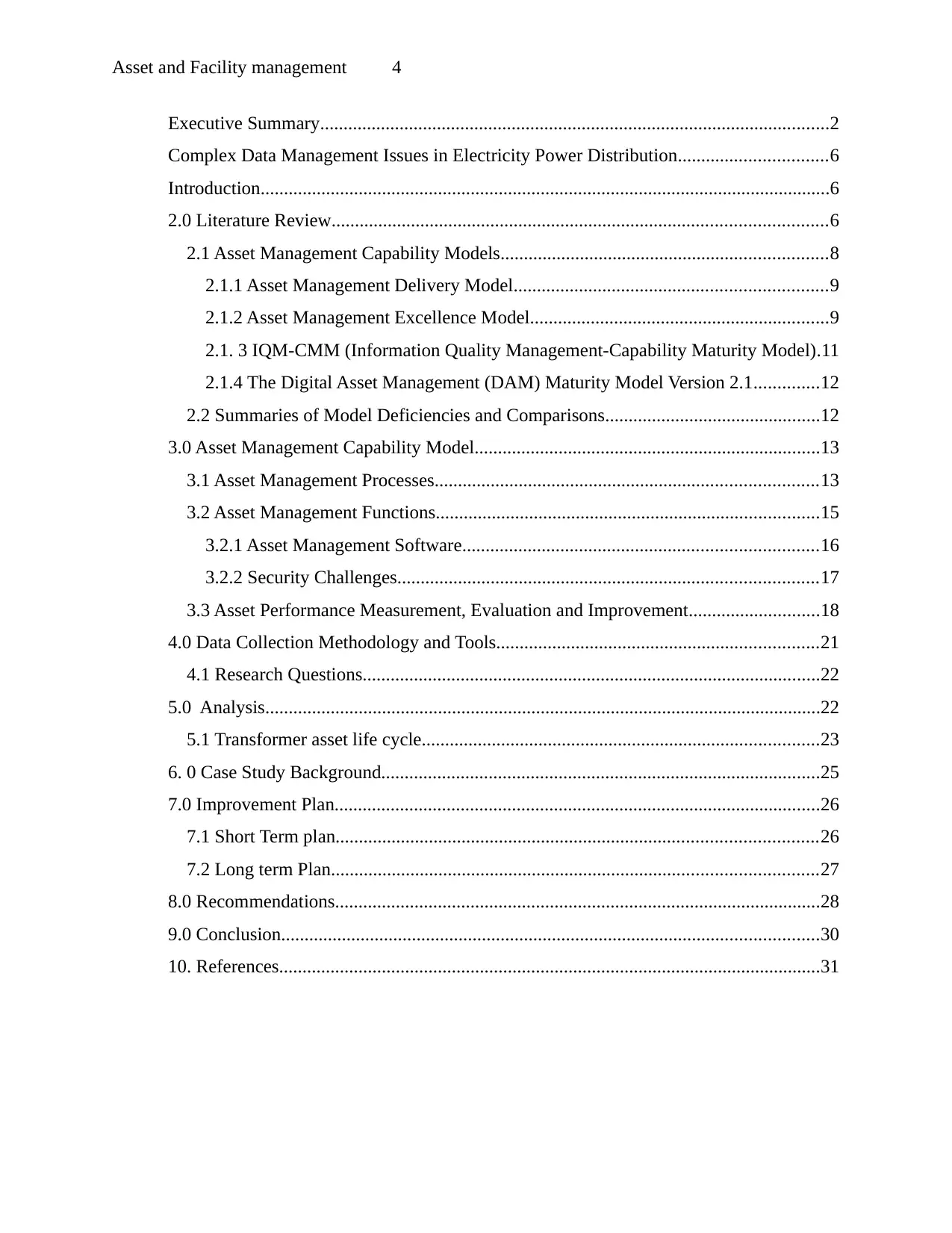
Executive Summary.............................................................................................................2
Complex Data Management Issues in Electricity Power Distribution................................6
Introduction..........................................................................................................................6
2.0 Literature Review..........................................................................................................6
2.1 Asset Management Capability Models......................................................................8
2.1.1 Asset Management Delivery Model...................................................................9
2.1.2 Asset Management Excellence Model................................................................9
2.1. 3 IQM-CMM (Information Quality Management-Capability Maturity Model).11
2.1.4 The Digital Asset Management (DAM) Maturity Model Version 2.1..............12
2.2 Summaries of Model Deficiencies and Comparisons..............................................12
3.0 Asset Management Capability Model..........................................................................13
3.1 Asset Management Processes..................................................................................13
3.2 Asset Management Functions..................................................................................15
3.2.1 Asset Management Software............................................................................16
3.2.2 Security Challenges..........................................................................................17
3.3 Asset Performance Measurement, Evaluation and Improvement............................18
4.0 Data Collection Methodology and Tools.....................................................................21
4.1 Research Questions..................................................................................................22
5.0 Analysis.......................................................................................................................22
5.1 Transformer asset life cycle.....................................................................................23
6. 0 Case Study Background..............................................................................................25
7.0 Improvement Plan........................................................................................................26
7.1 Short Term plan.......................................................................................................26
7.2 Long term Plan........................................................................................................27
8.0 Recommendations........................................................................................................28
9.0 Conclusion...................................................................................................................30
10. References....................................................................................................................31
Executive Summary.............................................................................................................2
Complex Data Management Issues in Electricity Power Distribution................................6
Introduction..........................................................................................................................6
2.0 Literature Review..........................................................................................................6
2.1 Asset Management Capability Models......................................................................8
2.1.1 Asset Management Delivery Model...................................................................9
2.1.2 Asset Management Excellence Model................................................................9
2.1. 3 IQM-CMM (Information Quality Management-Capability Maturity Model).11
2.1.4 The Digital Asset Management (DAM) Maturity Model Version 2.1..............12
2.2 Summaries of Model Deficiencies and Comparisons..............................................12
3.0 Asset Management Capability Model..........................................................................13
3.1 Asset Management Processes..................................................................................13
3.2 Asset Management Functions..................................................................................15
3.2.1 Asset Management Software............................................................................16
3.2.2 Security Challenges..........................................................................................17
3.3 Asset Performance Measurement, Evaluation and Improvement............................18
4.0 Data Collection Methodology and Tools.....................................................................21
4.1 Research Questions..................................................................................................22
5.0 Analysis.......................................................................................................................22
5.1 Transformer asset life cycle.....................................................................................23
6. 0 Case Study Background..............................................................................................25
7.0 Improvement Plan........................................................................................................26
7.1 Short Term plan.......................................................................................................26
7.2 Long term Plan........................................................................................................27
8.0 Recommendations........................................................................................................28
9.0 Conclusion...................................................................................................................30
10. References....................................................................................................................31
Paraphrase This Document
Need a fresh take? Get an instant paraphrase of this document with our AI Paraphraser
Asset and Facility management 5
Complex Data Management Issues in Electricity Power Distribution
Introduction
Electricity distribution is a complex system, which involves high-risk management. Its
process requires an Asset Management Plan (AMP) with a risk profile of each of its asset levels
(Haines & Hodkiewicz, 2014). A reliable plan needs a quality maintenance model and a
capability model that monitors the processes, functions and measurements. As an integral part of
asset management, it has a risk-based life cycle. A report by PWC on financial reporting for
power and utilities acknowledges the need for constant research and monitoring of power and
utility activities (PWC, 2011). The critical pillars for improved power usage are the real assets
and their components. These include the transformers, cables, towers, overhead line wiring
system and the switchgear. The maintenance issues in this system include maximized
performance, replacement and reliability issues. ISO 55000 and the ISO 14224 present global
standard policies for asset management to ensure a continuous and growing network (Shin &
Jun, 2015). These motivate financial efficiency, process viability, risk management and improved
services. Computerized Maintenance Systems ensure efficiency in the power generation process
through the prevention of impairments, and transmission failure. Using standardization as a
better process of data management and strategy, this discussion focuses on the transformer asset
and electricity distribution processes, control, maintenance and distribution management.
2.0 Literature Review
Asset management is unique for different industries and companies (GHD, 2014). The Asset
Management Council (ACM) defines asset management with a focus on asset integrity, its
functionality, safety, leadership and skills (The Asset Management Council, 2017). An asset
management process needs a plan that involves a management policy, strategy objectives and
maintenance and delivery plan. This is critical because an effective asset management reduces
the rate of failure within a distribution life cycle (Quezada, Szatow, & Liley, 2012). It captures
the network performance, its capability and reliable modes. It is also instrumental in cost
effectiveness because of the improved distribution. Fixed assets include the property, plant and
its equipment. Asset components include the distributed assets namely the transformers, cables,
overhead lines, switchgear and towers. The service components include the distribution,
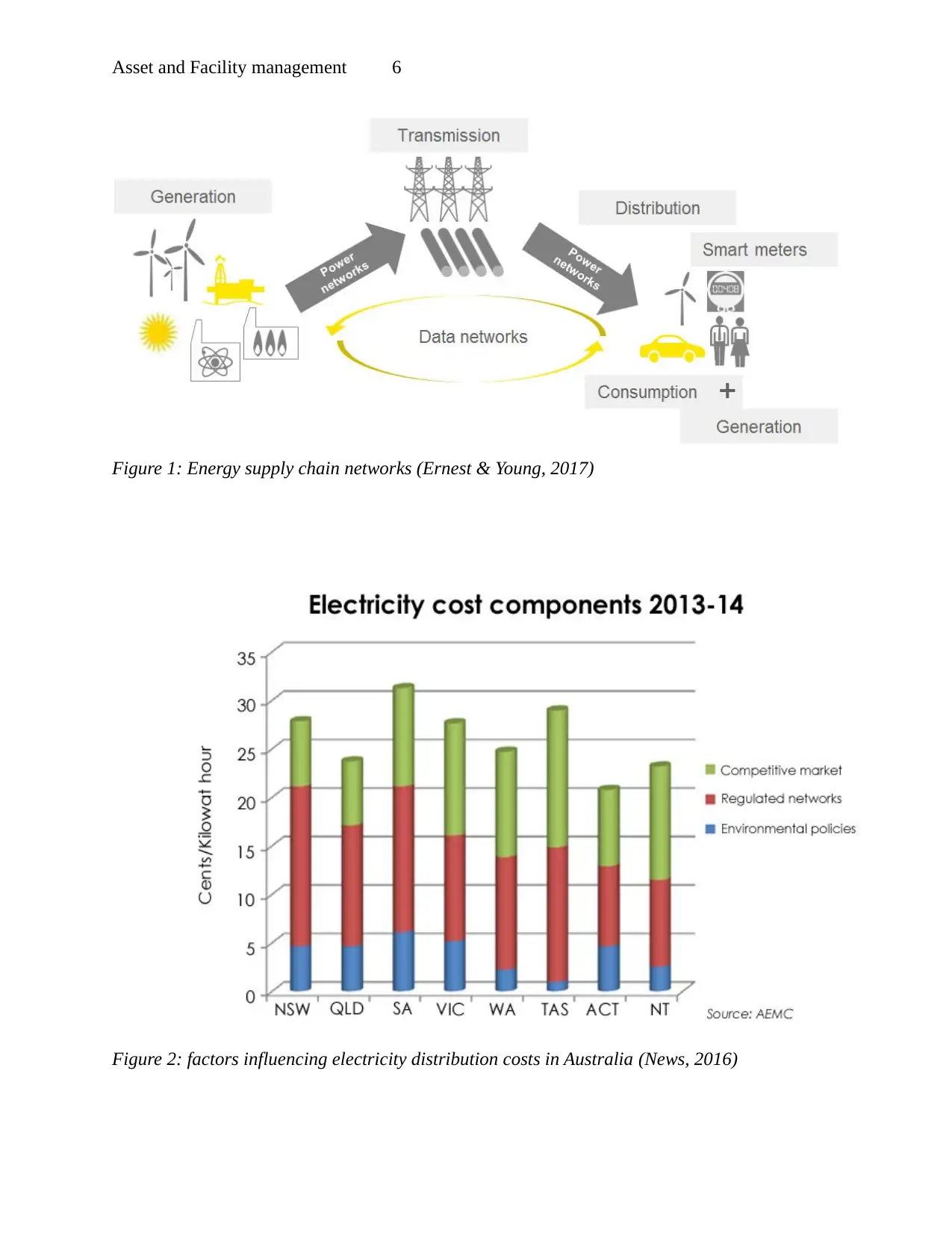
utilization, operational design, costs and strategic planning as shown in the figures below.
Complex Data Management Issues in Electricity Power Distribution
Introduction
Electricity distribution is a complex system, which involves high-risk management. Its
process requires an Asset Management Plan (AMP) with a risk profile of each of its asset levels
(Haines & Hodkiewicz, 2014). A reliable plan needs a quality maintenance model and a
capability model that monitors the processes, functions and measurements. As an integral part of
asset management, it has a risk-based life cycle. A report by PWC on financial reporting for
power and utilities acknowledges the need for constant research and monitoring of power and
utility activities (PWC, 2011). The critical pillars for improved power usage are the real assets
and their components. These include the transformers, cables, towers, overhead line wiring
system and the switchgear. The maintenance issues in this system include maximized
performance, replacement and reliability issues. ISO 55000 and the ISO 14224 present global
standard policies for asset management to ensure a continuous and growing network (Shin &
Jun, 2015). These motivate financial efficiency, process viability, risk management and improved
services. Computerized Maintenance Systems ensure efficiency in the power generation process
through the prevention of impairments, and transmission failure. Using standardization as a
better process of data management and strategy, this discussion focuses on the transformer asset
and electricity distribution processes, control, maintenance and distribution management.
2.0 Literature Review
Asset management is unique for different industries and companies (GHD, 2014). The Asset
Management Council (ACM) defines asset management with a focus on asset integrity, its
functionality, safety, leadership and skills (The Asset Management Council, 2017). An asset
management process needs a plan that involves a management policy, strategy objectives and
maintenance and delivery plan. This is critical because an effective asset management reduces
the rate of failure within a distribution life cycle (Quezada, Szatow, & Liley, 2012). It captures
the network performance, its capability and reliable modes. It is also instrumental in cost
effectiveness because of the improved distribution. Fixed assets include the property, plant and
its equipment. Asset components include the distributed assets namely the transformers, cables,
overhead lines, switchgear and towers. The service components include the distribution,
utilization, operational design, costs and strategic planning as shown in the figures below.
Asset and Facility management 6
Figure 1: Energy supply chain networks (Ernest & Young, 2017)
Figure 2: factors influencing electricity distribution costs in Australia (News, 2016)
Figure 1: Energy supply chain networks (Ernest & Young, 2017)
Figure 2: factors influencing electricity distribution costs in Australia (News, 2016)
⊘ This is a preview!⊘
Do you want full access?
Subscribe today to unlock all pages.
Trusted by 1+ million students worldwide
Asset and Facility management 7
2.1 Asset Management Capability Models
Kerry & Robyn (2015) specify that asset management thrive on a capability model
framework. The Asset Management Maturity Model (AMCaMM) is an integrated system with
different processes and levels of a capability indicator. The electricity power distributor depends
on a distributed generation (DG) system, which has clearly defined capacity units, appropriate
location, type of network and technology used (Khatod & Viral, 2012). This model supports a
continuous supply system to meets the growing demand. Research points out that Australia’s
energy intensive demands call for a reliable energy supply that goes beyond the costly blackouts
and peak hours (Kerin, 2014). This means a synchronization of total assets like generators and
structures in the electricity distribution system such as poles and wiring systems.
Suwnansri (2014) identifies the transformer as a major asset in electricity distribution.
This is a vital link in the electricity distribution network because it affects the life cycle process.
Its maintenance issues include visual inspection, electrical tests, unstable system, damage and
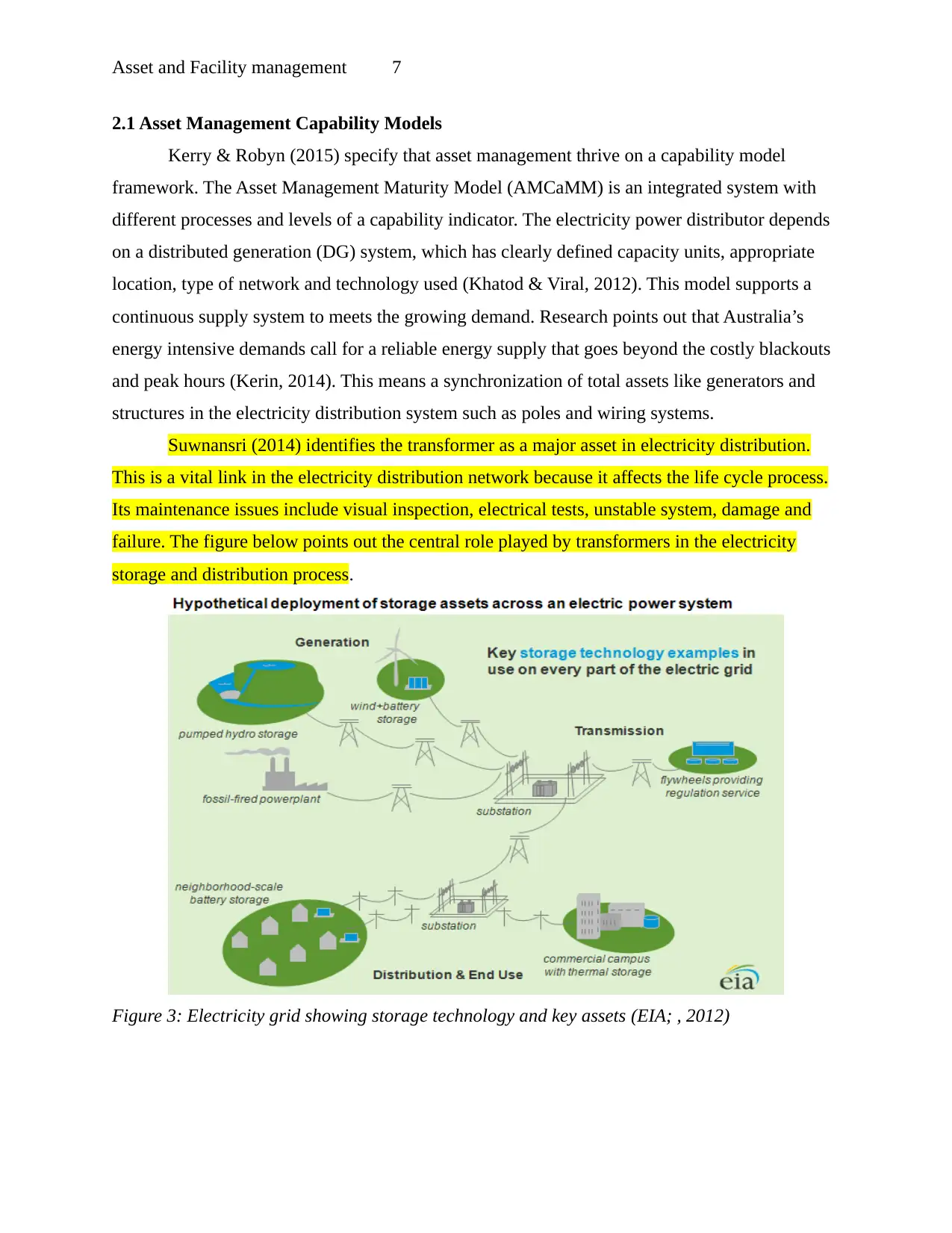
failure. The figure below points out the central role played by transformers in the electricity
storage and distribution process.
Figure 3: Electricity grid showing storage technology and key assets (EIA; , 2012)
2.1 Asset Management Capability Models
Kerry & Robyn (2015) specify that asset management thrive on a capability model
framework. The Asset Management Maturity Model (AMCaMM) is an integrated system with
different processes and levels of a capability indicator. The electricity power distributor depends
on a distributed generation (DG) system, which has clearly defined capacity units, appropriate
location, type of network and technology used (Khatod & Viral, 2012). This model supports a
continuous supply system to meets the growing demand. Research points out that Australia’s
energy intensive demands call for a reliable energy supply that goes beyond the costly blackouts
and peak hours (Kerin, 2014). This means a synchronization of total assets like generators and
structures in the electricity distribution system such as poles and wiring systems.
Suwnansri (2014) identifies the transformer as a major asset in electricity distribution.
This is a vital link in the electricity distribution network because it affects the life cycle process.
Its maintenance issues include visual inspection, electrical tests, unstable system, damage and
failure. The figure below points out the central role played by transformers in the electricity
storage and distribution process.
Figure 3: Electricity grid showing storage technology and key assets (EIA; , 2012)
Paraphrase This Document
Need a fresh take? Get an instant paraphrase of this document with our AI Paraphraser
Asset and Facility management 8
2.1.1 Asset Management Delivery Model
According to Stirna, Grabis, Henkel, & Zdravkovic, (2012), the evolving organizations
today need a capability driven approach to service delivery. This is an integration of the
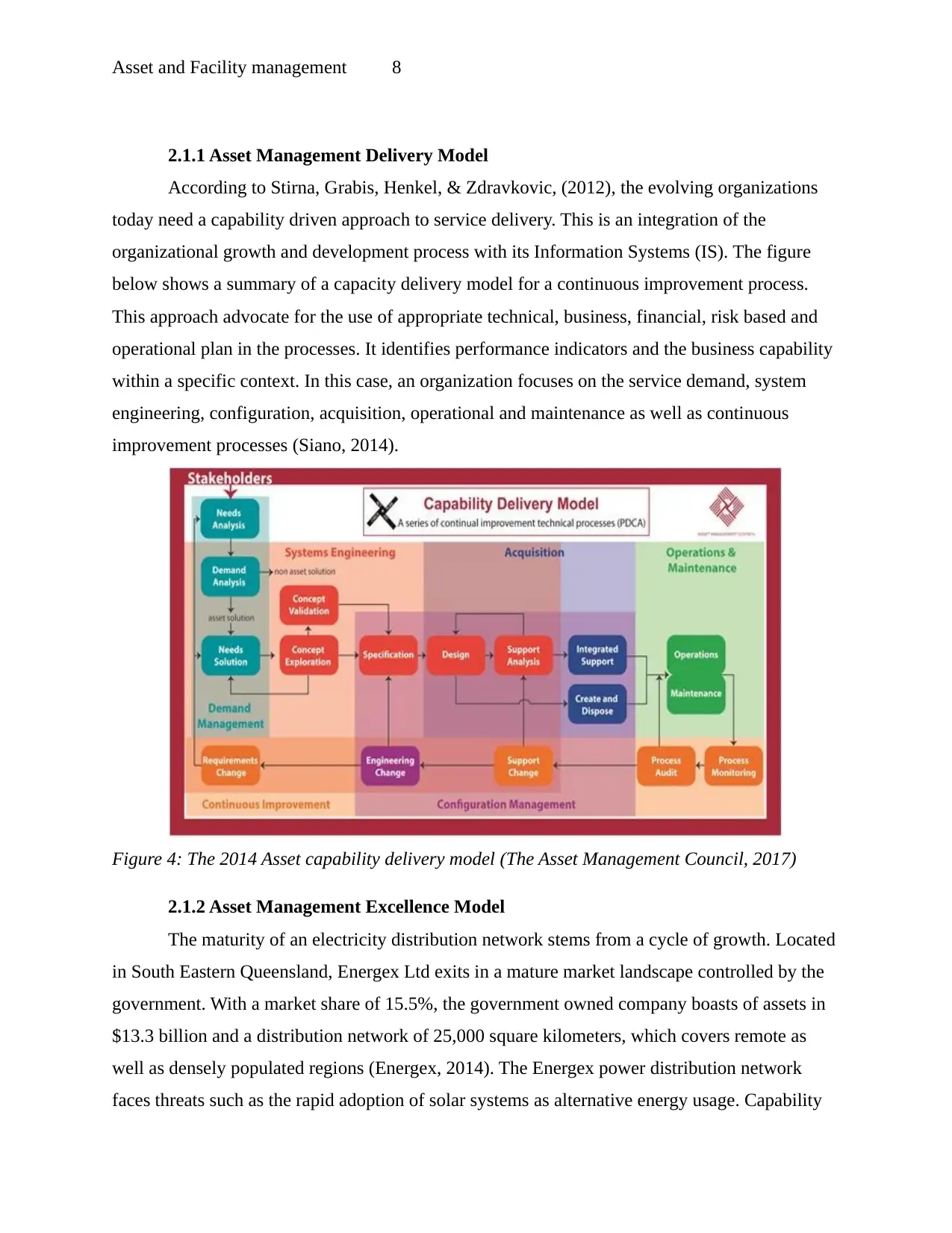
organizational growth and development process with its Information Systems (IS). The figure
below shows a summary of a capacity delivery model for a continuous improvement process.
This approach advocate for the use of appropriate technical, business, financial, risk based and
operational plan in the processes. It identifies performance indicators and the business capability
within a specific context. In this case, an organization focuses on the service demand, system
engineering, configuration, acquisition, operational and maintenance as well as continuous
improvement processes (Siano, 2014).
Figure 4: The 2014 Asset capability delivery model (The Asset Management Council, 2017)
2.1.2 Asset Management Excellence Model
The maturity of an electricity distribution network stems from a cycle of growth. Located
in South Eastern Queensland, Energex Ltd exits in a mature market landscape controlled by the
government. With a market share of 15.5%, the government owned company boasts of assets in
$13.3 billion and a distribution network of 25,000 square kilometers, which covers remote as
well as densely populated regions (Energex, 2014). The Energex power distribution network
faces threats such as the rapid adoption of solar systems as alternative energy usage. Capability
2.1.1 Asset Management Delivery Model
According to Stirna, Grabis, Henkel, & Zdravkovic, (2012), the evolving organizations
today need a capability driven approach to service delivery. This is an integration of the
organizational growth and development process with its Information Systems (IS). The figure
below shows a summary of a capacity delivery model for a continuous improvement process.
This approach advocate for the use of appropriate technical, business, financial, risk based and
operational plan in the processes. It identifies performance indicators and the business capability
within a specific context. In this case, an organization focuses on the service demand, system
engineering, configuration, acquisition, operational and maintenance as well as continuous
improvement processes (Siano, 2014).
Figure 4: The 2014 Asset capability delivery model (The Asset Management Council, 2017)
2.1.2 Asset Management Excellence Model
The maturity of an electricity distribution network stems from a cycle of growth. Located
in South Eastern Queensland, Energex Ltd exits in a mature market landscape controlled by the
government. With a market share of 15.5%, the government owned company boasts of assets in
$13.3 billion and a distribution network of 25,000 square kilometers, which covers remote as
well as densely populated regions (Energex, 2014). The Energex power distribution network
faces threats such as the rapid adoption of solar systems as alternative energy usage. Capability
Asset and Facility management 9
models provide guidance on software input with safety and environmental concerns. The
installation of technology systems at the poles, wiring systems, transformers and substations
determines the mechanism of the flow, supply and consumption at the accumulation meters as
well as the specific electricity demand. That is why Ahlemann, Stettiner, Messerscmidt, &
Legner ( 2012) suggetst that the Asset Management Excellence Model is a type of AMCaM with
a wider dimension of the critical processes. This data systems approach evaluates various options
such as the delivery, operational (equipment) governance, knowledge management and risk
management as shown in the table below.
Reliability Management of Life Cycle Operational Excellence
Distribution process Life cycle Waste reduction
Plant maintenance Management of error Elimination of loss
Reduced failure rate Standard utilization Risk mitigation
Risk reduction Quality controls Change management
Enhanced reliability Effective series Stable systems health
Table 1: Factors in an operational excellence system
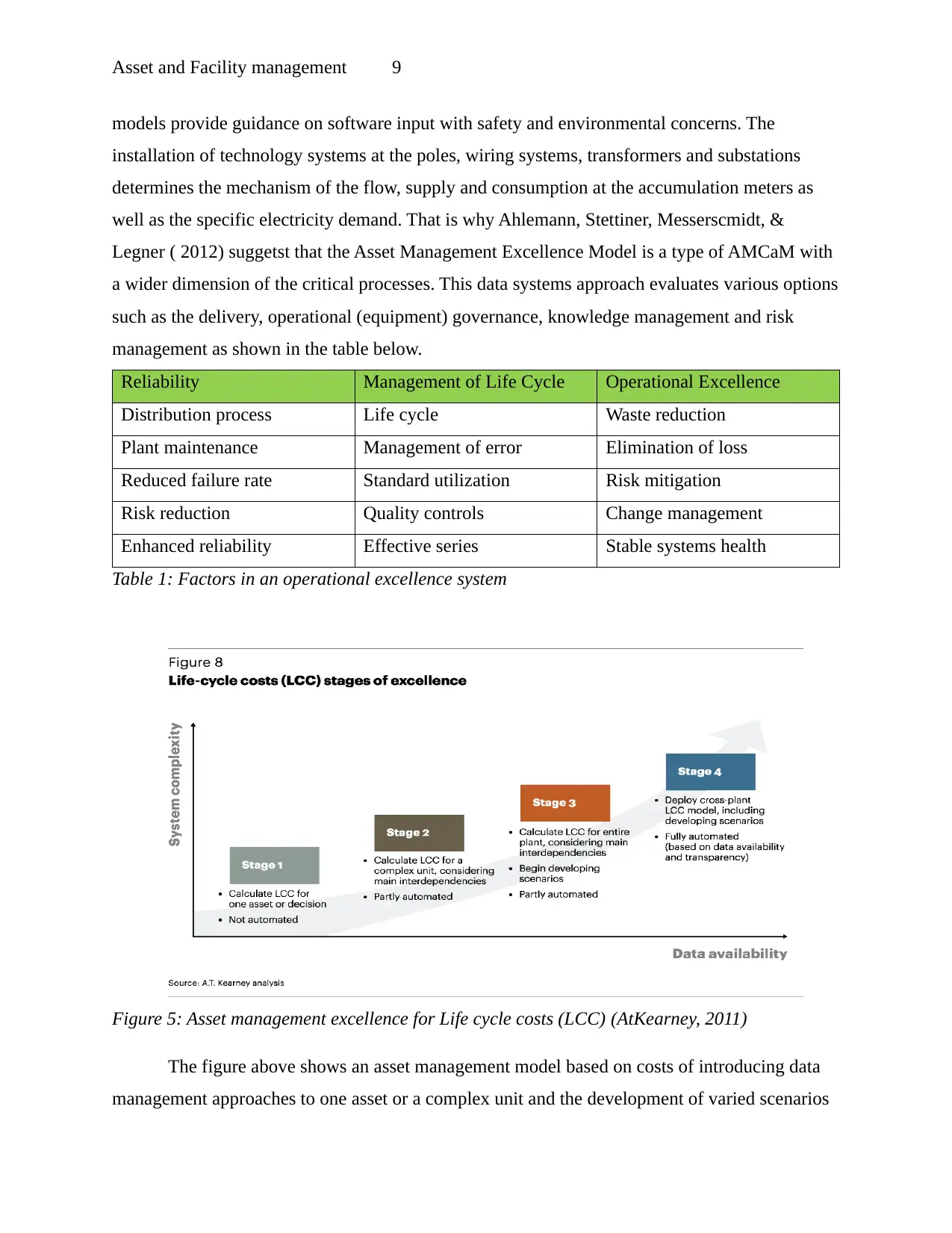
Figure 5: Asset management excellence for Life cycle costs (LCC) (AtKearney, 2011)
The figure above shows an asset management model based on costs of introducing data
management approaches to one asset or a complex unit and the development of varied scenarios
models provide guidance on software input with safety and environmental concerns. The
installation of technology systems at the poles, wiring systems, transformers and substations
determines the mechanism of the flow, supply and consumption at the accumulation meters as
well as the specific electricity demand. That is why Ahlemann, Stettiner, Messerscmidt, &
Legner ( 2012) suggetst that the Asset Management Excellence Model is a type of AMCaM with
a wider dimension of the critical processes. This data systems approach evaluates various options
such as the delivery, operational (equipment) governance, knowledge management and risk
management as shown in the table below.
Reliability Management of Life Cycle Operational Excellence
Distribution process Life cycle Waste reduction
Plant maintenance Management of error Elimination of loss
Reduced failure rate Standard utilization Risk mitigation
Risk reduction Quality controls Change management
Enhanced reliability Effective series Stable systems health
Table 1: Factors in an operational excellence system
Figure 5: Asset management excellence for Life cycle costs (LCC) (AtKearney, 2011)
The figure above shows an asset management model based on costs of introducing data
management approaches to one asset or a complex unit and the development of varied scenarios
⊘ This is a preview!⊘
Do you want full access?
Subscribe today to unlock all pages.
Trusted by 1+ million students worldwide
Asset and Facility management 10
in a lifecycle. The electricity distribution network keeps evolving over time as determined by the
supply and demand in a capacity-based process (AtKearney, 2011). Operational excellence starts
with systems set up and develops a maintenance plan within the lifecycle cost and performance
indicators. Service providers depend on strategy for an appropriate direction on efficiency
control and maintenance (Porter & Tanner, 2012).
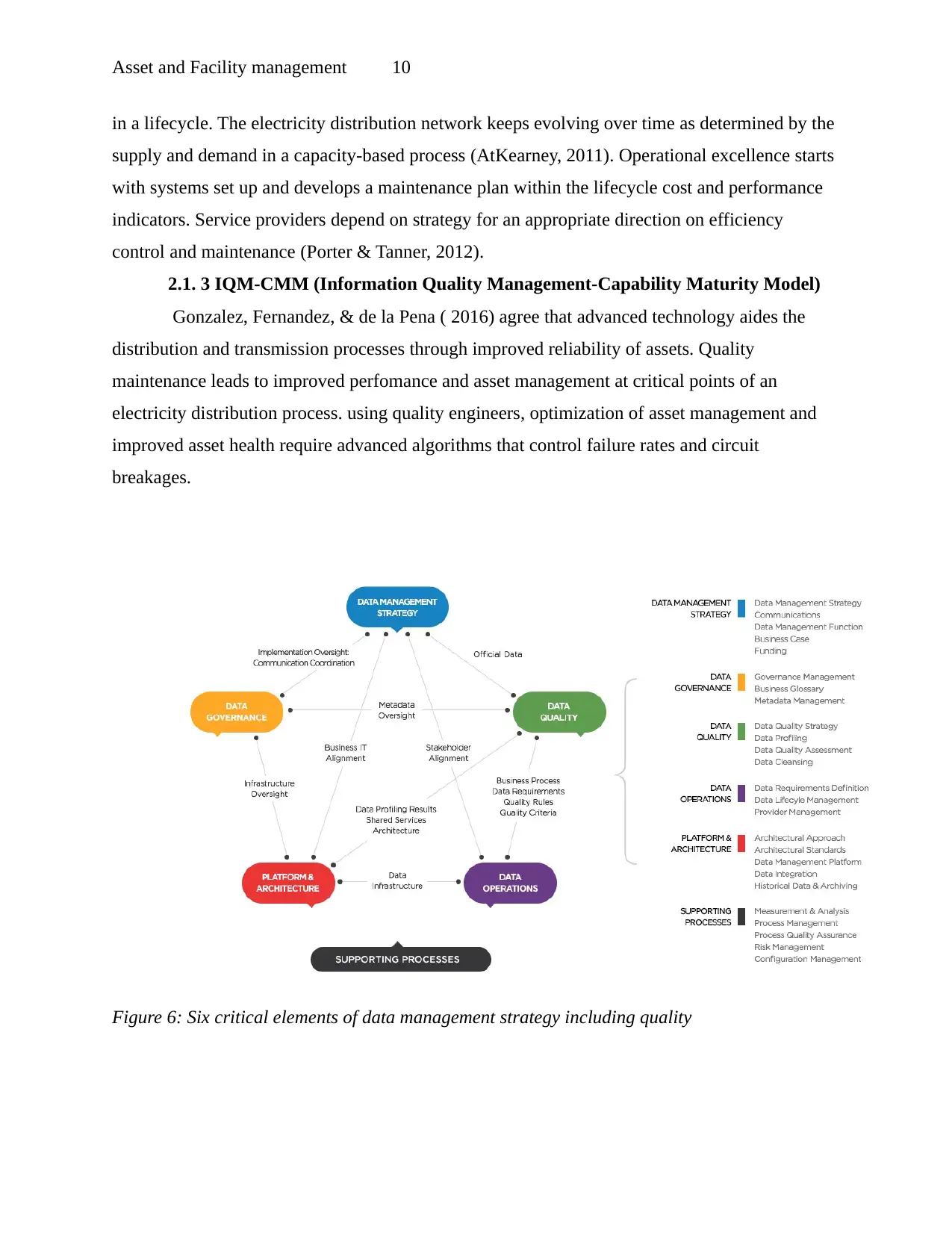
2.1. 3 IQM-CMM (Information Quality Management-Capability Maturity Model)
Gonzalez, Fernandez, & de la Pena ( 2016) agree that advanced technology aides the
distribution and transmission processes through improved reliability of assets. Quality
maintenance leads to improved perfomance and asset management at critical points of an
electricity distribution process. using quality engineers, optimization of asset management and
improved asset health require advanced algorithms that control failure rates and circuit
breakages.
Figure 6: Six critical elements of data management strategy including quality
in a lifecycle. The electricity distribution network keeps evolving over time as determined by the
supply and demand in a capacity-based process (AtKearney, 2011). Operational excellence starts
with systems set up and develops a maintenance plan within the lifecycle cost and performance
indicators. Service providers depend on strategy for an appropriate direction on efficiency
control and maintenance (Porter & Tanner, 2012).
2.1. 3 IQM-CMM (Information Quality Management-Capability Maturity Model)
Gonzalez, Fernandez, & de la Pena ( 2016) agree that advanced technology aides the
distribution and transmission processes through improved reliability of assets. Quality
maintenance leads to improved perfomance and asset management at critical points of an
electricity distribution process. using quality engineers, optimization of asset management and
improved asset health require advanced algorithms that control failure rates and circuit
breakages.
Figure 6: Six critical elements of data management strategy including quality
Paraphrase This Document
Need a fresh take? Get an instant paraphrase of this document with our AI Paraphraser
Asset and Facility management 11
2.1.4 The Digital Asset Management (DAM) Maturity Model Version 2.1
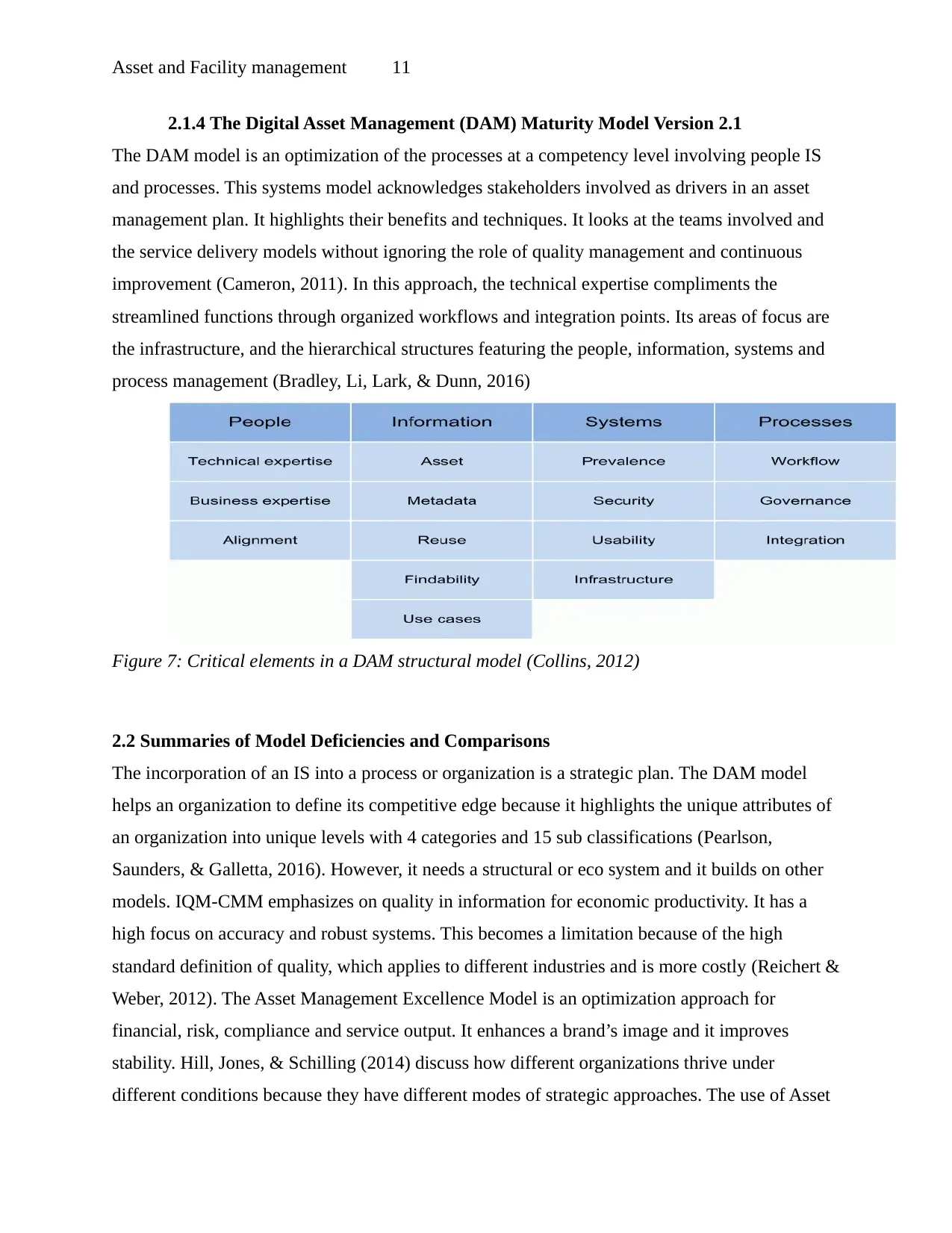
The DAM model is an optimization of the processes at a competency level involving people IS
and processes. This systems model acknowledges stakeholders involved as drivers in an asset
management plan. It highlights their benefits and techniques. It looks at the teams involved and
the service delivery models without ignoring the role of quality management and continuous
improvement (Cameron, 2011). In this approach, the technical expertise compliments the
streamlined functions through organized workflows and integration points. Its areas of focus are
the infrastructure, and the hierarchical structures featuring the people, information, systems and
process management (Bradley, Li, Lark, & Dunn, 2016)
Figure 7: Critical elements in a DAM structural model (Collins, 2012)
2.2 Summaries of Model Deficiencies and Comparisons
The incorporation of an IS into a process or organization is a strategic plan. The DAM model
helps an organization to define its competitive edge because it highlights the unique attributes of
an organization into unique levels with 4 categories and 15 sub classifications (Pearlson,
Saunders, & Galletta, 2016). However, it needs a structural or eco system and it builds on other
models. IQM-CMM emphasizes on quality in information for economic productivity. It has a
high focus on accuracy and robust systems. This becomes a limitation because of the high
standard definition of quality, which applies to different industries and is more costly (Reichert &
Weber, 2012). The Asset Management Excellence Model is an optimization approach for
financial, risk, compliance and service output. It enhances a brand’s image and it improves
stability. Hill, Jones, & Schilling (2014) discuss how different organizations thrive under
different conditions because they have different modes of strategic approaches. The use of Asset
2.1.4 The Digital Asset Management (DAM) Maturity Model Version 2.1
The DAM model is an optimization of the processes at a competency level involving people IS
and processes. This systems model acknowledges stakeholders involved as drivers in an asset
management plan. It highlights their benefits and techniques. It looks at the teams involved and
the service delivery models without ignoring the role of quality management and continuous
improvement (Cameron, 2011). In this approach, the technical expertise compliments the
streamlined functions through organized workflows and integration points. Its areas of focus are
the infrastructure, and the hierarchical structures featuring the people, information, systems and
process management (Bradley, Li, Lark, & Dunn, 2016)
Figure 7: Critical elements in a DAM structural model (Collins, 2012)
2.2 Summaries of Model Deficiencies and Comparisons
The incorporation of an IS into a process or organization is a strategic plan. The DAM model
helps an organization to define its competitive edge because it highlights the unique attributes of
an organization into unique levels with 4 categories and 15 sub classifications (Pearlson,
Saunders, & Galletta, 2016). However, it needs a structural or eco system and it builds on other
models. IQM-CMM emphasizes on quality in information for economic productivity. It has a
high focus on accuracy and robust systems. This becomes a limitation because of the high
standard definition of quality, which applies to different industries and is more costly (Reichert &
Weber, 2012). The Asset Management Excellence Model is an optimization approach for
financial, risk, compliance and service output. It enhances a brand’s image and it improves
stability. Hill, Jones, & Schilling (2014) discuss how different organizations thrive under
different conditions because they have different modes of strategic approaches. The use of Asset
Asset and Facility management 12
Management Capability Delivery Model concentrates on efficiency at the expense of other
optimization factors like quality and management practices (Kwon, Lee, & Shin, 2014).
3.0 Asset Management Capability Model
Asset management is a systematic approach to maintenance, upgrading and operating
tangible and intangible assets (Cosic, Shanks, & Maynard, 2012). Globally, the government
spends a considerable amount of money on electricity distribution systems. However, there are
challenges such as:
Aging infrastructure
High cost of electricity outages
Unexpected risks such as weather effects
Reliability in electricity supply
3.1 Asset Management Processes
Electricity generation depends on natural resources and it has complex supply and
demand factors. Constant changes in the market system also requires regular maintenance and
upgrades to meet the growing demand. The Asset Management Capability Model provides an
optimization approach for a multilevel system in a dynamic industry (Igor, Kyeong, & Bae,
2012). Asset management needs and infrastructural development for a sustainable service
delivery process (Mezger, 2014). It creates a competitive advantage whose system personnel,
procedural and technological implementation has a holistic approach. Asset management
connects business, technology and economic objectives of an organization. As an information
system, it provides a logical approach for lifecycle delivery, asset management strategy and
planning, risk and knowledge management.
The ISO 55000 is a global feature of asset managemet system that works with different
assets to provide technical specifications on the improvement on an assset base, improvement,
implimentation plans (ISO, 2014). The ISO 14224 is a maintenance system for best practice
procedures and distribution networks. It provides analytics for equipment and power distribution
for event analysis (Oshiro, 2017). Contemporary asset management strategies rely on data based
maintenance that adheres to international standardization. It covers safety standards, risk
management, lifecycle costs, reliability and maintenance and failure rate analysis. Applied
within the planning, system design, implimentation and constant reviews, it guides service
providers on the best asset management approach (ISO, 2014). Asset management capabilities
Management Capability Delivery Model concentrates on efficiency at the expense of other
optimization factors like quality and management practices (Kwon, Lee, & Shin, 2014).
3.0 Asset Management Capability Model
Asset management is a systematic approach to maintenance, upgrading and operating
tangible and intangible assets (Cosic, Shanks, & Maynard, 2012). Globally, the government
spends a considerable amount of money on electricity distribution systems. However, there are
challenges such as:
Aging infrastructure
High cost of electricity outages
Unexpected risks such as weather effects
Reliability in electricity supply
3.1 Asset Management Processes
Electricity generation depends on natural resources and it has complex supply and
demand factors. Constant changes in the market system also requires regular maintenance and
upgrades to meet the growing demand. The Asset Management Capability Model provides an
optimization approach for a multilevel system in a dynamic industry (Igor, Kyeong, & Bae,
2012). Asset management needs and infrastructural development for a sustainable service
delivery process (Mezger, 2014). It creates a competitive advantage whose system personnel,
procedural and technological implementation has a holistic approach. Asset management
connects business, technology and economic objectives of an organization. As an information
system, it provides a logical approach for lifecycle delivery, asset management strategy and
planning, risk and knowledge management.
The ISO 55000 is a global feature of asset managemet system that works with different
assets to provide technical specifications on the improvement on an assset base, improvement,
implimentation plans (ISO, 2014). The ISO 14224 is a maintenance system for best practice
procedures and distribution networks. It provides analytics for equipment and power distribution
for event analysis (Oshiro, 2017). Contemporary asset management strategies rely on data based
maintenance that adheres to international standardization. It covers safety standards, risk
management, lifecycle costs, reliability and maintenance and failure rate analysis. Applied
within the planning, system design, implimentation and constant reviews, it guides service
providers on the best asset management approach (ISO, 2014). Asset management capabilities
⊘ This is a preview!⊘
Do you want full access?
Subscribe today to unlock all pages.
Trusted by 1+ million students worldwide

1 out of 36


Related Documents


Your All-in-One AI-Powered Toolkit for Academic Success.
+13062052269
info@desklib.com
Available 24*7 on WhatsApp / Email
![[object Object]](/_next/static/media/star-bottom.7253800d.svg)
Unlock your academic potential
Copyright © 2020–2026 A2Z Services. All Rights Reserved. Developed and managed by ZUCOL.