Education: Assistive Technology and Accommodating Disabled Students
VerifiedAdded on 2023/06/05
|5
|1277
|342
Essay
AI Summary
This essay discusses strategies for effectively using assistive technology to promote learning for disabled students, including developing specialized computer devices and software. It also explores methods for accommodating disabled students in the classroom, such as grouping students by learning level and providing tailored reading materials. The essay addresses the implications of autism spectrum disorder on teaching and emphasizes the importance of teacher awareness and expert consultation. Furthermore, it examines the effects of NAPLAN on students, parents, and teachers, highlighting its benefits in identifying student strengths and weaknesses while also acknowledging the challenges it poses, suggesting individual responsibility as a key strategy. Desklib provides this and many more solved assignments for educational use.
Running head: EDUCATION
Education
Name
Student ID
Course
Unit
Lecturer
Date
Education
Name
Student ID
Course
Unit
Lecturer
Date
Paraphrase This Document
Need a fresh take? Get an instant paraphrase of this document with our AI Paraphraser

EDUCATION 2
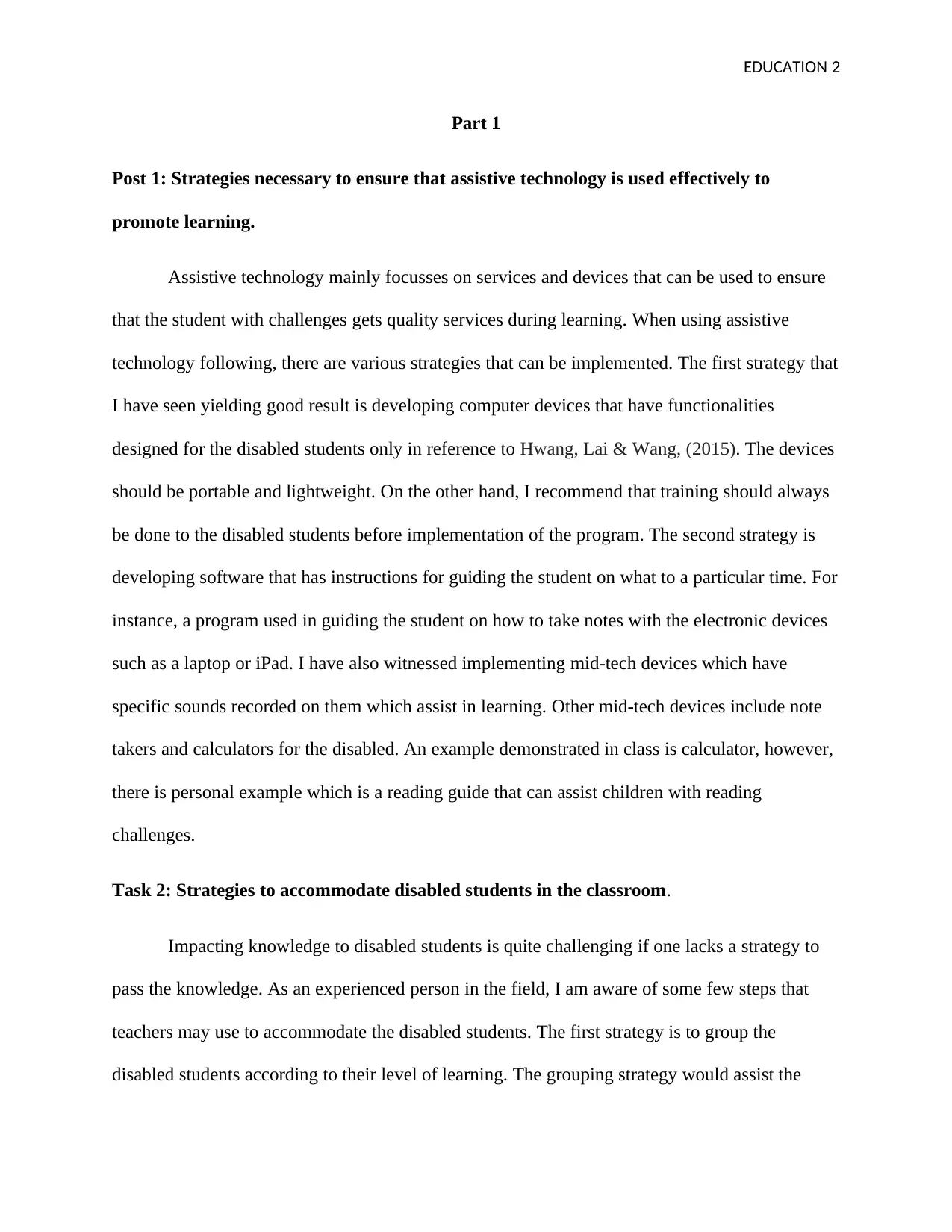
Part 1
Post 1: Strategies necessary to ensure that assistive technology is used effectively to
promote learning.
Assistive technology mainly focusses on services and devices that can be used to ensure
that the student with challenges gets quality services during learning. When using assistive
technology following, there are various strategies that can be implemented. The first strategy that
I have seen yielding good result is developing computer devices that have functionalities
designed for the disabled students only in reference to Hwang, Lai & Wang, (2015). The devices
should be portable and lightweight. On the other hand, I recommend that training should always
be done to the disabled students before implementation of the program. The second strategy is
developing software that has instructions for guiding the student on what to a particular time. For
instance, a program used in guiding the student on how to take notes with the electronic devices
such as a laptop or iPad. I have also witnessed implementing mid-tech devices which have
specific sounds recorded on them which assist in learning. Other mid-tech devices include note
takers and calculators for the disabled. An example demonstrated in class is calculator, however,
there is personal example which is a reading guide that can assist children with reading
challenges.
Task 2: Strategies to accommodate disabled students in the classroom.
Impacting knowledge to disabled students is quite challenging if one lacks a strategy to
pass the knowledge. As an experienced person in the field, I am aware of some few steps that
teachers may use to accommodate the disabled students. The first strategy is to group the
disabled students according to their level of learning. The grouping strategy would assist the
Part 1
Post 1: Strategies necessary to ensure that assistive technology is used effectively to
promote learning.
Assistive technology mainly focusses on services and devices that can be used to ensure
that the student with challenges gets quality services during learning. When using assistive
technology following, there are various strategies that can be implemented. The first strategy that
I have seen yielding good result is developing computer devices that have functionalities
designed for the disabled students only in reference to Hwang, Lai & Wang, (2015). The devices
should be portable and lightweight. On the other hand, I recommend that training should always
be done to the disabled students before implementation of the program. The second strategy is
developing software that has instructions for guiding the student on what to a particular time. For
instance, a program used in guiding the student on how to take notes with the electronic devices
such as a laptop or iPad. I have also witnessed implementing mid-tech devices which have
specific sounds recorded on them which assist in learning. Other mid-tech devices include note
takers and calculators for the disabled. An example demonstrated in class is calculator, however,
there is personal example which is a reading guide that can assist children with reading
challenges.
Task 2: Strategies to accommodate disabled students in the classroom.
Impacting knowledge to disabled students is quite challenging if one lacks a strategy to
pass the knowledge. As an experienced person in the field, I am aware of some few steps that
teachers may use to accommodate the disabled students. The first strategy is to group the
disabled students according to their level of learning. The grouping strategy would assist the

EDUCATION 3
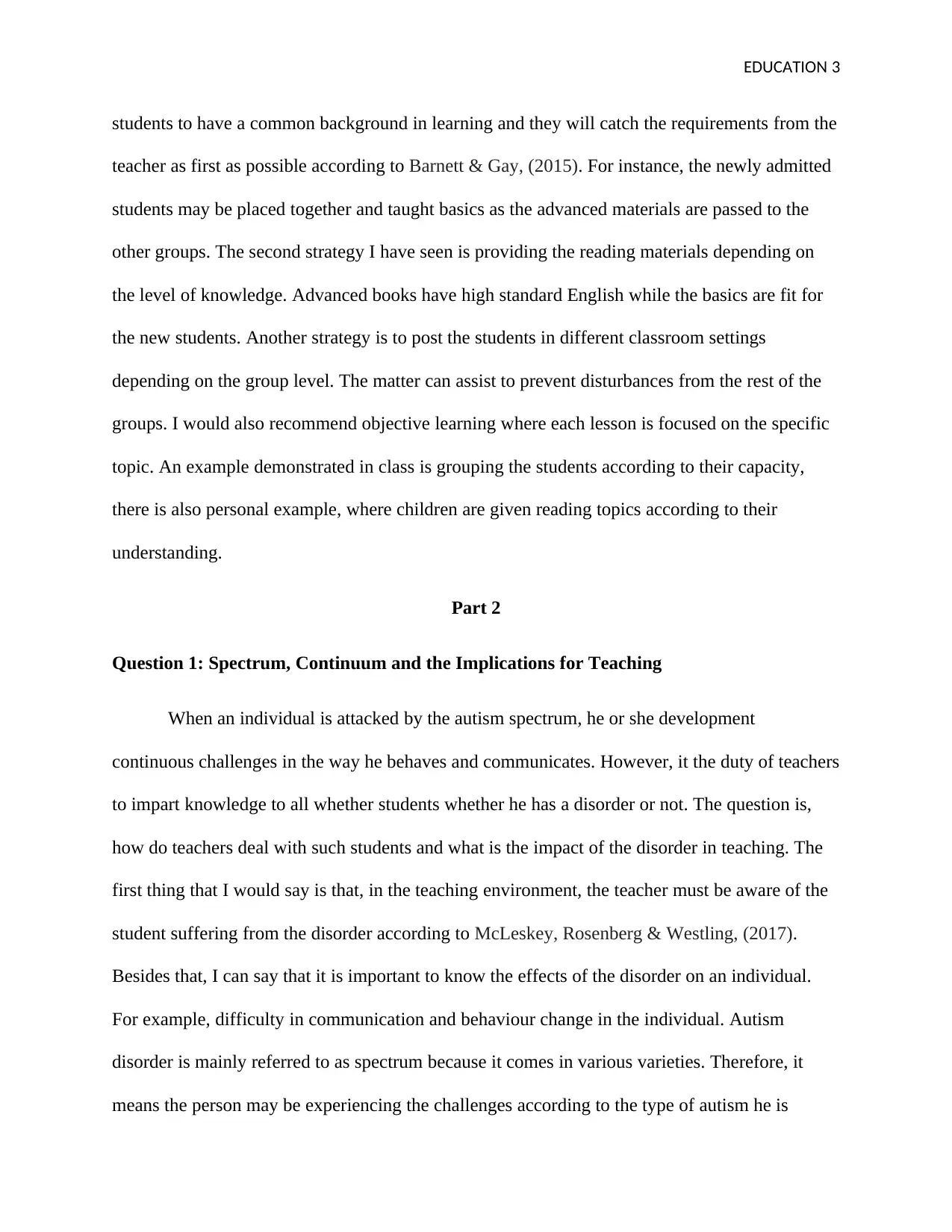
students to have a common background in learning and they will catch the requirements from the
teacher as first as possible according to Barnett & Gay, (2015). For instance, the newly admitted
students may be placed together and taught basics as the advanced materials are passed to the
other groups. The second strategy I have seen is providing the reading materials depending on
the level of knowledge. Advanced books have high standard English while the basics are fit for
the new students. Another strategy is to post the students in different classroom settings
depending on the group level. The matter can assist to prevent disturbances from the rest of the
groups. I would also recommend objective learning where each lesson is focused on the specific
topic. An example demonstrated in class is grouping the students according to their capacity,
there is also personal example, where children are given reading topics according to their
understanding.
Part 2
Question 1: Spectrum, Continuum and the Implications for Teaching
When an individual is attacked by the autism spectrum, he or she development
continuous challenges in the way he behaves and communicates. However, it the duty of teachers
to impart knowledge to all whether students whether he has a disorder or not. The question is,
how do teachers deal with such students and what is the impact of the disorder in teaching. The
first thing that I would say is that, in the teaching environment, the teacher must be aware of the
student suffering from the disorder according to McLeskey, Rosenberg & Westling, (2017).
Besides that, I can say that it is important to know the effects of the disorder on an individual.
For example, difficulty in communication and behaviour change in the individual. Autism
disorder is mainly referred to as spectrum because it comes in various varieties. Therefore, it
means the person may be experiencing the challenges according to the type of autism he is
students to have a common background in learning and they will catch the requirements from the
teacher as first as possible according to Barnett & Gay, (2015). For instance, the newly admitted
students may be placed together and taught basics as the advanced materials are passed to the
other groups. The second strategy I have seen is providing the reading materials depending on
the level of knowledge. Advanced books have high standard English while the basics are fit for
the new students. Another strategy is to post the students in different classroom settings
depending on the group level. The matter can assist to prevent disturbances from the rest of the
groups. I would also recommend objective learning where each lesson is focused on the specific
topic. An example demonstrated in class is grouping the students according to their capacity,
there is also personal example, where children are given reading topics according to their
understanding.
Part 2
Question 1: Spectrum, Continuum and the Implications for Teaching
When an individual is attacked by the autism spectrum, he or she development
continuous challenges in the way he behaves and communicates. However, it the duty of teachers
to impart knowledge to all whether students whether he has a disorder or not. The question is,
how do teachers deal with such students and what is the impact of the disorder in teaching. The
first thing that I would say is that, in the teaching environment, the teacher must be aware of the
student suffering from the disorder according to McLeskey, Rosenberg & Westling, (2017).
Besides that, I can say that it is important to know the effects of the disorder on an individual.
For example, difficulty in communication and behaviour change in the individual. Autism
disorder is mainly referred to as spectrum because it comes in various varieties. Therefore, it
means the person may be experiencing the challenges according to the type of autism he is
⊘ This is a preview!⊘
Do you want full access?
Subscribe today to unlock all pages.

Trusted by 1+ million students worldwide

EDUCATION 4
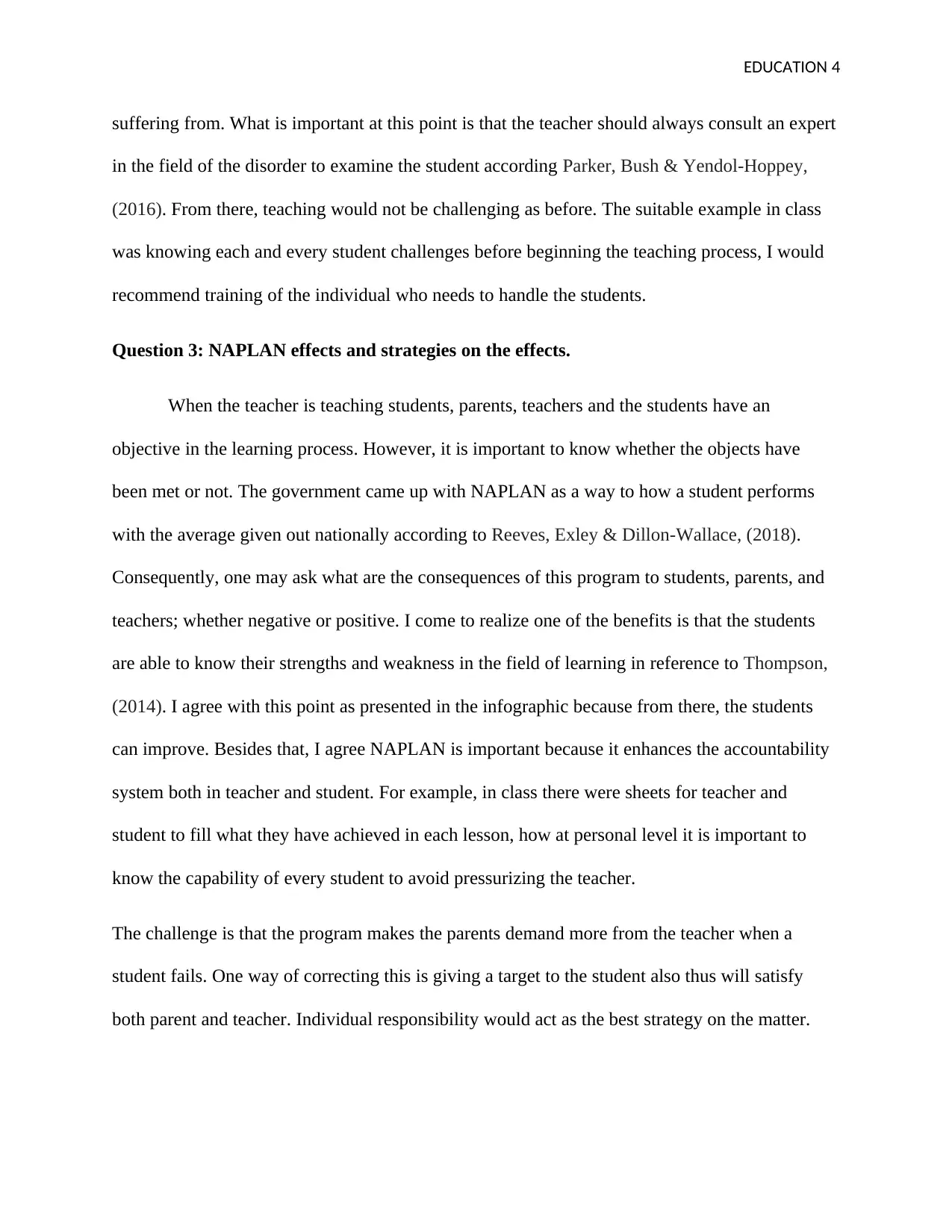
suffering from. What is important at this point is that the teacher should always consult an expert
in the field of the disorder to examine the student according Parker, Bush & Yendol-Hoppey,
(2016). From there, teaching would not be challenging as before. The suitable example in class
was knowing each and every student challenges before beginning the teaching process, I would
recommend training of the individual who needs to handle the students.
Question 3: NAPLAN effects and strategies on the effects.
When the teacher is teaching students, parents, teachers and the students have an
objective in the learning process. However, it is important to know whether the objects have
been met or not. The government came up with NAPLAN as a way to how a student performs
with the average given out nationally according to Reeves, Exley & Dillon-Wallace, (2018).
Consequently, one may ask what are the consequences of this program to students, parents, and
teachers; whether negative or positive. I come to realize one of the benefits is that the students
are able to know their strengths and weakness in the field of learning in reference to Thompson,
(2014). I agree with this point as presented in the infographic because from there, the students
can improve. Besides that, I agree NAPLAN is important because it enhances the accountability
system both in teacher and student. For example, in class there were sheets for teacher and
student to fill what they have achieved in each lesson, how at personal level it is important to
know the capability of every student to avoid pressurizing the teacher.
The challenge is that the program makes the parents demand more from the teacher when a
student fails. One way of correcting this is giving a target to the student also thus will satisfy
both parent and teacher. Individual responsibility would act as the best strategy on the matter.
suffering from. What is important at this point is that the teacher should always consult an expert
in the field of the disorder to examine the student according Parker, Bush & Yendol-Hoppey,
(2016). From there, teaching would not be challenging as before. The suitable example in class
was knowing each and every student challenges before beginning the teaching process, I would
recommend training of the individual who needs to handle the students.
Question 3: NAPLAN effects and strategies on the effects.
When the teacher is teaching students, parents, teachers and the students have an
objective in the learning process. However, it is important to know whether the objects have
been met or not. The government came up with NAPLAN as a way to how a student performs
with the average given out nationally according to Reeves, Exley & Dillon-Wallace, (2018).
Consequently, one may ask what are the consequences of this program to students, parents, and
teachers; whether negative or positive. I come to realize one of the benefits is that the students
are able to know their strengths and weakness in the field of learning in reference to Thompson,
(2014). I agree with this point as presented in the infographic because from there, the students
can improve. Besides that, I agree NAPLAN is important because it enhances the accountability
system both in teacher and student. For example, in class there were sheets for teacher and
student to fill what they have achieved in each lesson, how at personal level it is important to
know the capability of every student to avoid pressurizing the teacher.
The challenge is that the program makes the parents demand more from the teacher when a
student fails. One way of correcting this is giving a target to the student also thus will satisfy
both parent and teacher. Individual responsibility would act as the best strategy on the matter.
Paraphrase This Document
Need a fresh take? Get an instant paraphrase of this document with our AI Paraphraser

EDUCATION 5
Refences
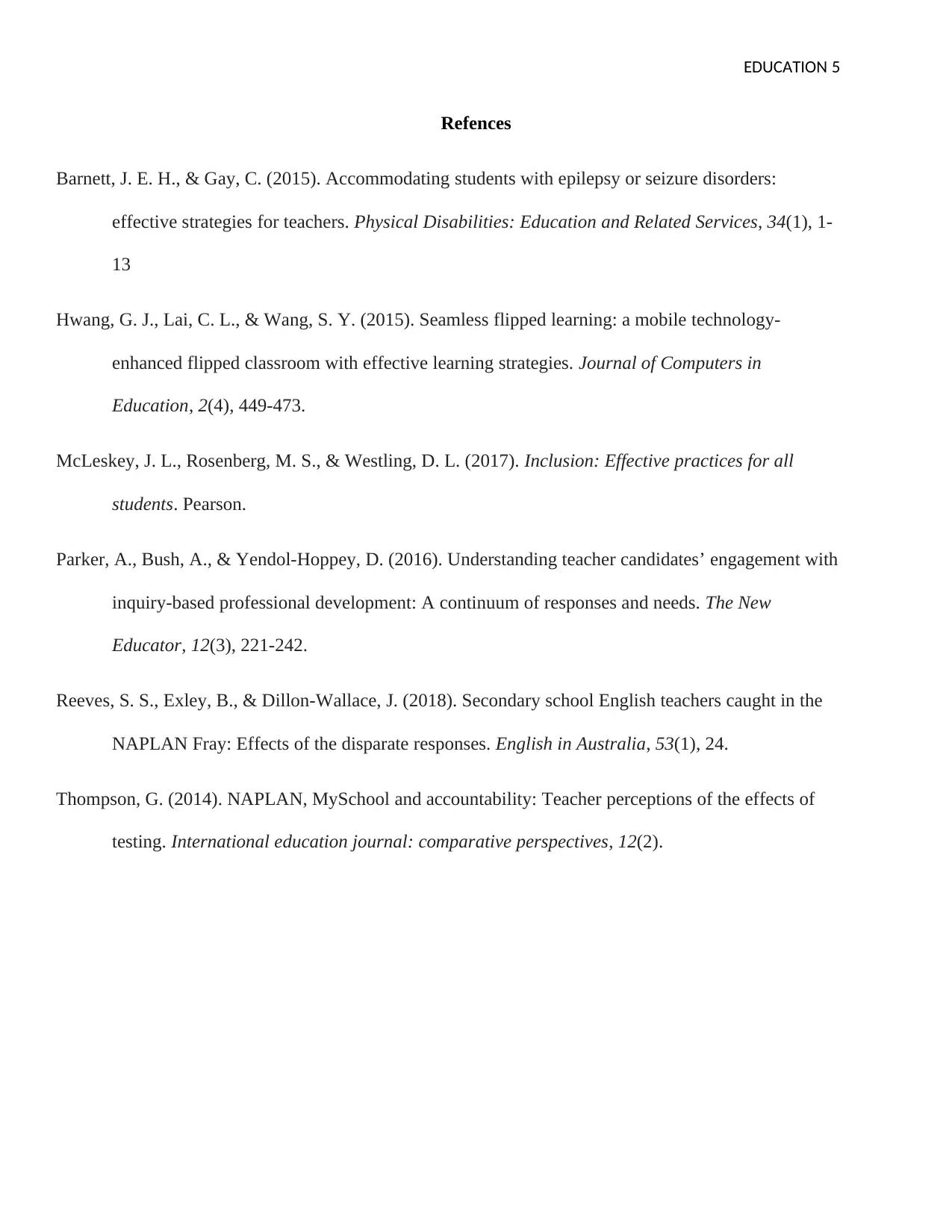
Barnett, J. E. H., & Gay, C. (2015). Accommodating students with epilepsy or seizure disorders:
effective strategies for teachers. Physical Disabilities: Education and Related Services, 34(1), 1-
13
Hwang, G. J., Lai, C. L., & Wang, S. Y. (2015). Seamless flipped learning: a mobile technology-
enhanced flipped classroom with effective learning strategies. Journal of Computers in
Education, 2(4), 449-473.
McLeskey, J. L., Rosenberg, M. S., & Westling, D. L. (2017). Inclusion: Effective practices for all
students. Pearson.
Parker, A., Bush, A., & Yendol-Hoppey, D. (2016). Understanding teacher candidates’ engagement with
inquiry-based professional development: A continuum of responses and needs. The New
Educator, 12(3), 221-242.
Reeves, S. S., Exley, B., & Dillon-Wallace, J. (2018). Secondary school English teachers caught in the
NAPLAN Fray: Effects of the disparate responses. English in Australia, 53(1), 24.
Thompson, G. (2014). NAPLAN, MySchool and accountability: Teacher perceptions of the effects of
testing. International education journal: comparative perspectives, 12(2).
Refences
Barnett, J. E. H., & Gay, C. (2015). Accommodating students with epilepsy or seizure disorders:
effective strategies for teachers. Physical Disabilities: Education and Related Services, 34(1), 1-
13
Hwang, G. J., Lai, C. L., & Wang, S. Y. (2015). Seamless flipped learning: a mobile technology-
enhanced flipped classroom with effective learning strategies. Journal of Computers in
Education, 2(4), 449-473.
McLeskey, J. L., Rosenberg, M. S., & Westling, D. L. (2017). Inclusion: Effective practices for all
students. Pearson.
Parker, A., Bush, A., & Yendol-Hoppey, D. (2016). Understanding teacher candidates’ engagement with
inquiry-based professional development: A continuum of responses and needs. The New
Educator, 12(3), 221-242.
Reeves, S. S., Exley, B., & Dillon-Wallace, J. (2018). Secondary school English teachers caught in the
NAPLAN Fray: Effects of the disparate responses. English in Australia, 53(1), 24.
Thompson, G. (2014). NAPLAN, MySchool and accountability: Teacher perceptions of the effects of
testing. International education journal: comparative perspectives, 12(2).
1 out of 5
Related Documents
Your All-in-One AI-Powered Toolkit for Academic Success.
+13062052269
info@desklib.com
Available 24*7 on WhatsApp / Email
Unlock your academic potential
Copyright © 2020–2026 A2Z Services. All Rights Reserved. Developed and managed by ZUCOL.