NSB303 - University Report: Critique of Asthma Health Resources

Verified

Added on  2023/01/19

|4
|766
|25
Report
AI Summary
This report presents a critical analysis of two digital health resources related to asthma management. The first resource, an online article from the Royal Children's Hospital Melbourne, is evaluated for its suitability for health professionals, particularly nurses. The report highlights the resource's strengths, such as its comprehensive clinical guidelines for assessing asthma severity and providing discharge education. However, it also points out limitations, including its focus on children and adolescents, neglecting the needs of older adults with asthma. The second resource, an online article from the National Asthma Council Australia, is assessed for its value in consumer education. The analysis acknowledges the resource's strengths in providing information on asthma action plans but critiques the lack of clear identification of the target audience and the absence of emergency contact information. The report concludes by summarizing the benefits of each resource for its intended users, emphasizing the importance of patient education and adherence to treatment plans.
Document Page
Running head: TRANSCRIPT OF CRITIQUE
TRANSCRIPT OF CRITIQUE
Name of the Student:
Name of the University:
Author note:
tabler-icon-diamond-filled.svg

Paraphrase This Document

Need a fresh take? Get an instant paraphrase of this document with our AI Paraphraser
Document Page
1TRANSCRIPT OF CRITIQUE
Health Resource for Health Professionals
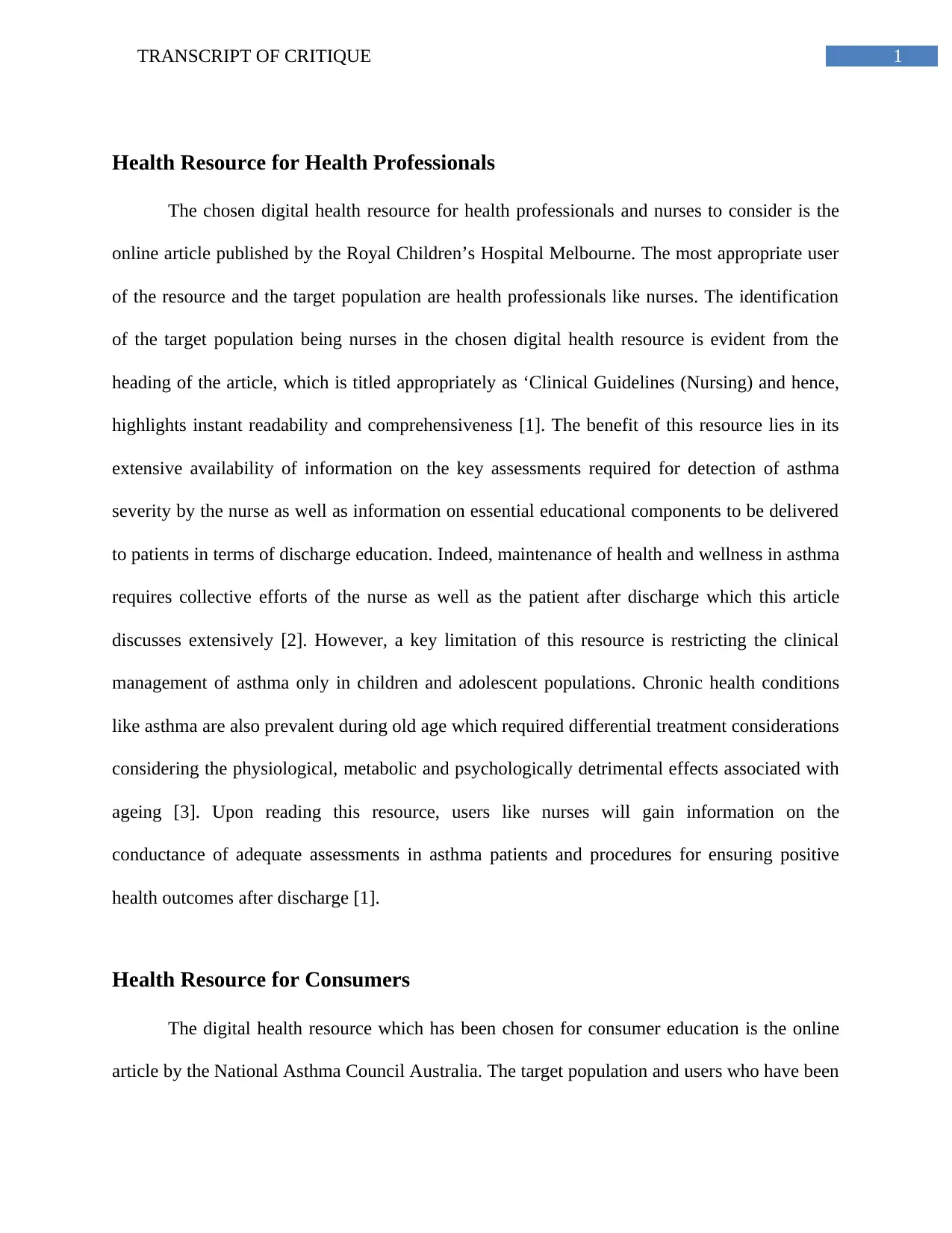
The chosen digital health resource for health professionals and nurses to consider is the
online article published by the Royal Children’s Hospital Melbourne. The most appropriate user
of the resource and the target population are health professionals like nurses. The identification
of the target population being nurses in the chosen digital health resource is evident from the
heading of the article, which is titled appropriately as ‘Clinical Guidelines (Nursing) and hence,
highlights instant readability and comprehensiveness [1]. The benefit of this resource lies in its
extensive availability of information on the key assessments required for detection of asthma
severity by the nurse as well as information on essential educational components to be delivered
to patients in terms of discharge education. Indeed, maintenance of health and wellness in asthma
requires collective efforts of the nurse as well as the patient after discharge which this article
discusses extensively [2]. However, a key limitation of this resource is restricting the clinical
management of asthma only in children and adolescent populations. Chronic health conditions
like asthma are also prevalent during old age which required differential treatment considerations
considering the physiological, metabolic and psychologically detrimental effects associated with
ageing [3]. Upon reading this resource, users like nurses will gain information on the
conductance of adequate assessments in asthma patients and procedures for ensuring positive
health outcomes after discharge [1].
Health Resource for Consumers
The digital health resource which has been chosen for consumer education is the online
article by the National Asthma Council Australia. The target population and users who have been
Document Page
2TRANSCRIPT OF CRITIQUE
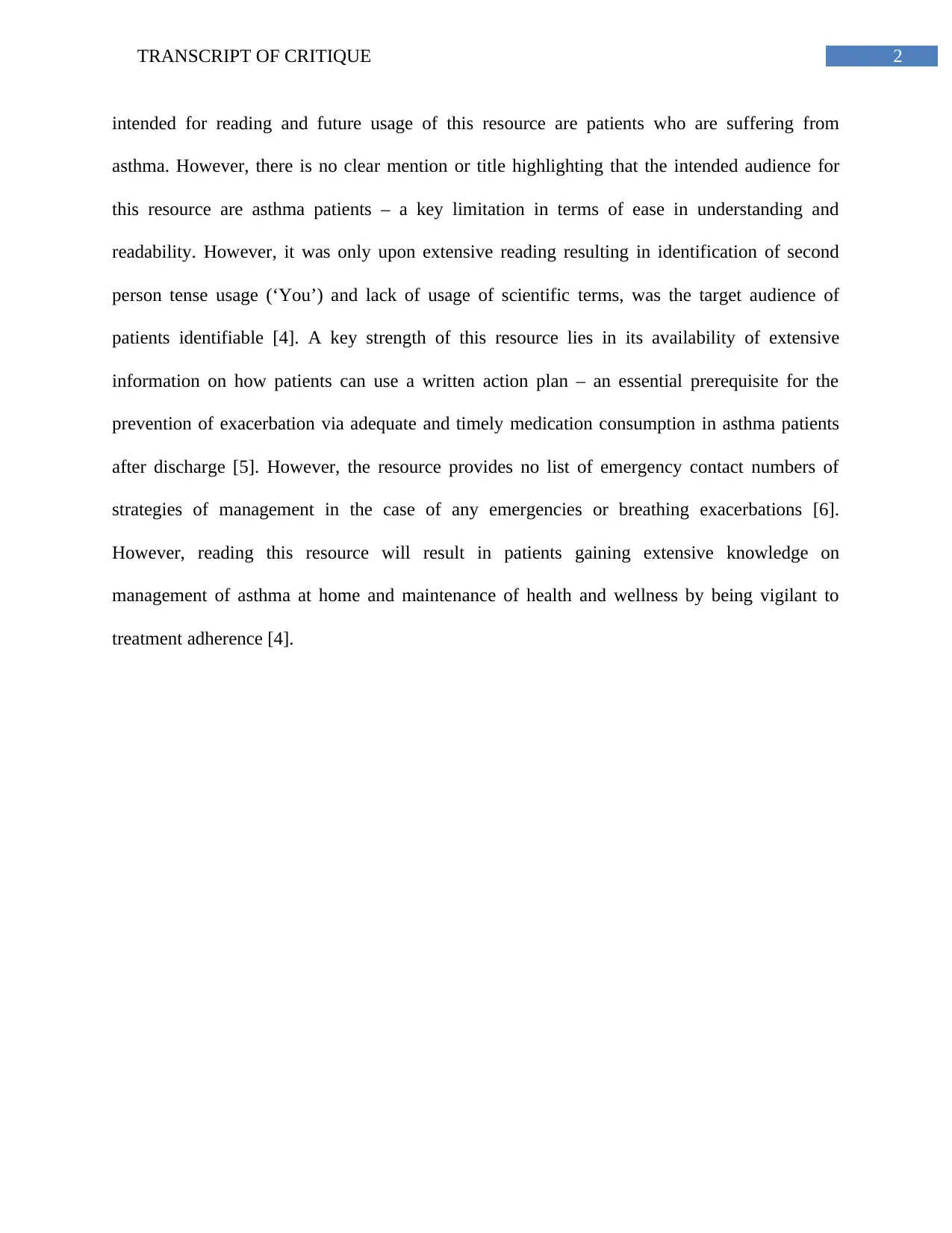
intended for reading and future usage of this resource are patients who are suffering from
asthma. However, there is no clear mention or title highlighting that the intended audience for
this resource are asthma patients – a key limitation in terms of ease in understanding and
readability. However, it was only upon extensive reading resulting in identification of second
person tense usage (‘You’) and lack of usage of scientific terms, was the target audience of
patients identifiable [4]. A key strength of this resource lies in its availability of extensive
information on how patients can use a written action plan – an essential prerequisite for the
prevention of exacerbation via adequate and timely medication consumption in asthma patients
after discharge [5]. However, the resource provides no list of emergency contact numbers of
strategies of management in the case of any emergencies or breathing exacerbations [6].
However, reading this resource will result in patients gaining extensive knowledge on
management of asthma at home and maintenance of health and wellness by being vigilant to
treatment adherence [4].
Document Page
3TRANSCRIPT OF CRITIQUE
References
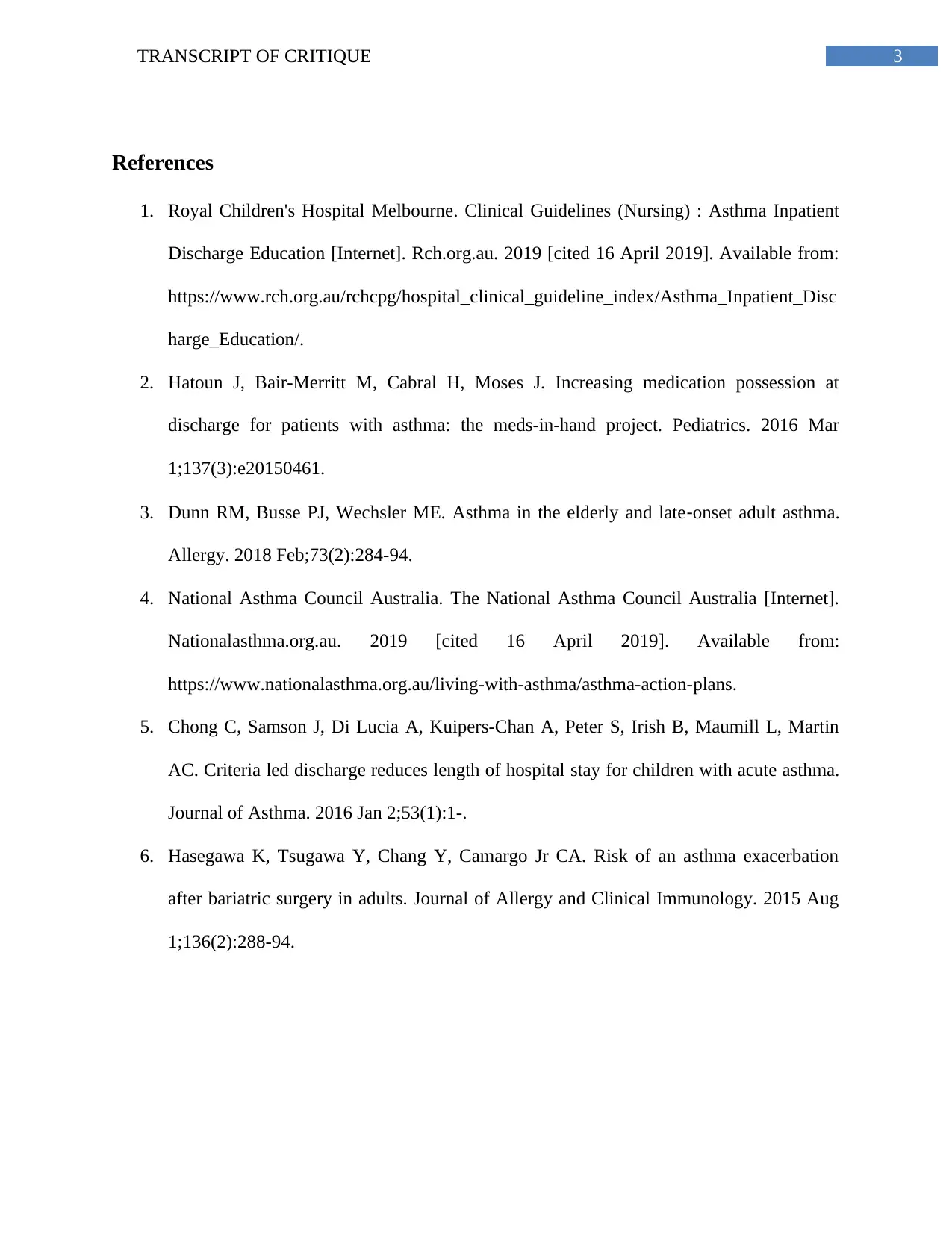
1. Royal Children's Hospital Melbourne. Clinical Guidelines (Nursing) : Asthma Inpatient
Discharge Education [Internet]. Rch.org.au. 2019 [cited 16 April 2019]. Available from:
https://www.rch.org.au/rchcpg/hospital_clinical_guideline_index/Asthma_Inpatient_Disc
harge_Education/.
2. Hatoun J, Bair-Merritt M, Cabral H, Moses J. Increasing medication possession at
discharge for patients with asthma: the meds-in-hand project. Pediatrics. 2016 Mar
1;137(3):e20150461.
3. Dunn RM, Busse PJ, Wechsler ME. Asthma in the elderly and lateonset adult asthma.
Allergy. 2018 Feb;73(2):284-94.
4. National Asthma Council Australia. The National Asthma Council Australia [Internet].
Nationalasthma.org.au. 2019 [cited 16 April 2019]. Available from:
https://www.nationalasthma.org.au/living-with-asthma/asthma-action-plans.
5. Chong C, Samson J, Di Lucia A, Kuipers-Chan A, Peter S, Irish B, Maumill L, Martin
AC. Criteria led discharge reduces length of hospital stay for children with acute asthma.
Journal of Asthma. 2016 Jan 2;53(1):1-.
6. Hasegawa K, Tsugawa Y, Chang Y, Camargo Jr CA. Risk of an asthma exacerbation
after bariatric surgery in adults. Journal of Allergy and Clinical Immunology. 2015 Aug
1;136(2):288-94.
chevron_up_icon
1 out of 4
circle_padding
hide_on_mobile
zoom_out_icon
[object Object]