Analysis of Asymmetric Cell Division: Aster De-centration Report

Verified

Added on  2022/12/14

|1
|833
|252
Report
AI Summary
This report, based on the study by Sallé et al., investigates the role of asymmetric cell division and aster de-centration in cell fate determination. The research uses symmetrically dividing sea urchin zygotes to generate cortical domains of magnetic particles, which cluster endogenous dynein activity. The study reveals that aster decentration occurs after an initial centering phase, driven by a global reduction in centering forces rather than local dynein activation. The research employs intracellular force measurements and models to demonstrate this time-regulated imbalance. The report explores methodologies including magnetic particle use, force measurements, and computational modeling to understand the interplay of microtubule forces and cell division asymmetry. These findings highlight a novel mechanism for regulating division asymmetry, crucial for generating cell fate and size diversity.
Document Page
Role of asymmetric cell division in
aster de-centration
Jérémy Sallé, Jing Xie, Dmitry Ershov, Milan Lacassin, Serge
Dmitrieff, and Nicolas Minc
.
Add The stepwise methodologies of the
experiments are
1. Sea urchin maintenance as well
as the
collection of gametes.
2.Magnetic particles as well as injection.
3.The use of magnetic tweezers for
artificial
cell division
4.Microscopy and analysis of the images
5.Studies for cortical force management
6.Drug treatments
7.Immunostaining studies
8.Computation of aster drag and the
spring
constant
9.Formulation of theoretical models.
Reduction in the stiffness of aster
centering leads to triggering of
asymmetric forces from domains of
asymmetric division.
The model shown here serves as a
major mechanism which regulates the
positioning of the asymmetric
centrosome position as well as division
in various cell types. In the zygotes of
C. elegans there is a net charge in
directionality which is gained in
recapitulation in the given experiments.
Pushing promote aster centering which
reduces in its efficiency as a result of
the increase or change in the
mitochondrial polymerization resulting
in a global regulation in the critical
domains.
Add your information, graphs and images to this section.
Introduction
Symmetric division is considered as one of
the most important categories of cell division
and divisional positioning control where all
the components of cell divisions like aster,
spindles, nuclei are firstly situated in the
center of the cell but afterwards get
dislocated to one corner of the cell which
ultimately leads to the unequal segregation
of the various cortical and cytoplasmic
contents as well as production of cells with
various sizes (Gomez, Lerner and Petrisch
2014). Spindle orientation is an
important part of cell division where the fate
of the symmetric or the asymmetric cell fates
are dependent on the effect of the coupling
to the cell intrinsic polarity cues as well as
its positioning to cues like niche derived
signals (Roubinet and Cabernard 2014).
There is a difference between the centering and
decentering asters. Through research studies
it has been found that centering asters are
usually
insensitive to domains and they can be
decentered (Hung, Hehnly and Doxey 2016).
In asymmetric cell division there is segregation
of the cell fate determinants including orientation
of the cell division plane contacting with the
niche as well as stem cell identities (Maite et al.
2016). In this following experiment, the role of
amalgamation of the in vivo force
measurements with main functioning of the
asymmetric divisions is studied. The
reduction of the centering forces among
various cortical pulling forces also have been
scientifically explored (Carvajal et al. 2016).
Methodology Conclusion
Aims and
objectives
The role of asymmetric divisions and its
specific
importance in reducing centering forces
under
the effect of constant pulling forces.
The co-ordination of the symmetric and
asymmetric forces in cell division.
Specific role of the asymmetric divisions
in only the centering forces through
computer
simulation and combined in vivo force
measurements studies.
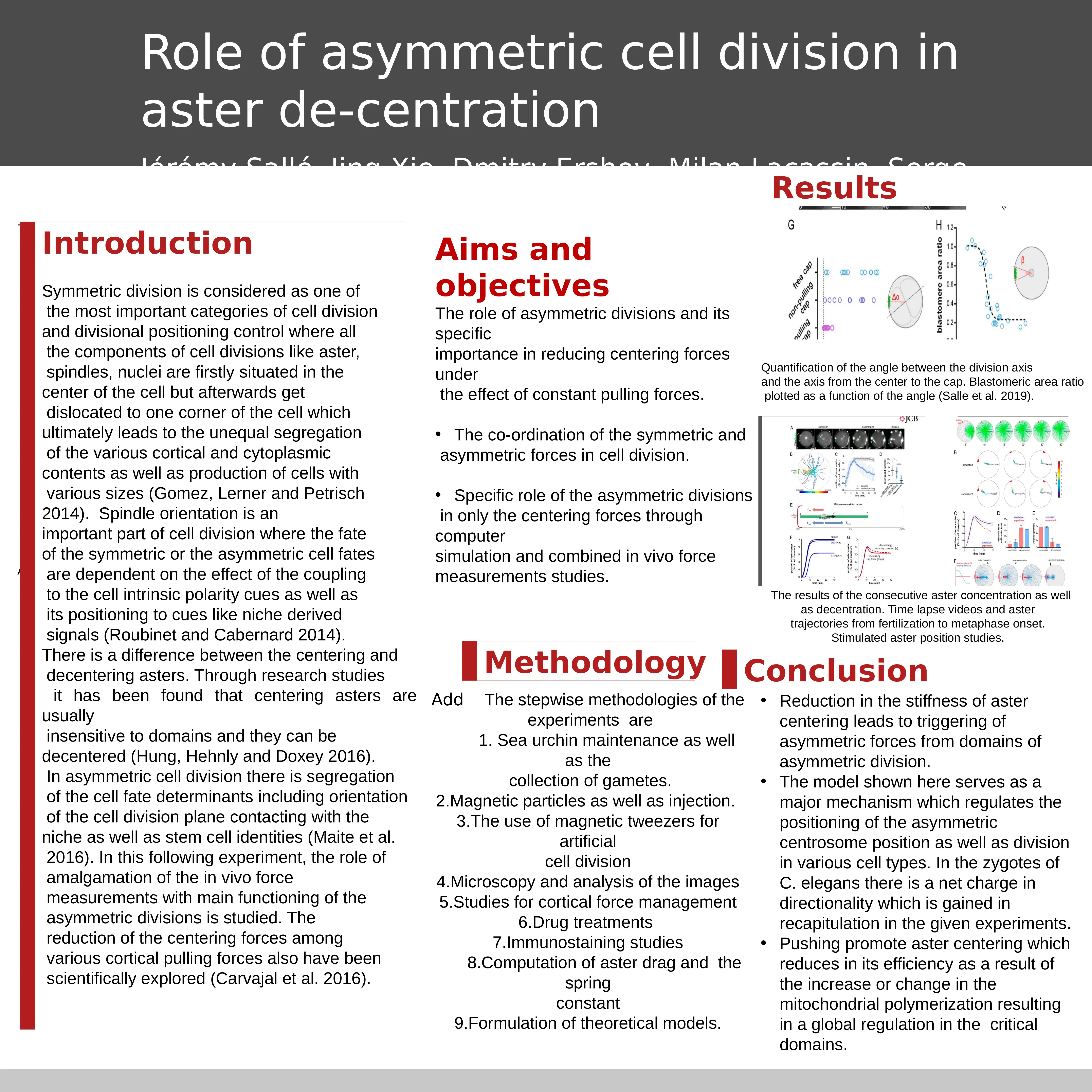
Quantification of the angle between the division axis
and the axis from the center to the cap. Blastomeric area ratio
plotted as a function of the angle (Salle et al. 2019).
The results of the consecutive aster concentration as well
as decentration. Time lapse videos and aster
trajectories from fertilization to metaphase onset.
Stimulated aster position studies.
Results
tabler-icon-diamond-filled.svg

Paraphrase This Document

Need a fresh take? Get an instant paraphrase of this document with our AI Paraphraser
[object Object]