Psychology Assignment: Attitudes, Prejudice, Social Influence Theories
VerifiedAdded on 2022/12/15
|14
|3065
|398
Essay
AI Summary
This psychology essay comprehensively examines the multifaceted concepts of attitudes, prejudice, and social influence. It begins by defining the components of attitude, including affective, behavioral, and cognitive aspects, and then explores how attitudes are formed through experiences and learning. The essay further delves into how attitudes influence behavior, emphasizing the principle of consistency and the interplay between attitudes and actions. It also evaluates theories of attitude change, such as the Theory of Planned Behavior, and their practical applications. The essay then differentiates between prejudice and discrimination, analyzing theories of their maintenance and reduction, including intergroup contact theory and anti-bias approaches. Finally, it defines three types of social influence—peer pressure, conformity, and obedience—and explains the processes involved in peer pressure, highlighting group dynamics and the impact of peer influence on behavior. This analysis provides a detailed understanding of these psychological concepts and their real-world implications.
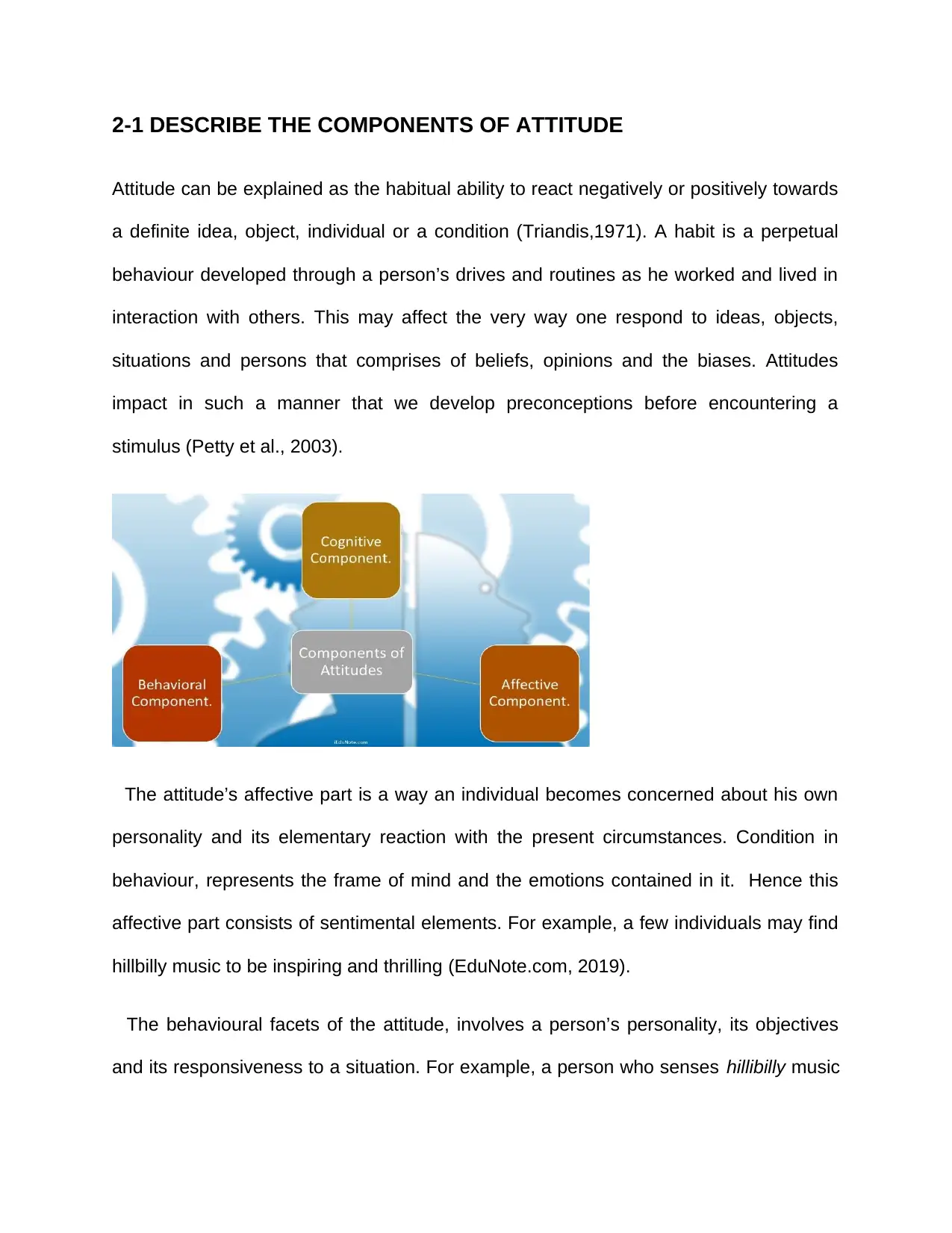
2-1 DESCRIBE THE COMPONENTS OF ATTITUDE
Attitude can be explained as the habitual ability to react negatively or positively towards
a definite idea, object, individual or a condition (Triandis,1971). A habit is a perpetual
behaviour developed through a person’s drives and routines as he worked and lived in
interaction with others. This may affect the very way one respond to ideas, objects,
situations and persons that comprises of beliefs, opinions and the biases. Attitudes
impact in such a manner that we develop preconceptions before encountering a
stimulus (Petty et al., 2003).
The attitude’s affective part is a way an individual becomes concerned about his own
personality and its elementary reaction with the present circumstances. Condition in
behaviour, represents the frame of mind and the emotions contained in it. Hence this
affective part consists of sentimental elements. For example, a few individuals may find
hillbilly music to be inspiring and thrilling (EduNote.com, 2019).
The behavioural facets of the attitude, involves a person’s personality, its objectives
and its responsiveness to a situation. For example, a person who senses hillibilly music
Attitude can be explained as the habitual ability to react negatively or positively towards
a definite idea, object, individual or a condition (Triandis,1971). A habit is a perpetual
behaviour developed through a person’s drives and routines as he worked and lived in
interaction with others. This may affect the very way one respond to ideas, objects,
situations and persons that comprises of beliefs, opinions and the biases. Attitudes
impact in such a manner that we develop preconceptions before encountering a
stimulus (Petty et al., 2003).
The attitude’s affective part is a way an individual becomes concerned about his own
personality and its elementary reaction with the present circumstances. Condition in
behaviour, represents the frame of mind and the emotions contained in it. Hence this
affective part consists of sentimental elements. For example, a few individuals may find
hillbilly music to be inspiring and thrilling (EduNote.com, 2019).
The behavioural facets of the attitude, involves a person’s personality, its objectives
and its responsiveness to a situation. For example, a person who senses hillibilly music

Paraphrase This Document
Need a fresh take? Get an instant paraphrase of this document with our AI Paraphraser
as delightful, will heart it repeatedly, purchase the albums and attend a hillibilly musical
show (Anon, 2019).
The attitude’s logical part is the manner an individual cogitates herself or himself, the
things and the situations. The reflections and consciousness (awareness) involves the
principles, thoughts that focuses on attitude. The patron of hillibilly music considers
hilibility music as the topmost genre of music and followed by people of fine taste
(Study.com, 2019).
2-2 EXPLAIN HOW ATTITUDE ARE FORMED
An attitude is a compiled set of emotional reactions, credence, values and perception
around a person, thing or organization, even an issue or about an event. These
attitudes are developed over time by repetitively being exposed to some stimuli and
then, by making an evaluation. Hence, the attitudes can be esteemed, oriented, or
transformed based on experience and learning. This is vital to the marketers and these
attitudes can shift negatively or positively, on basis of market and profit understandings.
(McLintic, 2019).
show (Anon, 2019).
The attitude’s logical part is the manner an individual cogitates herself or himself, the
things and the situations. The reflections and consciousness (awareness) involves the
principles, thoughts that focuses on attitude. The patron of hillibilly music considers
hilibility music as the topmost genre of music and followed by people of fine taste
(Study.com, 2019).
2-2 EXPLAIN HOW ATTITUDE ARE FORMED
An attitude is a compiled set of emotional reactions, credence, values and perception
around a person, thing or organization, even an issue or about an event. These
attitudes are developed over time by repetitively being exposed to some stimuli and
then, by making an evaluation. Hence, the attitudes can be esteemed, oriented, or
transformed based on experience and learning. This is vital to the marketers and these
attitudes can shift negatively or positively, on basis of market and profit understandings.
(McLintic, 2019).
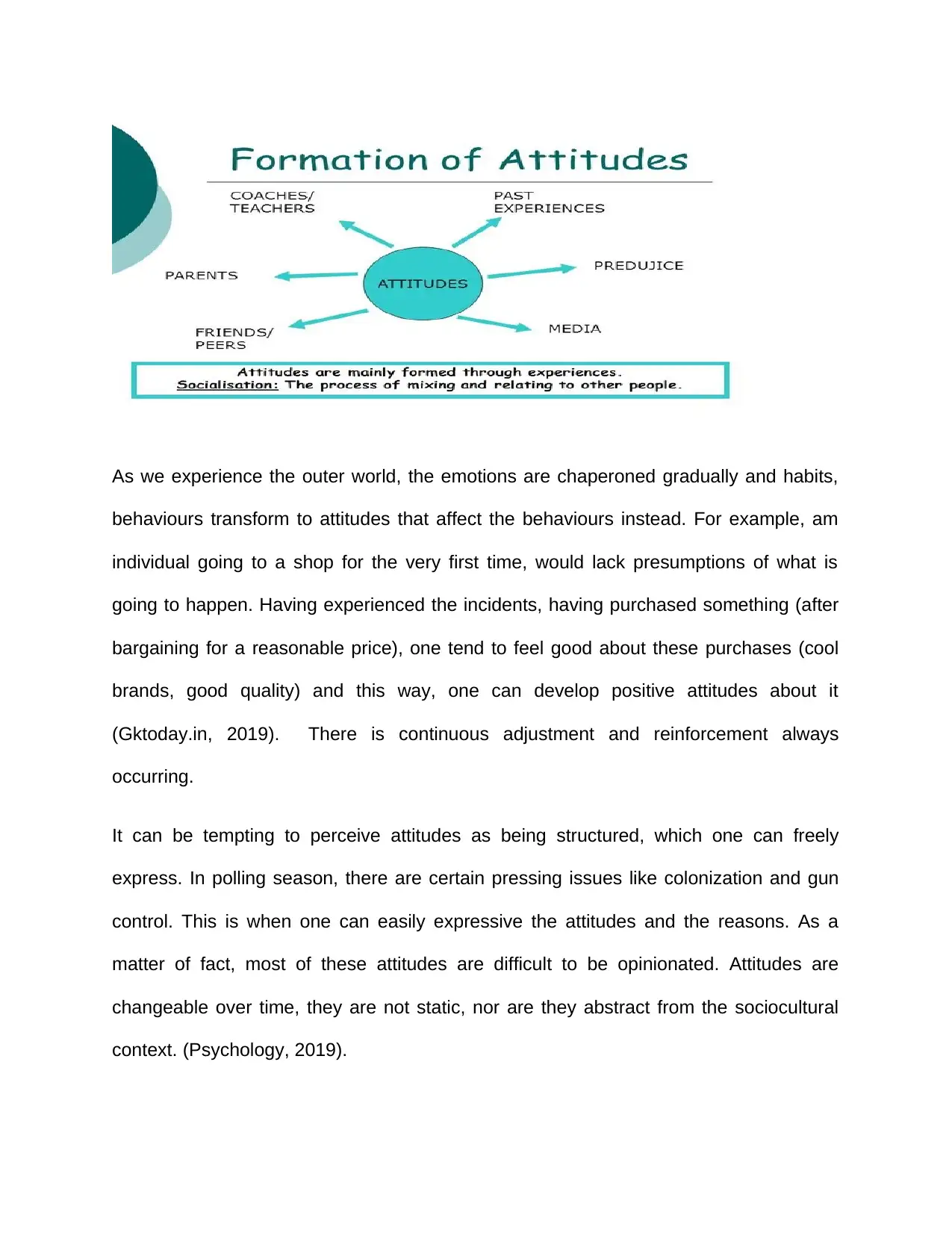
As we experience the outer world, the emotions are chaperoned gradually and habits,
behaviours transform to attitudes that affect the behaviours instead. For example, am
individual going to a shop for the very first time, would lack presumptions of what is
going to happen. Having experienced the incidents, having purchased something (after
bargaining for a reasonable price), one tend to feel good about these purchases (cool
brands, good quality) and this way, one can develop positive attitudes about it
(Gktoday.in, 2019). There is continuous adjustment and reinforcement always
occurring.
It can be tempting to perceive attitudes as being structured, which one can freely
express. In polling season, there are certain pressing issues like colonization and gun
control. This is when one can easily expressive the attitudes and the reasons. As a
matter of fact, most of these attitudes are difficult to be opinionated. Attitudes are
changeable over time, they are not static, nor are they abstract from the sociocultural
context. (Psychology, 2019).
behaviours transform to attitudes that affect the behaviours instead. For example, am
individual going to a shop for the very first time, would lack presumptions of what is
going to happen. Having experienced the incidents, having purchased something (after
bargaining for a reasonable price), one tend to feel good about these purchases (cool
brands, good quality) and this way, one can develop positive attitudes about it
(Gktoday.in, 2019). There is continuous adjustment and reinforcement always
occurring.
It can be tempting to perceive attitudes as being structured, which one can freely
express. In polling season, there are certain pressing issues like colonization and gun
control. This is when one can easily expressive the attitudes and the reasons. As a
matter of fact, most of these attitudes are difficult to be opinionated. Attitudes are
changeable over time, they are not static, nor are they abstract from the sociocultural
context. (Psychology, 2019).
⊘ This is a preview!⊘
Do you want full access?
Subscribe today to unlock all pages.

Trusted by 1+ million students worldwide
2-3 EXPLAIN HOW AND WHEN ATTITUDE INFLUENCE BEHAVIOUR
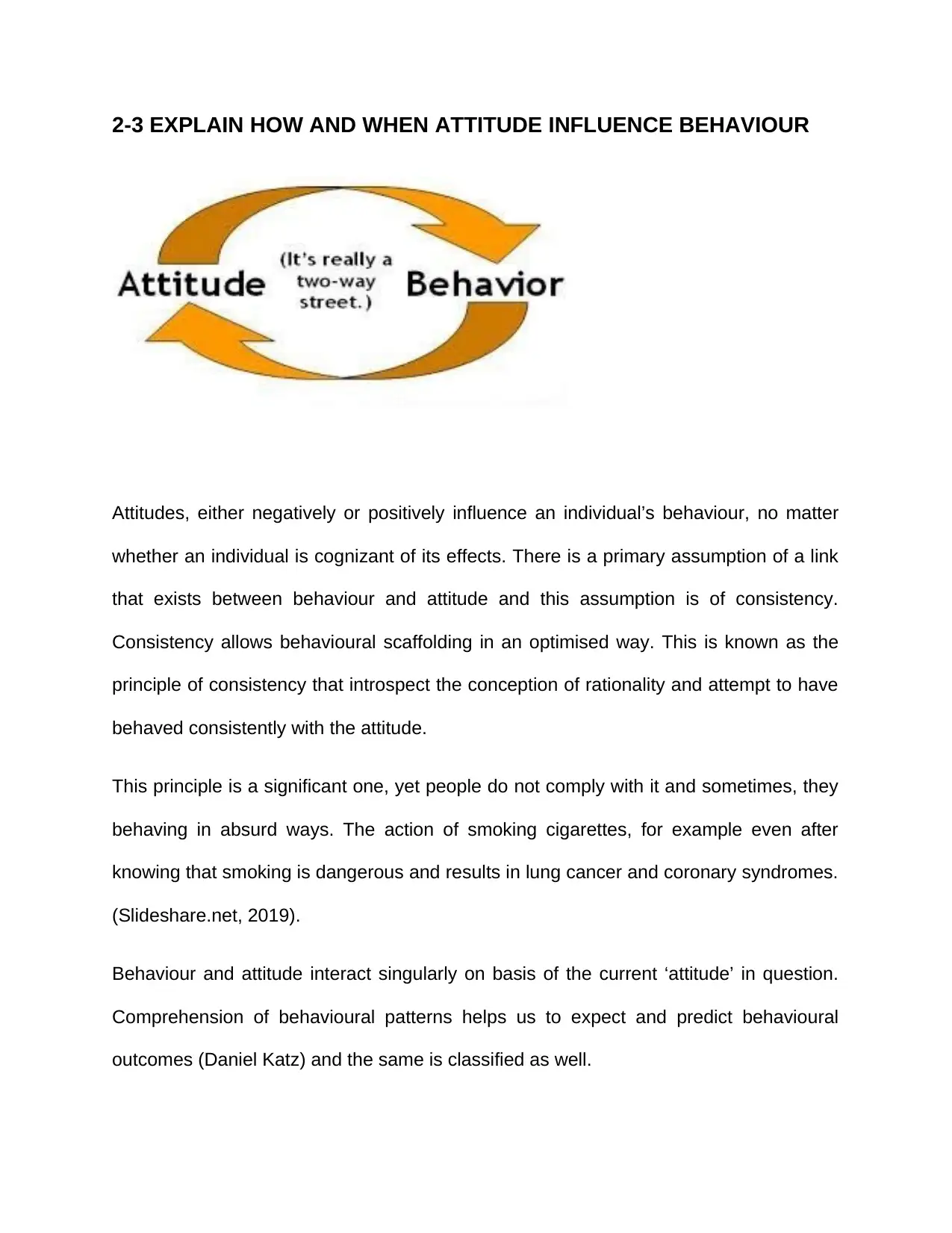
Attitudes, either negatively or positively influence an individual’s behaviour, no matter
whether an individual is cognizant of its effects. There is a primary assumption of a link
that exists between behaviour and attitude and this assumption is of consistency.
Consistency allows behavioural scaffolding in an optimised way. This is known as the
principle of consistency that introspect the conception of rationality and attempt to have
behaved consistently with the attitude.
This principle is a significant one, yet people do not comply with it and sometimes, they
behaving in absurd ways. The action of smoking cigarettes, for example even after
knowing that smoking is dangerous and results in lung cancer and coronary syndromes.
(Slideshare.net, 2019).
Behaviour and attitude interact singularly on basis of the current ‘attitude’ in question.
Comprehension of behavioural patterns helps us to expect and predict behavioural
outcomes (Daniel Katz) and the same is classified as well.
Attitudes, either negatively or positively influence an individual’s behaviour, no matter
whether an individual is cognizant of its effects. There is a primary assumption of a link
that exists between behaviour and attitude and this assumption is of consistency.
Consistency allows behavioural scaffolding in an optimised way. This is known as the
principle of consistency that introspect the conception of rationality and attempt to have
behaved consistently with the attitude.
This principle is a significant one, yet people do not comply with it and sometimes, they
behaving in absurd ways. The action of smoking cigarettes, for example even after
knowing that smoking is dangerous and results in lung cancer and coronary syndromes.
(Slideshare.net, 2019).
Behaviour and attitude interact singularly on basis of the current ‘attitude’ in question.
Comprehension of behavioural patterns helps us to expect and predict behavioural
outcomes (Daniel Katz) and the same is classified as well.
Paraphrase This Document
Need a fresh take? Get an instant paraphrase of this document with our AI Paraphraser
Egotistical people tend to apply the ego-protective attitudes that defend the ego,
resulting into a negative attitude. Manager’s criticism can lead to development of
negative perception in the executives and development of potential disruptive
behaviours. Managers need to give proper attention to this mechanism and improve on
the same. (prezi.com, 2019)
2-4 EVALUATE THEORIES OF ATTITUDE CHANGE AND THEIR
PRACTICAL APPLICATIONS
Theory of Planned Behaviour also known as TPB was stated as the Theory of
Reasoned Action in the year of 1980 in order to foresee individual intention during
engagement in the specific behaviour, oriented to particular time and place. This theory
was put forward to describe the factors and the barriers to self-controllable behaviours.
The main component in this model was a behavioural intent that can be affected by an
attitude about the likelihood that a particular behaviour will provide an expected result
and be subjective to assessment of benefits and risks of an outcome.
(He.kendallhunt.com, 2019).
The Theory of planned model is applied widely, to expect and describe a broad
spectrum of social and health related behaviours that results in incidences of smoking,
health services delivery, drinking and breastfeeding. The model depends on and applies
motivation and behavioural control to bring about a behavioural achievement. It also
differentiates between the variants of beliefs like normative and behavioural control. The
TPB model is composed of 6 constructs which jointly presents an actual control on
behaviour. (Verywell Mind, 2019).
resulting into a negative attitude. Manager’s criticism can lead to development of
negative perception in the executives and development of potential disruptive
behaviours. Managers need to give proper attention to this mechanism and improve on
the same. (prezi.com, 2019)
2-4 EVALUATE THEORIES OF ATTITUDE CHANGE AND THEIR
PRACTICAL APPLICATIONS
Theory of Planned Behaviour also known as TPB was stated as the Theory of
Reasoned Action in the year of 1980 in order to foresee individual intention during
engagement in the specific behaviour, oriented to particular time and place. This theory
was put forward to describe the factors and the barriers to self-controllable behaviours.
The main component in this model was a behavioural intent that can be affected by an
attitude about the likelihood that a particular behaviour will provide an expected result
and be subjective to assessment of benefits and risks of an outcome.
(He.kendallhunt.com, 2019).
The Theory of planned model is applied widely, to expect and describe a broad
spectrum of social and health related behaviours that results in incidences of smoking,
health services delivery, drinking and breastfeeding. The model depends on and applies
motivation and behavioural control to bring about a behavioural achievement. It also
differentiates between the variants of beliefs like normative and behavioural control. The
TPB model is composed of 6 constructs which jointly presents an actual control on
behaviour. (Verywell Mind, 2019).
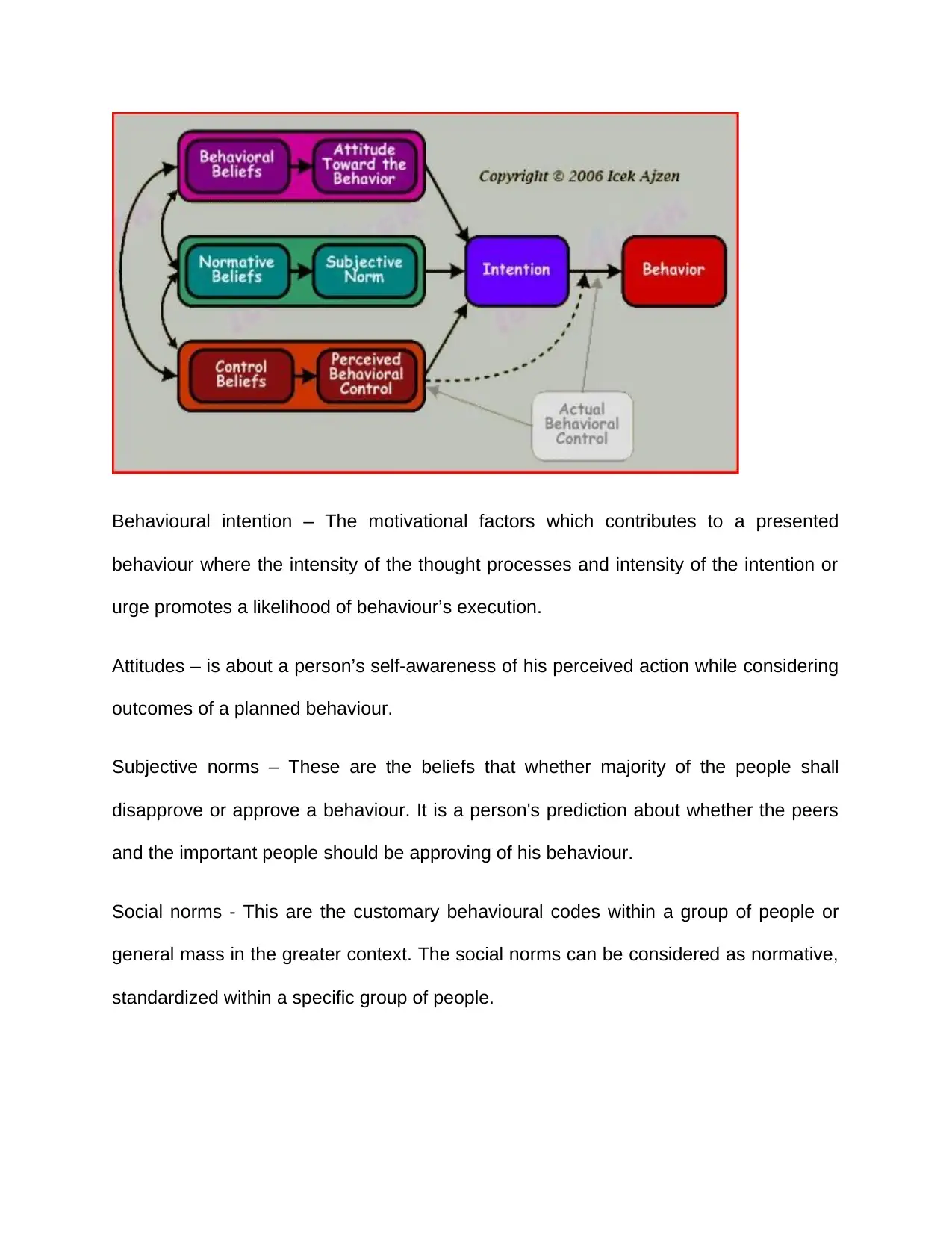
Behavioural intention – The motivational factors which contributes to a presented
behaviour where the intensity of the thought processes and intensity of the intention or
urge promotes a likelihood of behaviour’s execution.
Attitudes – is about a person’s self-awareness of his perceived action while considering
outcomes of a planned behaviour.
Subjective norms – These are the beliefs that whether majority of the people shall
disapprove or approve a behaviour. It is a person's prediction about whether the peers
and the important people should be approving of his behaviour.
Social norms - This are the customary behavioural codes within a group of people or
general mass in the greater context. The social norms can be considered as normative,
standardized within a specific group of people.
behaviour where the intensity of the thought processes and intensity of the intention or
urge promotes a likelihood of behaviour’s execution.
Attitudes – is about a person’s self-awareness of his perceived action while considering
outcomes of a planned behaviour.
Subjective norms – These are the beliefs that whether majority of the people shall
disapprove or approve a behaviour. It is a person's prediction about whether the peers
and the important people should be approving of his behaviour.
Social norms - This are the customary behavioural codes within a group of people or
general mass in the greater context. The social norms can be considered as normative,
standardized within a specific group of people.
⊘ This is a preview!⊘
Do you want full access?
Subscribe today to unlock all pages.
Trusted by 1+ million students worldwide
Perceived power - This is the perceived factor which is present during facilitation of a
specific behaviour. Perceived power attributes the person's behavioural regulation of
these factors.
Perceived behavioural control – The person's perception about an ease or the difficulty
pertaining to a performing of behaviour. The perception of behavioural control differs
across actions and situations where perceptual behavioural control depends upon the
situation. (Boutroux and Boutroux, 2019)
3-1 DESCRIBE AND DIFFERENCIATE PREJUDICE AND
DISCRIMINITION.
Because there are various resemblances and differences between 2 individuals – they
starts to misinterpret prejudice for the discrimination which happens to a completely
distinct ideas. A prejudice can be considered as a preconceived opinion that lacks
reasoning, whereas a discrimination is meant to be an unfair treatment received by
different people based on race, age and sex. (Cliffsnotes.com, 2019)
specific behaviour. Perceived power attributes the person's behavioural regulation of
these factors.
Perceived behavioural control – The person's perception about an ease or the difficulty
pertaining to a performing of behaviour. The perception of behavioural control differs
across actions and situations where perceptual behavioural control depends upon the
situation. (Boutroux and Boutroux, 2019)
3-1 DESCRIBE AND DIFFERENCIATE PREJUDICE AND
DISCRIMINITION.
Because there are various resemblances and differences between 2 individuals – they
starts to misinterpret prejudice for the discrimination which happens to a completely
distinct ideas. A prejudice can be considered as a preconceived opinion that lacks
reasoning, whereas a discrimination is meant to be an unfair treatment received by
different people based on race, age and sex. (Cliffsnotes.com, 2019)
Paraphrase This Document
Need a fresh take? Get an instant paraphrase of this document with our AI Paraphraser
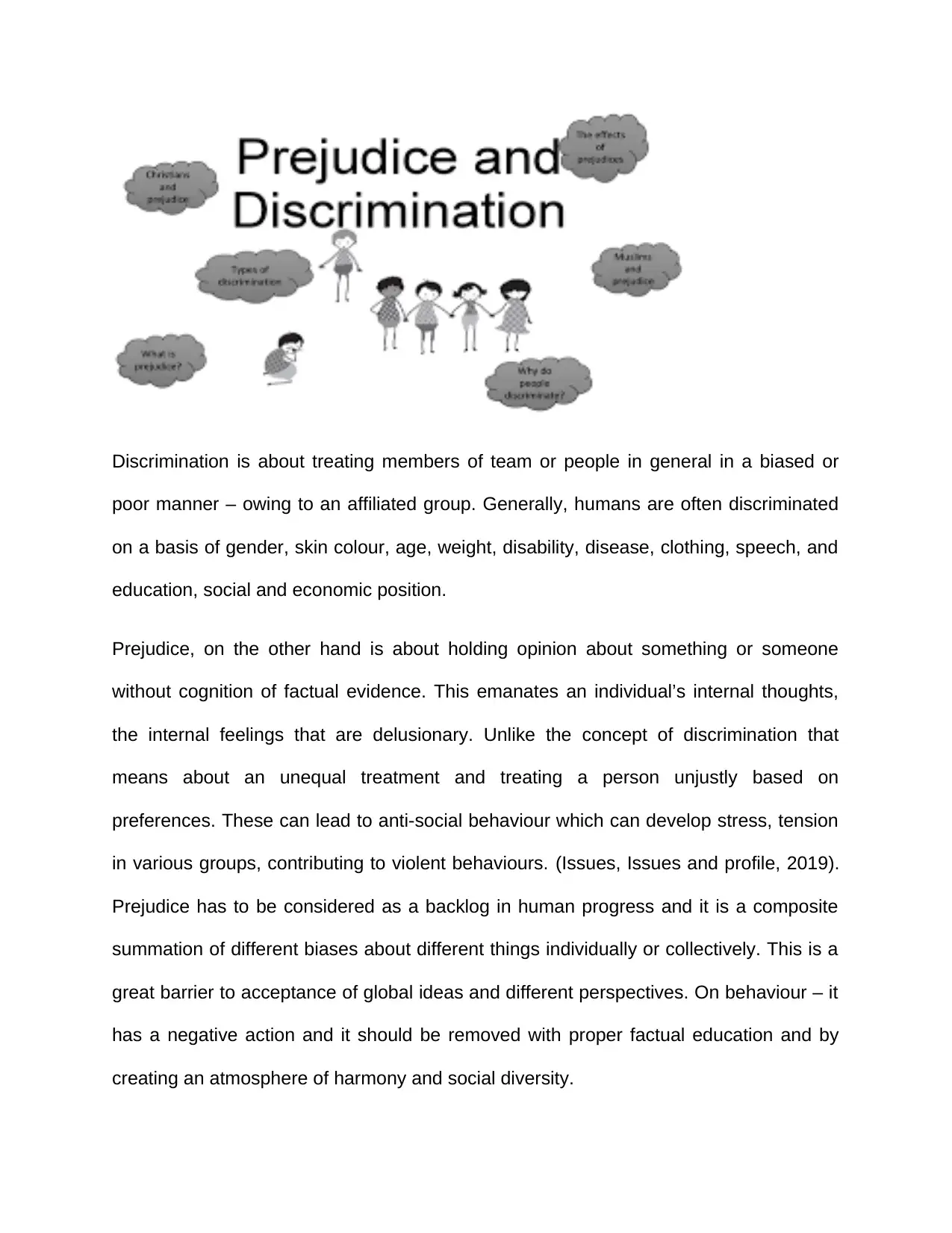
Discrimination is about treating members of team or people in general in a biased or
poor manner – owing to an affiliated group. Generally, humans are often discriminated
on a basis of gender, skin colour, age, weight, disability, disease, clothing, speech, and
education, social and economic position.
Prejudice, on the other hand is about holding opinion about something or someone
without cognition of factual evidence. This emanates an individual’s internal thoughts,
the internal feelings that are delusionary. Unlike the concept of discrimination that
means about an unequal treatment and treating a person unjustly based on
preferences. These can lead to anti-social behaviour which can develop stress, tension
in various groups, contributing to violent behaviours. (Issues, Issues and profile, 2019).
Prejudice has to be considered as a backlog in human progress and it is a composite
summation of different biases about different things individually or collectively. This is a
great barrier to acceptance of global ideas and different perspectives. On behaviour – it
has a negative action and it should be removed with proper factual education and by
creating an atmosphere of harmony and social diversity.
poor manner – owing to an affiliated group. Generally, humans are often discriminated
on a basis of gender, skin colour, age, weight, disability, disease, clothing, speech, and
education, social and economic position.
Prejudice, on the other hand is about holding opinion about something or someone
without cognition of factual evidence. This emanates an individual’s internal thoughts,
the internal feelings that are delusionary. Unlike the concept of discrimination that
means about an unequal treatment and treating a person unjustly based on
preferences. These can lead to anti-social behaviour which can develop stress, tension
in various groups, contributing to violent behaviours. (Issues, Issues and profile, 2019).
Prejudice has to be considered as a backlog in human progress and it is a composite
summation of different biases about different things individually or collectively. This is a
great barrier to acceptance of global ideas and different perspectives. On behaviour – it
has a negative action and it should be removed with proper factual education and by
creating an atmosphere of harmony and social diversity.
3-2 EVALUATE THEORIES OF THE MAINTENANCE AND REDUCTION
OF PREJUDICE AND DISCRIMINATION.
Before examining the prejudice lessening intervention and the evidence of its
effectiveness – it becomes vital to apply the key theories present in literature,
dominated with psychology studies. This very section will describe the pivotal theoretical
foundations of potentially useful prejudice-reduction techniques. Obviously, there are
the wider debates on whether the governments use and apply the correct interventions
within the domains (Libertarian versus 'nanny-state'). This report however presupposes
the intervention as acceptable by assuming its transparency, flexibility, voluntary and
reflective approach. (Revisionworld.com, 2019)
Any standardized way of categorization is still not present in different types of the
interventions, but the prejudice-lessening theory is divided into two camps. First is inter
group contact theory where the associations with distinct groups can diminish the extent
of negatively inclined attitudes and encourage an inclusivity. The second group is
involved of ideas that emphasize on information contact with different clusters, alter
getting a clear perception (by education and by re-education, media) of dynamics of
further groups. These are the anti-bias theories. This latter assumes - contact alone
cannot bring out the change, and individuals needs to re-educate their own selves to
shift from the former assumptions to new attitudes. The educational approaches, media
campaigns can aim to minimise the 'threats' through an empowered factual learning and
knowledge. They can be taught that two broader or very distinct topics or perspectives
are not totally different but have an overlapping space. (Dera.ioe.ac.uk, 2019).
OF PREJUDICE AND DISCRIMINATION.
Before examining the prejudice lessening intervention and the evidence of its
effectiveness – it becomes vital to apply the key theories present in literature,
dominated with psychology studies. This very section will describe the pivotal theoretical
foundations of potentially useful prejudice-reduction techniques. Obviously, there are
the wider debates on whether the governments use and apply the correct interventions
within the domains (Libertarian versus 'nanny-state'). This report however presupposes
the intervention as acceptable by assuming its transparency, flexibility, voluntary and
reflective approach. (Revisionworld.com, 2019)
Any standardized way of categorization is still not present in different types of the
interventions, but the prejudice-lessening theory is divided into two camps. First is inter
group contact theory where the associations with distinct groups can diminish the extent
of negatively inclined attitudes and encourage an inclusivity. The second group is
involved of ideas that emphasize on information contact with different clusters, alter
getting a clear perception (by education and by re-education, media) of dynamics of
further groups. These are the anti-bias theories. This latter assumes - contact alone
cannot bring out the change, and individuals needs to re-educate their own selves to
shift from the former assumptions to new attitudes. The educational approaches, media
campaigns can aim to minimise the 'threats' through an empowered factual learning and
knowledge. They can be taught that two broader or very distinct topics or perspectives
are not totally different but have an overlapping space. (Dera.ioe.ac.uk, 2019).
⊘ This is a preview!⊘
Do you want full access?
Subscribe today to unlock all pages.
Trusted by 1+ million students worldwide
5-1 DEFINE THREE TYPES OF SOCIAL INFLUENCES (e.g. peer
pressure, obedience, conformity)
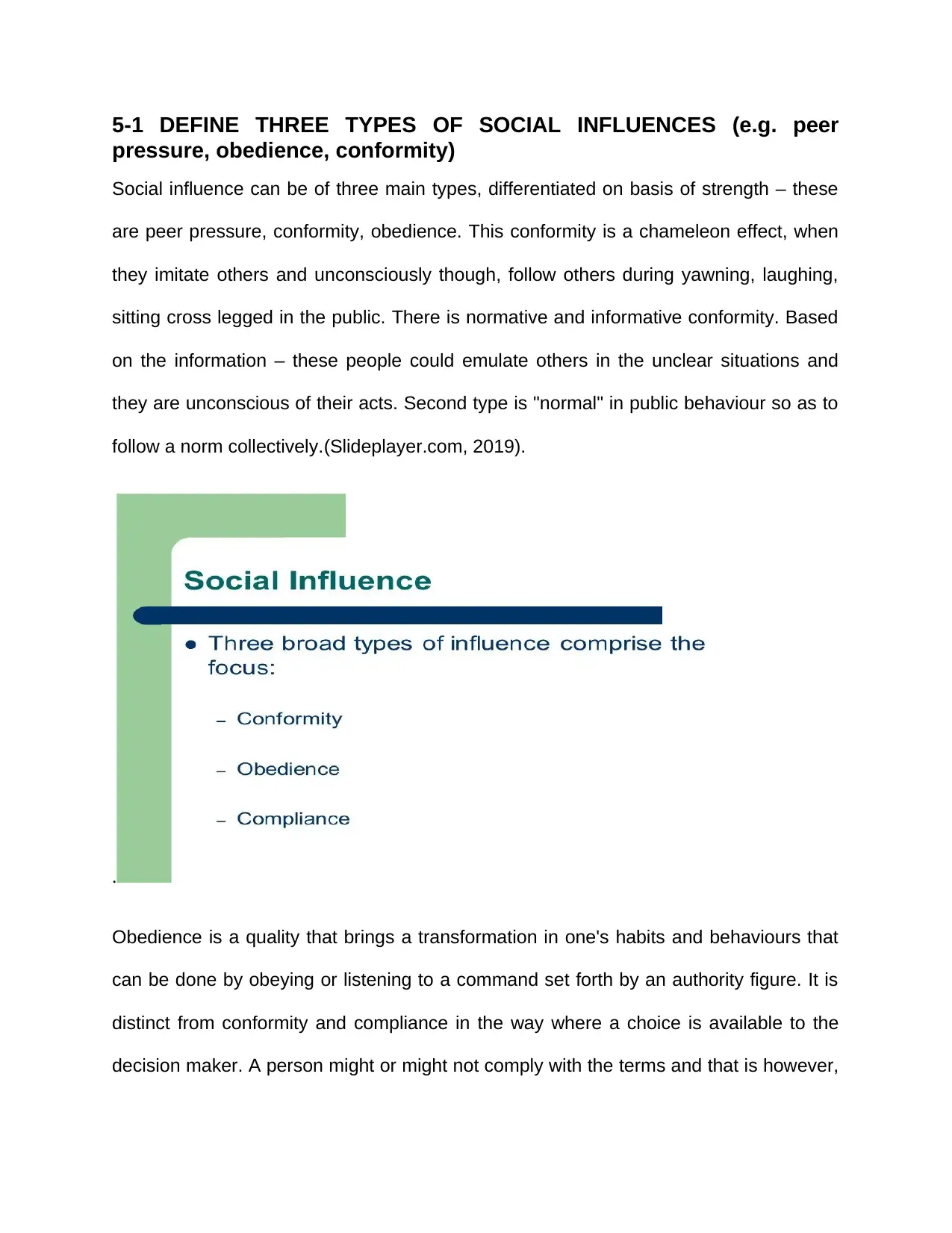
Social influence can be of three main types, differentiated on basis of strength – these
are peer pressure, conformity, obedience. This conformity is a chameleon effect, when
they imitate others and unconsciously though, follow others during yawning, laughing,
sitting cross legged in the public. There is normative and informative conformity. Based
on the information – these people could emulate others in the unclear situations and
they are unconscious of their acts. Second type is "normal" in public behaviour so as to
follow a norm collectively.(Slideplayer.com, 2019).
.
Obedience is a quality that brings a transformation in one's habits and behaviours that
can be done by obeying or listening to a command set forth by an authority figure. It is
distinct from conformity and compliance in the way where a choice is available to the
decision maker. A person might or might not comply with the terms and that is however,
pressure, obedience, conformity)
Social influence can be of three main types, differentiated on basis of strength – these
are peer pressure, conformity, obedience. This conformity is a chameleon effect, when
they imitate others and unconsciously though, follow others during yawning, laughing,
sitting cross legged in the public. There is normative and informative conformity. Based
on the information – these people could emulate others in the unclear situations and
they are unconscious of their acts. Second type is "normal" in public behaviour so as to
follow a norm collectively.(Slideplayer.com, 2019).
.
Obedience is a quality that brings a transformation in one's habits and behaviours that
can be done by obeying or listening to a command set forth by an authority figure. It is
distinct from conformity and compliance in the way where a choice is available to the
decision maker. A person might or might not comply with the terms and that is however,
Paraphrase This Document
Need a fresh take? Get an instant paraphrase of this document with our AI Paraphraser
in terms of obedience - a person feels is given no choice and he or she must agree to
the regulations. Constructive and destructive are the two forms of obedience.
We often interact with people who are of our age, share like interests or aims way in
some manner at-least. Peers are people who can be residential community friends or
school friends, and also work colleagues. Peer pressure can be felt when someone else
wants to drive your behaviour in their way - to achieve their expected outcome. When
these peer asks to comply with their choices against your will, convincing you in some
direct or indirect manner is peer pressure. (Wwnorton.com, 2019)
5-2 EXPLAIN THE PROCESS INVOLVED WITHIN THE ACTION OF AT
LEAST ONE TYPE OF SOCIAL INFLUENCE.
Peer - pressure is a form of behavioural reinforcement implied by the peers - which can
vary. The peer can burden a fellow friend directly using commands or teasing as the
tool so that you feel forced or driven in an indirectly way to finally do what they have
asked for. Group dynamics is a complex thing and there is critical play of ‘group
belonging’ and ‘group rules’ that emanates a resultant or a stimulant behaviour. If
someone do not comply with the collective decision-making or rules of a group, he or
she would be ignored and even casted out (Raising Children Network, 2019).
People can be complied to make negative choices but depending on the ethics of a
group, one can be influenced in a positive way as well. Friend, as matter of fact, can
often encourage another friend in studies, try out new sports and enhance their positive
behavioural patterns (Access NCBI through the World Wide Web (WWW 1995).
Although, there are different types of equations possible between two people – the
society and culture should be directing ideas towards unison so that everyone gets to
the regulations. Constructive and destructive are the two forms of obedience.
We often interact with people who are of our age, share like interests or aims way in
some manner at-least. Peers are people who can be residential community friends or
school friends, and also work colleagues. Peer pressure can be felt when someone else
wants to drive your behaviour in their way - to achieve their expected outcome. When
these peer asks to comply with their choices against your will, convincing you in some
direct or indirect manner is peer pressure. (Wwnorton.com, 2019)
5-2 EXPLAIN THE PROCESS INVOLVED WITHIN THE ACTION OF AT
LEAST ONE TYPE OF SOCIAL INFLUENCE.
Peer - pressure is a form of behavioural reinforcement implied by the peers - which can
vary. The peer can burden a fellow friend directly using commands or teasing as the
tool so that you feel forced or driven in an indirectly way to finally do what they have
asked for. Group dynamics is a complex thing and there is critical play of ‘group
belonging’ and ‘group rules’ that emanates a resultant or a stimulant behaviour. If
someone do not comply with the collective decision-making or rules of a group, he or
she would be ignored and even casted out (Raising Children Network, 2019).
People can be complied to make negative choices but depending on the ethics of a
group, one can be influenced in a positive way as well. Friend, as matter of fact, can
often encourage another friend in studies, try out new sports and enhance their positive
behavioural patterns (Access NCBI through the World Wide Web (WWW 1995).
Although, there are different types of equations possible between two people – the
society and culture should be directing ideas towards unison so that everyone gets to
participate towards a single cause. Teachers, educators, parents and family members
should be work together to eliminate any cognitive biases which can later on lead to
execution of combative behaviours and negative social pursuits.
REFERENCES
Access NCBI through the World Wide Web (WWW). (1995). Molecular Biotechnology,
3(1), pp.75-75.
Anon, (2019). [online] Available at:
http://oer2go.org/mods/en-boundless/www.boundless.com/management/textbooks/
should be work together to eliminate any cognitive biases which can later on lead to
execution of combative behaviours and negative social pursuits.
REFERENCES
Access NCBI through the World Wide Web (WWW). (1995). Molecular Biotechnology,
3(1), pp.75-75.
Anon, (2019). [online] Available at:
http://oer2go.org/mods/en-boundless/www.boundless.com/management/textbooks/
⊘ This is a preview!⊘
Do you want full access?
Subscribe today to unlock all pages.
Trusted by 1+ million students worldwide

1 out of 14


Related Documents


Your All-in-One AI-Powered Toolkit for Academic Success.
+13062052269
info@desklib.com
Available 24*7 on WhatsApp / Email
![[object Object]](/_next/static/media/star-bottom.7253800d.svg)
Unlock your academic potential
Copyright © 2020–2026 A2Z Services. All Rights Reserved. Developed and managed by ZUCOL.