Site Feasibility Report: Auckland Art Gallery Refurbishment Project
VerifiedAdded on 2022/08/13
|23
|4231
|285
Report
AI Summary
This report presents a site feasibility study for the Auckland Art Gallery Toi o Tamaki, evaluating the potential for refurbishment. The report begins with an executive summary and an introduction detailing the gallery's background, history, and significance as a heritage building. It outlines the project summary, purpose of the study, and the context of previous refurbishments. The current conditions of the existing building are assessed, including its geographical location, floor plan, and exterior and interior designs. The report then delves into physical constraints such as compatibility issues with existing Maori cultural elements and potential disturbances to the surroundings. Legislative conditions, including the Heritage New Zealand Pouhere Taonga Act and the Building Act, are examined to determine the feasibility of the refurbishment project. The report also addresses sustainability strategies, considering both nature and social sustainability aspects. The conclusion summarizes the findings, emphasizing the feasibility of refurbishment, and references are provided. The report aims to guide the Auckland Council in making informed decisions about the future of the art gallery.
Lecturer: Srividya Krishnamoorthy and Don
Samarasing
Student
ID
Assessment 1 – Site
Feasibility report
Samarasing
Student
ID
Assessment 1 – Site
Feasibility report

Paraphrase This Document
Need a fresh take? Get an instant paraphrase of this document with our AI Paraphraser
1
Executive Summary
The Auckland Art Gallery Toi o Tamaki is a principal public gallery which is situated in
Auckland, New Zealand. It keeps the most extensive collection for art based on national and
international piece as well as host different exhibitions for representing art. As museum has
received donation of 100 million, for maintenance and rebuilding of the gallery.
The project is established by the Auckland Government so that objective for conducting
impressive exhibition is accomplished. Thus, construction project is beginning for project in
two options. First, refurbishment of existing building and second is demolishment and
rebuilding for art gallery to enhance art buying, promotion, and workshops. However, before
proceeding towards the project construction and implementation process, it is necessary to
understand laws, rules, and compliance procedures for existing building.
As Auckland art gallery falls under the government and public domain, thus building acts
should be considered. The art gallery falls under Category I heritage building as follows
heritage laws. According to Heritage New Zealand Pouhere Taonga Act (2014), destruction
of a heritage building unless authority permit is illegal. Hence, refurbishment of art gallery is
quite feasible option in context of project. Hence, this site feasibility report has addressed
various laws, and legislations followed by current conditions of existing building to consider
feasible and eco-friendly option.
Executive Summary
The Auckland Art Gallery Toi o Tamaki is a principal public gallery which is situated in
Auckland, New Zealand. It keeps the most extensive collection for art based on national and
international piece as well as host different exhibitions for representing art. As museum has
received donation of 100 million, for maintenance and rebuilding of the gallery.
The project is established by the Auckland Government so that objective for conducting
impressive exhibition is accomplished. Thus, construction project is beginning for project in
two options. First, refurbishment of existing building and second is demolishment and
rebuilding for art gallery to enhance art buying, promotion, and workshops. However, before
proceeding towards the project construction and implementation process, it is necessary to
understand laws, rules, and compliance procedures for existing building.
As Auckland art gallery falls under the government and public domain, thus building acts
should be considered. The art gallery falls under Category I heritage building as follows
heritage laws. According to Heritage New Zealand Pouhere Taonga Act (2014), destruction
of a heritage building unless authority permit is illegal. Hence, refurbishment of art gallery is
quite feasible option in context of project. Hence, this site feasibility report has addressed
various laws, and legislations followed by current conditions of existing building to consider
feasible and eco-friendly option.
2
Table of Contents
Executive Summary...................................................................................................................1
Introduction...................................................................................................................................3
Project Summary........................................................................................................................4
Purpose of Study.........................................................................................................................4
Background Significance for Previous Refurbishment Undertaken...........................5
Limitations.....................................................................................................................................8
Current Conditions.....................................................................................................................8
Existing Building..........................................................................................................................8
Geographical Location...........................................................................................................8
Floor Plan...................................................................................................................................9
Exterior and Interior.............................................................................................................10
Conditions................................................................................................................................14
Physical Constraints.................................................................................................................14
Compatibility Issues.............................................................................................................15
Disturbance to Surroundings............................................................................................15
Legislative Conditions...........................................................................................................16
Historic Places Trust.................................................................................................................16
Building Act.................................................................................................................................16
Temporary and permanent Construction Work......................................................17
Sustainability strategies......................................................................................................17
Nature Sustainability...............................................................................................................17
Social Sustainability.................................................................................................................18
Conclusion....................................................................................................................................18
References....................................................................................................................................20
Table of Contents
Executive Summary...................................................................................................................1
Introduction...................................................................................................................................3
Project Summary........................................................................................................................4
Purpose of Study.........................................................................................................................4
Background Significance for Previous Refurbishment Undertaken...........................5
Limitations.....................................................................................................................................8
Current Conditions.....................................................................................................................8
Existing Building..........................................................................................................................8
Geographical Location...........................................................................................................8
Floor Plan...................................................................................................................................9
Exterior and Interior.............................................................................................................10
Conditions................................................................................................................................14
Physical Constraints.................................................................................................................14
Compatibility Issues.............................................................................................................15
Disturbance to Surroundings............................................................................................15
Legislative Conditions...........................................................................................................16
Historic Places Trust.................................................................................................................16
Building Act.................................................................................................................................16
Temporary and permanent Construction Work......................................................17
Sustainability strategies......................................................................................................17
Nature Sustainability...............................................................................................................17
Social Sustainability.................................................................................................................18
Conclusion....................................................................................................................................18
References....................................................................................................................................20
⊘ This is a preview!⊘
Do you want full access?
Subscribe today to unlock all pages.

Trusted by 1+ million students worldwide
3
Introduction
The Auckland Art Gallery Toi o Tamaki is a public gallery which is situated in Auckland,
New Zeeland. It is a very impressive art gallery collection for keeping monuments for
national and international art as well as artistic concepts. Further, hosting of international
exhibitions occurs in the art gallery understand government sanctioned programs. It is located
on hilltop inside central city area of Auckland, New Zeeland under category A heritage
building type.
Furthermore, before being an art gallery it was a public library and council office of
Auckland. Two important benefactors supported the establishment of Auckland public library
in early 1872 including Governor Sir George Grey and James Tannock Mackelvie whereas
considered second public library after year 1884 ("History and collection", n.d.). According
to the report, an American businessman offered $115 million in the year 2009 as a donation
for making changes in the current art gallery feature (Herrick, 2009). The construction was
performed in the year 2011 for refurbishment of certain building areas. In the year 2019
Kirsten Paisley was appointed director who currently operating as the chief authority of the
art gallery ("Directors", n.d.). The following image depicts the current building and modern
architecture of Auckland Art Gallery.
Figure 1. Art Gallery front gate Source (Auckland Council)
Henceforth, art gallery is quite established and conducts different national as well as
international exhibitions. Consider some examples – Sara Hughes: All My Favourite
Shapes 30 Nov 2019 — 30 Oct 2020; Living Portraits: Mata Raurangi 16 Mar 2019 — 8
Mar 2020; Love, Longing, Loss 1 Jul 2017 — 17 May 2020; The Body Reborn 2 Jun
Introduction
The Auckland Art Gallery Toi o Tamaki is a public gallery which is situated in Auckland,
New Zeeland. It is a very impressive art gallery collection for keeping monuments for
national and international art as well as artistic concepts. Further, hosting of international
exhibitions occurs in the art gallery understand government sanctioned programs. It is located
on hilltop inside central city area of Auckland, New Zeeland under category A heritage
building type.
Furthermore, before being an art gallery it was a public library and council office of
Auckland. Two important benefactors supported the establishment of Auckland public library
in early 1872 including Governor Sir George Grey and James Tannock Mackelvie whereas
considered second public library after year 1884 ("History and collection", n.d.). According
to the report, an American businessman offered $115 million in the year 2009 as a donation
for making changes in the current art gallery feature (Herrick, 2009). The construction was
performed in the year 2011 for refurbishment of certain building areas. In the year 2019
Kirsten Paisley was appointed director who currently operating as the chief authority of the
art gallery ("Directors", n.d.). The following image depicts the current building and modern
architecture of Auckland Art Gallery.
Figure 1. Art Gallery front gate Source (Auckland Council)
Henceforth, art gallery is quite established and conducts different national as well as
international exhibitions. Consider some examples – Sara Hughes: All My Favourite
Shapes 30 Nov 2019 — 30 Oct 2020; Living Portraits: Mata Raurangi 16 Mar 2019 — 8
Mar 2020; Love, Longing, Loss 1 Jul 2017 — 17 May 2020; The Body Reborn 2 Jun
Paraphrase This Document
Need a fresh take? Get an instant paraphrase of this document with our AI Paraphraser
4
2018 — 13 Apr 2020; Radical Beginnings 2 Jun 2018 — 13 Apr 2020 ("Exhibition
information", n.d.). On the contrary, building as well as location is quite accessible because
areas around this place offers much crowd. For example, cafe, universities, high court, and
other important sectors are situated across it making building widely acclaimed.
Project Summary
The project summary discusses the current option for site feasibility report respectively.
Additionally, it also offers background for previous refurbishment undertaken by Auckland
Council.
Purpose of Study
Auckland Art Gallery Toi o Tamaki has become a commercial area due to development of
infrastructure around the building. Hence, project is launched so that goal for more
exhibitions national and international level. In addition, two important options are provided
by Auckland council for construction site. First of all, section of café and auditorium could be
refurbished to add new element in gallery space. While, second is to demolish and build the
art gallery for promotion of art bullying, selling, promotions and workshops. The selection
for either options could be feasible if it aligns with building laws, rules, and regulations by
Auckland council.
As the Auckland Art Gallery Toi o Tamaki falls under heritage building category type due to
being an ancient monument since 1887 and 1916 (Rein, 2009). Henceforth, some regulations
are applicable for building restructure and designing construction. As per heritage plan of
Auckland council, compensatory measures should be undertaken for restoration and
refurbishment so that sustainability could be maintained effectively (City of Auckland -
District Plan Central Area Section - Operative 2004, 2015). Secondly, the law is aligned to
support first option exploring heritage building development. According to Heritage New
Zealand Pouhere Taonga Act, any renovation work on a building build before 1900 requires
permission of authority from Heritage New Zeeland ("Culture and heritage protection when
building", n.d.).
As project permission is granted for option first, therefore, project construction is followed by
site feasibility analysis. The purpose of this project report will be analysis of first option of
refurbishment and upgrading of building for adding new element in gallery space.
2018 — 13 Apr 2020; Radical Beginnings 2 Jun 2018 — 13 Apr 2020 ("Exhibition
information", n.d.). On the contrary, building as well as location is quite accessible because
areas around this place offers much crowd. For example, cafe, universities, high court, and
other important sectors are situated across it making building widely acclaimed.
Project Summary
The project summary discusses the current option for site feasibility report respectively.
Additionally, it also offers background for previous refurbishment undertaken by Auckland
Council.
Purpose of Study
Auckland Art Gallery Toi o Tamaki has become a commercial area due to development of
infrastructure around the building. Hence, project is launched so that goal for more
exhibitions national and international level. In addition, two important options are provided
by Auckland council for construction site. First of all, section of café and auditorium could be
refurbished to add new element in gallery space. While, second is to demolish and build the
art gallery for promotion of art bullying, selling, promotions and workshops. The selection
for either options could be feasible if it aligns with building laws, rules, and regulations by
Auckland council.
As the Auckland Art Gallery Toi o Tamaki falls under heritage building category type due to
being an ancient monument since 1887 and 1916 (Rein, 2009). Henceforth, some regulations
are applicable for building restructure and designing construction. As per heritage plan of
Auckland council, compensatory measures should be undertaken for restoration and
refurbishment so that sustainability could be maintained effectively (City of Auckland -
District Plan Central Area Section - Operative 2004, 2015). Secondly, the law is aligned to
support first option exploring heritage building development. According to Heritage New
Zealand Pouhere Taonga Act, any renovation work on a building build before 1900 requires
permission of authority from Heritage New Zeeland ("Culture and heritage protection when
building", n.d.).
As project permission is granted for option first, therefore, project construction is followed by
site feasibility analysis. The purpose of this project report will be analysis of first option of
refurbishment and upgrading of building for adding new element in gallery space.
5
Background Significance for Previous Refurbishment Undertaken
In the year 1884, the gallery was created so that artistic ways could be promoted. However,
several refurbishments were undertaken since then for upgrading the building. Following
timeline is demonstrated below to gather changes made.
1884 – The city’s central library was restructured into art gallery space in the Edmiston wing
of the Auckland city art gallery.
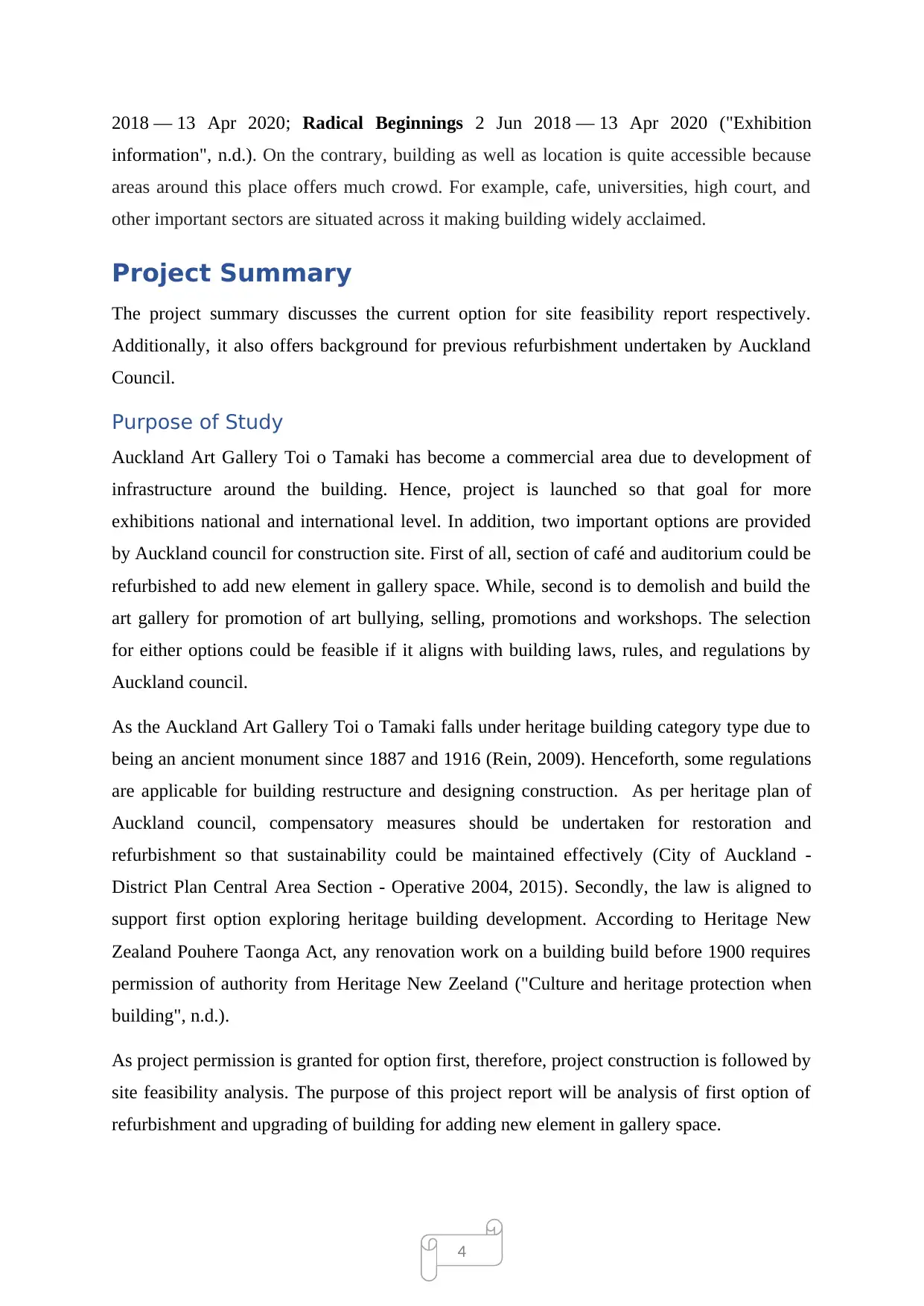
1988 – The Auckland council proposed for design and remoulding of building by Grainger &
D'Ebro's for Free Library and Art Gallery ("Building", n.d.).
Figure 2. Design for Free library art gallery Source ("Building", n.d.).
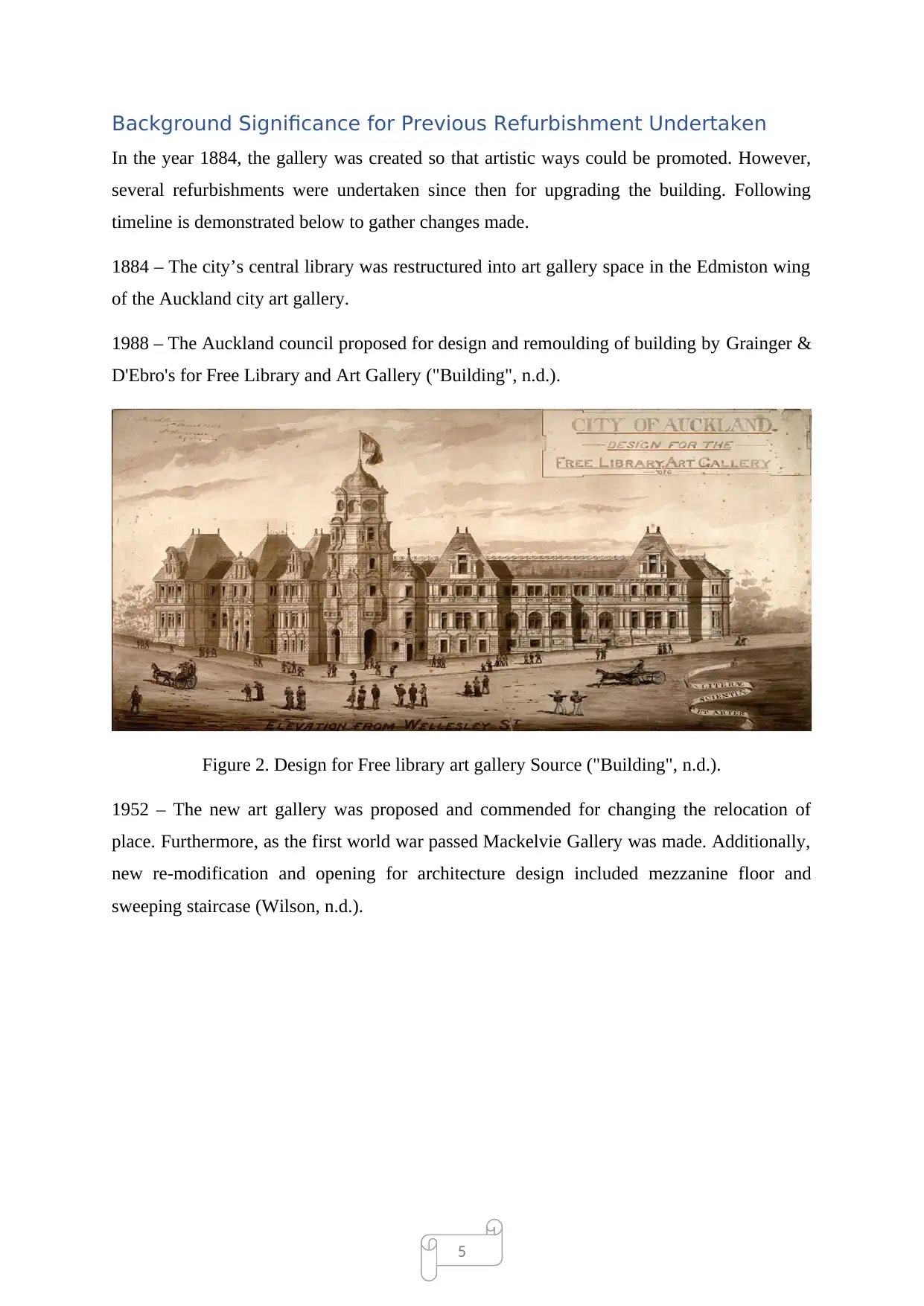
1952 – The new art gallery was proposed and commended for changing the relocation of
place. Furthermore, as the first world war passed Mackelvie Gallery was made. Additionally,
new re-modification and opening for architecture design included mezzanine floor and
sweeping staircase (Wilson, n.d.).
Background Significance for Previous Refurbishment Undertaken
In the year 1884, the gallery was created so that artistic ways could be promoted. However,
several refurbishments were undertaken since then for upgrading the building. Following
timeline is demonstrated below to gather changes made.
1884 – The city’s central library was restructured into art gallery space in the Edmiston wing
of the Auckland city art gallery.
1988 – The Auckland council proposed for design and remoulding of building by Grainger &
D'Ebro's for Free Library and Art Gallery ("Building", n.d.).
Figure 2. Design for Free library art gallery Source ("Building", n.d.).
1952 – The new art gallery was proposed and commended for changing the relocation of
place. Furthermore, as the first world war passed Mackelvie Gallery was made. Additionally,
new re-modification and opening for architecture design included mezzanine floor and
sweeping staircase (Wilson, n.d.).
⊘ This is a preview!⊘
Do you want full access?
Subscribe today to unlock all pages.
Trusted by 1+ million students worldwide
6
Figure 3. Sweeping Staircase Source (Wilson, n.d.)
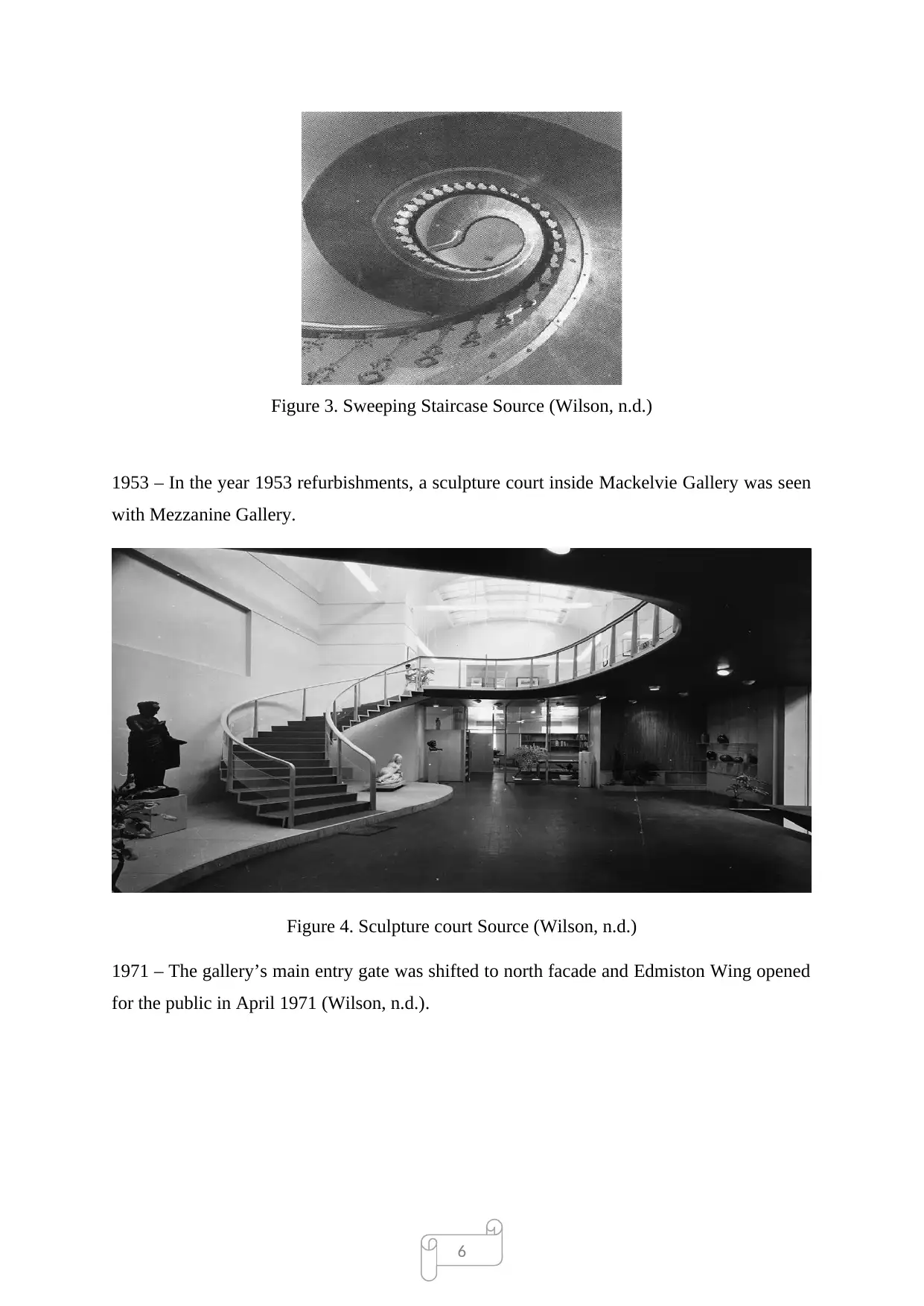
1953 – In the year 1953 refurbishments, a sculpture court inside Mackelvie Gallery was seen
with Mezzanine Gallery.
Figure 4. Sculpture court Source (Wilson, n.d.)
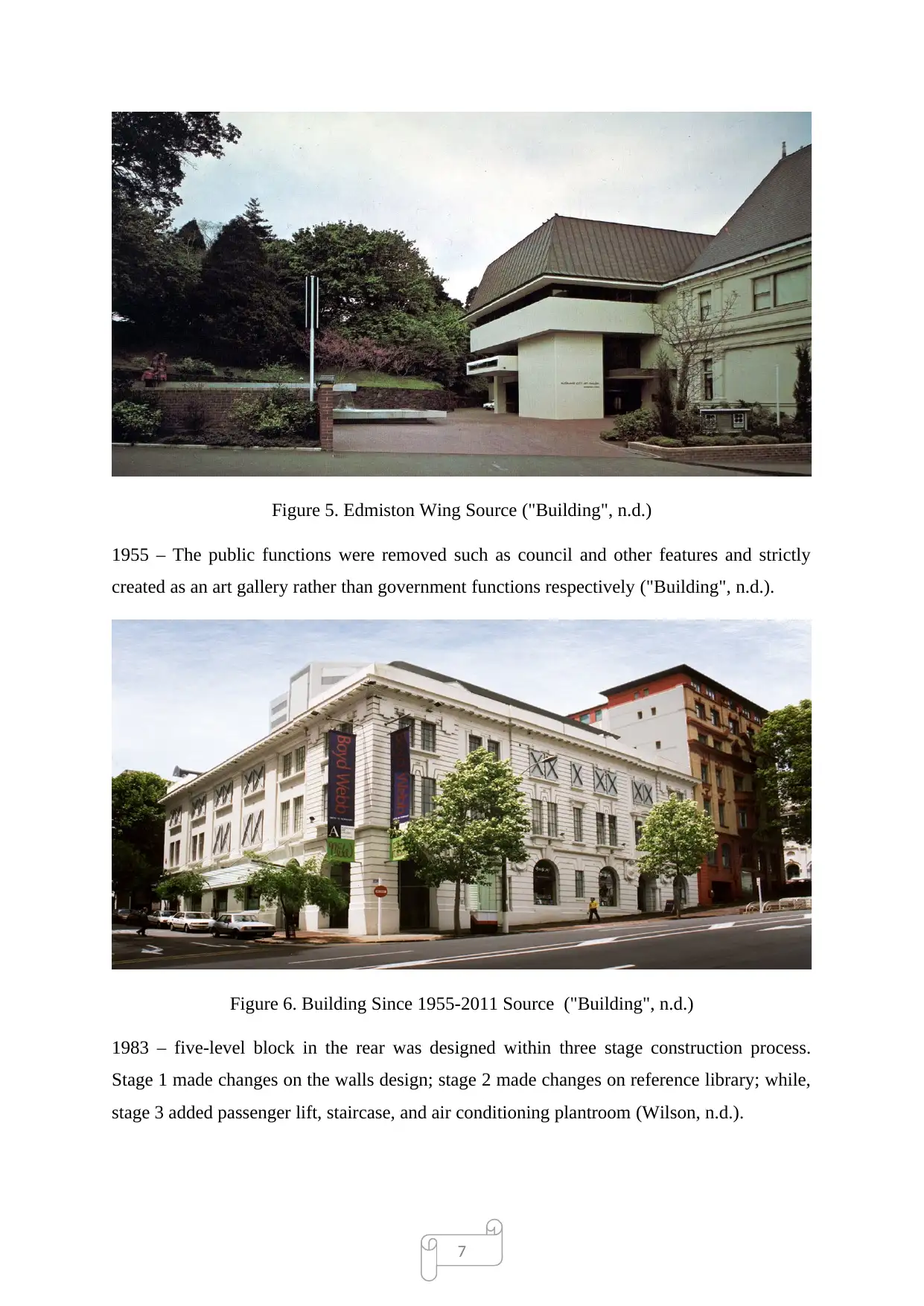
1971 – The gallery’s main entry gate was shifted to north facade and Edmiston Wing opened
for the public in April 1971 (Wilson, n.d.).
Figure 3. Sweeping Staircase Source (Wilson, n.d.)
1953 – In the year 1953 refurbishments, a sculpture court inside Mackelvie Gallery was seen
with Mezzanine Gallery.
Figure 4. Sculpture court Source (Wilson, n.d.)
1971 – The gallery’s main entry gate was shifted to north facade and Edmiston Wing opened
for the public in April 1971 (Wilson, n.d.).
Paraphrase This Document
Need a fresh take? Get an instant paraphrase of this document with our AI Paraphraser
7
Figure 5. Edmiston Wing Source ("Building", n.d.)
1955 – The public functions were removed such as council and other features and strictly
created as an art gallery rather than government functions respectively ("Building", n.d.).
Figure 6. Building Since 1955-2011 Source ("Building", n.d.)
1983 – five-level block in the rear was designed within three stage construction process.
Stage 1 made changes on the walls design; stage 2 made changes on reference library; while,
stage 3 added passenger lift, staircase, and air conditioning plantroom (Wilson, n.d.).
Figure 5. Edmiston Wing Source ("Building", n.d.)
1955 – The public functions were removed such as council and other features and strictly
created as an art gallery rather than government functions respectively ("Building", n.d.).
Figure 6. Building Since 1955-2011 Source ("Building", n.d.)
1983 – five-level block in the rear was designed within three stage construction process.
Stage 1 made changes on the walls design; stage 2 made changes on reference library; while,
stage 3 added passenger lift, staircase, and air conditioning plantroom (Wilson, n.d.).
8
2011 – In the year 2011, Auckland Art Gallery Toi o Tamaki was redeveloped effectively
incorporating fusion with canopies like structure.
Limitations
Although project research and study are apt, still some previous refurbishment processes
undertaken in previous years are difficult to gather and illustrate in this report. Therefore,
limitation of the project study is collection for exact evidence based on the research
undertaken to analyse and make judgements.
Current Conditions
The current conditions of the building will help to analyse existing building as well as
physical constraints. In addition, after analysing new improvements for site feasibility in
refurbishment could be obtained.
Existing Building
The existing building has area covered approximately 15,000 metre square feet.
Additionally, it is covered by series of tree like canopies which identify entry forecourt,
gallery areas and atrium ("Toi o Tāmaki Auckland Art Gallery Toi o Tamaki / FJMT +
Archimedia", n.d.). Furthermore, surroundings are covered with hotels, café, universities, and
court across existing building of art gallery. This existing building also has other features
including creative learning centre, education classroom, auditorium, research library, shops
and café ("Auckland Art Gallery…” n.d.). Hence, there are different aspects of existing
building which are measured to analyse building conditions.
Geographical Location
The geographical location is defined below with the help of google map. The art gallery
building is located at prime location with surrounding infrastructure well developed and
facility oriented.
2011 – In the year 2011, Auckland Art Gallery Toi o Tamaki was redeveloped effectively
incorporating fusion with canopies like structure.
Limitations
Although project research and study are apt, still some previous refurbishment processes
undertaken in previous years are difficult to gather and illustrate in this report. Therefore,
limitation of the project study is collection for exact evidence based on the research
undertaken to analyse and make judgements.
Current Conditions
The current conditions of the building will help to analyse existing building as well as
physical constraints. In addition, after analysing new improvements for site feasibility in
refurbishment could be obtained.
Existing Building
The existing building has area covered approximately 15,000 metre square feet.
Additionally, it is covered by series of tree like canopies which identify entry forecourt,
gallery areas and atrium ("Toi o Tāmaki Auckland Art Gallery Toi o Tamaki / FJMT +
Archimedia", n.d.). Furthermore, surroundings are covered with hotels, café, universities, and
court across existing building of art gallery. This existing building also has other features
including creative learning centre, education classroom, auditorium, research library, shops
and café ("Auckland Art Gallery…” n.d.). Hence, there are different aspects of existing
building which are measured to analyse building conditions.
Geographical Location
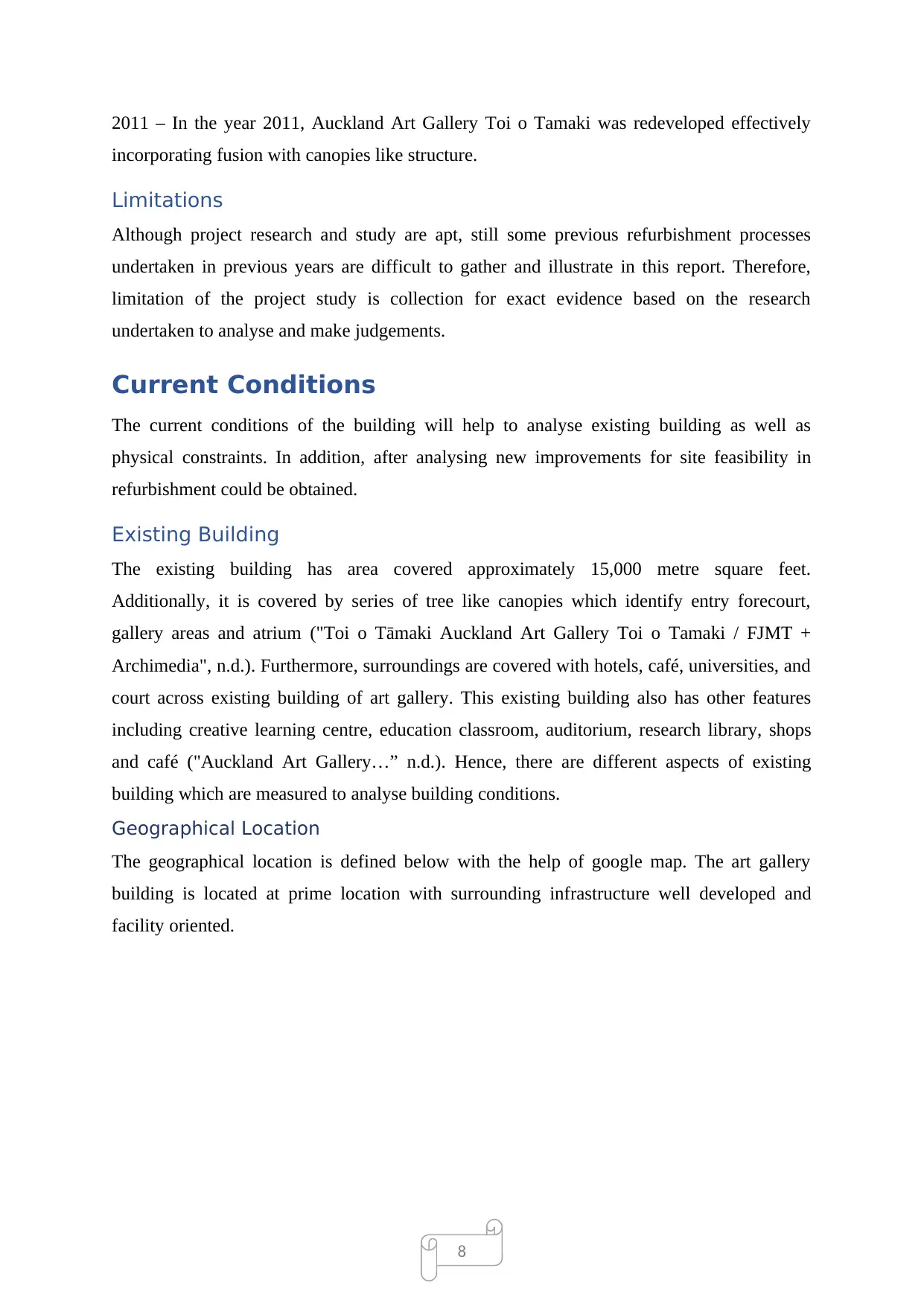
The geographical location is defined below with the help of google map. The art gallery
building is located at prime location with surrounding infrastructure well developed and
facility oriented.
⊘ This is a preview!⊘
Do you want full access?
Subscribe today to unlock all pages.
Trusted by 1+ million students worldwide
9
Figure 7. Source (Google Maps)
Floor Plan
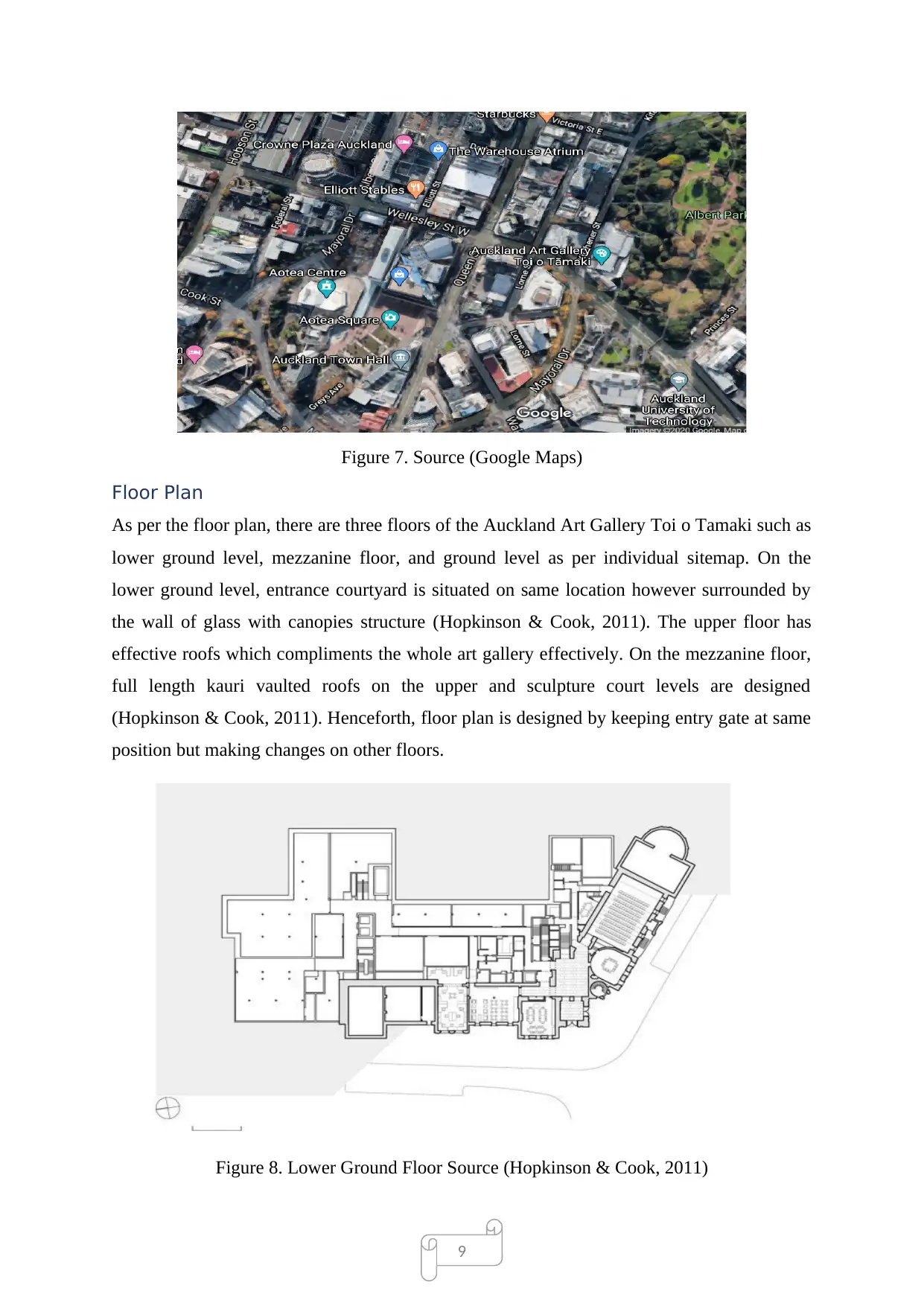
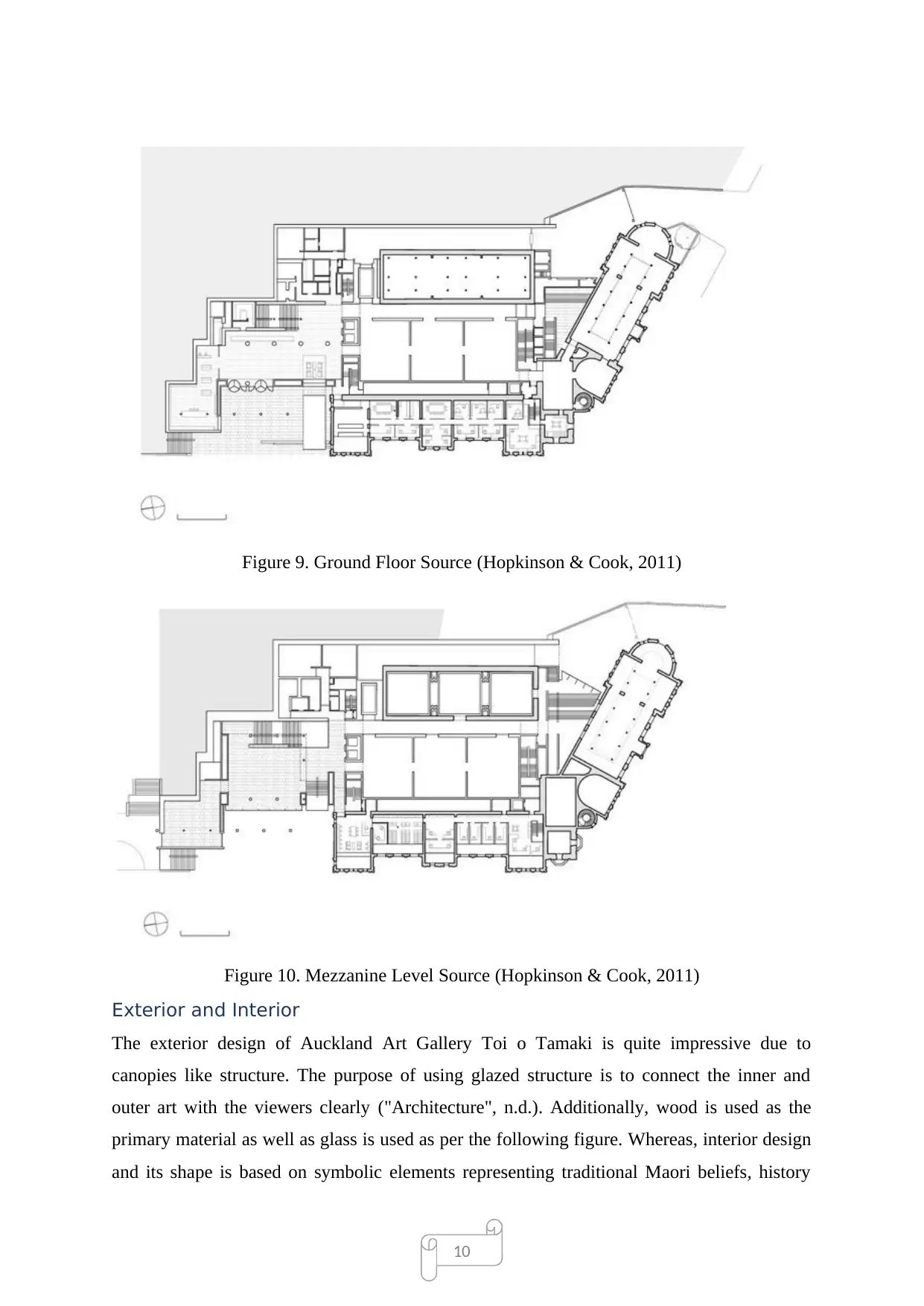
As per the floor plan, there are three floors of the Auckland Art Gallery Toi o Tamaki such as
lower ground level, mezzanine floor, and ground level as per individual sitemap. On the
lower ground level, entrance courtyard is situated on same location however surrounded by
the wall of glass with canopies structure (Hopkinson & Cook, 2011). The upper floor has
effective roofs which compliments the whole art gallery effectively. On the mezzanine floor,
full length kauri vaulted roofs on the upper and sculpture court levels are designed
(Hopkinson & Cook, 2011). Henceforth, floor plan is designed by keeping entry gate at same
position but making changes on other floors.
Figure 8. Lower Ground Floor Source (Hopkinson & Cook, 2011)
Figure 7. Source (Google Maps)
Floor Plan
As per the floor plan, there are three floors of the Auckland Art Gallery Toi o Tamaki such as
lower ground level, mezzanine floor, and ground level as per individual sitemap. On the
lower ground level, entrance courtyard is situated on same location however surrounded by
the wall of glass with canopies structure (Hopkinson & Cook, 2011). The upper floor has
effective roofs which compliments the whole art gallery effectively. On the mezzanine floor,
full length kauri vaulted roofs on the upper and sculpture court levels are designed
(Hopkinson & Cook, 2011). Henceforth, floor plan is designed by keeping entry gate at same
position but making changes on other floors.
Figure 8. Lower Ground Floor Source (Hopkinson & Cook, 2011)
Paraphrase This Document
Need a fresh take? Get an instant paraphrase of this document with our AI Paraphraser
10
Figure 9. Ground Floor Source (Hopkinson & Cook, 2011)
Figure 10. Mezzanine Level Source (Hopkinson & Cook, 2011)
Exterior and Interior
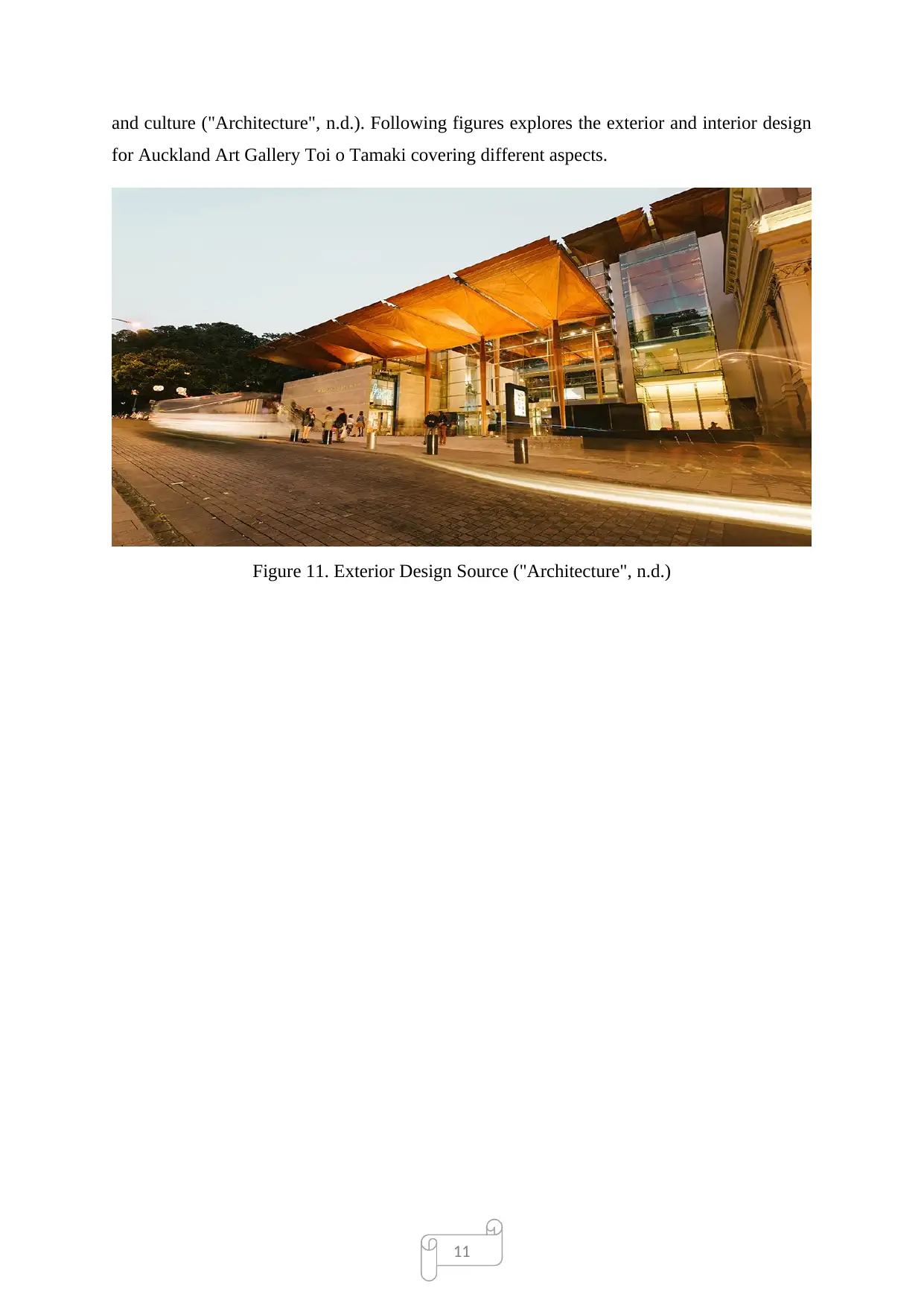
The exterior design of Auckland Art Gallery Toi o Tamaki is quite impressive due to
canopies like structure. The purpose of using glazed structure is to connect the inner and
outer art with the viewers clearly ("Architecture", n.d.). Additionally, wood is used as the
primary material as well as glass is used as per the following figure. Whereas, interior design
and its shape is based on symbolic elements representing traditional Maori beliefs, history
Figure 9. Ground Floor Source (Hopkinson & Cook, 2011)
Figure 10. Mezzanine Level Source (Hopkinson & Cook, 2011)
Exterior and Interior
The exterior design of Auckland Art Gallery Toi o Tamaki is quite impressive due to
canopies like structure. The purpose of using glazed structure is to connect the inner and
outer art with the viewers clearly ("Architecture", n.d.). Additionally, wood is used as the
primary material as well as glass is used as per the following figure. Whereas, interior design
and its shape is based on symbolic elements representing traditional Maori beliefs, history
11
and culture ("Architecture", n.d.). Following figures explores the exterior and interior design
for Auckland Art Gallery Toi o Tamaki covering different aspects.
Figure 11. Exterior Design Source ("Architecture", n.d.)
and culture ("Architecture", n.d.). Following figures explores the exterior and interior design
for Auckland Art Gallery Toi o Tamaki covering different aspects.
Figure 11. Exterior Design Source ("Architecture", n.d.)
⊘ This is a preview!⊘
Do you want full access?
Subscribe today to unlock all pages.
Trusted by 1+ million students worldwide

1 out of 23


Your All-in-One AI-Powered Toolkit for Academic Success.
+13062052269
info@desklib.com
Available 24*7 on WhatsApp / Email
![[object Object]](/_next/static/media/star-bottom.7253800d.svg)
Unlock your academic potential
Copyright © 2020–2026 A2Z Services. All Rights Reserved. Developed and managed by ZUCOL.