Marketing Campaign for Novotel Auckland Airport: A Detailed Report
VerifiedAdded on 2021/04/21
|26
|6211
|114
Report
AI Summary
This report presents a comprehensive marketing campaign for the Novotel Auckland Airport, commencing with an executive summary outlining the report's structure and key findings. It delves into the hotel's background, emphasizing its innovative approach, and details a 90-day marketing campaign aimed at enhancing brand awareness and attracting customers. The report meticulously analyzes the external and internal environments using PESTEL and other strategic tools, followed by a detailed STP (Segmentation, Targeting, and Positioning) analysis to identify the target market. An integrated marketing communication (IMC) strategy is developed, including media mix, geographic coverage, reach, and frequency, along with campaign prototypes and implementation plans. The report concludes with a robust evaluation and control section, outlining pre-testing activities and methods for measuring the performance of various media channels, culminating in recommendations for campaign improvement.

Running head: MARKETING
Marketing
Name of the Student:
Name of the University:
Author’s Note:
Marketing
Name of the Student:
Name of the University:
Author’s Note:

Paraphrase This Document
Need a fresh take? Get an instant paraphrase of this document with our AI Paraphraser
MARKETING 1
Executive Summary
The entire report has focused on the integrated marketing strategy of Novotel Auckland Airport.
In order carry out the entire report severe efforts have been put forwarded. In order to ensure the
effectiveness of the report it has been divided into different sections. These sections first
provided a brief idea about the hotel and what the report is all about. The overview of the market
along with the situational analysis of the hotel has also been performed. Finally an IMC strategy
of the company has been designed accordingly for which it has been stated that the hotel has
chosen launch a marketing campaign. The budget associated to the campaign and the time
duration of the campaign has also been provided. At the end the control evaluation process for
ensuring the effectiveness of the campaign has been provided along with a few plausible
recommendations.
Executive Summary
The entire report has focused on the integrated marketing strategy of Novotel Auckland Airport.
In order carry out the entire report severe efforts have been put forwarded. In order to ensure the
effectiveness of the report it has been divided into different sections. These sections first
provided a brief idea about the hotel and what the report is all about. The overview of the market
along with the situational analysis of the hotel has also been performed. Finally an IMC strategy
of the company has been designed accordingly for which it has been stated that the hotel has
chosen launch a marketing campaign. The budget associated to the campaign and the time
duration of the campaign has also been provided. At the end the control evaluation process for
ensuring the effectiveness of the campaign has been provided along with a few plausible
recommendations.
MARKETING 2
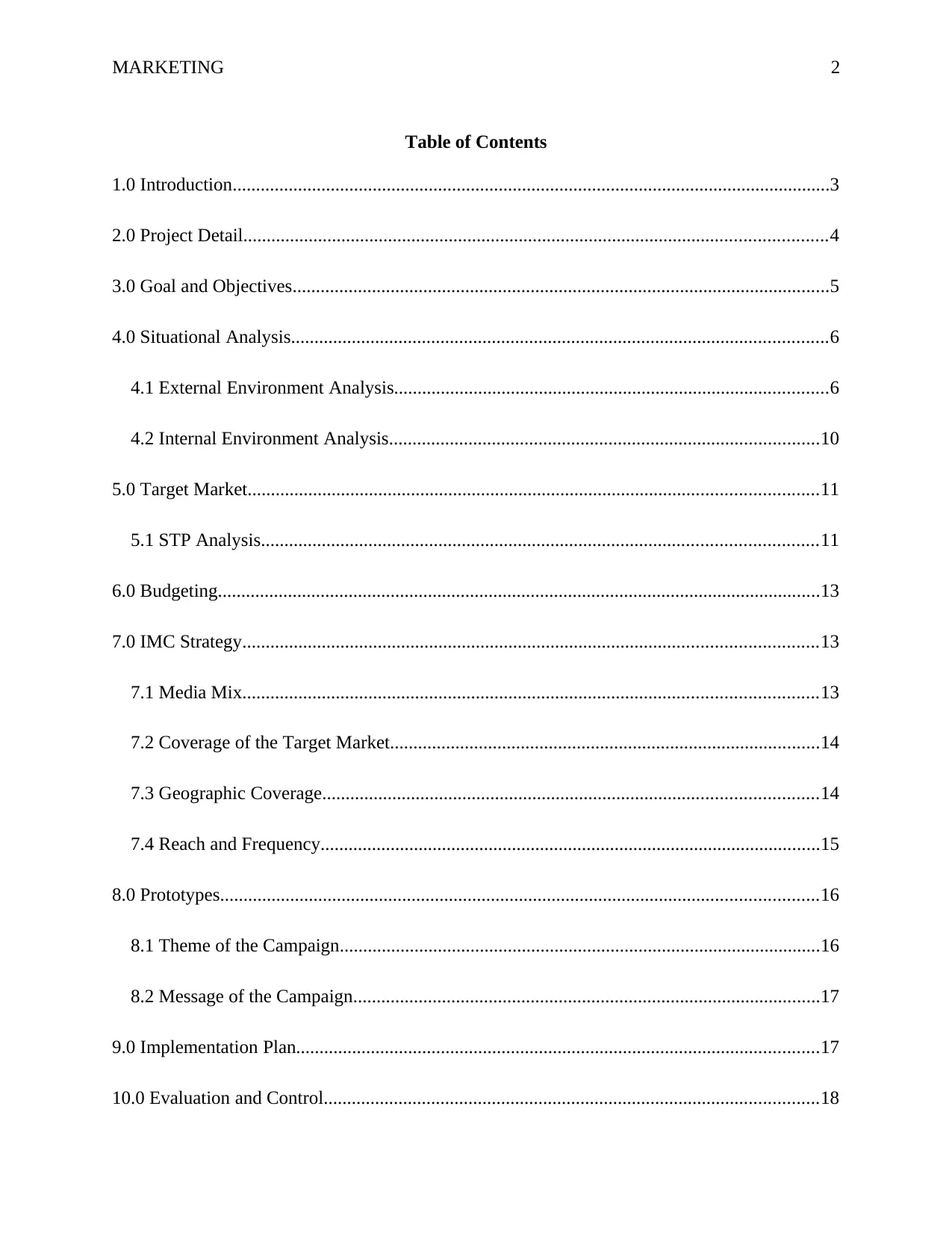
Table of Contents
1.0 Introduction................................................................................................................................3
2.0 Project Detail.............................................................................................................................4
3.0 Goal and Objectives...................................................................................................................5
4.0 Situational Analysis...................................................................................................................6
4.1 External Environment Analysis.............................................................................................6
4.2 Internal Environment Analysis............................................................................................10
5.0 Target Market..........................................................................................................................11
5.1 STP Analysis.......................................................................................................................11
6.0 Budgeting.................................................................................................................................13
7.0 IMC Strategy...........................................................................................................................13
7.1 Media Mix...........................................................................................................................13
7.2 Coverage of the Target Market............................................................................................14
7.3 Geographic Coverage..........................................................................................................14
7.4 Reach and Frequency...........................................................................................................15
8.0 Prototypes................................................................................................................................16
8.1 Theme of the Campaign.......................................................................................................16
8.2 Message of the Campaign....................................................................................................17
9.0 Implementation Plan................................................................................................................17
10.0 Evaluation and Control..........................................................................................................18
Table of Contents
1.0 Introduction................................................................................................................................3
2.0 Project Detail.............................................................................................................................4
3.0 Goal and Objectives...................................................................................................................5
4.0 Situational Analysis...................................................................................................................6
4.1 External Environment Analysis.............................................................................................6
4.2 Internal Environment Analysis............................................................................................10
5.0 Target Market..........................................................................................................................11
5.1 STP Analysis.......................................................................................................................11
6.0 Budgeting.................................................................................................................................13
7.0 IMC Strategy...........................................................................................................................13
7.1 Media Mix...........................................................................................................................13
7.2 Coverage of the Target Market............................................................................................14
7.3 Geographic Coverage..........................................................................................................14
7.4 Reach and Frequency...........................................................................................................15
8.0 Prototypes................................................................................................................................16
8.1 Theme of the Campaign.......................................................................................................16
8.2 Message of the Campaign....................................................................................................17
9.0 Implementation Plan................................................................................................................17
10.0 Evaluation and Control..........................................................................................................18
⊘ This is a preview!⊘
Do you want full access?
Subscribe today to unlock all pages.

Trusted by 1+ million students worldwide
MARKETING 3
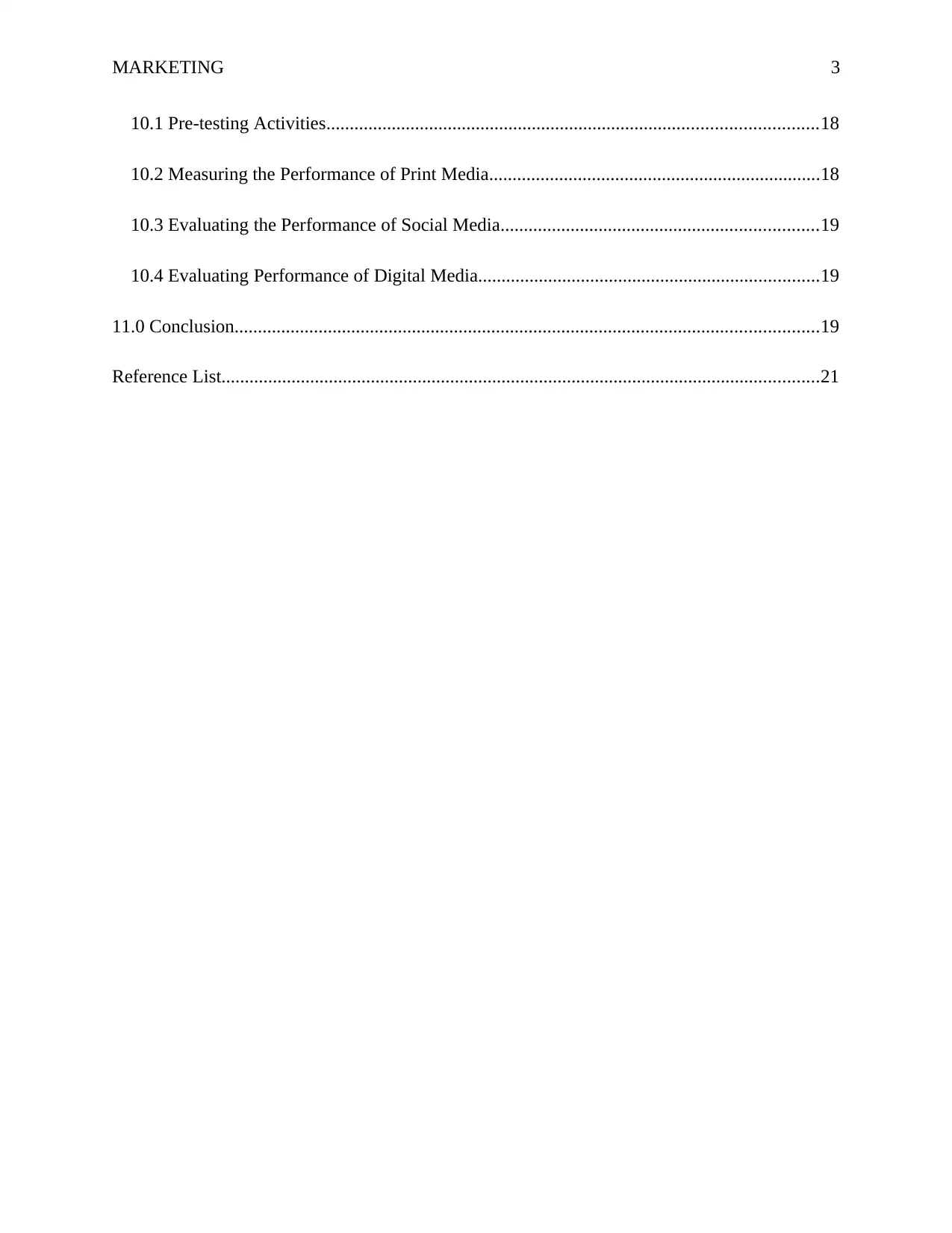
10.1 Pre-testing Activities.........................................................................................................18
10.2 Measuring the Performance of Print Media.......................................................................18
10.3 Evaluating the Performance of Social Media....................................................................19
10.4 Evaluating Performance of Digital Media.........................................................................19
11.0 Conclusion.............................................................................................................................19
Reference List................................................................................................................................21
10.1 Pre-testing Activities.........................................................................................................18
10.2 Measuring the Performance of Print Media.......................................................................18
10.3 Evaluating the Performance of Social Media....................................................................19
10.4 Evaluating Performance of Digital Media.........................................................................19
11.0 Conclusion.............................................................................................................................19
Reference List................................................................................................................................21
Paraphrase This Document
Need a fresh take? Get an instant paraphrase of this document with our AI Paraphraser
MARKETING 4
1.0 Introduction
Novotel was established in the year 1967 and presently is characterized as a midscale
hotel chain. The company was first introduced in France and it is a part of the Accor Group.
Presently Novotel operates in 58 countries and holds more than 400 properties. The key to this
success story of Novotel is its innovation centric strategic decision making structure. The
innovation and creativity can be regarded as the most important components of the brand DNA
of Novotel. For instance back in the 60’s Novotel was the first hotel that introduced bedrooms
with an attached bathroom and a color television (Accorhotels.group, 2018). Over time its
innovative nature flourished and during the 80’s it introduced the concept of breakfast buffet and
during the 90’s it further introduced contemporary art in the bedrooms. This zeal of
innovativeness of the organization has helped it to achieve the present growth path. The report
will briefly elaborate and develop a marketing campaign for Novotel Hotel in Auckland airport.
In order to do so, a basic analysis of the market and the target audience is necessary to be
performed. The market analysis will be done with the help of secondary data and numerous
effective and efficient tools. On the basis of the results of the analysis the integrated marketing
communication strategies for the campaign will be designed. As a marketing manager of the
organization it is quite easy to develop a proper understanding about the key customer base of
the hotel and what satisfies customers the most. Hence the integrated communication strategies
of the hotel will be designed in accord so that the campaign endorsed become successful
(Accorhotels.group, 2018). Furthermore, the report will also take into account designing a
prototype of the brochure which is expected to enhance the effectiveness of the campaign. A
budget will be presented where the costs will be considered in real terms and finally the
1.0 Introduction
Novotel was established in the year 1967 and presently is characterized as a midscale
hotel chain. The company was first introduced in France and it is a part of the Accor Group.
Presently Novotel operates in 58 countries and holds more than 400 properties. The key to this
success story of Novotel is its innovation centric strategic decision making structure. The
innovation and creativity can be regarded as the most important components of the brand DNA
of Novotel. For instance back in the 60’s Novotel was the first hotel that introduced bedrooms
with an attached bathroom and a color television (Accorhotels.group, 2018). Over time its
innovative nature flourished and during the 80’s it introduced the concept of breakfast buffet and
during the 90’s it further introduced contemporary art in the bedrooms. This zeal of
innovativeness of the organization has helped it to achieve the present growth path. The report
will briefly elaborate and develop a marketing campaign for Novotel Hotel in Auckland airport.
In order to do so, a basic analysis of the market and the target audience is necessary to be
performed. The market analysis will be done with the help of secondary data and numerous
effective and efficient tools. On the basis of the results of the analysis the integrated marketing
communication strategies for the campaign will be designed. As a marketing manager of the
organization it is quite easy to develop a proper understanding about the key customer base of
the hotel and what satisfies customers the most. Hence the integrated communication strategies
of the hotel will be designed in accord so that the campaign endorsed become successful
(Accorhotels.group, 2018). Furthermore, the report will also take into account designing a
prototype of the brochure which is expected to enhance the effectiveness of the campaign. A
budget will be presented where the costs will be considered in real terms and finally the
MARKETING 5
evaluation and control procedures will also be specified. Finally in the conclusion section
plausible concluding remarks are provided.
2.0 Project Detail
The Novotel, Auckland Airport is located just outside the international departure of the
Auckland airport. The hotel sports fully soundproof windows which provides the customers with
peaceful inner environment and ambient natural light. As it has been stated earlier that the key
strategy of Novotel is to stay innovative. In this hotel the clients are served with the breakfast,
lunch and dinner in a perfect time so that they can catch the flight at ease. On an added notion,
the “living wall” of the greenery of the bar is a perfect place where the customers wait for takeoff
(Accorhotels.group, 2018). The Novotel Auckland Airport has several luxurious rooms and
provides wide choice of boardrooms and conference halls where events could be organized.
Hence it can be observed that Novotel hotel is a part of the Accord Group it was
established in France in the year 1967 and is still operating profitably across the world. The
company has expanded significantly throughout the past few years and is expected to grow
further in near future. This overall success of the hotel chain also induces the success of Novotel
Auckland Airport. It is an important fact that is needed to be mentioned in this context that apart
from being very innovative and creative, during 2007 a new management team took over the
operations of the hotel. They stated that throughout the previous 10 years the hotel chain has not
innovated anything relevant and hence is becoming a common brand losing its differentiation
(Accorhotels.group, 2018). As a result a new project has been launched which was expected to
re-energize the brand Novotel and the program mainly focused on re-innovating. This project is
named as “Nextup 2015”.
evaluation and control procedures will also be specified. Finally in the conclusion section
plausible concluding remarks are provided.
2.0 Project Detail
The Novotel, Auckland Airport is located just outside the international departure of the
Auckland airport. The hotel sports fully soundproof windows which provides the customers with
peaceful inner environment and ambient natural light. As it has been stated earlier that the key
strategy of Novotel is to stay innovative. In this hotel the clients are served with the breakfast,
lunch and dinner in a perfect time so that they can catch the flight at ease. On an added notion,
the “living wall” of the greenery of the bar is a perfect place where the customers wait for takeoff
(Accorhotels.group, 2018). The Novotel Auckland Airport has several luxurious rooms and
provides wide choice of boardrooms and conference halls where events could be organized.
Hence it can be observed that Novotel hotel is a part of the Accord Group it was
established in France in the year 1967 and is still operating profitably across the world. The
company has expanded significantly throughout the past few years and is expected to grow
further in near future. This overall success of the hotel chain also induces the success of Novotel
Auckland Airport. It is an important fact that is needed to be mentioned in this context that apart
from being very innovative and creative, during 2007 a new management team took over the
operations of the hotel. They stated that throughout the previous 10 years the hotel chain has not
innovated anything relevant and hence is becoming a common brand losing its differentiation
(Accorhotels.group, 2018). As a result a new project has been launched which was expected to
re-energize the brand Novotel and the program mainly focused on re-innovating. This project is
named as “Nextup 2015”.
⊘ This is a preview!⊘
Do you want full access?
Subscribe today to unlock all pages.
Trusted by 1+ million students worldwide
MARKETING 6
In addition to this program of re-innovating and rejuvenating the brand image of Novotel
the Novotel Auckland Airport has designed a marketing campaign which is aimed at attracting
significantly large number of customers and also increasing the brand awareness of the hotel.
The name of the campaign is,
“Novotel, the best four star hotel of Auckland”
This campaign will last for 90 days, it is planned that if everything goes well the
organization will start the campaign from the 1st of May and it will end on the 30th of July.
Throughout this period the campaign will aim at increasing the brand awareness and attracting
more customers towards the hotel. The experts consulted have also stated that this may also help
to retain the existing customers as well.
3.0 Goal and Objectives
The main goal of this particular marketing campaign of Novotel will be to focus over the
targeted customer groups more specifically. This is because the chance of turning a non-targeted
into a potential buyer is quite less while the targeted customers are more likely to purchase the
products and services offered by the hotel. The campaign will endorse innovative and creative
contents which will present the company information in such a way that attracts the customers
and increases the probability that a person will visit the hotel repeatedly.
The key objectives of the campaign can be stated as follows,
To increase the number of customer of Novotel Auckland Hotel by 50% by the end of the
current year.
To increase the brand awareness and develop a perceived value among the customers and
potential customers of the hotel.
In addition to this program of re-innovating and rejuvenating the brand image of Novotel
the Novotel Auckland Airport has designed a marketing campaign which is aimed at attracting
significantly large number of customers and also increasing the brand awareness of the hotel.
The name of the campaign is,
“Novotel, the best four star hotel of Auckland”
This campaign will last for 90 days, it is planned that if everything goes well the
organization will start the campaign from the 1st of May and it will end on the 30th of July.
Throughout this period the campaign will aim at increasing the brand awareness and attracting
more customers towards the hotel. The experts consulted have also stated that this may also help
to retain the existing customers as well.
3.0 Goal and Objectives
The main goal of this particular marketing campaign of Novotel will be to focus over the
targeted customer groups more specifically. This is because the chance of turning a non-targeted
into a potential buyer is quite less while the targeted customers are more likely to purchase the
products and services offered by the hotel. The campaign will endorse innovative and creative
contents which will present the company information in such a way that attracts the customers
and increases the probability that a person will visit the hotel repeatedly.
The key objectives of the campaign can be stated as follows,
To increase the number of customer of Novotel Auckland Hotel by 50% by the end of the
current year.
To increase the brand awareness and develop a perceived value among the customers and
potential customers of the hotel.
Paraphrase This Document
Need a fresh take? Get an instant paraphrase of this document with our AI Paraphraser
MARKETING 7
To enhance the word of mouth marketing of the hotel which in turn increases the reach of
the marketing strategy of the hotel.
To develop a positive impression regarding the service and products offered by the hotel
among the customers and potential customers.
4.0 Situational Analysis
Situational analysis can be regarded as the collection of tools used by the managers for
analyzing the external and internal environment before an organization (Šeric et al., 2015). This
in turn enables the managers to develop a proper understanding about the capabilities of the
organization, its customers and the business environment through which it becomes easier to
design effective strategies. In this section the external as well as internal environment before
Novotel Auckland Airport will be analyzed which will help to determine the business
environment faced by the organization and how it can design the integrated communication
strategies which will contribute significantly in the success of the marketing campaign.
4.1 External Environment Analysis
The external environment analysis is a strategic tool that simultaneously identifies the
external factors and some of the internal factors which can affect the business operations of the
Novotel Hotel. In other words, it is quite evident that organizations do not operate in vacuum
they are also surrounded by certain environmental factors that poses significant impact over their
business operations (Šerić et al., 2014). In this context PESTEL analysis will be used to evaluate
the external environment of Novotel Auckland Airport.
PESTEL Analysis
To enhance the word of mouth marketing of the hotel which in turn increases the reach of
the marketing strategy of the hotel.
To develop a positive impression regarding the service and products offered by the hotel
among the customers and potential customers.
4.0 Situational Analysis
Situational analysis can be regarded as the collection of tools used by the managers for
analyzing the external and internal environment before an organization (Šeric et al., 2015). This
in turn enables the managers to develop a proper understanding about the capabilities of the
organization, its customers and the business environment through which it becomes easier to
design effective strategies. In this section the external as well as internal environment before
Novotel Auckland Airport will be analyzed which will help to determine the business
environment faced by the organization and how it can design the integrated communication
strategies which will contribute significantly in the success of the marketing campaign.
4.1 External Environment Analysis
The external environment analysis is a strategic tool that simultaneously identifies the
external factors and some of the internal factors which can affect the business operations of the
Novotel Hotel. In other words, it is quite evident that organizations do not operate in vacuum
they are also surrounded by certain environmental factors that poses significant impact over their
business operations (Šerić et al., 2014). In this context PESTEL analysis will be used to evaluate
the external environment of Novotel Auckland Airport.
PESTEL Analysis
MARKETING 8
PESTEL is a strategic management tool which is used to evaluate the external
environmental factors before an organization where the external environment encompasses on
six factors which are political, environmental, social, technological, economic and legal.
Political Factors
The political environment of New Zealand has been dominated by the left aligned labor
party and the National Party since the Labor Party established the government in 1935. This
Labor Party has acted significantly for enacting a number of legislations regarding the society
and economy (). It try to ensure an overall social safety and implementing a public works
program on a large scale. Moreover, the minimum basic wage is set by the party along with 40-
hour work per week and the existence of necessary unionism since the first 14 years of its
governance (Gibbs et al., 2015).
The National Party took control of the government in the year 1949 and adopted a few
welfare measures as coined by the Labor Party. In the year 1984 the Labor Party again came into
power and implemented a number of market oriented reforms. Presently the country is being led
by the national Party and the political environment of the country as it can be observed remained
significantly stable since ages. Hence, it can be stated that the political environment of the
country is in favor of the business activities of Novotel Hotel (Strauss, 2016). The principles and
legislations enacted by the respective governments of the country have in turn enhanced the
working environment of the country. The workers are benefitted and well treated within the
organizations which in turn increases their productivity as a result of which the overall
productivity of the organization increases (Van Huyssteen et al., 2015).
Economic Factors
PESTEL is a strategic management tool which is used to evaluate the external
environmental factors before an organization where the external environment encompasses on
six factors which are political, environmental, social, technological, economic and legal.
Political Factors
The political environment of New Zealand has been dominated by the left aligned labor
party and the National Party since the Labor Party established the government in 1935. This
Labor Party has acted significantly for enacting a number of legislations regarding the society
and economy (). It try to ensure an overall social safety and implementing a public works
program on a large scale. Moreover, the minimum basic wage is set by the party along with 40-
hour work per week and the existence of necessary unionism since the first 14 years of its
governance (Gibbs et al., 2015).
The National Party took control of the government in the year 1949 and adopted a few
welfare measures as coined by the Labor Party. In the year 1984 the Labor Party again came into
power and implemented a number of market oriented reforms. Presently the country is being led
by the national Party and the political environment of the country as it can be observed remained
significantly stable since ages. Hence, it can be stated that the political environment of the
country is in favor of the business activities of Novotel Hotel (Strauss, 2016). The principles and
legislations enacted by the respective governments of the country have in turn enhanced the
working environment of the country. The workers are benefitted and well treated within the
organizations which in turn increases their productivity as a result of which the overall
productivity of the organization increases (Van Huyssteen et al., 2015).
Economic Factors
⊘ This is a preview!⊘
Do you want full access?
Subscribe today to unlock all pages.
Trusted by 1+ million students worldwide
MARKETING 9
The Gross Domestic Product or GDP is considered as one of the most important
indicators of the health of the economy. GDP is nothing but the monetary value of all the goods
and services produced within the country in a specific time period. The GDP of New Zealand has
always been at a stable position. As per the recent statistics the GDP of the country in the year
2017 is 186.4 billion US dollars. In the context of historical data as well, it has been observed
that the GDP in 2010 was around 142.48 billion US dollar which was also found to be increased
in comparison to the previous year (Yoo and Gretzel, 2016). From the year 2004 to 2008, GDP
kept on increasing and only decreased in 2009.
However, it regained its previous situation in the year 2010. Hence as the GDP indicates
it can be stated that the economy of the country is in a good shape and health which is good for
the Novotel Hotel. In the context of unemployment rate and the rate of inflation it can be stated
that both of these are at a stable position. The rate of interest prevailing within New Zealand is
also in a moderate condition (De Pelsmacker et al., 2018). Therefore, the increased consumer
spending because of higher GDP and due to the moderate rate of interest it can be expected that
there will be more of the foreign investors who will be willing to invest in the country. This in
turn will be beneficial for Novotel Auckland Airport as more visitors mean more potential clients
and the increasing purchasing power of people will enable them to avail the services of the hotel
more frequently.
Social Factors
The key social feature of the country is that the people living here are very hard working
and maintains a proper work-life balance. This as a result turns the country in a very good place
for living. The residents of the country do not spend their precious time at the workplace rather
they also spend time with their family (Clarke et al., 2016). The population of the country is not
The Gross Domestic Product or GDP is considered as one of the most important
indicators of the health of the economy. GDP is nothing but the monetary value of all the goods
and services produced within the country in a specific time period. The GDP of New Zealand has
always been at a stable position. As per the recent statistics the GDP of the country in the year
2017 is 186.4 billion US dollars. In the context of historical data as well, it has been observed
that the GDP in 2010 was around 142.48 billion US dollar which was also found to be increased
in comparison to the previous year (Yoo and Gretzel, 2016). From the year 2004 to 2008, GDP
kept on increasing and only decreased in 2009.
However, it regained its previous situation in the year 2010. Hence as the GDP indicates
it can be stated that the economy of the country is in a good shape and health which is good for
the Novotel Hotel. In the context of unemployment rate and the rate of inflation it can be stated
that both of these are at a stable position. The rate of interest prevailing within New Zealand is
also in a moderate condition (De Pelsmacker et al., 2018). Therefore, the increased consumer
spending because of higher GDP and due to the moderate rate of interest it can be expected that
there will be more of the foreign investors who will be willing to invest in the country. This in
turn will be beneficial for Novotel Auckland Airport as more visitors mean more potential clients
and the increasing purchasing power of people will enable them to avail the services of the hotel
more frequently.
Social Factors
The key social feature of the country is that the people living here are very hard working
and maintains a proper work-life balance. This as a result turns the country in a very good place
for living. The residents of the country do not spend their precious time at the workplace rather
they also spend time with their family (Clarke et al., 2016). The population of the country is not
Paraphrase This Document
Need a fresh take? Get an instant paraphrase of this document with our AI Paraphraser
MARKETING 10
that much inclined towards the high end lifestyle rather they believe in simple living. Hence it
can be said that the lifestyle of the people of New Zealand may seem to be not in favor of the
hotel but the marketing campaign can influence them to avail the services and products offered
by the hotel.
Technological Factors
In the recent era of globalization and advancement New Zealand has depicted significant
development in its technological aspects. The recently developed technologies are environment
friendly as well as efficient to equip the employees whenever needed. Henceforth, the Novotel
Hotel Auckland Airport should always try to environment friendly technologies which will in
turn promote the corporate social responsibility of the organization (Hager, 2014). This is
because the population of the country is well concerned about the environmental factors and the
impact of different factors over the environment. Hence, the hotel should focus on dealing with
the technological aspects in a more effective and efficient manner so that the sentiments of the
people are not hurt as well as the productivity of the organization is not hampered (Geange et al.,
2017). The present situation depicts that the organization is maintain the technological standards
and also contributes towards maintaining the environmental sustainability. Through this it has
developed a better impression among the people around the world.
Environmental Factors
There are certain environmental factors that contribute towards the growth of the business
organizations. The first and foremost among them is the growing environmental awareness
among the people regarding the security of energy and preservation of non-renewable resources.
However, in the context of the hotel industry non-renewable energy or exhaustible resources are
that much inclined towards the high end lifestyle rather they believe in simple living. Hence it
can be said that the lifestyle of the people of New Zealand may seem to be not in favor of the
hotel but the marketing campaign can influence them to avail the services and products offered
by the hotel.
Technological Factors
In the recent era of globalization and advancement New Zealand has depicted significant
development in its technological aspects. The recently developed technologies are environment
friendly as well as efficient to equip the employees whenever needed. Henceforth, the Novotel
Hotel Auckland Airport should always try to environment friendly technologies which will in
turn promote the corporate social responsibility of the organization (Hager, 2014). This is
because the population of the country is well concerned about the environmental factors and the
impact of different factors over the environment. Hence, the hotel should focus on dealing with
the technological aspects in a more effective and efficient manner so that the sentiments of the
people are not hurt as well as the productivity of the organization is not hampered (Geange et al.,
2017). The present situation depicts that the organization is maintain the technological standards
and also contributes towards maintaining the environmental sustainability. Through this it has
developed a better impression among the people around the world.
Environmental Factors
There are certain environmental factors that contribute towards the growth of the business
organizations. The first and foremost among them is the growing environmental awareness
among the people regarding the security of energy and preservation of non-renewable resources.
However, in the context of the hotel industry non-renewable energy or exhaustible resources are
MARKETING 11
not used significantly (Schermerhorn et al., 2014). The environmental toxicity, waste disposal
system can be taken into consideration in this context. However, Novotel Auckland certainly
ensures the best possible way to dispose the waste, a proper drainage system and the adoption of
the best possible technology so as to reduce its impact over the environment. Hence, the
environmental factors would not be able to affect the organization adversely (Kelsey, 2015).
Legal Factors
There are a number of legal frameworks which have been implemented by the
government of New Zealand. There are laws enacted to maintain the sanctity of the tax system,
business operation standards, protecting human rights, ensuring the safety of the employees and
many more (Mandic et al., 2015). It is mandatory for the business organizations operating in the
country to follow the legal framework else they will become subject to legal jurisdiction.
Novotel Hotel strictly follows and maintains the laws and the guidelines provided by the
government of the concerned country.
4.2 Internal Environment Analysis
In order to evaluate the internal environment of the Novotel VRIO framework can be
used through which the factors like value, rarity, imitability and organization are evaluated.
Value
Value refers to the efficient and optimal use of the existing resource and capabilities so as
to gain additional opportunities in order to mitigate the future threats. Novotel Auckland Airport
mainly operates on the basis of its existing brands which helps it to generate increased value
offerings to its customers so that the customers receive luxury, comfort, design and premium
quality (Leung and Baloglu, 2015).
not used significantly (Schermerhorn et al., 2014). The environmental toxicity, waste disposal
system can be taken into consideration in this context. However, Novotel Auckland certainly
ensures the best possible way to dispose the waste, a proper drainage system and the adoption of
the best possible technology so as to reduce its impact over the environment. Hence, the
environmental factors would not be able to affect the organization adversely (Kelsey, 2015).
Legal Factors
There are a number of legal frameworks which have been implemented by the
government of New Zealand. There are laws enacted to maintain the sanctity of the tax system,
business operation standards, protecting human rights, ensuring the safety of the employees and
many more (Mandic et al., 2015). It is mandatory for the business organizations operating in the
country to follow the legal framework else they will become subject to legal jurisdiction.
Novotel Hotel strictly follows and maintains the laws and the guidelines provided by the
government of the concerned country.
4.2 Internal Environment Analysis
In order to evaluate the internal environment of the Novotel VRIO framework can be
used through which the factors like value, rarity, imitability and organization are evaluated.
Value
Value refers to the efficient and optimal use of the existing resource and capabilities so as
to gain additional opportunities in order to mitigate the future threats. Novotel Auckland Airport
mainly operates on the basis of its existing brands which helps it to generate increased value
offerings to its customers so that the customers receive luxury, comfort, design and premium
quality (Leung and Baloglu, 2015).
⊘ This is a preview!⊘
Do you want full access?
Subscribe today to unlock all pages.
Trusted by 1+ million students worldwide

1 out of 26


Related Documents


Your All-in-One AI-Powered Toolkit for Academic Success.
+13062052269
info@desklib.com
Available 24*7 on WhatsApp / Email
![[object Object]](/_next/static/media/star-bottom.7253800d.svg)
Unlock your academic potential
Copyright © 2020–2026 A2Z Services. All Rights Reserved. Developed and managed by ZUCOL.