Analysis of Audit, Assurance, and Compliance in AZN Banking
VerifiedAdded on 2023/06/05
|13
|3807
|424
Report
AI Summary
This report provides an in-depth analysis of audit, assurance, and compliance within the context of financial reporting, specifically using AZN Banking as a case study. It examines the importance of audit reporting quality and the adherence to accounting standards to provide assurance to financial information users. The report highlights the auditor's independence, emphasizing objectivity and integrity, and details the key roles and responsibilities of the audit committee, including its structure and functions. Various audit procedures, such as tests of controls, substantive tests of detail, and analytical procedures, are discussed to demonstrate how auditors provide assurance. Furthermore, the report analyzes the auditor's opinion, the roles of management and directors in financial reporting, and elements that indicate the effectiveness of an audit report, covering audit fees and remuneration. This report provides a comprehensive overview of audit processes, compliance requirements, and the significance of assurance in ensuring the reliability and transparency of financial statements.
Running head: AUDIT, ASSURANCE AND COMPLIANCE 1
Audit, Assurance and Compliance
Student’s Name
Institution Affiliate
Date
Audit, Assurance and Compliance
Student’s Name
Institution Affiliate
Date

Paraphrase This Document
Need a fresh take? Get an instant paraphrase of this document with our AI Paraphraser
AUDIT, ASSURANCE AND COMPLIANCE 2
Executive Summary
The quality of audit reporting is a fundamental issue in every company. The auditors are
all expected to comply with the various accounting standards when preparing their audit report,
and this is to provide assurance to the users of the financial information. This report aims at
highlighting some of the key issues undertaken during the auditing work to provide effective
material information which is beneficial to the company. The report has illustrated the
independence requirements of an audit report such as objectivity and integrity. Further, the
key roles and responsibilities of the audit committee have also been highlighted in the paper. The
various audit procedures have also been highlighted in the report such as the substantive detail
testing of the financial statements. Lastly, the report has explained the elements which typically
indicates the effectiveness of a particular audit report and all of the above issues have been
discussed in the paper below.
Introduction
Audit reports generally must give an assurance to the managers and directors of a
company a clear view of the financial position of such a fimr.There are therefore certain aspects
which have to be taken into considerations such as the audit procedures, various audit opinions,
existence of audit committee and factors which makes an audit report to be effective. Audit
assurance focuses on evaluating financial statements while compliance on the other hand focuses
on adherence to the laws, regulations and standards. This paper will focus on some of the above
mentioned aspects of audit, assurance and compliance.
Audit, Assurance, and Compliance
The company selected in the ASX is AZN Banking. Based on the assessment of the
auditors' section including the other areas of the auditors there are a number of an issue which
Executive Summary
The quality of audit reporting is a fundamental issue in every company. The auditors are
all expected to comply with the various accounting standards when preparing their audit report,
and this is to provide assurance to the users of the financial information. This report aims at
highlighting some of the key issues undertaken during the auditing work to provide effective
material information which is beneficial to the company. The report has illustrated the
independence requirements of an audit report such as objectivity and integrity. Further, the
key roles and responsibilities of the audit committee have also been highlighted in the paper. The
various audit procedures have also been highlighted in the report such as the substantive detail
testing of the financial statements. Lastly, the report has explained the elements which typically
indicates the effectiveness of a particular audit report and all of the above issues have been
discussed in the paper below.
Introduction
Audit reports generally must give an assurance to the managers and directors of a
company a clear view of the financial position of such a fimr.There are therefore certain aspects
which have to be taken into considerations such as the audit procedures, various audit opinions,
existence of audit committee and factors which makes an audit report to be effective. Audit
assurance focuses on evaluating financial statements while compliance on the other hand focuses
on adherence to the laws, regulations and standards. This paper will focus on some of the above
mentioned aspects of audit, assurance and compliance.
Audit, Assurance, and Compliance
The company selected in the ASX is AZN Banking. Based on the assessment of the
auditors' section including the other areas of the auditors there are a number of an issue which
AUDIT, ASSURANCE AND COMPLIANCE 3
has been noted. For example, the auditor has complied with the independence requirements. One
of the requirements of an auditor’s independence is that the auditor must hold the highest levels
of integrity and this was displayed in the auditor’s report. The auditor expressed the highest
levels of integrity by being honest while carrying out his duties (Church, Jenkins & Stanley,
2018). Additionally, the auditor was objective while carrying out the audit work and this
typically forms one of the key requirements for independence of an auditor. The audit report also
indicated more disclosure of information and also an increased communication with the
management.
The huge disclosure of information and more communication with the management is a
fundamental requirement of an auditor’s independence, and this was exhibited in the financial
statements under the auditors' section, and hence the auditor complied with the auditor’s
independence requirement (Peterson, 2018). Further, there were few cases of conflicts of interest
between the management and the auditor. The few cases of conflict of interest are one of the
critical requirements for an auditor's independence, and thus the auditor had adhered to the
independence requirements. The company also has the audit committee who are responsible for
pre-approval services after an audit report has been submitted to them. Audit committee typically
forms the significant requirements for auditor independence and this, therefore, proves that
indeed the auditors had complied with the independence requirements (Roy & Saha, 2018).
The auditor's section also indicated that the prohibited non-audit services such as
actuarial services, bookkeeping, valuation of services and financial information system design
had not been carried out by the auditor (Carcello, Neal, Reid & Shipman, 2017). The prohibited
non-audit services are one of the essential requirements of an auditor's independence, and this,
has been noted. For example, the auditor has complied with the independence requirements. One
of the requirements of an auditor’s independence is that the auditor must hold the highest levels
of integrity and this was displayed in the auditor’s report. The auditor expressed the highest
levels of integrity by being honest while carrying out his duties (Church, Jenkins & Stanley,
2018). Additionally, the auditor was objective while carrying out the audit work and this
typically forms one of the key requirements for independence of an auditor. The audit report also
indicated more disclosure of information and also an increased communication with the
management.
The huge disclosure of information and more communication with the management is a
fundamental requirement of an auditor’s independence, and this was exhibited in the financial
statements under the auditors' section, and hence the auditor complied with the auditor’s
independence requirement (Peterson, 2018). Further, there were few cases of conflicts of interest
between the management and the auditor. The few cases of conflict of interest are one of the
critical requirements for an auditor's independence, and thus the auditor had adhered to the
independence requirements. The company also has the audit committee who are responsible for
pre-approval services after an audit report has been submitted to them. Audit committee typically
forms the significant requirements for auditor independence and this, therefore, proves that
indeed the auditors had complied with the independence requirements (Roy & Saha, 2018).
The auditor's section also indicated that the prohibited non-audit services such as
actuarial services, bookkeeping, valuation of services and financial information system design
had not been carried out by the auditor (Carcello, Neal, Reid & Shipman, 2017). The prohibited
non-audit services are one of the essential requirements of an auditor's independence, and this,
⊘ This is a preview!⊘
Do you want full access?
Subscribe today to unlock all pages.

Trusted by 1+ million students worldwide
AUDIT, ASSURANCE AND COMPLIANCE 4
therefore, confirmed that the auditor of the company had complied with the independence
requirement.
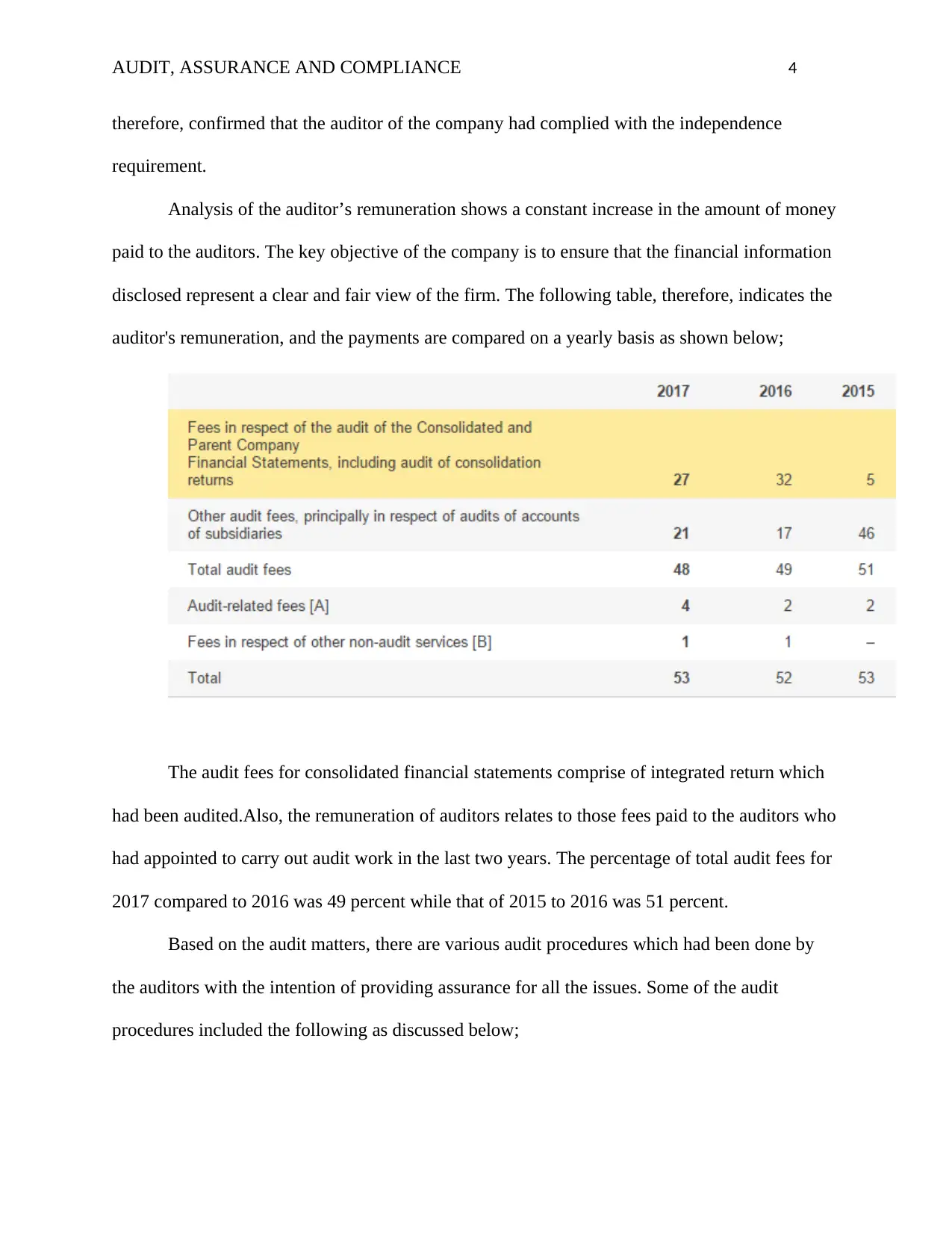
Analysis of the auditor’s remuneration shows a constant increase in the amount of money
paid to the auditors. The key objective of the company is to ensure that the financial information
disclosed represent a clear and fair view of the firm. The following table, therefore, indicates the
auditor's remuneration, and the payments are compared on a yearly basis as shown below;
The audit fees for consolidated financial statements comprise of integrated return which
had been audited.Also, the remuneration of auditors relates to those fees paid to the auditors who
had appointed to carry out audit work in the last two years. The percentage of total audit fees for
2017 compared to 2016 was 49 percent while that of 2015 to 2016 was 51 percent.
Based on the audit matters, there are various audit procedures which had been done by
the auditors with the intention of providing assurance for all the issues. Some of the audit
procedures included the following as discussed below;
therefore, confirmed that the auditor of the company had complied with the independence
requirement.
Analysis of the auditor’s remuneration shows a constant increase in the amount of money
paid to the auditors. The key objective of the company is to ensure that the financial information
disclosed represent a clear and fair view of the firm. The following table, therefore, indicates the
auditor's remuneration, and the payments are compared on a yearly basis as shown below;
The audit fees for consolidated financial statements comprise of integrated return which
had been audited.Also, the remuneration of auditors relates to those fees paid to the auditors who
had appointed to carry out audit work in the last two years. The percentage of total audit fees for
2017 compared to 2016 was 49 percent while that of 2015 to 2016 was 51 percent.
Based on the audit matters, there are various audit procedures which had been done by
the auditors with the intention of providing assurance for all the issues. Some of the audit
procedures included the following as discussed below;
Paraphrase This Document
Need a fresh take? Get an instant paraphrase of this document with our AI Paraphraser
AUDIT, ASSURANCE AND COMPLIANCE 5
Test of Controls
The above procedure was carried out to determine the effectiveness of the control
measure which was being sued by the management of the company. The procedure helps to
detect any particular material misstatements. There are various categories of a test of controls
which were used by the auditors and such include, an observation which entailed looking at a
variety of business processes and the control elements (Blokdijk, Drieenhuizen, Simunic &
Stein, 2014). The other category of test control which had been used was the inspection where
the auditors inspected different documents for approval such as stamps and signatures, and this
was to ascertain whether the controls had been conducted properly. The last category of tests of
control was reperformance, and this involved the initiation of new transactions in determining
whether the client had applied the controls.
Substantive Tests of Detail
The substantive testing is also another audit procedure which had been used by the
auditors of the company. The procedure was primarily conducted to assess the financial
statements including the supporting documents to get errors in the annual report. Further, the
audit procedure above was done to ensure that all the financial records were accurate, valid and
complete (Blokdijk et al., 2014). There are a variety of samples in which the tests had been
carried out in, and they included, contact of various clients to validate that the accounts
receivable were accurate. The other test was to ascertain the accuracy of inventory valuation
estimations. Some of the other tests were communication with the suppliers to validate whether
the accounts payable were accurate or not and a bank confirmation was issued to validate the
ending cash balances. During this procedure, the minutes of the board of directors were reviewed
Test of Controls
The above procedure was carried out to determine the effectiveness of the control
measure which was being sued by the management of the company. The procedure helps to
detect any particular material misstatements. There are various categories of a test of controls
which were used by the auditors and such include, an observation which entailed looking at a
variety of business processes and the control elements (Blokdijk, Drieenhuizen, Simunic &
Stein, 2014). The other category of test control which had been used was the inspection where
the auditors inspected different documents for approval such as stamps and signatures, and this
was to ascertain whether the controls had been conducted properly. The last category of tests of
control was reperformance, and this involved the initiation of new transactions in determining
whether the client had applied the controls.
Substantive Tests of Detail
The substantive testing is also another audit procedure which had been used by the
auditors of the company. The procedure was primarily conducted to assess the financial
statements including the supporting documents to get errors in the annual report. Further, the
audit procedure above was done to ensure that all the financial records were accurate, valid and
complete (Blokdijk et al., 2014). There are a variety of samples in which the tests had been
carried out in, and they included, contact of various clients to validate that the accounts
receivable were accurate. The other test was to ascertain the accuracy of inventory valuation
estimations. Some of the other tests were communication with the suppliers to validate whether
the accounts payable were accurate or not and a bank confirmation was issued to validate the
ending cash balances. During this procedure, the minutes of the board of directors were reviewed
AUDIT, ASSURANCE AND COMPLIANCE 6
to check for the presence of dividends which had been approved by the directors of the company
(Graham, Bedard & Dutta, 2018).
Substantive Test of Balances or Analytical Procedures.
The analytical procedure is also one of the audit procedures which had been used by the
auditors of the company. It entailed an assessment of the financial information by evaluating the
relationship between the non-financial and financial data. The key examples of analytical tests
which had been used by the auditors were the regression analysis and trend ratio. Also, the above
audit procedure was used together with the other audit procedures such as the substantive testing.
The primary reason for the integration of the other procedures was to identify the misstatements
in the various account balances (Tricker, 2016). Additionally, the procedure was found to be
more efficient compared to the traditional procedures which often necessitates for a lot of time to
be used for the verification of the various transactions and account balances. The analytical
procedure involved five key steps, and this included, an analysis of the possibility of
misstatement of material, the formation of an independent outcome based on particular account
balances. The other step involved an investigation into the cause of the various financial
discrepancies to typically identify the cause of such deviations in the financial statements. The
variations existing in the reported and estimated amounts were identified. The last step entailed
the ascertainment of the nature of any other auditing procedures (Schreiber, 2017).
The analysis of the audit section in the annual report also shows that there is an audit
committee. The audit committee comprises of five directors. There of the members of the
committee are executive members, and two of them are the non-executive members of the audit
committee (Desai, 2015). The committee is chaired by an independent auditor, and he is not part
of the board. The assessment of the auditors' section also shows that there exists an audit
to check for the presence of dividends which had been approved by the directors of the company
(Graham, Bedard & Dutta, 2018).
Substantive Test of Balances or Analytical Procedures.
The analytical procedure is also one of the audit procedures which had been used by the
auditors of the company. It entailed an assessment of the financial information by evaluating the
relationship between the non-financial and financial data. The key examples of analytical tests
which had been used by the auditors were the regression analysis and trend ratio. Also, the above
audit procedure was used together with the other audit procedures such as the substantive testing.
The primary reason for the integration of the other procedures was to identify the misstatements
in the various account balances (Tricker, 2016). Additionally, the procedure was found to be
more efficient compared to the traditional procedures which often necessitates for a lot of time to
be used for the verification of the various transactions and account balances. The analytical
procedure involved five key steps, and this included, an analysis of the possibility of
misstatement of material, the formation of an independent outcome based on particular account
balances. The other step involved an investigation into the cause of the various financial
discrepancies to typically identify the cause of such deviations in the financial statements. The
variations existing in the reported and estimated amounts were identified. The last step entailed
the ascertainment of the nature of any other auditing procedures (Schreiber, 2017).
The analysis of the audit section in the annual report also shows that there is an audit
committee. The audit committee comprises of five directors. There of the members of the
committee are executive members, and two of them are the non-executive members of the audit
committee (Desai, 2015). The committee is chaired by an independent auditor, and he is not part
of the board. The assessment of the auditors' section also shows that there exists an audit
⊘ This is a preview!⊘
Do you want full access?
Subscribe today to unlock all pages.
Trusted by 1+ million students worldwide
AUDIT, ASSURANCE AND COMPLIANCE 7
committee charter. The charter highlights the purpose of the committee, the composition of the
audit committee, the roles and responsibilities of the audit committee, the resources of the audit
committee and the various meetings of the audit committee.
Structure of Audit Committee
The audit committee is made up of five directors, and two of the members are non-
executive members. The audit committee has appointed by the board of directors of the
company. Also, the members are mainly independent directors, and this is based on the
regulations made by the Capital Market Supervisory Board. One of the members of the audit
committee has a wide knowledge to ensure that the financial statement and budgets are reliable.
Functions and Responsibilities of the Audit Committee
Sultana, Singh & Van der Zahn (2015), argues that there are various roles played by the
audit committee in the company. For example, the committee determines the internal control of
the company by ensuring that they are effective and this is done on a quarterly basis. The
committee also approves the appointment of the chief audit executive of the company through
voting by the members (Cohen, Krishnamoorthy & Wright, 2017). The committee also assists
the board of directors in oversight roles especially in the risk management systems, financial
reporting, and various audit functions.
Another responsibility of the audit committee is that it monitors and evaluates the
audited financial statements provided by the external auditors. Further, the audit committee plays
a fundamental function in corporate governance, and this relates to the control, accountability,
and directions of the company (Abernathy, Beyer, Masli & Stefaniak, 2015). Another
responsibility of the audit committee is that it oversees the process of disclosure of the AZN
Banking and this is to ensure that there is compliance with the international and local laws. Apart
committee charter. The charter highlights the purpose of the committee, the composition of the
audit committee, the roles and responsibilities of the audit committee, the resources of the audit
committee and the various meetings of the audit committee.
Structure of Audit Committee
The audit committee is made up of five directors, and two of the members are non-
executive members. The audit committee has appointed by the board of directors of the
company. Also, the members are mainly independent directors, and this is based on the
regulations made by the Capital Market Supervisory Board. One of the members of the audit
committee has a wide knowledge to ensure that the financial statement and budgets are reliable.
Functions and Responsibilities of the Audit Committee
Sultana, Singh & Van der Zahn (2015), argues that there are various roles played by the
audit committee in the company. For example, the committee determines the internal control of
the company by ensuring that they are effective and this is done on a quarterly basis. The
committee also approves the appointment of the chief audit executive of the company through
voting by the members (Cohen, Krishnamoorthy & Wright, 2017). The committee also assists
the board of directors in oversight roles especially in the risk management systems, financial
reporting, and various audit functions.
Another responsibility of the audit committee is that it monitors and evaluates the
audited financial statements provided by the external auditors. Further, the audit committee plays
a fundamental function in corporate governance, and this relates to the control, accountability,
and directions of the company (Abernathy, Beyer, Masli & Stefaniak, 2015). Another
responsibility of the audit committee is that it oversees the process of disclosure of the AZN
Banking and this is to ensure that there is compliance with the international and local laws. Apart
Paraphrase This Document
Need a fresh take? Get an instant paraphrase of this document with our AI Paraphraser
AUDIT, ASSURANCE AND COMPLIANCE 8
from the roles mentioned above of the audit committee, they also have a responsibility of
approving the budgets and plans proposed by an external auditor. They have to check the
benefits and costs of administering certain audit duties before carrying out an audit procedure of
the company (Khlif & Samaha, 2016).
The analysis of the auditors' sections shows that the auditor’s opinion was unqualified. It,
therefore, meant that the financial statements of the company are a true view of the position if the
company. Also, the unqualified audit opinion indicated that the Generally Accepted Accounting
Principles were conformed to by the financial statements (Bhasin, 2015). The above opinion was
arrived at by the auditors after getting adequate audit evidence on the financial statements due to
the various audit procedures such as the substantive detail testing of such statements provided by
the management.
The directors and management of the company have varied roles in relation to the
financial report. The main role of the management during the financial reporting is to ensure that
all the financial statements are sufficient and also are disclosed according to the reporting
standards. Also, they have to ensure that all the financial statements contain information which is
truthful and does not ruin the reputation of the company (Badolato, Donelson & Ege, 2014).
Additionally, the management checks the disclosures in the financial reports to ensure that the
available information is accurate, relevant and reliable for the users who will use the information
to make certain viable decisions. The directors, on the other hand, keep proper accounting
records which will be used during the disclosure of financial information in the annual reports.
The directors are also expected to have knowledge in accounting which will enable them to
challenge the assumptions and approximations in the financial reports. Further, the accounting
from the roles mentioned above of the audit committee, they also have a responsibility of
approving the budgets and plans proposed by an external auditor. They have to check the
benefits and costs of administering certain audit duties before carrying out an audit procedure of
the company (Khlif & Samaha, 2016).
The analysis of the auditors' sections shows that the auditor’s opinion was unqualified. It,
therefore, meant that the financial statements of the company are a true view of the position if the
company. Also, the unqualified audit opinion indicated that the Generally Accepted Accounting
Principles were conformed to by the financial statements (Bhasin, 2015). The above opinion was
arrived at by the auditors after getting adequate audit evidence on the financial statements due to
the various audit procedures such as the substantive detail testing of such statements provided by
the management.
The directors and management of the company have varied roles in relation to the
financial report. The main role of the management during the financial reporting is to ensure that
all the financial statements are sufficient and also are disclosed according to the reporting
standards. Also, they have to ensure that all the financial statements contain information which is
truthful and does not ruin the reputation of the company (Badolato, Donelson & Ege, 2014).
Additionally, the management checks the disclosures in the financial reports to ensure that the
available information is accurate, relevant and reliable for the users who will use the information
to make certain viable decisions. The directors, on the other hand, keep proper accounting
records which will be used during the disclosure of financial information in the annual reports.
The directors are also expected to have knowledge in accounting which will enable them to
challenge the assumptions and approximations in the financial reports. Further, the accounting
AUDIT, ASSURANCE AND COMPLIANCE 9
knowledge will enable the auditors to comprehend the substance of various transactions in the
financial reports (Kothari, Mizik & Roychowdhury, 2015).
The roles of the auditors, however, differ from those of the directors and management
during the financial reporting. For example, the auditors only carry out an evaluation of the
financial statements of the company, and this is unlike for the directors and management who
ensure that such financial statements are reported according to the accounting standards. The
work of the auditors is to just examine the documents of the firm (Knechel & Salterio, 2016).
During the financial reporting, the auditors' responsibility is to give details in report form as to
whether there was adequate evidence collected which would allow them to give the assurance
which is reasonable to indicate that such financial statements had been fairly prepared. They also
look at whether there was material misstatement in the documents which would justify that the
report prepared contained certain errors. Based on the above discussion, it is concluded that the
roles played by the directors, management and the auditors differ during the preparation of the
financial reports.
The auditors' section also shows that there were subsequent material events after the
reporting period. The subsequent material events identified were primarily two that is recognized
and non-recognized events. The recognized subsequent events are treated by adjusting the
financial statements in the current financial statements of the company, and this was done issuing
them in the statements of financial position (AICPA, 2017). The non-recognized events,
however, on the other hand, are treated by issuing them in the in the next year financial
statements.
Based on the assessment of the auditor’s report, it can be concluded that material
information reported by the auditor is effective. The report can be considered effective because
knowledge will enable the auditors to comprehend the substance of various transactions in the
financial reports (Kothari, Mizik & Roychowdhury, 2015).
The roles of the auditors, however, differ from those of the directors and management
during the financial reporting. For example, the auditors only carry out an evaluation of the
financial statements of the company, and this is unlike for the directors and management who
ensure that such financial statements are reported according to the accounting standards. The
work of the auditors is to just examine the documents of the firm (Knechel & Salterio, 2016).
During the financial reporting, the auditors' responsibility is to give details in report form as to
whether there was adequate evidence collected which would allow them to give the assurance
which is reasonable to indicate that such financial statements had been fairly prepared. They also
look at whether there was material misstatement in the documents which would justify that the
report prepared contained certain errors. Based on the above discussion, it is concluded that the
roles played by the directors, management and the auditors differ during the preparation of the
financial reports.
The auditors' section also shows that there were subsequent material events after the
reporting period. The subsequent material events identified were primarily two that is recognized
and non-recognized events. The recognized subsequent events are treated by adjusting the
financial statements in the current financial statements of the company, and this was done issuing
them in the statements of financial position (AICPA, 2017). The non-recognized events,
however, on the other hand, are treated by issuing them in the in the next year financial
statements.
Based on the assessment of the auditor’s report, it can be concluded that material
information reported by the auditor is effective. The report can be considered effective because
⊘ This is a preview!⊘
Do you want full access?
Subscribe today to unlock all pages.
Trusted by 1+ million students worldwide
AUDIT, ASSURANCE AND COMPLIANCE 10
the right audit procedures which had been used by the auditor to carry out the audit work. The
audit report can also be said to be effective since it had been carried out by certain competent
auditors of the company (Loughran & McDonald, 2014). Most of the auditing work was done
based on the appointees of the audit committee, and it is expected that any particular auditor of
the firm must have the experience and knowledge to undertake the activity. Additionally, they
have to meet the independent requirements before being allowed to carry out some of the
auditing tasks.
According to Leuz & Wysocki (2016), the other reason which makes the audit report to
be effective is because of the quality control which had been done by the auditors during the
process. All the control systems of the organization had been looked into, and this was done to
identify the strengths and weaknesses of the internal control system of the firm. Lastly, the
information in the audit report was effective due to the quality assurance which was displayed by
the auditors while carrying out their audit work for the company. The factors mentioned above
typically prove that the audit report was effective and hence could be relied on by a variety of
financial users such as the investors, government, employees and the public among others. The
auditing report was found to be effective and hence there no case of missing information in the
report. The level of competency which was applied in the preparation of the audit report resulted
in no missing material information. All the details were fully explained, and hence the
information provided could be relied upon by the different users of the financial information.
Conclusion
In summary, it is evident that the quality and assurance of an audit report is based on a
variety of issues which must be taken into account by auditors. For example, the auditors must
comply with the different accounting standards of auditing. There are also a variety of audit
the right audit procedures which had been used by the auditor to carry out the audit work. The
audit report can also be said to be effective since it had been carried out by certain competent
auditors of the company (Loughran & McDonald, 2014). Most of the auditing work was done
based on the appointees of the audit committee, and it is expected that any particular auditor of
the firm must have the experience and knowledge to undertake the activity. Additionally, they
have to meet the independent requirements before being allowed to carry out some of the
auditing tasks.
According to Leuz & Wysocki (2016), the other reason which makes the audit report to
be effective is because of the quality control which had been done by the auditors during the
process. All the control systems of the organization had been looked into, and this was done to
identify the strengths and weaknesses of the internal control system of the firm. Lastly, the
information in the audit report was effective due to the quality assurance which was displayed by
the auditors while carrying out their audit work for the company. The factors mentioned above
typically prove that the audit report was effective and hence could be relied on by a variety of
financial users such as the investors, government, employees and the public among others. The
auditing report was found to be effective and hence there no case of missing information in the
report. The level of competency which was applied in the preparation of the audit report resulted
in no missing material information. All the details were fully explained, and hence the
information provided could be relied upon by the different users of the financial information.
Conclusion
In summary, it is evident that the quality and assurance of an audit report is based on a
variety of issues which must be taken into account by auditors. For example, the auditors must
comply with the different accounting standards of auditing. There are also a variety of audit
Paraphrase This Document
Need a fresh take? Get an instant paraphrase of this document with our AI Paraphraser
AUDIT, ASSURANCE AND COMPLIANCE 11
procedures such as substantive detail testing and the analytical procedures and they must be
strictly adhered to when conducting audit work. In the financial reports, under the auditors
section, the company is said to have an audit committee tasked with various responsibilities such
as oversight roles especially in the risk management systems, financial reporting, and various
audit functions. However the responsibilities of the management and auditors differ on the basis
of planning and control. An audit report should also be effective and this is indicated by various
elements such as competency of the auditors among others.
procedures such as substantive detail testing and the analytical procedures and they must be
strictly adhered to when conducting audit work. In the financial reports, under the auditors
section, the company is said to have an audit committee tasked with various responsibilities such
as oversight roles especially in the risk management systems, financial reporting, and various
audit functions. However the responsibilities of the management and auditors differ on the basis
of planning and control. An audit report should also be effective and this is indicated by various
elements such as competency of the auditors among others.
AUDIT, ASSURANCE AND COMPLIANCE 12
References
Abernathy, J. L., Beyer, B., Masli, A., & Stefaniak, C. M. (2015). How the source of audit
committee accounting expertise influences financial reporting timeliness. Current Issues
in Auditing, 9(1), P1-P9.
AICPA. (2017). Statement on Auditing Standards, Number 126: The Auditor's Consideration of
an Entity's Ability to Continue as a Going Concern (No. 126). John Wiley & Sons.
Badolato, P. G., Donelson, D. C., & Ege, M. (2014). Audit committee financial expertise and
earnings management: The role of status. Journal of Accounting and Economics, 58(2-3),
208-230.
Bhasin, M. L. (2015). Audit committee mechanism to improve corporate governance: Evidence
from a developing country.
Blokdijk, H., Drieenhuizen, F., Simunic, D. A., & Stein, M. T. (2014). Determinants of the Mix
of Audit Procedures: Key Factors that Cause Auditors to Change What They Want.
Accessed on 20th December.
Carcello, J. V., Neal, T. L., Reid, L. C., & Shipman, J. E. (2017). Auditor Independence and Fair
Value Accounting: An Examination of Non-Audit Fees and Goodwill Impairments.
Church, B. K., Jenkins, J. G., & Stanley, J. D. (2018). Auditor Independence in the United
States: Cornerstone of the Profession or Thorn in Our Side?. Accounting Horizons.
Cohen, J., Krishnamoorthy, G., & Wright, A. (2017). Enterprise Risk Management and the
Financial Reporting Process: The Experiences of Audit Committee Members, CFO s, and
External Auditors. Contemporary Accounting Research, 34(2), 1178-1209.
Desai, N. (2015). The Effects of Fraud Risk Factors and Client Characteristics on Audit
Procedures.
References
Abernathy, J. L., Beyer, B., Masli, A., & Stefaniak, C. M. (2015). How the source of audit
committee accounting expertise influences financial reporting timeliness. Current Issues
in Auditing, 9(1), P1-P9.
AICPA. (2017). Statement on Auditing Standards, Number 126: The Auditor's Consideration of
an Entity's Ability to Continue as a Going Concern (No. 126). John Wiley & Sons.
Badolato, P. G., Donelson, D. C., & Ege, M. (2014). Audit committee financial expertise and
earnings management: The role of status. Journal of Accounting and Economics, 58(2-3),
208-230.
Bhasin, M. L. (2015). Audit committee mechanism to improve corporate governance: Evidence
from a developing country.
Blokdijk, H., Drieenhuizen, F., Simunic, D. A., & Stein, M. T. (2014). Determinants of the Mix
of Audit Procedures: Key Factors that Cause Auditors to Change What They Want.
Accessed on 20th December.
Carcello, J. V., Neal, T. L., Reid, L. C., & Shipman, J. E. (2017). Auditor Independence and Fair
Value Accounting: An Examination of Non-Audit Fees and Goodwill Impairments.
Church, B. K., Jenkins, J. G., & Stanley, J. D. (2018). Auditor Independence in the United
States: Cornerstone of the Profession or Thorn in Our Side?. Accounting Horizons.
Cohen, J., Krishnamoorthy, G., & Wright, A. (2017). Enterprise Risk Management and the
Financial Reporting Process: The Experiences of Audit Committee Members, CFO s, and
External Auditors. Contemporary Accounting Research, 34(2), 1178-1209.
Desai, N. (2015). The Effects of Fraud Risk Factors and Client Characteristics on Audit
Procedures.
⊘ This is a preview!⊘
Do you want full access?
Subscribe today to unlock all pages.
Trusted by 1+ million students worldwide

1 out of 13


Related Documents


Your All-in-One AI-Powered Toolkit for Academic Success.
+13062052269
info@desklib.com
Available 24*7 on WhatsApp / Email
![[object Object]](/_next/static/media/star-bottom.7253800d.svg)
Unlock your academic potential
Copyright © 2020–2026 A2Z Services. All Rights Reserved. Developed and managed by ZUCOL.