Analysis of Audit Quality and Assessment in Financial Reporting
VerifiedAdded on 2020/04/21
|12
|2525
|180
Report
AI Summary
This report provides a comprehensive analysis of audit quality and assessment, examining the various factors that influence the audit process. It begins by defining auditing and its importance to business success, emphasizing the auditor's role in ensuring accurate financial statements. The report identifies key drivers of audit quality, including business practices, financial reporting regulations, financial reporting frameworks, corporate governance, organizational information systems, and cultural factors. It then delves into the assessment of audit quality, differentiating between internal and external audit processes, outlining specific steps and techniques used in each. The report also explores methods to improve audit quality, such as effective leadership, thorough client background checks, using reputable audit firms, and implementing quality control departments. The study concludes by summarizing the key findings and reiterating the significance of audit quality in maintaining financial integrity and organizational success. The assessment processes for both internal and external auditors are different, with each using specific techniques to evaluate the effectiveness and quality of audit operations.

Running head: AUDITING
Auditing
Name of the Student
Name of the University
Author’s Note
Auditing
Name of the Student
Name of the University
Author’s Note

Paraphrase This Document
Need a fresh take? Get an instant paraphrase of this document with our AI Paraphraser
1AUDITING
Auditing is the process to conduct a formal inspection on the financial and accounting
statements of the companies. For this reason, business organizations consider auditing as one of
the major drivers for success for their business organizations. It is the responsibility of the
auditors to make it sure that the financial statements of the companies are free from any kind of
material misstatement (Arens, Elder and Mark 2012). In the audit process, the auditors are
required to maintain the quality of audit and this is an important aspect. In order to maintain the
quality of audit, the auditors are required to conduct audit assessment plan for the business
organizations. In this context, it is needed to be mentioned that certain factors create impact on
the quality of audit in the corporations. These factors are crucial factor and thus, the auditors are
required to consider all these factor at the time of assessing the audit quality (William Jr, Glover
and Prawitt 2016). The audit quality assessment process can be seen in both internal and external
audit processes. Hence, the main objective of this study is to conduct an analysis and evaluation
of various factors related to audit quality and audit quality assessment.
There are certain factors that have major impacts on the audit process of the business
organizations. These factors are considered as the Drivers of Audit Quality.
Auditing is the process to conduct a formal inspection on the financial and accounting
statements of the companies. For this reason, business organizations consider auditing as one of
the major drivers for success for their business organizations. It is the responsibility of the
auditors to make it sure that the financial statements of the companies are free from any kind of
material misstatement (Arens, Elder and Mark 2012). In the audit process, the auditors are
required to maintain the quality of audit and this is an important aspect. In order to maintain the
quality of audit, the auditors are required to conduct audit assessment plan for the business
organizations. In this context, it is needed to be mentioned that certain factors create impact on
the quality of audit in the corporations. These factors are crucial factor and thus, the auditors are
required to consider all these factor at the time of assessing the audit quality (William Jr, Glover
and Prawitt 2016). The audit quality assessment process can be seen in both internal and external
audit processes. Hence, the main objective of this study is to conduct an analysis and evaluation
of various factors related to audit quality and audit quality assessment.
There are certain factors that have major impacts on the audit process of the business
organizations. These factors are considered as the Drivers of Audit Quality.
2AUDITING
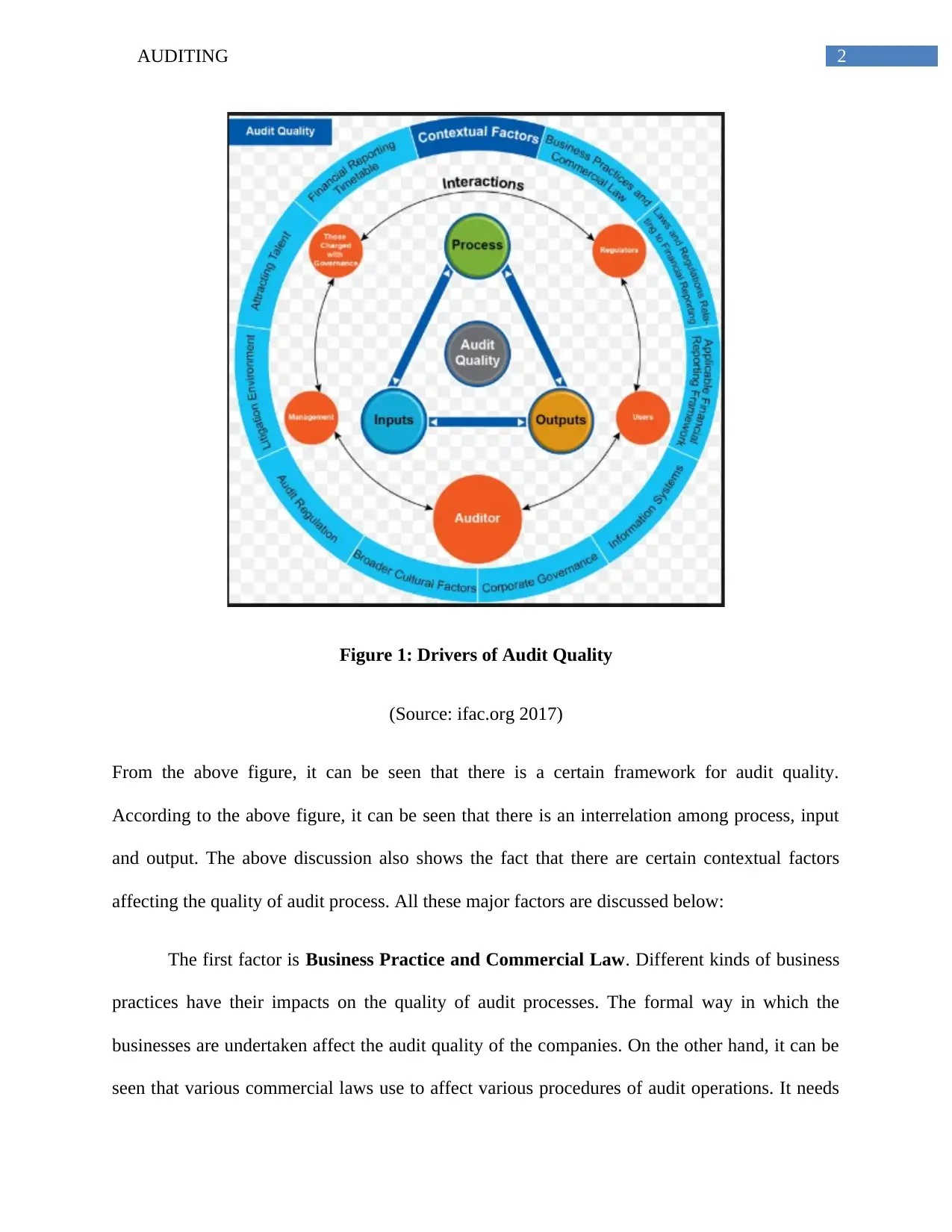
Figure 1: Drivers of Audit Quality
(Source: ifac.org 2017)
From the above figure, it can be seen that there is a certain framework for audit quality.
According to the above figure, it can be seen that there is an interrelation among process, input
and output. The above discussion also shows the fact that there are certain contextual factors
affecting the quality of audit process. All these major factors are discussed below:
The first factor is Business Practice and Commercial Law. Different kinds of business
practices have their impacts on the quality of audit processes. The formal way in which the
businesses are undertaken affect the audit quality of the companies. On the other hand, it can be
seen that various commercial laws use to affect various procedures of audit operations. It needs
Figure 1: Drivers of Audit Quality
(Source: ifac.org 2017)
From the above figure, it can be seen that there is a certain framework for audit quality.
According to the above figure, it can be seen that there is an interrelation among process, input
and output. The above discussion also shows the fact that there are certain contextual factors
affecting the quality of audit process. All these major factors are discussed below:
The first factor is Business Practice and Commercial Law. Different kinds of business
practices have their impacts on the quality of audit processes. The formal way in which the
businesses are undertaken affect the audit quality of the companies. On the other hand, it can be
seen that various commercial laws use to affect various procedures of audit operations. It needs
⊘ This is a preview!⊘
Do you want full access?
Subscribe today to unlock all pages.

Trusted by 1+ million students worldwide
3AUDITING
to be mentioned that the auditors have to comply with various business and commercial laws for
conducting the audit operations. The second important factor is Laws and Regulations related
to Financial Reporting. Various statutory laws and regulations have direct impact on the quality
of audit processes (archive.treasury.gov.au 2017). In this process, it needs to be mentioned that
the auditors of the companies have to conduct the audit operations of the companies by
complying with the regulations and laws. For this reason, the auditors have to undertake certain
procedures for conducting the audit operations. For this reason, the quality of audit process can
be affected. The next major factor is the Financial Reporting Framework. Financial reporting
framework is considered as a critical factor in case of maintaining the quality of audit processes.
It needs to be mentioned that the auditors are able to take effective audit decisions in the
presence of clear and sound financial reporting framework. At the same time, a complex
financial reporting framework makes it difficult for the auditors to understand various accounting
and financial requirements of the companies. Due to this reason, the quality of audit can be
affected. Another major factor is Corporate Governance. Corporate governance is considered
as a major driver for audit quality. Effective corporate governance strategy helps the
organizational managers to disclose accurate and reliable financial information and this
information is a great helps for the auditors to make effective audit opinion. In the absence of
effective corporate governance in the companies, organizational managers will not be able to get
access to the true and reliable financial information of the companies. Due to this, the quality of
audit can be affected.
Another important factor is Organizational Information System. It is required to have
sound information system for the auditors to maintain the quality of audit program. At the time
of maintaining the audit operations, the auditors needs true and fair financial as well as
to be mentioned that the auditors have to comply with various business and commercial laws for
conducting the audit operations. The second important factor is Laws and Regulations related
to Financial Reporting. Various statutory laws and regulations have direct impact on the quality
of audit processes (archive.treasury.gov.au 2017). In this process, it needs to be mentioned that
the auditors of the companies have to conduct the audit operations of the companies by
complying with the regulations and laws. For this reason, the auditors have to undertake certain
procedures for conducting the audit operations. For this reason, the quality of audit process can
be affected. The next major factor is the Financial Reporting Framework. Financial reporting
framework is considered as a critical factor in case of maintaining the quality of audit processes.
It needs to be mentioned that the auditors are able to take effective audit decisions in the
presence of clear and sound financial reporting framework. At the same time, a complex
financial reporting framework makes it difficult for the auditors to understand various accounting
and financial requirements of the companies. Due to this reason, the quality of audit can be
affected. Another major factor is Corporate Governance. Corporate governance is considered
as a major driver for audit quality. Effective corporate governance strategy helps the
organizational managers to disclose accurate and reliable financial information and this
information is a great helps for the auditors to make effective audit opinion. In the absence of
effective corporate governance in the companies, organizational managers will not be able to get
access to the true and reliable financial information of the companies. Due to this, the quality of
audit can be affected.
Another important factor is Organizational Information System. It is required to have
sound information system for the auditors to maintain the quality of audit program. At the time
of maintaining the audit operations, the auditors needs true and fair financial as well as
Paraphrase This Document
Need a fresh take? Get an instant paraphrase of this document with our AI Paraphraser
4AUDITING
accounting information of the companies. Effective information system provides the auditors
with required true and fair financial information. In the absence of effective information system,
the auditors are not able to make effective audit opinion as they lack true and fair financial
information. Thus, the audit quality can be affected. Another major factor is the Timetable of
Financial Reporting (frc.org.uk 2017). The specific timetable in which financial reporting of
the companies needs to be completed affects the audit quality. The auditors can get completed
financial information in case the financial reporting is done before the audit process. All the
financial information along with different press release help the auditors in gathering important
financial information. This particular aspect helps the auditors in maintaining the quality of audit
processes. The next important factor is Broader Cultural Factors. It needs to be mentioned that
national culture has impact on the quality of audit processes in the companies. In this aspect, a
major factor is transparency. It is easy for the auditors to maintain the good quality of audit in
case there is proper transparency in the financial statement and information of the companies.
Thus, based on the above discussion, it can be said that the above-discussed factors are the major
drivers of audit quality in the business organizations.
Assessment of audit quality is the process of evaluating the quality of audit programs of
the companies. In this context, it needs to be mentioned that different processes are followed
while assessing the audit quality of internal audit and external audit. The processes are described
below:
In case of the assessment of internal audit, certain steps are required to be followed. In
this step, the first process is Internal Assessment. In this particular process, the auditors of the
companies have to undertake certain processes; some of them are engagement planning,
supervision, working process standardization, engagement planning and others (theiia.org 2017).
accounting information of the companies. Effective information system provides the auditors
with required true and fair financial information. In the absence of effective information system,
the auditors are not able to make effective audit opinion as they lack true and fair financial
information. Thus, the audit quality can be affected. Another major factor is the Timetable of
Financial Reporting (frc.org.uk 2017). The specific timetable in which financial reporting of
the companies needs to be completed affects the audit quality. The auditors can get completed
financial information in case the financial reporting is done before the audit process. All the
financial information along with different press release help the auditors in gathering important
financial information. This particular aspect helps the auditors in maintaining the quality of audit
processes. The next important factor is Broader Cultural Factors. It needs to be mentioned that
national culture has impact on the quality of audit processes in the companies. In this aspect, a
major factor is transparency. It is easy for the auditors to maintain the good quality of audit in
case there is proper transparency in the financial statement and information of the companies.
Thus, based on the above discussion, it can be said that the above-discussed factors are the major
drivers of audit quality in the business organizations.
Assessment of audit quality is the process of evaluating the quality of audit programs of
the companies. In this context, it needs to be mentioned that different processes are followed
while assessing the audit quality of internal audit and external audit. The processes are described
below:
In case of the assessment of internal audit, certain steps are required to be followed. In
this step, the first process is Internal Assessment. In this particular process, the auditors of the
companies have to undertake certain processes; some of them are engagement planning,
supervision, working process standardization, engagement planning and others (theiia.org 2017).
5AUDITING
The major advantage of this process is that it helps the internal managers to identify major
strengths and weaknesses of internal control system of the companies. Apart from this, it helps
the auditors of the companies in the process to comply with the statutory rules and regulations of
the companies. The next process is called Ongoing Monitoring (na.theiia.org 2017). For many
years, the internal auditors of the companies have been using the technique of ongoing
monitoring for the measurement of the performance of internal control system of the companies.
However, it is required for the internal auditors to follow certain steps. First, the internal auditors
are needed to establish the necessary activities for assessing the internal audit. After that, there is
a need for routine practice for the assessment of internal control system of the companies. In this
particular process, the internal auditors are required to implement effective system of supervision
in the companies. Another most important part is to assess the performance of internal control
with the help of key performance indicators (KPI). These are the main steps under ongoing
supervision. The next process is called Periodic Self-Assessment (na.theiia.org 2017). With the
help of this process, the internal auditors of the companies can make sure the fact that the
internal audit process of the companies are complied with the rules and regulations. It can be
seen that the internal auditors have take major techniques under periodic self-assessment. One of
such major techniques is survey guide. With the help of survey guide, internal auditors are able
to monitor the input of company shareholders in the internal audit process.
In case of the assessment of external audit, some specific stages can be seen. Planning
is considered as the first step. Under this particular step, external auditors set the scope and
objectives of the whole audit assessment process. The second step is called Off-Site Work.
Under this step, the external auditors review the audit-planning document along with all the
necessary audit documents. In addition, the external auditors also review all the responses from
The major advantage of this process is that it helps the internal managers to identify major
strengths and weaknesses of internal control system of the companies. Apart from this, it helps
the auditors of the companies in the process to comply with the statutory rules and regulations of
the companies. The next process is called Ongoing Monitoring (na.theiia.org 2017). For many
years, the internal auditors of the companies have been using the technique of ongoing
monitoring for the measurement of the performance of internal control system of the companies.
However, it is required for the internal auditors to follow certain steps. First, the internal auditors
are needed to establish the necessary activities for assessing the internal audit. After that, there is
a need for routine practice for the assessment of internal control system of the companies. In this
particular process, the internal auditors are required to implement effective system of supervision
in the companies. Another most important part is to assess the performance of internal control
with the help of key performance indicators (KPI). These are the main steps under ongoing
supervision. The next process is called Periodic Self-Assessment (na.theiia.org 2017). With the
help of this process, the internal auditors of the companies can make sure the fact that the
internal audit process of the companies are complied with the rules and regulations. It can be
seen that the internal auditors have take major techniques under periodic self-assessment. One of
such major techniques is survey guide. With the help of survey guide, internal auditors are able
to monitor the input of company shareholders in the internal audit process.
In case of the assessment of external audit, some specific stages can be seen. Planning
is considered as the first step. Under this particular step, external auditors set the scope and
objectives of the whole audit assessment process. The second step is called Off-Site Work.
Under this step, the external auditors review the audit-planning document along with all the
necessary audit documents. In addition, the external auditors also review all the responses from
⊘ This is a preview!⊘
Do you want full access?
Subscribe today to unlock all pages.
Trusted by 1+ million students worldwide
6AUDITING
the auditing survey. After this, the next step is called On-Site Work (na.theiia.org 2017). This is
considered as a crucial step in the process of external audit assessment. In this step, the external
auditors take interview of the staffs, clients and stakeholders of the organizations. After the
interview process, the external auditors of the companies do a thorough review of all the
necessary audit documents of the companies for the development of audit opinions. After that,
the last stage is called Evaluation and Report Development (na.theiia.org 2017). In this step,
the external auditors of the companies do the evaluation or assessment of the total external audit
process against the resources of the companies. After this process, the external auditors develop
the draft report of their audit opinion for the making of effective recommendations regarding the
improvement of overall external audit process. Hence, from the above discussion, it can be
observed that the assessment process of both external and internal auditors is different from each
other.
There are many ways to improve the quality of an audit. In the business organizations,
the senior audit member need to know how to led the audit team. Thus, it is recommended that
there needs to be effective leadership in the audit process of the companies. It implies that the
senior members of the audit team needs to make it sure that all the auditing staffs have proper
access to the required resources for conducting the audit operations (aicpa.org 2017). After that,
it is recommended to the senior members of the audit team to communicate all the necessary
auditing rules, regulations and code of conducts to other members of the audit team. As a result
of this, the team members of the audit team will be able to engage with the audit issues more
effectively. Before engaging with the audit operations of the companies, the auditors are
recommended to do sufficient background check of the audit clients (aicpa.org 2017). This
aspect will provide the auditors with more specific knowledge about their client and this process
the auditing survey. After this, the next step is called On-Site Work (na.theiia.org 2017). This is
considered as a crucial step in the process of external audit assessment. In this step, the external
auditors take interview of the staffs, clients and stakeholders of the organizations. After the
interview process, the external auditors of the companies do a thorough review of all the
necessary audit documents of the companies for the development of audit opinions. After that,
the last stage is called Evaluation and Report Development (na.theiia.org 2017). In this step,
the external auditors of the companies do the evaluation or assessment of the total external audit
process against the resources of the companies. After this process, the external auditors develop
the draft report of their audit opinion for the making of effective recommendations regarding the
improvement of overall external audit process. Hence, from the above discussion, it can be
observed that the assessment process of both external and internal auditors is different from each
other.
There are many ways to improve the quality of an audit. In the business organizations,
the senior audit member need to know how to led the audit team. Thus, it is recommended that
there needs to be effective leadership in the audit process of the companies. It implies that the
senior members of the audit team needs to make it sure that all the auditing staffs have proper
access to the required resources for conducting the audit operations (aicpa.org 2017). After that,
it is recommended to the senior members of the audit team to communicate all the necessary
auditing rules, regulations and code of conducts to other members of the audit team. As a result
of this, the team members of the audit team will be able to engage with the audit issues more
effectively. Before engaging with the audit operations of the companies, the auditors are
recommended to do sufficient background check of the audit clients (aicpa.org 2017). This
aspect will provide the auditors with more specific knowledge about their client and this process
Paraphrase This Document
Need a fresh take? Get an instant paraphrase of this document with our AI Paraphraser
7AUDITING
helps in enhancing the audit quality (frascanada.ca 2017). After that, it is recommended to the
business organizations to hire renowned and reputed audit firms to conduct their audit
operations. It has been seen the large reputed audit firms have the ability to perform different
advance audit tests for the making of audit opinions. This process will enhance the quality of
audit operation of the companies. In addition, it is also recommended that there needs to be a
quality control department in the companies to maintain the good quality of audit engagement in
the companies (ifac.org 2017). Thus, from the above discussion, it can be see that the above are
the major techniques for enhancing the audit quality of the companies. However, it needs to be
mentioned that there are many other ways to enhance quality of an audit.
The main objective of this report is to conduct analysis on various aspect of audit quality
and assessment of audit quality. The above discussion shows the fact that there is a particular
framework for quality of audit. According to that framework, there are some major drivers for
the quality of audit; they are business practice and commercial law, laws and regulations related
to financial reporting, framework for financial reporting, corporate governance, organizational
information system and others. The above-mentioned factors have major effects on the quality of
audit process. According to the above discussion, it is clear that there are different processes for
the quality assessment of both internal and external audit. In both of the cases, the auditors are
seen using some major techniques to evaluate the effectiveness and quality of audit process. In
case of internal audit quality assessment, the major steps are internal assessment, ongoing
monitoring and periodic self-assessment. The steps in external audit quality assessment are
planning, off-site work, on-site work and evaluation along with report development. The study
also discusses some of the steps to enhance the quality of an audit. Some of them are
helps in enhancing the audit quality (frascanada.ca 2017). After that, it is recommended to the
business organizations to hire renowned and reputed audit firms to conduct their audit
operations. It has been seen the large reputed audit firms have the ability to perform different
advance audit tests for the making of audit opinions. This process will enhance the quality of
audit operation of the companies. In addition, it is also recommended that there needs to be a
quality control department in the companies to maintain the good quality of audit engagement in
the companies (ifac.org 2017). Thus, from the above discussion, it can be see that the above are
the major techniques for enhancing the audit quality of the companies. However, it needs to be
mentioned that there are many other ways to enhance quality of an audit.
The main objective of this report is to conduct analysis on various aspect of audit quality
and assessment of audit quality. The above discussion shows the fact that there is a particular
framework for quality of audit. According to that framework, there are some major drivers for
the quality of audit; they are business practice and commercial law, laws and regulations related
to financial reporting, framework for financial reporting, corporate governance, organizational
information system and others. The above-mentioned factors have major effects on the quality of
audit process. According to the above discussion, it is clear that there are different processes for
the quality assessment of both internal and external audit. In both of the cases, the auditors are
seen using some major techniques to evaluate the effectiveness and quality of audit process. In
case of internal audit quality assessment, the major steps are internal assessment, ongoing
monitoring and periodic self-assessment. The steps in external audit quality assessment are
planning, off-site work, on-site work and evaluation along with report development. The study
also discusses some of the steps to enhance the quality of an audit. Some of them are

8AUDITING
implementation of effective audit leadership, sufficient background check, hiring of reputed
audit firms and others.
implementation of effective audit leadership, sufficient background check, hiring of reputed
audit firms and others.
⊘ This is a preview!⊘
Do you want full access?
Subscribe today to unlock all pages.
Trusted by 1+ million students worldwide
9AUDITING
References
AICPA. (2017). Enhancing Audit Quality. [online] Available at:
https://www.aicpa.org/interestareas/peerreview/eaq.html [Accessed 10 Nov. 2017].
Archive.treasury.gov.au. (2017). [online] Available at:
https://archive.treasury.gov.au/documents/1745/PDF/Audit_Quality_in_Australia.pdf [Accessed
10 Nov. 2017].
Arens, A.A., Elder, R.J. and Mark, B., 2012. Auditing and assurance services: an integrated
approach. Boston: Prentice Hall.
Frascanada.ca. (2017). [online] Available at: http://www.frascanada.ca/canadian-auditing-
standards/documents-for-comment/item82830.pdf [Accessed 10 Nov. 2017].
Frc.org.uk. (2017). [online] Available at: https://www.frc.org.uk/getattachment/8f9c7425-e898-
4749-b255-3f9ca93e6865/Feedback-Paper-Promoting-Audit-Quality-Oct-2007.pdf [Accessed 10
Nov. 2017].
Ifac.org. (2017). [online] Available at: https://www.ifac.org/system/files/publications/files/A
%20Framework%20for%20Audit%20Quality.pdf [Accessed 10 Nov. 2017].
Ifac.org. (2017). Enhancing Audit Quality in the Public Interest: A Focus on Professional
Skepticism, Quality Control, and Group Audits | IFAC. [online] Available at:
https://www.ifac.org/global-knowledge-gateway/audit-assurance/discussion/enhancing-audit-
quality-public-interest-focus [Accessed 10 Nov. 2017].
References
AICPA. (2017). Enhancing Audit Quality. [online] Available at:
https://www.aicpa.org/interestareas/peerreview/eaq.html [Accessed 10 Nov. 2017].
Archive.treasury.gov.au. (2017). [online] Available at:
https://archive.treasury.gov.au/documents/1745/PDF/Audit_Quality_in_Australia.pdf [Accessed
10 Nov. 2017].
Arens, A.A., Elder, R.J. and Mark, B., 2012. Auditing and assurance services: an integrated
approach. Boston: Prentice Hall.
Frascanada.ca. (2017). [online] Available at: http://www.frascanada.ca/canadian-auditing-
standards/documents-for-comment/item82830.pdf [Accessed 10 Nov. 2017].
Frc.org.uk. (2017). [online] Available at: https://www.frc.org.uk/getattachment/8f9c7425-e898-
4749-b255-3f9ca93e6865/Feedback-Paper-Promoting-Audit-Quality-Oct-2007.pdf [Accessed 10
Nov. 2017].
Ifac.org. (2017). [online] Available at: https://www.ifac.org/system/files/publications/files/A
%20Framework%20for%20Audit%20Quality.pdf [Accessed 10 Nov. 2017].
Ifac.org. (2017). Enhancing Audit Quality in the Public Interest: A Focus on Professional
Skepticism, Quality Control, and Group Audits | IFAC. [online] Available at:
https://www.ifac.org/global-knowledge-gateway/audit-assurance/discussion/enhancing-audit-
quality-public-interest-focus [Accessed 10 Nov. 2017].
Paraphrase This Document
Need a fresh take? Get an instant paraphrase of this document with our AI Paraphraser
10AUDITING
Na.theiia.org. (2017). [online] Available at:
https://na.theiia.org/services/quality/Public_Documents/Quality-Assessment-Manual-Chapter-
4.pdf [Accessed 10 Nov. 2017].
Na.theiia.org. (2017). [online] Available at:
https://na.theiia.org/services/quality/Public_Documents/Quality-Assessment-Manual-Chapter-
3.pdf [Accessed 10 Nov. 2017].
William Jr, M., Glover, S. and Prawitt, D., 2016. Auditing and assurance services: A systematic
approach. McGraw-Hill Education.
Na.theiia.org. (2017). [online] Available at:
https://na.theiia.org/services/quality/Public_Documents/Quality-Assessment-Manual-Chapter-
4.pdf [Accessed 10 Nov. 2017].
Na.theiia.org. (2017). [online] Available at:
https://na.theiia.org/services/quality/Public_Documents/Quality-Assessment-Manual-Chapter-
3.pdf [Accessed 10 Nov. 2017].
William Jr, M., Glover, S. and Prawitt, D., 2016. Auditing and assurance services: A systematic
approach. McGraw-Hill Education.

11AUDITING
⊘ This is a preview!⊘
Do you want full access?
Subscribe today to unlock all pages.
Trusted by 1+ million students worldwide

1 out of 12


Related Documents


Your All-in-One AI-Powered Toolkit for Academic Success.
+13062052269
info@desklib.com
Available 24*7 on WhatsApp / Email
![[object Object]](/_next/static/media/star-bottom.7253800d.svg)
Unlock your academic potential
Copyright © 2020–2026 A2Z Services. All Rights Reserved. Developed and managed by ZUCOL.