Auditing Homework: Evidence, Ratios, and Internal Control Weaknesses
VerifiedAdded on 2023/01/06
|9
|2701
|83
Homework Assignment
AI Summary
This auditing assignment delves into various aspects of the auditing process. It begins by defining and explaining sufficient appropriate audit evidence. The assignment then analyzes financial ratios, providing possible explanations for their results. It identifies and explains internal control weaknesses within a given scenario, offering insights into how these weaknesses impact operational efficiency. Furthermore, the assignment examines a specific case, determining the appropriateness of a conclusion and providing justification. It also outlines procedures to audit revenue for a construction company. Finally, the assignment concludes by drafting notes on the features of both internal and external auditors, emphasizing their independence, roles in systems of internal control and operations, and reporting responsibilities. The assignment covers a wide range of auditing topics, from evidence gathering to internal control evaluations and revenue audit procedures.
Auditing

Paraphrase This Document
Need a fresh take? Get an instant paraphrase of this document with our AI Paraphraser
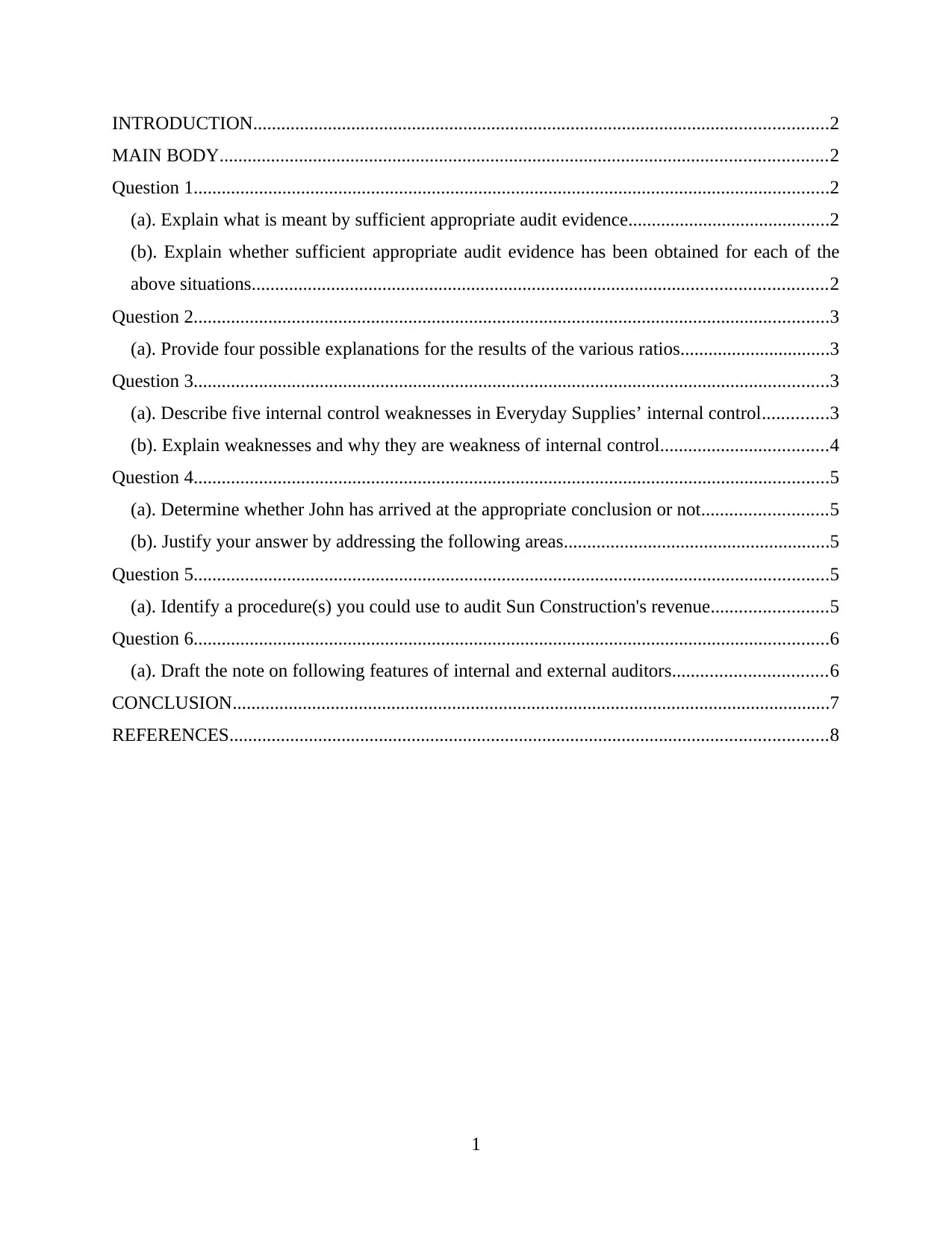
INTRODUCTION...........................................................................................................................2
MAIN BODY..................................................................................................................................2
Question 1........................................................................................................................................2
(a). Explain what is meant by sufficient appropriate audit evidence...........................................2
(b). Explain whether sufficient appropriate audit evidence has been obtained for each of the
above situations...........................................................................................................................2
Question 2........................................................................................................................................3
(a). Provide four possible explanations for the results of the various ratios................................3
Question 3........................................................................................................................................3
(a). Describe five internal control weaknesses in Everyday Supplies’ internal control..............3
(b). Explain weaknesses and why they are weakness of internal control....................................4
Question 4........................................................................................................................................5
(a). Determine whether John has arrived at the appropriate conclusion or not...........................5
(b). Justify your answer by addressing the following areas.........................................................5
Question 5........................................................................................................................................5
(a). Identify a procedure(s) you could use to audit Sun Construction's revenue.........................5
Question 6........................................................................................................................................6
(a). Draft the note on following features of internal and external auditors.................................6
CONCLUSION................................................................................................................................7
REFERENCES................................................................................................................................8
1
MAIN BODY..................................................................................................................................2
Question 1........................................................................................................................................2
(a). Explain what is meant by sufficient appropriate audit evidence...........................................2
(b). Explain whether sufficient appropriate audit evidence has been obtained for each of the
above situations...........................................................................................................................2
Question 2........................................................................................................................................3
(a). Provide four possible explanations for the results of the various ratios................................3
Question 3........................................................................................................................................3
(a). Describe five internal control weaknesses in Everyday Supplies’ internal control..............3
(b). Explain weaknesses and why they are weakness of internal control....................................4
Question 4........................................................................................................................................5
(a). Determine whether John has arrived at the appropriate conclusion or not...........................5
(b). Justify your answer by addressing the following areas.........................................................5
Question 5........................................................................................................................................5
(a). Identify a procedure(s) you could use to audit Sun Construction's revenue.........................5
Question 6........................................................................................................................................6
(a). Draft the note on following features of internal and external auditors.................................6
CONCLUSION................................................................................................................................7
REFERENCES................................................................................................................................8
1
INTRODUCTION
Audit is the review or assessment of the different accounting records by an auditor
accompanied by a physical stock check to ensure that all divisions follow a recorded method of
keeping records (Gepp and et.al., 2018). This shall be done to determine the quality of the
financial statements issued by the organisation. There are total six questions which are different
from each other and it is required to solve in order to identify that how auditing helps in
organization to make effective decisions.
MAIN BODY
Question 1
(a). Explain what is meant by sufficient appropriate audit evidence
Sufficiency is a test of the quantities of proof from the audit. The amount of audit
evidence required is influenced by the auditor's evaluation of risks of misrepresentation (the
greater the risk identified, the more audit evidence is likely to be necessary) but also by the
performance of such audit evidence (the higher the quality, the lower the requirement).
Appropriateness is an indicator of the consistency of the audit evidence; that is, its validity and
its accuracy in supporting the judgments over which the auditor's decision is based.
The audit evidence is essential to be obtained by the auditor in the course of his auditing
process. The main purpose of any auditing is to assess the conformity of the financial statements
of the organization with the implication of GAAP accounting application to the authority of the
entity.
(b). Explain whether sufficient appropriate audit evidence has been obtained for each of the
above situations
In the discussed two scenarios, there are sufficient and appropriate audit evidences found in
second case, from the 20 test count auditor found two small variations with one item each, that
he found to be immaterial (Harrison, 2018). During the physical examination, auditor found that
the client also found five small variations between both the perpetual records and the real amount
at hand. Neither of these variations was modified to perpetual documents as well as the sums
involved were only $ 50,000 in total and was deemed immaterial.
2
Audit is the review or assessment of the different accounting records by an auditor
accompanied by a physical stock check to ensure that all divisions follow a recorded method of
keeping records (Gepp and et.al., 2018). This shall be done to determine the quality of the
financial statements issued by the organisation. There are total six questions which are different
from each other and it is required to solve in order to identify that how auditing helps in
organization to make effective decisions.
MAIN BODY
Question 1
(a). Explain what is meant by sufficient appropriate audit evidence
Sufficiency is a test of the quantities of proof from the audit. The amount of audit
evidence required is influenced by the auditor's evaluation of risks of misrepresentation (the
greater the risk identified, the more audit evidence is likely to be necessary) but also by the
performance of such audit evidence (the higher the quality, the lower the requirement).
Appropriateness is an indicator of the consistency of the audit evidence; that is, its validity and
its accuracy in supporting the judgments over which the auditor's decision is based.
The audit evidence is essential to be obtained by the auditor in the course of his auditing
process. The main purpose of any auditing is to assess the conformity of the financial statements
of the organization with the implication of GAAP accounting application to the authority of the
entity.
(b). Explain whether sufficient appropriate audit evidence has been obtained for each of the
above situations
In the discussed two scenarios, there are sufficient and appropriate audit evidences found in
second case, from the 20 test count auditor found two small variations with one item each, that
he found to be immaterial (Harrison, 2018). During the physical examination, auditor found that
the client also found five small variations between both the perpetual records and the real amount
at hand. Neither of these variations was modified to perpetual documents as well as the sums
involved were only $ 50,000 in total and was deemed immaterial.
2
⊘ This is a preview!⊘
Do you want full access?
Subscribe today to unlock all pages.

Trusted by 1+ million students worldwide
Question 2
(a). Provide four possible explanations for the results of the various ratios
Current ratio: In relation to Nova Ltd, actual results of ratio are 1.97 which is higher than
the budgeted or industry ratio. Lower the ratio in compare to industry ratio is highly risky but
also at the same time, if it is low which means company unable to use their assets. According to
the auditors, current ratio of Nova Ltd is good and they are efficiently using their assets.
Quick assets ratio: Actual or budgeted ratio of Nova Ltd is same but both are less then
industry average which indicates high risk of distress. But, at the same time quick ratio is more
than 1 which means company has enough resource’s to meet its current liabilities.
Net profit ratio: Actual result of ratio is higher than industry average which indicates Nova
Ltd performing very well in comparison to their competitors.
Gross margin: Similarly, gross margin ratio of Nova Ltd is higher than the industry average
which means company is performing well in comparison to other organizations in same period.
Actual result is also more than the budgeted ratio which means company performing better to
achieving their goals.
Question 3
(a). Describe five internal control weaknesses in Everyday Supplies’ internal control
The accounts receivable supervisor: Supervisor conducts the billing process even without
any separate manual or computer testing. It has right to adjust the specifics of the fee forms
submitted by Sales Associates and using the updated details in the preparation of invoices. In
addition, there is also no monitoring to ensure that the daily averages of the invoices are
equivalent to the daily invoices (Jeppesen, 2019). The supervisor also has the power to cause the
transactions to be written off as unplayable since there is no independent audit of the accounts.
Likewise, accounts can stay on books long after they have been due and extra credit might be
given if they are removed by the supervisor from of the periodic notice to the accountant.
The cashier: This person performing three contradictory duties, first collecting cash
receipts, transferring cash in the bank, and documenting receipts. While the accountant or
bookkeeper directly reports the cash receipts, the cashier provides the details that may be
overdue, altered or unavailable. There is no independent audit of the authenticity or accuracy of
the financial transactions without the checked deposit slip or checklist. In addition, the cashier
3
(a). Provide four possible explanations for the results of the various ratios
Current ratio: In relation to Nova Ltd, actual results of ratio are 1.97 which is higher than
the budgeted or industry ratio. Lower the ratio in compare to industry ratio is highly risky but
also at the same time, if it is low which means company unable to use their assets. According to
the auditors, current ratio of Nova Ltd is good and they are efficiently using their assets.
Quick assets ratio: Actual or budgeted ratio of Nova Ltd is same but both are less then
industry average which indicates high risk of distress. But, at the same time quick ratio is more
than 1 which means company has enough resource’s to meet its current liabilities.
Net profit ratio: Actual result of ratio is higher than industry average which indicates Nova
Ltd performing very well in comparison to their competitors.
Gross margin: Similarly, gross margin ratio of Nova Ltd is higher than the industry average
which means company is performing well in comparison to other organizations in same period.
Actual result is also more than the budgeted ratio which means company performing better to
achieving their goals.
Question 3
(a). Describe five internal control weaknesses in Everyday Supplies’ internal control
The accounts receivable supervisor: Supervisor conducts the billing process even without
any separate manual or computer testing. It has right to adjust the specifics of the fee forms
submitted by Sales Associates and using the updated details in the preparation of invoices. In
addition, there is also no monitoring to ensure that the daily averages of the invoices are
equivalent to the daily invoices (Jeppesen, 2019). The supervisor also has the power to cause the
transactions to be written off as unplayable since there is no independent audit of the accounts.
Likewise, accounts can stay on books long after they have been due and extra credit might be
given if they are removed by the supervisor from of the periodic notice to the accountant.
The cashier: This person performing three contradictory duties, first collecting cash
receipts, transferring cash in the bank, and documenting receipts. While the accountant or
bookkeeper directly reports the cash receipts, the cashier provides the details that may be
overdue, altered or unavailable. There is no independent audit of the authenticity or accuracy of
the financial transactions without the checked deposit slip or checklist. In addition, the cashier
3
Paraphrase This Document
Need a fresh take? Get an instant paraphrase of this document with our AI Paraphraser
aligns monthly bank statements, which are often inconsistent with the processing of cash receipts
and the deposit of cash in the bank.
The bookkeeper: They have authority to write-off of uncollectible payments without an
audit of the motives and specifics of each unpaid account. The defined criteria for the write-off
of unpaid accounts is too restrictive and does not allow for the avoidance of the awarding of
additional loans at an earlier time, such as when the loan is due for the very first time. In
addition, the bookkeeper has the incompatible responsibility of approving write-offs and
documenting journal entries.
Management: Entire management process of Everyday Supplies Pty Ltd is collapse, so
store owner need to work of effective management which can leads to improve operational
efficiency as well as effectiveness (Kearns and et.al., 2018). Company need to hire a well-
managed person who can handle the entire work and assigned the separate duties to the each
person as per their capabilities. Internal control weakness can be improved with the help of
effective management.
Manager for monitoring entire process: Everyday Supplies Pty Ltd should hire manager
for only monitoring the entire process and provide direction regarding work which result
positively and helps the person to perform their task effectively with minimum error. Regular
monitoring and reviewing are very essential to produce results as per their strategy. This
weakness need to be improved from internal control process.
(b). Explain weaknesses and why they are weakness of internal control
There is no division of roles & responsibilities between the person, who making invoices,
reviewing and posting to ledger accounts that are probable to occur in inaccurate
accounts leading to mistakes.
The individual who receives the mail and remittances should never be the same person
who making the deposits although they reveal the business to fraud.
The details transmitted over the network by the accountant should be supported by
appropriate document, i.e. pre-listed checks and deposit slips.
There is no high credit management mechanism that requires conducting out a full
background check on a payment customer prior to the selling of credit, which introduces
the business to increased instances of uncollectible accounts.
4
and the deposit of cash in the bank.
The bookkeeper: They have authority to write-off of uncollectible payments without an
audit of the motives and specifics of each unpaid account. The defined criteria for the write-off
of unpaid accounts is too restrictive and does not allow for the avoidance of the awarding of
additional loans at an earlier time, such as when the loan is due for the very first time. In
addition, the bookkeeper has the incompatible responsibility of approving write-offs and
documenting journal entries.
Management: Entire management process of Everyday Supplies Pty Ltd is collapse, so
store owner need to work of effective management which can leads to improve operational
efficiency as well as effectiveness (Kearns and et.al., 2018). Company need to hire a well-
managed person who can handle the entire work and assigned the separate duties to the each
person as per their capabilities. Internal control weakness can be improved with the help of
effective management.
Manager for monitoring entire process: Everyday Supplies Pty Ltd should hire manager
for only monitoring the entire process and provide direction regarding work which result
positively and helps the person to perform their task effectively with minimum error. Regular
monitoring and reviewing are very essential to produce results as per their strategy. This
weakness need to be improved from internal control process.
(b). Explain weaknesses and why they are weakness of internal control
There is no division of roles & responsibilities between the person, who making invoices,
reviewing and posting to ledger accounts that are probable to occur in inaccurate
accounts leading to mistakes.
The individual who receives the mail and remittances should never be the same person
who making the deposits although they reveal the business to fraud.
The details transmitted over the network by the accountant should be supported by
appropriate document, i.e. pre-listed checks and deposit slips.
There is no high credit management mechanism that requires conducting out a full
background check on a payment customer prior to the selling of credit, which introduces
the business to increased instances of uncollectible accounts.
4
Question 4
(a). Determine whether John has arrived at the appropriate conclusion or not
On the basis of John analysis, taken conclusion was not appropriate because every
approval required CFO’s signature and remaining four payments does not have it (Moffitt,
Rozario and Vasarhelyi, 2018).
(b). Justify your answer by addressing the following areas
Related party transections: John does not taking appropriate decision which maximise the
risk of related party transactions. It can give rise to particular risks of misrepresentation of
financial statements, along with the risk of fraud, due to the importance of the relationship
between the parties. Financial reporting also benefits from the participation of related parties
that’s why approval of CFO will be must.
Reliability: In order to maximise the reliability, person need to minimise the risk but in this
case, taken decision was not appropriate which increase the risk which associated with related
parties. It further minimise the reliability which is not good for the Taxon Ltd.
Question 5
(a). Identify a procedure(s) you could use to audit Sun Construction's revenue
Below mentioned procedures are used by the auditor of Sun Construction to review the
total revenue and these are as follow:
Occurrence: Payment transactions and activities which have been registered or published
have occurred, and those transactions and events are the property of the organization (Ribeiro
and et.al., 2020).
Completeness: Transactions and activities that were to be reported have been documented
and all related documents that could be included in the financial statements of the organization.
Accuracy: Total amounts and other information related to reported transactions and events
are being documented in an appropriate way and the related records have been properly
calculated and identified.
Above discussed procedure used to audit Sun Construction's revenue where each and
every transection recorded and documented in the financial reports for the better analysis of
results. It helps in decision making process regarding company’s assets or liabilities.
5
(a). Determine whether John has arrived at the appropriate conclusion or not
On the basis of John analysis, taken conclusion was not appropriate because every
approval required CFO’s signature and remaining four payments does not have it (Moffitt,
Rozario and Vasarhelyi, 2018).
(b). Justify your answer by addressing the following areas
Related party transections: John does not taking appropriate decision which maximise the
risk of related party transactions. It can give rise to particular risks of misrepresentation of
financial statements, along with the risk of fraud, due to the importance of the relationship
between the parties. Financial reporting also benefits from the participation of related parties
that’s why approval of CFO will be must.
Reliability: In order to maximise the reliability, person need to minimise the risk but in this
case, taken decision was not appropriate which increase the risk which associated with related
parties. It further minimise the reliability which is not good for the Taxon Ltd.
Question 5
(a). Identify a procedure(s) you could use to audit Sun Construction's revenue
Below mentioned procedures are used by the auditor of Sun Construction to review the
total revenue and these are as follow:
Occurrence: Payment transactions and activities which have been registered or published
have occurred, and those transactions and events are the property of the organization (Ribeiro
and et.al., 2020).
Completeness: Transactions and activities that were to be reported have been documented
and all related documents that could be included in the financial statements of the organization.
Accuracy: Total amounts and other information related to reported transactions and events
are being documented in an appropriate way and the related records have been properly
calculated and identified.
Above discussed procedure used to audit Sun Construction's revenue where each and
every transection recorded and documented in the financial reports for the better analysis of
results. It helps in decision making process regarding company’s assets or liabilities.
5
⊘ This is a preview!⊘
Do you want full access?
Subscribe today to unlock all pages.
Trusted by 1+ million students worldwide
Question 6
(a). Draft the note on following features of internal and external auditors
Independence: Independence is the liberty from constraints that undermine the capacity of
internal audit operations to perform out internal audit duties in an impartial manner. The Chief
Audit Executive shall inform to the level within the company that enables the internal audit
operation to execute its obligations (Shen and et.al., 2018). In the case of external auditors, this is
distinguished by honesty and an impartial approach of audit process. The definition allows the
auditor to conduct his or her work honestly and critically. Internal auditor is not independent
because they are the employees of the organization and on the other side, external auditors are
independent because they are not a part of the organization.
Systems of internal control and operations: Internal Control is a mechanism carried out
by the executive committee, management and staff of the organisation to provide fair confidence
on the achievement of goals in the following groups such as efficacy and quality of operation.
Internal controls are the processes, regulations and procedures that are implemented by a
corporation to ensure the accuracy of finance and management records, encourage transparency
and avoid fraud. The purpose of the operational audit process is to assess if company's internal
controls, including such rules and procedures, are adequate to achieve an optimal level of
productivity and effectiveness. Efficient internal control eliminates the risk of asset losses and
helps to make sure that information on the plan is true and accurate, that the financial statements
are accurate and the activities of the plan are carried out in compliance with the provisions of the
relevant laws and regulations. System of internal control and operations are main features of
internal or external auditors. With the help of auditors, company is able to evaluate their current
situations and also identify the issues which can affect internal control process.
Reporting responsibilities: The external auditor's reporting responsibility is to examine the
company's financial records and transaction on the conclusions. The external auditor is
responsible for assessing the mistake and fraud accounts, conducting internal audits, reporting on
results and making recommendations. In addition, they need to evaluate internal processes and
activities, determine risk management methods, conduct audits for other divisions as appropriate,
report on mistakes and fraud, and provide input on findings that should be approved by the CFO
of the company. An internal auditor helps the organisation to achieve its goals by adopting a
structured, focused approach to evaluating and enhancing the efficacy of risk management,
6
(a). Draft the note on following features of internal and external auditors
Independence: Independence is the liberty from constraints that undermine the capacity of
internal audit operations to perform out internal audit duties in an impartial manner. The Chief
Audit Executive shall inform to the level within the company that enables the internal audit
operation to execute its obligations (Shen and et.al., 2018). In the case of external auditors, this is
distinguished by honesty and an impartial approach of audit process. The definition allows the
auditor to conduct his or her work honestly and critically. Internal auditor is not independent
because they are the employees of the organization and on the other side, external auditors are
independent because they are not a part of the organization.
Systems of internal control and operations: Internal Control is a mechanism carried out
by the executive committee, management and staff of the organisation to provide fair confidence
on the achievement of goals in the following groups such as efficacy and quality of operation.
Internal controls are the processes, regulations and procedures that are implemented by a
corporation to ensure the accuracy of finance and management records, encourage transparency
and avoid fraud. The purpose of the operational audit process is to assess if company's internal
controls, including such rules and procedures, are adequate to achieve an optimal level of
productivity and effectiveness. Efficient internal control eliminates the risk of asset losses and
helps to make sure that information on the plan is true and accurate, that the financial statements
are accurate and the activities of the plan are carried out in compliance with the provisions of the
relevant laws and regulations. System of internal control and operations are main features of
internal or external auditors. With the help of auditors, company is able to evaluate their current
situations and also identify the issues which can affect internal control process.
Reporting responsibilities: The external auditor's reporting responsibility is to examine the
company's financial records and transaction on the conclusions. The external auditor is
responsible for assessing the mistake and fraud accounts, conducting internal audits, reporting on
results and making recommendations. In addition, they need to evaluate internal processes and
activities, determine risk management methods, conduct audits for other divisions as appropriate,
report on mistakes and fraud, and provide input on findings that should be approved by the CFO
of the company. An internal auditor helps the organisation to achieve its goals by adopting a
structured, focused approach to evaluating and enhancing the efficacy of risk management,
6
Paraphrase This Document
Need a fresh take? Get an instant paraphrase of this document with our AI Paraphraser
control and governance procedures. Verify the compliances with defined internal controls
through the review of documents, reports, operational practises and documentation (Zhaokai and
Moffitt, 2019). Verified assets and liabilities are the relating objects to records. Full audit work
papers by recording audit checks and results.
Above discussed features helps the several firms to perform their audit function and govern
the business operations. Interdependence, internal control of operation and responsibility of
reporting are the key features of internal or external auditors. Main differences in both them is
that, internal auditors are the part of business who can manipulate the records but external
auditor is fully independent and his actions based on their evidences which provide error or fraud
free findings regarding organizational records.
CONCLUSION
On the basis of above discussion it has been concluded that auditing plays essential role in
reviewing organizational books of accounts. With the help of audit, company is able to see that
their internal process is working well through maintaining financial reports or not. It also helps in
governing business operations.
7
through the review of documents, reports, operational practises and documentation (Zhaokai and
Moffitt, 2019). Verified assets and liabilities are the relating objects to records. Full audit work
papers by recording audit checks and results.
Above discussed features helps the several firms to perform their audit function and govern
the business operations. Interdependence, internal control of operation and responsibility of
reporting are the key features of internal or external auditors. Main differences in both them is
that, internal auditors are the part of business who can manipulate the records but external
auditor is fully independent and his actions based on their evidences which provide error or fraud
free findings regarding organizational records.
CONCLUSION
On the basis of above discussion it has been concluded that auditing plays essential role in
reviewing organizational books of accounts. With the help of audit, company is able to see that
their internal process is working well through maintaining financial reports or not. It also helps in
governing business operations.
7
REFERENCES
Books & Journals
Gepp, A. and et.al., 2018. Big data techniques in auditing research and practice: Current trends
and future opportunities. Journal of Accounting Literature, 40, pp.102-115.
Harrison, L., 2018. Environmental, health, and safety auditing handbook. McGraw-Hill.
Jeppesen, K. K., 2019. The role of auditing in the fight against corruption. The British
Accounting Review, 51(5), p.100798.
Kearns, M. and et.al., 2018, July. Preventing fairness gerrymandering: Auditing and learning for
subgroup fairness. In International Conference on Machine Learning (pp. 2564-2572).
Moffitt, K. C., Rozario, A. M. and Vasarhelyi, M. A., 2018. Robotic process automation for
auditing. Journal of Emerging Technologies in Accounting, 15(1), pp.1-10.
Ribeiro, M. H. and et.al., 2020, January. Auditing radicalization pathways on youtube.
In Proceedings of the 2020 Conference on Fairness, Accountability, and
Transparency (pp. 131-141).
Shen, W. and et.al., 2018. Enabling identity-based integrity auditing and data sharing with
sensitive information hiding for secure cloud storage. IEEE Transactions on Information
Forensics and Security, 14(2), pp.331-346.
Zhaokai, Y. and Moffitt, K. C., 2019. Contract analytics in auditing. Accounting Horizons, 33(3),
pp.111-126.
8
Books & Journals
Gepp, A. and et.al., 2018. Big data techniques in auditing research and practice: Current trends
and future opportunities. Journal of Accounting Literature, 40, pp.102-115.
Harrison, L., 2018. Environmental, health, and safety auditing handbook. McGraw-Hill.
Jeppesen, K. K., 2019. The role of auditing in the fight against corruption. The British
Accounting Review, 51(5), p.100798.
Kearns, M. and et.al., 2018, July. Preventing fairness gerrymandering: Auditing and learning for
subgroup fairness. In International Conference on Machine Learning (pp. 2564-2572).
Moffitt, K. C., Rozario, A. M. and Vasarhelyi, M. A., 2018. Robotic process automation for
auditing. Journal of Emerging Technologies in Accounting, 15(1), pp.1-10.
Ribeiro, M. H. and et.al., 2020, January. Auditing radicalization pathways on youtube.
In Proceedings of the 2020 Conference on Fairness, Accountability, and
Transparency (pp. 131-141).
Shen, W. and et.al., 2018. Enabling identity-based integrity auditing and data sharing with
sensitive information hiding for secure cloud storage. IEEE Transactions on Information
Forensics and Security, 14(2), pp.331-346.
Zhaokai, Y. and Moffitt, K. C., 2019. Contract analytics in auditing. Accounting Horizons, 33(3),
pp.111-126.
8
⊘ This is a preview!⊘
Do you want full access?
Subscribe today to unlock all pages.
Trusted by 1+ million students worldwide

1 out of 9


Related Documents


Your All-in-One AI-Powered Toolkit for Academic Success.
+13062052269
info@desklib.com
Available 24*7 on WhatsApp / Email
![[object Object]](/_next/static/media/star-bottom.7253800d.svg)
Unlock your academic potential
Copyright © 2020–2026 A2Z Services. All Rights Reserved. Developed and managed by ZUCOL.