Comparative Analysis: Australia and Singapore Retail Management Report
VerifiedAdded on 2022/10/15
|19
|4307
|16
Report
AI Summary
This report offers a comparative analysis of the retail markets in Australia and Singapore. It delves into the structural differences, emphasizing the role of Point-of-Sale (POS) systems and the growth of e-commerce. The report examines the profitability and potential size of each market, highlighting the challenges related to competition, operational costs, and cultural considerations. It discusses the use of technology in both e-commerce and physical stores, along with recommendations for navigating the evolving retail landscape. The report also explores the impact of cultural aspects, such as language and consumer behavior, on retail strategies in both countries. Overall, the study provides insights into the dynamics of retail management in the Asia-Pacific region, offering a comprehensive overview of market structures, profitability, and the influence of technology and culture.
Running Head: AUSTRALIA AND SINGAPORE
0
Retail Management
Student Name:
Student University:
Retailing in the Asian
Pacific Region
0
Retail Management
Student Name:
Student University:
Retailing in the Asian
Pacific Region

Paraphrase This Document
Need a fresh take? Get an instant paraphrase of this document with our AI Paraphraser
AUSTRALIA AND SINGAPORE 1
Executive Summary
Both Australia and Singapore are the enormous retail markets globally. In this report, the
structural differences are shown between both the countries discussing the point of sale
(POS) retailing system. Singapore and Australia work on the same retailing systems for the
growth in the e-commerce market through technology innovation which provides the
companies various opportunities for the investors and increasing the market share. This report
mentions the profitability and potential size where the countries give priority in contributing
to incorporate profits. Both the countries experiences high-profitability based on the
customers population and for maintaining the position of the companies, in retailing they
need to face many challenges regarding competition and high operational costs. They need to
keep in mind of using technology with proper measures and corrective actions. Moreover,
cultural considerations are also the major aspects which need to be in mind consisting their
relations, language and literature. Hence, the use of technology in e-commerce retail markets
and physical stores need to be maintained.
Executive Summary
Both Australia and Singapore are the enormous retail markets globally. In this report, the
structural differences are shown between both the countries discussing the point of sale
(POS) retailing system. Singapore and Australia work on the same retailing systems for the
growth in the e-commerce market through technology innovation which provides the
companies various opportunities for the investors and increasing the market share. This report
mentions the profitability and potential size where the countries give priority in contributing
to incorporate profits. Both the countries experiences high-profitability based on the
customers population and for maintaining the position of the companies, in retailing they
need to face many challenges regarding competition and high operational costs. They need to
keep in mind of using technology with proper measures and corrective actions. Moreover,
cultural considerations are also the major aspects which need to be in mind consisting their
relations, language and literature. Hence, the use of technology in e-commerce retail markets
and physical stores need to be maintained.
AUSTRALIA AND SINGAPORE 2
Contents
Introduction and Background.....................................................................................................2
Difference in the retail market structure....................................................................................3
Profitability and potential size estimation..................................................................................7
Analysis of potential problems...................................................................................................9
Cultural aspects consideration..................................................................................................11
Conclusion and Recommendations..........................................................................................11
Bibliography.............................................................................................................................13
Contents
Introduction and Background.....................................................................................................2
Difference in the retail market structure....................................................................................3
Profitability and potential size estimation..................................................................................7
Analysis of potential problems...................................................................................................9
Cultural aspects consideration..................................................................................................11
Conclusion and Recommendations..........................................................................................11
Bibliography.............................................................................................................................13
⊘ This is a preview!⊘
Do you want full access?
Subscribe today to unlock all pages.

Trusted by 1+ million students worldwide
AUSTRALIA AND SINGAPORE 3
Introduction and Background
In today’s time, every country is focusing on technology innovation and e-commerce
business. Australia and Singapore uses POS (Point-of-Sale) retailing system where Australia
has its own myPOS software for e-commerce platform also referred as RSAPOS (Retail
Systems Australia POS) (Retail Systems, 2019). It helps in inventory control and stock
management which enables easy solution but is widespread. It consists of managing,
growing, selling and reporting retail business effortlessly. In Singapore, POS retailing system
is used to select the best deal from the partners in the Australian market and best connection
with the bank. These systems are used for managing online and offline stores with one base
for growth and expansion of business where Australia has the best POS solution and
servicing retailers than Singapore.
POS systems have drawbacks as well like restricted on-boarding and support, extra pay for
loyalty and reporting programs, and distorted decisions due to basic and incorrect reporting.
The Hashmicro POS retailing system software is used in Singapore for potential customers
accessible to understand the user interface for better offers and shopping experience and let
them choose their best product using this POS system which is less time consuming than
offline shopping with the reliable payment options and purchasing experience. It helps in
selecting better market to sell goods and analysing trends for sales growth (Hash Micro,
2019). There are many other systems other than Hashmicro to be used like EPOS (electronic
point-of-sale) granted by government with the goal of providing quality to the customers at
reasonable price. It helps in increasing efficiency of operations and costs reduction (EPOS,
2019).
In Singapore, there are many other systems like Enterprise Resource Planning (ERP) system,
edgeworks POS system, Hintel POS system, TigernixPOS system and Inspire POS system
Introduction and Background
In today’s time, every country is focusing on technology innovation and e-commerce
business. Australia and Singapore uses POS (Point-of-Sale) retailing system where Australia
has its own myPOS software for e-commerce platform also referred as RSAPOS (Retail
Systems Australia POS) (Retail Systems, 2019). It helps in inventory control and stock
management which enables easy solution but is widespread. It consists of managing,
growing, selling and reporting retail business effortlessly. In Singapore, POS retailing system
is used to select the best deal from the partners in the Australian market and best connection
with the bank. These systems are used for managing online and offline stores with one base
for growth and expansion of business where Australia has the best POS solution and
servicing retailers than Singapore.
POS systems have drawbacks as well like restricted on-boarding and support, extra pay for
loyalty and reporting programs, and distorted decisions due to basic and incorrect reporting.
The Hashmicro POS retailing system software is used in Singapore for potential customers
accessible to understand the user interface for better offers and shopping experience and let
them choose their best product using this POS system which is less time consuming than
offline shopping with the reliable payment options and purchasing experience. It helps in
selecting better market to sell goods and analysing trends for sales growth (Hash Micro,
2019). There are many other systems other than Hashmicro to be used like EPOS (electronic
point-of-sale) granted by government with the goal of providing quality to the customers at
reasonable price. It helps in increasing efficiency of operations and costs reduction (EPOS,
2019).
In Singapore, there are many other systems like Enterprise Resource Planning (ERP) system,
edgeworks POS system, Hintel POS system, TigernixPOS system and Inspire POS system
Paraphrase This Document
Need a fresh take? Get an instant paraphrase of this document with our AI Paraphraser
AUSTRALIA AND SINGAPORE 4
which is also the first web based POS system of Singapore (Bertino, 2016). In this report, the
aim is to know the difference between Australia and Singapore retailing with the effect on
products of both the countries. The discussion is based on summarising difference in the
retail market structure, estimation of potential size and profitability, and analyses of issues
considered to face due to the impact of cultural aspects in both the countries.
Difference in the retail market structure
In the countries like Australia and Singapore, retail market structure shows the multiple
companies according to the geographical area selling similar products with the rise in prices.
The structure in the companies focus on the operations centralization, regional and store
operations consists of marketing and retailing at the stores based on day-to-day performance.
In Singapore:
In the economy of Singapore, retail market is one of an essential area of the country. The role
of retailing helps in making Singapore a sustainable place for living and traveling. The area
consists of hypermarkets, retail stores and small specialist stores. Singapore is known as
“shopper’s paradise” by the customers. Global chains compete with retail chains and local
stores for providing retail mix to the customers. The development of niche retail movements
is the reason of Singaporean’s outgoings habits. There is a different market structure of every
company dependent on the number of companies and their participation (Dimitrova, et al.,
2016). The market structure is dependent on the nature of the industry which can be
oligopolistic and monopolistic. If the nature of the industry is oligopolistic, the company
faces high obstacles to entry in the market with mutual interdependence and broad economies
of scale. The company with monopolistic nature, competition is more prior with independent
pricing behaviours and lower obstacles to entry in the market (echo, 2016). The challenges
faced in the retail market structure of Singapore are its low entry barriers which makes easier
which is also the first web based POS system of Singapore (Bertino, 2016). In this report, the
aim is to know the difference between Australia and Singapore retailing with the effect on
products of both the countries. The discussion is based on summarising difference in the
retail market structure, estimation of potential size and profitability, and analyses of issues
considered to face due to the impact of cultural aspects in both the countries.
Difference in the retail market structure
In the countries like Australia and Singapore, retail market structure shows the multiple
companies according to the geographical area selling similar products with the rise in prices.
The structure in the companies focus on the operations centralization, regional and store
operations consists of marketing and retailing at the stores based on day-to-day performance.
In Singapore:
In the economy of Singapore, retail market is one of an essential area of the country. The role
of retailing helps in making Singapore a sustainable place for living and traveling. The area
consists of hypermarkets, retail stores and small specialist stores. Singapore is known as
“shopper’s paradise” by the customers. Global chains compete with retail chains and local
stores for providing retail mix to the customers. The development of niche retail movements
is the reason of Singaporean’s outgoings habits. There is a different market structure of every
company dependent on the number of companies and their participation (Dimitrova, et al.,
2016). The market structure is dependent on the nature of the industry which can be
oligopolistic and monopolistic. If the nature of the industry is oligopolistic, the company
faces high obstacles to entry in the market with mutual interdependence and broad economies
of scale. The company with monopolistic nature, competition is more prior with independent
pricing behaviours and lower obstacles to entry in the market (echo, 2016). The challenges
faced in the retail market structure of Singapore are its low entry barriers which makes easier
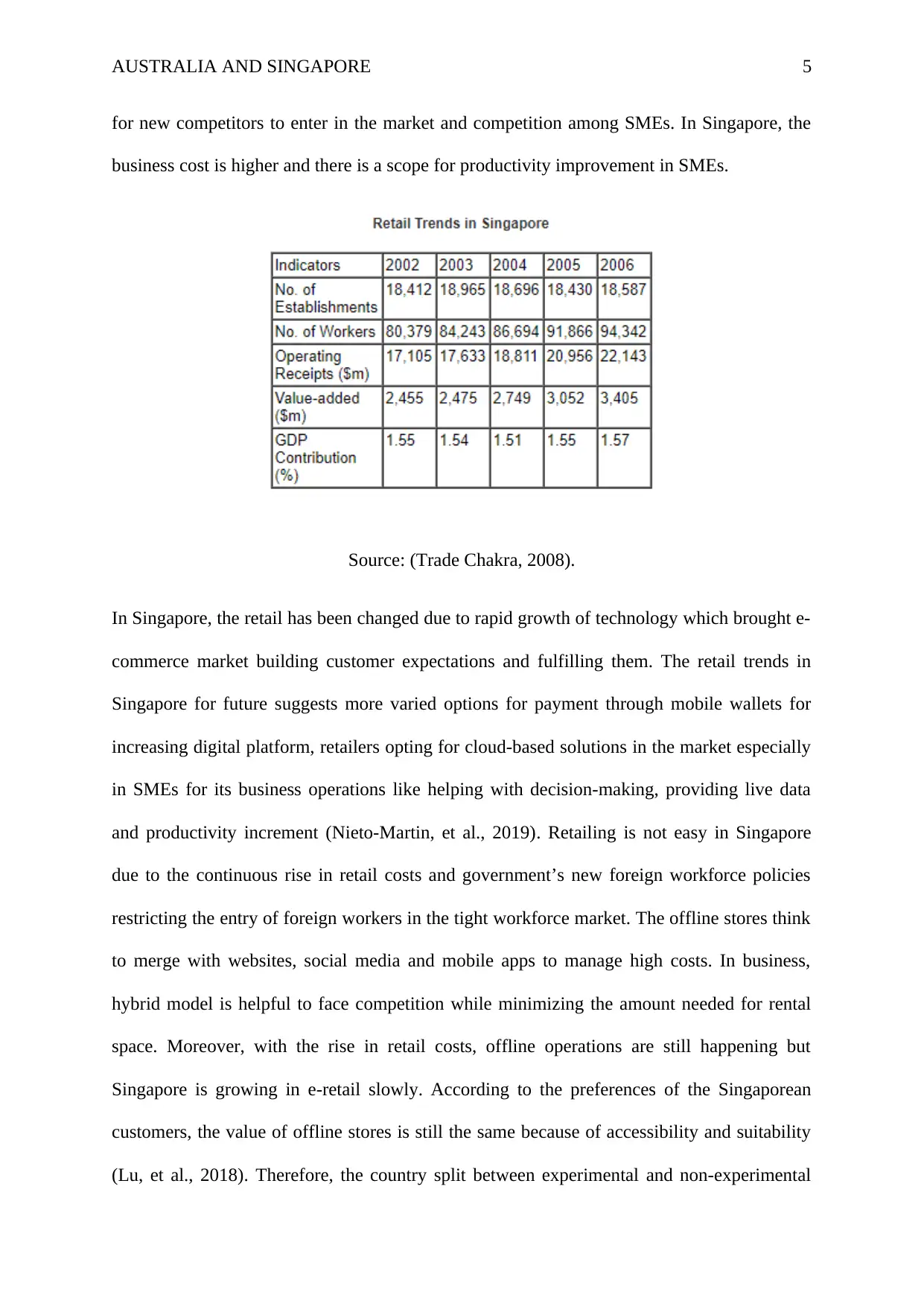
AUSTRALIA AND SINGAPORE 5
for new competitors to enter in the market and competition among SMEs. In Singapore, the
business cost is higher and there is a scope for productivity improvement in SMEs.
Source: (Trade Chakra, 2008).
In Singapore, the retail has been changed due to rapid growth of technology which brought e-
commerce market building customer expectations and fulfilling them. The retail trends in
Singapore for future suggests more varied options for payment through mobile wallets for
increasing digital platform, retailers opting for cloud-based solutions in the market especially
in SMEs for its business operations like helping with decision-making, providing live data
and productivity increment (Nieto-Martin, et al., 2019). Retailing is not easy in Singapore
due to the continuous rise in retail costs and government’s new foreign workforce policies
restricting the entry of foreign workers in the tight workforce market. The offline stores think
to merge with websites, social media and mobile apps to manage high costs. In business,
hybrid model is helpful to face competition while minimizing the amount needed for rental
space. Moreover, with the rise in retail costs, offline operations are still happening but
Singapore is growing in e-retail slowly. According to the preferences of the Singaporean
customers, the value of offline stores is still the same because of accessibility and suitability
(Lu, et al., 2018). Therefore, the country split between experimental and non-experimental
for new competitors to enter in the market and competition among SMEs. In Singapore, the
business cost is higher and there is a scope for productivity improvement in SMEs.
Source: (Trade Chakra, 2008).
In Singapore, the retail has been changed due to rapid growth of technology which brought e-
commerce market building customer expectations and fulfilling them. The retail trends in
Singapore for future suggests more varied options for payment through mobile wallets for
increasing digital platform, retailers opting for cloud-based solutions in the market especially
in SMEs for its business operations like helping with decision-making, providing live data
and productivity increment (Nieto-Martin, et al., 2019). Retailing is not easy in Singapore
due to the continuous rise in retail costs and government’s new foreign workforce policies
restricting the entry of foreign workers in the tight workforce market. The offline stores think
to merge with websites, social media and mobile apps to manage high costs. In business,
hybrid model is helpful to face competition while minimizing the amount needed for rental
space. Moreover, with the rise in retail costs, offline operations are still happening but
Singapore is growing in e-retail slowly. According to the preferences of the Singaporean
customers, the value of offline stores is still the same because of accessibility and suitability
(Lu, et al., 2018). Therefore, the country split between experimental and non-experimental
⊘ This is a preview!⊘
Do you want full access?
Subscribe today to unlock all pages.
Trusted by 1+ million students worldwide
AUSTRALIA AND SINGAPORE 6
goods due to the different preferences of customers regarding offline and online shopping.
Lastly, in-stores experiences improvement with the help of technology expansion using POS
systems for the management handling and customer experiences improvement (Teh, 2016).
In Australia:
The retail market of Australia is divided on the basis of distribution channel, product kind and
market dynamics. Australia is one of the developed countries in the world with a positive
growth in retail market ignore the fact of rising household debt and low increase in wages. In
retailing, the formulation of new approaches by overseas companies is done for the business
growth in the market (Poruschi, et al., 2018). The future of retail market in Australia relies on
the disruptive forces like change in the patterns of consumer spending and overseas
companies focusing on entry in the retail market. In Australia, the companies required to
delivering platforms with multiplicity and liveliness for identifying non-responsive retailers
(Duvall & Salt, 2018). Moreover, the trouble faced in the market due to rise in overseas
companies inflow with the change in consumer preferences because of technology
advancement more than the change in retail background. The retail market is facing
competition due to competitors in terms of revenue share whereas SMEs are focused on
improvisation by entering into new markets and new contracts security.
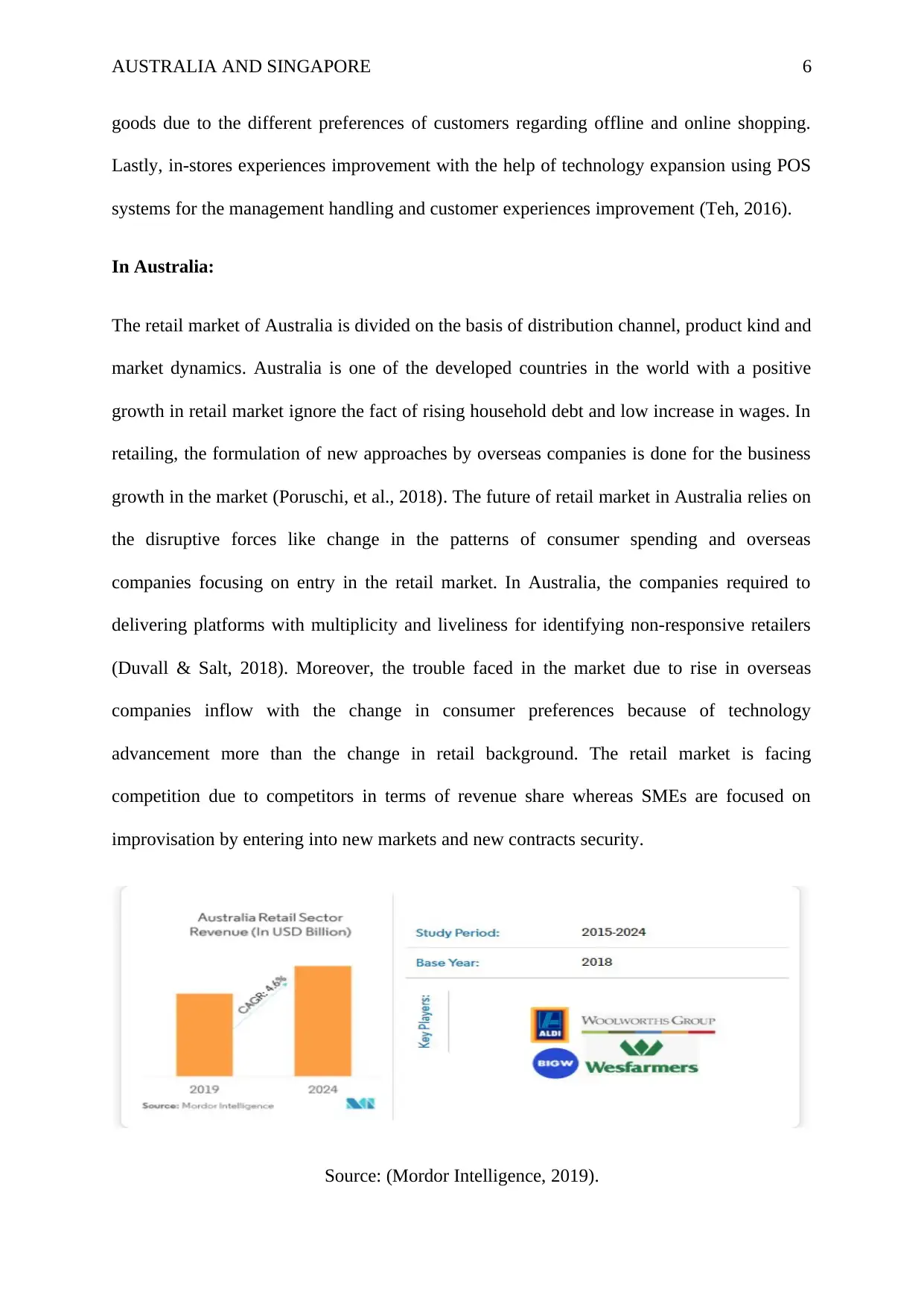
Source: (Mordor Intelligence, 2019).
goods due to the different preferences of customers regarding offline and online shopping.
Lastly, in-stores experiences improvement with the help of technology expansion using POS
systems for the management handling and customer experiences improvement (Teh, 2016).
In Australia:
The retail market of Australia is divided on the basis of distribution channel, product kind and
market dynamics. Australia is one of the developed countries in the world with a positive
growth in retail market ignore the fact of rising household debt and low increase in wages. In
retailing, the formulation of new approaches by overseas companies is done for the business
growth in the market (Poruschi, et al., 2018). The future of retail market in Australia relies on
the disruptive forces like change in the patterns of consumer spending and overseas
companies focusing on entry in the retail market. In Australia, the companies required to
delivering platforms with multiplicity and liveliness for identifying non-responsive retailers
(Duvall & Salt, 2018). Moreover, the trouble faced in the market due to rise in overseas
companies inflow with the change in consumer preferences because of technology
advancement more than the change in retail background. The retail market is facing
competition due to competitors in terms of revenue share whereas SMEs are focused on
improvisation by entering into new markets and new contracts security.
Source: (Mordor Intelligence, 2019).
Paraphrase This Document
Need a fresh take? Get an instant paraphrase of this document with our AI Paraphraser
AUSTRALIA AND SINGAPORE 7
In Australia, the main concern is competition in the retail market where the ACCC
(Australian Competition and Consumer Commission) uses measures for examining the
market structure with an increase in competition related conditions of the business using
market power. Retail market and geographical areas are filled with diversified and
heterogeneous industries with the development in online retailing for promoting
diversification through the industry and challenging positions in the market for established
members (Australian Government, 2011). RSAPOS system is the hospitality software leading
in Australia with 1,000 plus installations through the country in retail stores, hotels, clubs and
more and it delivers solutions with better results (Retail Systems, 2019). The countries using
POS system change on regular basis to be focused on the major requirements like stock
control, system reliability, security, cash control and ease-of-use through new technologies
for the enhancement of system’s basic capabilities.
Profitability and potential size estimation
In Singapore:
The retail market of Singapore has a strong presence with department stores, overseas
retailers and shopping centres at different locations through the country. The increment in
sales volume helps mini-markets and convenience stores. In Singapore, the overseas retailers
strong presence impact the country’s positive and open climate of foreign investment (Diao,
2019). Moreover, the market remains uneven and there is a strong growth of hypermarkets
and supermarkets with the restricted volume of land accessible.
In Australia, the main concern is competition in the retail market where the ACCC
(Australian Competition and Consumer Commission) uses measures for examining the
market structure with an increase in competition related conditions of the business using
market power. Retail market and geographical areas are filled with diversified and
heterogeneous industries with the development in online retailing for promoting
diversification through the industry and challenging positions in the market for established
members (Australian Government, 2011). RSAPOS system is the hospitality software leading
in Australia with 1,000 plus installations through the country in retail stores, hotels, clubs and
more and it delivers solutions with better results (Retail Systems, 2019). The countries using
POS system change on regular basis to be focused on the major requirements like stock
control, system reliability, security, cash control and ease-of-use through new technologies
for the enhancement of system’s basic capabilities.
Profitability and potential size estimation
In Singapore:
The retail market of Singapore has a strong presence with department stores, overseas
retailers and shopping centres at different locations through the country. The increment in
sales volume helps mini-markets and convenience stores. In Singapore, the overseas retailers
strong presence impact the country’s positive and open climate of foreign investment (Diao,
2019). Moreover, the market remains uneven and there is a strong growth of hypermarkets
and supermarkets with the restricted volume of land accessible.
AUSTRALIA AND SINGAPORE 8
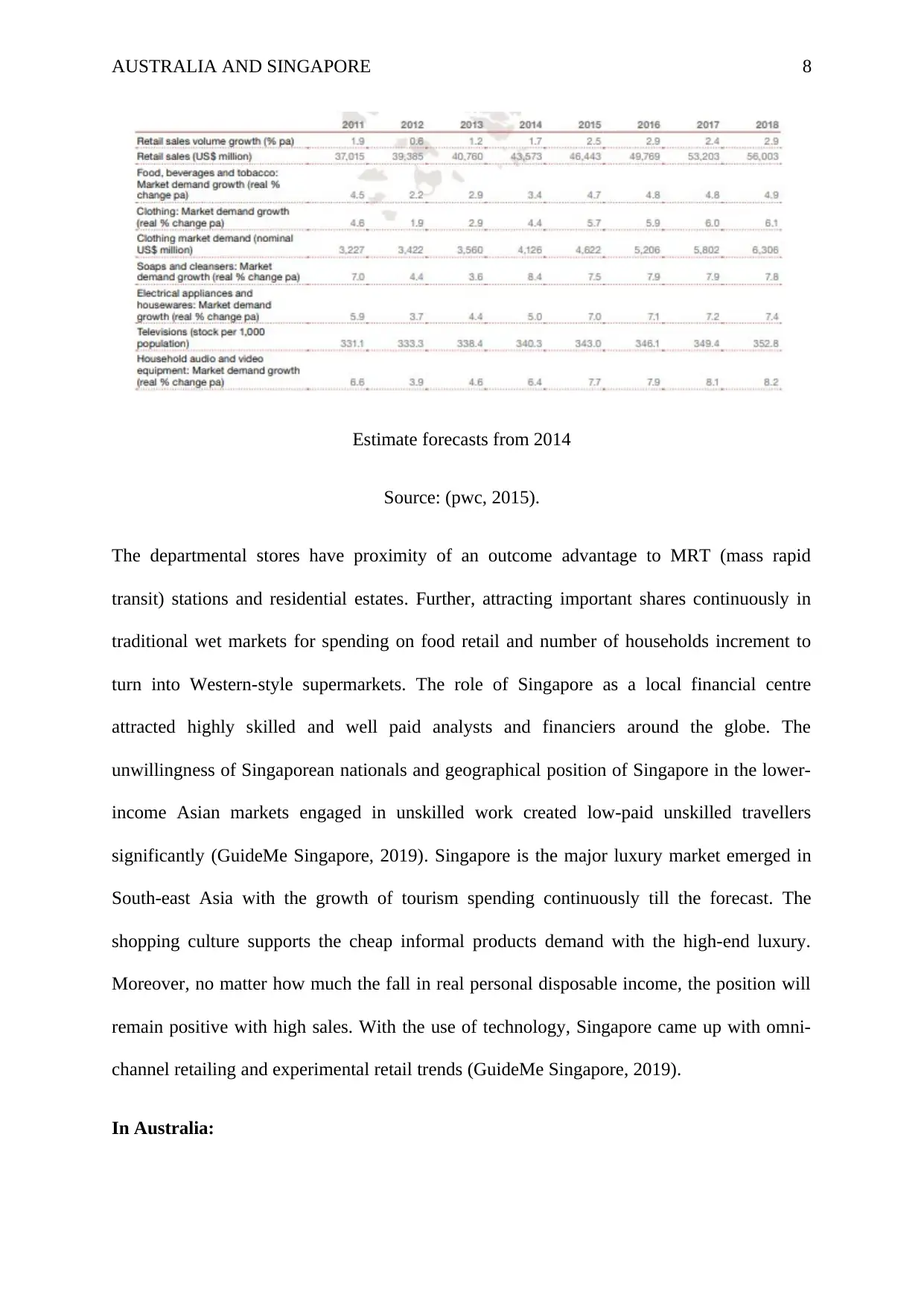
Estimate forecasts from 2014
Source: (pwc, 2015).
The departmental stores have proximity of an outcome advantage to MRT (mass rapid
transit) stations and residential estates. Further, attracting important shares continuously in
traditional wet markets for spending on food retail and number of households increment to
turn into Western-style supermarkets. The role of Singapore as a local financial centre
attracted highly skilled and well paid analysts and financiers around the globe. The
unwillingness of Singaporean nationals and geographical position of Singapore in the lower-
income Asian markets engaged in unskilled work created low-paid unskilled travellers
significantly (GuideMe Singapore, 2019). Singapore is the major luxury market emerged in
South-east Asia with the growth of tourism spending continuously till the forecast. The
shopping culture supports the cheap informal products demand with the high-end luxury.
Moreover, no matter how much the fall in real personal disposable income, the position will
remain positive with high sales. With the use of technology, Singapore came up with omni-
channel retailing and experimental retail trends (GuideMe Singapore, 2019).
In Australia:
Estimate forecasts from 2014
Source: (pwc, 2015).
The departmental stores have proximity of an outcome advantage to MRT (mass rapid
transit) stations and residential estates. Further, attracting important shares continuously in
traditional wet markets for spending on food retail and number of households increment to
turn into Western-style supermarkets. The role of Singapore as a local financial centre
attracted highly skilled and well paid analysts and financiers around the globe. The
unwillingness of Singaporean nationals and geographical position of Singapore in the lower-
income Asian markets engaged in unskilled work created low-paid unskilled travellers
significantly (GuideMe Singapore, 2019). Singapore is the major luxury market emerged in
South-east Asia with the growth of tourism spending continuously till the forecast. The
shopping culture supports the cheap informal products demand with the high-end luxury.
Moreover, no matter how much the fall in real personal disposable income, the position will
remain positive with high sales. With the use of technology, Singapore came up with omni-
channel retailing and experimental retail trends (GuideMe Singapore, 2019).
In Australia:
⊘ This is a preview!⊘
Do you want full access?
Subscribe today to unlock all pages.
Trusted by 1+ million students worldwide
AUSTRALIA AND SINGAPORE 9
In Australia, there are indications of having high barriers in some areas with high competition
where profitability is one of the reasons from the Australian retailers’ point-of-view world-
wide. The comparison of the profitability of companies with Australian industries with large
retail firms with high returns on shareholders’ funds. The potential size of the market depends
on the productivity of Australian retailers with the growth of experienced rate of workforce in
the economy. The sound performance is linked to the growth rate of productivity and its level
in the retail industry comparing with other countries (Yang, et al., 2018). The workforce
productivity as per the output after working per hours is lower than the most other countries.
There is a size gap between overseas leading countries and Australia in terms of retail
productivity. If the Australian retailers will close this broad productivity gap, it will benefit
the consumers and retailers differently (Sebri & Zaccour, 2017). The differences in profit
margins and cost structures, the accessibility is for retailers related to competitive offers, and
specials for out season in the context of products offered to local and overseas retailers where
multiple factors contributes to the price differences. The business strategy from the retailers’
perspective shows the potential for higher profit margins, controlling marketing and product
design, retailer with the potential of higher consumer loyalty, and the off-set competition
privately from competitors (Audzeyeva & Hudson, 2016). The country is increasing profits
and achieving growth with maintaining the market share as well for working on business
operations with gaining profitability and potential size. In Australia, the performance in terms
of profits keeps on fluctuating where larger business base are much profitable than the small
ones in the economy. The huge retailers are with rational returns on capital comparing to the
overseas areas and maintains the global financial crisis.
In the retail market, contributing in profits of the business at the marketplace is different. The
retail operations happen at the low profit margins where the business models are reflected by
the retailers with high-sales volume. The profitability of the area is linked with the firm size
In Australia, there are indications of having high barriers in some areas with high competition
where profitability is one of the reasons from the Australian retailers’ point-of-view world-
wide. The comparison of the profitability of companies with Australian industries with large
retail firms with high returns on shareholders’ funds. The potential size of the market depends
on the productivity of Australian retailers with the growth of experienced rate of workforce in
the economy. The sound performance is linked to the growth rate of productivity and its level
in the retail industry comparing with other countries (Yang, et al., 2018). The workforce
productivity as per the output after working per hours is lower than the most other countries.
There is a size gap between overseas leading countries and Australia in terms of retail
productivity. If the Australian retailers will close this broad productivity gap, it will benefit
the consumers and retailers differently (Sebri & Zaccour, 2017). The differences in profit
margins and cost structures, the accessibility is for retailers related to competitive offers, and
specials for out season in the context of products offered to local and overseas retailers where
multiple factors contributes to the price differences. The business strategy from the retailers’
perspective shows the potential for higher profit margins, controlling marketing and product
design, retailer with the potential of higher consumer loyalty, and the off-set competition
privately from competitors (Audzeyeva & Hudson, 2016). The country is increasing profits
and achieving growth with maintaining the market share as well for working on business
operations with gaining profitability and potential size. In Australia, the performance in terms
of profits keeps on fluctuating where larger business base are much profitable than the small
ones in the economy. The huge retailers are with rational returns on capital comparing to the
overseas areas and maintains the global financial crisis.
In the retail market, contributing in profits of the business at the marketplace is different. The
retail operations happen at the low profit margins where the business models are reflected by
the retailers with high-sales volume. The profitability of the area is linked with the firm size
Paraphrase This Document
Need a fresh take? Get an instant paraphrase of this document with our AI Paraphraser
AUSTRALIA AND SINGAPORE 10
where the huge retailers in Australia generate a higher profit margin than the other areas
overseas (Preston, 2018). The productivity contributes in the economy of Australia with the
increase in shareholder’s profits and workforce wages with lowering the prices or providing
better services to the customers. The retail market plays an international competition with the
world-wide online retailers where it is essential to understand the importance of productivity
for retailers to ready to face opportunities and competitive pressures.
Analysis of potential problems
The companies face different set of problems in the retail sector with more of challenges in
both the markets of the Singapore and Australia.
In Singapore:
The retail stores were struggling with the rise in costs, sales minimization and disruption of
industry from e-commerce. In Singapore, the retail sales are decreasing with an increase in
online shopping. Moreover, the use of technology in the country retail is not limited only to
buying of goods online for the customers while the traditional retailers stand the benefits as
well. The improvement in efficient working of supply chain procedures for using huge data to
provide customized services where digital adoption will help the retailers in the retail sector
of Singapore for not just surviving instead booming (Kosorić, et al., 2018). In Singapore,
retailers want to increase the pace to offline stores by enhancing the shopping experience for
customers’ offline. In today’s time, the use of technology is must by providing AR
(augmented reality) and tech-enabled product customization to the shopkeepers engaging at
the terms of physicality (GuideMe Singapore, 2019). According, retailers think of reinvention
as recovery in Singapore for recovering the losses made earlier with the innovation through
technology by enhancing traditional retailing and experiencing storefront as well to make it
move slowly but steadily in future. The difficulties faced were the entry of new brands where
where the huge retailers in Australia generate a higher profit margin than the other areas
overseas (Preston, 2018). The productivity contributes in the economy of Australia with the
increase in shareholder’s profits and workforce wages with lowering the prices or providing
better services to the customers. The retail market plays an international competition with the
world-wide online retailers where it is essential to understand the importance of productivity
for retailers to ready to face opportunities and competitive pressures.
Analysis of potential problems
The companies face different set of problems in the retail sector with more of challenges in
both the markets of the Singapore and Australia.
In Singapore:
The retail stores were struggling with the rise in costs, sales minimization and disruption of
industry from e-commerce. In Singapore, the retail sales are decreasing with an increase in
online shopping. Moreover, the use of technology in the country retail is not limited only to
buying of goods online for the customers while the traditional retailers stand the benefits as
well. The improvement in efficient working of supply chain procedures for using huge data to
provide customized services where digital adoption will help the retailers in the retail sector
of Singapore for not just surviving instead booming (Kosorić, et al., 2018). In Singapore,
retailers want to increase the pace to offline stores by enhancing the shopping experience for
customers’ offline. In today’s time, the use of technology is must by providing AR
(augmented reality) and tech-enabled product customization to the shopkeepers engaging at
the terms of physicality (GuideMe Singapore, 2019). According, retailers think of reinvention
as recovery in Singapore for recovering the losses made earlier with the innovation through
technology by enhancing traditional retailing and experiencing storefront as well to make it
move slowly but steadily in future. The difficulties faced were the entry of new brands where
AUSTRALIA AND SINGAPORE 11
more investments were required and make differentiation from the competitors in the retail
market as well.
In Australia:
The challenge faced by the retailing companies in Australia is linked to the workforce
management where companies are finding varied routes by hiring non-Australian cultural
background for the people working in the retail stores which is also related to the diversity
management due to skill shortage in the larger business. The high use of technology
influenced the brick-and-mortar based business in the country while in the marketing created
challenges linked to privacy concerns of the company (Oliva, et al., 2016). Due to this,
companies are trying to save individual data of the customers for not creating ethical
challenges for the company and minimizing the risks of fraud. In Australia, the pay rates and
operational costs are high impacting the overall profits of the company. The competition at
the e-commerce level is also high and the operational costs in the environment are making a
difference for the companies with serious challenges to be concerned about (Neo, 2019). The
economy impact due to global recession is also a challenge faced by the companies in the
Australia mainly on the luxury products in the retail market.
Cultural aspects consideration
In Singapore:
Singaporeans are mostly comfortable with booking holidays online and not with OTA or
traditional travel agent. The consumer having the strong knowledge of Australia and
Singapore is a rational market where FIT (free and independent traveller) sectors grow quick
continuously (Tourism Australia, 2019). Singapore is looking for new stores to open for new
retail experiences offered to retailers and for the customers as well. The culture of the
more investments were required and make differentiation from the competitors in the retail
market as well.
In Australia:
The challenge faced by the retailing companies in Australia is linked to the workforce
management where companies are finding varied routes by hiring non-Australian cultural
background for the people working in the retail stores which is also related to the diversity
management due to skill shortage in the larger business. The high use of technology
influenced the brick-and-mortar based business in the country while in the marketing created
challenges linked to privacy concerns of the company (Oliva, et al., 2016). Due to this,
companies are trying to save individual data of the customers for not creating ethical
challenges for the company and minimizing the risks of fraud. In Australia, the pay rates and
operational costs are high impacting the overall profits of the company. The competition at
the e-commerce level is also high and the operational costs in the environment are making a
difference for the companies with serious challenges to be concerned about (Neo, 2019). The
economy impact due to global recession is also a challenge faced by the companies in the
Australia mainly on the luxury products in the retail market.
Cultural aspects consideration
In Singapore:
Singaporeans are mostly comfortable with booking holidays online and not with OTA or
traditional travel agent. The consumer having the strong knowledge of Australia and
Singapore is a rational market where FIT (free and independent traveller) sectors grow quick
continuously (Tourism Australia, 2019). Singapore is looking for new stores to open for new
retail experiences offered to retailers and for the customers as well. The culture of the
⊘ This is a preview!⊘
Do you want full access?
Subscribe today to unlock all pages.
Trusted by 1+ million students worldwide

1 out of 19


Related Documents


Your All-in-One AI-Powered Toolkit for Academic Success.
+13062052269
info@desklib.com
Available 24*7 on WhatsApp / Email
![[object Object]](/_next/static/media/star-bottom.7253800d.svg)
Unlock your academic potential
Copyright © 2020–2026 A2Z Services. All Rights Reserved. Developed and managed by ZUCOL.