The Capital Market in Australia: Evolution, Structure and Functions

Verified

Added on  2023/06/05

|9
|2304
|126
Report
AI Summary
This research report provides a comprehensive analysis of the capital market, focusing on its evolution, structure, and functions, with a specific emphasis on the Australian market. The report begins by defining capital and exploring its various forms, then delves into the mechanics of the capital market, including the factors influencing stock prices, such as supply and demand. It examines the role of investor sentiment and company performance in determining stock valuation, highlighting the importance of financial transparency. Furthermore, the report discusses the development of the capital market in Australia, its significance for economic growth, and the measures needed to ensure its sustainable development. It also touches upon the globalization of world capital markets and its consequences, referencing various theoretical and empirical studies to support its analysis. The study concludes by emphasizing the necessity of attracting additional capital for enterprises to overcome economic recession and ensure sustainable economic growth in Australia. Desklib is your go-to platform for accessing this document and a wealth of other study resources.
Document Page
1
Marketing Management
Name:
Course
Professor’s name
University name
City, State
Date of submission
tabler-icon-diamond-filled.svg

Paraphrase This Document

Need a fresh take? Get an instant paraphrase of this document with our AI Paraphraser
Document Page
2
Introduction
The topic of this research work contributes to a deep understanding of the processes
taking place in the economy. The creation and development of commercial firms - the main
components of market economy units - requires the acquisition of physical and immaterial
capital. This requires the investment of money capital. However, since usually the financial
means for organizing the production of goods or services from the owners of the company is not
enough, there is a need for additional capital, which is attracted from the capital market
(Agbloyor, Abor, Adjasi, and Yawson, 2014).
Practicle motivation
In countries with developed market-type economic systems (such as the United States,
Western Europe, Japan), the capital market has a rather complex structure, formed over many
centuries. The capital market analysts and investment bankers use the capital markets
fluctuations to get profits.This structure is generated by the need to best reconcile the very
conflicting interests of savings owners and commercial firms wishing to receive these savings as
investments.The concept of the capital market is closely linked to the stock market .The stock
market arises from the objective need to attract additional financial resources for the enterprise,
corporation, state. (Ayadi, Arbak, Naceur, and De Groen, 2015).
Theoretical motivation
The stock market plays a significant role in the system of market relations, which can be
reduced to the following factors: attraction of free funds in the form of investments for the
development of production; ensuring the flow of capital from damped industries into rapidly
Document Page
3
advancing industries; raising funds to cover the budget deficit; generation of indicators, which
can assess the state of the economy as a whole; influence on the change in the rate of inflation.
Literature review
The current stage of development of the stock market began after the great depression
and is connected with ongoing economic reforms. The stock market is an indispensable element
of any market system. Australia had to create its stock market in fact "from scratch." Therefore,
to date, the most important, perhaps, is the fact that Australia has a securities market with a
developed infrastructure, technologically equipped at the modern level and almost in no way
inferior in this sense to foreign counterparts (Ballings, Van den Poel, and Gryp, 2015).
Since every citizen of the country by investing his savings can be a participant in the
economic process of forming funds in the capital market, there is a need to understand the basic
concepts and categories of the capital market, its structure and forms. It is with this that the
special relevance of this topic is connected. This course paper deals with the essence and
evolution of the capital market, its structure and functions, the problems of the functioning of the
capital market in Australia, as well as the nature and structure of the world capital market. The
purpose of this paper is to analyze the features of the development of the modern capital market.
To fulfill this goal, the following tasks were set in the work: to characterize the concept
of "capital", to show its essence, to identify the forms of capital, to show how the capital market
operates, to consider the features of the capital market of Australia and the world capital market,
and also to explore the globalization of world capital markets and its consequences
(Baharumshah, Slesman, and Devadason, 2017).
Document Page
4
The concept of the capital market
Before giving a definition of the concept of the capital market, it is necessary, in my
opinion, to have an idea of what capital is. Capital (originally - the main property, the principal
amount, from the Latin capitals - the main one) is one of the most important categories of
economic science, an indispensable element of market economy.
Capital has many meanings and can be treated as
- a certain supply of material goods ("physical capital"),
- as a sum of money, or "financial capital"
- as something that includes not only material elements, such as knowledge, education,
qualifications, human abilities used in the production of goods and services ("human capital"),
- as an element of wealth, bringing its owner a regular income for a long time ("discounted
income stream"),
- as the sum of the rights to dispose of certain values, giving their owners income without
investing the relevant labor ("legal capital").
All these views are one in one: capital is any resource of the economy created for the
purpose of producing more economic goods and capable of generating revenue.The creation of
joint-stock companies, the high concentration and centralization of production, the development
of new industries based on scientific and technical discoveries, the strengthening of the role of
the state in the economy and a number of other reasons have caused a huge demand for loan
tabler-icon-diamond-filled.svg

Paraphrase This Document

Need a fresh take? Get an instant paraphrase of this document with our AI Paraphraser
Document Page
5
capital (Ding, Zhang, Liu, and Duan, 2014). State-monopoly capitalism created the prerequisites
for the further growth of the rural economy.
Hypothesis
What affects the price of the stock? Such a simple question, interests all investors, even
potential investors who want to multiply their investments.The answer is no less simple - supply
and demand. If the demand for the company's shares exceeds the offer to sell these shares, then
the shares become more expensive, and the higher the demand over the offer, the more expensive
the share price becomes. But if the number of people willing to sell shares exceeds the number of
those willing to buy them, the price will fall.
The essence of the supply and demand is quite simple, but it is much more difficult to
understand what exactly makes people buy some stocks and ignore others. All this comes down
to knowing what factors are good for the company and which are bad for the company. There are
many opinions and various tactics about this, and each investor uses his own (Kumar, 2015). The
main driving force driving the price of shares to move is that investors think about this company
and how much, in their opinion, this company can cost
Overvalued and undervalued stock
If investors consider the company to be overvalued (its shares are too expensive), then
they can decide to sell these shares. This will entail a fall in prices. At the same time, if investors
believe that the company's shares are very cheap, they can start buying them. This will make the
price rise.
Document Page
6
The most important factor affecting the value of a company is its income. If the company makes
a regular profit, it will be able to develop and bring profit to investors. If the company regularly
incurs losses, only uneducated investors will buy its shares, whose future is under threat.
Information on their financial condition of the company must be provided regularly, so
that investors can see the real picture and on the basis of this make decisions. In more detail
about what information companies provide, we'll talk in future articles. Undoubtedly, not only
the company's earnings cause its shares to change in price. There are many other factors and
indicators that demonstrate the state of the company. Proceeding from them, investors make their
own decisions (Mamun, Basher, Hoque, and Ali, 2018).
But it should be remembered that the price of shares can change quite quickly, both up
and down. Currently in Australia there is an active process of strengthening and improving
market relations. An important component of the market system is the capital market. Various
theoretical models and empirical studies show that the level of development of the capital market
is one of the main factors determining the effectiveness of the functioning of the economy
(PRICE, 2014).
The gradual overcoming of the economic recession creates the prerequisites for the
resumption of the reproduction process, but the necessary condition is the possibility of attracting
additional capital to the enterprises. Therefore, to ensure sustainable economic growth of the
Australian economy, measures are needed to develop the capital market (Nthoesane, and Kruger,
2014). The essence of these measures can only be determined on the basis of an analysis of the
features of the formation of the capital market in a transforming economy. With a relatively high
Document Page
7
degree of study of the issue in developed economies, the problem of the formation and
development of the capital markets.
Degree of elaboration of the problem:
In the subsequent period in foreign economic literature, much attention is paid to the analysis of
formal and logical relationships existing under the conditions of a developed capital market, the
conditions of equilibrium in the market are studied (Rodrik, 2014).
5 foreign researchers are often a technique of choosing the strategy and tactics of behavior in the
market, forecasting its conjuncture. At the same time, the question of the process of the origin
and development of the market in foreign literature, as a rule, generally does not rise.
A certain contribution to the study of the problems of capital market formation was made by
foreign authors who investigated the transforming economy and the laws of the processes
occurring in itHowever, in these works the theme of capital market formation is present only as
an additional aspect in the context of searching for solutions to other problems, such as
macroeconomic stabilization, combating inflation, developing a competitive environment (Van
den Berg, 2016).At the same time, in practical terms for the planned economy, the practical
significance of the capital market research was virtually absent, so only the state dealt with the
distribution of capital investments in the centralized distribution economic system.
tabler-icon-diamond-filled.svg

Paraphrase This Document

Need a fresh take? Get an instant paraphrase of this document with our AI Paraphraser
Document Page
8
References
Agbloyor, E.K., Abor, J.Y., Adjasi, C.K.D. and Yawson, A., 2014. Private capital flows and
economic growth in Africa: The role of domestic financial markets. Journal of International
Financial Markets, Institutions and Money, 30, pp.137-152.
Ayadi, R., Arbak, E., Naceur, S.B. and De Groen, W.P., 2015. Financial development, bank
efficiency, and economic growth across the Mediterranean. In Economic and social development
of the Southern and Eastern Mediterranean countries (pp. 219-233). Springer, Cham.
Ballings, M., Van den Poel, D., Hespeels, N. and Gryp, R., 2015. Evaluating multiple classifiers
for stock price direction prediction. Expert Systems with Applications, 42(20), pp.7046-7056.
Baharumshah, A.Z., Slesman, L. and Devadason, E.S., 2017. Types of foreign capital inflows
and economic growth: New evidence on role of financial markets. Journal of International
Development, 29(6), pp.768-789.
Ding, X., Zhang, Y., Liu, T. and Duan, J., 2014. Using structured events to predict stock price
movement: An empirical investigation. In Proceedings of the 2014 Conference on Empirical
Methods in Natural Language Processing (EMNLP) (pp. 1415-1425).
Kumar, K., 2015. Analyzing price movement and stock volatility of selected BSE listed
pharmaceutical companies. International Journal of Research in Management & Social
Science, 3(2), p.3.
Document Page
9
Mamun, A., Basher, S., Hoque, N. and Ali, M.H., 2018. DOES STOCK MARKET
DEVELOPMENT AFFECT ECONOMIC GROWTH? ECONOMETRIC EVIDENCE FROM
BANGLADESH. Management & Accounting Review, 17(1).
Nthoesane, M.G. and Kruger, J.W., 2014. Market reaction to chief executive officers (CEOs)
appointments on Johannesburg securities exchange (JSE): stock price and volume
approach. Journal of Economics and International Finance, 6(5), pp.91-102.
PRICE, S.G.C.O.S., 2014. Movement. Journal of Financial Economics.
Rodrik, D., 2014. The past, present, and future of economic growth. Challenge, 57(3), pp.5-39.
Van den Berg, H., 2016. Economic growth and development. World Scientific Publishing
Company.
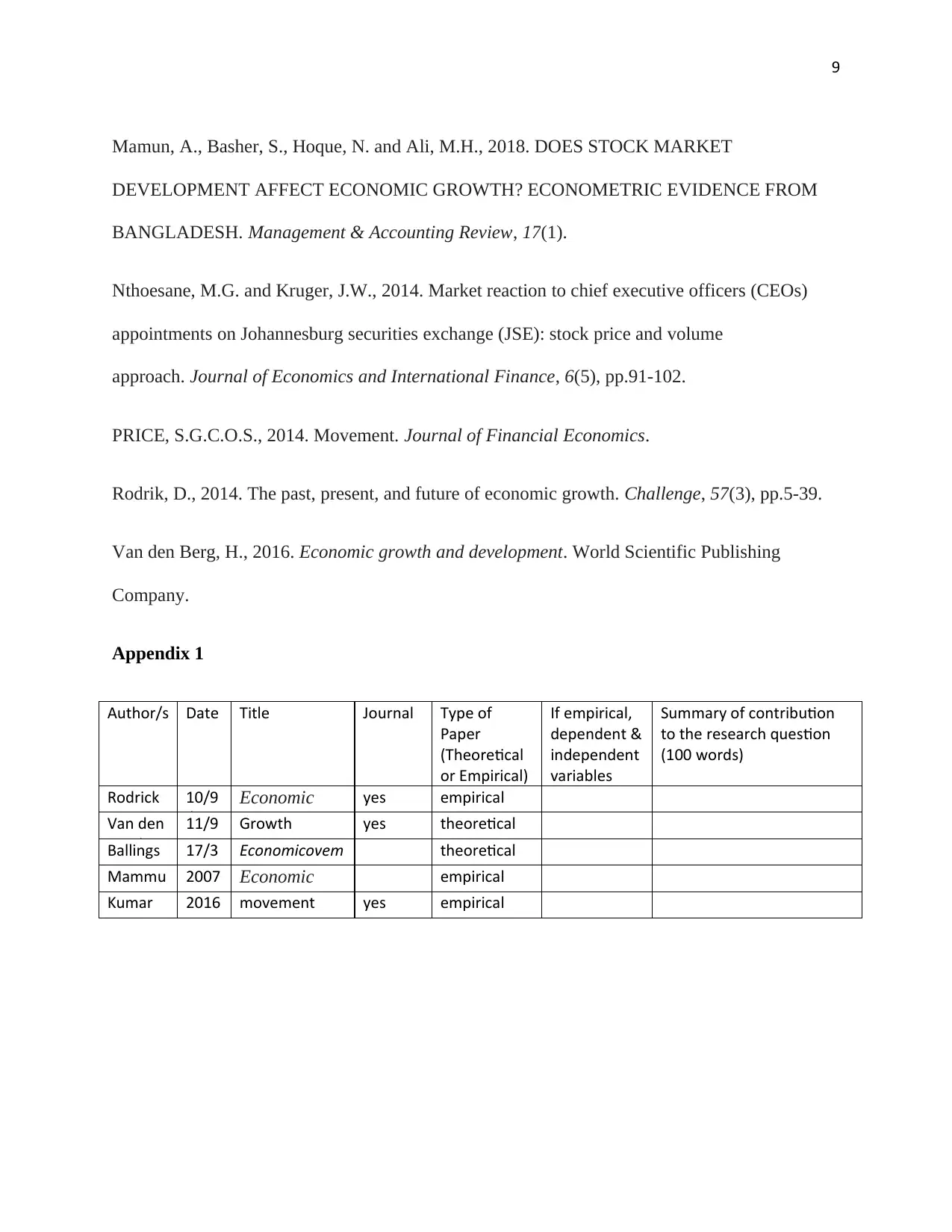
Appendix 1
Author/s Date Title Journal Type of
Paper
(Theoretical
or Empirical)
If empirical,
dependent &
independent
variables
Summary of contribution
to the research question
(100 words)
Rodrick 10/9
/
Economic
growth
yes empirical
Van den
Bergb
11/9 Growth yes theoretical
Ballings 17/3
008
Economicovem
ent
theoretical
Mammu
en
2007 Economic empirical
Kumar 2016 movement yes empirical
chevron_up_icon
1 out of 9
circle_padding
hide_on_mobile
zoom_out_icon
[object Object]