Health Equity in Australia: A Case Study on Cervical Cancer Screening
VerifiedAdded on 2020/10/22
|12
|3075
|495
Case Study
AI Summary
This case study examines the National Cervical Screening Program (NCSP) in Australia, focusing on integrating health equity to address disparities in cervical cancer screening. It analyzes the program's objectives, interventions, and the five-step EQUITY methodology to identify and address barriers to access and participation, such as socioeconomic factors, cultural beliefs, and knowledge gaps. The study highlights interventions like the Cervical Screening Test, digital communication, and community outreach to improve awareness and screening rates among women aged 25-74. The case study emphasizes the importance of understanding social determinants of health (SDH) and redesigning programs to promote equitable access and outcomes, ultimately aiming to reduce cervical cancer incidence and mortality. The analysis provides recommendations for action and emphasizes the need for continuous efforts to achieve health equity in cervical cancer screening.
CASE STUDY

Paraphrase This Document
Need a fresh take? Get an instant paraphrase of this document with our AI Paraphraser
TABLE OF CONTENTS
INTRODUCTION ..........................................................................................................................1
MAIN BODY...................................................................................................................................1
Part 1...........................................................................................................................................1
Part 2...........................................................................................................................................2
Part 3...........................................................................................................................................7
Identification the aims and priorities for improving equity .......................................................8
Recommendations for action.......................................................................................................8
Part 4...........................................................................................................................................9
CONCLUSION................................................................................................................................9
REFERENCES..............................................................................................................................10
INTRODUCTION ..........................................................................................................................1
MAIN BODY...................................................................................................................................1
Part 1...........................................................................................................................................1
Part 2...........................................................................................................................................2
Part 3...........................................................................................................................................7
Identification the aims and priorities for improving equity .......................................................8
Recommendations for action.......................................................................................................8
Part 4...........................................................................................................................................9
CONCLUSION................................................................................................................................9
REFERENCES..............................................................................................................................10
INTRODUCTION
Health Equity is an important social aspect in today's globalization. There is a stigma
attached with the health care provisions that still need to overcome the challenges and uneven
progress and this social injustice has been inferred as the inequity in the health sector. This has
fostered the necessity of this integration to get a grip regarding the remedial implications to
engage the individuals by providing them the required needs to surpass their personal
indifferences. This case study is going to emphasize on integrating equity into health strategies,
programmes and activities for controlling the disparities that have been prevailing in the
community due to several components such as vulnerability, differences in socio-economic
status, cultural beliefs etc.
MAIN BODY
Part 1
Introduction
Cancer screening here, gives insights on the inclusion of equity relevant determinants to
benchmark the health systems of Australia. This supports by advocating the multi-lateral reforms
to be at forefront to comprehend the policy-making and program designing of the healthcare
sector to ensure the proactive approachability for maintenance of surveillance of onset of
cervical cancer and related provisions like vaccines, tests etc. It would assist in restricting the
threats by incorporating the robust techniques and methods for quick response in pursuit of
effective and equitable approaches. Here, the rise of cervical screening test has been considered
to comprehend the nuances of the cervical cancer, its prognosis and other effects.
Overview of Health Program
Aim: To generate awareness on the Health EQUITY for targeting 25 to 74 years women
population to enhance the proximity of heath SPA's
Objectives:
To understand the five-step review cycle, refereed with EQUITY as an acronym as per
the Spanish methodological guide
To analyse the existing program with an outline for redesigning to provide better care and
facilities
Health Equity is an important social aspect in today's globalization. There is a stigma
attached with the health care provisions that still need to overcome the challenges and uneven
progress and this social injustice has been inferred as the inequity in the health sector. This has
fostered the necessity of this integration to get a grip regarding the remedial implications to
engage the individuals by providing them the required needs to surpass their personal
indifferences. This case study is going to emphasize on integrating equity into health strategies,
programmes and activities for controlling the disparities that have been prevailing in the
community due to several components such as vulnerability, differences in socio-economic
status, cultural beliefs etc.
MAIN BODY
Part 1
Introduction
Cancer screening here, gives insights on the inclusion of equity relevant determinants to
benchmark the health systems of Australia. This supports by advocating the multi-lateral reforms
to be at forefront to comprehend the policy-making and program designing of the healthcare
sector to ensure the proactive approachability for maintenance of surveillance of onset of
cervical cancer and related provisions like vaccines, tests etc. It would assist in restricting the
threats by incorporating the robust techniques and methods for quick response in pursuit of
effective and equitable approaches. Here, the rise of cervical screening test has been considered
to comprehend the nuances of the cervical cancer, its prognosis and other effects.
Overview of Health Program
Aim: To generate awareness on the Health EQUITY for targeting 25 to 74 years women
population to enhance the proximity of heath SPA's
Objectives:
To understand the five-step review cycle, refereed with EQUITY as an acronym as per
the Spanish methodological guide
To analyse the existing program with an outline for redesigning to provide better care and
facilities
⊘ This is a preview!⊘
Do you want full access?
Subscribe today to unlock all pages.

Trusted by 1+ million students worldwide
In the same regard, the program that has been focused upon is called National Cervical
Screening Program (NCSP). It is one of the progressive programs that was initiated in 1991 with
realignment of it by incorporating new recommendations with effective from December 1, 2017.
The purpose was to reduce the number of women who develop cervical cancer along with
reduction in the number of women who die from cervical cancer. Nonetheless, it mainly deals
with protecting and generating awareness about cervical cancer and the overall assessment of its
repercussions on the female body. Recently, there is an incorporation of a tool named Cervical
screening Test, which concentrates on the detection of human papillomavirus (HPV) and assist in
decreasing 30 percent of the total affected cases. This program has replaced the two year Pap
Test and has shown accurate outcomes with a validation for five years.
Overview of Population
Women aged between 25 to 74 years is the targeted populace that tend to ignore the
symptoms in context to the well-being of their cervix by adopting this simple medical procedure.
The main aim is to make the testing method faster and quicker to support the decision making of
women by conducting interventions to lay an understanding on the step-by-step equity review to
combat the inequalities in relation to cancer.
Part 2
Brief Assessment of integration of equity with chosen program
This cervical testing program has elucidated on the social gaps that have been connected
with the affordability factor. For instance, a 20 year old female could not afford this test
however, her mother can and thus this is one of the causes for women avoidance towards this
type of cancer. Along with, there is an overlapping of the medical concepts that affect the health
concerns while tackling the inequities of this cervical cancer continuum and the associated
screening methods (Anna and et.al., 2015). This also shed light on the researches done on the
areas which have been ignored until now and needs immediate recognition to address them on
wider scale.
Addressing health inequities with using specific approaches
The basic inequity shown here was the inadequate knowledge of cervical cancer and its
after effects on female's body. They are being vulnerable by being naïve and ignorant towards
Screening Program (NCSP). It is one of the progressive programs that was initiated in 1991 with
realignment of it by incorporating new recommendations with effective from December 1, 2017.
The purpose was to reduce the number of women who develop cervical cancer along with
reduction in the number of women who die from cervical cancer. Nonetheless, it mainly deals
with protecting and generating awareness about cervical cancer and the overall assessment of its
repercussions on the female body. Recently, there is an incorporation of a tool named Cervical
screening Test, which concentrates on the detection of human papillomavirus (HPV) and assist in
decreasing 30 percent of the total affected cases. This program has replaced the two year Pap
Test and has shown accurate outcomes with a validation for five years.
Overview of Population
Women aged between 25 to 74 years is the targeted populace that tend to ignore the
symptoms in context to the well-being of their cervix by adopting this simple medical procedure.
The main aim is to make the testing method faster and quicker to support the decision making of
women by conducting interventions to lay an understanding on the step-by-step equity review to
combat the inequalities in relation to cancer.
Part 2
Brief Assessment of integration of equity with chosen program
This cervical testing program has elucidated on the social gaps that have been connected
with the affordability factor. For instance, a 20 year old female could not afford this test
however, her mother can and thus this is one of the causes for women avoidance towards this
type of cancer. Along with, there is an overlapping of the medical concepts that affect the health
concerns while tackling the inequities of this cervical cancer continuum and the associated
screening methods (Anna and et.al., 2015). This also shed light on the researches done on the
areas which have been ignored until now and needs immediate recognition to address them on
wider scale.
Addressing health inequities with using specific approaches
The basic inequity shown here was the inadequate knowledge of cervical cancer and its
after effects on female's body. They are being vulnerable by being naïve and ignorant towards
Paraphrase This Document
Need a fresh take? Get an instant paraphrase of this document with our AI Paraphraser
this condition. Mostly, the cervical cancer is underpinned as a disease occurred in elderly,
however it is conflicting due to the inclination towards the social injustice in areas like social
status, economic abilities or race etc. Moreover, it is evident that this can occur in any women
who is either sexually active or above twenty years.
Furthermore, an array of multidisciplinary approaches has been implemented which
involves campaigning on nationwide level, active participation from nongovernment
organisations (NGO's) along with partnering with public regulatory bodies to make this test
feasible at low costs. Along with, setting up of clinics with proper equipment and tool-kits in
both rural and urban set ups that inspired this replacement of two year pap test with the five year
cervical screening test (Lauren, Vetta L and Sanders ,2012). Additionally, there was the utility of
digitalalization like using social media platforms like Facebook, Twitter etc. to connect with
them in easy mode plus utilisation of sending messages either through text or Whatsapp to
inform about this with importance of regular visits to clinics or hospitals to gain an overview on
the treatment and related queries.
Interventions Utility
These interventions indicated towards the improvisations done for generating awareness
among the women, especially the youth who might get sexually active and has no clue how the
cervical cancer progresses and affect their lifestyle in astounding order. Along with, proper and
structured tactic to reach women in convenient modes would lead the concerned authorities to
achieve targets in less time with cost effectiveness.
however it is conflicting due to the inclination towards the social injustice in areas like social
status, economic abilities or race etc. Moreover, it is evident that this can occur in any women
who is either sexually active or above twenty years.
Furthermore, an array of multidisciplinary approaches has been implemented which
involves campaigning on nationwide level, active participation from nongovernment
organisations (NGO's) along with partnering with public regulatory bodies to make this test
feasible at low costs. Along with, setting up of clinics with proper equipment and tool-kits in
both rural and urban set ups that inspired this replacement of two year pap test with the five year
cervical screening test (Lauren, Vetta L and Sanders ,2012). Additionally, there was the utility of
digitalalization like using social media platforms like Facebook, Twitter etc. to connect with
them in easy mode plus utilisation of sending messages either through text or Whatsapp to
inform about this with importance of regular visits to clinics or hospitals to gain an overview on
the treatment and related queries.
Interventions Utility
These interventions indicated towards the improvisations done for generating awareness
among the women, especially the youth who might get sexually active and has no clue how the
cervical cancer progresses and affect their lifestyle in astounding order. Along with, proper and
structured tactic to reach women in convenient modes would lead the concerned authorities to
achieve targets in less time with cost effectiveness.
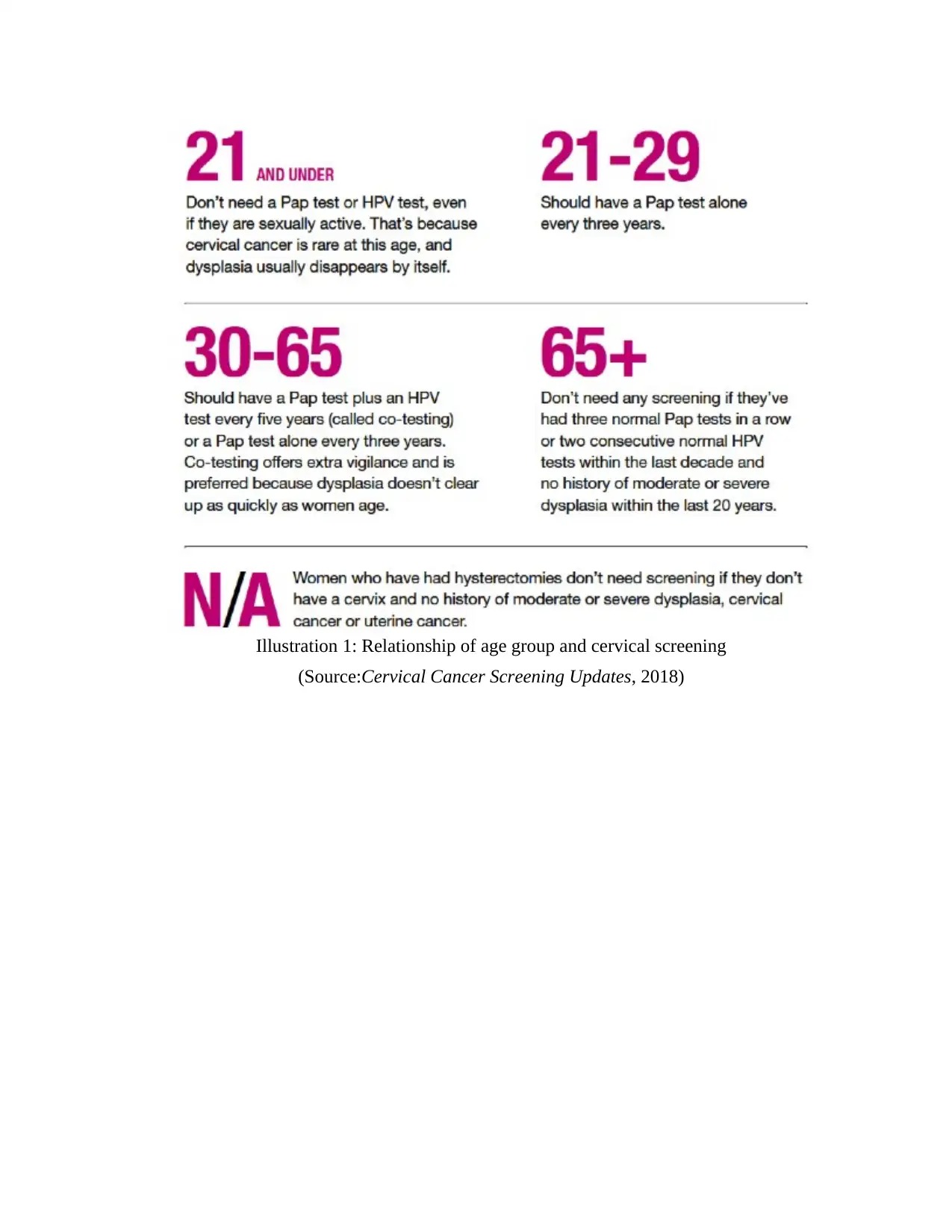
Illustration 1: Relationship of age group and cervical screening
(Source:Cervical Cancer Screening Updates, 2018)
(Source:Cervical Cancer Screening Updates, 2018)
⊘ This is a preview!⊘
Do you want full access?
Subscribe today to unlock all pages.
Trusted by 1+ million students worldwide
Five-steps of EQUITY methodology
E- This part infers on the examination of the strategies, practices and activities (SPA's) of this
program. The major strategic decisions assisted for generation of consciousness with genuine
realization about cervical cancer among the targeted people. However, the three policies of
national importance aid in setting up a framework for regular screening appointments to enhance
the participation from both never and under screened women.
Q- Here, the emphasis is on the demonstration of access to combat the prognosis in early stages
only. It is one of the important steps that lay the foundation of promoting this screening test. This
is done by the professionals and regulatory bodies working in relation with the health care sector.
Examples are WHO, Department of Health of Australia and other non-governmental
organisations like The Aged Care etc. Moreover, it reflects on the job roles of general
practitioners, doctors, gynaecologists, nurses and more. This can be established in many
locations such as women's or community health centre, any medical service or health clinics like
doctor's, family planning etc.
Additionally, this program's ulterior aim is to promote this screening test by combining
with the HPV vaccination for helping to reduce the mortality rate with the cervical cancer
incidence with a percentage of thirty. Therefore, the motive benefited the women in leaps and
bounds. The rate not only reduced but also made women realise the significance of health
hazards and concepts in more expansive manner.
U- It is that phase of the review plan that shed an enlightenment on the basic obstacles that have
been seen or faced by the women while going through medical conditions. With reference to the
same, the lack of knowledge to differentiate between the unleaded information and ignorance
would accelerate the early symptoms. Nevertheless, emergence of any abnormalities contribute
to this phase. There is also need to know about the imperative role of early detection that
facilitates in inhibiting the advancements in the cervical area/vaginal region of the affected
woman. Along with, one must provide complete support and encouragement to visit the
professional when facing any difficulty.
I-This is critical to know the inter-relationship between SPA and SDH. In this context, it is
important to know that the social determinants of health (SDH) has a defining landmark to
access the differences that have affected the different groups. Along with, it described the
E- This part infers on the examination of the strategies, practices and activities (SPA's) of this
program. The major strategic decisions assisted for generation of consciousness with genuine
realization about cervical cancer among the targeted people. However, the three policies of
national importance aid in setting up a framework for regular screening appointments to enhance
the participation from both never and under screened women.
Q- Here, the emphasis is on the demonstration of access to combat the prognosis in early stages
only. It is one of the important steps that lay the foundation of promoting this screening test. This
is done by the professionals and regulatory bodies working in relation with the health care sector.
Examples are WHO, Department of Health of Australia and other non-governmental
organisations like The Aged Care etc. Moreover, it reflects on the job roles of general
practitioners, doctors, gynaecologists, nurses and more. This can be established in many
locations such as women's or community health centre, any medical service or health clinics like
doctor's, family planning etc.
Additionally, this program's ulterior aim is to promote this screening test by combining
with the HPV vaccination for helping to reduce the mortality rate with the cervical cancer
incidence with a percentage of thirty. Therefore, the motive benefited the women in leaps and
bounds. The rate not only reduced but also made women realise the significance of health
hazards and concepts in more expansive manner.
U- It is that phase of the review plan that shed an enlightenment on the basic obstacles that have
been seen or faced by the women while going through medical conditions. With reference to the
same, the lack of knowledge to differentiate between the unleaded information and ignorance
would accelerate the early symptoms. Nevertheless, emergence of any abnormalities contribute
to this phase. There is also need to know about the imperative role of early detection that
facilitates in inhibiting the advancements in the cervical area/vaginal region of the affected
woman. Along with, one must provide complete support and encouragement to visit the
professional when facing any difficulty.
I-This is critical to know the inter-relationship between SPA and SDH. In this context, it is
important to know that the social determinants of health (SDH) has a defining landmark to
access the differences that have affected the different groups. Along with, it described the
Paraphrase This Document
Need a fresh take? Get an instant paraphrase of this document with our AI Paraphraser
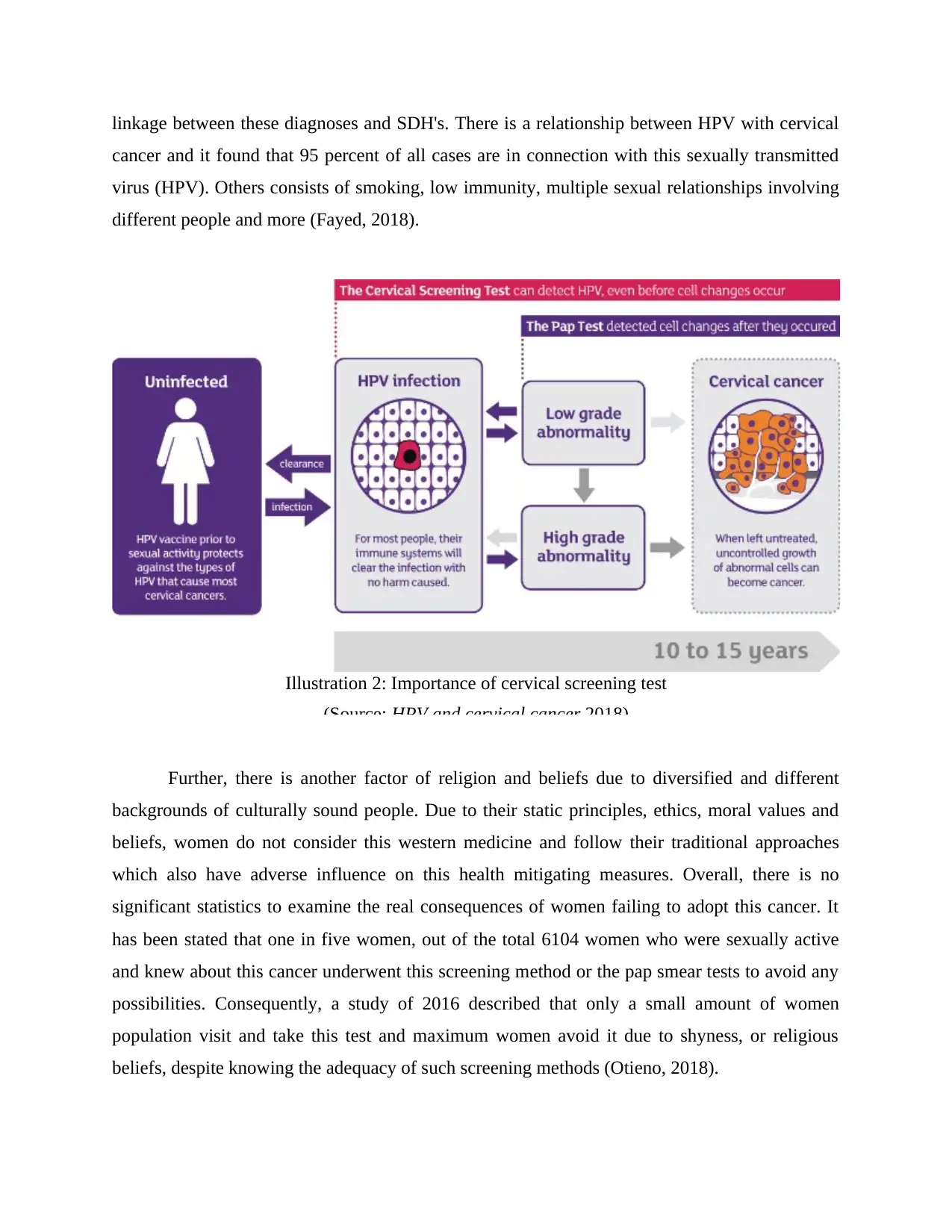
linkage between these diagnoses and SDH's. There is a relationship between HPV with cervical
cancer and it found that 95 percent of all cases are in connection with this sexually transmitted
virus (HPV). Others consists of smoking, low immunity, multiple sexual relationships involving
different people and more (Fayed, 2018).
Further, there is another factor of religion and beliefs due to diversified and different
backgrounds of culturally sound people. Due to their static principles, ethics, moral values and
beliefs, women do not consider this western medicine and follow their traditional approaches
which also have adverse influence on this health mitigating measures. Overall, there is no
significant statistics to examine the real consequences of women failing to adopt this cancer. It
has been stated that one in five women, out of the total 6104 women who were sexually active
and knew about this cancer underwent this screening method or the pap smear tests to avoid any
possibilities. Consequently, a study of 2016 described that only a small amount of women
population visit and take this test and maximum women avoid it due to shyness, or religious
beliefs, despite knowing the adequacy of such screening methods (Otieno, 2018).
Illustration 2: Importance of cervical screening test
(Source: HPV and cervical cancer,2018)
cancer and it found that 95 percent of all cases are in connection with this sexually transmitted
virus (HPV). Others consists of smoking, low immunity, multiple sexual relationships involving
different people and more (Fayed, 2018).
Further, there is another factor of religion and beliefs due to diversified and different
backgrounds of culturally sound people. Due to their static principles, ethics, moral values and
beliefs, women do not consider this western medicine and follow their traditional approaches
which also have adverse influence on this health mitigating measures. Overall, there is no
significant statistics to examine the real consequences of women failing to adopt this cancer. It
has been stated that one in five women, out of the total 6104 women who were sexually active
and knew about this cancer underwent this screening method or the pap smear tests to avoid any
possibilities. Consequently, a study of 2016 described that only a small amount of women
population visit and take this test and maximum women avoid it due to shyness, or religious
beliefs, despite knowing the adequacy of such screening methods (Otieno, 2018).
Illustration 2: Importance of cervical screening test
(Source: HPV and cervical cancer,2018)
Part 3
T-There is a redesigning plan that has to be followed to gain the insights and bring people
together to fight back this medical condition in appropriate manner. One of the effective
measures include the visibility factor in regard to psychological effects on the minds of women.
Their attachment to religious beliefs and societal norms can be misleading and might hamper
their lives. Mostly, this type of cancer is caused due to HPV whereas less than one percent are
accounted towards the neuroendocrine cancer due to the hormonal dis-balance. Henceforth, both
pap test and cervical screening tests have no role in tackling to this type and leads to understand
the re-orientation of the research study for bringing some solutions.
Promotion must be done on both the levels, regional and national levels to generate
awareness among people, including men, elderly about the need of choosing this test every five
years to safeguard themselves as few vaccines protect against only few types of HPV, leaving a
pool of entries to be affected by this disease. Along with, active participation from the
government and social personalities can help in popularizing the utilities of this testing program
with its overall benefits and advantages.
Y- This is the last stage in which the above mentioned redesigning components must be in the
same lines of the SDH approach. Along with, this modification is the need of the hour due to
vulnerabilities that women faces because of the pertinent gender inequality and injustice at the
community level. Here, the time-frame cannot be in variable terms as the barriers that have been
aforementioned are difficult to eliminate in short span of time. However, with consistent efforts
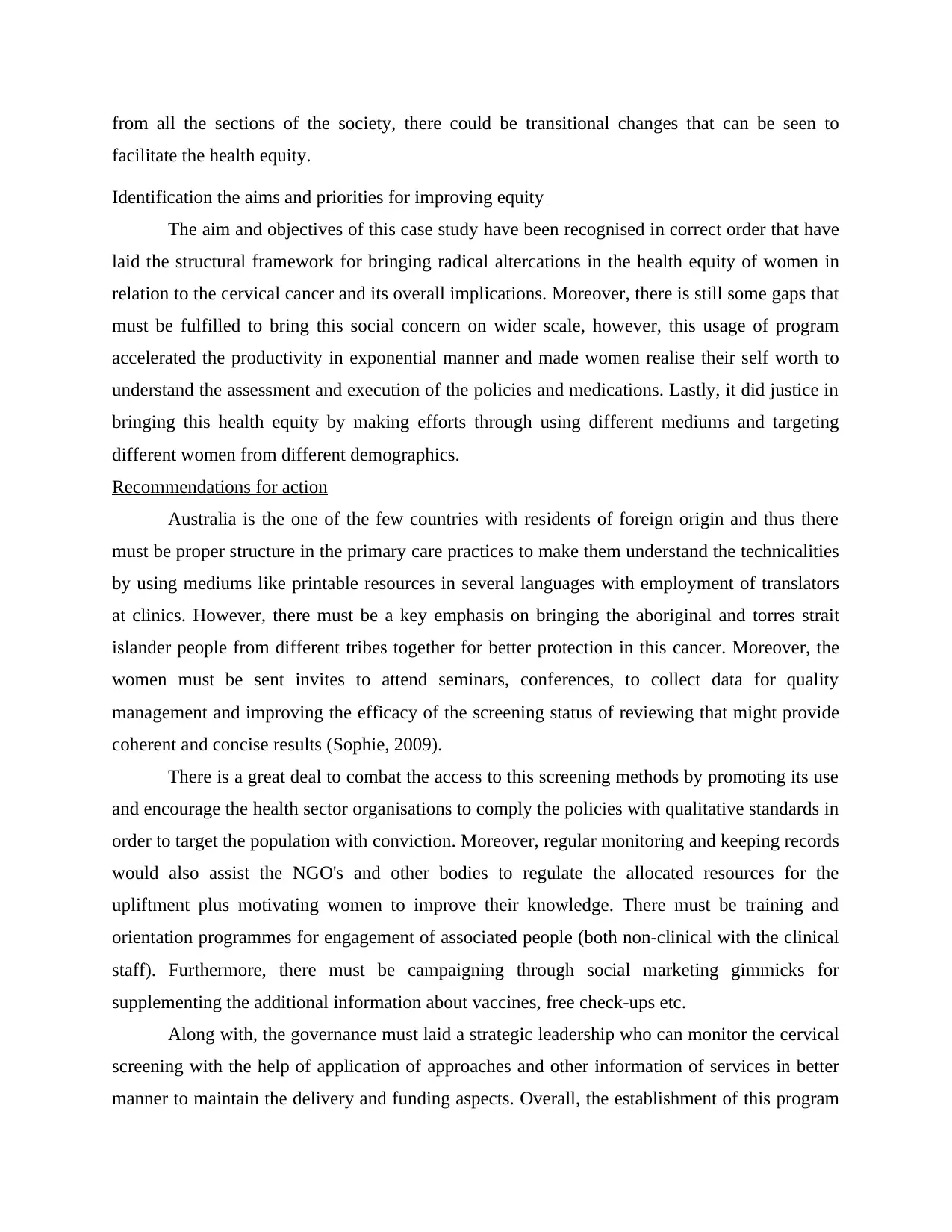
Illustration 3: Common reasons for not attending this screening test by women
(Source: Sofianos, 2017)
T-There is a redesigning plan that has to be followed to gain the insights and bring people
together to fight back this medical condition in appropriate manner. One of the effective
measures include the visibility factor in regard to psychological effects on the minds of women.
Their attachment to religious beliefs and societal norms can be misleading and might hamper
their lives. Mostly, this type of cancer is caused due to HPV whereas less than one percent are
accounted towards the neuroendocrine cancer due to the hormonal dis-balance. Henceforth, both
pap test and cervical screening tests have no role in tackling to this type and leads to understand
the re-orientation of the research study for bringing some solutions.
Promotion must be done on both the levels, regional and national levels to generate
awareness among people, including men, elderly about the need of choosing this test every five
years to safeguard themselves as few vaccines protect against only few types of HPV, leaving a
pool of entries to be affected by this disease. Along with, active participation from the
government and social personalities can help in popularizing the utilities of this testing program
with its overall benefits and advantages.
Y- This is the last stage in which the above mentioned redesigning components must be in the
same lines of the SDH approach. Along with, this modification is the need of the hour due to
vulnerabilities that women faces because of the pertinent gender inequality and injustice at the
community level. Here, the time-frame cannot be in variable terms as the barriers that have been
aforementioned are difficult to eliminate in short span of time. However, with consistent efforts
Illustration 3: Common reasons for not attending this screening test by women
(Source: Sofianos, 2017)
⊘ This is a preview!⊘
Do you want full access?
Subscribe today to unlock all pages.
Trusted by 1+ million students worldwide
from all the sections of the society, there could be transitional changes that can be seen to
facilitate the health equity.
Identification the aims and priorities for improving equity
The aim and objectives of this case study have been recognised in correct order that have
laid the structural framework for bringing radical altercations in the health equity of women in
relation to the cervical cancer and its overall implications. Moreover, there is still some gaps that
must be fulfilled to bring this social concern on wider scale, however, this usage of program
accelerated the productivity in exponential manner and made women realise their self worth to
understand the assessment and execution of the policies and medications. Lastly, it did justice in
bringing this health equity by making efforts through using different mediums and targeting
different women from different demographics.
Recommendations for action
Australia is the one of the few countries with residents of foreign origin and thus there
must be proper structure in the primary care practices to make them understand the technicalities
by using mediums like printable resources in several languages with employment of translators
at clinics. However, there must be a key emphasis on bringing the aboriginal and torres strait
islander people from different tribes together for better protection in this cancer. Moreover, the
women must be sent invites to attend seminars, conferences, to collect data for quality
management and improving the efficacy of the screening status of reviewing that might provide
coherent and concise results (Sophie, 2009).
There is a great deal to combat the access to this screening methods by promoting its use
and encourage the health sector organisations to comply the policies with qualitative standards in
order to target the population with conviction. Moreover, regular monitoring and keeping records
would also assist the NGO's and other bodies to regulate the allocated resources for the
upliftment plus motivating women to improve their knowledge. There must be training and
orientation programmes for engagement of associated people (both non-clinical with the clinical
staff). Furthermore, there must be campaigning through social marketing gimmicks for
supplementing the additional information about vaccines, free check-ups etc.
Along with, the governance must laid a strategic leadership who can monitor the cervical
screening with the help of application of approaches and other information of services in better
manner to maintain the delivery and funding aspects. Overall, the establishment of this program
facilitate the health equity.
Identification the aims and priorities for improving equity
The aim and objectives of this case study have been recognised in correct order that have
laid the structural framework for bringing radical altercations in the health equity of women in
relation to the cervical cancer and its overall implications. Moreover, there is still some gaps that
must be fulfilled to bring this social concern on wider scale, however, this usage of program
accelerated the productivity in exponential manner and made women realise their self worth to
understand the assessment and execution of the policies and medications. Lastly, it did justice in
bringing this health equity by making efforts through using different mediums and targeting
different women from different demographics.
Recommendations for action
Australia is the one of the few countries with residents of foreign origin and thus there
must be proper structure in the primary care practices to make them understand the technicalities
by using mediums like printable resources in several languages with employment of translators
at clinics. However, there must be a key emphasis on bringing the aboriginal and torres strait
islander people from different tribes together for better protection in this cancer. Moreover, the
women must be sent invites to attend seminars, conferences, to collect data for quality
management and improving the efficacy of the screening status of reviewing that might provide
coherent and concise results (Sophie, 2009).
There is a great deal to combat the access to this screening methods by promoting its use
and encourage the health sector organisations to comply the policies with qualitative standards in
order to target the population with conviction. Moreover, regular monitoring and keeping records
would also assist the NGO's and other bodies to regulate the allocated resources for the
upliftment plus motivating women to improve their knowledge. There must be training and
orientation programmes for engagement of associated people (both non-clinical with the clinical
staff). Furthermore, there must be campaigning through social marketing gimmicks for
supplementing the additional information about vaccines, free check-ups etc.
Along with, the governance must laid a strategic leadership who can monitor the cervical
screening with the help of application of approaches and other information of services in better
manner to maintain the delivery and funding aspects. Overall, the establishment of this program
Paraphrase This Document
Need a fresh take? Get an instant paraphrase of this document with our AI Paraphraser
must recognise the opportunities for coordination and collaboration of professional bodies
through suitable functioning of all the procedural instructions and guidelines to make it easier for
women to convene the monthly cervical screening project.
Part 4
Lessoned Learned
This section comprises the influence of the screening studies with an overview of the
traige studies that have been conducted in context to this screening program. Also, there has been
reductions in this form of cancer through the adoption of this program at national levels.
However, there were few limitations that were seen as the range got increased but it acted as an
effective move taken by the authorities to combat this cervical cancer and analysed the overall
consequences it had on the characterization of the onset of this disease in women (Beth and
et.al., 2018).
CONCLUSION
It has been summarized that this NCSP has successfully decreased the entire pressure of
the cervical cancer cases by substantial amount through proper facilitation in terms of planning,
detecting and treating the pre-cancerous cells. Along with, there has been an upsurge in adopting
other technologies in this arena and included HPV vaccination, review of this policy and few
more recommended changes that brought revolutionary changes in this sector. It had also
highlighted the adoption of this program among those women also who have already crossed the
age range which has put a stark difference in the standard of living of women on the whole.
Lastly, it has laid an understanding on the women between 20-24 years that have suppressed the
rate in efficient order and now in control of this condition that has spiralling effects on their well-
being and health.
through suitable functioning of all the procedural instructions and guidelines to make it easier for
women to convene the monthly cervical screening project.
Part 4
Lessoned Learned
This section comprises the influence of the screening studies with an overview of the
traige studies that have been conducted in context to this screening program. Also, there has been
reductions in this form of cancer through the adoption of this program at national levels.
However, there were few limitations that were seen as the range got increased but it acted as an
effective move taken by the authorities to combat this cervical cancer and analysed the overall
consequences it had on the characterization of the onset of this disease in women (Beth and
et.al., 2018).
CONCLUSION
It has been summarized that this NCSP has successfully decreased the entire pressure of
the cervical cancer cases by substantial amount through proper facilitation in terms of planning,
detecting and treating the pre-cancerous cells. Along with, there has been an upsurge in adopting
other technologies in this arena and included HPV vaccination, review of this policy and few
more recommended changes that brought revolutionary changes in this sector. It had also
highlighted the adoption of this program among those women also who have already crossed the
age range which has put a stark difference in the standard of living of women on the whole.
Lastly, it has laid an understanding on the women between 20-24 years that have suppressed the
rate in efficient order and now in control of this condition that has spiralling effects on their well-
being and health.
REFERENCES
Books and Journals
Anna M. and et.al., 2015. Cancer screening for people with learning disabilities and the role of
the screening liaison nurse. Vol. 20 Issue: 4. pp.239-246
Beth S. and et.al., 2018. It’s My Time: applying the health belief model to prevent cervical
cancer among college-age women. Vol. 22 Issue: 2. pp.161-178
Lauren D., Vetta L. and Sanders Thompson,2012. Racial and Global Disparities in Human
Papillomavirus Infection and Cervical Cancer, in Sheri R. Notaro(ed.)Health Disparities
Among Under-served Populations: Implications for Research, Policy and Praxis (Advances
in Education in Diverse Communities: Research, Policy and Praxis, Volume 9)Emerald
Group Publishing Limited, pp.135 - 156
Sophie, C., 2009. A media analysis approach to evaluating national health information
infrastructure development".Vol. 11 Issue: 3. pp.208-229
Online
Cervical Cancer Screening Updates, 2018. [Online].Available
through:<https://www.lvhn.org/conditions_treatments/cancer/cervical_cancer/
why_choose_us/cervical_cancer_screening_updates>.
Fayed,L., 2018. An Overview of Cervical Cancer.[Online].Available
through:<https://www.verywellhealth.com/cervical-cancer-overview-513847>
HPV and cervical cancer,2018. [Online].Available
through:<https://www.cancer.nsw.gov.au/cervical-screening-nsw/cervical-cancer/about-
cervical-cancer>.
Otieno,D.,2018. Most women know screening for the cancer is useful but few follow through.
[Online].Available through:<https://www.nation.co.ke/newsplex/cervicalcancer/2718262-
4686408-3jynnv/index.html>.
Sofianos, G.,2017. Cervical screening. [Online].Available
through:<http://gemsofianos.co.uk/latest/2017/6/16/cervical-screening-week-how-smears-save-
lives>.
Books and Journals
Anna M. and et.al., 2015. Cancer screening for people with learning disabilities and the role of
the screening liaison nurse. Vol. 20 Issue: 4. pp.239-246
Beth S. and et.al., 2018. It’s My Time: applying the health belief model to prevent cervical
cancer among college-age women. Vol. 22 Issue: 2. pp.161-178
Lauren D., Vetta L. and Sanders Thompson,2012. Racial and Global Disparities in Human
Papillomavirus Infection and Cervical Cancer, in Sheri R. Notaro(ed.)Health Disparities
Among Under-served Populations: Implications for Research, Policy and Praxis (Advances
in Education in Diverse Communities: Research, Policy and Praxis, Volume 9)Emerald
Group Publishing Limited, pp.135 - 156
Sophie, C., 2009. A media analysis approach to evaluating national health information
infrastructure development".Vol. 11 Issue: 3. pp.208-229
Online
Cervical Cancer Screening Updates, 2018. [Online].Available
through:<https://www.lvhn.org/conditions_treatments/cancer/cervical_cancer/
why_choose_us/cervical_cancer_screening_updates>.
Fayed,L., 2018. An Overview of Cervical Cancer.[Online].Available
through:<https://www.verywellhealth.com/cervical-cancer-overview-513847>
HPV and cervical cancer,2018. [Online].Available
through:<https://www.cancer.nsw.gov.au/cervical-screening-nsw/cervical-cancer/about-
cervical-cancer>.
Otieno,D.,2018. Most women know screening for the cancer is useful but few follow through.
[Online].Available through:<https://www.nation.co.ke/newsplex/cervicalcancer/2718262-
4686408-3jynnv/index.html>.
Sofianos, G.,2017. Cervical screening. [Online].Available
through:<http://gemsofianos.co.uk/latest/2017/6/16/cervical-screening-week-how-smears-save-
lives>.
⊘ This is a preview!⊘
Do you want full access?
Subscribe today to unlock all pages.
Trusted by 1+ million students worldwide

1 out of 12


Related Documents


Your All-in-One AI-Powered Toolkit for Academic Success.
+13062052269
info@desklib.com
Available 24*7 on WhatsApp / Email
![[object Object]](/_next/static/media/star-bottom.7253800d.svg)
Unlock your academic potential
Copyright © 2020–2026 A2Z Services. All Rights Reserved. Developed and managed by ZUCOL.