Evaluating Indigenous Perspectives in Australian Policy Design
VerifiedAdded on 2023/04/11
|10
|2474
|449
Essay
AI Summary
This essay examines the representation of Indigenous people in Australian policy in Australia, focusing on whether their worldviews are adequately represented. It discusses historical government policies and recent initiatives aimed at supporting Indigenous communities, including the right to vote, land rights, and the "Closing the Gap" campaign. The essay further analyzes challenges such as poverty, poor education, health issues, and discrimination, and how these factors impact Indigenous people's ability to thrive. It also highlights international efforts, such as the UN Declaration on the Rights of Indigenous Peoples, and ongoing surveys to assess the effectiveness of government aid and address persisting inequalities. Desklib provides access to this essay and other resources to assist students in their studies.
Indigenous people 1
Introduction
This essay has been penned down to clarify the position and representation of
indigenous people in Australia. Indigenous affairs have always been the first concern of the
Australian government. Whether they are being represented at a national platform or being
neglected by the government? This will help in understanding the condition of indigenous
people, if they are being supported and facilitated by the government and if they would have
been given basic rights or not? Has the government made any policy in their favour?
Moreover, are treated like other citizens in policies, or there is no policy for them?
(Delfabbro et al. 2010)
Indigenous people of Australia are known as the oldest societies of the world. Their
culture is very attractive and fascinating although difficult to understand. Few of them know
the importance of preserving their culture and few integrate them into white Australian
society because they have to deal with the current situation and their status. They recently
represent 3% of the population. Australian indigenous people are the Aboriginal and Torres
Strait Islander of Australia (Humphreys 2010). These are the groups of people who lived in
Australia and nearby islands before the British establishment. This is considered as a debate
topic among researchers about the first arrival of indigenous people in Australia. Since the
European invasions till to date, government policies, in favor of indigenous people has been
set and exercised by non-indigenous people (Clements et al. 2010).
For the well-being and increasing development of a country, it is important for a state
to give basic human rights to minorities as well. In early, their population was not that much,
and they were considered as minorities and were not given the basic citizen's rights (Ramsay
2016a). But now as their population is increasing rapidly, they are not only given the basic
citizen's rights but also there are policies designed in their favour. In the past few years,
Introduction
This essay has been penned down to clarify the position and representation of
indigenous people in Australia. Indigenous affairs have always been the first concern of the
Australian government. Whether they are being represented at a national platform or being
neglected by the government? This will help in understanding the condition of indigenous
people, if they are being supported and facilitated by the government and if they would have
been given basic rights or not? Has the government made any policy in their favour?
Moreover, are treated like other citizens in policies, or there is no policy for them?
(Delfabbro et al. 2010)
Indigenous people of Australia are known as the oldest societies of the world. Their
culture is very attractive and fascinating although difficult to understand. Few of them know
the importance of preserving their culture and few integrate them into white Australian
society because they have to deal with the current situation and their status. They recently
represent 3% of the population. Australian indigenous people are the Aboriginal and Torres
Strait Islander of Australia (Humphreys 2010). These are the groups of people who lived in
Australia and nearby islands before the British establishment. This is considered as a debate
topic among researchers about the first arrival of indigenous people in Australia. Since the
European invasions till to date, government policies, in favor of indigenous people has been
set and exercised by non-indigenous people (Clements et al. 2010).
For the well-being and increasing development of a country, it is important for a state
to give basic human rights to minorities as well. In early, their population was not that much,
and they were considered as minorities and were not given the basic citizen's rights (Ramsay
2016a). But now as their population is increasing rapidly, they are not only given the basic
citizen's rights but also there are policies designed in their favour. In the past few years,

Paraphrase This Document
Need a fresh take? Get an instant paraphrase of this document with our AI Paraphraser
Indigenous people 2
significant steps have been taken at the international level to increase awareness and to
protect the rights of indigenous people.
Policy for indigenous people
In 1962, the Australian government gave indigenous people the optional right to vote,
but they were still categorised as "ward of states" considered as they did not have a right of
vote in state elections (Waterhouse & McGhee 2015). In 1943, the board administered
government policies, dictating where indigenous people could work, live, their freedom
movement, their personal finances and their child-rearing practices. In addition to this, a
referendum was made in 1967 that sought to give the Commonwealth parliament power to
make laws which respect to indigenous people wherever they live in Australia. It also sought
to make it possible to include indigenous people in national censuses.
On a serious note, the basic human rights of indigenous people are still not given to
them. It is like far worse than non-indigenous people. Their life expectancy is still low
because the infant mortality rate is higher than non-indigenous people. The housing
conditions of non-indigenous people are worst because of lack of supplying of basic needs
like water, health and education. The education levels for indigenous people are below
average level (Skattebol 2017). Very few can have access to higher school and university.
Indigenous people have a long and scary experience of living life on their own. However, it
was stated in the policy that they can have their own lands, but despite of that, they were
forcibly taken from their land.
They have gone through soo much in their lives just for they can have access to the
basic necessity of life. But the picture of this history is still seen today where indigenous
people are still forced in alcoholism and drug dependence so that they can achieve higher
standards of living. That's the reason their life expectancy is low (Gill & Oakley 2018).
Australia is count in one of those countries where the highest standards of living are
being practised. But unfortunately, indigenous people are still lacking these standards.
significant steps have been taken at the international level to increase awareness and to
protect the rights of indigenous people.
Policy for indigenous people
In 1962, the Australian government gave indigenous people the optional right to vote,
but they were still categorised as "ward of states" considered as they did not have a right of
vote in state elections (Waterhouse & McGhee 2015). In 1943, the board administered
government policies, dictating where indigenous people could work, live, their freedom
movement, their personal finances and their child-rearing practices. In addition to this, a
referendum was made in 1967 that sought to give the Commonwealth parliament power to
make laws which respect to indigenous people wherever they live in Australia. It also sought
to make it possible to include indigenous people in national censuses.
On a serious note, the basic human rights of indigenous people are still not given to
them. It is like far worse than non-indigenous people. Their life expectancy is still low
because the infant mortality rate is higher than non-indigenous people. The housing
conditions of non-indigenous people are worst because of lack of supplying of basic needs
like water, health and education. The education levels for indigenous people are below
average level (Skattebol 2017). Very few can have access to higher school and university.
Indigenous people have a long and scary experience of living life on their own. However, it
was stated in the policy that they can have their own lands, but despite of that, they were
forcibly taken from their land.
They have gone through soo much in their lives just for they can have access to the
basic necessity of life. But the picture of this history is still seen today where indigenous
people are still forced in alcoholism and drug dependence so that they can achieve higher
standards of living. That's the reason their life expectancy is low (Gill & Oakley 2018).
Australia is count in one of those countries where the highest standards of living are
being practised. But unfortunately, indigenous people are still lacking these standards.
Indigenous people 3
Generally, it can be stated that indigenous people are still living in rural and remote
areas as compared to other Australians. About 70% population of indigenous people
comprises in towns with less than 100 000 inhabitants compared to 40% of the total
population of Australia. There are multi-family households, and on an average, the only
person is earning. Still, their hospitality is on point. Their house is every time open for family
and friends (Meyer & Eggins 2018a).
Unemployment is the major issue indigenous people are facing these days. The reason
for this is they are not given the right education to take high standards jobs. Very few of them
reaches a higher level of school and university graduate level. Many of them are working in
public forums or some organisations working for indigenous people (Connolly 2017). In
many professions indigenous people are underrepresented. Mostly they live their lives on
unemployment benefits and welfare.
Today the main root of problems faced by indigenous people is poor education. The
less education rate of indigenous people leads them to fewer opportunities and thus results in
unemployment and poverty. No doubt programs are being made to educate them, and
government programs are being run to provide financial aid. White Australians fails to
indigenous people due to sarcasm and racism (Hollinsworth 2016).
The health issue of indigenous people is in the worst condition. The bad health
condition may have several reasons. Poverty, low standards of hygiene and not suitable
nutritious food is the main reason for bad health. Some of them suffer from depression and
anxiety, and the problem here goes round about and come to the point of education. They are
not educated and thus engage themselves in alcoholism and drug addictive (Godinet et al.
2011).
1970 is marked as a turning point in the history of non-indigenous people. The
essential development was the non-indigenous Land Right Act, implemented by the liberal
Generally, it can be stated that indigenous people are still living in rural and remote
areas as compared to other Australians. About 70% population of indigenous people
comprises in towns with less than 100 000 inhabitants compared to 40% of the total
population of Australia. There are multi-family households, and on an average, the only
person is earning. Still, their hospitality is on point. Their house is every time open for family
and friends (Meyer & Eggins 2018a).
Unemployment is the major issue indigenous people are facing these days. The reason
for this is they are not given the right education to take high standards jobs. Very few of them
reaches a higher level of school and university graduate level. Many of them are working in
public forums or some organisations working for indigenous people (Connolly 2017). In
many professions indigenous people are underrepresented. Mostly they live their lives on
unemployment benefits and welfare.
Today the main root of problems faced by indigenous people is poor education. The
less education rate of indigenous people leads them to fewer opportunities and thus results in
unemployment and poverty. No doubt programs are being made to educate them, and
government programs are being run to provide financial aid. White Australians fails to
indigenous people due to sarcasm and racism (Hollinsworth 2016).
The health issue of indigenous people is in the worst condition. The bad health
condition may have several reasons. Poverty, low standards of hygiene and not suitable
nutritious food is the main reason for bad health. Some of them suffer from depression and
anxiety, and the problem here goes round about and come to the point of education. They are
not educated and thus engage themselves in alcoholism and drug addictive (Godinet et al.
2011).
1970 is marked as a turning point in the history of non-indigenous people. The
essential development was the non-indigenous Land Right Act, implemented by the liberal
⊘ This is a preview!⊘
Do you want full access?
Subscribe today to unlock all pages.

Trusted by 1+ million students worldwide
Indigenous people 4
government in 1976. This Act initiated the basis for some extent of long-term security and
economic development for them. But still, they have been neglected in many aspects as just
because they are less in number and because of sarcasm.
Though the government has now started some programs and campaigns to mark their identity
in Australia and give them equal rights as given to other Australians (Tilbury & Thoburn
2009).
For closing the gap between indigenous people and non-indigenous people, the
government has started the campaign named "closing the gap". This is the initiative taken by
the government for mingling indigenous people and giving them chances to let them match
their every foot-step with others. The goals to be achieved for this area are health, education,
employment will be going to prove as key drivers for removing differences among
indigenous and non-indigenous people (Brown et al. 2011).
Rights to indigenous people
This is the international law that explains the self-determination law as the basic right
of all individuals to freely pursue their political status and their social, economic and cultural
development. Indigenous people are represented along with other identities of Australia.
The government has taken various steps for the advancement of indigenous people.
And these are funded through the Prime minister and cabinet to make it possible and easy for
the development of their community. Pumping their three basic rights can help them to boost
them economically and socially also are
The positive impact of education that they can have on their society, and this will
definitely help them improving and moving forward (Leinaweaver 2015a).
Employment, social participation and economic development help them to improve the lives
of their families and as well as their community.
Investing in their health because no one can prosper without sufficient health
condition. Growing up in a safe and healthy environment is every individual’s right.
government in 1976. This Act initiated the basis for some extent of long-term security and
economic development for them. But still, they have been neglected in many aspects as just
because they are less in number and because of sarcasm.
Though the government has now started some programs and campaigns to mark their identity
in Australia and give them equal rights as given to other Australians (Tilbury & Thoburn
2009).
For closing the gap between indigenous people and non-indigenous people, the
government has started the campaign named "closing the gap". This is the initiative taken by
the government for mingling indigenous people and giving them chances to let them match
their every foot-step with others. The goals to be achieved for this area are health, education,
employment will be going to prove as key drivers for removing differences among
indigenous and non-indigenous people (Brown et al. 2011).
Rights to indigenous people
This is the international law that explains the self-determination law as the basic right
of all individuals to freely pursue their political status and their social, economic and cultural
development. Indigenous people are represented along with other identities of Australia.
The government has taken various steps for the advancement of indigenous people.
And these are funded through the Prime minister and cabinet to make it possible and easy for
the development of their community. Pumping their three basic rights can help them to boost
them economically and socially also are
The positive impact of education that they can have on their society, and this will
definitely help them improving and moving forward (Leinaweaver 2015a).
Employment, social participation and economic development help them to improve the lives
of their families and as well as their community.
Investing in their health because no one can prosper without sufficient health
condition. Growing up in a safe and healthy environment is every individual’s right.
Paraphrase This Document
Need a fresh take? Get an instant paraphrase of this document with our AI Paraphraser
Indigenous people 5
The Department of Prime Minister and the cabinet is spending $222.3 million in
funding in 2015-2016 in support of indigenous people to provide them with a better
opportunity which nourishes, nurture and educates indigenous people to educate their
children, youth and adults for their improvement to select the better pathway for them. This
includes in the improvement of family and parenting support, higher education and youth
engagement (Tomyn et al. 2015). This program is mainly focused on increasing the number
of schools in underprivileged areas and in remote areas to improve the educational outcome
which leads them to increase the employment rate.
This area has been supported by the education department to the indigenous people
living in remote areas where their goal is to provide primary education to the children. The
teacher takes a decision over the learning criteria and outcomes and demonstrates them by
modelling and check their understanding through assessments. They simply focus on making
them proficient in their pre-developed skills.
Steps have been taken to take it to the international level for protecting the rights of
indigenous people including the landmark adoption of the UN Declaration of the rights of
indigenous people in 2007. The Australian government showed its support to the declaration
in April 2009.
In addition to this, there are more UN bodies that are mainly established in spreading
awareness, promoting and protecting the rights of indigenous people of Australia, where their
goal is to see the reflection in national laws and policies (Connolly 2017a).
Analysing from one end of the picture, some indigenous are living in urban areas and
engaging them with the increasing market economy like other Australians. While the other
image shows those, who reside in remote parts and maintaining the important aspects of the
indigenous economy. The department of infrastructure and regional development facilitates
the underprivileged through air services to remote areas where they don’t have access to any
The Department of Prime Minister and the cabinet is spending $222.3 million in
funding in 2015-2016 in support of indigenous people to provide them with a better
opportunity which nourishes, nurture and educates indigenous people to educate their
children, youth and adults for their improvement to select the better pathway for them. This
includes in the improvement of family and parenting support, higher education and youth
engagement (Tomyn et al. 2015). This program is mainly focused on increasing the number
of schools in underprivileged areas and in remote areas to improve the educational outcome
which leads them to increase the employment rate.
This area has been supported by the education department to the indigenous people
living in remote areas where their goal is to provide primary education to the children. The
teacher takes a decision over the learning criteria and outcomes and demonstrates them by
modelling and check their understanding through assessments. They simply focus on making
them proficient in their pre-developed skills.
Steps have been taken to take it to the international level for protecting the rights of
indigenous people including the landmark adoption of the UN Declaration of the rights of
indigenous people in 2007. The Australian government showed its support to the declaration
in April 2009.
In addition to this, there are more UN bodies that are mainly established in spreading
awareness, promoting and protecting the rights of indigenous people of Australia, where their
goal is to see the reflection in national laws and policies (Connolly 2017a).
Analysing from one end of the picture, some indigenous are living in urban areas and
engaging them with the increasing market economy like other Australians. While the other
image shows those, who reside in remote parts and maintaining the important aspects of the
indigenous economy. The department of infrastructure and regional development facilitates
the underprivileged through air services to remote areas where they don’t have access to any
Indigenous people 6
commercially viable (Ramsay 2016b). They subside weekly air service for the carrying
passengers and transportation of goods such as medicines, fresh foods, educational materials
and any urgent supply that is the requirement of indigenous people.
Surveys have been done and continue doing on the present condition of indigenous
people in Australia to reveal the truth behind the picture. If the government aid has been
reaching to them? Are they facilitated with the basic necessity of life? Or they are still being
neglected at anywhere in the state.
According to the surveys, alcoholism is one of the major prejudice. This is the result
of poverty and poor education. Many of them were asked why they don’t let children attend
the school to which they reply. It is because white Australians don’t let them practice their
culture and force them to follow theirs (Connollyn 2017b).
Some of them were asked what is the other reason for their less employment rate
despite of education. To which they reply that most of the white Australians do not want to
work with them on the basis of sarcasm and racism. But on the contrary, this reason is being
demolished due to increased awareness.
This question was asked to non-indigenous people, that is it fair that the government
is supporting indigenous people more than non-indigenous people. And the results are quite
astonishing. They said they have no issues if the government is supporting them more. Even
some of them agree on a point that non-indigenous society has some responsibilities towards
them to build their community strong and help them to improve their standards of living
(Meyer & Eggins 2018b).
Many non-indigenous people say that reconciliation week and sorry days can be
celebrated in sympathy with indigenous people of Australia to make them realise and believe
that what has done in the past with them was wrong and now we are standing with them
(Leinaweaver 2015b).
commercially viable (Ramsay 2016b). They subside weekly air service for the carrying
passengers and transportation of goods such as medicines, fresh foods, educational materials
and any urgent supply that is the requirement of indigenous people.
Surveys have been done and continue doing on the present condition of indigenous
people in Australia to reveal the truth behind the picture. If the government aid has been
reaching to them? Are they facilitated with the basic necessity of life? Or they are still being
neglected at anywhere in the state.
According to the surveys, alcoholism is one of the major prejudice. This is the result
of poverty and poor education. Many of them were asked why they don’t let children attend
the school to which they reply. It is because white Australians don’t let them practice their
culture and force them to follow theirs (Connollyn 2017b).
Some of them were asked what is the other reason for their less employment rate
despite of education. To which they reply that most of the white Australians do not want to
work with them on the basis of sarcasm and racism. But on the contrary, this reason is being
demolished due to increased awareness.
This question was asked to non-indigenous people, that is it fair that the government
is supporting indigenous people more than non-indigenous people. And the results are quite
astonishing. They said they have no issues if the government is supporting them more. Even
some of them agree on a point that non-indigenous society has some responsibilities towards
them to build their community strong and help them to improve their standards of living
(Meyer & Eggins 2018b).
Many non-indigenous people say that reconciliation week and sorry days can be
celebrated in sympathy with indigenous people of Australia to make them realise and believe
that what has done in the past with them was wrong and now we are standing with them
(Leinaweaver 2015b).
⊘ This is a preview!⊘
Do you want full access?
Subscribe today to unlock all pages.
Trusted by 1+ million students worldwide
Indigenous people 7
Conclusion
Though the challenges are still there government along with individuals are working
hard to make the living standards of indigenous people more sufficient. Even the government
has taken this issue to the international level for their basic rights. Unites Nations have
formed bodies for the protection of the rights of indigenous people.
Any community either in the majority or in the minority should be given equal
citizen's rights in the state. Policies must be formed in favour of minorities for the protection
of their rights.
Conclusion
Though the challenges are still there government along with individuals are working
hard to make the living standards of indigenous people more sufficient. Even the government
has taken this issue to the international level for their basic rights. Unites Nations have
formed bodies for the protection of the rights of indigenous people.
Any community either in the majority or in the minority should be given equal
citizen's rights in the state. Policies must be formed in favour of minorities for the protection
of their rights.
Paraphrase This Document
Need a fresh take? Get an instant paraphrase of this document with our AI Paraphraser
Indigenous people 8
References
Tomyn, A.J., Cummins, R.A. and Norrish, J.M., 2015. The subjective wellbeing of ‘At-
Risk’indigenous and non-indigenous Australian adolescents. Journal of happiness
studies, Vol. 16(4), pp.813-837.
Connolly, M., 2017. Beyond the Risk Paradigm in Child Protection: Current Debates and
New Directions. Palgrave.
Meyer, S. and Eggins, E., 2018. Formal and Informal Help‐Seeking by Australian Parents
who Misuse Alcohol. Child Abuse Review, Vol. 27(4), pp.317-335.
Ramsay, G., 2016. Black mothers, bad mothers: African refugee women and the governing of
‘Good’Citizens through the Australian child welfare system. Australian Feminist Studies,
Vol. 31(89), pp.319-335.
Hollinsworth, D., 2016. Unsettling Australian settler supremacy: combating resistance in
university Aboriginal studies. Race ethnicity and education, Vol. 19(2), pp.412-432.
Humphreys, C., 2010. Crossing the great divide: Response to Douglas and Walsh. Violence
Against Women, Vol. 16(5), pp.509-515.
Brown, J.D., St. Arnault, D., Sintzel, J. and George, N., 2011. Caring for children from the
same culture: Challenges for foster parents. Journal of Family Social Work, Vol. 14(5),
pp.446-460
Leinaweaver, J. B. (2015). Adoption, Demography of, International Encyclopedia of the
Social & Behavioral Sciences,
Waterhouse, L. and McGhee, J., 2015. Practitioner–mother relationships and the processes
that bind them. Child & Family Social Work, Vol. 20(2), pp.244-251.
Godinet, M.T., Arnsberger, P. and Garlock, J., 2011. Native Hawaiian Families Systemic
Disparities in Hawaii's Child Welfare System. Asia Pacific Journal of Social Work and
Development, Vol. 21(2), pp.34-45.
Clements, N., Clapton, J. and Chenoweth, L., 2010. Indigenous Australians and Impaired
Decision‐Making Capacity. Australian Journal of Social Issues, Vol. 45(3), pp.383-393.
Gill, A. and Oakley, G., 2018. Agency Workers’ Perceptions of Cross-System Collaboration
to Support Students in Out-of-Home Care. Children Australia, Vol. 43(1), pp.47-56.
References
Tomyn, A.J., Cummins, R.A. and Norrish, J.M., 2015. The subjective wellbeing of ‘At-
Risk’indigenous and non-indigenous Australian adolescents. Journal of happiness
studies, Vol. 16(4), pp.813-837.
Connolly, M., 2017. Beyond the Risk Paradigm in Child Protection: Current Debates and
New Directions. Palgrave.
Meyer, S. and Eggins, E., 2018. Formal and Informal Help‐Seeking by Australian Parents
who Misuse Alcohol. Child Abuse Review, Vol. 27(4), pp.317-335.
Ramsay, G., 2016. Black mothers, bad mothers: African refugee women and the governing of
‘Good’Citizens through the Australian child welfare system. Australian Feminist Studies,
Vol. 31(89), pp.319-335.
Hollinsworth, D., 2016. Unsettling Australian settler supremacy: combating resistance in
university Aboriginal studies. Race ethnicity and education, Vol. 19(2), pp.412-432.
Humphreys, C., 2010. Crossing the great divide: Response to Douglas and Walsh. Violence
Against Women, Vol. 16(5), pp.509-515.
Brown, J.D., St. Arnault, D., Sintzel, J. and George, N., 2011. Caring for children from the
same culture: Challenges for foster parents. Journal of Family Social Work, Vol. 14(5),
pp.446-460
Leinaweaver, J. B. (2015). Adoption, Demography of, International Encyclopedia of the
Social & Behavioral Sciences,
Waterhouse, L. and McGhee, J., 2015. Practitioner–mother relationships and the processes
that bind them. Child & Family Social Work, Vol. 20(2), pp.244-251.
Godinet, M.T., Arnsberger, P. and Garlock, J., 2011. Native Hawaiian Families Systemic
Disparities in Hawaii's Child Welfare System. Asia Pacific Journal of Social Work and
Development, Vol. 21(2), pp.34-45.
Clements, N., Clapton, J. and Chenoweth, L., 2010. Indigenous Australians and Impaired
Decision‐Making Capacity. Australian Journal of Social Issues, Vol. 45(3), pp.383-393.
Gill, A. and Oakley, G., 2018. Agency Workers’ Perceptions of Cross-System Collaboration
to Support Students in Out-of-Home Care. Children Australia, Vol. 43(1), pp.47-56.
Indigenous people 9
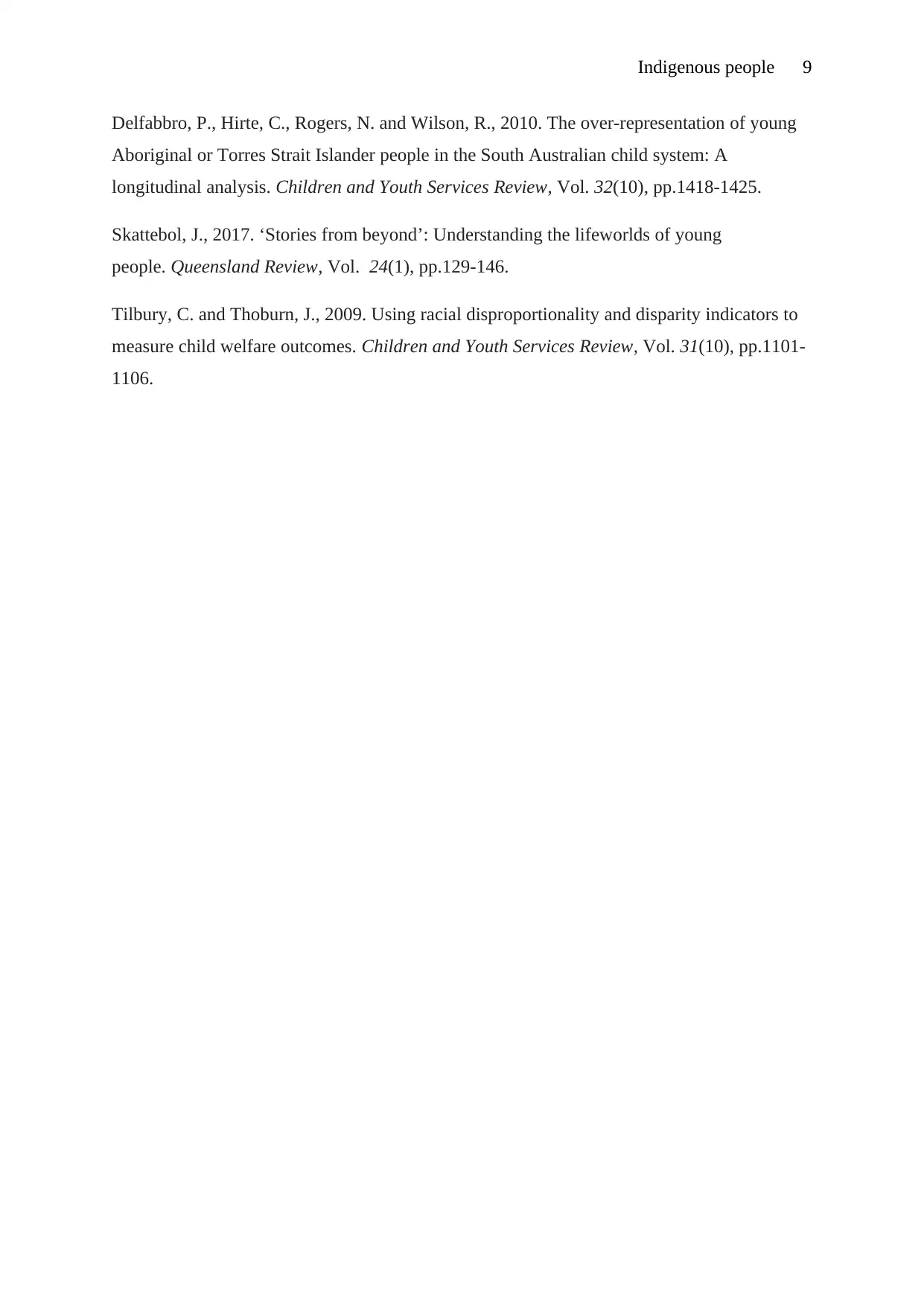
Delfabbro, P., Hirte, C., Rogers, N. and Wilson, R., 2010. The over-representation of young
Aboriginal or Torres Strait Islander people in the South Australian child system: A
longitudinal analysis. Children and Youth Services Review, Vol. 32(10), pp.1418-1425.
Skattebol, J., 2017. ‘Stories from beyond’: Understanding the lifeworlds of young
people. Queensland Review, Vol. 24(1), pp.129-146.
Tilbury, C. and Thoburn, J., 2009. Using racial disproportionality and disparity indicators to
measure child welfare outcomes. Children and Youth Services Review, Vol. 31(10), pp.1101-
1106.
Delfabbro, P., Hirte, C., Rogers, N. and Wilson, R., 2010. The over-representation of young
Aboriginal or Torres Strait Islander people in the South Australian child system: A
longitudinal analysis. Children and Youth Services Review, Vol. 32(10), pp.1418-1425.
Skattebol, J., 2017. ‘Stories from beyond’: Understanding the lifeworlds of young
people. Queensland Review, Vol. 24(1), pp.129-146.
Tilbury, C. and Thoburn, J., 2009. Using racial disproportionality and disparity indicators to
measure child welfare outcomes. Children and Youth Services Review, Vol. 31(10), pp.1101-
1106.
⊘ This is a preview!⊘
Do you want full access?
Subscribe today to unlock all pages.
Trusted by 1+ million students worldwide
Indigenous people 10
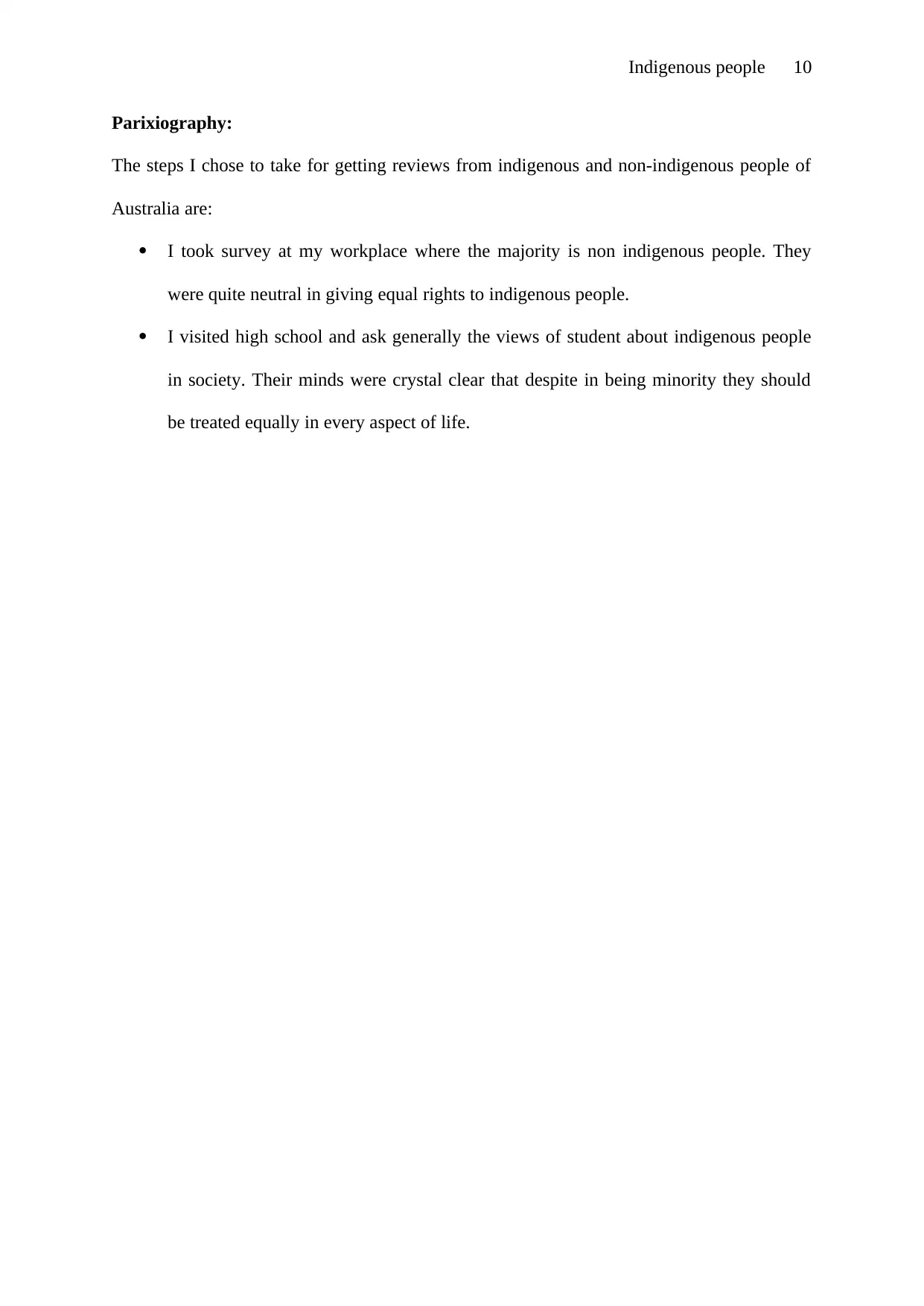
Parixiography:
The steps I chose to take for getting reviews from indigenous and non-indigenous people of
Australia are:
I took survey at my workplace where the majority is non indigenous people. They
were quite neutral in giving equal rights to indigenous people.
I visited high school and ask generally the views of student about indigenous people
in society. Their minds were crystal clear that despite in being minority they should
be treated equally in every aspect of life.
Parixiography:
The steps I chose to take for getting reviews from indigenous and non-indigenous people of
Australia are:
I took survey at my workplace where the majority is non indigenous people. They
were quite neutral in giving equal rights to indigenous people.
I visited high school and ask generally the views of student about indigenous people
in society. Their minds were crystal clear that despite in being minority they should
be treated equally in every aspect of life.

1 out of 10


Related Documents


Your All-in-One AI-Powered Toolkit for Academic Success.
+13062052269
info@desklib.com
Available 24*7 on WhatsApp / Email
![[object Object]](/_next/static/media/star-bottom.7253800d.svg)
Unlock your academic potential
Copyright © 2020–2026 A2Z Services. All Rights Reserved. Developed and managed by ZUCOL.