Impact of Retail & Hospitality Employment Levels on Australia's GDP
VerifiedAdded on 2023/06/04
|26
|5780
|94
Report
AI Summary
This report investigates the impact of employment levels in the retail and hospitality industries on Australia's GDP. It examines factors contributing to employment growth in these sectors, including the influence of technology, consumer behavior, infrastructure development, and tourism. The study analyzes the relationship between employment rates, unemployment rates, and GDP growth, highlighting the service sector's significant contribution to the Australian economy. The research also discusses challenges such as training gaps, seasonal job functions, and wage levels within the hospitality industry. Desklib offers students access to similar reports and solved assignments for further research and study.
Running head: IMPACT OF EMPLOYMENT LEVEL OF RETAIL AND
HOSPITALITY INDUSTRIES ON THE GDP OF THE AUSTRALIA
1
IMPACT OF EMPLOYMENT LEVEL OF RETAIL AND HOSPITALITY INDUSTRIES ON
THE GDP OF THE AUSTRALIA
[Author]
[Institution]
HOSPITALITY INDUSTRIES ON THE GDP OF THE AUSTRALIA
1
IMPACT OF EMPLOYMENT LEVEL OF RETAIL AND HOSPITALITY INDUSTRIES ON
THE GDP OF THE AUSTRALIA
[Author]
[Institution]

Paraphrase This Document
Need a fresh take? Get an instant paraphrase of this document with our AI Paraphraser
IMPACT OF EMPLOYMENT LEVEL OF RETAIL AND HOSPITALITY
INDUSTRIES ON THE GDP OF THE AUSTRALIA
2
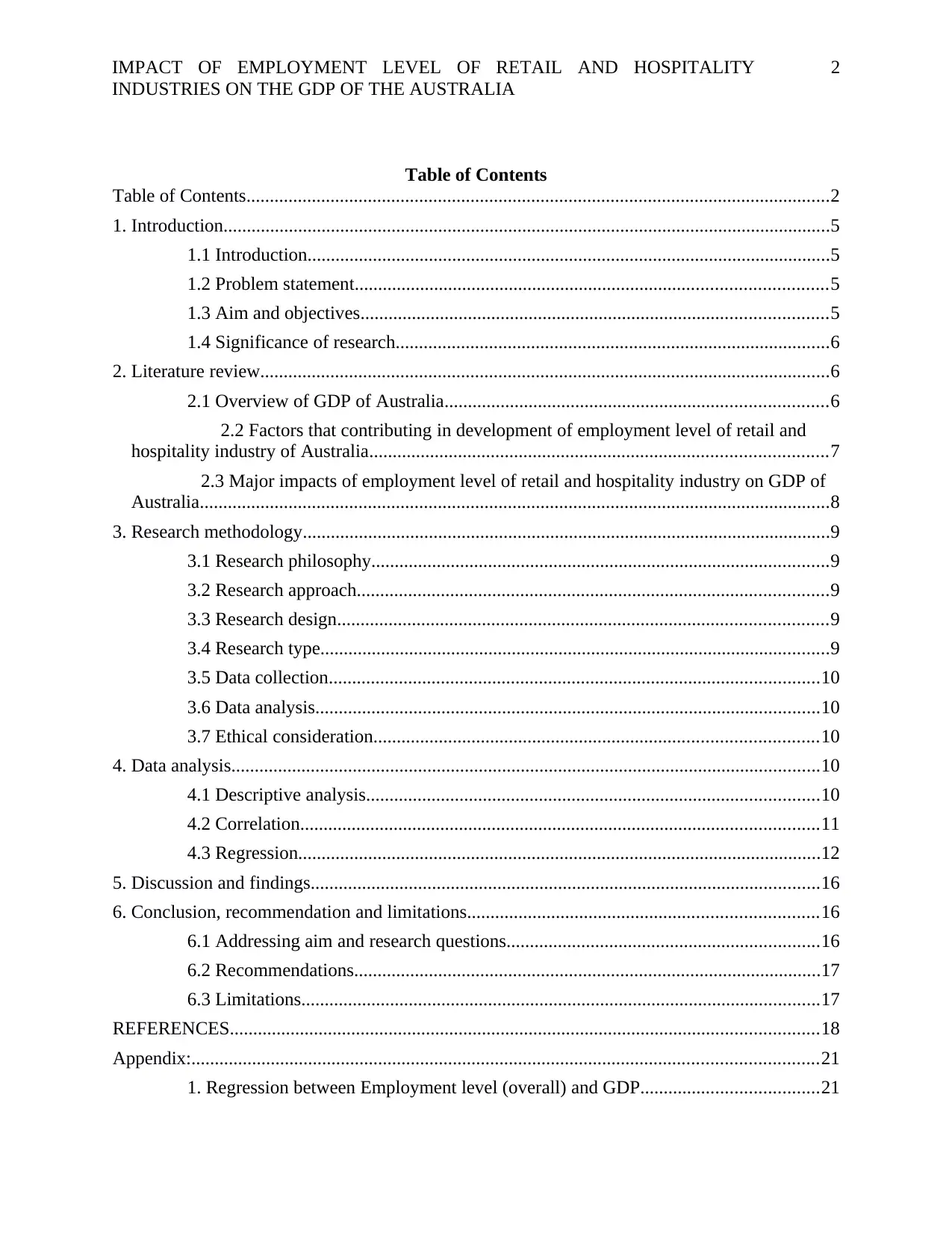
Table of Contents
Table of Contents.............................................................................................................................2
1. Introduction..................................................................................................................................5
1.1 Introduction................................................................................................................5
1.2 Problem statement.....................................................................................................5
1.3 Aim and objectives....................................................................................................5
1.4 Significance of research.............................................................................................6
2. Literature review..........................................................................................................................6
2.1 Overview of GDP of Australia..................................................................................6
2.2 Factors that contributing in development of employment level of retail and
hospitality industry of Australia..................................................................................................7
2.3 Major impacts of employment level of retail and hospitality industry on GDP of
Australia.......................................................................................................................................8
3. Research methodology.................................................................................................................9
3.1 Research philosophy..................................................................................................9
3.2 Research approach.....................................................................................................9
3.3 Research design.........................................................................................................9
3.4 Research type.............................................................................................................9
3.5 Data collection.........................................................................................................10
3.6 Data analysis............................................................................................................10
3.7 Ethical consideration...............................................................................................10
4. Data analysis..............................................................................................................................10
4.1 Descriptive analysis.................................................................................................10
4.2 Correlation...............................................................................................................11
4.3 Regression................................................................................................................12
5. Discussion and findings.............................................................................................................16
6. Conclusion, recommendation and limitations...........................................................................16
6.1 Addressing aim and research questions...................................................................16
6.2 Recommendations....................................................................................................17
6.3 Limitations...............................................................................................................17
REFERENCES..............................................................................................................................18
Appendix:......................................................................................................................................21
1. Regression between Employment level (overall) and GDP......................................21
INDUSTRIES ON THE GDP OF THE AUSTRALIA
2
Table of Contents
Table of Contents.............................................................................................................................2
1. Introduction..................................................................................................................................5
1.1 Introduction................................................................................................................5
1.2 Problem statement.....................................................................................................5
1.3 Aim and objectives....................................................................................................5
1.4 Significance of research.............................................................................................6
2. Literature review..........................................................................................................................6
2.1 Overview of GDP of Australia..................................................................................6
2.2 Factors that contributing in development of employment level of retail and
hospitality industry of Australia..................................................................................................7
2.3 Major impacts of employment level of retail and hospitality industry on GDP of
Australia.......................................................................................................................................8
3. Research methodology.................................................................................................................9
3.1 Research philosophy..................................................................................................9
3.2 Research approach.....................................................................................................9
3.3 Research design.........................................................................................................9
3.4 Research type.............................................................................................................9
3.5 Data collection.........................................................................................................10
3.6 Data analysis............................................................................................................10
3.7 Ethical consideration...............................................................................................10
4. Data analysis..............................................................................................................................10
4.1 Descriptive analysis.................................................................................................10
4.2 Correlation...............................................................................................................11
4.3 Regression................................................................................................................12
5. Discussion and findings.............................................................................................................16
6. Conclusion, recommendation and limitations...........................................................................16
6.1 Addressing aim and research questions...................................................................16
6.2 Recommendations....................................................................................................17
6.3 Limitations...............................................................................................................17
REFERENCES..............................................................................................................................18
Appendix:......................................................................................................................................21
1. Regression between Employment level (overall) and GDP......................................21
IMPACT OF EMPLOYMENT LEVEL OF RETAIL AND HOSPITALITY
INDUSTRIES ON THE GDP OF THE AUSTRALIA
3
2. Regression between Employment level in retail industry and GDP..........................23
3. Regression between Employment level in hospitality industry and GDP.................25
INDUSTRIES ON THE GDP OF THE AUSTRALIA
3
2. Regression between Employment level in retail industry and GDP..........................23
3. Regression between Employment level in hospitality industry and GDP.................25
⊘ This is a preview!⊘
Do you want full access?
Subscribe today to unlock all pages.

Trusted by 1+ million students worldwide
IMPACT OF EMPLOYMENT LEVEL OF RETAIL AND HOSPITALITY
INDUSTRIES ON THE GDP OF THE AUSTRALIA
4
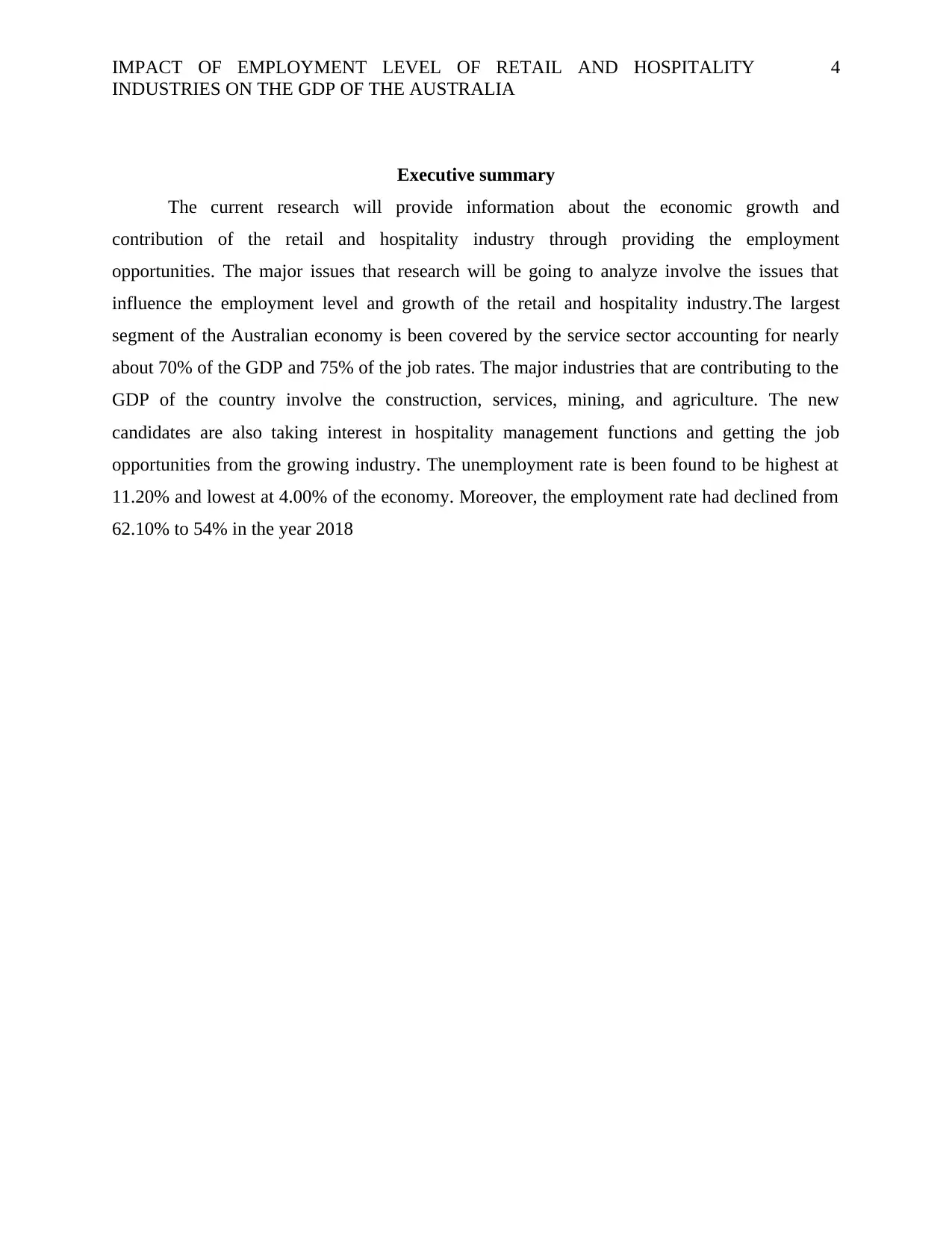
Executive summary
The current research will provide information about the economic growth and
contribution of the retail and hospitality industry through providing the employment
opportunities. The major issues that research will be going to analyze involve the issues that
influence the employment level and growth of the retail and hospitality industry.The largest
segment of the Australian economy is been covered by the service sector accounting for nearly
about 70% of the GDP and 75% of the job rates. The major industries that are contributing to the
GDP of the country involve the construction, services, mining, and agriculture. The new
candidates are also taking interest in hospitality management functions and getting the job
opportunities from the growing industry. The unemployment rate is been found to be highest at
11.20% and lowest at 4.00% of the economy. Moreover, the employment rate had declined from
62.10% to 54% in the year 2018
INDUSTRIES ON THE GDP OF THE AUSTRALIA
4
Executive summary
The current research will provide information about the economic growth and
contribution of the retail and hospitality industry through providing the employment
opportunities. The major issues that research will be going to analyze involve the issues that
influence the employment level and growth of the retail and hospitality industry.The largest
segment of the Australian economy is been covered by the service sector accounting for nearly
about 70% of the GDP and 75% of the job rates. The major industries that are contributing to the
GDP of the country involve the construction, services, mining, and agriculture. The new
candidates are also taking interest in hospitality management functions and getting the job
opportunities from the growing industry. The unemployment rate is been found to be highest at
11.20% and lowest at 4.00% of the economy. Moreover, the employment rate had declined from
62.10% to 54% in the year 2018
Paraphrase This Document
Need a fresh take? Get an instant paraphrase of this document with our AI Paraphraser
IMPACT OF EMPLOYMENT LEVEL OF RETAIL AND HOSPITALITY
INDUSTRIES ON THE GDP OF THE AUSTRALIA
5
1. Introduction
1.1 Introduction
The employment level and GDP of the country has the direct relationship. The level of
employment influences the spending power of people and support the growth of the country. The
economic policy changes and initiatives of the national government have supported the overall
all growth of industries of Australia. The free movement development of quality infrastructure
for business has influenced the employment level and business operations of organizations from
different industries (Chok, Mannix, Dickson and Wilkes, 2018). The current research will
provide information about the economic growth and contribution of the retail and hospitality
industry through providing the employment opportunities.
1.2 Problem statement
The economic changes and initiatives of industries have the direct and indirect impact on
the spending power and level of employment that influence the level of employment. The major
issues that research will be going to analyze involve the issues that influence the employment
level and growth of the retail and hospitality industry. Moreover, the identification of overall
GDP operations that creating opportunities for selected industries to generate the numbers of job
positions (Malik, Rosenberger, Fitzgerald, and Houlcroft, 2016). Apart from that, the research
will analyze the relationship between employment level and GDP growth of the country.
1.3 Aim and objectives
Aim
The aim of study is to identify the impact of employment level of retail and hospitality
industries on the GDP of the Australia.
Objectives
To assess the impact of employment level on the GDP of Australia
To analyze the factors contributing in development of employment level of retail and
hospitality industries of Australia
To identify the growth of GDP of country considering the growth of retail and
hospitality industries in recent times
INDUSTRIES ON THE GDP OF THE AUSTRALIA
5
1. Introduction
1.1 Introduction
The employment level and GDP of the country has the direct relationship. The level of
employment influences the spending power of people and support the growth of the country. The
economic policy changes and initiatives of the national government have supported the overall
all growth of industries of Australia. The free movement development of quality infrastructure
for business has influenced the employment level and business operations of organizations from
different industries (Chok, Mannix, Dickson and Wilkes, 2018). The current research will
provide information about the economic growth and contribution of the retail and hospitality
industry through providing the employment opportunities.
1.2 Problem statement
The economic changes and initiatives of industries have the direct and indirect impact on
the spending power and level of employment that influence the level of employment. The major
issues that research will be going to analyze involve the issues that influence the employment
level and growth of the retail and hospitality industry. Moreover, the identification of overall
GDP operations that creating opportunities for selected industries to generate the numbers of job
positions (Malik, Rosenberger, Fitzgerald, and Houlcroft, 2016). Apart from that, the research
will analyze the relationship between employment level and GDP growth of the country.
1.3 Aim and objectives
Aim
The aim of study is to identify the impact of employment level of retail and hospitality
industries on the GDP of the Australia.
Objectives
To assess the impact of employment level on the GDP of Australia
To analyze the factors contributing in development of employment level of retail and
hospitality industries of Australia
To identify the growth of GDP of country considering the growth of retail and
hospitality industries in recent times
IMPACT OF EMPLOYMENT LEVEL OF RETAIL AND HOSPITALITY
INDUSTRIES ON THE GDP OF THE AUSTRALIA
6
1.4 Significance of research
The research will help to gain knowledge about employment level and GDP growth
considering the data about the retail and hospitality industry. The analysis of tactical and
strategic decisions that have taken by the retail and hospitality industry for creating the job
opportunities will help to understand the continuous growth will also support in understanding
the stable financial conditions of the country and approach to overcoming the unemployment
level (Bugeja, da Silva Rosa, Izan, and Ngan, 2017). However, Australia is experiencing the
positive growth in GDP and development of infrastructure for the business organization but there
are some factors that have the negative impact on the growth of particular industries that will be
analyzed in the study.
2. Literature review
2.1 Overview of GDP of Australia
According to Chua and Robinson (2018), Australia is been listed among one of the
wealthiest Asia Pacific countries and had experienced remarkable economic expansion in the
past two decades. The Australian economy is the mixed market economy having the GDP of
about A$ 1.69 trillion in the year 2017. The strong market democracy of the country is been
benefitted by the effective governmental system which allows vibrant development of
entrepreneurship (GDP Australia, 2012-2022, 2018). It has been seen that the labor market of
Australia is well supported by the flexible and modern employment code. The largest segment
of the Australian economy is been covered by the service sector accounting for nearly about 70%
of the GDP and 75% of the job rates (Bajada, 2017). The country is been experiencing a
continuous growth, low public debt, low unemployment, contained inflation, and the stable
financial system from past two decades.
Australia is been identified as one of the few countries which are still experiencing
positive economic growth. It is been recorded that the economy of Australia had continued to
grow with the increase in GDP of 2.4% in 2017. It has been identified that the Australian
economy had recorded a growth of nearly about 0.9% in the June quarter of 2018. The major
industries that are contributing to the GDP of the country involve the construction, services,
mining, and agriculture (Nguyen and Duncan, 2017). The level of unemployment in the country
is 5.5 % in February 2018 and the labor force was 12.7 million. Apart from that, the GDP of the
INDUSTRIES ON THE GDP OF THE AUSTRALIA
6
1.4 Significance of research
The research will help to gain knowledge about employment level and GDP growth
considering the data about the retail and hospitality industry. The analysis of tactical and
strategic decisions that have taken by the retail and hospitality industry for creating the job
opportunities will help to understand the continuous growth will also support in understanding
the stable financial conditions of the country and approach to overcoming the unemployment
level (Bugeja, da Silva Rosa, Izan, and Ngan, 2017). However, Australia is experiencing the
positive growth in GDP and development of infrastructure for the business organization but there
are some factors that have the negative impact on the growth of particular industries that will be
analyzed in the study.
2. Literature review
2.1 Overview of GDP of Australia
According to Chua and Robinson (2018), Australia is been listed among one of the
wealthiest Asia Pacific countries and had experienced remarkable economic expansion in the
past two decades. The Australian economy is the mixed market economy having the GDP of
about A$ 1.69 trillion in the year 2017. The strong market democracy of the country is been
benefitted by the effective governmental system which allows vibrant development of
entrepreneurship (GDP Australia, 2012-2022, 2018). It has been seen that the labor market of
Australia is well supported by the flexible and modern employment code. The largest segment
of the Australian economy is been covered by the service sector accounting for nearly about 70%
of the GDP and 75% of the job rates (Bajada, 2017). The country is been experiencing a
continuous growth, low public debt, low unemployment, contained inflation, and the stable
financial system from past two decades.
Australia is been identified as one of the few countries which are still experiencing
positive economic growth. It is been recorded that the economy of Australia had continued to
grow with the increase in GDP of 2.4% in 2017. It has been identified that the Australian
economy had recorded a growth of nearly about 0.9% in the June quarter of 2018. The major
industries that are contributing to the GDP of the country involve the construction, services,
mining, and agriculture (Nguyen and Duncan, 2017). The level of unemployment in the country
is 5.5 % in February 2018 and the labor force was 12.7 million. Apart from that, the GDP of the
⊘ This is a preview!⊘
Do you want full access?
Subscribe today to unlock all pages.
Trusted by 1+ million students worldwide
IMPACT OF EMPLOYMENT LEVEL OF RETAIL AND HOSPITALITY
INDUSTRIES ON THE GDP OF THE AUSTRALIA
7
nation is highly dominated by the services sectors that have 61.1% contribution. The services
sector organizations like hospitality and retail sector are employing 79.8% labor force and
supporting the growth of the country. The banking system of the country is strong and supporting
the government to maintain the growth in different sectors of business and infrastructure
development (Próchniak, 2018). The nation has applied the open market policies with minimal
restrictions on the import of goods and services that help to increase the productivity in the retail
sector. In spite of that, the tourism sector of the nation is also contributing in the GDP as in the
financial year of 2016/17 the tourism activities were increased by 3 % and encouraged the
hospitality industry to expand the level of services and products to attract the visitors and
customers (Australia Economy - overview - Economy. 2018). Additionally, the domestic tourism
is having the significant role in the GDP of the country as the tourism industry is representing the
73% of total direct tourism GDP. The hospitality industry is offering jobs for new and
experienced candidates considering their level of skills.
2.2 Factors that contributing in development of employment level of retail and hospitality
industry of Australia
The retail and hospitality industries are having potential and growing the business by
utilizing the trends and opportunities of the market. According to Pandya and Sisombat, (2017),
the trends for the retail industry like online ordering and home delivery functions of the
organizations have created new technical and operational job positions for the people. There are
more than 140,000 businesses are running within the retail industry of Australia and providing
the employment to the 1.2 million workers or 10% of the Australian workforce. This is the
second largest industry of the country in terms of employment level (Labor force, Australia,
2018). The retail industry is undergoing significant transformation due to the impact of the
technology and changes in the consumer expectations and the behavior. Apart from that, the
major challenge of the retail industry to maintaining the growth in the employment level is
training to the staff. The formal training culture of the industry is affecting the growth and
approach of developing the workforce (Oddo et al., 2017). The organizations are looking for
experienced people for managing the operations but lack of job functions and training initiatives
affecting the innovation drive in the retail industry.
INDUSTRIES ON THE GDP OF THE AUSTRALIA
7
nation is highly dominated by the services sectors that have 61.1% contribution. The services
sector organizations like hospitality and retail sector are employing 79.8% labor force and
supporting the growth of the country. The banking system of the country is strong and supporting
the government to maintain the growth in different sectors of business and infrastructure
development (Próchniak, 2018). The nation has applied the open market policies with minimal
restrictions on the import of goods and services that help to increase the productivity in the retail
sector. In spite of that, the tourism sector of the nation is also contributing in the GDP as in the
financial year of 2016/17 the tourism activities were increased by 3 % and encouraged the
hospitality industry to expand the level of services and products to attract the visitors and
customers (Australia Economy - overview - Economy. 2018). Additionally, the domestic tourism
is having the significant role in the GDP of the country as the tourism industry is representing the
73% of total direct tourism GDP. The hospitality industry is offering jobs for new and
experienced candidates considering their level of skills.
2.2 Factors that contributing in development of employment level of retail and hospitality
industry of Australia
The retail and hospitality industries are having potential and growing the business by
utilizing the trends and opportunities of the market. According to Pandya and Sisombat, (2017),
the trends for the retail industry like online ordering and home delivery functions of the
organizations have created new technical and operational job positions for the people. There are
more than 140,000 businesses are running within the retail industry of Australia and providing
the employment to the 1.2 million workers or 10% of the Australian workforce. This is the
second largest industry of the country in terms of employment level (Labor force, Australia,
2018). The retail industry is undergoing significant transformation due to the impact of the
technology and changes in the consumer expectations and the behavior. Apart from that, the
major challenge of the retail industry to maintaining the growth in the employment level is
training to the staff. The formal training culture of the industry is affecting the growth and
approach of developing the workforce (Oddo et al., 2017). The organizations are looking for
experienced people for managing the operations but lack of job functions and training initiatives
affecting the innovation drive in the retail industry.
Paraphrase This Document
Need a fresh take? Get an instant paraphrase of this document with our AI Paraphraser
IMPACT OF EMPLOYMENT LEVEL OF RETAIL AND HOSPITALITY
INDUSTRIES ON THE GDP OF THE AUSTRALIA
8
The hospitality industry is maintaining significant growth in business and contributing to
the improvement of the employment level for the county. According to Schofield and et al.,
(2018), the hospitality industry of the country is offering products and services to the 8.2 million
international visitors every year. The domestic tourism growth of country was 7% in last year.
However, the employment level of the hospitality industry was low in the past few years but the
development of infrastructure and demand for standards accommodation, food, and beverages
services is increased. As per the analysis of Jackson, (2014), the factors that influence the
employment level for hospitality industry involves the development of infrastructure,
improvement in the services like spa, beautification, transportation and online support to the
visitors. In addition to this, a collaborative approach with tourism organizations from the
international market has also generated new job positions within the industry. The new
candidates are also taking interest in hospitality management functions and getting the job
opportunities from the growing industry. The issues that affect the employment level in the
hospitality industry is the high availability of people on holidays, seasonal jobs functions and
long working hours (Scott, Falkmer, Girdler and Falkmer, 2015). The salary and wages that
offered by the organizations is also low that influencing the decisions of experienced people to
avoid such jobs position.
2.3 Major impacts of employment level of retail and hospitality industry on GDP of
Australia
The retail and hospitality industries are looking to maintain growth and employment level
in their areas of working. The positive approach of both industries particularly in employment
level is having the positive impact on the overall GDP of the country as the spending power of
people is increasing. The earning level of people is increased that has the vital role in GDP and
consumer behavior of the local population. As per the views of Daniell and Kay, (2018), GDP of
any country could be enhanced by increasing the employment rate i.e. by hiring the larger
number of labor the producer would produce more and then attain the higher GDP out of it. It is
been identified that the GDP could be increased even if the rate of unemployment is high.
However, it has been normally observed that with the rise in employment, there is a strong
tendency of raising the GDP as well.
INDUSTRIES ON THE GDP OF THE AUSTRALIA
8
The hospitality industry is maintaining significant growth in business and contributing to
the improvement of the employment level for the county. According to Schofield and et al.,
(2018), the hospitality industry of the country is offering products and services to the 8.2 million
international visitors every year. The domestic tourism growth of country was 7% in last year.
However, the employment level of the hospitality industry was low in the past few years but the
development of infrastructure and demand for standards accommodation, food, and beverages
services is increased. As per the analysis of Jackson, (2014), the factors that influence the
employment level for hospitality industry involves the development of infrastructure,
improvement in the services like spa, beautification, transportation and online support to the
visitors. In addition to this, a collaborative approach with tourism organizations from the
international market has also generated new job positions within the industry. The new
candidates are also taking interest in hospitality management functions and getting the job
opportunities from the growing industry. The issues that affect the employment level in the
hospitality industry is the high availability of people on holidays, seasonal jobs functions and
long working hours (Scott, Falkmer, Girdler and Falkmer, 2015). The salary and wages that
offered by the organizations is also low that influencing the decisions of experienced people to
avoid such jobs position.
2.3 Major impacts of employment level of retail and hospitality industry on GDP of
Australia
The retail and hospitality industries are looking to maintain growth and employment level
in their areas of working. The positive approach of both industries particularly in employment
level is having the positive impact on the overall GDP of the country as the spending power of
people is increasing. The earning level of people is increased that has the vital role in GDP and
consumer behavior of the local population. As per the views of Daniell and Kay, (2018), GDP of
any country could be enhanced by increasing the employment rate i.e. by hiring the larger
number of labor the producer would produce more and then attain the higher GDP out of it. It is
been identified that the GDP could be increased even if the rate of unemployment is high.
However, it has been normally observed that with the rise in employment, there is a strong
tendency of raising the GDP as well.
IMPACT OF EMPLOYMENT LEVEL OF RETAIL AND HOSPITALITY
INDUSTRIES ON THE GDP OF THE AUSTRALIA
9
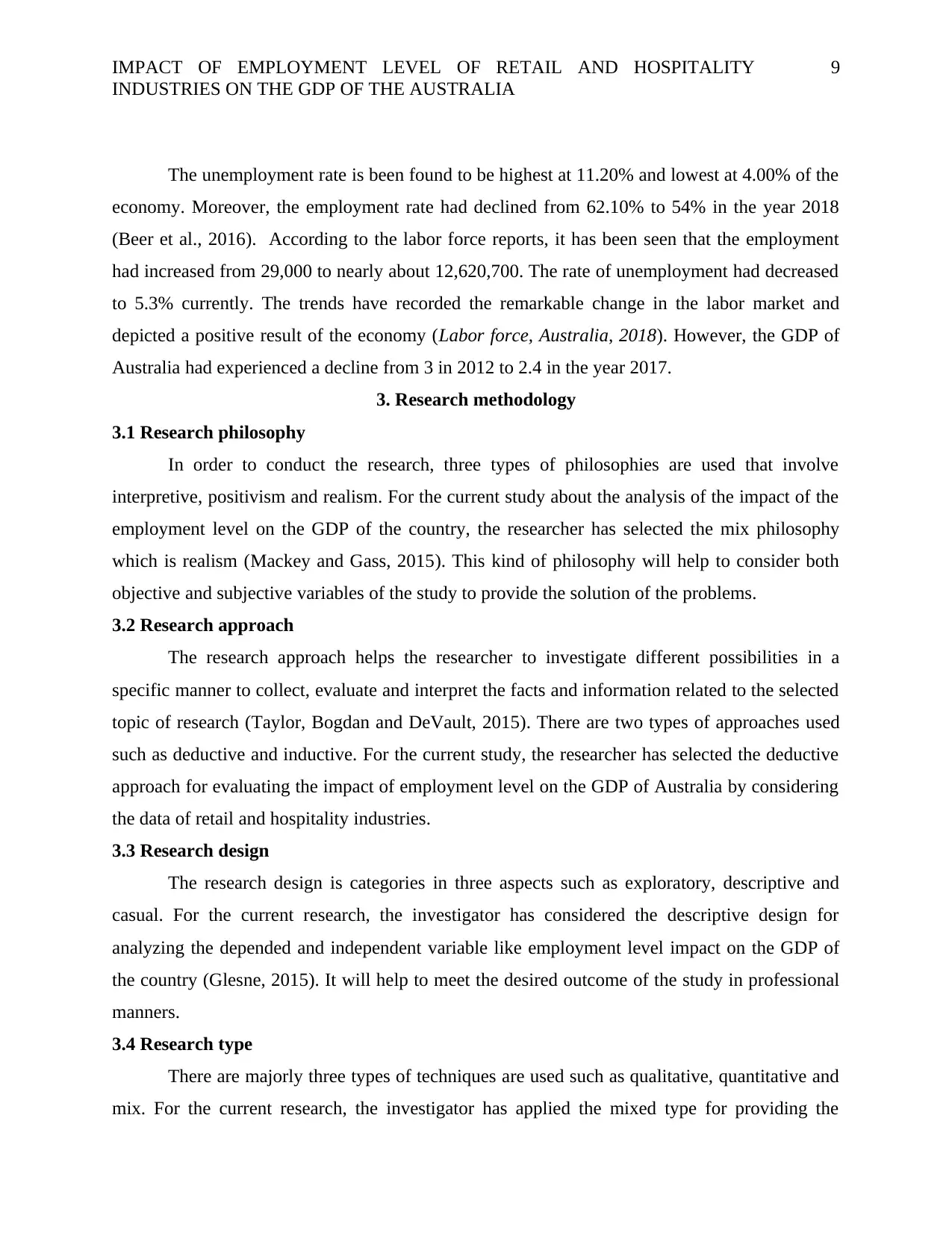
The unemployment rate is been found to be highest at 11.20% and lowest at 4.00% of the
economy. Moreover, the employment rate had declined from 62.10% to 54% in the year 2018
(Beer et al., 2016). According to the labor force reports, it has been seen that the employment
had increased from 29,000 to nearly about 12,620,700. The rate of unemployment had decreased
to 5.3% currently. The trends have recorded the remarkable change in the labor market and
depicted a positive result of the economy (Labor force, Australia, 2018). However, the GDP of
Australia had experienced a decline from 3 in 2012 to 2.4 in the year 2017.
3. Research methodology
3.1 Research philosophy
In order to conduct the research, three types of philosophies are used that involve
interpretive, positivism and realism. For the current study about the analysis of the impact of the
employment level on the GDP of the country, the researcher has selected the mix philosophy
which is realism (Mackey and Gass, 2015). This kind of philosophy will help to consider both
objective and subjective variables of the study to provide the solution of the problems.
3.2 Research approach
The research approach helps the researcher to investigate different possibilities in a
specific manner to collect, evaluate and interpret the facts and information related to the selected
topic of research (Taylor, Bogdan and DeVault, 2015). There are two types of approaches used
such as deductive and inductive. For the current study, the researcher has selected the deductive
approach for evaluating the impact of employment level on the GDP of Australia by considering
the data of retail and hospitality industries.
3.3 Research design
The research design is categories in three aspects such as exploratory, descriptive and
casual. For the current research, the investigator has considered the descriptive design for
analyzing the depended and independent variable like employment level impact on the GDP of
the country (Glesne, 2015). It will help to meet the desired outcome of the study in professional
manners.
3.4 Research type
There are majorly three types of techniques are used such as qualitative, quantitative and
mix. For the current research, the investigator has applied the mixed type for providing the
INDUSTRIES ON THE GDP OF THE AUSTRALIA
9
The unemployment rate is been found to be highest at 11.20% and lowest at 4.00% of the
economy. Moreover, the employment rate had declined from 62.10% to 54% in the year 2018
(Beer et al., 2016). According to the labor force reports, it has been seen that the employment
had increased from 29,000 to nearly about 12,620,700. The rate of unemployment had decreased
to 5.3% currently. The trends have recorded the remarkable change in the labor market and
depicted a positive result of the economy (Labor force, Australia, 2018). However, the GDP of
Australia had experienced a decline from 3 in 2012 to 2.4 in the year 2017.
3. Research methodology
3.1 Research philosophy
In order to conduct the research, three types of philosophies are used that involve
interpretive, positivism and realism. For the current study about the analysis of the impact of the
employment level on the GDP of the country, the researcher has selected the mix philosophy
which is realism (Mackey and Gass, 2015). This kind of philosophy will help to consider both
objective and subjective variables of the study to provide the solution of the problems.
3.2 Research approach
The research approach helps the researcher to investigate different possibilities in a
specific manner to collect, evaluate and interpret the facts and information related to the selected
topic of research (Taylor, Bogdan and DeVault, 2015). There are two types of approaches used
such as deductive and inductive. For the current study, the researcher has selected the deductive
approach for evaluating the impact of employment level on the GDP of Australia by considering
the data of retail and hospitality industries.
3.3 Research design
The research design is categories in three aspects such as exploratory, descriptive and
casual. For the current research, the investigator has considered the descriptive design for
analyzing the depended and independent variable like employment level impact on the GDP of
the country (Glesne, 2015). It will help to meet the desired outcome of the study in professional
manners.
3.4 Research type
There are majorly three types of techniques are used such as qualitative, quantitative and
mix. For the current research, the investigator has applied the mixed type for providing the
⊘ This is a preview!⊘
Do you want full access?
Subscribe today to unlock all pages.
Trusted by 1+ million students worldwide
IMPACT OF EMPLOYMENT LEVEL OF RETAIL AND HOSPITALITY
INDUSTRIES ON THE GDP OF THE AUSTRALIA
10
solutions for the issues (Flick, 2015). The quantitative type will help to understand the different
factors related to the employment level in the retail and hospitality industries and qualitative type
will support to identify the growth of GDP. The proper consideration of statistical and theoretical
data will improve the outcome of the study.
3.5 Data collection
The collection of data is an important element of research that increases the reliability
and validity of the research. There are two types of approaches used for collecting data such as
primary and secondary. For the current research, the researcher has selected secondary data
collection process for obtaining the relevant data for the study. In order to collect the secondary
data, the researcher has analyzed the source like books, journals, and websites of particular retail
and hospitality industries (Ledford, and Gast, 2018). Moreover, the researcher has obtained the
data of GDP of Australia from the government sites.
3.6 Data analysis
The data analysis is having the significant impact on the outcome of the study as proper
analysis and interpretation of data support to provide the solution of the problems. For the
current study, the researcher has analyzed the data using the SPSS tool and provides analysis of
data using graphs and tables (Fusch and Ness, 2015). Moreover, the consideration of statistical
data has helped to improve the validity and reliability of the research.
3.7 Ethical consideration
The researcher has followed principles of conducting research to improve the
effectiveness of the research. The researcher has tried to avoid ethical issues in the collection of
secondary data as well as maintaining the standards parameters of the study. The researcher
ensures that the data is plagiarism free and cannot be manipulated. Moreover, the collected data
will not be used for the further purpose (McCusker and Gunaydin, 2015).
4. Data analysis
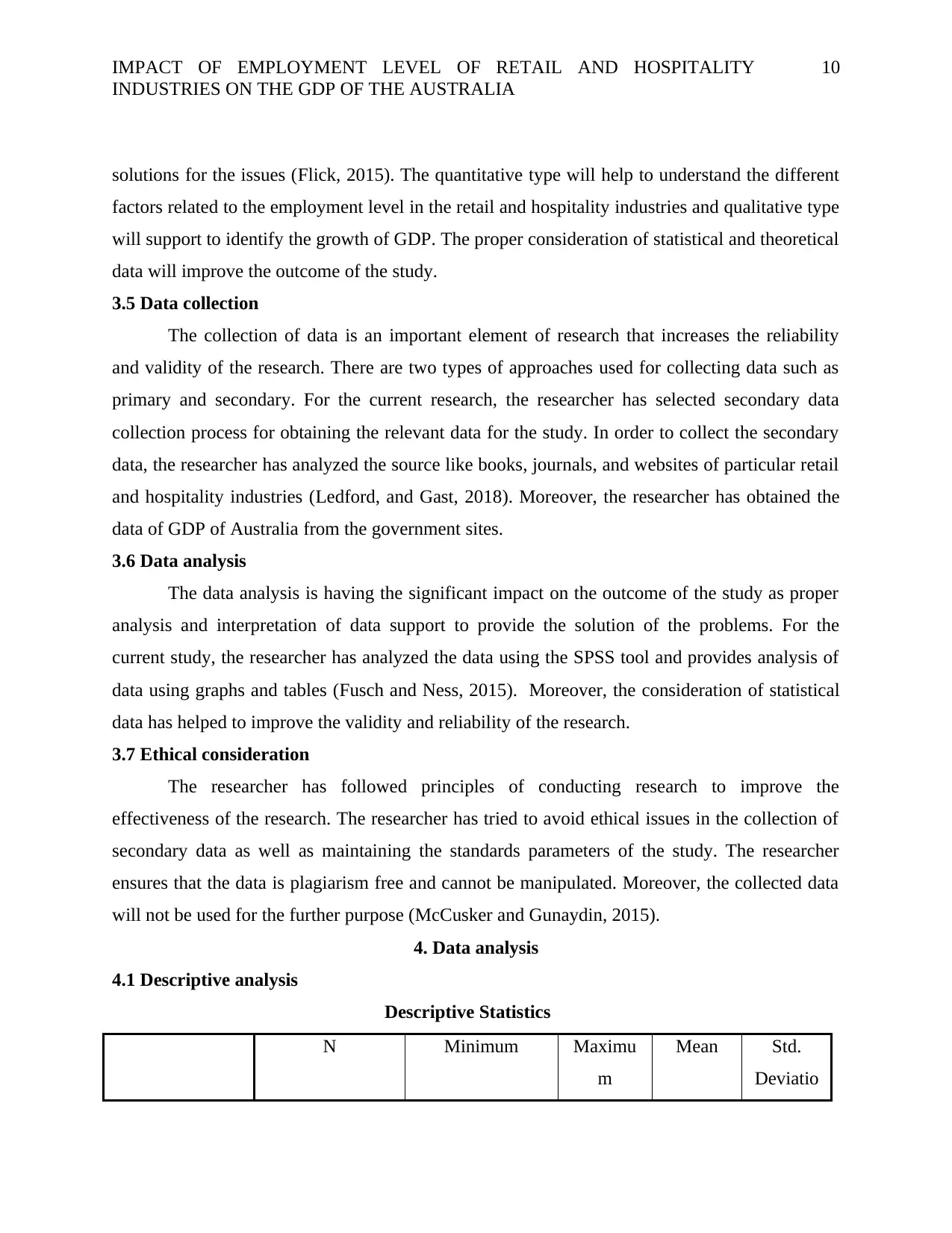
4.1 Descriptive analysis
Descriptive Statistics
N Minimum Maximu
m
Mean Std.
Deviatio
INDUSTRIES ON THE GDP OF THE AUSTRALIA
10
solutions for the issues (Flick, 2015). The quantitative type will help to understand the different
factors related to the employment level in the retail and hospitality industries and qualitative type
will support to identify the growth of GDP. The proper consideration of statistical and theoretical
data will improve the outcome of the study.
3.5 Data collection
The collection of data is an important element of research that increases the reliability
and validity of the research. There are two types of approaches used for collecting data such as
primary and secondary. For the current research, the researcher has selected secondary data
collection process for obtaining the relevant data for the study. In order to collect the secondary
data, the researcher has analyzed the source like books, journals, and websites of particular retail
and hospitality industries (Ledford, and Gast, 2018). Moreover, the researcher has obtained the
data of GDP of Australia from the government sites.
3.6 Data analysis
The data analysis is having the significant impact on the outcome of the study as proper
analysis and interpretation of data support to provide the solution of the problems. For the
current study, the researcher has analyzed the data using the SPSS tool and provides analysis of
data using graphs and tables (Fusch and Ness, 2015). Moreover, the consideration of statistical
data has helped to improve the validity and reliability of the research.
3.7 Ethical consideration
The researcher has followed principles of conducting research to improve the
effectiveness of the research. The researcher has tried to avoid ethical issues in the collection of
secondary data as well as maintaining the standards parameters of the study. The researcher
ensures that the data is plagiarism free and cannot be manipulated. Moreover, the collected data
will not be used for the further purpose (McCusker and Gunaydin, 2015).
4. Data analysis
4.1 Descriptive analysis
Descriptive Statistics
N Minimum Maximu
m
Mean Std.
Deviatio
Paraphrase This Document
Need a fresh take? Get an instant paraphrase of this document with our AI Paraphraser
IMPACT OF EMPLOYMENT LEVEL OF RETAIL AND HOSPITALITY
INDUSTRIES ON THE GDP OF THE AUSTRALIA
11
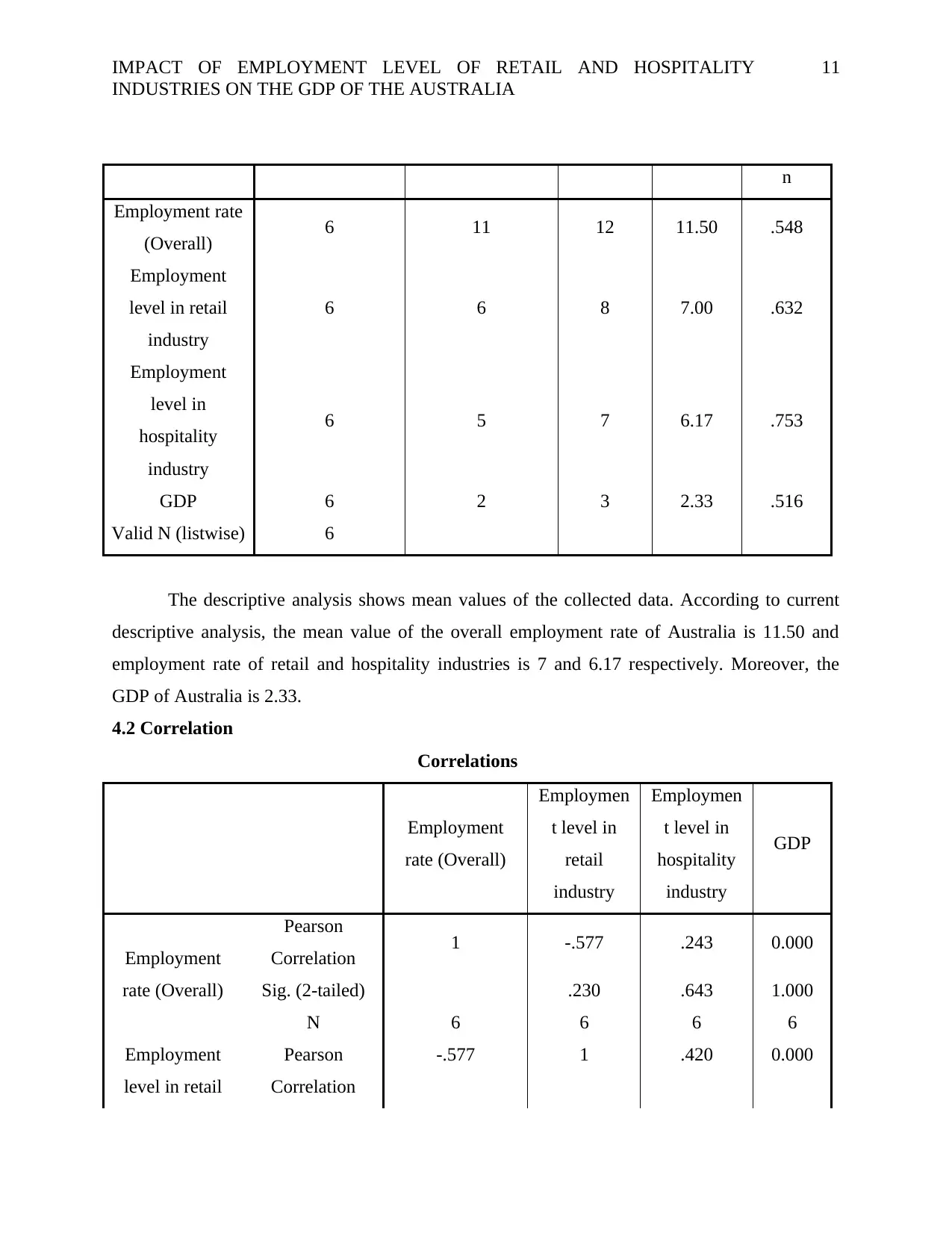
n
Employment rate
(Overall) 6 11 12 11.50 .548
Employment
level in retail
industry
6 6 8 7.00 .632
Employment
level in
hospitality
industry
6 5 7 6.17 .753
GDP 6 2 3 2.33 .516
Valid N (listwise) 6
The descriptive analysis shows mean values of the collected data. According to current
descriptive analysis, the mean value of the overall employment rate of Australia is 11.50 and
employment rate of retail and hospitality industries is 7 and 6.17 respectively. Moreover, the
GDP of Australia is 2.33.
4.2 Correlation
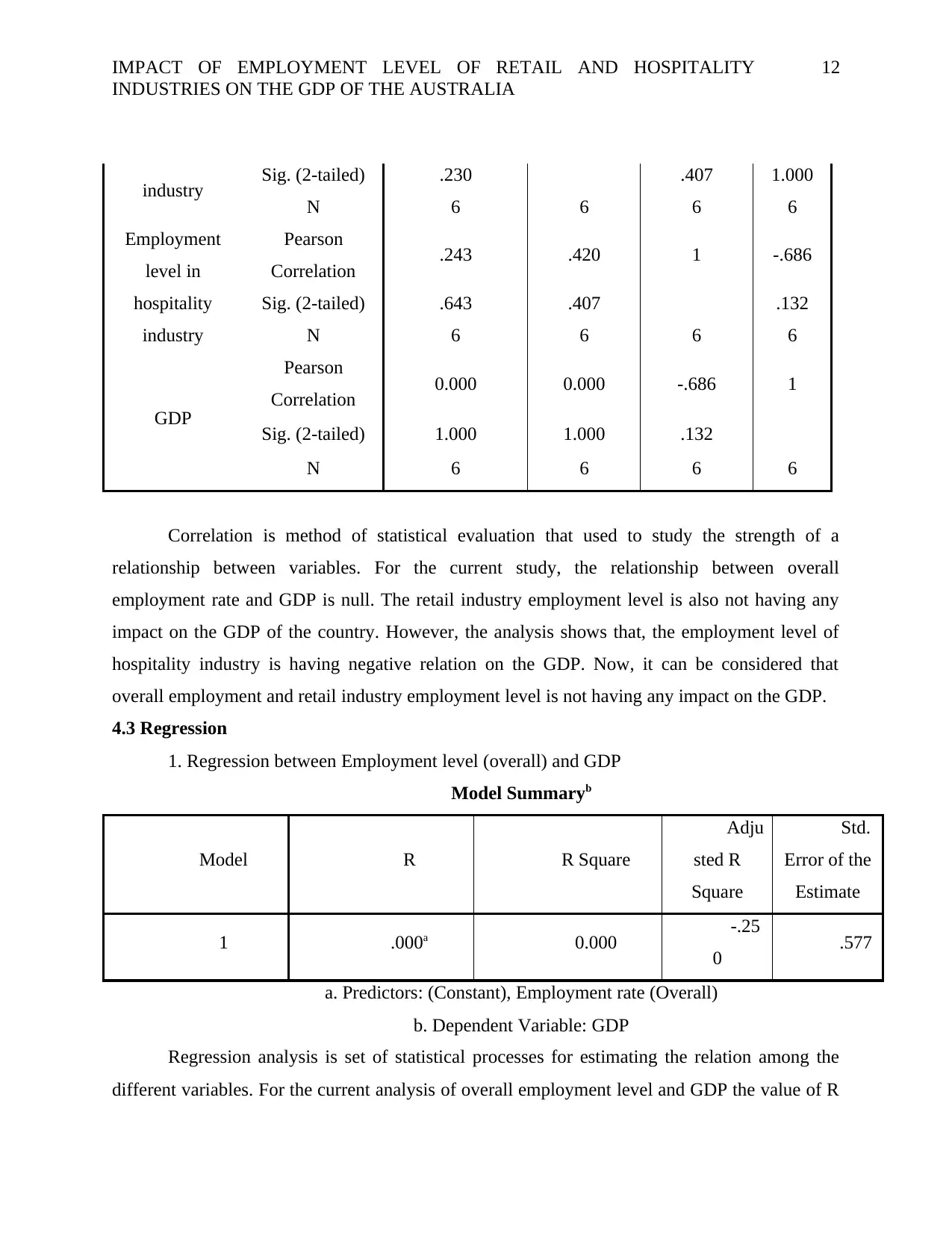
Correlations
Employment
rate (Overall)
Employmen
t level in
retail
industry
Employmen
t level in
hospitality
industry
GDP
Employment
rate (Overall)
Pearson
Correlation 1 -.577 .243 0.000
Sig. (2-tailed) .230 .643 1.000
N 6 6 6 6
Employment
level in retail
Pearson
Correlation
-.577 1 .420 0.000
INDUSTRIES ON THE GDP OF THE AUSTRALIA
11
n
Employment rate
(Overall) 6 11 12 11.50 .548
Employment
level in retail
industry
6 6 8 7.00 .632
Employment
level in
hospitality
industry
6 5 7 6.17 .753
GDP 6 2 3 2.33 .516
Valid N (listwise) 6
The descriptive analysis shows mean values of the collected data. According to current
descriptive analysis, the mean value of the overall employment rate of Australia is 11.50 and
employment rate of retail and hospitality industries is 7 and 6.17 respectively. Moreover, the
GDP of Australia is 2.33.
4.2 Correlation
Correlations
Employment
rate (Overall)
Employmen
t level in
retail
industry
Employmen
t level in
hospitality
industry
GDP
Employment
rate (Overall)
Pearson
Correlation 1 -.577 .243 0.000
Sig. (2-tailed) .230 .643 1.000
N 6 6 6 6
Employment
level in retail
Pearson
Correlation
-.577 1 .420 0.000
IMPACT OF EMPLOYMENT LEVEL OF RETAIL AND HOSPITALITY
INDUSTRIES ON THE GDP OF THE AUSTRALIA
12
industry Sig. (2-tailed) .230 .407 1.000
N 6 6 6 6
Employment
level in
hospitality
industry
Pearson
Correlation .243 .420 1 -.686
Sig. (2-tailed) .643 .407 .132
N 6 6 6 6
GDP
Pearson
Correlation 0.000 0.000 -.686 1
Sig. (2-tailed) 1.000 1.000 .132
N 6 6 6 6
Correlation is method of statistical evaluation that used to study the strength of a
relationship between variables. For the current study, the relationship between overall
employment rate and GDP is null. The retail industry employment level is also not having any
impact on the GDP of the country. However, the analysis shows that, the employment level of
hospitality industry is having negative relation on the GDP. Now, it can be considered that
overall employment and retail industry employment level is not having any impact on the GDP.
4.3 Regression
1. Regression between Employment level (overall) and GDP
Model Summaryb
Model R R Square
Adju
sted R
Square
Std.
Error of the
Estimate
1 .000a 0.000 -.25
0 .577
a. Predictors: (Constant), Employment rate (Overall)
b. Dependent Variable: GDP
Regression analysis is set of statistical processes for estimating the relation among the
different variables. For the current analysis of overall employment level and GDP the value of R
INDUSTRIES ON THE GDP OF THE AUSTRALIA
12
industry Sig. (2-tailed) .230 .407 1.000
N 6 6 6 6
Employment
level in
hospitality
industry
Pearson
Correlation .243 .420 1 -.686
Sig. (2-tailed) .643 .407 .132
N 6 6 6 6
GDP
Pearson
Correlation 0.000 0.000 -.686 1
Sig. (2-tailed) 1.000 1.000 .132
N 6 6 6 6
Correlation is method of statistical evaluation that used to study the strength of a
relationship between variables. For the current study, the relationship between overall
employment rate and GDP is null. The retail industry employment level is also not having any
impact on the GDP of the country. However, the analysis shows that, the employment level of
hospitality industry is having negative relation on the GDP. Now, it can be considered that
overall employment and retail industry employment level is not having any impact on the GDP.
4.3 Regression
1. Regression between Employment level (overall) and GDP
Model Summaryb
Model R R Square
Adju
sted R
Square
Std.
Error of the
Estimate
1 .000a 0.000 -.25
0 .577
a. Predictors: (Constant), Employment rate (Overall)
b. Dependent Variable: GDP
Regression analysis is set of statistical processes for estimating the relation among the
different variables. For the current analysis of overall employment level and GDP the value of R
⊘ This is a preview!⊘
Do you want full access?
Subscribe today to unlock all pages.
Trusted by 1+ million students worldwide

1 out of 26


Related Documents


Your All-in-One AI-Powered Toolkit for Academic Success.
+13062052269
info@desklib.com
Available 24*7 on WhatsApp / Email
![[object Object]](/_next/static/media/star-bottom.7253800d.svg)
Unlock your academic potential
Copyright © 2020–2025 A2Z Services. All Rights Reserved. Developed and managed by ZUCOL.