Comprehensive Analysis of Unemployment Issues in Australia
VerifiedAdded on 2021/06/17
|12
|3235
|79
Report
AI Summary
This report provides a comprehensive analysis of the unemployment rate in Australia, examining its causes, types (frictional, structural, cyclical, and seasonal), and the factors contributing to it. It delves into the impact of industry closures, changes in infrastructure spending, offshoring, and poor economic performance. The report also explores the different types of unemployment, government policies implemented, and the role of minimum wages. It also addresses issues like underemployment and discouraged workers, highlighting their impact on the unemployment statistics. The analysis includes data from the World Bank and Statista.com, offering insights into the Australian labor market and the effectiveness of government policies. The report concludes with recommendations for both the unemployed and the government, aiming to improve economic performance and reduce unemployment.
Running Head: Unemployment Issues
Analysis of the Unemployment Rate in Australia
By (Name)
(Tutor)
(University)
(Date)
Analysis of the Unemployment Rate in Australia
By (Name)
(Tutor)
(University)
(Date)

Paraphrase This Document
Need a fresh take? Get an instant paraphrase of this document with our AI Paraphraser
Unemployment Issues 2
Analysis of Unemployment Rate in Australia
Introduction
The unemployment increment in Australia has been a major threat on this economy. The
poverty rate in Australia is very high owing to a high unemployment rate. There many people is
Australia seeking to be employed. Others have no jobs but are not searching as they have done so
for long without success and they’ve ended up losing hope. A high unemployment rate
symbolizes the fact that Australia is not healthy and that its growth is not sufficient to create
sufficient jobs. The easiness of getting a job in Australia has greatly reduced. The supply for
workers has gone up while the rate of job creation has fallen. The unfavorable business
conditions has also weakened the demand for workers by companies. This paper shall define
clearly what unemployment is and describe certain set conditions that one has to fit so as to be
included in that bracket.
The various changes that have been observed in the Australian workforce will also be
discussed. The analysis on the Australian states mostly affected by high unemployment rate will
also be done. Here we shall discuss the various causes and unemployment types. The
government policies that have been implemented to affect changes in the workforce will also be
considered. This will include the implementation of minimum wages, fiscal and monetary
policies intended to stimulate the economy so as to create more jobs. The paper will give a good
picture of the current situation in the Australian economy. It shall also determine whether the
reported unemployment rate is sufficient to give an interpretation on Australian economic
Performance. Other issues such as that of underemployed and discouraged workers will be an
important part of this study. The policy makers will thus be the major beneficially of this
research as they may use it to gauge the effectiveness of their policies. Recommendations will be
provided for both the unemployed persons, and the government.
Analysis of Unemployment Rate in Australia
Introduction
The unemployment increment in Australia has been a major threat on this economy. The
poverty rate in Australia is very high owing to a high unemployment rate. There many people is
Australia seeking to be employed. Others have no jobs but are not searching as they have done so
for long without success and they’ve ended up losing hope. A high unemployment rate
symbolizes the fact that Australia is not healthy and that its growth is not sufficient to create
sufficient jobs. The easiness of getting a job in Australia has greatly reduced. The supply for
workers has gone up while the rate of job creation has fallen. The unfavorable business
conditions has also weakened the demand for workers by companies. This paper shall define
clearly what unemployment is and describe certain set conditions that one has to fit so as to be
included in that bracket.
The various changes that have been observed in the Australian workforce will also be
discussed. The analysis on the Australian states mostly affected by high unemployment rate will
also be done. Here we shall discuss the various causes and unemployment types. The
government policies that have been implemented to affect changes in the workforce will also be
considered. This will include the implementation of minimum wages, fiscal and monetary
policies intended to stimulate the economy so as to create more jobs. The paper will give a good
picture of the current situation in the Australian economy. It shall also determine whether the
reported unemployment rate is sufficient to give an interpretation on Australian economic
Performance. Other issues such as that of underemployed and discouraged workers will be an
important part of this study. The policy makers will thus be the major beneficially of this
research as they may use it to gauge the effectiveness of their policies. Recommendations will be
provided for both the unemployed persons, and the government.
Unemployment Issues 3
Analysis
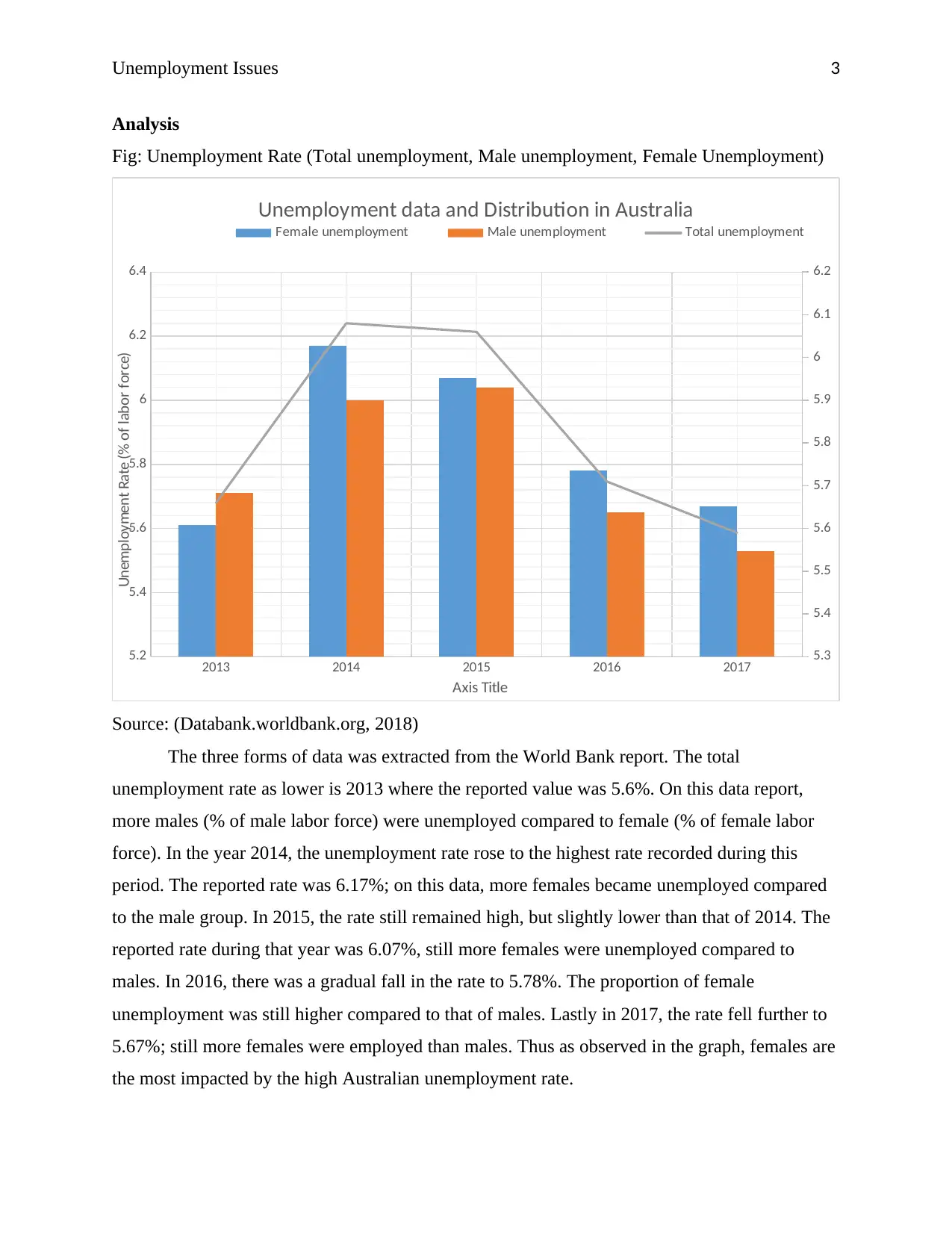
Fig: Unemployment Rate (Total unemployment, Male unemployment, Female Unemployment)
2013 2014 2015 2016 2017
5.2
5.4
5.6
5.8
6
6.2
6.4
5.3
5.4
5.5
5.6
5.7
5.8
5.9
6
6.1
6.2
Unemployment data and Distribution in Australia
Female unemployment Male unemployment Total unemployment
Axis Title
Unemployment Rate (% of labor force)
Source: (Databank.worldbank.org, 2018)
The three forms of data was extracted from the World Bank report. The total
unemployment rate as lower is 2013 where the reported value was 5.6%. On this data report,
more males (% of male labor force) were unemployed compared to female (% of female labor
force). In the year 2014, the unemployment rate rose to the highest rate recorded during this
period. The reported rate was 6.17%; on this data, more females became unemployed compared
to the male group. In 2015, the rate still remained high, but slightly lower than that of 2014. The
reported rate during that year was 6.07%, still more females were unemployed compared to
males. In 2016, there was a gradual fall in the rate to 5.78%. The proportion of female
unemployment was still higher compared to that of males. Lastly in 2017, the rate fell further to
5.67%; still more females were employed than males. Thus as observed in the graph, females are
the most impacted by the high Australian unemployment rate.
Analysis
Fig: Unemployment Rate (Total unemployment, Male unemployment, Female Unemployment)
2013 2014 2015 2016 2017
5.2
5.4
5.6
5.8
6
6.2
6.4
5.3
5.4
5.5
5.6
5.7
5.8
5.9
6
6.1
6.2
Unemployment data and Distribution in Australia
Female unemployment Male unemployment Total unemployment
Axis Title
Unemployment Rate (% of labor force)
Source: (Databank.worldbank.org, 2018)
The three forms of data was extracted from the World Bank report. The total
unemployment rate as lower is 2013 where the reported value was 5.6%. On this data report,
more males (% of male labor force) were unemployed compared to female (% of female labor
force). In the year 2014, the unemployment rate rose to the highest rate recorded during this
period. The reported rate was 6.17%; on this data, more females became unemployed compared
to the male group. In 2015, the rate still remained high, but slightly lower than that of 2014. The
reported rate during that year was 6.07%, still more females were unemployed compared to
males. In 2016, there was a gradual fall in the rate to 5.78%. The proportion of female
unemployment was still higher compared to that of males. Lastly in 2017, the rate fell further to
5.67%; still more females were employed than males. Thus as observed in the graph, females are
the most impacted by the high Australian unemployment rate.
⊘ This is a preview!⊘
Do you want full access?
Subscribe today to unlock all pages.

Trusted by 1+ million students worldwide
Unemployment Issues 4
Unemployment Causes
The contribution of high unemployment rate is related to many factors. However, there
are specific factors that have been noted to contribute heavily to the Australian unemployment
increment. The common causes are state-specific and others are common in the whole of
Australia. The following factors are the common causes in Australia excluding the
discrimination of senior and younger workers.
One is the closure of industries; Sebastian (2015) pointed out that closing down of shops
is the major reason behind the high rates. There are so many people that have been left jobless
after their industries have shut down. These people have added to the number of the unemployed
persons. From a matter of fact, there is less industrial diversification in the South Australian state
making it difficult for those who lose their job to get a newer one. Some of the industries closing
down include; manufacturing, agriculture and textile industries. These industries employ a
greater proportion of the total labor force. Sebastian (2015) also noted that the federal
government has failed in its advanced planning on preparing the workforce on how they will
switch to other jobs after the close down of Holden. The blame cannot be wholly laid on the
failure of the government but also on individuals. Sebastian argued that individuals should
observe the state and performance of their industry and it’s not good, they should plan ahead and
start looking for a new job. The bank is blamed by some people for their failure on promoting
innovation on new business startup so that the businesses might grow to employ more people.
Second, changes in infrastructure spending; the harder economic times has resulted in a
decline in public and private infrastructural spending. This has led to the shifting of skilled
personnel including engineers to overseas which has left so many without jobs. When the hard
economic time comes to an end, these skilled personnel are not available which keeps workers
out of jobs until such skills are available once again. For this reason, South Australia had been
using more of Victorian workers for their major projects. The use of interstate workers prevented
the picking up of work by the South Australian locals.
Third, offshoring; some years back, the western countries began receiving tax incentives
from other countries to factories and jobs to their country. This force workers to adapt as many
textile and manufacturing jobs were going offshore. This movement has led to the decline in the
manufacturing sector such that exportation has fallen and Australia is becoming more of a
service-based economy. The workers left behind lose their previously held skills and therefore a
Unemployment Causes
The contribution of high unemployment rate is related to many factors. However, there
are specific factors that have been noted to contribute heavily to the Australian unemployment
increment. The common causes are state-specific and others are common in the whole of
Australia. The following factors are the common causes in Australia excluding the
discrimination of senior and younger workers.
One is the closure of industries; Sebastian (2015) pointed out that closing down of shops
is the major reason behind the high rates. There are so many people that have been left jobless
after their industries have shut down. These people have added to the number of the unemployed
persons. From a matter of fact, there is less industrial diversification in the South Australian state
making it difficult for those who lose their job to get a newer one. Some of the industries closing
down include; manufacturing, agriculture and textile industries. These industries employ a
greater proportion of the total labor force. Sebastian (2015) also noted that the federal
government has failed in its advanced planning on preparing the workforce on how they will
switch to other jobs after the close down of Holden. The blame cannot be wholly laid on the
failure of the government but also on individuals. Sebastian argued that individuals should
observe the state and performance of their industry and it’s not good, they should plan ahead and
start looking for a new job. The bank is blamed by some people for their failure on promoting
innovation on new business startup so that the businesses might grow to employ more people.
Second, changes in infrastructure spending; the harder economic times has resulted in a
decline in public and private infrastructural spending. This has led to the shifting of skilled
personnel including engineers to overseas which has left so many without jobs. When the hard
economic time comes to an end, these skilled personnel are not available which keeps workers
out of jobs until such skills are available once again. For this reason, South Australia had been
using more of Victorian workers for their major projects. The use of interstate workers prevented
the picking up of work by the South Australian locals.
Third, offshoring; some years back, the western countries began receiving tax incentives
from other countries to factories and jobs to their country. This force workers to adapt as many
textile and manufacturing jobs were going offshore. This movement has led to the decline in the
manufacturing sector such that exportation has fallen and Australia is becoming more of a
service-based economy. The workers left behind lose their previously held skills and therefore a
Paraphrase This Document
Need a fresh take? Get an instant paraphrase of this document with our AI Paraphraser
Unemployment Issues 5
need to retrain then on other areas of business. Picking up of the manufacturing industry with
thus demand more and more retraining to restore the lost skills. This would happen in any other
sector that closes down and leave workers unemployed.
Lastly, poor economic performance and immigration; Australia has performed poorly in
the past years. A poor performance tend to make businesses to lower their costs, they achieve
this by lowering the number of workers. Immigrants adds up to the labor force and they increase
the unemployment rate.
Australian Types of Unemployment
Frictional
This exists as an impact of the existence of a negative externality in the labor market. The
externality is on the existence of information asymmetry. The jobless people and the employing
firms fail to have information on the existence of each other (McEachern, 2017). However, after
a period of time, these two parties will get together and the person will be employed; the issue is
the time in between. Information on job vacancies only reach some people while others fail to
receive such news.
Structural
This is mostly caused by technological changes where new technology kicks some
workers out of the market. E.g. the introduction of robots that can do a job done by 5 people can
displace many workers. Unlike frictional unemployment, the impacts of this might take many
years. We discussed offshoring earlier, when an industry is not able to sustain the rising
production costs (e.g. Australian textile and manufacturing industries) and finds it more
profitable to move the factory to another country, many are left jobless (Amadeo, 2018). The
government role in controlling this unemployment type is critical as it exists even when the
creation of jobs is high.
Cyclical
Business cycles influence the rate of unemployment. During recessions when businesses
are producing less due to demand deficiency, workers are reduced with an attempt to tighten
revenues (Grimsley, 2017). Australian contractionary phase has resulted in a loss of many jobs.
The workers will get their jobs back when the economy falls in an expansion cycle.
need to retrain then on other areas of business. Picking up of the manufacturing industry with
thus demand more and more retraining to restore the lost skills. This would happen in any other
sector that closes down and leave workers unemployed.
Lastly, poor economic performance and immigration; Australia has performed poorly in
the past years. A poor performance tend to make businesses to lower their costs, they achieve
this by lowering the number of workers. Immigrants adds up to the labor force and they increase
the unemployment rate.
Australian Types of Unemployment
Frictional
This exists as an impact of the existence of a negative externality in the labor market. The
externality is on the existence of information asymmetry. The jobless people and the employing
firms fail to have information on the existence of each other (McEachern, 2017). However, after
a period of time, these two parties will get together and the person will be employed; the issue is
the time in between. Information on job vacancies only reach some people while others fail to
receive such news.
Structural
This is mostly caused by technological changes where new technology kicks some
workers out of the market. E.g. the introduction of robots that can do a job done by 5 people can
displace many workers. Unlike frictional unemployment, the impacts of this might take many
years. We discussed offshoring earlier, when an industry is not able to sustain the rising
production costs (e.g. Australian textile and manufacturing industries) and finds it more
profitable to move the factory to another country, many are left jobless (Amadeo, 2018). The
government role in controlling this unemployment type is critical as it exists even when the
creation of jobs is high.
Cyclical
Business cycles influence the rate of unemployment. During recessions when businesses
are producing less due to demand deficiency, workers are reduced with an attempt to tighten
revenues (Grimsley, 2017). Australian contractionary phase has resulted in a loss of many jobs.
The workers will get their jobs back when the economy falls in an expansion cycle.
Unemployment Issues 6
Seasonal
Some people are employed in sectors where the production process comes to a break at
given time periods, these people become unemployed during the breaks. There are many
examples of these types of jobs. E.g. In the tourism industry, during holidays, most people are
employed because the flow of tourists is high (Pettinger, 2017). Goods with multiple stage
production also have this type of employment especially where workers only have skills on some
stages but not others. During the stage where they have skills, they have a job. However, when
production moves to the next stage where they fail to have the necessary skills, they are left
unemployed. However, this unemployment is only temporary as long as the seasons happens at
the same period of the year.
Issues of Unemployment
Underemployment Workers
Under the conditions for unemployment, there is a requirement that one should not have
worked even for an hour during the survey week. Anyone who had worked at least for an hour
and was paid is excluded from the unemployment bracket. Given the current hourly minimum
wage, this person has earned nothing, the income is so small to meet any of the basic needs.
Most of these people are in an active search for a job (Murphy, 2017). Australia is thus making a
mistake for including these people in the employed bracket. Some of these people may rather
prefer staying without jobs than be considered employed while they are not. The Australian
government has completely ignored the underemployed.
Discouraged Workers
In Australia, some citizens have no jobs and are not looking for them. The government
has also ignored this group. These people in the real sense are unemployed and if they got a job
they would gratefully accept the offer (Jericho, 2017). The reason for their inactiveness in job
seeking is that they have become tired with the labor market; they had for long been looking for
a job but have not been successful for a long period. It’s very wrong to exclude this people from
the unemployment measure. This explains why the creation of jobs does not have a significant
improvement in unemployment and wages. Letts (2018) noted that despite the surge in jobs, the
unemployment rate still went higher and wages remained stalled.
Seasonal
Some people are employed in sectors where the production process comes to a break at
given time periods, these people become unemployed during the breaks. There are many
examples of these types of jobs. E.g. In the tourism industry, during holidays, most people are
employed because the flow of tourists is high (Pettinger, 2017). Goods with multiple stage
production also have this type of employment especially where workers only have skills on some
stages but not others. During the stage where they have skills, they have a job. However, when
production moves to the next stage where they fail to have the necessary skills, they are left
unemployed. However, this unemployment is only temporary as long as the seasons happens at
the same period of the year.
Issues of Unemployment
Underemployment Workers
Under the conditions for unemployment, there is a requirement that one should not have
worked even for an hour during the survey week. Anyone who had worked at least for an hour
and was paid is excluded from the unemployment bracket. Given the current hourly minimum
wage, this person has earned nothing, the income is so small to meet any of the basic needs.
Most of these people are in an active search for a job (Murphy, 2017). Australia is thus making a
mistake for including these people in the employed bracket. Some of these people may rather
prefer staying without jobs than be considered employed while they are not. The Australian
government has completely ignored the underemployed.
Discouraged Workers
In Australia, some citizens have no jobs and are not looking for them. The government
has also ignored this group. These people in the real sense are unemployed and if they got a job
they would gratefully accept the offer (Jericho, 2017). The reason for their inactiveness in job
seeking is that they have become tired with the labor market; they had for long been looking for
a job but have not been successful for a long period. It’s very wrong to exclude this people from
the unemployment measure. This explains why the creation of jobs does not have a significant
improvement in unemployment and wages. Letts (2018) noted that despite the surge in jobs, the
unemployment rate still went higher and wages remained stalled.
⊘ This is a preview!⊘
Do you want full access?
Subscribe today to unlock all pages.
Trusted by 1+ million students worldwide
Unemployment Issues 7
Minimum Wages in Australia
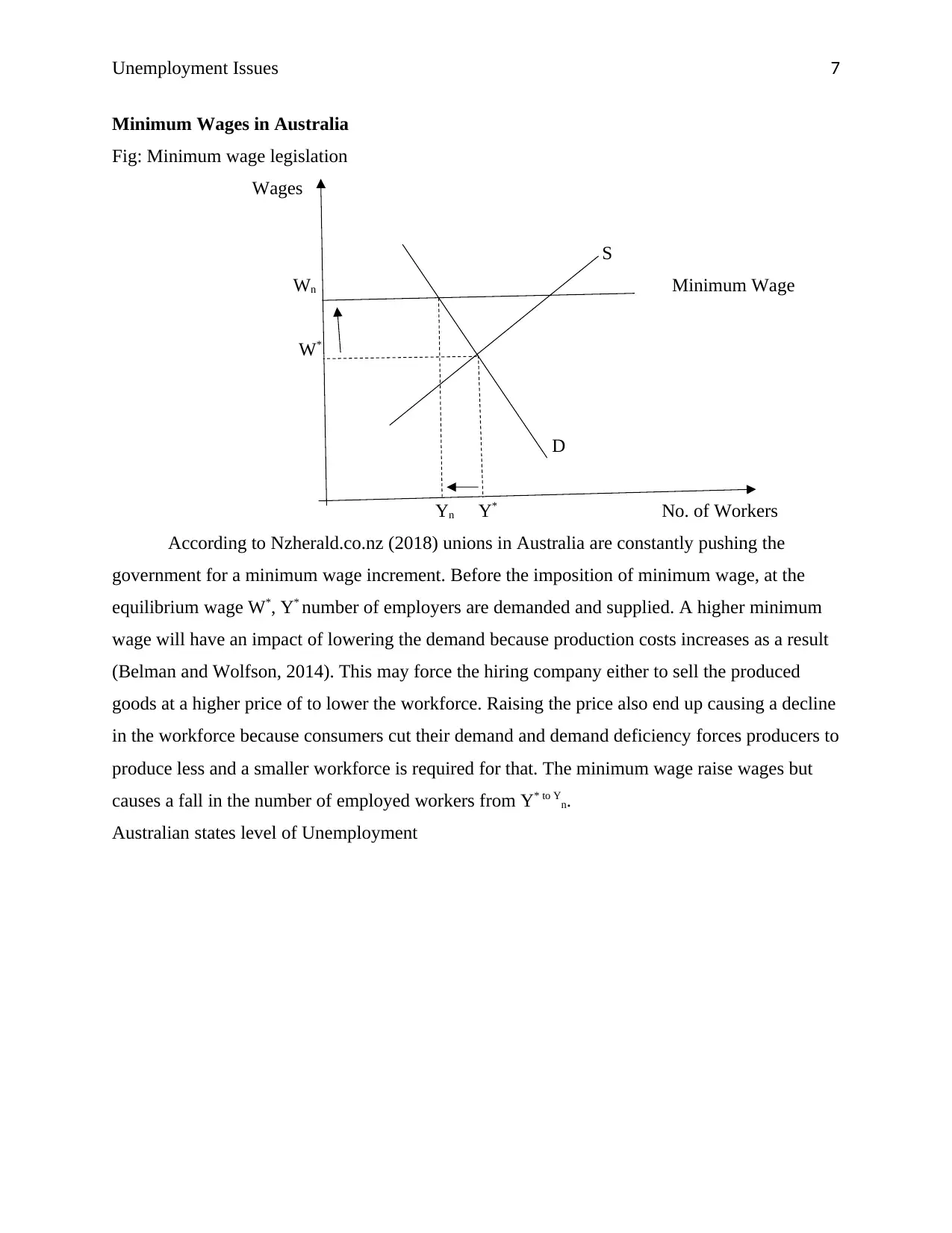
Fig: Minimum wage legislation
Wages
S
Wn Minimum Wage
W*
D
Yn Y* No. of Workers
According to Nzherald.co.nz (2018) unions in Australia are constantly pushing the
government for a minimum wage increment. Before the imposition of minimum wage, at the
equilibrium wage W*, Y* number of employers are demanded and supplied. A higher minimum
wage will have an impact of lowering the demand because production costs increases as a result
(Belman and Wolfson, 2014). This may force the hiring company either to sell the produced
goods at a higher price of to lower the workforce. Raising the price also end up causing a decline
in the workforce because consumers cut their demand and demand deficiency forces producers to
produce less and a smaller workforce is required for that. The minimum wage raise wages but
causes a fall in the number of employed workers from Y* to Yn.
Australian states level of Unemployment
Minimum Wages in Australia
Fig: Minimum wage legislation
Wages
S
Wn Minimum Wage
W*
D
Yn Y* No. of Workers
According to Nzherald.co.nz (2018) unions in Australia are constantly pushing the
government for a minimum wage increment. Before the imposition of minimum wage, at the
equilibrium wage W*, Y* number of employers are demanded and supplied. A higher minimum
wage will have an impact of lowering the demand because production costs increases as a result
(Belman and Wolfson, 2014). This may force the hiring company either to sell the produced
goods at a higher price of to lower the workforce. Raising the price also end up causing a decline
in the workforce because consumers cut their demand and demand deficiency forces producers to
produce less and a smaller workforce is required for that. The minimum wage raise wages but
causes a fall in the number of employed workers from Y* to Yn.
Australian states level of Unemployment
Paraphrase This Document
Need a fresh take? Get an instant paraphrase of this document with our AI Paraphraser
Unemployment Issues 8
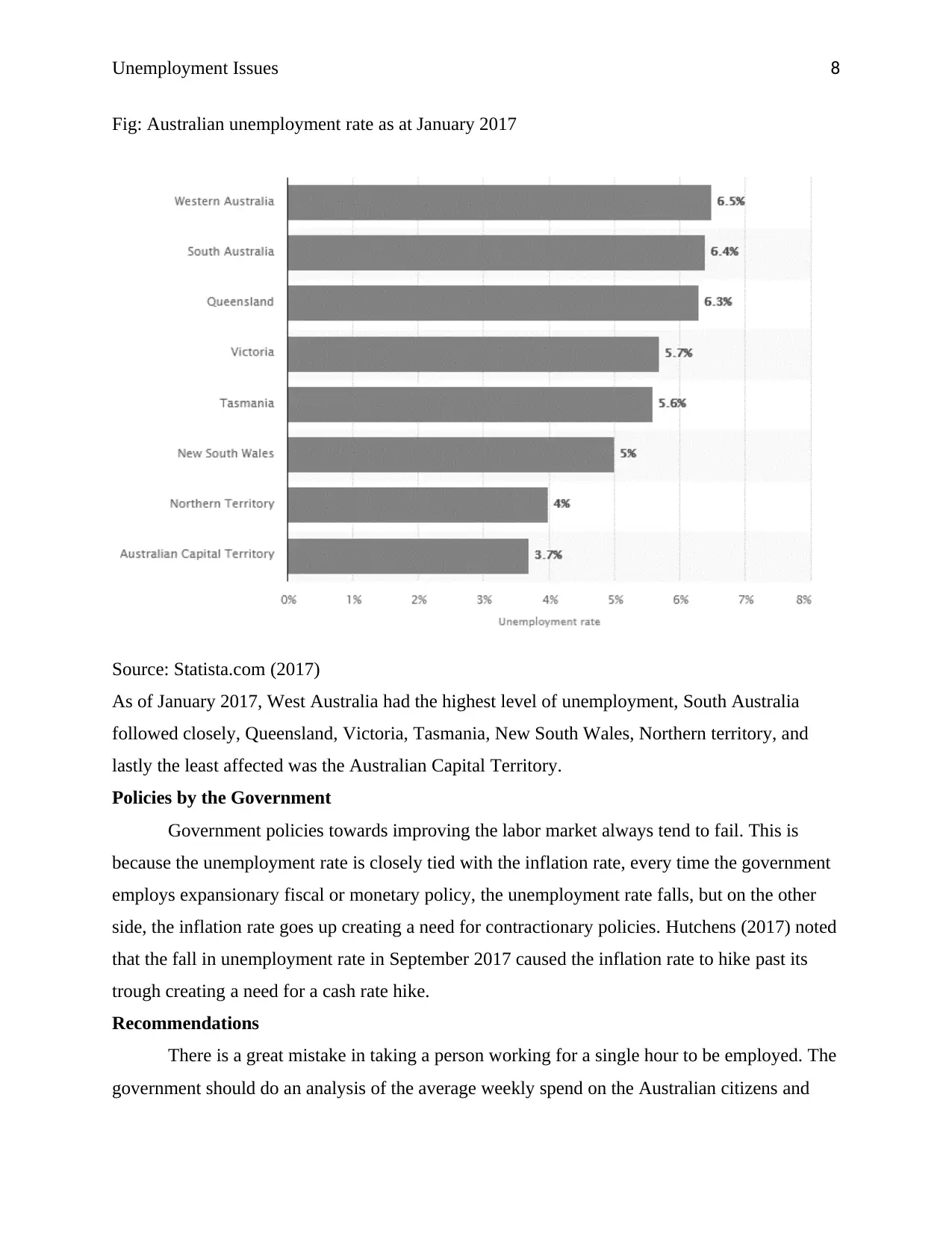
Fig: Australian unemployment rate as at January 2017
Source: Statista.com (2017)
As of January 2017, West Australia had the highest level of unemployment, South Australia
followed closely, Queensland, Victoria, Tasmania, New South Wales, Northern territory, and
lastly the least affected was the Australian Capital Territory.
Policies by the Government
Government policies towards improving the labor market always tend to fail. This is
because the unemployment rate is closely tied with the inflation rate, every time the government
employs expansionary fiscal or monetary policy, the unemployment rate falls, but on the other
side, the inflation rate goes up creating a need for contractionary policies. Hutchens (2017) noted
that the fall in unemployment rate in September 2017 caused the inflation rate to hike past its
trough creating a need for a cash rate hike.
Recommendations
There is a great mistake in taking a person working for a single hour to be employed. The
government should do an analysis of the average weekly spend on the Australian citizens and
Fig: Australian unemployment rate as at January 2017
Source: Statista.com (2017)
As of January 2017, West Australia had the highest level of unemployment, South Australia
followed closely, Queensland, Victoria, Tasmania, New South Wales, Northern territory, and
lastly the least affected was the Australian Capital Territory.
Policies by the Government
Government policies towards improving the labor market always tend to fail. This is
because the unemployment rate is closely tied with the inflation rate, every time the government
employs expansionary fiscal or monetary policy, the unemployment rate falls, but on the other
side, the inflation rate goes up creating a need for contractionary policies. Hutchens (2017) noted
that the fall in unemployment rate in September 2017 caused the inflation rate to hike past its
trough creating a need for a cash rate hike.
Recommendations
There is a great mistake in taking a person working for a single hour to be employed. The
government should do an analysis of the average weekly spend on the Australian citizens and
Unemployment Issues 9
determine the minimum weekly wage required to support the basic needs. After doing this, it
should revise the number of hour requirement according to the minimum wages and the average
wage. For instance the government may find out that one need to work for at least 15 hours if the
basic needs are met effectively. This at least will lower the problem of unemployment and a
clearer picture of the unemployment situation in Australia will be obtained.
The government should completely do away with the conditions that one must meet to be
considered unemployed and take all persons above the age of 15Years to be unemployed. This is
the real labor force. One argument why the unemployment rate in Australia remains high even
when there is an increase in job creation is because of these ignored workers. For instance, if we
may consider the fact that the unemployed persons were say two million, if the government
created 500,000 jobs, there is still a possibility that the unemployment rate will still remain to be
the same or even go higher. Why? This is because the government has no ability to specify the
allocation of those jobs to the unemployed. Most of these jobs might go to the discouraged
workers and the underemployed. This is the reason why ignoring these people leads to the
government making misleading decisions. If the government considered all those without jobs to
be unemployed, it would easily track the changes in the unemployment rate. The government
should use other rules and regulation to control this market other that trying to use expansionary
policies as they have negative impacts.
Conclusions
Even though there seem to be an improvement in the unemployment rate in Australia
over the 5 years under analysis, the rate is higher and still not favorable and need to be improved
further. There is no single factor which we can base all the blame for the problem of
unemployment rate in Australia, however, the decline in the performance of manufacturing
sector has had a greater contribution. High taxation rate will generate more revenue for the
government but it hurts the economy when it’s not doing well.
The government policies implemented has not had sufficient impact on improving the
creation of jobs in Australia. The condition necessary for an unemployed person are unrealistic
as they exclude many people who have no jobs from this bracket, some others work for only a
few hours in a week and are considered unemployed, this is not a true representation of the
unemployment rate in Australia. If the true unemployment rate was reported, Australia would
have a very high unemployment rate; above 40%. For this reason, if the government used the
determine the minimum weekly wage required to support the basic needs. After doing this, it
should revise the number of hour requirement according to the minimum wages and the average
wage. For instance the government may find out that one need to work for at least 15 hours if the
basic needs are met effectively. This at least will lower the problem of unemployment and a
clearer picture of the unemployment situation in Australia will be obtained.
The government should completely do away with the conditions that one must meet to be
considered unemployed and take all persons above the age of 15Years to be unemployed. This is
the real labor force. One argument why the unemployment rate in Australia remains high even
when there is an increase in job creation is because of these ignored workers. For instance, if we
may consider the fact that the unemployed persons were say two million, if the government
created 500,000 jobs, there is still a possibility that the unemployment rate will still remain to be
the same or even go higher. Why? This is because the government has no ability to specify the
allocation of those jobs to the unemployed. Most of these jobs might go to the discouraged
workers and the underemployed. This is the reason why ignoring these people leads to the
government making misleading decisions. If the government considered all those without jobs to
be unemployed, it would easily track the changes in the unemployment rate. The government
should use other rules and regulation to control this market other that trying to use expansionary
policies as they have negative impacts.
Conclusions
Even though there seem to be an improvement in the unemployment rate in Australia
over the 5 years under analysis, the rate is higher and still not favorable and need to be improved
further. There is no single factor which we can base all the blame for the problem of
unemployment rate in Australia, however, the decline in the performance of manufacturing
sector has had a greater contribution. High taxation rate will generate more revenue for the
government but it hurts the economy when it’s not doing well.
The government policies implemented has not had sufficient impact on improving the
creation of jobs in Australia. The condition necessary for an unemployed person are unrealistic
as they exclude many people who have no jobs from this bracket, some others work for only a
few hours in a week and are considered unemployed, this is not a true representation of the
unemployment rate in Australia. If the true unemployment rate was reported, Australia would
have a very high unemployment rate; above 40%. For this reason, if the government used the
⊘ This is a preview!⊘
Do you want full access?
Subscribe today to unlock all pages.
Trusted by 1+ million students worldwide
Unemployment Issues 10
current unrealistic report on unemployment rate to gauge its economic performance, it will be
making misleading decisions as the situation seem to be in control while it’s not. The rate will
continue being higher.
current unrealistic report on unemployment rate to gauge its economic performance, it will be
making misleading decisions as the situation seem to be in control while it’s not. The rate will
continue being higher.
Paraphrase This Document
Need a fresh take? Get an instant paraphrase of this document with our AI Paraphraser
Unemployment Issues 11
Bibliography
Amadeo, K. (2018). Structural Unemployment, Its Causes, and Examples: Why It's Harder to
Find A Job Now. [Online] The Balance. Available at: https://www.thebalance.com/structural-
unemployment-3306202 [Accessed 13 May 2018].
Belman, D. And Wolfson, J. (2014). What does the minimum wage do? Kalamazoo Michigan:
W.E. Upjohn Institute for Employment Research
Databank.worldbank.org. (2018). World Development Indicators | DataBank. [Online] Available
at: http://databank.worldbank.org/data/reports.aspx?source=world-development-indicators#
[Accessed 13 May 2018].
Grimsley, S. (2017). Cyclical Unemployment: Definition & Examples. [Online] Study.com.
Available at: https://study.com/academy/lesson/cyclical-unemployment-definition-examples-
quiz.html [Accessed 13 May 2018].
Hutchens, G. (2017). Australia’s unemployment rate falls to four-year low of 5.5%. [Online] The
Guardian. Available at: https://www.theguardian.com/business/2017/oct/19/australias-
unemployment-rate-falls-to-four-year-low-of-55 [Accessed 14 May 2018].
Jericho, G. (2017). To those who claim Australia's unemployment data is dishonest – please stop.
[Online] The Guardian. Available at:
https://www.theguardian.com/business/grogonomics/2017/may/30/to-those-who-claim-
australias-unemployment-data-is-dishonest-please-stop [Accessed 14 May 2018].
Letts, S. (2018). Jobs surge failing to deliver wage rises. [Online] ABC News. Available at:
http://www.abc.net.au/news/2018-01-18/unemployment-december-2017/9338664 [Accessed 14
May 2018].
Levin-Waldman, O. (2018). Restoring the middle class through wage policy: arguments for a
minimum wage. Cham: Palgrave Macmillan.
McEachern, W. (2017). Economics: a contemporary introduction. Australia: Cengage Learning.
Murphy, J. (2017). The work boast you should keep to yourself. [Online] NewsComAu.
Available at: http://www.news.com.au/finance/work/at-work/i-need-more-worklife-balance-and-
other-boasts-you-should-keep-to-yourself/news-story/5854afeae670301d45f64ccb1a0f0d33
[Accessed 14 May 2018].
Bibliography
Amadeo, K. (2018). Structural Unemployment, Its Causes, and Examples: Why It's Harder to
Find A Job Now. [Online] The Balance. Available at: https://www.thebalance.com/structural-
unemployment-3306202 [Accessed 13 May 2018].
Belman, D. And Wolfson, J. (2014). What does the minimum wage do? Kalamazoo Michigan:
W.E. Upjohn Institute for Employment Research
Databank.worldbank.org. (2018). World Development Indicators | DataBank. [Online] Available
at: http://databank.worldbank.org/data/reports.aspx?source=world-development-indicators#
[Accessed 13 May 2018].
Grimsley, S. (2017). Cyclical Unemployment: Definition & Examples. [Online] Study.com.
Available at: https://study.com/academy/lesson/cyclical-unemployment-definition-examples-
quiz.html [Accessed 13 May 2018].
Hutchens, G. (2017). Australia’s unemployment rate falls to four-year low of 5.5%. [Online] The
Guardian. Available at: https://www.theguardian.com/business/2017/oct/19/australias-
unemployment-rate-falls-to-four-year-low-of-55 [Accessed 14 May 2018].
Jericho, G. (2017). To those who claim Australia's unemployment data is dishonest – please stop.
[Online] The Guardian. Available at:
https://www.theguardian.com/business/grogonomics/2017/may/30/to-those-who-claim-
australias-unemployment-data-is-dishonest-please-stop [Accessed 14 May 2018].
Letts, S. (2018). Jobs surge failing to deliver wage rises. [Online] ABC News. Available at:
http://www.abc.net.au/news/2018-01-18/unemployment-december-2017/9338664 [Accessed 14
May 2018].
Levin-Waldman, O. (2018). Restoring the middle class through wage policy: arguments for a
minimum wage. Cham: Palgrave Macmillan.
McEachern, W. (2017). Economics: a contemporary introduction. Australia: Cengage Learning.
Murphy, J. (2017). The work boast you should keep to yourself. [Online] NewsComAu.
Available at: http://www.news.com.au/finance/work/at-work/i-need-more-worklife-balance-and-
other-boasts-you-should-keep-to-yourself/news-story/5854afeae670301d45f64ccb1a0f0d33
[Accessed 14 May 2018].
Unemployment Issues 12
Nzherald.co.nz (2018). Cost of Uber Eats could skyrocket due to union pressure in Australia.
[Online] NZ Herald. Available at: https://www.nzherald.co.nz/business/news/article.cfm?
c_id=3&objectid=11985970 [Accessed 13 May 2018].
Pettinger, T. (2017). Seasonal Unemployment. [Online] Economicshelp.org. Available at:
https://www.economicshelp.org/blog/glossary/seasonal-unemployment/ [Accessed 13 May
2018].
Sebastian (2015). Causes of unemployment - common causes in Australia. [Online] Adelaide-
southaustralia.com. Available at: http://www.adelaide-southaustralia.com/money/causes-of-
unemployment/ [Accessed 15 May 2018].
Statista.com (2017). Australia - unemployment rate by state 2017. [Online] Statista. Available at:
https://www.statista.com/statistics/786491/australia-unemployment-rate-by-state/ [Accessed 14
May 2018].
Nzherald.co.nz (2018). Cost of Uber Eats could skyrocket due to union pressure in Australia.
[Online] NZ Herald. Available at: https://www.nzherald.co.nz/business/news/article.cfm?
c_id=3&objectid=11985970 [Accessed 13 May 2018].
Pettinger, T. (2017). Seasonal Unemployment. [Online] Economicshelp.org. Available at:
https://www.economicshelp.org/blog/glossary/seasonal-unemployment/ [Accessed 13 May
2018].
Sebastian (2015). Causes of unemployment - common causes in Australia. [Online] Adelaide-
southaustralia.com. Available at: http://www.adelaide-southaustralia.com/money/causes-of-
unemployment/ [Accessed 15 May 2018].
Statista.com (2017). Australia - unemployment rate by state 2017. [Online] Statista. Available at:
https://www.statista.com/statistics/786491/australia-unemployment-rate-by-state/ [Accessed 14
May 2018].
⊘ This is a preview!⊘
Do you want full access?
Subscribe today to unlock all pages.
Trusted by 1+ million students worldwide

1 out of 12


Related Documents


Your All-in-One AI-Powered Toolkit for Academic Success.
+13062052269
info@desklib.com
Available 24*7 on WhatsApp / Email
![[object Object]](/_next/static/media/star-bottom.7253800d.svg)
Unlock your academic potential
Copyright © 2020–2026 A2Z Services. All Rights Reserved. Developed and managed by ZUCOL.