Impact of Populism and Executive Control on Australian Asylum Policy
VerifiedAdded on 2022/10/01
|11
|3168
|424
Essay
AI Summary
This essay delves into the complexities of Australian asylum policy, examining the influence of populism, executive control, and regional relationships, particularly with Indonesia. It begins by defining populism and analyzing its impact on shaping policies and public discourse, including the role of nativism and anti-immigration sentiments. The essay then explores the concept of executive control within the Australian government, highlighting its implications for the judiciary and legislature, and its role in implementing asylum policies. Furthermore, it investigates the impact of Australia's asylum policies on its relationship with Indonesia, analyzing cooperation on immigration detention programs and regional frameworks. Finally, the essay discusses the influence of the Global Compact on Refugees (GCR) and the Global Compact on Safe, Orderly and Regular Migration (GCM) on Australia's migration frameworks, emphasizing the establishment of new human rights frameworks and the promotion of international cooperation, concluding with a discussion on the prospects of a better future for migrants globally.
Introduction
The regime of global refugee protection is considered as a global public good under
which countries share the obligation of such protection. The idea of sharing responsibilities
among states underlies the refugee goals as indicated in article 35 of the refugee convention.
Even though Australia has been keen in presenting itself as the leading power on matters
concerning refuges, immigrants and asylum seekers in Asia-pacific regions. Therefore, we can
argue that setting up immigration policies in Australia is highly challenged by the Indonesia-
Australia cooperation in these matters.
Populism
The presence of populist ideologies in the Australian Government has had direct
consequences, either in terms of shaping the policies in order to reflect the views or prompting
them to backtrack through some electoral pledges. Populism is not something new. In Australia,
it has been a strong force to be reckoned with at least since the 1990s and a subject of
comprehensive studies up to date. Most of the studies have mainly focused on the impact of
populism a liberal democracy among other factors such as the ant pluralist approaches,
authoritarian features among others (Nethery, & Gordyn, 2014 p. 130-140). The definition
around which most of the consensus is held points out that, it is an ideology that perceives
society as separated into two homogenous and antagonistic factions: The good people against the
corrupt elite. In such circumstances, it is often argued that politics should be a reflection of the
peoples’ general will. The fundamental aspect is that the populist party argues that it represents
the people, while in real sense ventriloquizes (Betts, 2011 p. 79-89). By definition, populism is
exclusive while the other can variously be foreigners, elites, immigrants of even the entire
establishment.
The regime of global refugee protection is considered as a global public good under
which countries share the obligation of such protection. The idea of sharing responsibilities
among states underlies the refugee goals as indicated in article 35 of the refugee convention.
Even though Australia has been keen in presenting itself as the leading power on matters
concerning refuges, immigrants and asylum seekers in Asia-pacific regions. Therefore, we can
argue that setting up immigration policies in Australia is highly challenged by the Indonesia-
Australia cooperation in these matters.
Populism
The presence of populist ideologies in the Australian Government has had direct
consequences, either in terms of shaping the policies in order to reflect the views or prompting
them to backtrack through some electoral pledges. Populism is not something new. In Australia,
it has been a strong force to be reckoned with at least since the 1990s and a subject of
comprehensive studies up to date. Most of the studies have mainly focused on the impact of
populism a liberal democracy among other factors such as the ant pluralist approaches,
authoritarian features among others (Nethery, & Gordyn, 2014 p. 130-140). The definition
around which most of the consensus is held points out that, it is an ideology that perceives
society as separated into two homogenous and antagonistic factions: The good people against the
corrupt elite. In such circumstances, it is often argued that politics should be a reflection of the
peoples’ general will. The fundamental aspect is that the populist party argues that it represents
the people, while in real sense ventriloquizes (Betts, 2011 p. 79-89). By definition, populism is
exclusive while the other can variously be foreigners, elites, immigrants of even the entire
establishment.

Paraphrase This Document
Need a fresh take? Get an instant paraphrase of this document with our AI Paraphraser
The most fundamental and often shared by the populist factions is the nativist point of
view as well as the great preference for an exclusionist Asylum policy in Australia. In the
nativist point of view. constant immigration is a huge threat to the homogenous state. The
biggest concerns about immigration and asylum policies distinguishes the populist party family
from other parties (Klein, 2013 p. 113-113). Far-right populist often prefer restive policies that
are currently implemented in areas of immigrant admission as well as integration of the
immigrants. The central perspective of the asylum policies implies that, assessing its impact on
the output of the polices is imperative to the general evaluation of its performance (Moffitt, &
Tormey, 2014).
The indirect impact of populism on asylum polices results from the capacity of the party
to influence the party competition as well as its overall direction. Populism particularly has
influenced competition by presenting the issue of asylum seekers as a salient political matter and
mobilizing anti-immigration sentiments. The successful mobilization against immigration by
populist parties in Australia has hindered other mainstream parties from ignoring the restrictive
preferences of the media voter. Therefore, liberal policies about asylum seekers and immigrants,
become huge electoral risks to them. As a result, it is expected that the mainstream parties to
move towards policies that are perceived as restrictive.
It is important to note that, in immigration policies. Cultural conservatism and economic
liberalism split the populist parties in the country. While the protection of workers and the
universal concept of justice and equality divide the left-wing party. Moreover, populist parties
tend to share a moderate position on matters of immigrations in an effort to ensure that there is a
balanced framework for all internal factions with competing preferences.
view as well as the great preference for an exclusionist Asylum policy in Australia. In the
nativist point of view. constant immigration is a huge threat to the homogenous state. The
biggest concerns about immigration and asylum policies distinguishes the populist party family
from other parties (Klein, 2013 p. 113-113). Far-right populist often prefer restive policies that
are currently implemented in areas of immigrant admission as well as integration of the
immigrants. The central perspective of the asylum policies implies that, assessing its impact on
the output of the polices is imperative to the general evaluation of its performance (Moffitt, &
Tormey, 2014).
The indirect impact of populism on asylum polices results from the capacity of the party
to influence the party competition as well as its overall direction. Populism particularly has
influenced competition by presenting the issue of asylum seekers as a salient political matter and
mobilizing anti-immigration sentiments. The successful mobilization against immigration by
populist parties in Australia has hindered other mainstream parties from ignoring the restrictive
preferences of the media voter. Therefore, liberal policies about asylum seekers and immigrants,
become huge electoral risks to them. As a result, it is expected that the mainstream parties to
move towards policies that are perceived as restrictive.
It is important to note that, in immigration policies. Cultural conservatism and economic
liberalism split the populist parties in the country. While the protection of workers and the
universal concept of justice and equality divide the left-wing party. Moreover, populist parties
tend to share a moderate position on matters of immigrations in an effort to ensure that there is a
balanced framework for all internal factions with competing preferences.
The role played by populist parties and their association with the mainstream politics in
Australia, needs to be explored. Such parties, particularly those from the Centre-right, have
shifted further to the right on immigration, law an order, austerity and finally national security.
Sometime they do so base on their desire, propelled by internal dynamics to transform their
approaches, rather than being under pressure from the extremists. In most cases, populists often
exploit the challenge of the left in order to toughen their rhetoric as well as policies in
accordance with the themes and resolutions. This has, for quite a long period benefited the
populist, which in turn has pushed immigration policies further to the right. This means that the
new regulations are more restrictive. I this sense, the views of the populist might be considered
as reactions to the changing contexts rather than just a cause of the populist shift to far restrictive
policies.
Executive control
Executive control is framework in the government whereby all the key officials are
responsible of the administrative superiors often known as ministers within the Australian
government. The role of this framework is to ensure that all the senior officials are responsible of
all that goes on within his department (Hirsch, 2017). The model clearly points out that is an
error is made by a civil servant in a certain department, the senior official in charge of such
department are held responsible irrespective of whether they had knowledge about it or not. In
Australia, Misters have to resign for any wrongdoings made by the official within the
department.
Executive controls are considered as more important for their positive input towards
development and enforcement of laws in the actional operations under the substantive. The
provide a constructive and progressive guidance to the administration. This ensures that the
Australia, needs to be explored. Such parties, particularly those from the Centre-right, have
shifted further to the right on immigration, law an order, austerity and finally national security.
Sometime they do so base on their desire, propelled by internal dynamics to transform their
approaches, rather than being under pressure from the extremists. In most cases, populists often
exploit the challenge of the left in order to toughen their rhetoric as well as policies in
accordance with the themes and resolutions. This has, for quite a long period benefited the
populist, which in turn has pushed immigration policies further to the right. This means that the
new regulations are more restrictive. I this sense, the views of the populist might be considered
as reactions to the changing contexts rather than just a cause of the populist shift to far restrictive
policies.
Executive control
Executive control is framework in the government whereby all the key officials are
responsible of the administrative superiors often known as ministers within the Australian
government. The role of this framework is to ensure that all the senior officials are responsible of
all that goes on within his department (Hirsch, 2017). The model clearly points out that is an
error is made by a civil servant in a certain department, the senior official in charge of such
department are held responsible irrespective of whether they had knowledge about it or not. In
Australia, Misters have to resign for any wrongdoings made by the official within the
department.
Executive controls are considered as more important for their positive input towards
development and enforcement of laws in the actional operations under the substantive. The
provide a constructive and progressive guidance to the administration. This ensures that the
⊘ This is a preview!⊘
Do you want full access?
Subscribe today to unlock all pages.

Trusted by 1+ million students worldwide
department are always alert. It can therefore be argued that the asylum policies Have been
characterized by the increasing powers of the executive (Betts, 2011). Such powers have been
accomplished through diminution of the powers bestowed upon the judiciary and the legislature.
Moreover, it has also been achieved through the dismissal of criticism about asylum policies and
practices from other non-government actors. In order to justify the increased executive control
over asylum policies and other immigration regulations. Consecutive Australian government
have articulated a populist ideology about matters of immigration (Tan, 2015). This is the
consideration that all migration matters ought to be determined by the Australian people through
an elected government and not through the judiciary process of Human rights establishments.
This view further extends that the executive is the most suited to implement the will of the
people, and that any immigration policy decisions ought not to be labored down through
constitutional liberalism and appropriate democratic checks and balances (Appleby, 2017).
One big challenge that has occurred is that most of the immigration programs have been
taken over by lawyers. Successive ministers of immigration have found it very challenging to
provide proper administration under their increasing responsibilities. Therefore, it is important
for the Australian government to ensure that the legal system does not preclude the government
as well as the executive control of the minister from exercising their obligations (Missbach, &
Tanu, 2016).
characterized by the increasing powers of the executive (Betts, 2011). Such powers have been
accomplished through diminution of the powers bestowed upon the judiciary and the legislature.
Moreover, it has also been achieved through the dismissal of criticism about asylum policies and
practices from other non-government actors. In order to justify the increased executive control
over asylum policies and other immigration regulations. Consecutive Australian government
have articulated a populist ideology about matters of immigration (Tan, 2015). This is the
consideration that all migration matters ought to be determined by the Australian people through
an elected government and not through the judiciary process of Human rights establishments.
This view further extends that the executive is the most suited to implement the will of the
people, and that any immigration policy decisions ought not to be labored down through
constitutional liberalism and appropriate democratic checks and balances (Appleby, 2017).
One big challenge that has occurred is that most of the immigration programs have been
taken over by lawyers. Successive ministers of immigration have found it very challenging to
provide proper administration under their increasing responsibilities. Therefore, it is important
for the Australian government to ensure that the legal system does not preclude the government
as well as the executive control of the minister from exercising their obligations (Missbach, &
Tanu, 2016).
Paraphrase This Document
Need a fresh take? Get an instant paraphrase of this document with our AI Paraphraser
Regional relationships:
It is important to note that the detention of asylum seeker from different parts of Asia
applies equally. Moreover, Children and adults are usually treated equally. This implies that
minors were often detained until they were granted permission. Section 177of the Migration Act
indicates that the definition of designated person also includes other non-citizens born in
Australia whose parents are designated persons (Turk, and Garlik, 2016). However, in 2005 the
laws were changed in order to ensure that children and their main caregivers could stay for the
period of their detention in the immigration facilities (McDonald, 2011 p. 89).
Foreign fishermen from various parts of Asia are subject to immigration detention,
particularly if they have been caught within the Australian territory, which is unlawful. They are
often young men from various south east Asia countries or Indonesia. Until 2005, immigrants
were first detained in the immigration facilities until they were approved to enter the country or
deported (Martin, 2015). The policy of detaining immigrants from the sea is properly outlined in
section 84 of the Fisheries Management Act 1991. This section further provides immigration
officer power to detain immigrant of the sea in Australia with the objective of determining the
authenticity of the subjects (Long, & Yet, 2017). We shall discuss the how Indonesia has been
impacted by the Australia’s asylum seekers policies.
In the last two years the relationship between Indonesia and Australia has been
developing drastically. One of the fundamental aspects of the relationship has been the
development of cooperation over asylum policies. For Australia, the unauthorized entry of
asylum seekers in the country by the sea is a contentious policy issue, in which “stopping the
It is important to note that the detention of asylum seeker from different parts of Asia
applies equally. Moreover, Children and adults are usually treated equally. This implies that
minors were often detained until they were granted permission. Section 177of the Migration Act
indicates that the definition of designated person also includes other non-citizens born in
Australia whose parents are designated persons (Turk, and Garlik, 2016). However, in 2005 the
laws were changed in order to ensure that children and their main caregivers could stay for the
period of their detention in the immigration facilities (McDonald, 2011 p. 89).
Foreign fishermen from various parts of Asia are subject to immigration detention,
particularly if they have been caught within the Australian territory, which is unlawful. They are
often young men from various south east Asia countries or Indonesia. Until 2005, immigrants
were first detained in the immigration facilities until they were approved to enter the country or
deported (Martin, 2015). The policy of detaining immigrants from the sea is properly outlined in
section 84 of the Fisheries Management Act 1991. This section further provides immigration
officer power to detain immigrant of the sea in Australia with the objective of determining the
authenticity of the subjects (Long, & Yet, 2017). We shall discuss the how Indonesia has been
impacted by the Australia’s asylum seekers policies.
In the last two years the relationship between Indonesia and Australia has been
developing drastically. One of the fundamental aspects of the relationship has been the
development of cooperation over asylum policies. For Australia, the unauthorized entry of
asylum seekers in the country by the sea is a contentious policy issue, in which “stopping the
boats” from Indonesia has turned out to be the greatest marker of policy success. However, for
Indonesia, asylum seekers have not been a contentious issue (Cerbule, 2015 p. 75-79). This is
due to the fact that the number of asylum seeker in Indonesia are often small. Moreover, the
UNHCR operates from Jakarta to review and resettle persons for asylum there.
Since the late 90s, there have been a huge shift in Indonesia’s approach to the asylum
policies on the side of Indonesia. Australia have further invested significantly on political
resources into Indonesia in order to strengthen their relationship on the matter. As a result,
Indonesia and Australia now cooperate on a wider spectrum of asylum policies (Missbach, 2015
p. 75-79). Australia has further facilitated, through political and financial resources, the
development of Indonesia’s immigration detention programs, which now operate more than 10
detention centers across the country (Mann, 2018 p. 70-75). Australia provides additional
financing, education programs, and intelligence support in an effort to fight anti-smuggling
operations. In regional level, both countries are diplomatic allies and together they are able to
direct the Regional cooperation Framework, which was established in 2011 to manage the
movement of irregular persons in South East Asia (Furman, et al., 2016 p. 34-36).
The Global Compacts
The GCM and the GCR have had a significant impact on Australia migration
frameworks. It has led to the establishment of new Human rights normative framework for safe
and orderly migration. The GCM and the GCR, through non-binding frameworks has indeed
provided a milestone on matters migration. It is important in the sense that it clearly links
International human rights frameworks to Australia’s international migration programs. In
addition, driven by the normative framework, the zero Draft plus of the GCM provides that the
member states will be working on specific actions (Missbach, 2015 p. 70-12). For instance,
Indonesia, asylum seekers have not been a contentious issue (Cerbule, 2015 p. 75-79). This is
due to the fact that the number of asylum seeker in Indonesia are often small. Moreover, the
UNHCR operates from Jakarta to review and resettle persons for asylum there.
Since the late 90s, there have been a huge shift in Indonesia’s approach to the asylum
policies on the side of Indonesia. Australia have further invested significantly on political
resources into Indonesia in order to strengthen their relationship on the matter. As a result,
Indonesia and Australia now cooperate on a wider spectrum of asylum policies (Missbach, 2015
p. 75-79). Australia has further facilitated, through political and financial resources, the
development of Indonesia’s immigration detention programs, which now operate more than 10
detention centers across the country (Mann, 2018 p. 70-75). Australia provides additional
financing, education programs, and intelligence support in an effort to fight anti-smuggling
operations. In regional level, both countries are diplomatic allies and together they are able to
direct the Regional cooperation Framework, which was established in 2011 to manage the
movement of irregular persons in South East Asia (Furman, et al., 2016 p. 34-36).
The Global Compacts
The GCM and the GCR have had a significant impact on Australia migration
frameworks. It has led to the establishment of new Human rights normative framework for safe
and orderly migration. The GCM and the GCR, through non-binding frameworks has indeed
provided a milestone on matters migration. It is important in the sense that it clearly links
International human rights frameworks to Australia’s international migration programs. In
addition, driven by the normative framework, the zero Draft plus of the GCM provides that the
member states will be working on specific actions (Missbach, 2015 p. 70-12). For instance,
⊘ This is a preview!⊘
Do you want full access?
Subscribe today to unlock all pages.
Trusted by 1+ million students worldwide
Indonesia Implemented zero draft plus framework on July 2011, with specific actions such as
labor rights and temporary protection of asylum seekers among other key frameworks. Notably,
it has taken a people centered framework, which recognizes that, irrespective of the legal status,
there are person on the move and in vulnerable situations whose basic rights as human beings
must be upheld (Gammeltoft-Hansen, & Hathaway, 2014 p. 112-117).
Another positive input by the GCM and GCR is its positive and principled framing. In
addition to the core international human right treaties, Indonesia has based the compact on key
international frameworks such as human trafficking, international organized crimes, climate
change and disaster. Notably, The GCM cast international migration and the role if migrants in
constructive terms. The framework underscores the importance of migration towards unlocking
human capital which in turn would help in promoting economic development (Missbach, &
Komnas, 2016 p. 156-160). It further reinforces to reduce the risks and share responsibilities as a
way of ensuring that migration is effective for all. In addition, it has set out a range of
fundamental measures to mitigate racial discrimination, racism among other related migration
issues. The draft further provides key guiding principles that mandates countries to be sensitive
to human rights, and the rule of law among other important issues (Kneebone, 2014 p. 160-165).
That being said, GCR and the GCM provides the prospects of a better future for many people not
only in Australia and Indonesia but also in all other parts of the world. As earlier indicated, the
existing version of both documents have multiple useful aspects to the migrants. It also provides
key provisions that ought to be strengthened in the future. This would ensure that there is
sustainable engagement among countries process (Nethery, & Gordyn,2014 p. 75-79).
Conclusion
labor rights and temporary protection of asylum seekers among other key frameworks. Notably,
it has taken a people centered framework, which recognizes that, irrespective of the legal status,
there are person on the move and in vulnerable situations whose basic rights as human beings
must be upheld (Gammeltoft-Hansen, & Hathaway, 2014 p. 112-117).
Another positive input by the GCM and GCR is its positive and principled framing. In
addition to the core international human right treaties, Indonesia has based the compact on key
international frameworks such as human trafficking, international organized crimes, climate
change and disaster. Notably, The GCM cast international migration and the role if migrants in
constructive terms. The framework underscores the importance of migration towards unlocking
human capital which in turn would help in promoting economic development (Missbach, &
Komnas, 2016 p. 156-160). It further reinforces to reduce the risks and share responsibilities as a
way of ensuring that migration is effective for all. In addition, it has set out a range of
fundamental measures to mitigate racial discrimination, racism among other related migration
issues. The draft further provides key guiding principles that mandates countries to be sensitive
to human rights, and the rule of law among other important issues (Kneebone, 2014 p. 160-165).
That being said, GCR and the GCM provides the prospects of a better future for many people not
only in Australia and Indonesia but also in all other parts of the world. As earlier indicated, the
existing version of both documents have multiple useful aspects to the migrants. It also provides
key provisions that ought to be strengthened in the future. This would ensure that there is
sustainable engagement among countries process (Nethery, & Gordyn,2014 p. 75-79).
Conclusion
Paraphrase This Document
Need a fresh take? Get an instant paraphrase of this document with our AI Paraphraser
It is important to note that responsibility does not lie with the politicians. It is an act that
every citizen ought to demand for themselves prior to expecting anything from others. Therefore,
it is important for citizens to be engaged and socially responsible. This would ensure that matters
such as immigration and asylum-seeking policies are not lost to the populist arguments. In
addition, it would ensure that civic participation is made easier and more accessible, even on
policy development. Therefore, the Australian government should seize the opportunity and
engage in migration policy. Even though the existing political dynamics show more support for
populist ideologies, they are not the representatives of the majority of the population in most
countries. Therefore, the majority ought to be mobilized and get more engaged.
every citizen ought to demand for themselves prior to expecting anything from others. Therefore,
it is important for citizens to be engaged and socially responsible. This would ensure that matters
such as immigration and asylum-seeking policies are not lost to the populist arguments. In
addition, it would ensure that civic participation is made easier and more accessible, even on
policy development. Therefore, the Australian government should seize the opportunity and
engage in migration policy. Even though the existing political dynamics show more support for
populist ideologies, they are not the representatives of the majority of the population in most
countries. Therefore, the majority ought to be mobilized and get more engaged.
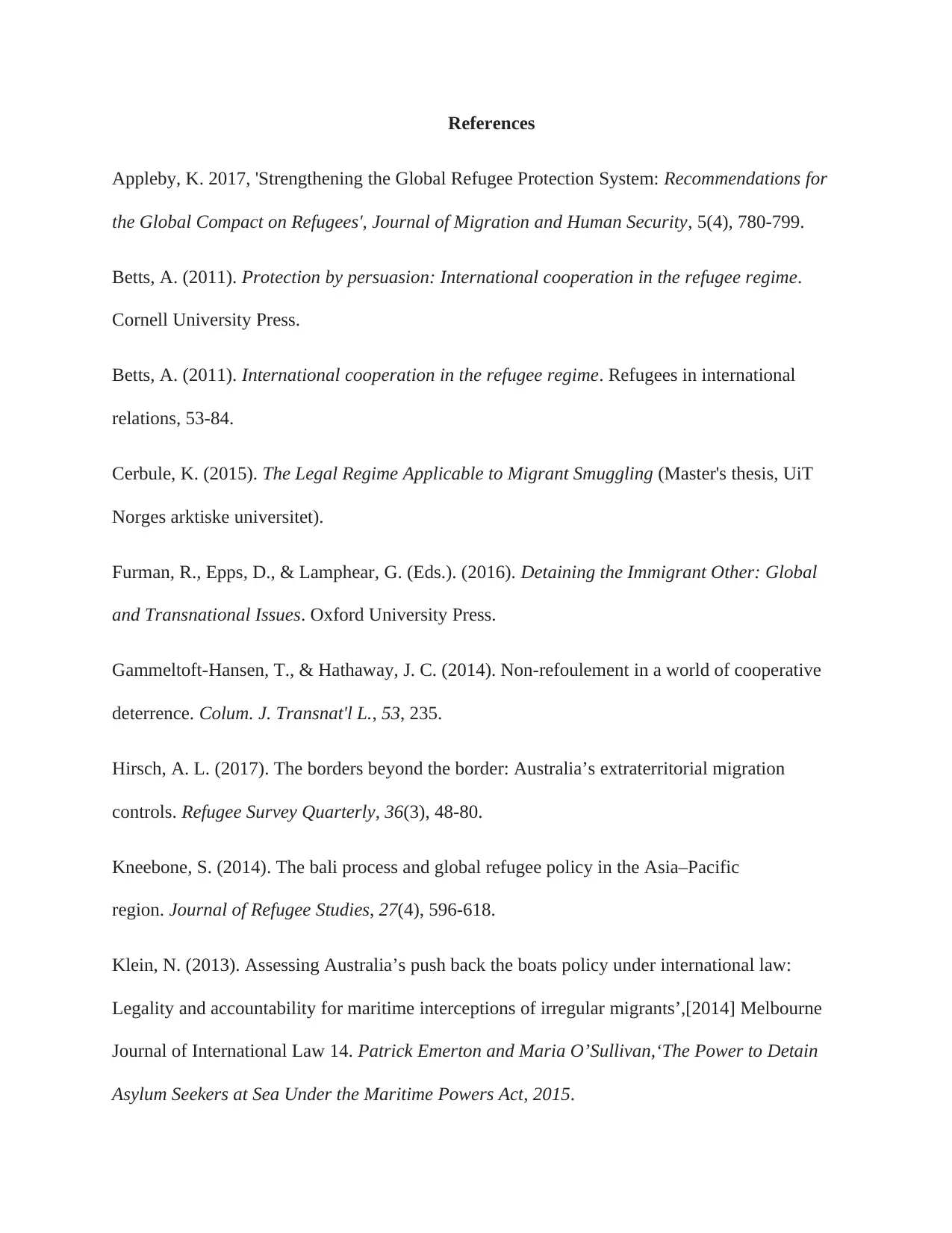
References
Appleby, K. 2017, 'Strengthening the Global Refugee Protection System: Recommendations for
the Global Compact on Refugees', Journal of Migration and Human Security, 5(4), 780-799.
Betts, A. (2011). Protection by persuasion: International cooperation in the refugee regime.
Cornell University Press.
Betts, A. (2011). International cooperation in the refugee regime. Refugees in international
relations, 53-84.
Cerbule, K. (2015). The Legal Regime Applicable to Migrant Smuggling (Master's thesis, UiT
Norges arktiske universitet).
Furman, R., Epps, D., & Lamphear, G. (Eds.). (2016). Detaining the Immigrant Other: Global
and Transnational Issues. Oxford University Press.
Gammeltoft-Hansen, T., & Hathaway, J. C. (2014). Non-refoulement in a world of cooperative
deterrence. Colum. J. Transnat'l L., 53, 235.
Hirsch, A. L. (2017). The borders beyond the border: Australia’s extraterritorial migration
controls. Refugee Survey Quarterly, 36(3), 48-80.
Kneebone, S. (2014). The bali process and global refugee policy in the Asia–Pacific
region. Journal of Refugee Studies, 27(4), 596-618.
Klein, N. (2013). Assessing Australia’s push back the boats policy under international law:
Legality and accountability for maritime interceptions of irregular migrants’,[2014] Melbourne
Journal of International Law 14. Patrick Emerton and Maria O’Sullivan,‘The Power to Detain
Asylum Seekers at Sea Under the Maritime Powers Act, 2015.
Appleby, K. 2017, 'Strengthening the Global Refugee Protection System: Recommendations for
the Global Compact on Refugees', Journal of Migration and Human Security, 5(4), 780-799.
Betts, A. (2011). Protection by persuasion: International cooperation in the refugee regime.
Cornell University Press.
Betts, A. (2011). International cooperation in the refugee regime. Refugees in international
relations, 53-84.
Cerbule, K. (2015). The Legal Regime Applicable to Migrant Smuggling (Master's thesis, UiT
Norges arktiske universitet).
Furman, R., Epps, D., & Lamphear, G. (Eds.). (2016). Detaining the Immigrant Other: Global
and Transnational Issues. Oxford University Press.
Gammeltoft-Hansen, T., & Hathaway, J. C. (2014). Non-refoulement in a world of cooperative
deterrence. Colum. J. Transnat'l L., 53, 235.
Hirsch, A. L. (2017). The borders beyond the border: Australia’s extraterritorial migration
controls. Refugee Survey Quarterly, 36(3), 48-80.
Kneebone, S. (2014). The bali process and global refugee policy in the Asia–Pacific
region. Journal of Refugee Studies, 27(4), 596-618.
Klein, N. (2013). Assessing Australia’s push back the boats policy under international law:
Legality and accountability for maritime interceptions of irregular migrants’,[2014] Melbourne
Journal of International Law 14. Patrick Emerton and Maria O’Sullivan,‘The Power to Detain
Asylum Seekers at Sea Under the Maritime Powers Act, 2015.
⊘ This is a preview!⊘
Do you want full access?
Subscribe today to unlock all pages.
Trusted by 1+ million students worldwide
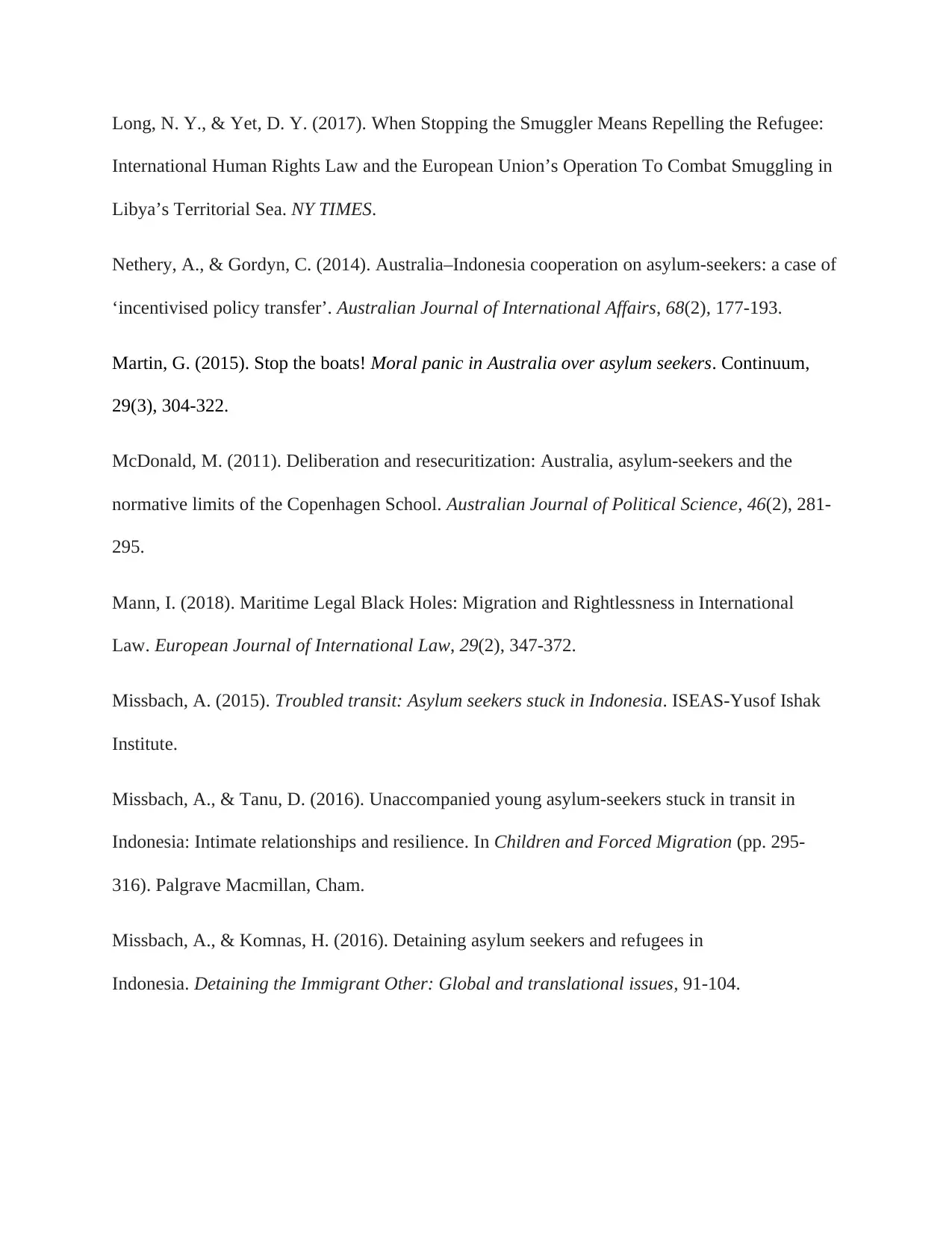
Long, N. Y., & Yet, D. Y. (2017). When Stopping the Smuggler Means Repelling the Refugee:
International Human Rights Law and the European Union’s Operation To Combat Smuggling in
Libya’s Territorial Sea. NY TIMES.
Nethery, A., & Gordyn, C. (2014). Australia–Indonesia cooperation on asylum-seekers: a case of
‘incentivised policy transfer’. Australian Journal of International Affairs, 68(2), 177-193.
Martin, G. (2015). Stop the boats! Moral panic in Australia over asylum seekers. Continuum,
29(3), 304-322.
McDonald, M. (2011). Deliberation and resecuritization: Australia, asylum-seekers and the
normative limits of the Copenhagen School. Australian Journal of Political Science, 46(2), 281-
295.
Mann, I. (2018). Maritime Legal Black Holes: Migration and Rightlessness in International
Law. European Journal of International Law, 29(2), 347-372.
Missbach, A. (2015). Troubled transit: Asylum seekers stuck in Indonesia. ISEAS-Yusof Ishak
Institute.
Missbach, A., & Tanu, D. (2016). Unaccompanied young asylum-seekers stuck in transit in
Indonesia: Intimate relationships and resilience. In Children and Forced Migration (pp. 295-
316). Palgrave Macmillan, Cham.
Missbach, A., & Komnas, H. (2016). Detaining asylum seekers and refugees in
Indonesia. Detaining the Immigrant Other: Global and translational issues, 91-104.
International Human Rights Law and the European Union’s Operation To Combat Smuggling in
Libya’s Territorial Sea. NY TIMES.
Nethery, A., & Gordyn, C. (2014). Australia–Indonesia cooperation on asylum-seekers: a case of
‘incentivised policy transfer’. Australian Journal of International Affairs, 68(2), 177-193.
Martin, G. (2015). Stop the boats! Moral panic in Australia over asylum seekers. Continuum,
29(3), 304-322.
McDonald, M. (2011). Deliberation and resecuritization: Australia, asylum-seekers and the
normative limits of the Copenhagen School. Australian Journal of Political Science, 46(2), 281-
295.
Mann, I. (2018). Maritime Legal Black Holes: Migration and Rightlessness in International
Law. European Journal of International Law, 29(2), 347-372.
Missbach, A. (2015). Troubled transit: Asylum seekers stuck in Indonesia. ISEAS-Yusof Ishak
Institute.
Missbach, A., & Tanu, D. (2016). Unaccompanied young asylum-seekers stuck in transit in
Indonesia: Intimate relationships and resilience. In Children and Forced Migration (pp. 295-
316). Palgrave Macmillan, Cham.
Missbach, A., & Komnas, H. (2016). Detaining asylum seekers and refugees in
Indonesia. Detaining the Immigrant Other: Global and translational issues, 91-104.
Paraphrase This Document
Need a fresh take? Get an instant paraphrase of this document with our AI Paraphraser
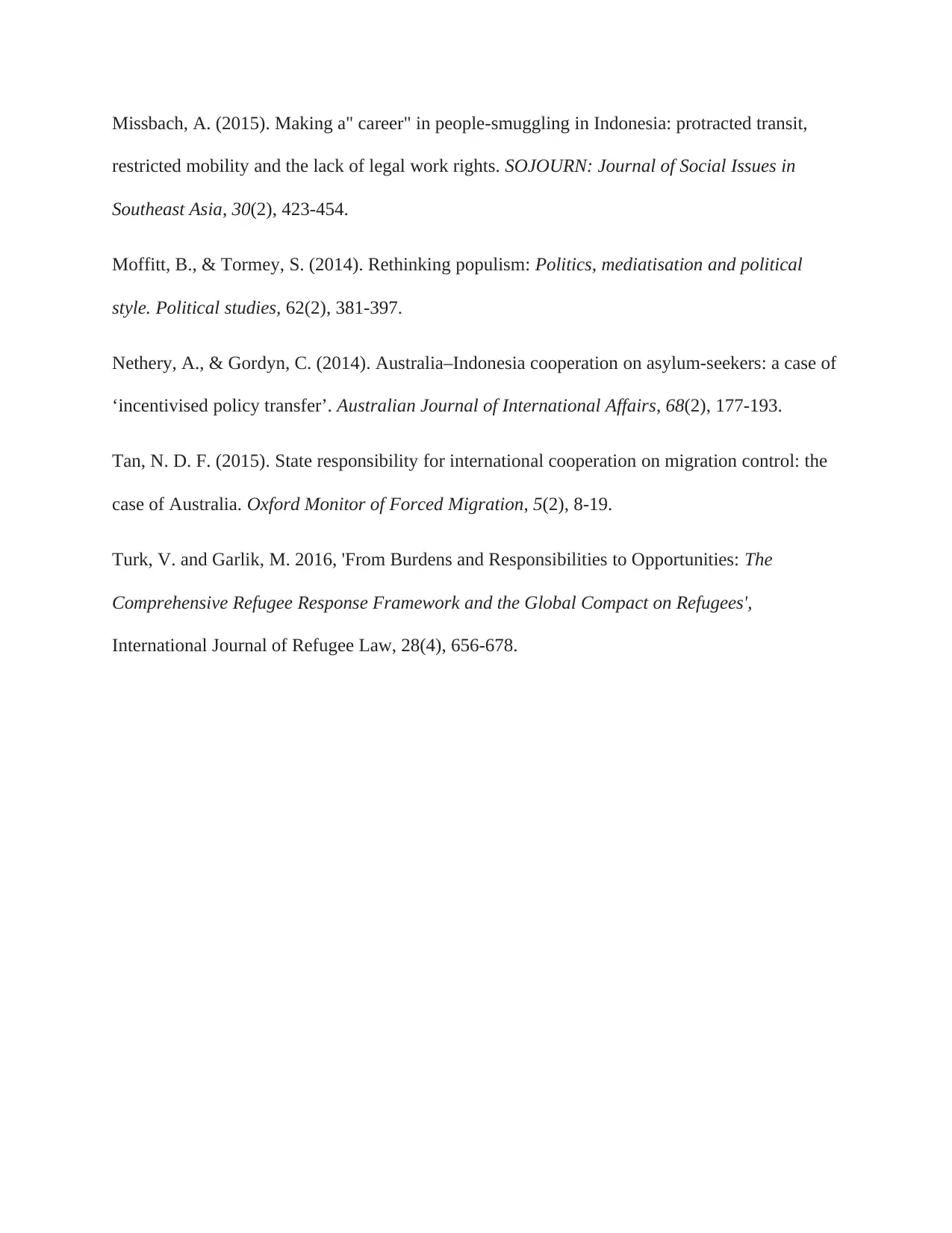
Missbach, A. (2015). Making a" career" in people-smuggling in Indonesia: protracted transit,
restricted mobility and the lack of legal work rights. SOJOURN: Journal of Social Issues in
Southeast Asia, 30(2), 423-454.
Moffitt, B., & Tormey, S. (2014). Rethinking populism: Politics, mediatisation and political
style. Political studies, 62(2), 381-397.
Nethery, A., & Gordyn, C. (2014). Australia–Indonesia cooperation on asylum-seekers: a case of
‘incentivised policy transfer’. Australian Journal of International Affairs, 68(2), 177-193.
Tan, N. D. F. (2015). State responsibility for international cooperation on migration control: the
case of Australia. Oxford Monitor of Forced Migration, 5(2), 8-19.
Turk, V. and Garlik, M. 2016, 'From Burdens and Responsibilities to Opportunities: The
Comprehensive Refugee Response Framework and the Global Compact on Refugees',
International Journal of Refugee Law, 28(4), 656-678.
restricted mobility and the lack of legal work rights. SOJOURN: Journal of Social Issues in
Southeast Asia, 30(2), 423-454.
Moffitt, B., & Tormey, S. (2014). Rethinking populism: Politics, mediatisation and political
style. Political studies, 62(2), 381-397.
Nethery, A., & Gordyn, C. (2014). Australia–Indonesia cooperation on asylum-seekers: a case of
‘incentivised policy transfer’. Australian Journal of International Affairs, 68(2), 177-193.
Tan, N. D. F. (2015). State responsibility for international cooperation on migration control: the
case of Australia. Oxford Monitor of Forced Migration, 5(2), 8-19.
Turk, V. and Garlik, M. 2016, 'From Burdens and Responsibilities to Opportunities: The
Comprehensive Refugee Response Framework and the Global Compact on Refugees',
International Journal of Refugee Law, 28(4), 656-678.

1 out of 11


Your All-in-One AI-Powered Toolkit for Academic Success.
+13062052269
info@desklib.com
Available 24*7 on WhatsApp / Email
![[object Object]](/_next/static/media/star-bottom.7253800d.svg)
Unlock your academic potential
Copyright © 2020–2026 A2Z Services. All Rights Reserved. Developed and managed by ZUCOL.