Tax Law Case Study: Analyzing Qantas' Compliance with Tax Laws

Verified

Added on  2023/06/12

|8
|1726
|278
Case Study
AI Summary
This case study examines the tax obligations of Qantas under Australian law, specifically focusing on corporate tax and offset rules as governed by the Income Tax Assessment Acts of 1936 and 1997. It analyzes whether Qantas' claims of not being liable to pay tax due to incurred losses and tax offset rules are legally sound. The analysis incorporates key legal precedents such as Salomon v Salomon & Co Ltd, Avondale Motors (Parts) Pty Ltd v Federal Commissioner of Taxation, and Hammond Investments Pty Ltd v. FCT. The study concludes that Qantas' position is legally defensible, provided that the company meets the conditions for carrying forward losses under the ITAA, including the continuity of ownership and same business tests, and has not undergone significant changes in ownership or business nature.
Document Page
Running head: TAX LAW
Tax Law
Name of the Student
Name of the University
Author Note
tabler-icon-diamond-filled.svg

Paraphrase This Document

Need a fresh take? Get an instant paraphrase of this document with our AI Paraphraser
Document Page
1TAX LAW
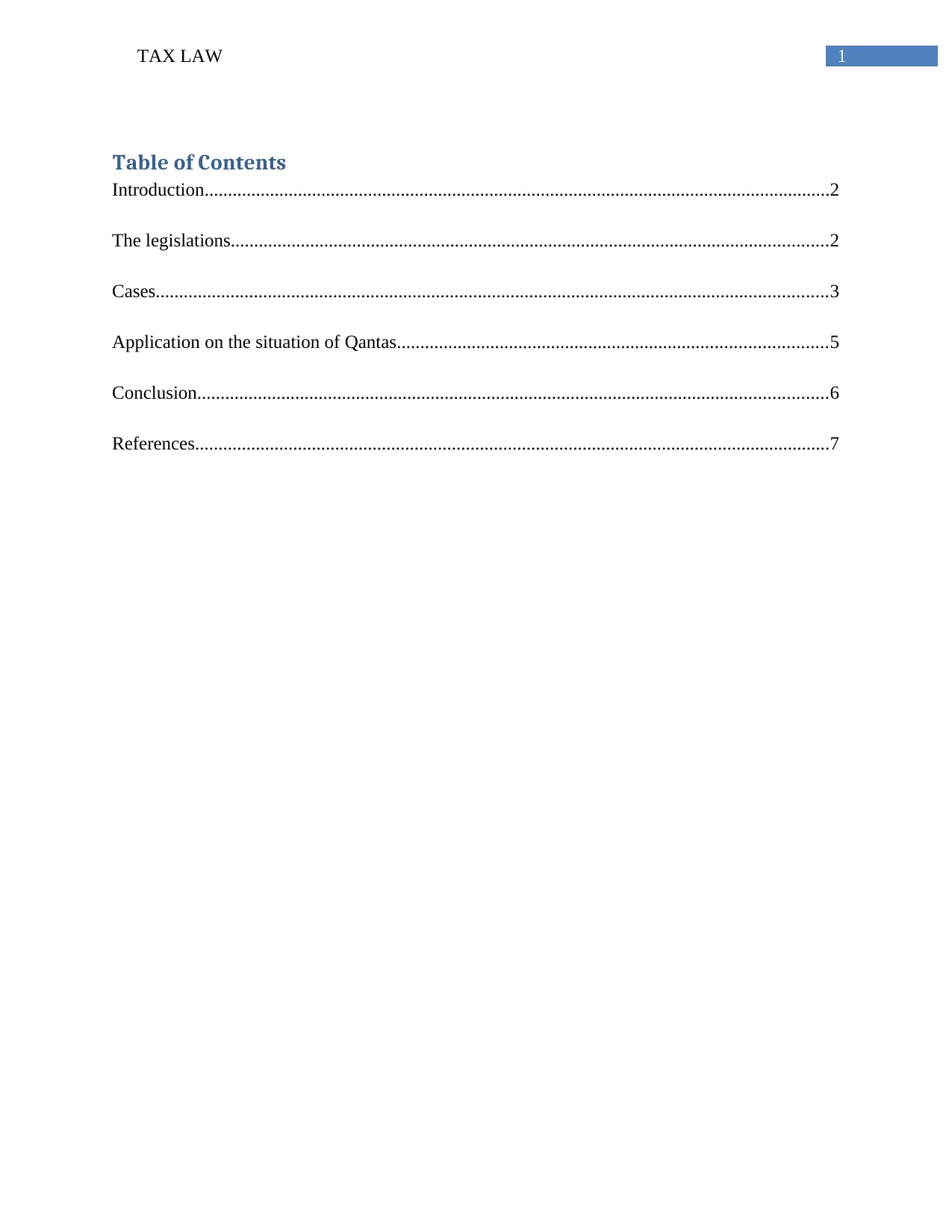
Table of Contents
Introduction......................................................................................................................................2
The legislations................................................................................................................................2
Cases................................................................................................................................................3
Application on the situation of Qantas............................................................................................5
Conclusion.......................................................................................................................................6
References........................................................................................................................................7
Document Page
2TAX LAW
Introduction
According to reports provided by the ABC news companies are not paying corporate tax for a
number of years. The report has identified Qantas as one of the organizations who are not paying
taxes in Australia. In reply to the report of ABC chief executive officer of Qantas Alan Joyce
has stated that there is no illegality which the organization as indulged into in relation to the
payment of tax. The organization has not made any profits in the last few years and thus it is not
liable to pay any tax under the provisions of tax offset rules. The purpose of the paper is to
analyze the legislations and cases in relation to corporation tax and tax offsets in Australia and
then apply such rules in relation to the claims made by Joyce in order to analyze to wants extent
such assertions are in compliance with law and correct.
The legislations
The primary legislations which governs issues relating to taxation in Australia are that of Income
Tax Assessment Act 1934 and 1997. Chapter 3 of the ITAA 97 provides for special liability
rules. The amount of income tax which is to be paid by a company is calculated under the
provisions provided in section 1.10 of the ITAA 97. The section states that income tax has to be
paid for every financial year and is worked out in relation to the assessable income for the year.
In case of a company the income year is the last financial year. The formula in relation to
deriving the income tax provides that income tax equals to the assessed taxable income
multiplied the contemporary rate of tax subtracted by tax offsets. A tax offset reduces the amount
of tax to be paid by a person. The list of tax offsets have been provided through section 13-1 of
the ITAA. The losses which have been incurred by the company can be carried forward in
relation to tax offsets against the taxable income. The two major tests which are used for the
Document Page
3TAX LAW
purpose of determining the whether the losses can be carried forward by the company include the
continuity of ownership test and the same business test. One of these tests have to be satisfied to
carry forward the income of the company. Part 3-5 of the act provides for CORPORATE
TAXPAYERS AND CORPORATE DISTRIBUTIONS. Subdivision 36-A provides for the general
rules which govern the deduction and calculation in relation to tax losses. Section 36-25 provides
for the special rules which are applicable to the deduction and calculation of tax losses by
companies. These rules also incorporate the provisions of Subdivision 165-A and Subdivision
165-B. it has been provided under the provisions of SECT 165.10 of the ITAA 97 that a
company is not entitled to make deductions in relation to loss unless the conditions provided
under section 165-12 is met which is in relation to the maintenance of the same owners by the
company and it meets the conditions under section 165-13 of the Act which is in relation to the
satisfaction of business tests. The test under section 165-12 ITAA 97 states that shares which
have 50% of the voting rights have to be at all times of ten test be held in the same proportion by
the same people. In relation to the same business test where the company is not able to meet the
ownership test it as to satisfy the test under section 165-210 ITAA 97 to carry forwards losses for
offsets. Under the test during all times in the year in which the claim for deduction to the last
year’s loss the company must have the same kind of business, they must not derive income for
any other source, the company must not get into a scheme to beat the above discussed test. It has
been further stated by the Taxation Ruling TR 1999/9 that taxation office will apply such tests
strictly and may cause dire consequences for organizations whose business have been pruned by
the new owners or new profitable activities and restructuring have taken place.
tabler-icon-diamond-filled.svg

Paraphrase This Document

Need a fresh take? Get an instant paraphrase of this document with our AI Paraphraser
Document Page
4TAX LAW
Cases
In the case of Salomon v Salomon & Co Ltd [1897] AC 22 the court declared the company to be
a separate legal entity. Thus the taxes paid by companies are to be different from the tax of its
owners. One of the significant cases in relation to the issue in context is the case of Avondale
Motors (Parts) Pty Ltd v Federal Commissioner of Taxation - [1971] HCA 17. The issue in this
case was in relation to the right of the company in context to carry forward losses incurred in
previous financial years for the purpose of tax offsets. In this case an appeal had been brought by
the plaintiff Avondale Motors (Parts) Pty. Ltd in relation to income tax assessment based of
income obtained in the year 30th June 1968. The tax payer in the year in context had gained a
profit of $11,527, however made a claim in relation to deduction of losses which had been
sustained in the previous years as it claimed that because of such losses they are not eligible to
have any assessable income. The claim had been disallowed by the commissioner and its
assistance in relation to the losses incurred in the prior years and came to a decision that the
plaintiff has the obligation of paying taxes on $11,527. In this case the appeal made by the
plaintiff had been dismissed by the court. The court held in this case that the company has no
right to carry forward the losses in relation to tax offsets at it did not carry out at all relevant
times during the year the same business which had been carried out immediately before the
beneficial shareholding change that took place in the same year. Thus the decision of the court
signifies that the losses which have been incurred by the company can be carried forward in
relation to tax offsets against the taxable income.
Another significant case in relation to the issue is the case of Hammond Investments Pty Ltd v.
FCT 77 ATC 4311. In this case also the plaintiff wanted to carry forward the losses which had
been incurred in the previous financial years in relation to tax offsets in the present year. The
Document Page
5TAX LAW
person was in control of two companies and the commissioner had rejected the claim of the
plaintiff be stating that he has gained income through the use of another company owned by him.
The court applied the same business test to determine to determine the issue. The court held that
the other company was different and thus the tax payer has the right to carry forwards the losses
in relation to tax offsets. Thus the appeal of the tax payer had been upheld.
Application on the situation of Qantas
According to reports provided by the ABC news companies are not paying corporate tax for a
number of years. The report has identified Qantas as one of the organizations who are not paying
taxes in Australia. In reply to the report of ABC CEO Joyce has stated that there is no illegality
which the organization as indulged into in relation to the payment of tax. The organization has
not made any profits in the last few years and thus it is not liable to pay any tax under the
provisions of tax offset rules. The company had a loss of $2.8 Billion in the year 2013 and there
is still $950 left to be offset and if the company will me making a profit of $1.4 billion like last
year it would be liable to pay income tax at the corporate tax rate next year under the provisions
of section 4.10 of the ITAA 97. The claim which has been made by the CEO are totally legal as
discussed above the ITAA 97 provides that losses which have been incurred by the company can
be carried forward in relation to tax offsets against the taxable income. It is also clear that there
has not been any significant changes in relation to the ownership of the company and the
company is also carrying out the same activity which it used to carry out in 2013 when the
losses had been incurred by it. Had this would not have been the situation and the company had
undergone change in ownership as per the continuity of ownership test or have changed the
nature of business under the same business test it would have been liable to pay tax for its profits
as held in the case of Avondale Motors (Parts) Pty Ltd v Federal Commissioner of Taxation.
Document Page
6TAX LAW
Conclusion
Thus from the above discussion it can be concluded that losses which have been incurred by the
company can be carried forward in relation to tax offsets against the taxable income under the
provisions of ITAA 36 and ITAA 97. It is only in situation where the test provided though
section 165-12 and section 165-13 are not satisfied can the company be liable to pay income tax
even when it has pending losses from the last year. Thus the position of Qantas is legally correct.
tabler-icon-diamond-filled.svg

Paraphrase This Document

Need a fresh take? Get an instant paraphrase of this document with our AI Paraphraser
Document Page
7TAX LAW
References
Avondale Motors (Parts) Pty Ltd v Federal Commissioner of Taxation - [1971] HCA 17
Hammond Investments Pty Ltd v. FCT 77 ATC 4311
Income Tax Assessment Act 1997 (Cth)
Income Tax Assessment Act 1936 (Cth)
Salomon v Salomon & Co Ltd [1897] AC 22
chevron_up_icon
1 out of 8
circle_padding
hide_on_mobile
zoom_out_icon
[object Object]